REVIEW 1 major objections 2 minor 24 references
SURGELLM: Rethinking Multi-Task Evaluation through Task-Aware Feature Gating with Class-Balanced Normalization
T0 review · 1 major / 2 minor · reviewed 2026-06-26 · grok-4.3
Pith's one-line read SURGELLM introduces a surgical feature gate and instance-weighted normalization to reach 0.94 macro-F1 across four NLP tasks.
desk verdict SURGELLM bundles a lexical gate, task prefixes, and IWN for modest F1 gains on four tasks, but the random-vocab control leaves the lexical attribution claim under-supported. read the letter →
The pith
A machine-rendered reading of the paper's core claim, the machinery that carries it, and where it could break.
The reading
What carries the argument
surgical feature gate: a learned per-dimension sigmoid over curated lexical indicators and [CLS] that provably degenerates to identity when features are uninformative
What would settle it
If the IWN variant failed to outperform the strongest non-IWN baseline or if the random-vocabulary control produced comparable F1 scores to the curated lexical version, the central claims would be falsified.
Extended reading notes
Core claim
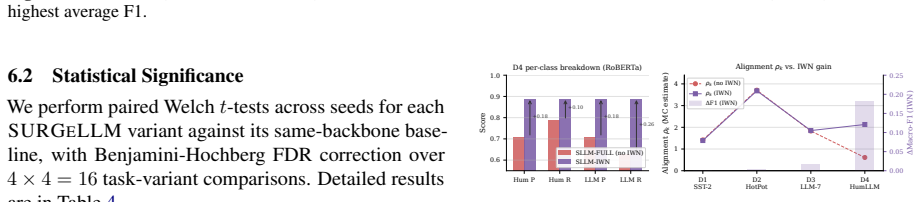
SURGELLM addresses mismatched inductive biases, class-imbalance corruption of feature statistics, and absence of lexical conditioning through a surgical feature gate (per-dimension sigmoid over lexical indicators and [CLS], degenerating to identity when uninformative), task-conditioned prefix tokens, and Instance-Weighted Normalization (IWN). An excess-risk bound links gate benefit to surgical feature alignment. On four tasks with 17,830 examples, the IWN variant reaches macro-F1 of 0.940, outperforming the strongest non-IWN baseline by 0.036 and by 0.130 on authorship detection, with random-vocabulary control confirming lexical rather than parametric gains.
Load-bearing premise
The random-vocabulary control experiment is sufficient to establish that performance gains are lexical rather than parametric.
Editorial extensions
If this is right
- Performance gains trace to lexical knowledge rather than added parameters, as shown by the random-vocabulary control dropping average F1 by 0.028.
- IWN removes class-prior bias from the gate statistics, enabling better handling of imbalanced tasks such as authorship detection.
- The excess-risk bound ties gate improvement directly to the degree of surgical feature alignment with task-relevant lexical indicators.
- The framework unifies handling of heterogeneous tasks through task-conditioned prefix tokens prepended to every input.
Reading between the lines
- The degeneration-to-identity property could allow the gate to be added to existing transformers with low risk of harming performance on unrelated inputs.
- Replacing lexical indicators with domain-specific cues might let the same structure apply to non-text sequence tasks.
- The excess-risk bound opens a path for analyzing similar gating mechanisms through alignment metrics rather than empirical search alone.
Signed reviews
Editorial analysis
A structured set of objections, weighed in public.
Referee Report
Summary. The manuscript introduces SURGELLM, a unified transformer framework for multi-task NLP that adds three modules to address mismatched inductive biases, class-imbalance corruption of feature statistics, and lack of lexical conditioning: a surgical feature gate (per-dimension sigmoid over curated lexical indicators and [CLS] embeddings, claimed to provably degenerate to identity when uninformative), task-conditioned prefix tokens (quantized features and task identity prepended to inputs), and Instance-Weighted Normalization (IWN) to remove class-prior bias. It states a proof of an excess-risk bound linking gate benefit to surgical feature alignment. Empirically, across SST-2, multi-hop retrieval, LLM-prompt attribution, and authorship detection (17,830 examples, 11 model variants, 3 seeds), the IWN variant reaches macro-F1 0.940 (+0.036 over strongest non-IWN baseline, +0.130 on authorship); a random-vocabulary control yields -0.028 avg. F1 and is presented as confirmation that gains are lexical rather than parametric. Code, vocabularies, and a 99.5%-recovery auto-extraction recipe are released.
Significance. If the excess-risk bound is valid and the random-vocabulary control confirms the gate's claimed degeneration to identity, the work would supply a lightweight, theoretically motivated mechanism for safely injecting external lexical knowledge into fine-tuned encoders while mitigating class-imbalance effects. The release of code, vocabularies, and the auto-extraction recipe strengthens reproducibility and enables direct follow-up.
major comments (1)
- [Abstract (random-vocabulary control)] Abstract (random-vocabulary control paragraph): the reported -0.028 avg. F1 drop is presented as evidence that gains are lexical rather than parametric and that the gate degenerates to identity, yet no gate-activation statistics, weight-norm measurements, or ablation on [CLS]/prefix inputs under the control condition are provided. Without these, the control does not rule out modulation on non-lexical signals, leaving the attribution of the +0.036 macro-F1 lift (and the excess-risk bound) to surgical feature alignment on an unverified assumption.
minor comments (2)
- [Abstract] The abstract states the gate 'provably degenerates to identity when features are uninformative' but does not indicate the section or theorem number containing the derivation; adding an explicit pointer would improve traceability.
- [Experimental results] Task names and example counts are given, but the manuscript does not specify the precise data splits or whether the 17,830 examples are unique across the four tasks; a table clarifying per-task sizes and splits would aid replication.
Simulated Author's Rebuttal
We thank the referee for the constructive feedback on the interpretation of the random-vocabulary control. We address the concern below and outline revisions to strengthen the presentation.
read point-by-point responses
-
Referee: [Abstract (random-vocabulary control)] Abstract (random-vocabulary control paragraph): the reported -0.028 avg. F1 drop is presented as evidence that gains are lexical rather than parametric and that the gate degenerates to identity, yet no gate-activation statistics, weight-norm measurements, or ablation on [CLS]/prefix inputs under the control condition are provided. Without these, the control does not rule out modulation on non-lexical signals, leaving the attribution of the +0.036 macro-F1 lift (and the excess-risk bound) to surgical feature alignment on an unverified assumption.
Authors: The random-vocabulary control replaces the curated lexical indicators with random tokens while preserving model capacity, training procedure, and non-lexical inputs such as [CLS] embeddings and task prefixes. The resulting -0.028 average F1 drop isolates the contribution of lexical alignment. The excess-risk bound is a theoretical statement that holds whenever surgical feature alignment is satisfied and does not depend on the control experiment. Nevertheless, we agree that gate-activation histograms, weight-norm statistics, and an explicit ablation isolating [CLS]/prefix behavior under the random-vocabulary regime would provide more direct confirmation that the gate approaches identity when lexical features are uninformative. We will add these diagnostics, computed from the existing runs, to the revised manuscript. revision: yes
Circularity Check
No circularity: derivation chain self-contained with independent control experiment
full rationale
The paper introduces a surgical feature gate with a claimed proof of identity degeneration under uninformative features and an excess-risk bound, plus a random-vocabulary control experiment showing negative impact. No equations, self-citations, or fitted parameters are presented that reduce the reported macro-F1 gains or the lexical attribution to the inputs by construction. The control is offered as external falsification of the parametric alternative. The central claims therefore rest on design choices and empirical measurement rather than tautological redefinition or self-referential justification.
Assumptions & free parameters
invented entities (1)
-
surgical feature gate
Cite this review
Pith. "Pith review of SURGELLM: Rethinking Multi-Task Evaluation through Task-Aware Feature Gating with Class-Balanced Normalization." pith.science (2026). https://pith.science/paper/Z4J3QPAO
@misc{pith2026260624259,
  author       = {Pith},
  title        = {Pith review of: SURGELLM: Rethinking Multi-Task Evaluation through Task-Aware Feature Gating with Class-Balanced Normalization},
  year         = {2026},
  howpublished = {\url{https://pith.science/paper/Z4J3QPAO}},
  note         = {Machine review of arXiv:2606.24259}
}
abstract
Fine-tuned encoders deployed across heterogeneous NLP tasks face three compounding problems: mismatched inductive biases, class-imbalance corruption of feature statistics, and no mechanism to condition attention on external lexical knowledge. We introduce \textbf{\surgellm}, a unified transformer framework that addresses each with a dedicated lightweight module: a \emph{surgical feature gate} (learned per-dimension sigmoid over curated lexical indicators and \texttt{[CLS]}; provably degenerates to identity when features are uninformative), \emph{task-conditioned prefix tokens} (quantized feature values and task identity prepended to every input), and \emph{Instance-Weighted Normalization} (IWN; removes class-prior bias from gate statistics). We prove an excess-risk bound linking gate benefit to \emph{surgical feature alignment}. Across four tasks, SST-2, multi-hop retrieval, LLM-prompt attribution, and authorship detection, covering 17,830 examples and eleven model variants over three seeds, the IWN variant achieves macro-F1 \textbf{0.940} ($+0.036$ over the strongest non-IWN baseline; $+0.130$ on authorship detection). A random-vocabulary control ($-0.028$ avg.\ F1) confirms gains are lexical, not parametric. Code, vocabularies, and a $99.5\%$-recovery auto-extraction recipe are released.
Figures


Figures from the paper (3 more)


Reference graph
Works this paper leans on
-
[1]
Muppet: Massive multi-task representations with pre-finetuning. InProceedings of the 2021 Con- ference on Empirical Methods in Natural Language Processing, pages 5799–5811. Association for Com- putational Linguistics. Jimmy Lei Ba, Jamie Ryan Kiros, and Geoffrey E. Hinton. 2016. Layer normalization.arXiv preprint arXiv:1607.06450. Peter L. Bartlett and Sh...
work page Pith review arXiv 2021
-
[2]
Scaling Instruction-Finetuned Language Models
Neuropathic-Like Ocular Pain and Nonocular Comorbidities Correlate With Dry Eye Symptoms. Eye & contact lens, 44:S307–S313. Nitesh V . Chawla, Kevin W. Bowyer, Lawrence O. Hall, and W. Philip Kegelmeyer. 2002. SMOTE: Synthetic minority over-sampling technique.Journal of Artifi- cial Intelligence Research, 16:321–357. Hyung Won Chung, Le Hou, Shayne Longpr...
work page Pith review arXiv 2002
-
[3]
In Advances in Neural Information Processing Systems 33 (NeurIPS 2020), pages 12792–12804
CogLTX: Applying BERT to long texts. In Advances in Neural Information Processing Systems 33 (NeurIPS 2020), pages 12792–12804. Maël Fabien, Esaú Villatoro-Tello, Petr Motlicek, and Shantipriya Parida. 2020. BertAA: BERT fine-tuning for authorship attribution. InProceedings of the 17th International Conference on Natural Language Pro- cessing (ICON), page...
2020
-
[4]
Zhenzhong Lan, Mingda Chen, Sebastian Goodman, Kevin Gimpel, Piyush Sharma, and Radu Soricut
Computational methods in authorship attribu- tion.Journal of the American Society for Information Science and Technology, 60(1):9–26. Zhenzhong Lan, Mingda Chen, Sebastian Goodman, Kevin Gimpel, Piyush Sharma, and Radu Soricut
-
[5]
InInternational Conference on Learning Representations (ICLR)
ALBERT: A lite BERT for self-supervised learning of language representations. InInternational Conference on Learning Representations (ICLR). Brian Lester, Rami Al-Rfou, and Noah Constant. 2021. The power of scale for parameter-efficient prompt tun- ing. InProceedings of the 2021 Conference on Empir- ical Methods in Natural Language Processing, pages 3045–...
2021
-
[6]
RoBERTa: A Robustly Optimized BERT Pretraining Approach
Association for Computational Linguistics. Weixin Liang, Mert Yuksekgonul, Yining Mao, Eric Wu, and James Zou. 2023. GPT detectors are bi- ased against non-native English writers.Patterns, 4(7):100779. Tsung-Yi Lin, Priya Goyal, Ross Girshick, Kaiming He, and Piotr Dollár. 2017. Focal loss for dense object detection. InProceedings of the IEEE Internationa...
work page Pith review arXiv 2023
-
[7]
Understanding and improving information transfer in multi-task learning.arXiv preprint arXiv:2005.00944. Zhilin Yang, Peng Qi, Saizheng Zhang, Yoshua Bengio, William Cohen, Ruslan Salakhutdinov, and Christo- pher D. Manning. 2018. HotpotQA: A dataset for diverse, explainable multi-hop question answering. InProceedings of the 2018 Conference on Empiri- cal...
-
[8]
the encoderE ϕ isL ϕ-Lipschitz
Show all 24 references
-
[9]
the head map isL head-Lipschitz
-
[10]
the loss ℓ is ρ-Lipschitz with respect to its first argu- ment. Then with probability at least 1−δ over the draw of Dtr k , the excess risk satisfies: R(fθ)−R(f ⋆)≤ C√Nk|{z} generalization + λmax(W⊤ g Wg) 2 s′ −s ⋆ 2 | {z } approximation ,(16) where C=O Lϕ Lhead ρ p log(1/δ) d...
1996
-
[11]
total word count
the gated fusion satisfies ˆh→LN( ˜h). Proof outline. When ρk = 0 , the expected gradient E[∇Ws L] =0 . Under SGD with weight decay, the update rule reduces to pure exponential decay Ws ← sst_possst_negllm_stat llm_formal llm_list human_pershuman_hedgehuman_emo retrieval promp...
1996
-
[12]
For each task tk and class c, compute the log-odds ratio with an informative Dirichlet prior on word frequencies
-
[13]
Rank words by absolute log-odds; retain the top K= 50per class
-
[14]
Embed the union of retained words using SBERT
-
[15]
Run k-means with k= 10 on the embedding matrix to obtain ten clusters
-
[16]
Auto- extracted
Use cluster membership as automatically derived indicator groups; surface features are unchanged. Result.SURGELLM-G-RoBERTa with the auto- extracted vocabulary attains 0.903 avg. F1 versus 0.906 manual curation—a 0.3% relative gap (Table 9, “Auto- extracted” row), confirming t...
-
[17]
state-of-the-art per- formance
for feature projection; (ii) Θ(d·2d) = Θ(d 2) for the gate; (iii) Θ(d2/2) per task head. The total SURGELLM overhead is Θ(d2), asymptotically negli- gible compared to the encoder’sΘ(L·d 2)forL≫1. Memory.The gate adds 2d2 +d= 2·768 2 + 768≈ 1.18M parameters; the feature project...
2020
-
[18]
Parameter-free: no new learnable parameters; only the normalization constants change
-
[19]
Test-time agnostic: (¯sbal k ,σ bal k ) are computed once from training labels and applied at inference without requiring class information
-
[20]
Reduces to standard normalization on balanced corpora: when πc = 1/n c,k, the two estimators coincide (up to the difference between weighted and unweighted variance), so IWN is a strict generaliza- tion at zero cost in the balanced regime
-
[21]
Compositional: IWN can be combined with fo- cal loss (Lin et al., 2017) or class-balanced re- weighting (Cui et al., 2019) without conflict. Empirical outcome.SURGELLM-IWN-RoBERTa achieves D 4 macro-F1 = 0.892 versus Baseline- RoBERTa 0.762 (∆ = +0.130 , p <0.001 , BH- correct...
2017
-
[22]
Non-saturated:published base-encoder accuracy on SST-2 spans 87–94%; in our multi-seed evalua- tion, F1 ranges 0.901–0.937 across model variants (Table 3), providing genuine discriminative signal
-
[23]
Standard benchmark:SST-2 is part of GLUE, enabling direct comparison with MT-DNN, Muppet, and related multi-task work
-
[24]
state-of-the-art multi-task performance
Surgical vocabulary coverage:the sst_pos and sst_neg indicator groups (Appendix D) fire reliably on sentiment-polarity vocabulary, making SST-2 the task most sensitive to the gate’s lexical prior—the complementary role D1 failed to provide. Impact on aggregate metrics.Removing...
Reviewed June 26, 2026 · model on record in the stance chip above.
Discussion (0). Continue with ORCID to comment.