Charge Collection Efficiency in Air-Vented Plane-Parallel Ionisation Chambers at Ultra-High Dose Rates: A Self-Consistent Garfield++ Monte Carlo Model Including Space-Charge Effects and Ion Recombination
Pith reviewed 2026-06-25 22:10 UTC · model grok-4.3
The pith
Space charge in air-vented plane-parallel ionisation chambers at ultra-high dose rates reduces charge collection efficiency mainly by lowering the free electron fraction through electric-field-dependent electron attachment.
A machine-rendered reading of the paper's core claim, the machinery that carries it, and where it could break.
Core claim
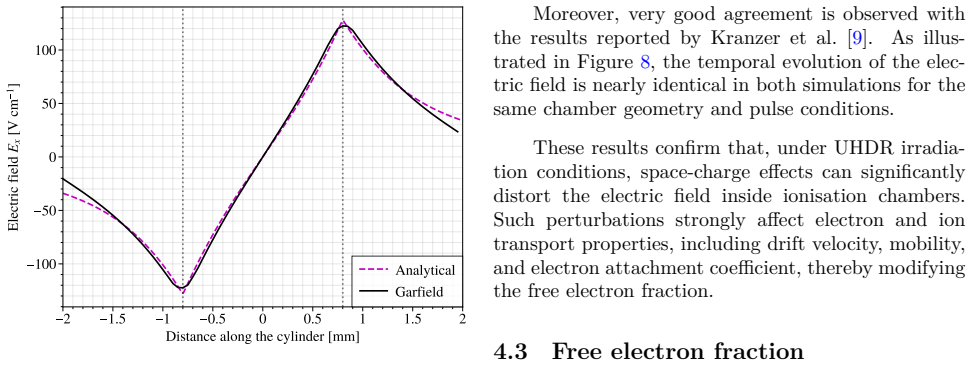
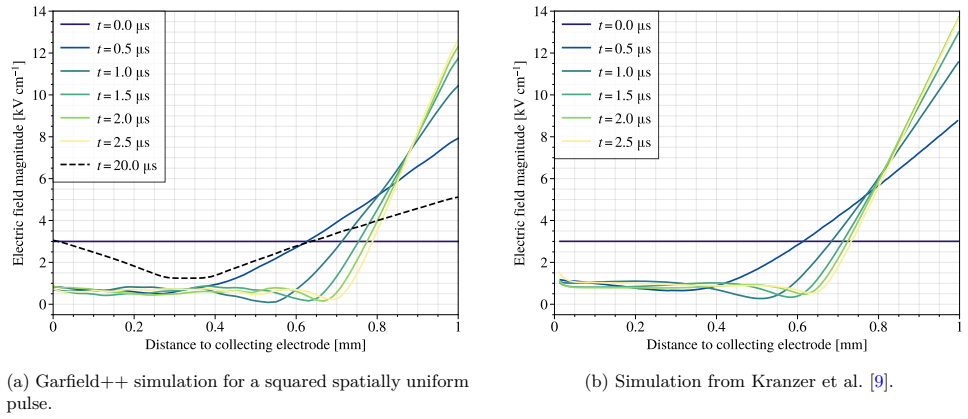
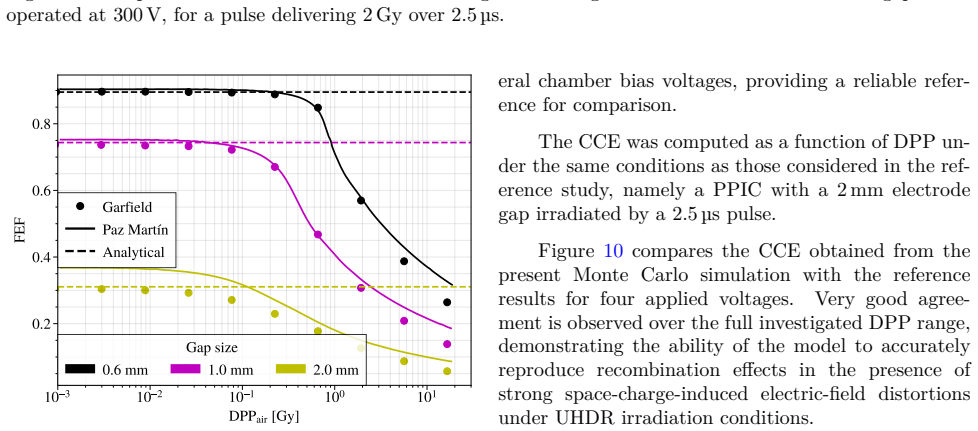
The model couples particle transport, electron attachment, recombination, and dynamic electric-field evolution. Validation against prior analytical and numerical results confirms accurate prediction of free electron fraction, charge collection efficiency, induced current, and field evolution. Under ultra-high dose rate irradiation the space-charge field distortion drives a field-dependent increase in electron attachment, which lowers the free electron fraction and thereby accounts for most of the observed reduction in charge collection efficiency.
What carries the argument
The self-consistent Monte Carlo model that couples particle transport with recombination processes and dynamic electric-field distortions caused by space charge.
If this is right
- Space charge can locally increase the electric field by more than a factor of four or reduce it to nearly zero.
- Charge collection efficiency reduction is driven primarily by the decrease in free electron fraction from field-dependent electron attachment.
- Recombination effects are largely governed by the evolution of the free electron fraction.
- The approach opens routes to improved analytical models and real-time correction methods for ionisation chamber dosimetry.
Where Pith is reading between the lines
- The finding suggests that correction factors for ultra-high dose rate dosimetry could be derived directly from real-time electric field monitoring rather than from full recombination calculations.
- The same field-distortion mechanism may affect other gas-filled detectors used in high-intensity radiation environments.
- Extending the model to different gas mixtures or chamber geometries would test whether the free-electron-fraction dominance holds beyond air-vented plane-parallel designs.
Load-bearing premise
The implemented calculations of ion-ion recombination and self-consistent space-charge electric fields accurately represent the physical processes occurring at ultra-high dose rates.
What would settle it
An experiment that measures free electron fraction and charge collection efficiency simultaneously in an air-vented plane-parallel chamber while independently varying the applied electric field strength at fixed ultra-high dose rate.
Figures


read the original abstract
Ultra-high dose rate (UHDR) irradiation used in FLASH radiotherapy induces strong space-charge effects in plane-parallel ionisation chambers (PPICs), leading to significant reductions in charge collection efficiency (CCE). To investigate these effects, we extended the Garfield++ framework by implementing ion-ion recombination and self-consistent space-charge electric field calculations. The developed Monte Carlo model couples particle transport, electron attachment, recombination processes, and dynamic electric-field distortions. The implementation was validated against analytical and numerical models from the literature, including the works of Fenwick and Kumar, Kranzer et al., and Paz Mart\'in et al., with excellent agreement for the free electron fraction (FEF), CCE, induced current, and electric field evolution. The simulations show that space charge can locally increase the electric field by more than a factor of four or reduce it to nearly zero. The results suggest that CCE reduction under UHDR conditions is mainly driven by the decrease of the FEF caused by electric-field-dependent electron attachment, indicating that recombination may be largely governed by FEF evolution. This opens promising perspectives for improved analytical models and real-time correction methods for ionisation chamber dosimetry under UHDR conditions.
Editorial analysis
A structured set of objections, weighed in public.
Referee Report
Summary. The manuscript extends the Garfield++ Monte Carlo framework to incorporate ion-ion recombination and self-consistent space-charge electric field calculations for air-vented plane-parallel ionization chambers under ultra-high dose rate (UHDR) conditions. The model couples particle transport, electron attachment, recombination, and dynamic field distortions. It is validated against analytical and numerical literature models (Fenwick & Kumar, Kranzer et al., Paz Martín et al.), reporting excellent quantitative agreement on free electron fraction (FEF), charge collection efficiency (CCE), induced current, and electric field evolution. The central interpretation is that CCE reduction at UHDR is driven primarily by the decrease in FEF due to electric-field-dependent electron attachment, implying that recombination is largely governed by FEF evolution.
Significance. If the implementation and validation hold, the work supplies a self-consistent simulation framework for space-charge effects in UHDR dosimetry relevant to FLASH radiotherapy. Explicit credit is due for the multi-model validation (against Fenwick & Kumar, Kranzer et al., and Paz Martín et al.) on FEF, CCE, current, and field evolution, and for deriving the FEF-dominance claim directly from simulation outputs rather than post-hoc fitting. This could support improved analytical models and real-time corrections.
minor comments (2)
- [Abstract and §4 (Validation)] The abstract states 'excellent agreement' for FEF, CCE, current, and field evolution; the main text should include quantitative metrics (e.g., mean absolute percentage differences or R² values) for each benchmark quantity and each cited model to allow readers to assess the strength of the validation.
- [§3 (Model Implementation)] The description of the self-consistent field solver and ion-ion recombination implementation would benefit from explicit statements on time-step convergence criteria, grid resolution, and any parameter choices (e.g., attachment coefficients) to address potential concerns about numerical robustness under extreme space-charge conditions.
Simulated Author's Rebuttal
We thank the referee for the positive assessment of our manuscript, the accurate summary of its contributions, and the recommendation for minor revision. No specific major comments were provided in the report.
Circularity Check
No significant circularity identified
full rationale
The paper extends Garfield++ with ion-ion recombination and self-consistent space-charge field calculations, then validates the implementation against independent external models (Fenwick & Kumar, Kranzer et al., Paz Martín et al.) reporting quantitative agreement on FEF, CCE, current, and field evolution. The central claim that CCE reduction is driven by field-dependent attachment lowering FEF is an interpretation of simulation outputs, not a parameter fit or self-referential definition. No self-citations, uniqueness theorems from the same authors, ansatzes smuggled via citation, or fitted inputs renamed as predictions appear in the derivation chain. The model is self-contained against external benchmarks.
Axiom & Free-Parameter Ledger
Reference graph
Works this paper leans on
-
[1]
Ultrahigh Dose-Rate FLASH Irradiation Increases the Differential Response between Normal and Tumor Tissue in Mice
Vincent Favaudon et al. “Ultrahigh Dose-Rate FLASH Irradiation Increases the Differential Response between Normal and Tumor Tissue in Mice” . In: Science Translational Medicine 11 6.245 (July 16, 2014). issn: 1946-6234, 1946-
2014
-
[2]
1126 / scitranslmed
doi: 10 . 1126 / scitranslmed . 3008973. url: https : / / www . science . org / doi / 10 . 1126 / scitranslmed . 3008973 (visited on 09/15/2024)
2024
-
[3]
Absorbed Dose Determination in External Beam Radiotherapy
INTERNATIONAL ATOMIC ENERGY AGENCY. Absorbed Dose Determination in External Beam Radiotherapy . Rev. 1. Technical Reports Series. INTERNATIONAL ATOMIC ENERGY AGENCY, 2024. isbn: 978-92-0- 146022-6. doi: 10.61092/iaea.ve7q-y94k. url: https://www.iaea.org/publications/15048 (visited on 10/24/2025)
-
[4]
Ionization Measurements at Very High Intensities. Pulsed Radiation Beams
J. W. Boag. “Ionization Measurements at Very High Intensities. Pulsed Radiation Beams. ” In: The British journal of radiology 23.274 (Oct. 1950), pp. 601–611. issn: 0007-1285. doi: 10 . 1259 / 0007 - 1285 - 23 - 274 - 601 . PMID: 14777875
1950
-
[6]
R F Laitano et al. “Charge Collection Efficiency in Ionization Chambers Exposed to Electron Beams with High Dose per Pulse” . In: Physics in Medicine and Biology 51.24 (Dec. 21, 2006), pp. 6419–6436. issn: 0031-9155, 1361-6560. doi: 10.1088/0031- 9155/51/24/009 . url: https: / / iopscience . iop . org / article / 10 . 1088 / 0031-9155/51/24/009 (visited on...
-
[7]
Collection Efficiencies of Ionization Chambers in Pulsed Ra- diation Beams: An Exact Solution of an Ion Re- combination Model Including Free Electron Ef- fects
John D Fenwick and Sudhir Kumar. “Collection Efficiencies of Ionization Chambers in Pulsed Ra- diation Beams: An Exact Solution of an Ion Re- combination Model Including Free Electron Ef- fects” . In: Physics in Medicine & Biology 68.1 (Jan. 7, 2023), p. 015016. issn: 0031-9155, 1361-
2023
-
[8]
1088 / 1361 - 6560 / aca74e
doi: 10 . 1088 / 1361 - 6560 / aca74e. url: https : / / iopscience . iop . org / article / 10 . 1088 / 1361 - 6560 / aca74e (visited on 07/11/2025)
2025
-
[10]
Study of the Charge Col- lection Efficiency in Air Vented Ionization Cham- bers in UHDR Proton Beams
Pierre Gérard Ortega. “Study of the Charge Col- lection Efficiency in Air Vented Ionization Cham- bers in UHDR Proton Beams” . Université libre de Bruxelles, 2024. url: https : / / difusion . ulb.ac.be/vufind/Record/ULB-MASTER:oai: dipot.ulb.ac.be:2013/374074/Holdings
2024
-
[11]
Ion Collection Effi- ciency of Ionization Chambers in Ultra‐high Dose‐per‐pulse Electron Beams
Rafael Kranzer et al. “Ion Collection Effi- ciency of Ionization Chambers in Ultra‐high Dose‐per‐pulse Electron Beams” . In: Medical Physics 48.2 (Feb. 2021), pp. 819–830. issn: 0094- 2405, 2473-4209. doi: 10 . 1002 / mp . 14620 . url: https : / / aapm . onlinelibrary . wiley . com / doi / 10 . 1002 / mp . 14620 (visited on 10/16/2025)
2021
-
[12]
Reduction of Recombina- tion Effects in Large Plane Parallel Beam Mon- itors for FLASH Radiotherapy with Scanned Ion Beams
Leon Baack et al. “Reduction of Recombina- tion Effects in Large Plane Parallel Beam Mon- itors for FLASH Radiotherapy with Scanned Ion Beams” . In: Physica medica: PM: an inter- national journal devoted to the applications of physics to medicine and biology: official journal of the Italian Association of Biomedical Physics (AIFB) 104 (Dec. 2022), pp. 136–...
2022
-
[13]
Chambres d’ionisation en Protonthérapie et Hadronthérapie
Guillaume Boissonnat. “Chambres d’ionisation en Protonthérapie et Hadronthérapie” . PhD thesis. Université Caen Normandie,
-
[14]
url: https : / / theses . hal . science / tel - 01292466v1 / file / theseGuillaumeBoissonnat.pdf
-
[15]
Garfield++
Heinrich Schindler et al. Garfield++. Ver- sion 2025.01. url: https://garfieldpp.docs. cern.ch
2025
-
[16]
Well-conditioned ptychographic imaging via lost subspace completion
J de Urquijo et al. “Two- and Three-Body At- tachment, Electron Transport and Ionisation in Water-Air Mixtures” . In: Journal of Physics D: Applied Physics 57.12 (Mar. 22, 2024), p. 125205. issn: 0022-3727, 1361-6463. doi: 10.1088/1361- 6463/ad164a. url: https://iopscience.iop. org/article/10.1088/1361-6463/ad164a (vis- ited on 09/15/2024)
-
[17]
Particle Detection with Drift Chambers
Walter Blum, Werner Riegler, and Luigi Rolandi. Particle Detection with Drift Chambers . 2. ed. Particle Acceleration and Detection. Berlin Hei- delberg: Springer, 2008. 448 pp. isbn: 978-3-540- 76683-4
2008
-
[18]
Two- and Three- Body Electron Attachment in Air
B I Schneider and C A Brau. “Two- and Three- Body Electron Attachment in Air” . In:Journal of Physics B: Atomic and Molecular Physics (1982). doi: 10.1088/0022-3700/15/10/019
-
[19]
Magboltz
Stephen Biagi. Magboltz. Version 11.18. url: https://magboltz.web.cern.ch
-
[20]
D. K. Davies and P. J. Chantry. Air Chem- istry Measurements II . AFWL-TR-84-130. Pre- pared for the Air Force Weapons Laboratory, Kirtland AFB, NM, under Contract F29601-81- C-0044. NTIS/DTIC accession no. AD-A156 041. Pittsburgh, PA, May 1985. url: https://apps. dtic.mil/sti/tr/pdf/ADA156041.pdf. 12
1985
-
[21]
A local exchange-correlation potential for the spin polarized case. I,
E Hochhäuser et al. “The significance of the life- time and collection time of free electrons for the recombination correction in the ionometric dosimetry of pulsed radiation” . In: Journal of Physics D: Applied Physics 27.3 (Mar. 14, 1994), pp. 431–440. issn: 0022-3727, 1361-6463. doi: 10.1088/0022- 3727/27/3/001 . url: https: / / iopscience . iop . org ...
-
[22]
Transport Properties of Gaseous Ions over a Wide Energy Range
H.W. Ellis et al. “Transport Properties of Gaseous Ions over a Wide Energy Range” . In: Atomic Data and Nuclear Data Tables 17.3 (Mar. 1976), pp. 177–210. issn: 0092640X. doi: 10 . 1016 / 0092 - 640X(76 ) 90001 - 2. url: https : //linkinghub.elsevier.com/retrieve/pii/ 0092640X76900012 (visited on 09/15/2024)
1976
-
[23]
Transport Properties of Gaseous Ions over a Wide En- ergy Range, IV
L.A. Viehland and E.A. Mason. “Transport Properties of Gaseous Ions over a Wide En- ergy Range, IV” . In: Atomic Data and Nuclear Data Tables 60.1 (May 1995), pp. 37–95. issn: 0092640X. doi: 10 . 1006 / adnd . 1995 . 1004 . url: https : / / linkinghub . elsevier . com / retrieve/pii/S0092640X85710042 (visited on 09/15/2024)
1995
-
[24]
Measurement Method of Ionic Mobilities in Direct Current Corona Discharge in Air
Zhilong Zou et al. “Measurement Method of Ionic Mobilities in Direct Current Corona Discharge in Air” . In: IEEE Transactions on Dielectrics and Electrical Insulation 23.3 (June 2016), pp. 1879–
2016
-
[25]
issn: 1070-9878. doi: 10 . 1109 / TDEI . 2016 . 005249 . url: http : / / ieeexplore . ieee . org / document / 7534675/ (visited on 10/15/2025)
2016
-
[26]
Depen- dence of the A verage Mobility of Ions in Air with Pressure and Humidity
Bo Zhang, Jinliang He, and Yiming Ji. “Depen- dence of the A verage Mobility of Ions in Air with Pressure and Humidity” . In: IEEE Trans- actions on Dielectrics and Electrical Insulation 24.2 (Apr. 2017), pp. 923–929. issn: 1070-9878. doi: 10.1109/TDEI.2017.006542 . url: http: //ieeexplore.ieee.org/document/7909201/ (visited on 10/15/2025)
-
[27]
Predic- tion of A verage Mobility of Ions from Corona Dis- charge in Air with Respect to Pressure, Humid- ity and Temperature
Bo Zhang, Jinliang He, and Yiming Ji. “Predic- tion of A verage Mobility of Ions from Corona Dis- charge in Air with Respect to Pressure, Humid- ity and Temperature” . In: IEEE Transactions on Dielectrics and Electrical Insulation 26.5 (Oct. 2019), pp. 1403–1410. issn: 1070-9878, 1558-
2019
-
[28]
1109 / TDEI
doi: 10 . 1109 / TDEI . 2019 . 008001. url: https : / / ieeexplore . ieee . org / document / 8858105/ (visited on 10/14/2025)
2019
-
[29]
Experimental Investigation of Ion–Ion Recombination under Atmospheric Con- ditions
A. Franchin et al. “Experimental Investigation of Ion–Ion Recombination under Atmospheric Con- ditions” . In:Atmospheric Chemistry and Physics 15.13 (July 1, 2015), pp. 7203–7216. issn: 1680-
2015
-
[30]
url: https://acp.copernicus.org/articles/15/ 7203/2015/ (visited on 09/20/2024)
doi: 10.5194/acp- 15- 7203- 2015 . url: https://acp.copernicus.org/articles/15/ 7203/2015/ (visited on 09/20/2024)
-
[31]
Ion-Ion Recombination in Labo- ratory Air
S McGowan. “Ion-Ion Recombination in Labo- ratory Air” . In: Physics in Medicine & Biology 10.1 (Jan. 1, 1965), pp. 25–40. issn: 0031-9155, 1361-6560. doi: 10.1088/0031-9155/10/1/303. url: https://iopscience.iop.org/article/ 10 . 1088 / 0031 - 9155 / 10 / 1 / 303 (visited on 09/15/2024)
-
[32]
A New Model for Volume Recombination in Plane- Parallel Chambers in Pulsed Fields of High Dose- per-Pulse
M Gotz, L Karsch, and J Pawelke. “A New Model for Volume Recombination in Plane- Parallel Chambers in Pulsed Fields of High Dose- per-Pulse” . In: Physics in Medicine & Biology 62.22 (Nov. 1, 2017), pp. 8634–8654. issn: 1361-
2017
-
[33]
1088 / 1361 - 6560 / aa8985
doi: 10 . 1088 / 1361 - 6560 / aa8985. url: https : / / iopscience . iop . org / article / 10 . 1088 / 1361 - 6560 / aa8985 (visited on 11/08/2025)
2025
-
[34]
ROOT: An Object Oriented Data Analysis Framework
R. Brun and F. Rademakers. “ROOT: An Object Oriented Data Analysis Framework” . In: Nucl. Instrum. Meth. A 389 (1997). Ed. by M. Werlen and D. Perret-Gallix, pp. 81–86. doi: 10.1016/ S0168-9002(97)00048-X
1997
-
[35]
Modeling of Ionization Produced by Fast Charged Particles in Gases
I. B. Smirnov. “Modeling of Ionization Produced by Fast Charged Particles in Gases” . In: Nuclear Instruments and Methods in Physics Research Section A: Accelerators, Spectrometers, Detec- tors and Associated Equipment 554.1 (Dec. 1, 2005), pp. 474–493. issn: 0168-9002. doi: 10 . 1016/j.nima.2005.08.064. url: https://www. sciencedirect . com / science / a...
2005
-
[36]
Microscopic Simulation of Particle Detectors
Heinrich Schindler. “Microscopic Simulation of Particle Detectors” . PhD thesis. Technische Uni- versität Wien, Oct. 2012. url: https : / / repositum . tuwien . at / bitstream / 20 . 500 . 12708 / 8911 / 2 / Schindler % 20Heinrich % 20 - %202012%20- %20Microscopic%20simulation% 20of%20particle%20detectors.pdf
2012
-
[37]
Colloquium: Quantum coherence as a resource
John M. Dawson. “Particle Simulation of Plas- mas” . In:Reviews of Modern Physics 55.2 (Apr. 1, 1983), pp. 403–447. doi: 10.1103/RevModPhys. 55 . 403. url: https : / / link . aps . org / doi / 10 . 1103 / RevModPhys . 55 . 403 (visited on 01/08/2026)
-
[38]
Rigor- ous Charge Conservation for Local Electromag- netic Field Solvers
John Villasenor and Oscar Buneman. “Rigor- ous Charge Conservation for Local Electromag- netic Field Solvers” . In: Computer Physics Com- munications 69.2 (Mar. 1, 1992), pp. 306–316. issn: 0010-4655. doi: 10.1016/0010- 4655(92) 90169- Y. url: https://www.sciencedirect. com/science/article/pii/001046559290169Y (visited on 01/08/2026)
-
[39]
C. K. Birdsall, A. Bruce Langdon, and A. B. Langdon. Plasma Physics via Computer Simu- lation. Boca Raton: CRC Press, Oct. 8, 2018. 504 pp. isbn: 978-1-315-27504-8. doi: 10.1201/ 9781315275048. 13
2018
-
[40]
R. W. Hockney and J. W. Eastwood. Computer Simulation Using Particles . Boca Raton: CRC Press, Mar. 24, 2021. 540 pp. isbn: 978-0-367- 80693-4. doi: 10.1201/9780367806934
-
[41]
Über ein Verfahren, die Gleichungen, auf welche die Methode der kleinsten Quadrate führt, sowie lineare Gle- ichungen überhaupt, durch successive An- näherung aufzulösen
Ludwig Seidel. “Über ein Verfahren, die Gleichungen, auf welche die Methode der kleinsten Quadrate führt, sowie lineare Gle- ichungen überhaupt, durch successive An- näherung aufzulösen. ” In: Abhandlungen der Mathematisch-Physikalischen Klasse der Königlich Bayerischen Akademie der Wis- senschaften 11.3 (1874), pp. 81–108. url: https : / / www . biodiver...
2026
-
[42]
Iterative Methods for Solving Partial Difference Equations of Elliptic Type
David Young. “Iterative Methods for Solving Partial Difference Equations of Elliptic Type” . In: Transactions of the American Mathematical Society 76.1 (1954), pp. 92–111. issn: 0002-9947, 1088-6850. doi: 10 . 1090 / S0002 - 9947 - 1954 - 0059635-7. url: https://www.ams.org/tran/ 1954- 076- 01/S0002- 9947- 1954- 0059635- 7/ (visited on 11/14/2025)
1954
-
[43]
Improvised Asymptotic Boundary Conditions for Electrostatic Finite El- ements
David C. Meeker. “Improvised Asymptotic Boundary Conditions for Electrostatic Finite El- ements” . In: IEEE Transactions on Magnetics 50.6 (2014), pp. 1–9. doi: 10.1109/TMAG.2014. 2300196
-
[44]
The Finite Element Method in Electromagnetics
Jianming Jin. The Finite Element Method in Electromagnetics. en. 3rd ed. Wiley - IEEE. Nashville, TN: John Wiley & Sons, Mar. 2014
2014
-
[45]
Numerical Modeling of Air-Vented Parallel Plate Ionization Cham- bers for Ultra-High Dose Rate Applications
Jose Paz-Martín et al. “Numerical Modeling of Air-Vented Parallel Plate Ionization Cham- bers for Ultra-High Dose Rate Applications” . In: Physica Medica 103 (Nov. 2022), pp. 147–156. issn: 11201797. doi: 10 . 1016 / j . ejmp . 2022 . 10.006. url: https://linkinghub.elsevier. com / retrieve / pii / S1120179722020671 (vis- ited on 09/15/2024). 14 A Discret...
2022
discussion (0)
Sign in with ORCID, Apple, or X to comment. Anyone can read and Pith papers without signing in.