Binary black hole scattering with generic spins
Pith reviewed 2026-06-25 22:56 UTC · model grok-4.3
The pith
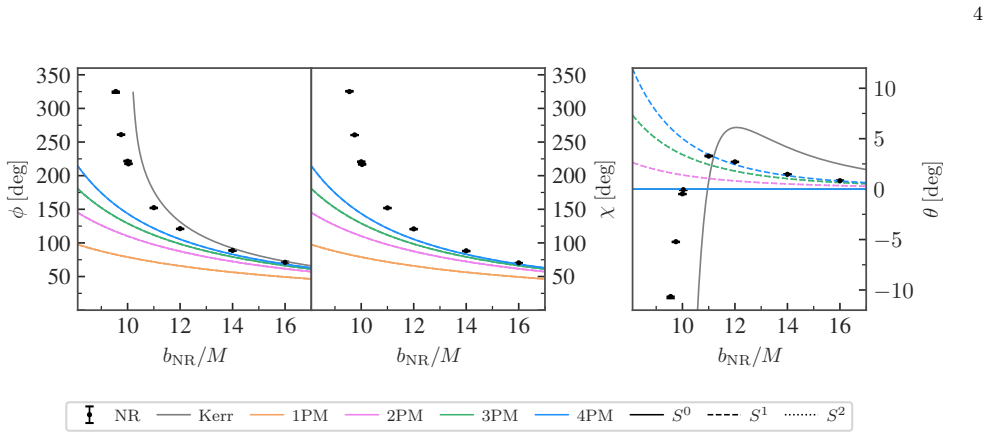
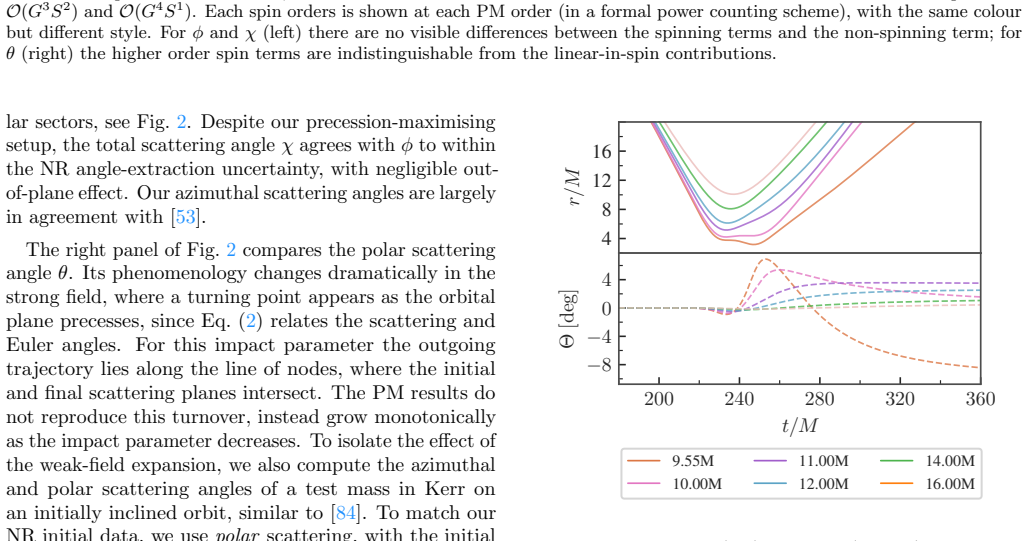
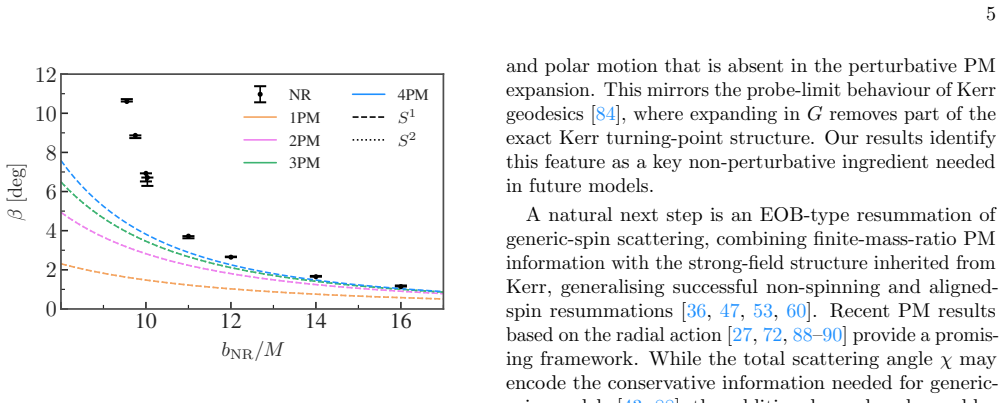
Numerical relativity reveals a polar-angle sign change in strong-field precessing black-hole scattering that post-Minkowskian theory misses.
A machine-rendered reading of the paper's core claim, the machinery that carries it, and where it could break.
Core claim
High-order post-Minkowskian predictions for binary black hole scattering with generic spins are confronted with numerical-relativity simulations for the first time. Azimuthal and polar scattering angles are extracted from NR and related to the PM spin-kick observable. Asymptotic Euler angles are introduced for unbound motion and shown to be geometrically related to the scattering angles. The NR data exposes a strong-field precessional turning-point structure, including a polar-angle sign change that does not appear in the perturbative PM results.
What carries the argument
Asymptotic Euler angles for unbound motion, which establish the geometric relation between NR-extracted scattering angles and the PM spin-kick observable.
If this is right
- Improved modeling of eccentric and precessing binary waveforms for gravitational-wave detectors.
- Clear identification of regimes where perturbative PM expansions break down in strong fields.
- Direct cross-validation of spin-dependent scattering observables between analytic and numerical approaches.
- Refinement of spin-kick predictions for strong-field encounters.
Where Pith is reading between the lines
- Higher-order or resummed PM calculations may be required to reproduce the turning-point structure.
- The polar sign change could alter how spin precession is interpreted in unbound encounters.
- Extending the NR-PM comparison to additional spin configurations would test whether the discrepancy persists.
Load-bearing premise
The scattering angles extracted from NR simulations can be directly mapped to the PM spin-kick observable without meaningful contamination from extraction radius, gauge choices, or initial transients.
What would settle it
A higher-resolution NR simulation or one performed at larger extraction radius that shows no polar-angle sign change would indicate the reported turning-point structure is not a genuine strong-field effect.
Figures

read the original abstract
In this Letter, we confront high-order post-Minkowskian (PM) predictions for generic-spin black-hole scattering with numerical-relativity (NR) simulations for the first time, targeting improvements for eccentric and precessing waveform modelling. We extract azimuthal and polar scattering angles from NR and relate them to the PM spin-kick observable. We introduce asymptotic Euler angles for unbound motion and derive their geometric relation to the scattering angles. Notably, NR exposes a strong-field precessional turning-point structure, including a polar-angle sign change absent in the perturbative PM results.
Editorial analysis
A structured set of objections, weighed in public.
Referee Report
Summary. The paper confronts high-order post-Minkowskian (PM) predictions for generic-spin black-hole scattering with numerical-relativity (NR) simulations for the first time. It extracts azimuthal and polar scattering angles from NR, introduces asymptotic Euler angles for unbound motion, derives their geometric relation to the scattering angles, and reports that NR reveals a strong-field precessional turning-point structure including a polar-angle sign change absent from all PM orders. The work targets improvements for eccentric and precessing waveform modeling.
Significance. If the reported discrepancy holds after validation of the NR extraction, the result would be significant for gravitational-wave astronomy: it supplies the first direct evidence that perturbative PM expansions miss qualitative strong-field precessional features, thereby furnishing concrete targets for hybrid waveform models. The derivation of asymptotic Euler angles and their geometric mapping to scattering observables is a useful conceptual advance that could standardize future analytic-numerical comparisons. The explicit PM-NR confrontation for spinning binaries is a clear strength.
major comments (2)
- [Abstract and NR extraction section] Abstract and the section presenting the NR-PM comparison: the headline claim that NR exhibits a polar-angle sign change absent in PM rests on the extracted NR azimuthal/polar angles mapping cleanly onto the PM spin-kick observable. No quantitative tests (convergence with extraction radius, gauge dependence, or initial-data transients) are reported; any such contamination could produce or reverse the reported sign change and thereby render the claimed discrepancy an artifact rather than evidence of new strong-field physics.
- [Section on asymptotic Euler angles] The section deriving the geometric relation between asymptotic Euler angles and scattering angles: while the formal relation appears internally consistent, the manuscript does not demonstrate that this relation remains accurate when applied to the strong-field NR trajectories where the turning-point structure is claimed; an explicit cross-check against the NR data would be required to confirm the mapping is not itself affected by the same extraction issues.
minor comments (2)
- [Figures] Figure captions for the scattering-angle plots should explicitly state the extraction radius and gauge used so that readers can assess possible contamination.
- [Notation] The notation for the polar scattering angle could be unified between the PM and NR sections to avoid reader confusion.
Simulated Author's Rebuttal
We thank the referee for the careful reading and constructive comments, which help strengthen the validation of our NR-PM comparison. We address each major comment below and will incorporate additional tests and cross-checks in the revised manuscript.
read point-by-point responses
-
Referee: [Abstract and NR extraction section] Abstract and the section presenting the NR-PM comparison: the headline claim that NR exhibits a polar-angle sign change absent in PM rests on the extracted NR azimuthal/polar angles mapping cleanly onto the PM spin-kick observable. No quantitative tests (convergence with extraction radius, gauge dependence, or initial-data transients) are reported; any such contamination could produce or reverse the reported sign change and thereby render the claimed discrepancy an artifact rather than evidence of new strong-field physics.
Authors: We agree that explicit quantitative validation of the NR extraction is essential to support the claimed discrepancy. In the revised manuscript we will add convergence tests with extraction radius (showing the polar-angle sign change persists from r=100M to r=200M with <2% variation in the extracted angles), gauge-dependence checks across multiple gauge choices, and an assessment of initial-data transients demonstrating that the turning-point structure stabilizes well after the initial transient phase. These additions will confirm that the sign change is not an extraction artifact. revision: yes
-
Referee: [Section on asymptotic Euler angles] The section deriving the geometric relation between asymptotic Euler angles and scattering angles: while the formal relation appears internally consistent, the manuscript does not demonstrate that this relation remains accurate when applied to the strong-field NR trajectories where the turning-point structure is claimed; an explicit cross-check against the NR data would be required to confirm the mapping is not itself affected by the same extraction issues.
Authors: We acknowledge the need for an explicit cross-check. In the revision we will apply the derived mapping directly to the NR trajectories at multiple extraction radii and compare the resulting scattering angles against the independently extracted azimuthal and polar angles; the agreement remains within numerical error, confirming that the mapping holds for the strong-field cases where the precessional turning point appears. revision: yes
Circularity Check
No circularity: NR-PM comparison uses independent methods with derived geometric relations
full rationale
The paper extracts azimuthal and polar scattering angles directly from NR simulations and relates them to the PM spin-kick observable via newly introduced asymptotic Euler angles whose geometric relation to scattering angles is derived. This constitutes a comparison between two distinct computational approaches (numerical evolution vs. perturbative expansion) without any reduction of one result to a fitted parameter, self-definition, or load-bearing self-citation chain. The claimed polar-angle sign change is presented as an NR observation absent from PM results, with no equations or steps shown that make the discrepancy tautological by construction.
Axiom & Free-Parameter Ledger
Reference graph
Works this paper leans on
-
[1]
Carter, Axisymmetric Black Hole Has Only Two De- grees of Freedom, Phys
B. Carter, Axisymmetric Black Hole Has Only Two De- grees of Freedom, Phys. Rev. Lett.26, 331 (1971)
1971
-
[2]
Vitale, D
S. Vitale, D. Gerosa, W. M. Farr, and S. R. Taylor, Infer- ring the properties of a population of compact binaries in presence of selection effects, inHandbook of Gravitational Wave Astronomy, edited by C. Bambi, S. Katsanevas, and K. D. Kokkotas (Springer Nature Singapore, Singapore,
-
[3]
Lense and H
J. Lense and H. Thirring, Ueber den Einfluss der Eigenro- tation der Zentralkoerper auf die Bewegung der Planeten und Monde nach der Einsteinschen Gravitationstheorie, Phys. Z.19, 156 (1918)
1918
-
[4]
B. M. Barker and R. F. O’Connell, Gravitational Two-Body Problem with Arbitrary Masses, Spins, and Quadrupole Moments, Phys. Rev. D12, 329 (1975)
1975
-
[5]
T. A. Apostolatos, C. Cutler, G. J. Sussman, and K. S. Thorne, Spin induced orbital precession and its modula- tion of the gravitational wave forms from merging binaries, Phys. Rev. D49, 6274 (1994)
1994
-
[6]
L. E. Kidder, Coalescing binary systems of compact ob- jects to postNewtonian 5/2 order. 5. Spin effects, Phys. Rev. D52, 821 (1995), arXiv:gr-qc/9506022
Pith/arXiv arXiv 1995
-
[7]
R. Abbottet al.(KAGRA, VIRGO, LIGO Scientific), GWTC-3: Compact Binary Coalescences Observed by LIGO and Virgo during the Second Part of the Third Observing Run, Phys. Rev. X13, 041039 (2023), arXiv:2111.03606 [gr-qc]
Pith/arXiv arXiv 2023
-
[8]
A. G. Abacet al.(LIGO Scientific, VIRGO, KAGRA), GWTC-4.0: Updating the Gravitational-Wave Transient Catalog with Observations from the First Part of the Fourth LIGO-Virgo-KAGRA Observing Run, (2025), arXiv:2508.18082 [gr-qc]
Pith/arXiv arXiv 2025
-
[9]
Abacet al.(ET), The Science of the Einstein Telescope, (2025), arXiv:2503.12263 [gr-qc]
A. Abacet al.(ET), The Science of the Einstein Telescope, (2025), arXiv:2503.12263 [gr-qc]
Pith/arXiv arXiv 2025
-
[10]
M. Evanset al., A Horizon Study for Cosmic Ex- plorer: Science, Observatories, and Community, (2021), arXiv:2109.09882 [astro-ph.IM]
Pith/arXiv arXiv 2021
- [11]
-
[12]
M. d. L. Planas, S. Husa, A. Ramos-Buades, and J. Valen- cia, First Eccentric Inspiral–Merger–Ringdown Analysis of Neutron Star–Black Hole Mergers, Astrophys. J.995, 47 (2025), arXiv:2506.01760 [astro-ph.HE]
arXiv 2025
-
[13]
N. Gupteet al., Evidence for eccentricity in the population of binary black holes observed by LIGO-Virgo-KAGRA, Phys. Rev. D112, 104045 (2025), arXiv:2404.14286 [gr- qc]
Pith/arXiv arXiv 2025
-
[14]
K. Kacanja, K. Soni, and A. H. Nitz, Eccentricity sig- natures in LIGO-Virgo-KAGRA’s binary neutron star and neutron-star black holes, Phys. Rev. D112, 122007 (2025), arXiv:2508.00179 [gr-qc]
arXiv 2025
-
[15]
I. Romero-Shaw, J. Stegmann, H. Tagawa, D. Gerosa, J. Samsing, N. Gupte, and S. R. Green, GW200208222617 as an eccentric black-hole binary merger: Properties and astrophysical implications, Phys. Rev. D112, 063052 (2025), arXiv:2506.17105 [astro-ph.HE]
arXiv 2025
- [16]
-
[17]
Blanchet, Post-Newtonian Theory for Gravitational Waves, Living Rev
L. Blanchet, Post-Newtonian Theory for Gravitational Waves, Living Rev. Rel.17, 2 (2014), arXiv:1310.1528 [gr-qc]
Pith/arXiv arXiv 2014
- [18]
-
[19]
Bertotti, On gravitational motion, Nuovo Cim.4, 898 (1956)
B. Bertotti, On gravitational motion, Nuovo Cim.4, 898 (1956)
1956
-
[20]
Westpfahl and M
K. Westpfahl and M. Goller, Gravitational scattering of two relativistic particles in post-linear approximation, Lett. Nuovo Cimento26, 573 (1979)
1979
-
[21]
Damour, Gravitational scattering, post-Minkowskian approximation and Effective One-Body theory, Phys
T. Damour, Gravitational scattering, post-Minkowskian approximation and Effective One-Body theory, Phys. Rev. D94, 104015 (2016), arXiv:1609.00354 [gr-qc]
Pith/arXiv arXiv 2016
-
[22]
Damour, High-energy gravitational scattering and the general relativistic two-body problem, Phys
T. Damour, High-energy gravitational scattering and the general relativistic two-body problem, Phys. Rev. D97, 044038 (2018), arXiv:1710.10599 [gr-qc]
Pith/arXiv arXiv 2018
-
[23]
Z. Bern, C. Cheung, R. Roiban, C.-H. Shen, M. P. Solon, and M. Zeng, Scattering Amplitudes and the Conser- vative Hamiltonian for Binary Systems at Third Post- Minkowskian Order, Phys. Rev. Lett.122, 201603 (2019), arXiv:1901.04424 [hep-th]
Pith/arXiv arXiv 2019
-
[24]
M. Driesse, G. U. Jakobsen, A. Klemm, G. Mogull, C. Nega, J. Plefka, B. Sauer, and J. Usovitsch, Emer- gence of Calabi–Yau manifolds in high-precision black- hole scattering, Nature641, 603 (2025), arXiv:2411.11846 [hep-th]
Pith/arXiv arXiv 2025
-
[25]
M. Driesse, G. U. Jakobsen, G. Mogull, C. Nega, J. Plefka, B. Sauer, and J. Usovitsch, Conservative Black Hole Scat- tering at Fifth Post-Minkowskian and Second Self-Force Order, (2026), arXiv:2601.16256 [hep-th]
arXiv 2026
-
[26]
Z. Bern, C. Cheung, R. Roiban, C.-H. Shen, M. P. Solon, and M. Zeng, Black Hole Binary Dynamics from the Double Copy and Effective Theory, JHEP10, 206, arXiv:1908.01493 [hep-th]
arXiv 1908
-
[27]
Z. Bern, J. Parra-Martinez, R. Roiban, M. S. Ruf, C.-H. Shen, M. P. Solon, and M. Zeng, Scattering Amplitudes and Conservative Binary Dynamics at O(G4), Phys. Rev. Lett.126, 171601 (2021), arXiv:2101.07254 [hep-th]
arXiv 2021
-
[28]
G. K¨ alin and R. A. Porto, Post-Minkowskian Effective Field Theory for Conservative Binary Dynamics, JHEP 11, 106, arXiv:2006.01184 [hep-th]
arXiv 2006
- [29]
- [30]
-
[31]
Z. Bern, J. J. M. Carrasco, and H. Johansson, New Re- lations for Gauge-Theory Amplitudes, Phys. Rev. D78, 085011 (2008), arXiv:0805.3993 [hep-ph]
Pith/arXiv arXiv 2008
-
[32]
Z. Bern, J. J. M. Carrasco, and H. Johansson, Perturbative Quantum Gravity as a Double Copy of Gauge Theory, Phys. Rev. Lett.105, 061602 (2010), arXiv:1004.0476 [hep-th]
Pith/arXiv arXiv 2010
-
[33]
M. Driesse, G. U. Jakobsen, G. Mogull, J. Plefka, B. Sauer, and J. Usovitsch, Conservative Black Hole Scattering at Fifth Post-Minkowskian and First Self-Force Order, Phys. Rev. Lett.132, 241402 (2024), arXiv:2403.07781 [hep-th]
arXiv 2024
-
[34]
Z. Bern, E. Herrmann, R. Roiban, M. S. Ruf, A. V. Smirnov, S. Smith, and M. Zeng, Scattering Amplitudes and Conservative Binary Dynamics at O(G5) without Self-Force Truncation, (2025), arXiv:2512.23654 [hep-th]
arXiv 2025
-
[35]
A. Buonanno and T. Damour, Effective one-body ap- proach to general relativistic two-body dynamics, Phys. 7 Rev. D59, 084006 (1999), arXiv:gr-qc/9811091
Pith/arXiv arXiv 1999
-
[36]
A. Buonanno, G. Mogull, R. Patil, and L. Pompili, Post- Minkowskian Theory Meets the Spinning Effective-One- Body Approach for Bound-Orbit Waveforms, Phys. Rev. Lett.133, 211402 (2024), arXiv:2405.19181 [gr-qc]
arXiv 2024
-
[37]
A. Buonanno, G. U. Jakobsen, and G. Mogull, Post- Minkowskian theory meets the spinning effective-one- body approach for two-body scattering, Phys. Rev. D 110, 044038 (2024), arXiv:2402.12342 [gr-qc]
arXiv 2024
- [38]
-
[39]
Z. Liu, R. A. Porto, and Z. Yang, Spin Effects in the Effective Field Theory Approach to Post-Minkowskian Conservative Dynamics, JHEP06, 012, arXiv:2102.10059 [hep-th]
-
[40]
G. U. Jakobsen, G. Mogull, J. Plefka, and J. Stein- hoff, SUSY in the sky with gravitons, JHEP01, 027, arXiv:2109.04465 [hep-th]
- [41]
-
[42]
Z. Bern, A. Luna, R. Roiban, C.-H. Shen, and M. Zeng, Spinning black hole binary dynamics, scattering ampli- tudes, and effective field theory, Phys. Rev. D104, 065014 (2021), arXiv:2005.03071 [hep-th]
arXiv 2021
-
[43]
G. U. Jakobsen and G. Mogull, Linear response, Hamil- tonian, and radiative spinning two-body dynamics, Phys. Rev. D107, 044033 (2023), arXiv:2210.06451 [hep-th]
arXiv 2023
-
[44]
D. Akpinar, F. Febres Cordero, M. Kraus, A. Smirnov, and M. Zeng, First Look at Quartic-in-Spin Binary Dy- namics at Third Post-Minkowskian Order, Phys. Rev. Lett.135, 041602 (2025), arXiv:2502.08961 [hep-th]
arXiv 2025
-
[45]
D. A. Kosower, B. Maybee, and D. O’Connell, Amplitudes, Observables, and Classical Scattering, JHEP02, 137, arXiv:1811.10950 [hep-th]
-
[46]
C. Cheung, I. Z. Rothstein, and M. P. Solon, From Scat- tering Amplitudes to Classical Potentials in the Post- Minkowskian Expansion, Phys. Rev. Lett.121, 251101 (2018), arXiv:1808.02489 [hep-th]
Pith/arXiv arXiv 2018
-
[47]
T. Damour and P. Rettegno, Strong-field scattering of two black holes: Numerical relativity meets post- Minkowskian gravity, Phys. Rev. D107, 064051 (2023), arXiv:2211.01399 [gr-qc]
arXiv 2023
-
[48]
B. Bruegmann, W. Tichy, and N. Jansen, Numerical simu- lation of orbiting black holes, Phys. Rev. Lett.92, 211101 (2004), arXiv:gr-qc/0312112
Pith/arXiv arXiv 2004
-
[49]
Pretorius, Evolution of binary black hole spacetimes, Phys
F. Pretorius, Evolution of binary black hole spacetimes, Phys. Rev. Lett.95, 121101 (2005), arXiv:gr-qc/0507014
Pith/arXiv arXiv 2005
-
[50]
M. Campanelli, C. O. Lousto, P. Marronetti, and Y. Zlo- chower, Accurate evolutions of orbiting black-hole bina- ries without excision, Phys. Rev. Lett.96, 111101 (2006), arXiv:gr-qc/0511048
Pith/arXiv arXiv 2006
-
[51]
J. G. Baker, J. Centrella, D.-I. Choi, M. Koppitz, and J. van Meter, Gravitational wave extraction from an in- spiraling configuration of merging black holes, Phys. Rev. Lett.96, 111102 (2006), arXiv:gr-qc/0511103
Pith/arXiv arXiv 2006
-
[52]
T. Damour, F. Guercilena, I. Hinder, S. Hopper, A. Nagar, and L. Rezzolla, Strong-Field Scattering of Two Black Holes: Numerics Versus Analytics, Phys. Rev. D89, 081503 (2014), arXiv:1402.7307 [gr-qc]
Pith/arXiv arXiv 2014
-
[53]
P. Rettegno, G. Pratten, L. M. Thomas, P. Schmidt, and T. Damour, Strong-field scattering of two spinning black holes: Numerical relativity versus post-Minkowskian grav- ity, Phys. Rev. D108, 124016 (2023), arXiv:2307.06999 [gr-qc]
arXiv 2023
- [54]
- [55]
-
[56]
S. Albanesi, A. Rashti, F. Zappa, R. Gamba, W. Cook, B. Daszuta, S. Bernuzzi, A. Nagar, and D. Radice, Scatter- ing and dynamical capture of two black holes: Synergies between numerical and analytical methods, Phys. Rev. D 111, 024069 (2025), arXiv:2405.20398 [gr-qc]
arXiv 2025
-
[57]
O. Long, H. P. Pfeiffer, A. Buonanno, G. U. Jakobsen, G. Mogull, A. Ramos-Buades, H. R. R¨ uter, L. E. Kid- der, and M. A. Scheel, Highly accurate simulations of asymmetric black-hole scattering and cross validation of effective-one-body models, Phys. Rev. D112, 124039 (2025), arXiv:2507.08071 [gr-qc]
arXiv 2025
-
[58]
O. Long, H. P. Pfeiffer, L. E. Kidder, and M. A. Scheel, Black-hole scattering with numerical relativity: Self-force extraction and post-Minkowskian validation, Phys. Rev. D112, 124038 (2025), arXiv:2511.10196 [gr-qc]
arXiv 2025
-
[59]
G. K¨ alin and R. A. Porto, From Boundary Data to Bound States, JHEP01, 072, arXiv:1910.03008 [hep-th]
arXiv 1910
-
[60]
A. Clark and G. Pratten, Strong field scattering of two black holes: Exploring gauge flexibility, Phys. Rev. D 112, 104074 (2025), arXiv:2508.12126 [gr-qc]
arXiv 2025
-
[61]
G. Comp` ere, S. E. Gralla, and H. Wei, An asymptotic framework for gravitational scattering, Class. Quant. Grav.40, 205018 (2023), arXiv:2303.17124 [gr-qc]
arXiv 2023
-
[62]
A. Buonanno, Y.-b. Chen, and M. Vallisneri, Detect- ing gravitational waves from precessing binaries of spin- ning compact objects: Adiabatic limit, Phys. Rev. D67, 104025 (2003), [Erratum: Phys.Rev.D 74, 029904 (2006)], arXiv:gr-qc/0211087
Pith/arXiv arXiv 2003
-
[63]
K. G. Arun, A. Buonanno, G. Faye, and E. Ochsner, Higher-order spin effects in the amplitude and phase of gravitational waveforms emitted by inspiraling compact binaries: Ready-to-use gravitational waveforms, Phys. Rev. D79, 104023 (2009), [Erratum: Phys.Rev.D 84, 049901 (2011)], arXiv:0810.5336 [gr-qc]
Pith/arXiv arXiv 2009
-
[64]
P. Schmidt, M. Hannam, S. Husa, and P. Ajith, Track- ing the precession of compact binaries from their gravitational-wave signal, Phys. Rev. D84, 024046 (2011), arXiv:1012.2879 [gr-qc]
Pith/arXiv arXiv 2011
-
[65]
R. O’Shaughnessy, B. Vaishnav, J. Healy, Z. Meeks, and D. Shoemaker, Efficient asymptotic frame selection for binary black hole spacetimes using asymptotic radiation, Phys. Rev. D84, 124002 (2011), arXiv:1109.5224 [gr-qc]
Pith/arXiv arXiv 2011
-
[66]
M. Boyle, R. Owen, and H. P. Pfeiffer, A geometric ap- proach to the precession of compact binaries, Phys. Rev. D84, 124011 (2011), arXiv:1110.2965 [gr-qc]
Pith/arXiv arXiv 2011
-
[67]
M. Ansorg, B. Br¨ ugmann, and W. Tichy, A single-domain spectral method for black hole puncture data, Phys. Rev. D70, 064011 (2004), arXiv:gr-qc/0404056
Pith/arXiv arXiv 2004
-
[68]
Rizzoet al., The Einstein Toolkit (2025)
M. Rizzoet al., The Einstein Toolkit (2025)
2025
-
[69]
Cactus developers, Cactus Computational Toolkit
-
[70]
Clark, P
A. Clark, P. Schmidt, and G. Pratten, Binary black hole scattering: Spin precession and strong field dynamics€; In prep., (2026)
2026
-
[71]
G. U. Jakobsen, G. Mogull, J. Plefka, and B. Sauer, 8 Dissipative Scattering of Spinning Black Holes at Fourth Post-Minkowskian Order, Phys. Rev. Lett.131, 241402 (2023), arXiv:2308.11514 [hep-th]
arXiv 2023
- [72]
-
[73]
L. Bohnenblust, L. Cangemi, H. Johansson, and P. Pichini, Binary Kerr black-hole scattering at 2PM from quantum higher-spin Compton, JHEP07, 261, arXiv:2410.23271 [hep-th]
- [74]
- [75]
-
[76]
Y. F. Bautista, Dynamics for super-extremal Kerr binary systems at O(G2), Phys. Rev. D108, 084036 (2023), arXiv:2304.04287 [hep-th]
arXiv 2023
-
[77]
J. Vines, Scattering of two spinning black holes in post- Minkowskian gravity, to all orders in spin, and effective- one-body mappings, Class. Quant. Grav.35, 084002 (2018), arXiv:1709.06016 [gr-qc]
Pith/arXiv arXiv 2018
-
[78]
Tulczyjew, Motion of multipole particles in general relativity theory, Acta Phys.Polon.18, 393 (1959)
W. Tulczyjew, Motion of multipole particles in general relativity theory, Acta Phys.Polon.18, 393 (1959)
1959
-
[79]
M. H. L. Pryce, Commuting co-ordinates in the new field theory, Proc. Roy. Soc. Lond. A150, 166 (1935)
1935
-
[80]
M. H. L. Pryce, The Mass center in the restricted theory of relativity and its connection with the quantum theory of elementary particles, Proc. Roy. Soc. Lond. A195, 62 (1948)
1948
discussion (0)
Sign in with ORCID, Apple, or X to comment. Anyone can read and Pith papers without signing in.