Rigidity of McMullen Julia sets
Pith reviewed 2026-06-25 22:06 UTC · model grok-4.3
The pith
The Julia sets of postcritically finite McMullen maps are quasisymmetrically classified, each with exactly its natural finite dihedral symmetry group.
A machine-rendered reading of the paper's core claim, the machinery that carries it, and where it could break.
Core claim
The authors establish a complete quasisymmetric classification of the Julia sets of postcritically finite McMullen maps f_λ(z)=z^n+λ/z^n and prove that the quasisymmetry group of each such Julia set coincides exactly with the finite dihedral group generated by the natural symmetries of the map. This holds uniformly for the Sierpiński-like carpet, necklace, and cluster topological classes.
What carries the argument
The quasisymmetric equivalence relation on these Julia sets, together with the explicit identification of each equivalence class's symmetry group as the finite dihedral group induced by the map.
If this is right
- Every postcritically finite McMullen Julia set is quasisymmetrically rigid.
- The quasisymmetry group of each such set is precisely the finite dihedral group coming from the map's natural symmetries.
- The three topological classes (Sierpiński-like carpets, necklaces, clusters) each contain rigid examples.
- Any two postcritically finite McMullen Julia sets are quasisymmetrically equivalent if and only if they belong to the same class and share the same symmetry type.
Where Pith is reading between the lines
- Quasisymmetric conjugacy between two such maps must preserve the parameter λ up to the action of the dihedral group.
- Small perturbations of λ that leave the postcritically finite set will generally produce Julia sets outside these rigid classes.
- The same rigidity technique may apply to other families of rational maps whose postcritical sets are finite.
Load-bearing premise
The postcritically finite condition on the maps is assumed to produce and exhaust all three topological classes of Julia sets without leaving any class outside the classification.
What would settle it
Exhibiting either a quasisymmetric homeomorphism between two postcritically finite McMullen Julia sets from distinct topological classes or a quasisymmetric self-homeomorphism of one such set that is not an element of its dihedral symmetry group.
Figures

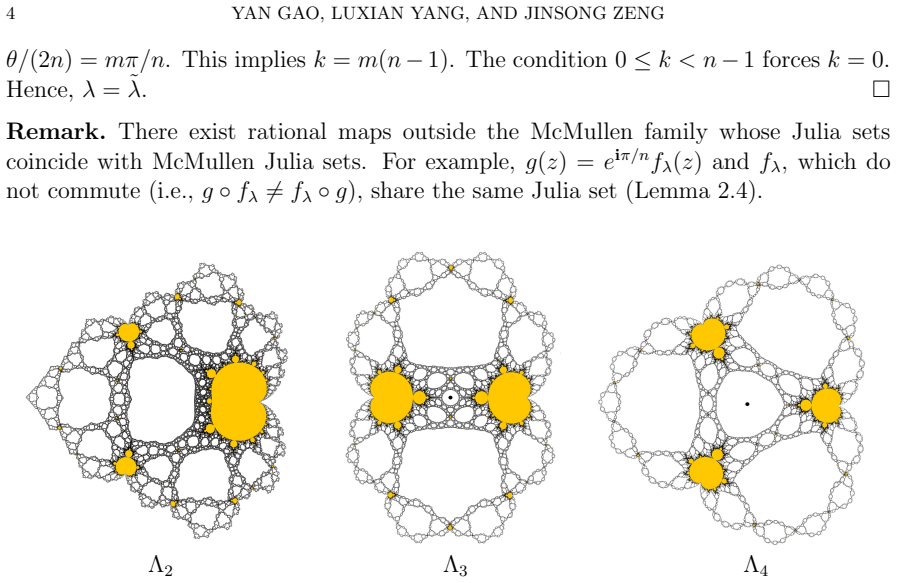
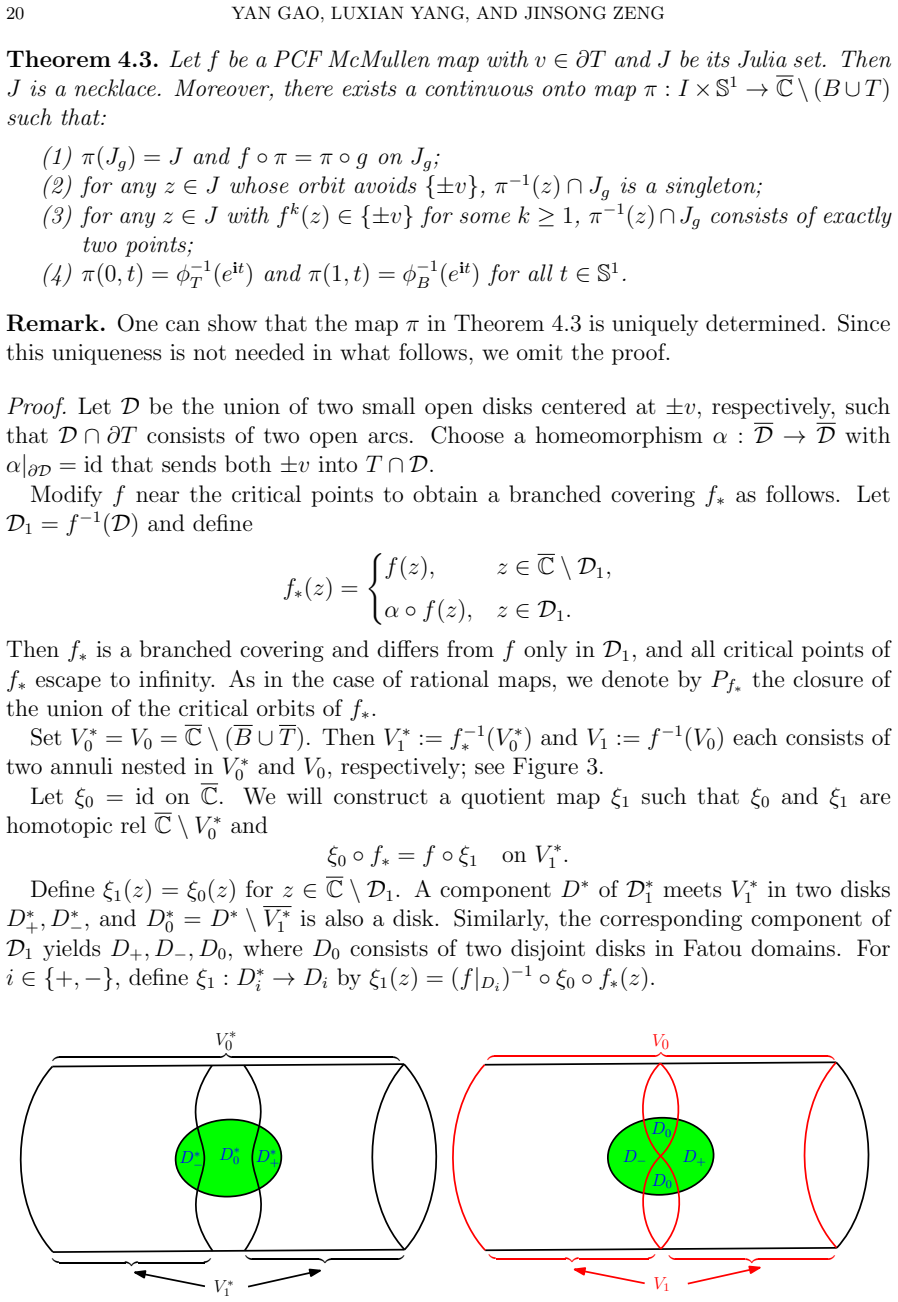
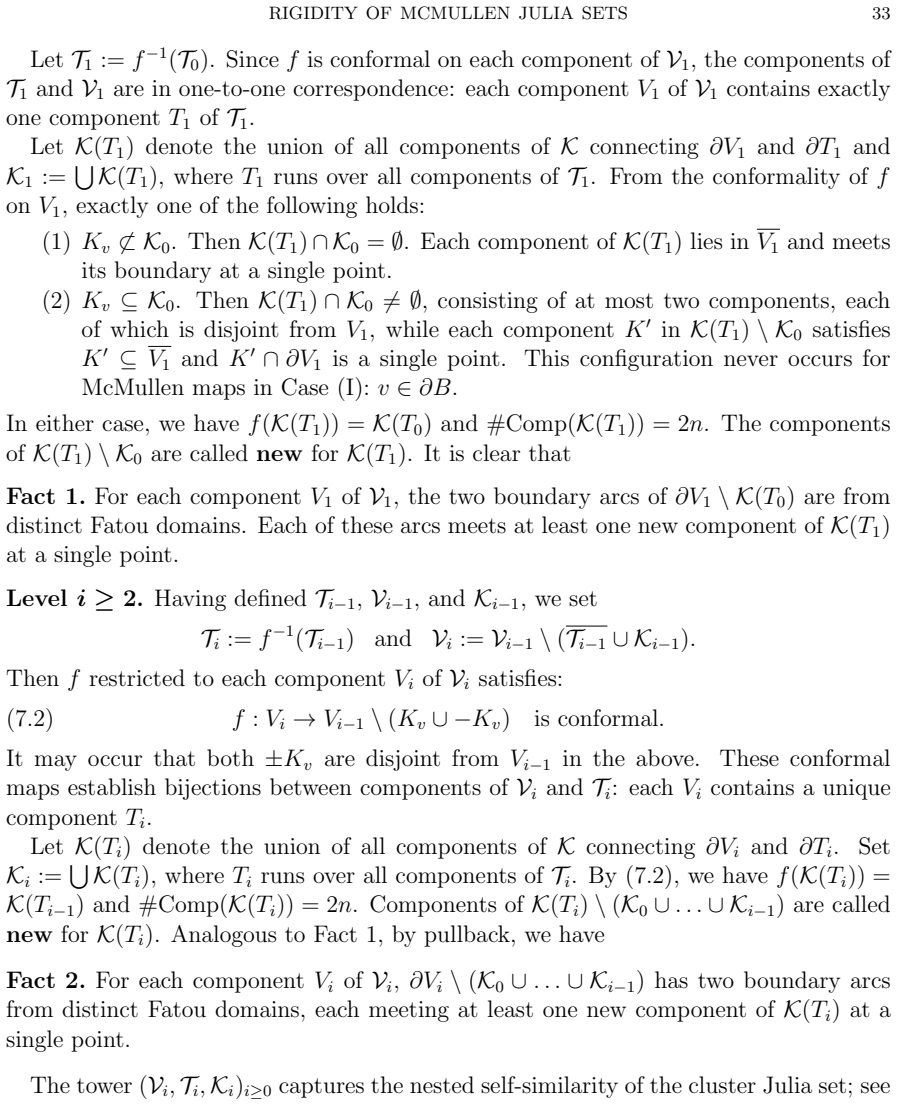
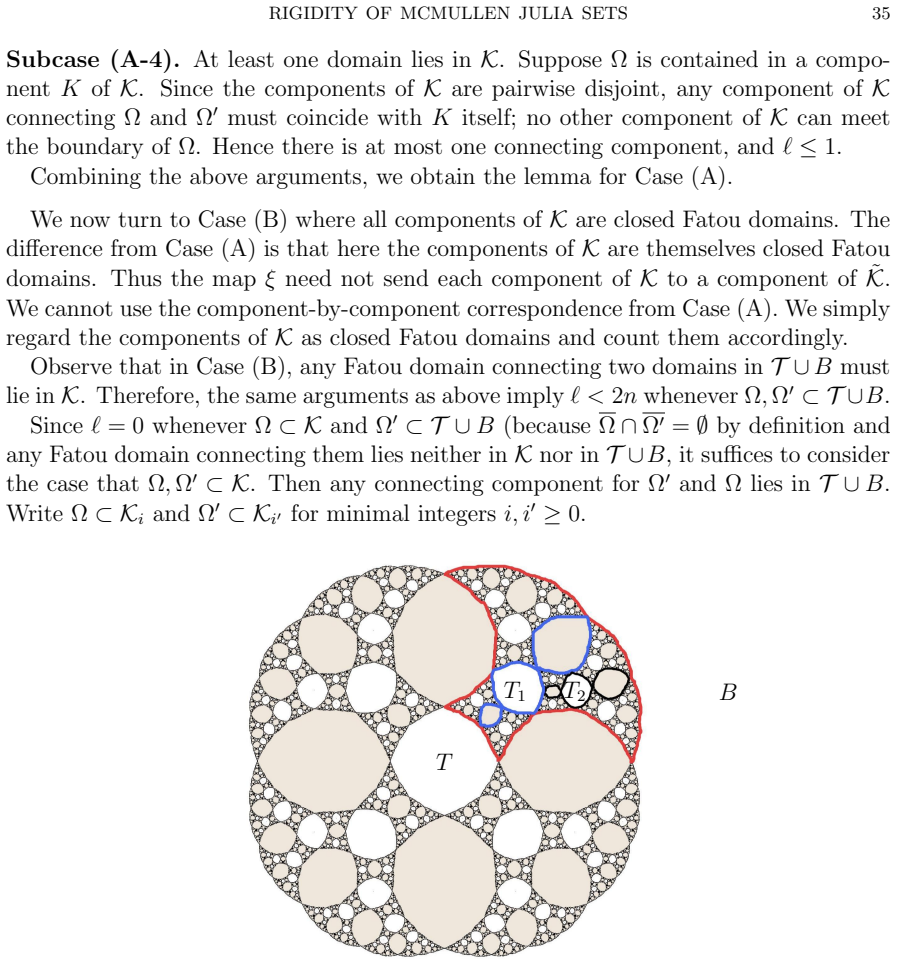
read the original abstract
We provide a complete quasisymmetric classification of the Julia sets of postcritically finite McMullen maps $f_\lambda(z)=z^n+\lambda/z^n$ with $\lambda\in\mathbb{C}^*$ and $n\geq 2$, and prove that the quasisymmetry group of each such Julia set is exactly the finite dihedral group generated by the natural symmetries of the map. These results establish quasisymmetric rigidity for all topological classes in this family, including Sierpi\'{n}ski-like carpets, necklaces, and clusters, and provide the first known examples of rigid Julia sets in each of the three classes.
Editorial analysis
A structured set of objections, weighed in public.
Referee Report
Summary. The manuscript provides a complete quasisymmetric classification of the Julia sets of postcritically finite McMullen maps f_λ(z)=z^n + λ/z^n with λ∈C* and n≥2. It proves that the quasisymmetry group of each such Julia set is exactly the finite dihedral group generated by the natural symmetries of the map. These results are claimed to hold uniformly across all three topological classes (Sierpiński-like carpets, necklaces, and clusters) and to supply the first rigid examples in each class.
Significance. If the classification and rigidity statements hold, the work supplies the first known rigid Julia sets in each of the three topological classes for this family and advances the program of quasisymmetric rigidity results in complex dynamics.
major comments (1)
- [The section (or theorem) classifying or enumerating postcritically finite parameters λ] The central claim of a 'complete' classification that covers 'all topological classes' rests on the assertion that the postcritically finite locus for each fixed n realizes every one of the three classes without gaps or omitted sub-families. The manuscript must contain an explicit enumeration or parametrization (with a dedicated theorem or subsection) showing that PCF parameters exist in each class and that the case analysis exhausts the PCF locus; without this, the uniformity statement is not load-bearing.
Simulated Author's Rebuttal
We thank the referee for the careful reading and constructive comments. We address the major comment below.
read point-by-point responses
-
Referee: [The section (or theorem) classifying or enumerating postcritically finite parameters λ] The central claim of a 'complete' classification that covers 'all topological classes' rests on the assertion that the postcritically finite locus for each fixed n realizes every one of the three classes without gaps or omitted sub-families. The manuscript must contain an explicit enumeration or parametrization (with a dedicated theorem or subsection) showing that PCF parameters exist in each class and that the case analysis exhausts the PCF locus; without this, the uniformity statement is not load-bearing.
Authors: We agree that an explicit enumeration strengthens the presentation. The manuscript already classifies PCF parameters via the possible finite critical orbit configurations for the maps f_λ, which partitions the locus into the three topological classes with no omissions (as the orbit conditions are exhaustive). To make this fully transparent as requested, the revised version will include a dedicated theorem (with a short subsection) that parametrizes the PCF locus for each fixed n≥2, confirms existence in each class, and verifies that the subsequent case analysis covers the entire locus. revision: yes
Circularity Check
No circularity: classification and rigidity proved from standard complex-dynamics tools under explicit PCF hypothesis
full rationale
The paper states a theorem classifying quasisymmetric equivalence classes of Julia sets for postcritically finite McMullen maps and proves that the quasisymmetry group equals the dihedral group generated by the map symmetries. The PCF condition is an explicit, externally verifiable hypothesis on the parameter λ; it is not fitted to data nor defined in terms of the target classification. No equations or steps in the abstract or described argument reduce a prediction to a fitted input by construction, nor does any load-bearing step rest solely on a self-citation whose content is itself unverified. The three topological classes are enumerated by direct analysis of the dynamics under the PCF assumption rather than by renaming or smuggling an ansatz. The derivation is therefore self-contained against external benchmarks in the field.
Axiom & Free-Parameter Ledger
Reference graph
Works this paper leans on
-
[1]
Astala, T
K. Astala, T. Iwaniec, G. M. Martin, Elliptic partial differential equations and quasiconformal mappings in the plane, Princeton Univ. Press, Princetion, NJ, 2009
2009
-
[2]
A. F. Beardon, The geometry of discrete groups, Springer, New York, 1983
1983
-
[3]
L. V. Alhfors, Lectures on quasi-conformal mappings, Wadsworth & Brook/Cole, Advanced Books & Software, Monsterey 1987
1987
-
[4]
Belk and B
J. Belk and B. Forrest, Quasisymmetries of finitely ramified Julia sets, Math. Ann., (2025) 393:1683-1740
2025
-
[5]
Bonk, The quasiconformal geometry of fractals, in Proceedings of the International Congress of Mathematicians, Madrid 2006, Vol
M. Bonk, The quasiconformal geometry of fractals, in Proceedings of the International Congress of Mathematicians, Madrid 2006, Vol. II, 1349--1373, Eur. Math. Soc., Z\" u rich, 2006
2006
-
[6]
Bonk, Uniformization of Sierpi\' n ski carpets in the plane, Invent
M. Bonk, Uniformization of Sierpi\' n ski carpets in the plane, Invent. Math. 186 (2011), 559-665
2011
-
[7]
Bonk and S
M. Bonk and S. Merenkov, Quasisymmetric rigidity of square Sierpi\' n ski carpets, Ann. of Math. (2)177(2013) 591-643
2013
-
[8]
Bonk and S
M. Bonk and S. Merenkov, Quasisymmetric rigicity of square Sierpi\' n ski carpets, Ann. of Math. (2)177(2013) 591-643
2013
-
[9]
Bonk and S, Merenkov, Square Sierpi\' n ski carpets and Latt\` e s maps, Math
M. Bonk and S, Merenkov, Square Sierpi\' n ski carpets and Latt\` e s maps, Math. Z. 296(2020), 695--718
2020
-
[10]
M. Bonk, M. Lyubich and S. Merenkov, Quasisymmetries of Sierpi\' n ski carpet Julia sets, Adv. Math. 301 (2016) 383-422
2016
-
[11]
M. Bonk, B. Kleiner, S. Merenkov, Rigidity of Schottky sets, Amer. J. Math. 131 (2009) 409--443
2009
-
[12]
Bourdon, Immeubles hyperboliques, dimension conforme et rigidit\' e de Mostow, Geom
M. Bourdon, Immeubles hyperboliques, dimension conforme et rigidit\' e de Mostow, Geom. Funct. Anal. 7 (1997), 245-268
1997
-
[13]
Branner and N
B. Branner and N. Fagella, Quasiconformal Surgery in Holomorphic Dynamics, Cambridge University Press, New York, 2014
2014
-
[14]
Bourdon and H
M. Bourdon and H. Pajot, Quasiconformal geometry and hyperbolic geometry, in Rigidity in dynamics and geometry (Cambridge, 2000), pages 1-17, Springer, Berlin, 2002
2000
- [15]
-
[16]
G. Cui, W. Peng, and L. Tan, On a theorem of Rees-Shishikura, Ann. Fac. Sci. Toulouse Math. 21 (2012), no. 5, 981-993
2012
-
[17]
G. Cui, W. Peng, and L. Tan, Renormalizations and wandering Jordan curves of rational maps, Commun. Math. Phys. 344 (2016), 67--115
2016
-
[18]
Cui, and L
G. Cui, and L. Tan, A characterization of hyperbolic rational maps, Invent. math.. 183 (2011), 451--516
2011
-
[19]
R. L. Devaney, N. Fagella, A. Garijo and X. Jarque, Sierpi\' n ski curve Julia sets for quadratic rational maps, Ann. Acad. Sci. Fenn. Math. 39 (2014), 3-22
2014
-
[20]
R. L. Devaney, D. Look and D. Uminsky, The escape trichotomy for singularly perturbed rational maps, Indiana Univ. Math. J. 54 (2005), 1621-1634
2005
-
[21]
R. L. Devaney and K. Pilgrim, Dynamic classification of escape-time Sierpi\' n ski curve Julia sets. Fund. Math., 202(2009), 181-198
2009
-
[22]
Y. Gao, J. Zeng, Polynomials in molecules, arXiv: 2601. 18605v1
-
[23]
Hatcher, Algebraic topology, Cambridge Univ
A. Hatcher, Algebraic topology, Cambridge Univ. Press, Cambridge, 2002
2002
-
[24]
Ha\" ssinsky and K
P. Ha\" ssinsky and K. Pilgrim, Quasisymmetrically inequivalent hyperbolic Julia sets, Revista Math. Iberoamericana, 28 (2012), 1025-1034
2012
-
[25]
B. Kleiner. The asymptotic geometry of negatively curved spaces: uniformization, geometrization and rigidity, In International Congress of Mathematicians. Vol. II, pages 743-768. Eur. Math. Soc., Z\" u rich, 2006
2006
-
[26]
Kahn and M
J. Kahn and M. Lyubich, Quasi-Additivity Law in conformal geometry, Ann. Math. 169 (2009), 561-193
2009
-
[27]
Lehto and K
O. Lehto and K. I. Virtanen, Quasiconformal Mappings in the Plane, Springer Verlag, Berlin, Heidelberg, New York, 1973
1973
-
[28]
Levin, Symmetries on Julia sets (Russian), Mat
G. Levin, Symmetries on Julia sets (Russian), Mat. Zametki 48 (1990), 72-79, 159; translation in Math. Notes 48 (1990), 1126-1131 (1991)
1990
-
[29]
Levin, Letter to the editors: ``Symmetries on Julia sets" (Russian), Mat
G. Levin, Letter to the editors: ``Symmetries on Julia sets" (Russian), Mat. Zametki 69 (2001), 479-480; translation in Math. Notes 69 (2001), 432-433
2001
-
[30]
Lodge, M
R. Lodge, M. Lyubich, S. Merenkov and S. Mukherjee, On dynamical gaskets generated by rational maps, Kleinian groups, and Schwarz reflections. Conform. Geom. Dyn., 27(01), 1-54(2023)
2023
-
[31]
Levin and F
G. Levin and F. Przytycki, When do two rational functions have the same Julia set? Proc. Amer. Math. Soc. 125 (1997), 2179-2190
1997
-
[32]
Lyubich, Dynamics of quadratic polynomials I-II, Acta Math
M. Lyubich, Dynamics of quadratic polynomials I-II, Acta Math. 178 (1997), 185-297
1997
-
[33]
Lyubich and S
M. Lyubich and S. Merenkov, Quasisymmetries of the basilica and the Thompson group. Geom. Funct. Anal., 28(3),727-754(2018)
2018
- [34]
- [35]
-
[36]
Ma\ n \' e , On a lemma of Fatou, Bol
R. Ma\ n \' e , On a lemma of Fatou, Bol. Soc. Bras. Mat. 24 (1993), 1-11
1993
-
[37]
C. T. McMullen, Complex Dynamics and Renormalization, Ann. Math. Studies 135, Princeton U. Press, Princeton, NJ, 1994
1994
-
[38]
C. T. McMullen, The classification of conformal dynamical system. In Current developments in mathematics, 1995 (Cambridge, MA), pages 323-360. Internat. Press, Cambridge, MA 1994
1995
-
[39]
C. T. McMullen, Self-similarity of Siegel disks and Hausdorff dimension of Julia sets, Acta Math., 180(1998), 247-292
1998
-
[40]
Merenkov, A Sierpi\' n ski carpet with the co-Hopfian property, Invent
S. Merenkov, A Sierpi\' n ski carpet with the co-Hopfian property, Invent. Math. 180 (2010), 361-388
2010
-
[41]
Merenkov, Planar relative Schottky sets and quasisymmetric maps, Proc
S. Merenkov, Planar relative Schottky sets and quasisymmetric maps, Proc. Lond. Math. Soc. (3) 104 (2012), no. 3, 455-485
2012
-
[42]
Merenkov, Local rigidity of Schottky maps, Proc
S. Merenkov, Local rigidity of Schottky maps, Proc. Amer. Math. Soc. 142 (2014), no. 12, 4321-4332
2014
-
[43]
Milnor, Geometry and dynamics of quadratic rational maps, with an appendix by J
J. Milnor, Geometry and dynamics of quadratic rational maps, with an appendix by J. Milnor and L. Tan, Exper. Math. 2 (1993), Vol 1, 37-83
1993
-
[44]
J. Milnor, Periodic orbits, externals rays and the Mandelbrot set: An expository account, in `` G\' e om\' e Complexe et Syst\` e mes Dynamiques, Colloque en l'honneur d'Adrien Douady '', Ast\' e risque , 261 (2000), 277-333
2000
-
[45]
Milnor, Dynamics in One Complex Variable, 3rd ed., Princeton Univ
J. Milnor, Dynamics in One Complex Variable, 3rd ed., Princeton Univ. Press, Princeton, NJ, 2006
2006
-
[46]
R. L. Moore, Concerning upper semicontinuous collections of compacta, Trans. Amer. Math. Soc. 27 (1925), 416-426
1925
-
[47]
C. T. McMullen and D. Sullivan, Quasiconformal homeomorphisms and dynamics. III. The Teichm\" u ller space of a holomorphic dynamical system. Adv. Math., 135(1998), 351-395
1998
-
[48]
W. Qiu, P. Roesch, X. Wang and Y. Yin, Hyperbolic components of McMullen maps. Ann. Sci. \' E c. Norm. Sup\' e r (4) , 48(3)(2015), 703-737
2015
-
[49]
W. Qiu, X. Wang and Y. Yin, Dynamics of McMullen maps, Adv. Math. 229 (2012), 2525-2577
2012
-
[50]
W. Qiu, F. Yang, and J. Zeng, Quasisymmetric geometry of Sierpi\' n ski carpet Julia sets, Fund. Math. 244 (2019), no. 1, 73-107
2019
-
[51]
Steinmetz, On the dynamics of the McMullen family R(z)=z^m+ /z^ , Conform
N. Steinmetz, On the dynamics of the McMullen family R(z)=z^m+ /z^ , Conform. Geom. Dyn. 10 (2006), 159-183
2006
-
[52]
Sullivan, Quasiconformal homeomorphisms and dynamics I: Solution of the Fatou-Julia problem on wandering domains, Ann
D. Sullivan, Quasiconformal homeomorphisms and dynamics I: Solution of the Fatou-Julia problem on wandering domains, Ann. of Math. 122 (1985), 401-418
1985
-
[53]
Tiozzo, Topological entropy of quadratic polynomials and dimension of sections of the Manderbrot set, Adv
G. Tiozzo, Topological entropy of quadratic polynomials and dimension of sections of the Manderbrot set, Adv. Math. 273 (2015), 651-715
2015
-
[54]
Whyburn, Topological characterization of the Sierpi\' n ski curves, Fund
G. Whyburn, Topological characterization of the Sierpi\' n ski curves, Fund. Math. 45 (1958), 320-324
1958
-
[55]
Y. Xiao, W. Qiu and Y. Yin, On the dynamics of generalized McMullen maps, Ergod. Th. & Dynam. Sys. 34 (2014), 2093-2112
2014
-
[56]
Yin, On the Julia sets of semi-hyperbolic rational maps, Chinese J
Y. Yin, On the Julia sets of semi-hyperbolic rational maps, Chinese J. Contemp. Math. 20 (1999), no. 4, 469-476
1999
-
[57]
Yin, Geometry and dimension of Julia sets, in The Mandelbrot Set, Theme and Variations, London Math
Y. Yin, Geometry and dimension of Julia sets, in The Mandelbrot Set, Theme and Variations, London Math. Soc. Lecture Note Ser. 274, Cambridge Univ. Press, Cambridge, 2000, pp. 281-287
2000
-
[58]
Zakeri, External rays and the real slice of the Mandelbrot set, Ergod
S. Zakeri, External rays and the real slice of the Mandelbrot set, Ergod. Th. & Dynam. Sys. 23 (2003), 637-660
2003
discussion (0)
Sign in with ORCID, Apple, or X to comment. Anyone can read and Pith papers without signing in.