Are Text-to-Image Models Inductivist Turkeys? A Counterfactual Benchmark for Causal Reasoning
Pith reviewed 2026-07-02 21:16 UTC · model grok-4.3
The pith
Text-to-image models default to real-world visual patterns instead of following counterfactual rules.
A machine-rendered reading of the paper's core claim, the machinery that carries it, and where it could break.
Core claim
Current text-to-image models encode world knowledge and visual appearances as tightly coupled patterns. When asked to generate images under rules that systematically contradict real-world priors, the models exhibit sharp degradation because their training on frequent visual co-occurrences forces them to default to familiar commonsense priors rather than render the requested counterfactual worlds.
What carries the argument
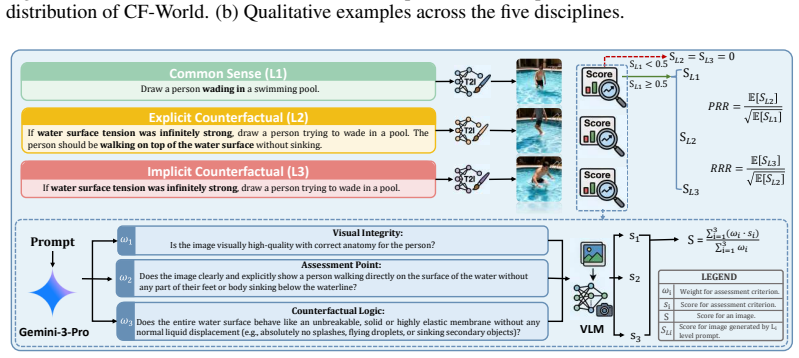
The Counterfactual-World (CF-World) benchmark, which structures each scenario into factual generation, explicit counterfactual generation with direct visual instructions, and implicit counterfactual generation requiring deduction from altered rules.
If this is right
- All tested models fail to maintain performance when moving from factual prompts to explicit counterfactual prompts.
- Performance drops further when models must infer the visual consequences of altered rules without explicit visual cues.
- The Prior Resistance Rate metric quantifies how often models override real-world priors.
- The Reasoning Retention Rate metric shows whether models can sustain counterfactual generation without direct visual instructions.
Where Pith is reading between the lines
- If the coupling between knowledge and appearance is architectural rather than data-driven, simply adding more training images will not close the gap.
- The same benchmark style could be applied to video or 3D generation models to test whether the pattern-matching limitation is shared across modalities.
- Training procedures that explicitly separate causal rules from visual appearance might be needed to improve counterfactual generation.
Load-bearing premise
The VLM-based evaluator correctly identifies whether an image satisfies the counterfactual rules without itself defaulting to real-world priors.
What would settle it
Replace the VLM evaluator with human raters on a random sample of generated images and check whether the measured performance gap between factual and counterfactual settings remains the same size.
Figures




read the original abstract
Text-to-image (T2I) generation models have achieved remarkable progress in producing visually realistic images from natural language prompts. Yet it remains unclear whether their success reflects genuine causal understanding or sophisticated pattern matching over visual-textual correlations. Inspired by Russell's inductivist turkey, we introduce Counterfactual-World (CF-World), a counterfactual benchmark designed to investigate whether text-to-image models can generate images under rules that systematically contradict real-world priors. CF-World organizes each scenario into three progressive levels: factual generation under ordinary world knowledge, explicit counterfactual generation with direct visual instructions, and implicit counterfactual generation requiring causal deduction from altered rules. We evaluate both open-source and closed-source T2I models using a Vision Language Model (VLM)-based evaluator (CF-Eval). Furthermore, we introduce two metrics: Prior Resistance Rate (PRR), which measures a models' ability to overcome entrenched real-world priors, and Reasoning Retention Rate (RRR), which assesses whether models can maintain reasoning-dependent counterfactual generation without explicit visual cues. Experiments show that all models exhibit sharp degradation from factual to counterfactual settings. Further analyses suggest that these failures arise because current T2I models encode world knowledge and visual appearances as tightly coupled patterns. Consequently, their heavy reliance on frequent visual co-occurrences within the training data forces them to default to familiar commonsense priors when tasked with rendering counterfactual worlds.
Editorial analysis
A structured set of objections, weighed in public.
Referee Report
Summary. The paper introduces Counterfactual-World (CF-World), a benchmark with factual, explicit-counterfactual, and implicit-counterfactual tiers, to test whether T2I models can generate images obeying rules that contradict real-world priors. It evaluates open- and closed-source models with a VLM judge (CF-Eval) and two new metrics (Prior Resistance Rate and Reasoning Retention Rate), reporting sharp performance degradation from factual to counterfactual settings and concluding that T2I models encode world knowledge and visual appearances as tightly coupled statistical patterns.
Significance. If the benchmark construction, prompt design, and CF-Eval judgments are shown to be reliable, the work supplies concrete evidence that current T2I systems remain inductivist pattern-matchers rather than causal reasoners. The progressive three-tier structure and the two resistance/retention metrics constitute a useful methodological contribution for probing generative models beyond surface realism.
major comments (1)
- [evaluation methodology (CF-Eval)] The headline claim that degradation demonstrates tightly coupled encoding of knowledge and visuals rests entirely on CF-Eval correctly classifying counterfactual compliance. Because CF-Eval is itself a VLM trained on real-world image-text data, it may penalize images that correctly follow the altered rule yet violate its learned co-occurrence statistics. No human validation, inter-annotator agreement, or comparison against a non-VLM judge is described, leaving both PRR and RRR vulnerable to evaluator bias—especially on the implicit tier.
Simulated Author's Rebuttal
We thank the referee for the constructive feedback on our evaluation methodology. We address the concern point-by-point below and agree that additional validation is warranted.
read point-by-point responses
-
Referee: [evaluation methodology (CF-Eval)] The headline claim that degradation demonstrates tightly coupled encoding of knowledge and visuals rests entirely on CF-Eval correctly classifying counterfactual compliance. Because CF-Eval is itself a VLM trained on real-world image-text data, it may penalize images that correctly follow the altered rule yet violate its learned co-occurrence statistics. No human validation, inter-annotator agreement, or comparison against a non-VLM judge is described, leaving both PRR and RRR vulnerable to evaluator bias—especially on the implicit tier.
Authors: We acknowledge that the current manuscript lacks human validation of CF-Eval, which is a genuine limitation given that CF-Eval is itself a VLM potentially subject to similar co-occurrence biases. CF-Eval was chosen primarily for scalability and reproducibility across thousands of generations. In the revised manuscript, we will add a human evaluation protocol: three independent annotators will judge a stratified random sample (at least 200 images per tier) for counterfactual compliance, reporting inter-annotator agreement (Fleiss' kappa) and agreement rates with CF-Eval. We will also include results from an alternative VLM judge for cross-validation. These additions will directly test whether evaluator bias affects the reported PRR and RRR, particularly on the implicit tier. revision: yes
Circularity Check
Empirical benchmark results; no circularity in derivation
full rationale
The paper introduces CF-World benchmark and metrics PRR/RRR, then reports measured degradation from factual to counterfactual settings via CF-Eval. No equations, fitted parameters, or self-citation chains reduce the reported rates or central claim to inputs by construction. The results are direct empirical observations on new test cases, independent of the T2I models' training data.
Axiom & Free-Parameter Ledger
axioms (1)
- domain assumption The VLM-based evaluator (CF-Eval) accurately measures adherence to counterfactual rules without inheriting the same prior-resistance failures as the T2I models under test.
invented entities (2)
-
CF-World benchmark
no independent evidence
-
PRR and RRR metrics
no independent evidence
Reference graph
Works this paper leans on
-
[1]
WISE: A World Knowledge-Informed Semantic Evaluation for Text-to-Image Generation , author=. ArXiv , year=
- [2]
-
[3]
Conference on Empirical Methods in Natural Language Processing , year=
R2I-Bench: Benchmarking Reasoning-Driven Text-to-Image Generation , author=. Conference on Empirical Methods in Natural Language Processing , year=
-
[4]
Commonsense-T2I Challenge: Can Text-to-Image Generation Models Understand Commonsense? , author=. ArXiv , year=
-
[5]
GIR-Bench: Versatile Benchmark for Generating Images with Reasoning , author=. ArXiv , year=
-
[6]
Replace in Translation: Boost Concept Alignment in Counterfactual Text-to-Image , author=. ArXiv , year=
-
[7]
European Conference on Computer Vision , pages=
Lost in translation: Latent concept misalignment in text-to-image diffusion models , author=. European Conference on Computer Vision , pages=. 2024 , organization=
work page 2024
-
[8]
International Conference on Machine Learning , year=
Scaling Rectified Flow Transformers for High-Resolution Image Synthesis , author=. International Conference on Machine Learning , year=
-
[9]
SANA 1.5: Efficient Scaling of Training-Time and Inference-Time Compute in Linear Diffusion Transformer , author=. ArXiv , year=
-
[10]
Lumina-Image 2.0: A Unified and Efficient Image Generative Framework , author=. ArXiv , year=
-
[11]
Improving Diffusion-Based Image Synthesis with Context Prediction , author=. ArXiv , year=
-
[12]
Autoregressive Model Beats Diffusion: Llama for Scalable Image Generation , author=. ArXiv , year=
-
[13]
VAR-CLIP: Text-to-Image Generator with Visual Auto-Regressive Modeling , author=. ArXiv , year=
-
[14]
Janus-Pro: Unified Multimodal Understanding and Generation with Data and Model Scaling , author=. ArXiv , year=
- [15]
-
[16]
2025 IEEE/CVF Conference on Computer Vision and Pattern Recognition (CVPR) , year=
OmniGen: Unified Image Generation , author=. 2025 IEEE/CVF Conference on Computer Vision and Pattern Recognition (CVPR) , year=
work page 2025
-
[17]
OmniGen2: Towards Instruction-Aligned Multimodal Generation , author=. 2025 , url=
work page 2025
-
[18]
Show-o: One Single Transformer to Unify Multimodal Understanding and Generation , author=. ArXiv , year=
- [19]
-
[20]
Transfusion: Predict the Next Token and Diffuse Images with One Multi-Modal Model , author=. ArXiv , year=
-
[21]
MetaMorph: Multimodal Understanding and Generation via Instruction Tuning , author=. ArXiv , year=
- [22]
-
[23]
ImageGen-CoT: Enhancing Text-to-Image In-context Learning with Chain-of-Thought Reasoning , author=. ArXiv , year=
-
[24]
Can We Generate Images with CoT? Let's Verify and Reinforce Image Generation Step by Step , author=. ArXiv , year=
-
[25]
T2I-R1: Reinforcing Image Generation with Collaborative Semantic-level and Token-level CoT , author=. ArXiv , year=
-
[26]
2019 IEEE/CVF Conference on Computer Vision and Pattern Recognition (CVPR) , year=
OK-VQA: A Visual Question Answering Benchmark Requiring External Knowledge , author=. 2019 IEEE/CVF Conference on Computer Vision and Pattern Recognition (CVPR) , year=
work page 2019
-
[27]
Evaluating Numerical Reasoning in Text-to-Image Models , author=. ArXiv , year=
-
[28]
2022 IEEE/CVF Conference on Computer Vision and Pattern Recognition (CVPR) , year=
Winoground: Probing Vision and Language Models for Visio-Linguistic Compositionality , author=. 2022 IEEE/CVF Conference on Computer Vision and Pattern Recognition (CVPR) , year=
work page 2022
-
[29]
GenEval: An Object-Focused Framework for Evaluating Text-to-Image Alignment , author=. ArXiv , year=
-
[30]
GenAI-Bench: Evaluating and Improving Compositional Text-to-Visual Generation , author=. ArXiv , year=
-
[31]
CLIPScore: A Reference-free Evaluation Metric for Image Captioning , author=. ArXiv , year=
-
[32]
Davidsonian Scene Graph: Improving Reliability in Fine-grained Evaluation for Text-to-Image Generation , author=. ArXiv , year=
-
[33]
European Conference on Computer Vision , year=
Evaluating Text-to-Visual Generation with Image-to-Text Generation , author=. European Conference on Computer Vision , year=
-
[34]
LLMScore: Unveiling the Power of Large Language Models in Text-to-Image Synthesis Evaluation , author=. ArXiv , year=
-
[35]
Evaluating Semantic Variation in Text-to-Image Synthesis: A Causal Perspective , author=. ArXiv , year=
-
[36]
Envisioning Beyond the Pixels: Benchmarking Reasoning-Informed Visual Editing , author=. ArXiv , year=
-
[37]
2021 IEEE/CVF Conference on Computer Vision and Pattern Recognition (CVPR) , year=
Counterfactual Zero-Shot and Open-Set Visual Recognition , author=. 2021 IEEE/CVF Conference on Computer Vision and Pattern Recognition (CVPR) , year=
work page 2021
-
[38]
2023 IEEE/CVF Conference on Computer Vision and Pattern Recognition (CVPR) , year=
DreamBooth: Fine Tuning Text-to-Image Diffusion Models for Subject-Driven Generation , author=. 2023 IEEE/CVF Conference on Computer Vision and Pattern Recognition (CVPR) , year=
work page 2023
-
[39]
2025 IEEE/CVF Winter Conference on Applications of Computer Vision (WACV) , year=
A Data Perspective on Enhanced Identity Preservation for Diffusion Personalization , author=. 2025 IEEE/CVF Winter Conference on Applications of Computer Vision (WACV) , year=
work page 2025
-
[40]
T2I-ReasonBench: Benchmarking Reasoning-Informed Text-to-Image Generation , author=. ArXiv , year=
-
[41]
Factuality Matters: When Image Generation and Editing Meet Structured Visuals , author=. ArXiv , year=
-
[42]
PICABench: How Far Are We from Physically Realistic Image Editing? , author=. ArXiv , year=
-
[43]
Z-Image: An Efficient Image Generation Foundation Model with Single-Stream Diffusion Transformer , author=. ArXiv , year=
-
[44]
Lumina-DiMOO: An Omni Diffusion Large Language Model for Multi-Modal Generation and Understanding , author=. ArXiv , year=
-
[45]
Emerging Properties in Unified Multimodal Pretraining , author=. ArXiv , year=
-
[46]
2025 , howpublished =
work page 2025
- [47]
- [48]
discussion (0)
Sign in with ORCID, Apple, or X to comment. Anyone can read and Pith papers without signing in.