PatternGSL: A Structured Specification Language for Template-Free and Simulation-Ready 3D Garments
Pith reviewed 2026-07-03 22:52 UTC · model grok-4.3
The pith
PatternGSL is a template-free specification language for complete sewing patterns that a vision-language model predicts from one image and decodes into simulation-ready garments.
A machine-rendered reading of the paper's core claim, the machinery that carries it, and where it could break.
Core claim
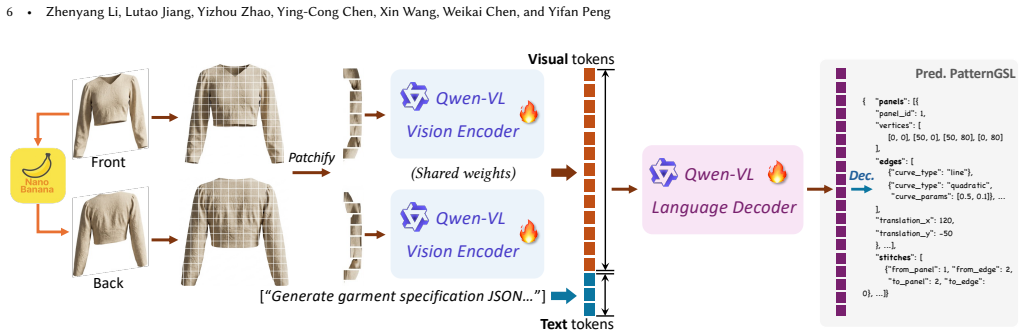
PatternGSL is a structured garment representation in the form of a template-free and learnable specification language that encodes complete sewing patterns, including panel boundaries, parameterized seams, and explicit stitch topology, in a compact and standardized form. A vision-language framework predicts PatternGSL specifications directly from a single image and decodes them into garments using lightweight deterministic validity handling, without optimization-based refinement or manual cleanup, enabled by the PatternGSLData dataset of 300K samples with complete sewing pattern annotations.
What carries the argument
PatternGSL specification language encoding panel boundaries, parameterized seams, and explicit stitch topology in a compact standardized form for template-free sewing patterns.
If this is right
- Enables direct supervised training of vision-language models on image-to-sewing-pattern pairs at 300K scale.
- Produces garments with explicit sewing structure that support reliable cloth simulation.
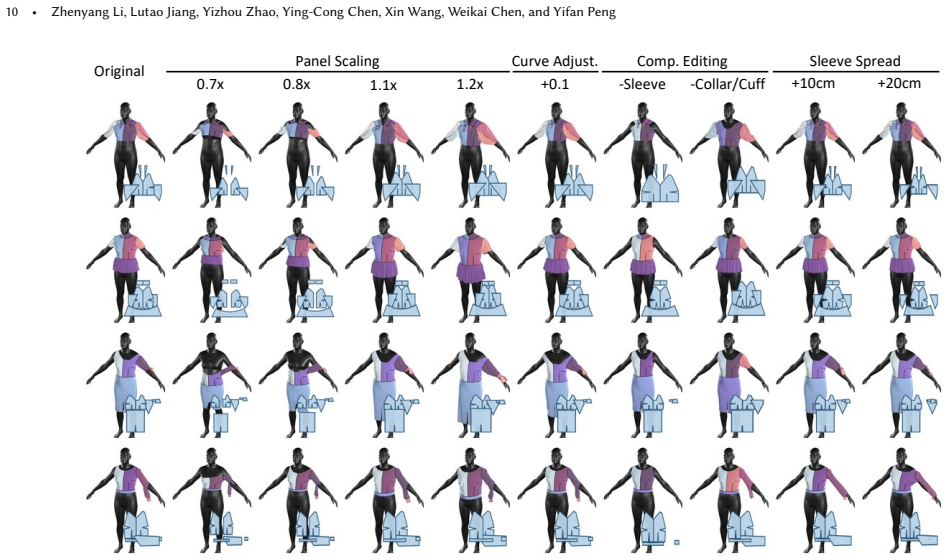
- Allows pattern-level editing through the same deterministic decoding pipeline used for reconstruction.
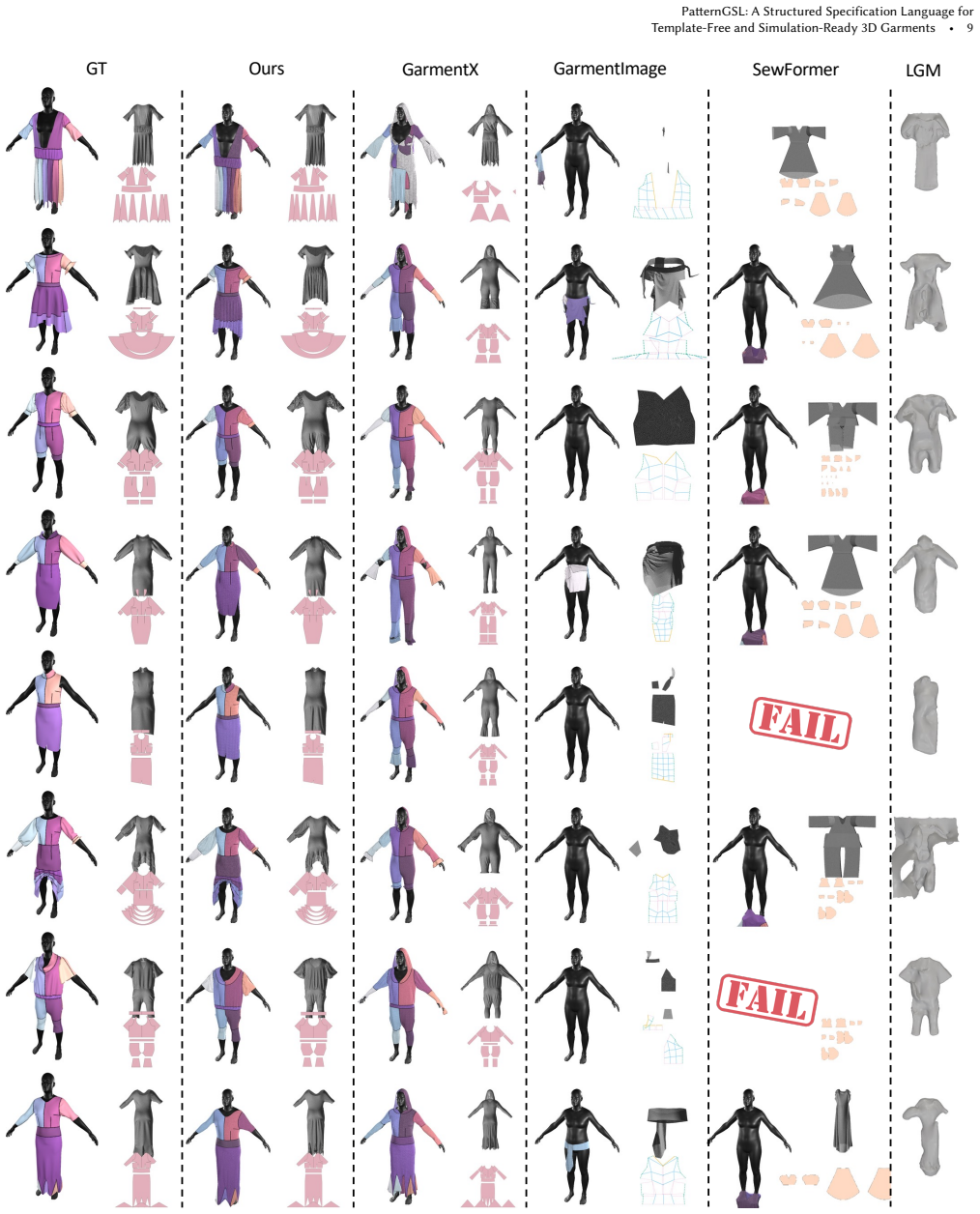
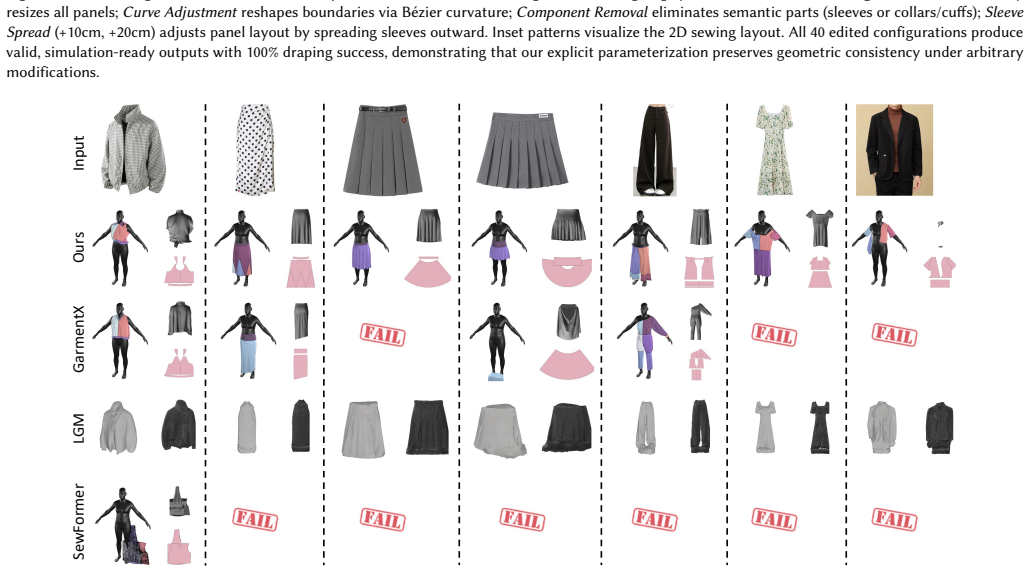
- Achieves improved pattern accuracy compared to prior template-free and template-based baselines.
Where Pith is reading between the lines
- The same deterministic decoding could be tested on multi-view or video inputs to enforce consistency across frames.
- PatternGSL might serve as a representation for other assembly-structured objects such as furniture or mechanical parts.
- Extending the dataset with real photographed garments rather than synthetic ones could expose gaps in topology coverage.
Load-bearing premise
The deterministic validity handling rules are sufficient to produce valid simulation-ready patterns for arbitrary inputs without optimization or manual cleanup, and the 300K dataset annotations accurately capture real sewing topology.
What would settle it
Test whether the decoded patterns from diverse real-world garment images frequently produce intersecting panels, invalid seams, or simulation failures that require manual intervention or further optimization.
Figures





read the original abstract
Reconstructing realistic, physically plausible garments from a single image remains a fundamental challenge. Template-free methods capture surface geometry but lack explicit sewing structure for simulation; while programmatic systems are simulation-ready but constrained by predefined templates. This reveals a fundamental representation gap between geometric reconstruction and structured garment construction. We present PatternGSL, a structured garment representation in the form of a template-free and learnable specification language that encodes complete sewing patterns, including panel boundaries, parameterized seams, and explicit stitch topology, in a compact and standardized form. PatternGSL preserves the physical rigor of pattern-based models while removing template dependence, elevating sewing structure as a first-class target for generative modeling. We further propose a vision-language framework that predicts PatternGSL specifications directly from a single image and decodes them into garments using lightweight deterministic validity handling, without optimization-based refinement or manual cleanup. In addition, we introduce PatternGSLData, the first large-scale image-to-GSL paired dataset comprising 300K samples with complete sewing pattern annotations, enabling supervised VLM training for structured garment reconstruction. Experiments demonstrate improved pattern accuracy over prior baselines, explicit sewing-structure recovery, reliable cloth simulation, and pattern-level editing through the same deterministic decoding pipeline. Code and data-processing scripts will be released at https://lagrangeli.github.io/PatternGSL/.
Editorial analysis
A structured set of objections, weighed in public.
Referee Report
Summary. The paper introduces PatternGSL as a template-free, learnable specification language that encodes complete sewing patterns (panel boundaries, parameterized seams, explicit stitch topology) in a compact standardized form. It presents a vision-language framework that predicts PatternGSL directly from a single image and decodes to garments via lightweight deterministic validity handling without optimization or manual cleanup. A new 300K image-to-GSL paired dataset (PatternGSLData) is introduced to enable supervised training, with experiments claiming improved pattern accuracy, explicit sewing-structure recovery, reliable cloth simulation, and pattern-level editing.
Significance. If the claims hold, the work would be significant for bridging the gap between template-free geometric reconstruction and simulation-ready structured garments in computer vision and graphics. Elevating sewing topology as a first-class generative target, combined with the large-scale dataset and deterministic decoding, could support more practical downstream applications in animation, virtual clothing, and design without template constraints or post-processing. The planned release of code and data-processing scripts would strengthen reproducibility.
major comments (2)
- [Abstract] Abstract: the central claim that 'lightweight deterministic validity handling' always yields valid, simulation-ready patterns for arbitrary VLM outputs (without optimization or manual cleanup) is load-bearing for the template-free property, yet no explicit description of the rules, coverage of topological edge cases, or failure-mode analysis is provided; this directly matches the weakest assumption that the rules suffice for any prediction error.
- [Abstract] Abstract / Experiments section: the statements of 'improved pattern accuracy over prior baselines' and 'reliable cloth simulation' are presented without any quantitative metrics, error analysis, baseline comparisons, or dataset split details; given that the abstract supplies no numbers, it is impossible to assess whether the 300K annotations accurately capture real sewing topology or whether the deterministic decoder truly eliminates the need for refinement.
minor comments (1)
- The abstract mentions 'parameterized seams' and 'explicit stitch topology' but does not define the grammar or compactness properties of PatternGSL; a short formal definition or example in the main text would improve clarity.
Simulated Author's Rebuttal
We thank the referee for the constructive feedback. We agree that the abstract requires strengthening to better support its claims and will revise accordingly. Point-by-point responses to the major comments are provided below.
read point-by-point responses
-
Referee: [Abstract] Abstract: the central claim that 'lightweight deterministic validity handling' always yields valid, simulation-ready patterns for arbitrary VLM outputs (without optimization or manual cleanup) is load-bearing for the template-free property, yet no explicit description of the rules, coverage of topological edge cases, or failure-mode analysis is provided; this directly matches the weakest assumption that the rules suffice for any prediction error.
Authors: We acknowledge that the abstract does not explicitly describe the validity rules or provide failure-mode analysis. The full manuscript details the deterministic checks (panel closure, seam consistency, and stitch topology) in Section 3.3. To address the concern, we will add a high-level summary of the rules to the abstract and include a new subsection in the experiments with coverage of topological edge cases and observed failure rates. revision: yes
-
Referee: [Abstract] Abstract / Experiments section: the statements of 'improved pattern accuracy over prior baselines' and 'reliable cloth simulation' are presented without any quantitative metrics, error analysis, baseline comparisons, or dataset split details; given that the abstract supplies no numbers, it is impossible to assess whether the 300K annotations accurately capture real sewing topology or whether the deterministic decoder truly eliminates the need for refinement.
Authors: The abstract summarizes outcomes without numbers for brevity. The experiments section reports quantitative results, including pattern accuracy metrics versus baselines, simulation success rates, error analysis, and dataset splits. We will incorporate key quantitative figures and references to tables/splits into the revised abstract to make these claims verifiable from the abstract alone. revision: yes
Circularity Check
No circularity detected in derivation chain
full rationale
The paper introduces PatternGSL as a new structured specification language and a VLM-based prediction framework with deterministic decoding, supported by a new 300K dataset. No equations, derivations, or first-principles results are presented that reduce any claimed prediction or result to fitted parameters or self-referential definitions by construction. Central claims rest on empirical performance, dataset annotation, and deterministic post-processing rules rather than any of the enumerated circular patterns. The work is self-contained against external benchmarks with no load-bearing self-citation chains or ansatz smuggling.
Axiom & Free-Parameter Ledger
axioms (1)
- domain assumption Standard geometric and topological validity rules for sewing patterns suffice for deterministic correction
invented entities (1)
-
PatternGSL specification language
no independent evidence
Reference graph
Works this paper leans on
-
[1]
Advances in Neural Information Processing Systems , volume=
Denoising diffusion probabilistic models , author=. Advances in Neural Information Processing Systems , volume=
-
[2]
International Conference on Learning Representations , year=
Denoising diffusion implicit models , author=. International Conference on Learning Representations , year=
-
[3]
International Conference on Learning Representations , year=
Score-based generative modeling through stochastic differential equations , author=. International Conference on Learning Representations , year=
-
[4]
NeurIPS 2021 Workshop on Deep Generative Models and Downstream Applications , year=
Classifier-free diffusion guidance , author=. NeurIPS 2021 Workshop on Deep Generative Models and Downstream Applications , year=
work page 2021
-
[5]
Proceedings of the IEEE/CVF conference on computer vision and pattern recognition , pages=
High-resolution image synthesis with latent diffusion models , author=. Proceedings of the IEEE/CVF conference on computer vision and pattern recognition , pages=
-
[6]
Advances in Neural Information Processing Systems , volume=
Photorealistic Text-to-Image Diffusion Models with Deep Language Understanding , author=. Advances in Neural Information Processing Systems , volume=
-
[7]
Loper, Matthew and Mahmood, Naureen and Romero, Javier and Pons-Moll, Gerard and Black, Michael J , journal=. 2015 , doi=
work page 2015
-
[8]
Proceedings of the IEEE/CVF conference on computer vision and pattern recognition , pages=
Expressive body capture: 3d hands, face, and body from a single image , author=. Proceedings of the IEEE/CVF conference on computer vision and pattern recognition , pages=
-
[9]
Proceedings of the IEEE/CVF Conference on Computer Vision and Pattern Recognition , pages=
Ghum & ghuml: Generative 3d human shape and articulated pose models , author=. Proceedings of the IEEE/CVF Conference on Computer Vision and Pattern Recognition , pages=
-
[10]
ACM Transactions on Graphics (ToG) , volume=
Drape: Dressing any person , author=. ACM Transactions on Graphics (ToG) , volume=. 2012 , publisher=
work page 2012
-
[11]
ACM Transactions on Graphics (ToG) , volume=
ClothCap: Seamless 4D clothing capture and retargeting , author=. ACM Transactions on Graphics (ToG) , volume=. 2017 , publisher=
work page 2017
-
[12]
Computer Graphics Forum , volume=
Learning-based animation of clothing for virtual try-on , author=. Computer Graphics Forum , volume=. 2019 , doi=
work page 2019
-
[13]
Proceedings of the IEEE/CVF Conference on Computer Vision and Pattern Recognition , pages=
Learning to dress 3d people in generative clothing , author=. Proceedings of the IEEE/CVF Conference on Computer Vision and Pattern Recognition , pages=
-
[14]
Computer Graphics Forum , volume=
Fully convolutional graph neural networks for parametric virtual try-on , author=. Computer Graphics Forum , volume=. 2020 , doi=
work page 2020
-
[15]
Proceedings of the IEEE/CVF international conference on computer vision , pages=
Pifu: Pixel-aligned implicit function for high-resolution clothed human digitization , author=. Proceedings of the IEEE/CVF international conference on computer vision , pages=
-
[16]
Proceedings of the IEEE/CVF conference on computer vision and pattern recognition , pages=
Pifuhd: Multi-level pixel-aligned implicit function for high-resolution 3d human digitization , author=. Proceedings of the IEEE/CVF conference on computer vision and pattern recognition , pages=
-
[17]
Proceedings of the IEEE/CVF conference on computer vision and pattern recognition , pages=
Smplicit: Topology-aware generative model for clothed people , author=. Proceedings of the IEEE/CVF conference on computer vision and pattern recognition , pages=
-
[18]
Proceedings of the IEEE/CVF international conference on computer vision , pages=
Arch++: Animation-ready clothed human reconstruction revisited , author=. Proceedings of the IEEE/CVF international conference on computer vision , pages=
-
[19]
2022 IEEE/CVF Conference on Computer Vision and Pattern Recognition (CVPR) , pages=
Icon: Implicit clothed humans obtained from normals , author=. 2022 IEEE/CVF Conference on Computer Vision and Pattern Recognition (CVPR) , pages=. 2022 , organization=
work page 2022
-
[20]
Proceedings of the IEEE/CVF international conference on computer vision , pages=
Multi-garment net: Learning to dress 3d people from images , author=. Proceedings of the IEEE/CVF international conference on computer vision , pages=
-
[21]
European Conference on Computer Vision , pages=
Bcnet: Learning body and cloth shape from a single image , author=. European Conference on Computer Vision , pages=. 2020 , organization=
work page 2020
-
[22]
European Conference on Computer Vision , pages=
Deep fashion3d: A dataset and benchmark for 3d garment reconstruction from single images , author=. European Conference on Computer Vision , pages=. 2020 , organization=
work page 2020
-
[23]
Proceedings of the IEEE/CVF conference on computer vision and pattern recognition , pages=
Deepsdf: Learning continuous signed distance functions for shape representation , author=. Proceedings of the IEEE/CVF conference on computer vision and pattern recognition , pages=
-
[24]
Applied Intelligence , volume=
ClotheDreamer: Text-guided garment generation with 3D gaussians , author=. Applied Intelligence , volume=. 2025 , doi=
work page 2025
-
[25]
European Conference on Computer Vision , pages=
Wordrobe: Text-guided generation of textured 3d garments , author=. European Conference on Computer Vision , pages=. 2024 , organization=
work page 2024
-
[26]
Huang, Yangyi and Yi, Hongwei and Xiu, Yuliang and Liao, Tingting and Tang, Jiaxiang and Cai, Deng and Thies, Justus , booktitle=. 2024 , doi=
work page 2024
-
[27]
Luo, Zhongjin and Liu, Haolin and Li, Chenghong and Du, Wanghao and Jin, Zirong and Sun, Wanhu and Nie, Yinyu and Chen, Weikai and Han, Xiaoguang , journal=. 2024 , doi=
work page 2024
-
[28]
ACM Transactions on Graphics (TOG) , volume=
Neuraltailor: Reconstructing sewing pattern structures from 3d point clouds of garments , author=. ACM Transactions on Graphics (TOG) , volume=. 2022 , publisher=
work page 2022
-
[29]
ACM Transactions on Graphics (TOG) , volume=
Towards garment sewing pattern reconstruction from a single image , author=. ACM Transactions on Graphics (TOG) , volume=. 2023 , publisher=
work page 2023
- [30]
-
[31]
Tatsukawa, Yuki and Qi, Anran and Shen, I-Chao and Igarashi, Takeo , booktitle=. 2025 , doi=
work page 2025
-
[32]
arXiv preprint arXiv:2504.20409 , year=
GarmentX: Autoregressive Parametric Representations for High-Fidelity 3D Garment Generation , author=. arXiv preprint arXiv:2504.20409 , year=
-
[33]
Korosteleva, Maria and Kesdogan, Timur Levent and Kemper, Fabian and Wenninger, Stephan and Koller, Jasmin and Zhang, Yuhan and Botsch, Mario and Sorkine-Hornung, Olga , booktitle=. 2024 , doi=
work page 2024
-
[34]
ACM Transactions on Graphics (TOG) , volume=
Dress-1-to-3: Single Image to Simulation-Ready 3D Outfit with Diffusion Prior and Differentiable Physics , author=. ACM Transactions on Graphics (TOG) , volume=. 2025 , doi=
work page 2025
-
[35]
Proceedings of the Thirty-Fourth International Joint Conference on Artificial Intelligence,
GarmentDiffusion: 3D Garment Sewing Pattern Generation with Multimodal Diffusion Transformers , author=. Proceedings of the Thirty-Fourth International Joint Conference on Artificial Intelligence,. 2025 , doi=
work page 2025
-
[36]
DreamFusion: Text-to-3D using 2D Diffusion
Dreamfusion: Text-to-3d using 2d diffusion , author=. arXiv preprint arXiv:2209.14988 , year=
work page internal anchor Pith review Pith/arXiv arXiv
-
[37]
Proceedings of the IEEE/CVF conference on computer vision and pattern recognition , pages=
Magic3d: High-resolution text-to-3d content creation , author=. Proceedings of the IEEE/CVF conference on computer vision and pattern recognition , pages=
-
[38]
Advances in neural information processing systems , volume=
Prolificdreamer: High-fidelity and diverse text-to-3d generation with variational score distillation , author=. Advances in neural information processing systems , volume=
-
[39]
Proceedings of the IEEE/CVF international conference on computer vision , pages=
Zero-1-to-3: Zero-shot one image to 3d object , author=. Proceedings of the IEEE/CVF international conference on computer vision , pages=
-
[40]
Shi, Yichun and Wang, Peng and Ye, Jianglong and Mai, Long and Li, Kejie and Yang, Xiao , booktitle=
-
[41]
European Conference on Computer Vision , pages=
Lgm: Large multi-view gaussian model for high-resolution 3d content creation , author=. European Conference on Computer Vision , pages=. 2024 , organization=
work page 2024
-
[42]
Proceedings of the IEEE/CVF conference on computer vision and pattern recognition , pages=
Wonder3d: Single image to 3d using cross-domain diffusion , author=. Proceedings of the IEEE/CVF conference on computer vision and pattern recognition , pages=
-
[43]
Proceedings of the IEEE/CVF conference on computer vision and pattern recognition , pages=
Diffusion probabilistic models for 3d point cloud generation , author=. Proceedings of the IEEE/CVF conference on computer vision and pattern recognition , pages=
-
[44]
Proceedings of the IEEE/CVF international conference on computer vision , pages=
3d shape generation and completion through point-voxel diffusion , author=. Proceedings of the IEEE/CVF international conference on computer vision , pages=
-
[45]
Point-E: A System for Generating 3D Point Clouds from Complex Prompts
Point-e: A system for generating 3d point clouds from complex prompts , author=. arXiv preprint arXiv:2212.08751 , year=
work page internal anchor Pith review Pith/arXiv arXiv
-
[46]
Advances in neural information processing systems , volume=
Get3d: A generative model of high quality 3d textured shapes learned from images , author=. Advances in neural information processing systems , volume=
-
[47]
Proceedings of the IEEE/CVF conference on computer vision and pattern recognition , pages=
Meshgpt: Generating triangle meshes with decoder-only transformers , author=. Proceedings of the IEEE/CVF conference on computer vision and pattern recognition , pages=
-
[48]
International conference on machine learning , pages=
Equivariant diffusion for molecule generation in 3d , author=. International conference on machine learning , pages=. 2022 , organization=
work page 2022
-
[49]
Proceedings of the IEEE/CVF Conference on Computer Vision and Pattern Recognition , pages=
Layoutdm: Discrete diffusion model for controllable layout generation , author=. Proceedings of the IEEE/CVF Conference on Computer Vision and Pattern Recognition , pages=
-
[50]
Proceedings of the IEEE/CVF Conference on Computer Vision and Pattern Recognition , pages=
Layoutdm: Transformer-based diffusion model for layout generation , author=. Proceedings of the IEEE/CVF Conference on Computer Vision and Pattern Recognition , pages=
-
[51]
arXiv preprint arXiv:2211.04604 , year=
Structdiffusion: Language-guided creation of physically-valid structures using unseen objects , author=. arXiv preprint arXiv:2211.04604 , year=
-
[52]
Human motion diffusion model , author=. arXiv preprint arXiv:2209.14916 , year=
work page internal anchor Pith review Pith/arXiv arXiv
-
[53]
Proceedings of the IEEE/CVF international conference on computer vision , pages=
Physdiff: Physics-guided human motion diffusion model , author=. Proceedings of the IEEE/CVF international conference on computer vision , pages=
-
[54]
ACM transactions on graphics (TOG) , volume=
Adaptive anisotropic remeshing for cloth simulation , author=. ACM transactions on graphics (TOG) , volume=. 2012 , publisher=
work page 2012
-
[55]
ACM Transactions on Graphics (TOG) , volume=
I-Cloth: Incremental collision handling for GPU-based interactive cloth simulation , author=. ACM Transactions on Graphics (TOG) , volume=. 2018 , publisher=
work page 2018
-
[56]
ACM Transactions on Graphics (TOG) , volume=
P-cloth: interactive complex cloth simulation on multi-GPU systems using dynamic matrix assembly and pipelined implicit integrators , author=. ACM Transactions on Graphics (TOG) , volume=. 2020 , publisher=
work page 2020
-
[57]
Advances in neural information processing systems , volume=
Differentiable cloth simulation for inverse problems , author=. Advances in neural information processing systems , volume=
-
[58]
ACM Transactions on Graphics (TOG) , volume=
Diffcloth: Differentiable cloth simulation with dry frictional contact , author=. ACM Transactions on Graphics (TOG) , volume=. 2022 , publisher=
work page 2022
-
[59]
ACM Transactions on Graphics (TOG) , volume=
Rule-free sewing pattern adjustment with precision and efficiency , author=. ACM Transactions on Graphics (TOG) , volume=. 2018 , publisher=
work page 2018
-
[60]
ACM Transactions on Graphics (TOG) , volume=
Neural cloth simulation , author=. ACM Transactions on Graphics (TOG) , volume=. 2022 , publisher=
work page 2022
-
[61]
Proceedings of the IEEE/CVF conference on computer vision and pattern recognition , pages=
Hood: Hierarchical graphs for generalized modelling of clothing dynamics , author=. Proceedings of the IEEE/CVF conference on computer vision and pattern recognition , pages=
-
[62]
Proceedings of the IEEE conference on computer vision and pattern recognition , pages=
Viton: An image-based virtual try-on network , author=. Proceedings of the IEEE conference on computer vision and pattern recognition , pages=
-
[63]
Proceedings of the European conference on computer vision (ECCV) , pages=
Toward characteristic-preserving image-based virtual try-on network , author=. Proceedings of the European conference on computer vision (ECCV) , pages=
-
[64]
Proceedings of the IEEE/CVF conference on computer vision and pattern recognition , pages=
Viton-hd: High-resolution virtual try-on via misalignment-aware normalization , author=. Proceedings of the IEEE/CVF conference on computer vision and pattern recognition , pages=
-
[65]
Computer aided geometric design , pages=
A class of local interpolating splines , author=. Computer aided geometric design , pages=. 1974 , publisher=
work page 1974
-
[66]
International Conference on Medical image computing and computer-assisted intervention , pages=
U-net: Convolutional networks for biomedical image segmentation , author=. International Conference on Medical image computing and computer-assisted intervention , pages=. 2015 , organization=
work page 2015
-
[67]
Proceedings of the IEEE international conference on computer vision , pages=
Focal loss for dense object detection , author=. Proceedings of the IEEE international conference on computer vision , pages=
-
[68]
Proceedings of the IEEE conference on computer vision and pattern recognition , pages=
A point set generation network for 3d object reconstruction from a single image , author=. Proceedings of the IEEE conference on computer vision and pattern recognition , pages=
-
[69]
Proceedings of the 9th International Conference on Motion in Games , pages=
XPBD: position-based simulation of compliant constrained dynamics , author=. Proceedings of the 9th International Conference on Motion in Games , pages=
-
[70]
Warp: A High-Performance Python Framework for GPU Simulation and Graphics , author=. 2022 , howpublished=
work page 2022
-
[71]
NVIDIA Warp: A Python Framework for High Performance GPU Simulation and Graphics , author=. 2022 , url=
work page 2022
-
[72]
Decoupled Weight Decay Regularization
Decoupled weight decay regularization , author=. arXiv preprint arXiv:1711.05101 , year=
work page internal anchor Pith review Pith/arXiv arXiv
-
[73]
SGDR: Stochastic Gradient Descent with Warm Restarts
Sgdr: Stochastic gradient descent with warm restarts , author=. arXiv preprint arXiv:1608.03983 , year=
work page internal anchor Pith review Pith/arXiv arXiv
-
[74]
International conference on machine learning , pages=
Batch normalization: Accelerating deep network training by reducing internal covariate shift , author=. International conference on machine learning , pages=. 2015 , organization=
work page 2015
-
[75]
Adam: A Method for Stochastic Optimization
Adam: A method for stochastic optimization , author=. arXiv preprint arXiv:1412.6980 , year=
work page internal anchor Pith review Pith/arXiv arXiv
-
[76]
Proceedings of the IEEE international conference on computer vision , pages=
Fast r-cnn , author=. Proceedings of the IEEE international conference on computer vision , pages=
-
[77]
Proceedings of the IEEE conference on computer vision and pattern recognition , pages=
Deep residual learning for image recognition , author=. Proceedings of the IEEE conference on computer vision and pattern recognition , pages=
-
[78]
Evaluating Large Language Models Trained on Code
Evaluating large language models trained on code , author=. arXiv preprint arXiv:2107.03374 , year=
work page internal anchor Pith review Pith/arXiv arXiv
-
[79]
arXiv preprint arXiv:2103.16564 , year=
Grounding physical concepts of objects and events through dynamic visual reasoning , author=. arXiv preprint arXiv:2103.16564 , year=
-
[80]
Qwen-VL: A Versatile Vision-Language Model for Understanding, Localization, Text Reading, and Beyond
Qwen-VL: A Versatile Vision-Language Model for Understanding, Localization, Text Reading, and Beyond , author=. arXiv preprint arXiv:2308.12966 , year=
work page internal anchor Pith review Pith/arXiv arXiv
discussion (0)
Sign in with ORCID, Apple, or X to comment. Anyone can read and Pith papers without signing in.