Quantum-enabled active matter at the atomic scale
Pith reviewed 2026-06-25 23:46 UTC · model grok-4.3
The pith
Individual cesium atoms extract energy from a rubidium bath via quantum spin exchange and convert it into active motion.
A machine-rendered reading of the paper's core claim, the machinery that carries it, and where it could break.
Core claim
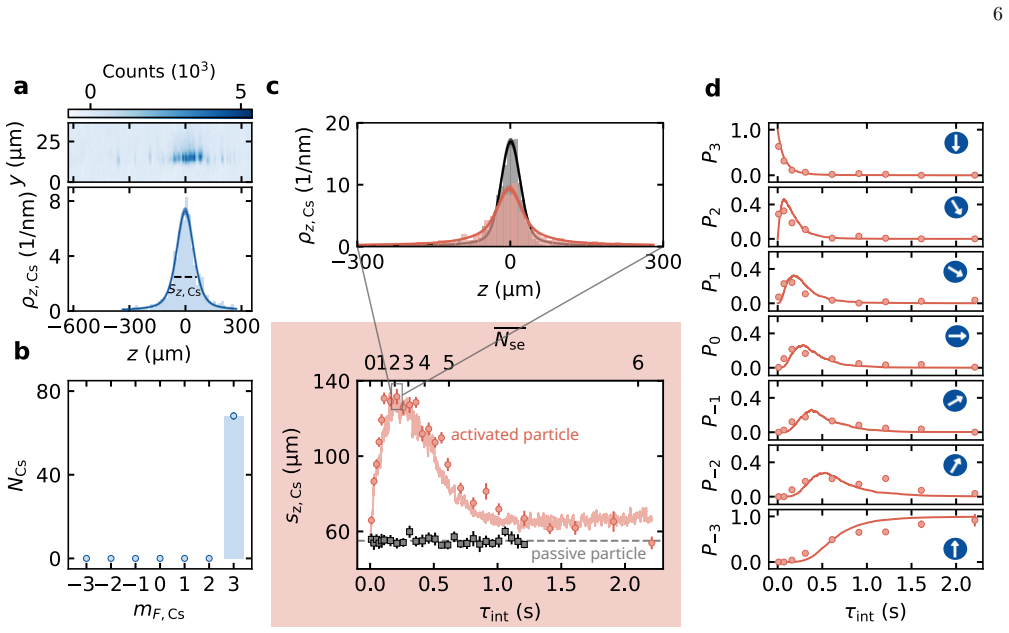
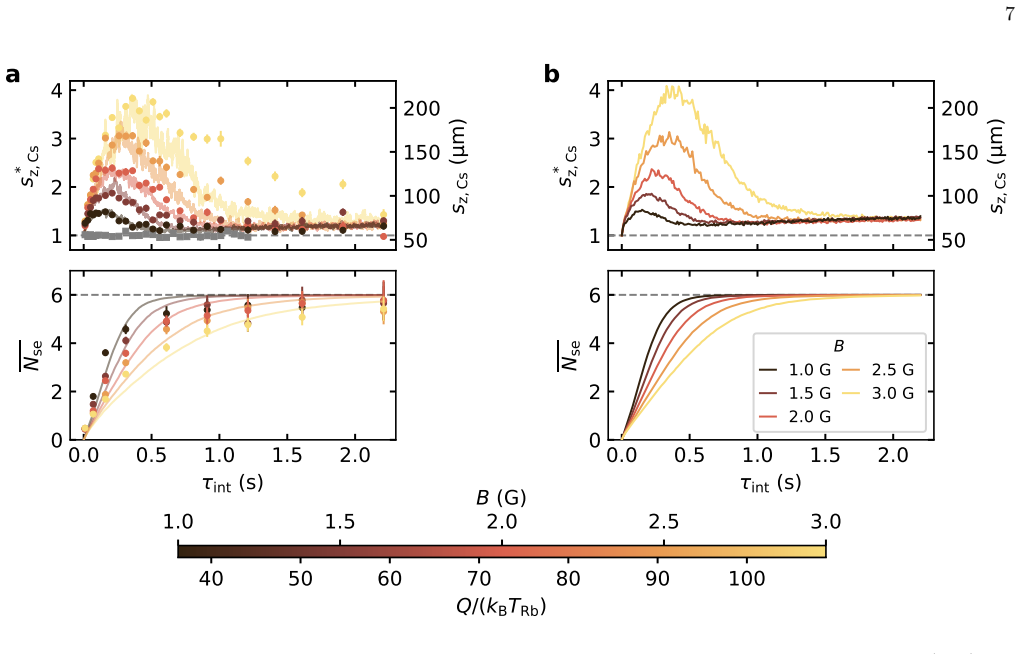
Individual Cs-133 atoms confined in an optical dipole trap extract energy from an ultracold bath of Rb-87 atoms via quantum-mechanical spin interactions and convert it into active motion. The resulting dynamics are quantitatively reproduced by a parameter-free active Langevin model derived from kinetic theory, supported by event-driven Monte Carlo collision simulations. The microscopic origin of the activity is identified as quantum spin exchange, which transfers discrete internal spin energy into kinetic motion.
What carries the argument
Quantum spin exchange between individual Cs and Rb atoms, which converts discrete internal spin energy into center-of-mass kinetic motion.
If this is right
- Active matter exists at the single-atom scale with quantum mechanics as the energy-conversion mechanism.
- A parameter-free Langevin description derived from kinetic theory suffices to predict the trajectories.
- Quantum spin exchange supplies a microscopic channel that links internal-state energy to external motion.
- The setup opens quantitative study of mesoscopic non-equilibrium thermodynamics driven by discrete quantum events.
Where Pith is reading between the lines
- Controlling the initial spin populations could allow engineered trajectories or directed transport without external fields.
- The same spin-exchange mechanism might be tested in other atomic pairs or in optical lattices to vary dimensionality.
- Time-resolved spin-state measurements correlated with velocity changes would directly map energy quanta to motion quanta.
Load-bearing premise
The observed atomic motion arises specifically from quantum spin exchange rather than other heating or scattering channels.
What would settle it
Prepare the atoms in hyperfine states that forbid spin exchange and check whether the active motion disappears while other scattering channels remain open.
Figures



read the original abstract
Active matter comprises particles that extract energy from their local environment and convert it into motion. Although active particles have been miniaturized down to the nanoscale, realizing activity at the fundamentally smaller scale of individual atoms remains an open challenge, where quantum effects become increasingly relevant. Here, we experimentally demonstrate that individual Cs-133 atoms confined in an optical dipole trap extract energy from an ultracold bath of Rb-87 atoms via quantum-mechanical spin interactions and convert it into active motion. We quantitatively reproduce the resulting dynamics using a parameter-free active Langevin model derived from kinetic theory and support it with event-driven Monte Carlo collision simulations. The microscopic origin of activity is identified as quantum spin exchange, which transfers discrete internal spin energy into kinetic motion. Our work establishes a quantum-enabled route to active matter at the fundamental size limit of single atoms and opens perspectives for exploring the interplay of activity, quantum physics, and mesoscopic non-equilibrium thermodynamics.
Editorial analysis
A structured set of objections, weighed in public.
Referee Report
Summary. The manuscript claims to experimentally demonstrate that individual Cs-133 atoms in an optical dipole trap extract energy from an ultracold Rb-87 bath via quantum-mechanical spin interactions and convert it into active motion. The resulting dynamics are quantitatively reproduced by a parameter-free active Langevin model derived from kinetic theory and supported by event-driven Monte Carlo collision simulations. The microscopic origin of the activity is identified as quantum spin exchange transferring discrete internal spin energy into kinetic motion.
Significance. If the central claims hold, the work would establish a quantum-enabled route to active matter at the single-atom scale and open perspectives on the interplay between activity, quantum physics, and mesoscopic non-equilibrium thermodynamics. The parameter-free derivation from kinetic theory and the use of Monte Carlo simulations would constitute notable strengths if the zero-parameter status and quantitative match to data are explicitly verified.
major comments (2)
- [Abstract] Abstract: the claim of quantitative agreement with a 'parameter-free' active Langevin model is presented without any figures, error bars, data-selection criteria, or explicit verification that the model contains zero fitted parameters; this prevents confirmation that the prediction does not implicitly depend on quantities fitted to the same experiment.
- [Abstract] Abstract/Results: no controls are described to isolate quantum spin exchange as the dominant driver (e.g., varying hyperfine states, magnetic fields, or laser detunings to suppress vs. enable exchange while holding other scattering rates fixed). Alternative channels such as residual photon scattering or elastic momentum transfer could produce similar kinetics, leaving the microscopic identification unsecured.
minor comments (1)
- [Abstract] Abstract: the Monte Carlo simulations are cited as support but without explicit comparison metrics or statements showing that only the spin-exchange term reproduces the measured statistics.
Simulated Author's Rebuttal
We thank the referee for the careful reading and constructive comments. We address each major comment below.
read point-by-point responses
-
Referee: [Abstract] Abstract: the claim of quantitative agreement with a 'parameter-free' active Langevin model is presented without any figures, error bars, data-selection criteria, or explicit verification that the model contains zero fitted parameters; this prevents confirmation that the prediction does not implicitly depend on quantities fitted to the same experiment.
Authors: The abstract is a concise summary and does not include figures or detailed verification, which is standard. The full manuscript (Section III, Figs. 2-4, and Methods) derives the active Langevin model from kinetic theory with explicitly zero fitted parameters; all inputs are taken from independent measurements or literature values. Error bars, data-selection criteria, and the quantitative match are shown in the main text. We will revise the abstract to reference this verification explicitly. revision: partial
-
Referee: [Abstract] Abstract/Results: no controls are described to isolate quantum spin exchange as the dominant driver (e.g., varying hyperfine states, magnetic fields, or laser detunings to suppress vs. enable exchange while holding other scattering rates fixed). Alternative channels such as residual photon scattering or elastic momentum transfer could produce similar kinetics, leaving the microscopic identification unsecured.
Authors: The identification rests on the observed energy transfer precisely matching the Rb hyperfine splitting (not elastic momentum transfer) and on Monte Carlo simulations reproducing the data only when the spin-exchange channel is included. We will add a discussion paragraph in the revised manuscript explicitly ruling out alternative channels using the existing quantitative match and simulation results. Explicit experimental controls of the suggested type were not performed. revision: partial
Circularity Check
No significant circularity detected
full rationale
The paper presents an experimental demonstration of Cs atoms gaining active motion from a Rb bath via spin exchange, supported by a parameter-free active Langevin model derived from kinetic theory and Monte Carlo simulations. No load-bearing derivation step reduces by construction to a fitted input, self-citation chain, or self-definitional loop; the model is explicitly positioned as independently derived from external kinetic theory without adjustable parameters fitted to the target data. The identification of spin exchange as the microscopic driver rests on experimental controls and simulation comparisons rather than tautological renaming or imported uniqueness theorems. This is the normal case of a self-contained experimental claim with external theoretical grounding.
Axiom & Free-Parameter Ledger
axioms (1)
- domain assumption Kinetic theory accurately describes the spin-exchange collision rates between Cs and Rb in the ultracold regime
Forward citations
Cited by 1 Pith paper
-
Self-propulsion of a polaron with an oscillating coupling to its quantum bath
A polaron with periodically oscillating coupling to a quantum bath develops negative drag and self-propels above a critical modulation frequency.
Reference graph
Works this paper leans on
-
[1]
In the first step, we perform an all-optical preparation of the thermal Rb cloud
Experimental sequence and observables The initial preparation of the two atomic samples is carried out sequentially in spatially separated regions. In the first step, we perform an all-optical preparation of the thermal Rb cloud. This stage consists of a laser-cooling step followed by evaporative cooling in an anisotropic, crossed optical dipole trap (ODT...
-
[2]
We choose a right-hand coordinate system which is oriented in such a way that gravity acts along thex-direction
Optical dipole trap model The ODT potential of our experiment is generated by two crossed laser beams at a wavelength of 1064 nm. We choose a right-hand coordinate system which is oriented in such a way that gravity acts along thex-direction. One laser beam is traveling along thez-direction and the second one is traveling along thex-direction. We employ a...
-
[3]
Importantly, the Cs-Cs interaction is negligible due to the extremely low Cs density
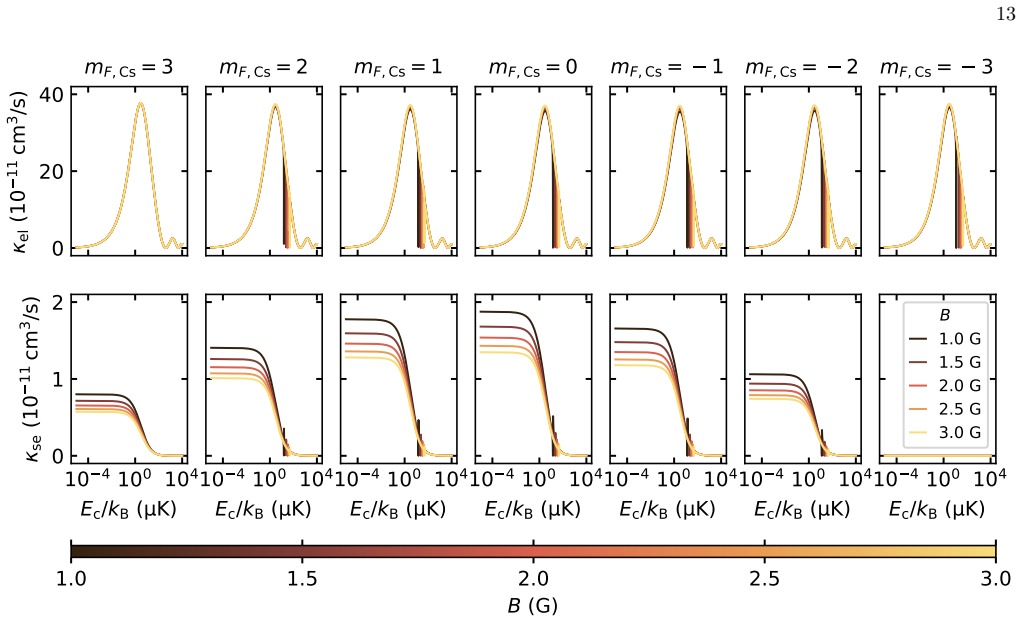
Scattering properties In our experiment, the atoms interact via ultracold two-body collisions, with both Rb-Rb and Rb-Cs interactions being repulsive. Importantly, the Cs-Cs interaction is negligible due to the extremely low Cs density. We quantify 12 0 10 20el (10 11 cm2) Q a 0 50 100se (10 11 cm2) Q b 10 3 100 103 Ec/kB ( K) 0 20 40el (10 11 cm3/s) Q 10...
-
[4]
The heating is accompanied by a constant loss of Rb atoms from the ODT
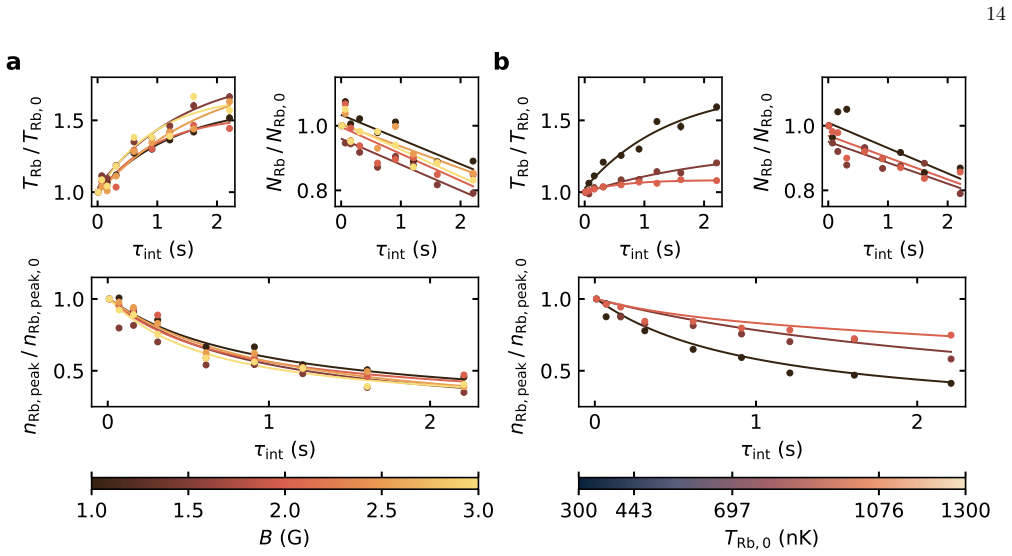
Rb lifetime We find that the Rb cloud is constantly heated during the interaction with the Cs atoms. The heating is accompanied by a constant loss of Rb atoms from the ODT. Possible heating sources are recombination heating due to three-body recombination, technical noise, or spontaneous scattering of trap photons [61–63]. We detect the atom numberN Rb an...
1929
-
[5]
Event-driven Monte-Carlo collision simulations We use numerical event-driven Monte-Carlo collision simulations to model the active motion of individual Cs atoms inside the Rb cloud. The Rb cloud is modeled as a thermalized, classical gas with a time-dependent temperature and density, i.e., the heating of the Rb cloud in the ODT is included, but the dynami...
-
[6]
(3) for an ensemble ofN Cs = 5000 Cs atoms
Langevin simulations To validate our model, we performed three-dimensional (3D) stochastic numerical simulations of Eq. (3) for an ensemble ofN Cs = 5000 Cs atoms. We initialized the Cs atoms by sampling their positions and velocities from a Maxwell-Boltzmann distribution at initial temperatureT Cs,0 = 2.4µK; the initial spatial widthss j,Cs (j∈ {x, y, z}...
-
[7]
M. C. Marchetti, J. F. Joanny, S. Ramaswamy, T. B. Liverpool, J. Prost, M. Rao, and R. A. Simha, Hydrody- namics of soft active matter, Rev. Mod. Phys.85, 1143 (2013)
2013
-
[8]
Bechinger, R
C. Bechinger, R. Di Leonardo, H. L¨ owen, C. Reichhardt, G. Volpe, and G. Volpe, Active particles in complex and crowded environments, Rev. Mod. Phys.88, 045006 (2016)
2016
-
[9]
Cavagna and I
A. Cavagna and I. Giardina, Bird flocks as condensed matter, Annu. Rev. Condens. Matter Phys.5, 183 (2014)
2014
-
[10]
I. S. Aranson, Bacterial active matter, Rep. Progr. Phys. 85, 076601 (2022)
2022
-
[11]
Doostmohammadi, J
A. Doostmohammadi, J. Ign´ es-Mullol, J. M. Yeomans, and F. Sagu´ es, Active nematics, Nat. Commun.9, 3246 (2018)
2018
-
[12]
Z. Shi, Z. Zhang, J. Schnermann, S. C. Neuhauss, N. Nama, R. Wittkowski, and D. Ahmed, Ultrasound- driven programmable artificial muscles, Nature646, 1096 (2025)
2025
-
[13]
F. C. Landers, L. Hertle, V. Pustovalov, D. Sivakumaran, C. M. Oral, O. Brinkmann, K. Meiners, P. Theiler, V. Gantenbein, A. Veciana, M. Mattmann, S. Riss, S. Gervasoni, C. Chautems, H. Ye, S. Sevim, A. D. Flouris, J. Puigmart´ ı-Luis, T. Sotto Mayor, P. Alves, T. L¨ uhmann, X. Chen, N. Ochsenbein, U. Moehrlen, T. Schubert, Z. Kulcsar, P. Gruber, M. Weiss...
2025
-
[14]
Walther and A
A. Walther and A. H. E. M¨ uller, Janus particles, Soft Matter4, 663 (2008)
2008
-
[15]
S. Chen, D. E. Fan, P. Fischer, A. Ghosh, K. G¨ opfrich, R. Golestanian, H. Hess, X. Ma, B. J. Nelson, T. Pati˜ no Padial, J. Tang, K. Villa, W. Wang, L. Zhang, A. Sen, and S. S´ anchez, A roadmap for next-generation nanomotors, Nat. Nanotech.20, 990 (2025)
2025
-
[16]
Calero, E
C. Calero, E. L. Sibert III, and R. Rey, Self- thermophoresis at the nanoscale using light induced sol- vation dynamics, Nanoscale12, 7557 (2020)
2020
-
[17]
S. M. Douglas, I. Bachelet, and G. M. Church, A logic- gated nanorobot for targeted transport of molecular pay- loads, Science335, 831 (2012)
2012
-
[18]
Ciuti, R
G. Ciuti, R. J. Webster III, K.-W. Kwok, and A. Menci- assi, Robotic surgery, Nat. Rev. Bioeng.3, 565 (2025)
2025
-
[19]
Y. Amir, E. Ben-Ishay, D. Levner, S. Ittah, A. Abu- Horowitz, and I. Bachelet, Universal computing by DNA origami robots in a living animal, Nat. Nanotech.9, 353 (2014)
2014
-
[20]
K. Wang, W. Chen, B. Guo, Q. Huang, G. Zhu, H. Ni, L. Zhang, M. Perez, R. Sha, N. C. Seeman, and P. M. Chaikin, A tunable autonomous RNA-fueled micro- engine, Nat. Commun.17, 3164 (2026)
2026
-
[21]
Adachi, K
K. Adachi, K. Takasan, and K. Kawaguchi, Activity- induced phase transition in a quantum many-body sys- tem, Phys. Rev. Res.4, 013194 (2022)
2022
-
[22]
Takasan, K
K. Takasan, K. Adachi, and K. Kawaguchi, Activity- induced ferromagnetism in one-dimensional quantum many-body systems, Phys. Rev. Res.6, 023096 (2024)
2024
-
[23]
Khasseh, S
R. Khasseh, S. Wald, R. Moessner, C. A. Weber, and M. Heyl, Active quantum flocks, Phys. Rev. Lett.135, 248302 (2025)
2025
-
[24]
Yamagishi, N
M. Yamagishi, N. Hatano, and H. Obuse, Proposal of a quantum version of active particles via a nonunitary quantum walk, Sci. Rep.14, 28648 (2024)
2024
-
[25]
Penner, L
A.-G. Penner, L. Viotti, R. Fazio, L. Arrachea, and F. von Oppen, Heat-to-motion conversion for quantum active matter, Phys. Rev. B112, L180303 (2025)
2025
-
[26]
J. F. Steiner, F. von Oppen, and R. Egger, Active quantum matter from monitored pure-state dynamics, arXiv:2603.12629 10.48550/arXiv.2603.12629 (2026)
-
[27]
A. P. Antonov, Y. Zheng, B. Liebchen, and H. L¨ owen, Engineering active motion in quantum matter, Phys. Rev. Res.7, 033008 (2025)
2025
-
[28]
A. P. Antonov, S. Lee, B. Liebchen, H. L¨ owen, J. Melles, G. Morigi, Y. Tuchkov, and M. te Vrugt, Modeling dis- sipation in quantum active matter, Phys. Rev. A (ac- cepted) (2026)
2026
-
[29]
Hanai, D
R. Hanai, D. Ootsuki, and R. Tazai, Photoinduced non- reciprocal magnetism, Nat. Commun.16, 8195 (2025)
2025
-
[30]
Nadolny, C
T. Nadolny, C. Bruder, and M. Brunelli, Nonreciprocal synchronization of active quantum spins, Phys. Rev. X 15, 011010 (2025)
2025
-
[31]
Rieser, M
J. Rieser, M. A. Ciampini, H. Rudolph, N. Kiesel, K. Hornberger, B. A. Stickler, M. Aspelmeyer, and U. Deli´ c, Tunable light-induced dipole-dipole interaction between optically levitated nanoparticles, Science377, 987 (2022)
2022
-
[32]
Reisenbauer, H
M. Reisenbauer, H. Rudolph, L. Egyed, K. Hornberger, A. V. Zasedatelev, M. Abuzarli, B. A. Stickler, and U. Deli´ c, Non-Hermitian dynamics and non-reciprocity of optically coupled nanoparticles, Nat. Phys.20, 1629 (2024)
2024
-
[33]
G. V. Kolmakov and I. S. Aranson, Superfluid swimmers, Phys. Rev. Res.3, 013188 (2021)
2021
-
[34]
Baker-Rasooli, T
M. Baker-Rasooli, T. Aladjidi, T. D. Ferreira, A. Bra- mati, M. Albert, P.-E. Larr´ e, and Q. Glorieux, Swimming against a superfluid flow: Self-propulsion via vortex- antivortex shedding in a quantum fluid of light, Phys. Rev. Lett.136, 223401 (2026)
2026
-
[35]
Massignan, S
P. Massignan, S. Richard, G. E. Astrakharchik, A. ˙Imamoglu, M. Zwierlein, J. J. Arlt, and G. M. Bruun, Polarons in atomic gases and two-dimensional semicon- ductors, Rev. Mod. Phys. (accepted) (2026)
2026
-
[36]
Gross and W
C. Gross and W. Bakr, Quantum gas microscopy for sin- gle atom and spin detection, Nat. Phys.17, 1316 (2021)
2021
-
[37]
Grusdt, N
F. Grusdt, N. Mostaan, E. Demler, and L. A. P. Ardila, Impurities and polarons in bosonic quantum gases: a re- view on recent progress, Rep. Prog. Phys.88, 066401 (2025)
2025
-
[38]
Baroni, G
C. Baroni, G. Lamporesi, and M. Zaccanti, Quantum mixtures of ultracold gases of neutral atoms, Nat. Rev. Phys.6, 736 (2024)
2024
-
[39]
L.-N. Wu, J. Nettersheim, J. Feß, A. Schnell, S. Burgardt, S. Hiebel, D. Adam, A. Eckardt, and A. Widera, Indica- tion of critical scaling in time during the relaxation of an open quantum system, Nat. Commun.15, 1714 (2024)
2024
-
[40]
Schmidt, D
F. Schmidt, D. Mayer, Q. Bouton, D. Adam, T. Lausch, N. Spethmann, and A. Widera, Quantum spin dy- namics of individual neutral impurities coupled to a Bose-Einstein condensate, Phys. Rev. Lett.121, 130403 (2018)
2018
-
[41]
Schmidt, D
F. Schmidt, D. Mayer, Q. Bouton, D. Adam, T. Lausch, 23 J. Nettersheim, E. Tiemann, and A. Widera, Tailored single-atom collisions at ultralow energies, Phys. Rev. Lett.122, 013401 (2019)
2019
-
[42]
Le Blay, J
M. Le Blay, J. H. K. Saldi, and A. Morin, Control of collective activity to crystallize an oscillator gas, Nat. Phys.21, 1412 (2025)
2025
-
[43]
S. A. M. Loos and S. H. L. Klapp, Irreversibility, heat and information flows induced by non-reciprocal interactions, New. J. Phys.22, 123051 (2020)
2020
-
[44]
Nardini, ´E
C. Nardini, ´E. Fodor, E. Tjhung, F. van Wijland, J. Tailleur, and M. E. Cates, Entropy production in field theories without time-reversal symmetry: quantify- ing the non-equilibrium character of active matter, Phys. Rev. X7, 021007 (2017)
2017
-
[45]
Thomas, M
R. Thomas, M. Chilcott, C. Chisholm, A. B. Deb, M. Horvath, B. J. Sawyer, and N. Kjærgaard, Quantum scattering in an optical collider for ultracold atoms, J. Phys.: Conf. Ser.875, 012007 (2017)
2017
-
[46]
M. S. J. Horvath, R. Thomas, E. Tiesinga, A. B. Deb, and N. Kjærgaard, Above-threshold scattering about a feshbach resonance for ultracold atoms in an optical col- lider, Nat. Commun.8, 452 (2017)
2017
-
[47]
E. G. M. van Kempen, S. J. J. M. F. Kokkelmans, D. J. Heinzen, and B. J. Verhaar, Interisotope determination of ultracold rubidium interactions from three high-precision experiments, Phys. Rev. Lett.88, 093201 (2002)
2002
-
[48]
Fiasconaro, E
A. Fiasconaro, E. Gudowska-Nowak, and W. Ebeling, Tuning active Brownian motion with shot-noise energy pulses, J. Stat. Mech.2009, P01029 (2009)
2009
-
[49]
Di Bello, R
C. Di Bello, R. Majumdar, R. Marathe, R. Metzler, and ´E. Rold´ an, Brownian particle in a Poisson-shot-noise ac- tive bath: exact statistics, effective temperature, and in- ference, Ann. Phys. (Berlin)536, 2300427 (2024)
2024
-
[50]
Ferrari, A proper mobility formula for large, heavy particles in gases in any regime, Chem
L. Ferrari, A proper mobility formula for large, heavy particles in gases in any regime, Chem. Phys.257, 63 (2000)
2000
-
[51]
Ferrari, Particles dispersed in a dilute gas: Limits of validity of the Langevin equation, Chem
L. Ferrari, Particles dispersed in a dilute gas: Limits of validity of the Langevin equation, Chem. Phys.336, 27 (2007)
2007
-
[52]
Dunkel and P
J. Dunkel and P. H¨ anggi, Relativistic Brownian mo- tion: From a microscopic binary collision model to the Langevin equation, Phys. Rev. E74, 051106 (2006)
2006
-
[53]
Hohmann, F
M. Hohmann, F. Kindermann, T. Lausch, D. Mayer, F. Schmidt, E. Lutz, and A. Widera, Individual tracer atoms in an ultracold dilute gas, Phys. Rev. Lett.118, 263401 (2017)
2017
-
[54]
Lin and P
H. Lin and P. Danielewicz, One-body Langevin dynam- ics in heavy-ion collisions at intermediate energies, Phys. Rev. C99, 024612 (2019)
2019
-
[55]
Londo˜ no, J
M. Londo˜ no, J. Madro˜ nero, and J. P´ erez-R´ ıos, Dynam- ics of a single trapped ion in a high-density medium: A stochastic approach, Phys. Rev. A106, 022803 (2022)
2022
-
[56]
Londo˜ no, J
M. Londo˜ no, J. Madro˜ nero, and J. P´ erez-R´ ıos, Cold atom-ion systems in radio-frequency multipole traps: Event-driven molecular dynamics and stochastic simu- lations, Phys. Rev. A108, 053324 (2023)
2023
-
[57]
A. A. Dubkov, P. H¨ anggi, and I. Goychuk, Non-linear Brownian motion: The problem of obtaining the ther- mal Langevin equation for a non-Gaussian bath, J. Stat. Mech.2009, P01034 (2009)
2009
-
[58]
Barbosa, M
S. Barbosa, M. Miefer-Emmanouilidis, F. Lang, J. Koch, and A. Widera, Stabilizing an ultracold fermi gas against fermi acceleration to superdiffusion through localization, Phys. Rev. Lett.134, 253402 (2025)
2025
-
[59]
S. Finelli, B. Restivo, A. Ciamei, A. Trenkwalder, M. In- guscio, D. Petrov, S. Skipetroc, and M. Zaccanti, Anoma- lous diffusion and localization in a disorder-free atomic mixture, arXiv:2601.13226 (2026)
arXiv 2026
-
[60]
Y. Sagi, M. Brook, I. Almog, and N. Davidson, Observa- tion of anomalous diffusion and fractional self-similarity in one dimension, Phys. Rev. Lett.108, 093002 (2012)
2012
-
[61]
G. Afek, J. Coslovsky, A. Courvoisier, O. Livneh, and N. Davidson, Observing power-law dynamics of position- velocity correlation in anomalous diffusion, Phys. Rev. Lett.119, 060602 (2017)
2017
-
[62]
Paparelle, J
I. Paparelle, J. Henaff, J. Garcia-Beni, E. Gillet, D. Mon- tesinos, G. L. Giorgi, M. C. Soriano, R. Zambrini, and V. Parigi, Experimental memory control in continuous- variable optical quantum reservoir computing, Nat. Pho- ton.20, 413 (2026)
2026
-
[63]
Jeggle and R
J. Jeggle and R. Wittkowski, Intelligent matter consist- ing of active particles, inArtificial Intelligence and In- telligent Matter, edited by M. te Vrugt (Springer, Cham, Switzerland, 2026) pp. 273–288
2026
-
[64]
M. Gaimann and M. Klopotek, Optimal information in- jection and transfer mechanisms for active matter reser- voir computing, arXiv:2509.01799 (2025)
arXiv 2025
-
[65]
Cannoni, Relativisticσv rel in the calculation of relics abundances: A closer look, Phys
M. Cannoni, Relativisticσv rel in the calculation of relics abundances: A closer look, Phys. Rev. D89, 103533 (2014)
2014
-
[66]
J. M. Hutson, Feshbach resonances in ultracold atomic and molecular collisions: threshold behaviour and sup- pression of poles in scattering lengths, New J. Phys.9, 152 (2007)
2007
-
[67]
Weber, J
T. Weber, J. Herbig, M. Mark, H.-C. N¨ agerl, and R. Grimm, Three-body recombination at large scatter- ing lengths in an ultracold atomic gas, Phys. Rev. Lett. 91, 123201 (2003)
2003
-
[68]
M. E. Gehm, K. M. O’Hara, T. A. Savard, and J. E. Thomas, Dynamics of noise-induced heating in atom traps, Phys. Rev. A58, 3914 (1998)
1998
-
[69]
Optical dipole traps for neutral atoms
R. Grimm, M. Weidem¨ uller, and Y. B. Ovchin- nikov, Optical dipole traps for neutral atoms, arXiv:physics/9902072 10.48550/arXiv.physics/9902072 (1999)
work page internal anchor Pith review Pith/arXiv arXiv doi:10.48550/arxiv.physics/9902072 1999
-
[70]
C. Kim, E. K. Lee, P. H¨ anggi, and P. Talkner, Numerical method for solving stochastic differential equations with Poissonian white shot noise, Phys. Rev. E76, 011109 (2007)
2007
-
[71]
Rossani and G
A. Rossani and G. Spiga, Kinetic theory with inelastic in- teractions, Transp. Theory Statist. Phys.27, 273 (1998)
1998
discussion (0)
Sign in with ORCID, Apple, or X to comment. Anyone can read and Pith papers without signing in.