Self-propulsion of a polaron with an oscillating coupling to its quantum bath
Pith reviewed 2026-07-01 03:13 UTC · model grok-4.3
The pith
An impurity in a quantum gas self-propels when its coupling to the bath is modulated above a critical frequency, turning the drag coefficient negative at low speeds.
A machine-rendered reading of the paper's core claim, the machinery that carries it, and where it could break.
Core claim
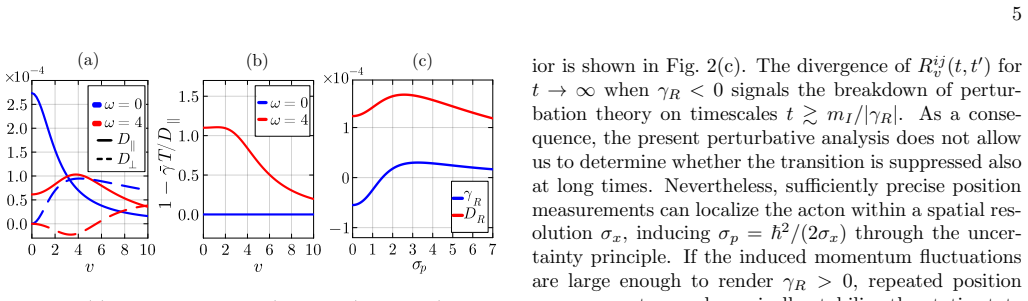
By integrating out the bath degrees of freedom, an effective velocity-dependent drag force is obtained for the impurity whose coupling to the quantum gas is periodically modulated in sign. Above a critical modulation frequency the corresponding drag coefficient becomes negative at low velocities, which signals the onset of self-propulsion. The transition is characterized in the classical limit and remains robust under leading-order quantum corrections, although it can be suppressed by sufficiently precise position measurements.
What carries the argument
Effective velocity-dependent drag force obtained by integrating out the bath degrees of freedom under periodic sign-alternating modulation of the impurity-bath coupling.
If this is right
- In the classical limit the self-propulsion threshold depends on both the modulation frequency and the bath chemical potential.
- The transition to negative drag survives the inclusion of leading quantum corrections to the impurity motion.
- Sufficiently precise measurements of the impurity position can suppress the onset of self-propulsion.
Where Pith is reading between the lines
- Time-periodic sign changes in coupling strength may serve as a general route to induce active motion in other quantum impurity systems.
- Negative drag could enable force-free transport mechanisms inside quantum fluids that are otherwise passive.
- Ultracold-atom experiments with tunable interaction modulation would provide a direct test of the predicted velocity-dependent force sign change.
Load-bearing premise
The effective velocity-dependent drag force derived by integrating out the bath degrees of freedom accurately captures the impurity dynamics under periodic modulation.
What would settle it
Observe whether an impurity at near-zero velocity begins to accelerate spontaneously once the modulation frequency is raised past the calculated critical value, with no external force applied.
Figures

read the original abstract
Motivated by the quest for active quantum matter, we investigate the dynamics of an impurity immersed in a quantum gas -- a polaron -- whose coupling to the surrounding medium is periodically modulated in time, alternating in sign. By integrating out the bath degrees of freedom, we derive an effective velocity-dependent drag force acting on the impurity. Above a critical modulation frequency, the corresponding drag coefficient becomes negative at low velocities, signaling the onset of self-propulsion. In the classical limit, we characterize this transition as a function of the modulation frequency and the bath chemical potential. We then compute the leading-order quantum corrections to the impurity dynamics and show that, while the transition remains robust, it can be suppressed by sufficiently precise measurements of the impurity position.
Editorial analysis
A structured set of objections, weighed in public.
Referee Report
Summary. The manuscript studies an impurity (polaron) in a quantum gas whose coupling to the bath is periodically modulated in time, alternating in sign. By integrating out the bath, the authors derive an effective velocity-dependent drag force on the impurity. They report that above a critical modulation frequency the low-velocity drag coefficient changes sign and becomes negative, indicating the onset of self-propulsion. The transition is characterized in the classical limit as a function of modulation frequency and bath chemical potential; leading-order quantum corrections are then computed and shown to leave the transition robust but suppressible by precise position measurements.
Significance. If the central derivation is valid, the work supplies a concrete, tunable mechanism for generating negative drag and self-propulsion in a quantum many-body setting, extending ideas from active matter into the polaron context. The explicit treatment of both classical and quantum regimes, together with the parameter-free character of the frequency threshold in the classical limit, strengthens the result. The finding that sufficiently precise measurements can suppress the effect is a useful falsifiable prediction.
major comments (2)
- [Bath integration / effective force derivation] The derivation of the effective drag force (presumably in the section following the model definition) proceeds by integrating out the bath under periodic sign-alternating modulation. The skeptic note correctly flags that this step implicitly assumes the resulting memory kernel remains short-ranged enough for a Markovian drag coefficient to be well-defined. When the modulation period becomes comparable to the bath correlation time, residual non-local terms could alter or eliminate the sign change of the low-velocity coefficient. The manuscript should explicitly state the separation-of-timescales assumption and, if possible, provide a consistency check (e.g., comparison of modulation frequency to the inverse bath correlation time extracted from the spectral function).
- [Classical limit section] In the classical-limit analysis, the transition is reported as a function of modulation frequency and chemical potential. It is not clear whether the sign change of the drag coefficient survives when the modulation frequency approaches the inverse of the impurity-bath scattering time; a plot or analytic estimate of the drag coefficient versus frequency for several values of the chemical potential would make the robustness of the critical frequency explicit.
minor comments (2)
- Notation for the time-dependent coupling strength and the modulation frequency should be introduced once and used consistently; occasional redefinition of symbols makes the equations harder to follow.
- [Quantum corrections paragraph] The abstract states that quantum corrections 'can be suppressed by sufficiently precise measurements'; the corresponding section should quantify what precision is required (e.g., in terms of position variance relative to the healing length).
Simulated Author's Rebuttal
We thank the referee for the positive evaluation of our work and for the detailed, constructive comments. We respond to each major comment below.
read point-by-point responses
-
Referee: [Bath integration / effective force derivation] The derivation of the effective drag force (presumably in the section following the model definition) proceeds by integrating out the bath under periodic sign-alternating modulation. The skeptic note correctly flags that this step implicitly assumes the resulting memory kernel remains short-ranged enough for a Markovian drag coefficient to be well-defined. When the modulation period becomes comparable to the bath correlation time, residual non-local terms could alter or eliminate the sign change of the low-velocity coefficient. The manuscript should explicitly state the separation-of-timescales assumption and, if possible, provide a consistency check (e.g., comparison of modulation frequency to the inverse bath correlation time extracted from the spectral function).
Authors: We agree that an explicit statement of the separation-of-timescales assumption is needed for clarity. Our derivation of the effective drag force relies on the modulation frequency being low enough that the integrated memory kernel can be approximated as local (Markovian) at the velocities of interest. We will revise the manuscript to state this assumption explicitly after the model definition and to note that the bath correlation time is set by the inverse of the scale appearing in the spectral function (Eq. 3). A brief consistency check comparing the critical modulation frequency to this scale will also be added; within the parameter regime studied, the assumption holds. revision: yes
-
Referee: [Classical limit section] In the classical-limit analysis, the transition is reported as a function of modulation frequency and chemical potential. It is not clear whether the sign change of the drag coefficient survives when the modulation frequency approaches the inverse of the impurity-bath scattering time; a plot or analytic estimate of the drag coefficient versus frequency for several values of the chemical potential would make the robustness of the critical frequency explicit.
Authors: The analytic expression for the classical drag coefficient (Eq. 10) is derived under the condition that the modulation frequency remains below the impurity-bath scattering rate. The location of the sign-change threshold is independent of chemical potential in the classical limit. To make the robustness explicit, we will add a figure in the revised manuscript that plots the drag coefficient versus modulation frequency for several values of chemical potential, together with a short analytic estimate of the frequency at which the scattering-time cutoff begins to matter. revision: yes
Circularity Check
No significant circularity detected
full rationale
The derivation proceeds by integrating out bath degrees of freedom to obtain an effective velocity-dependent drag force whose low-velocity coefficient is then shown to change sign above a critical modulation frequency. This is a direct computational outcome of the model rather than a self-definitional relation, a fitted parameter renamed as prediction, or a result imported via self-citation chain. No ansatz is smuggled in, no uniqueness theorem is invoked, and the central claim remains independent of its inputs.
Axiom & Free-Parameter Ledger
axioms (1)
- domain assumption Standard techniques for integrating out bath degrees of freedom in polaron models are valid for time-dependent couplings.
Reference graph
Works this paper leans on
-
[1]
M. C. Marchetti, J. F. Joanny, S. Ramaswamy, T. B. Liverpool, J. Prost, M. Rao, and R. A. Simha, Rev. Mod. Phys.85, 1143 (2013)
2013
-
[2]
Golestanian, T
R. Golestanian, T. B. Liverpool, and A. Ajdari, Phys. Rev. Lett.94, 220801 (2005)
2005
-
[3]
H. C. Berg,E. coli in Motion(Springer, 2004)
2004
-
[4]
Di Leonardo, L
R. Di Leonardo, L. Angelani, D. Dell’Arciprete, G. Ruocco, V. Iebba, S. Schippa, M. P. Conte, F. Mecarini, F. De Angelis, and E. Di Fabrizio, Proc. Natl. Acad. Sci. U.S.A.107, 9541 (2010)
2010
-
[5]
Romano and A
J. Romano and A. Gambassi, Phys. Rev. Lett.136, 107102 (2026)
2026
-
[6]
Lagzi, S
I. Lagzi, S. Soh, P. J. Wesson, K. P. Browne, and B. A. Grzybowski, J. Am. Chem. Soc132, 1198 (2010)
2010
-
[7]
Vicsek, A
T. Vicsek, A. Czir´ ok, E. Ben-Jacob, I. Cohen, and O. Shochet, Phys. Rev. Lett.75, 1226 (1995)
1995
-
[8]
Toner and Y
J. Toner and Y. Tu, Phys. Rev. Lett.75, 4326 (1995)
1995
-
[9]
M. E. Cates and J. Tailleur, Annu. Rev. Condens. Matter Phys.6, 219 (2015)
2015
-
[10]
Tailleur and M
J. Tailleur and M. E. Cates, Phys. Rev. Lett.100, 218103 (2008)
2008
-
[11]
S. Saha, J. Agudo-Canalejo, and R. Golestanian, Phys. Rev. X10, 041009 (2020)
2020
-
[12]
Zwicker, R
D. Zwicker, R. Seyboldt, C. A. Weber, A. A. Hyman, and F. J¨ ulicher, Nat. Phys.13, 408 (2017)
2017
-
[13]
Romano, M
J. Romano, M. K. Johnsrud, B. Mahault, and R. Golesta- nian, Phys. Rev. Lett.136, 198301 (2026)
2026
-
[14]
W. F. Paxton, K. C. Kistler, C. C. Olmeda, A. Sen, S. K. St. Angelo, Y. Cao, T. E. Mallouk, P. E. Lammert, and V. H. Crespi, J. Am. Chem. Soc126, 13424 (2004)
2004
-
[15]
Y. Ajaj, Z. H. Mahmoud, A. N. Obeed, M. Al-Salih, B. A. Ahmed, E. A. Hassan, M. S. Falih, M. Nosratabadi, and E. Kianfar, Results Chem.7, 101250 (2024)
2024
-
[16]
Svoboda, C
K. Svoboda, C. F. Schmidt, B. J. Schnapp, and S. M. Block, Nature365, 721 (1993)
1993
-
[17]
A. D. Mehta, R. S. Rock, M. Rief, J. A. Spudich, M. S. Mooseker, and R. E. Cheney, Nature400, 590 (1999)
1999
-
[18]
W. B. Sherman and N. C. Seeman, Nano Lett.4, 1203 (2004)
2004
-
[19]
Omabegho, R
T. Omabegho, R. Sha, and N. C. Seeman, Science324, 67 (2009)
2009
-
[20]
Quantum-enabled active matter at the atomic scale
S. Burgardt, J. Feß, A. Guthmann, S. Hiebel, A. K. Mukhopadhyay, S. Lee, M. t. Vrugt, B. Liebchen, H. L¨ owen, R. Wittkowski, and A. Widera, Quantum- enabled active matter at the atomic scale (2026), arXiv:2606.24615 [quant-ph]
work page internal anchor Pith review Pith/arXiv arXiv 2026
-
[21]
Takasan, K
K. Takasan, K. Adachi, and K. Kawaguchi, Phys. Rev. Res.6, 023096 (2024)
2024
-
[22]
Khasseh, S
R. Khasseh, S. Wald, R. Moessner, C. A. Weber, and M. Heyl, Phys. Rev. Lett.135, 248302 (2025)
2025
-
[23]
Nadolny, C
T. Nadolny, C. Bruder, and M. Brunelli, Phys. Rev. X 15, 011010 (2025)
2025
-
[24]
Adachi, K
K. Adachi, K. Takasan, and K. Kawaguchi, Phys. Rev. Res.4, 013194 (2022)
2022
-
[25]
Yamagishi, N
M. Yamagishi, N. Hatano, and H. Obuse, Sci. Rep.14, 28648 (2024)
2024
-
[26]
Penner, L
A.-G. Penner, L. Viotti, R. Fazio, L. Arrachea, and F. Von Oppen, Phys. Rev. B112, L180303 (2025)
2025
-
[27]
A. P. Antonov, Y. Zheng, B. Liebchen, and H. L¨ owen, Phys. Rev. Res.7, 033008 (2025)
2025
-
[28]
S. K. Barik, A. Thakur, Y. Jindal, S. B. S, and S. Roy, Front. Quantum Sci. Technol.3, 10.3389/frqst.2024.1426216 (2024)
-
[29]
Sch¨ afer, T
F. Sch¨ afer, T. Fukuhara, S. Sugawa, Y. Takasu, and Y. Takahashi, Nat. Rev. Phys.2, 411 (2020)
2020
-
[30]
M¨ uller, S
M. M¨ uller, S. Diehl, G. Pupillo, and P. Zoller, in Advances in Atomic, Molecular, and Optical Physics, Vol. 61 (Elsevier, 2012) pp. 1–80
2012
-
[31]
L. D. Landau, Phys. Z. Sowjet.3, 664 (1933)
1933
-
[32]
Pekar, J
S. Pekar, J. Exp. Theor. Phys16, 335 (1946)
1946
-
[33]
A. P. Chikkatur, A. G¨ orlitz, D. M. Stamper-Kurn, S. In- ouye, S. Gupta, and W. Ketterle, Phys. Rev. Lett.85, 483 (2000)
2000
-
[34]
Catani, G
J. Catani, G. Lamporesi, D. Naik, M. Gring, M. Inguscio, F. Minardi, A. Kantian, and T. Giamarchi, Phys. Rev. A85, 023623 (2012)
2012
-
[35]
Spethmann, F
N. Spethmann, F. Kindermann, S. John, C. Weber, D. Meschede, and A. Widera, Phys. Rev. Lett.109, 235301 (2012)
2012
-
[36]
Scelle, T
R. Scelle, T. Rentrop, A. Trautmann, T. Schuster, and M. K. Oberthaler, Phys. Rev. Lett.111, 070401 (2013)
2013
-
[37]
Massignan, M
P. Massignan, M. Zaccanti, and G. M. Bruun, Rep. Prog. Phys.77, 034401 (2014)
2014
-
[38]
Kohstall, M
C. Kohstall, M. Zaccanti, M. Jag, A. Trenkwalder, P. Massignan, G. M. Bruun, F. Schreck, and R. Grimm, Nature485, 615 (2012)
2012
-
[39]
Koschorreck, D
M. Koschorreck, D. Pertot, E. Vogt, B. Fr¨ ohlich, M. Feld, and M. K¨ ohl, Nature485, 619 (2012)
2012
-
[40]
C. Chin, R. Grimm, P. Julienne, and E. Tiesinga, Rev. Mod. Phys.82, 1225 (2010)
2010
-
[41]
Schirotzek, C.-H
A. Schirotzek, C.-H. Wu, A. Sommer, and M. W. Zwier- lein, Phys. Rev. Lett.102, 230402 (2009)
2009
-
[42]
F. J. Vivanco, A. Schuckert, S. Huang, G. L. Schumacher, G. G. T. Assump¸ c˜ ao, Y. Ji, J. Chen, M. Knap, and 7 N. Navon, Nat. Phys.21, 564 (2025)
2025
-
[43]
Trefzger and Y
C. Trefzger and Y. Castin, Europhys. Lett.104, 50005 (2013)
2013
-
[44]
Nascimbene, N
S. Nascimbene, N. Navon, K. Jiang, L. Tarruell, M. Te- ichmann, J. Mckeever, F. Chevy, and C. Salomon, Phys. Rev. Lett.103, 170402 (2009)
2009
-
[45]
G. E. Astrakharchik and L. P. Pitaevskii, Phys. Rev. A 70, 013608 (2004)
2004
-
[46]
A. G. Sykes, M. J. Davis, and D. C. Roberts, Phys. Rev. Lett.103, 085302 (2009)
2009
-
[47]
Since the semiclassical limit considered in this work is in- sensitive to the underlying particle statistics, the results presented here apply also to Fermi gases
-
[48]
Kamenev,Field Theory of Non-Equilibrium Systems (Cambridge University Press, Cambridge, 2023)
A. Kamenev,Field Theory of Non-Equilibrium Systems (Cambridge University Press, Cambridge, 2023)
2023
-
[49]
See Supplemental Material at URL for details on the derivations and additional plots
-
[50]
U. Basu, V. D´ emery, and A. Gambassi, SciPost Phys.13, 078 (2022)
2022
-
[51]
D´ emery and A
V. D´ emery and A. Gambassi, Phys. Rev. E108, 044604 (2023)
2023
-
[52]
Since the characteristic length scale of the field pertur- bation is set by the spatial rangeaof the potentialV, its typical momentum isp w =h/a, corresponding to a kinetic energyE K =p 2 w/(2m) =h 2/(2ma2)
-
[53]
Harada and S.-i
T. Harada and S.-i. Sasa, Phys. Rev. Lett.95, 130602 (2005). 8 Supplementary material for: Self-propulsion of a polaron with oscillating coupling to its quantum bath Jacopo Romano and Andrea Gambassi SISSA — International School for Advanced Studies and INFN, via Bonomea 265, 34136 Trieste, Italy This supplemental material provides details concerning the ...
2005
discussion (0)
Sign in with ORCID, Apple, or X to comment. Anyone can read and Pith papers without signing in.