Inverse designed photonic crystal waveguides for pulsed operation: dispersion, losses, and controlled light-matter interactions
Pith reviewed 2026-06-25 22:31 UTC · model grok-4.3
The pith
Inverse design with an efficient mode solver reduces photonic crystal waveguide design time by over 100 times while increasing bandwidth by up to 10 times and decreasing loss by up to 4 times.
A machine-rendered reading of the paper's core claim, the machinery that carries it, and where it could break.
Core claim
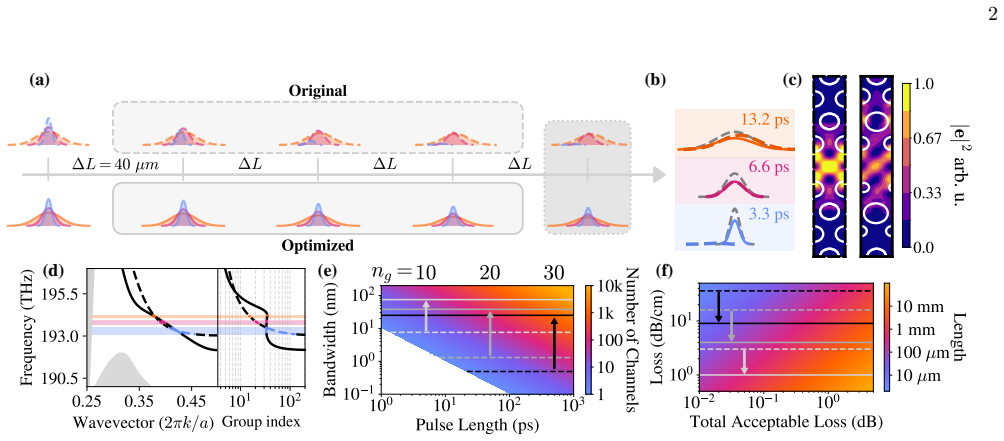
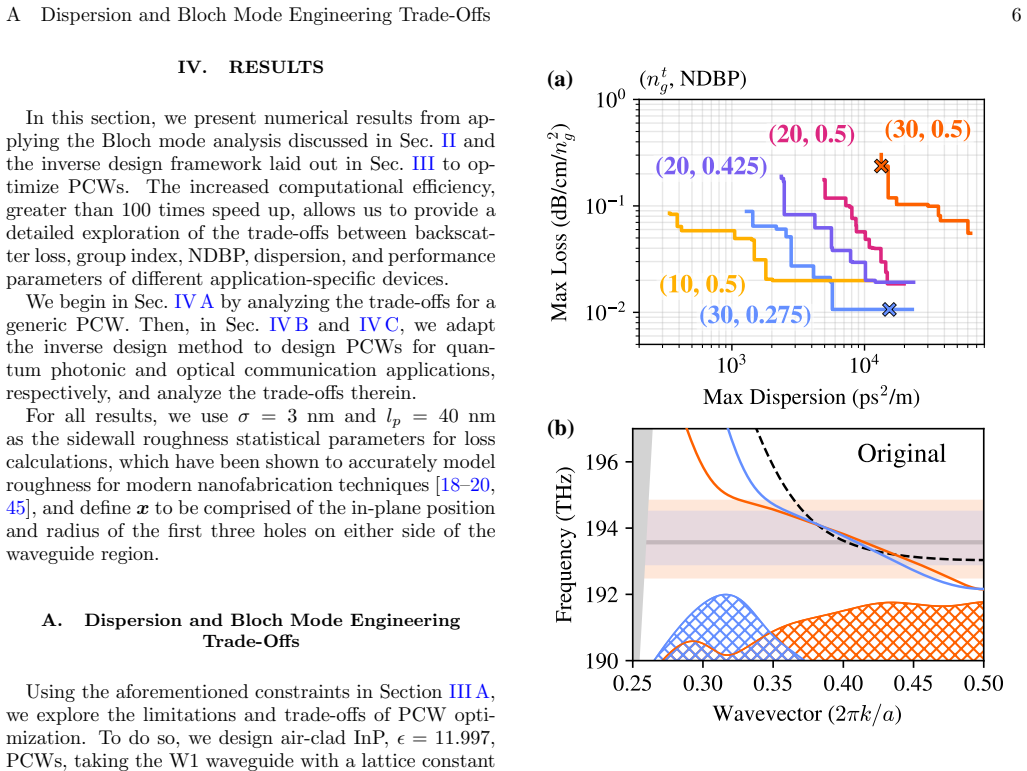
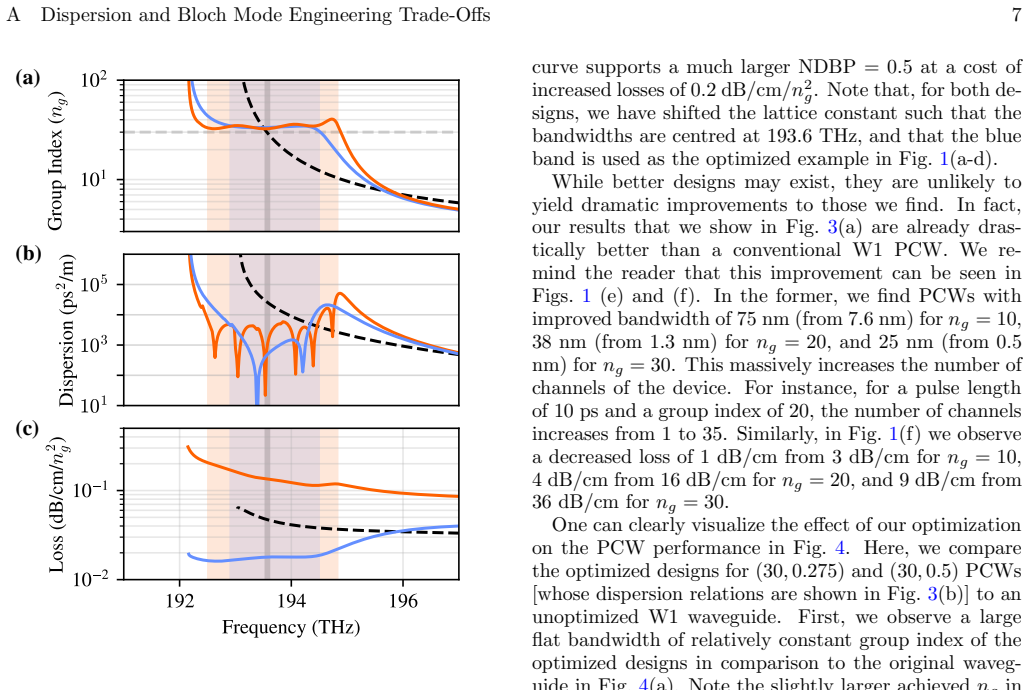
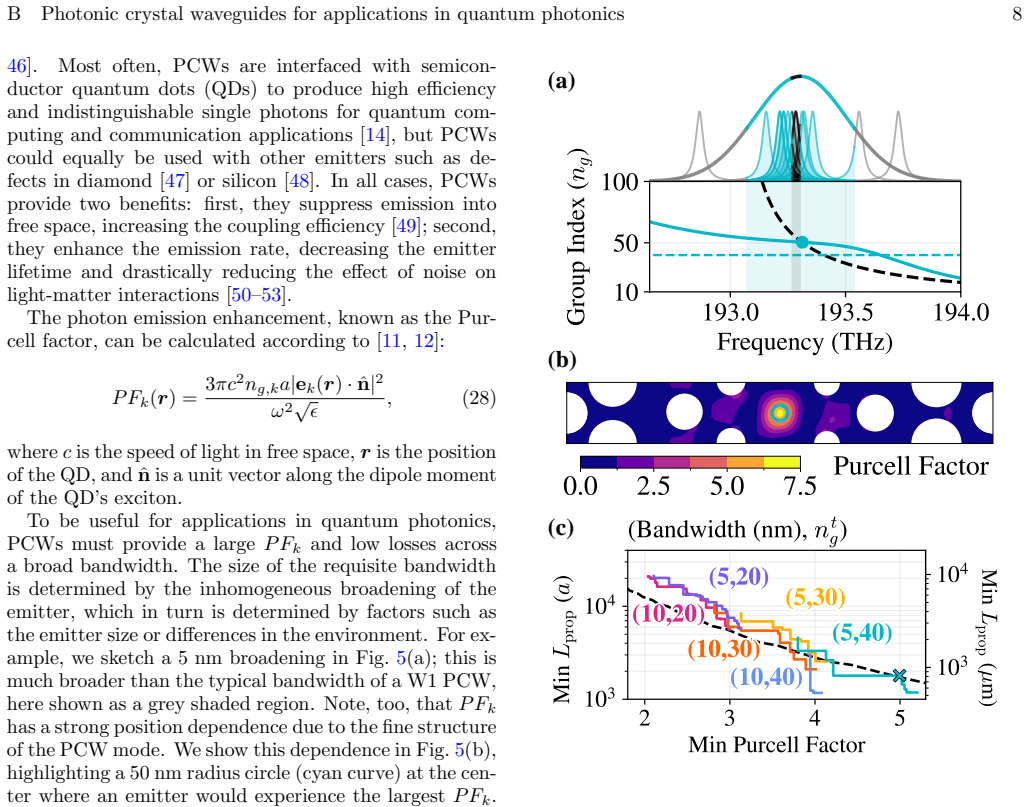
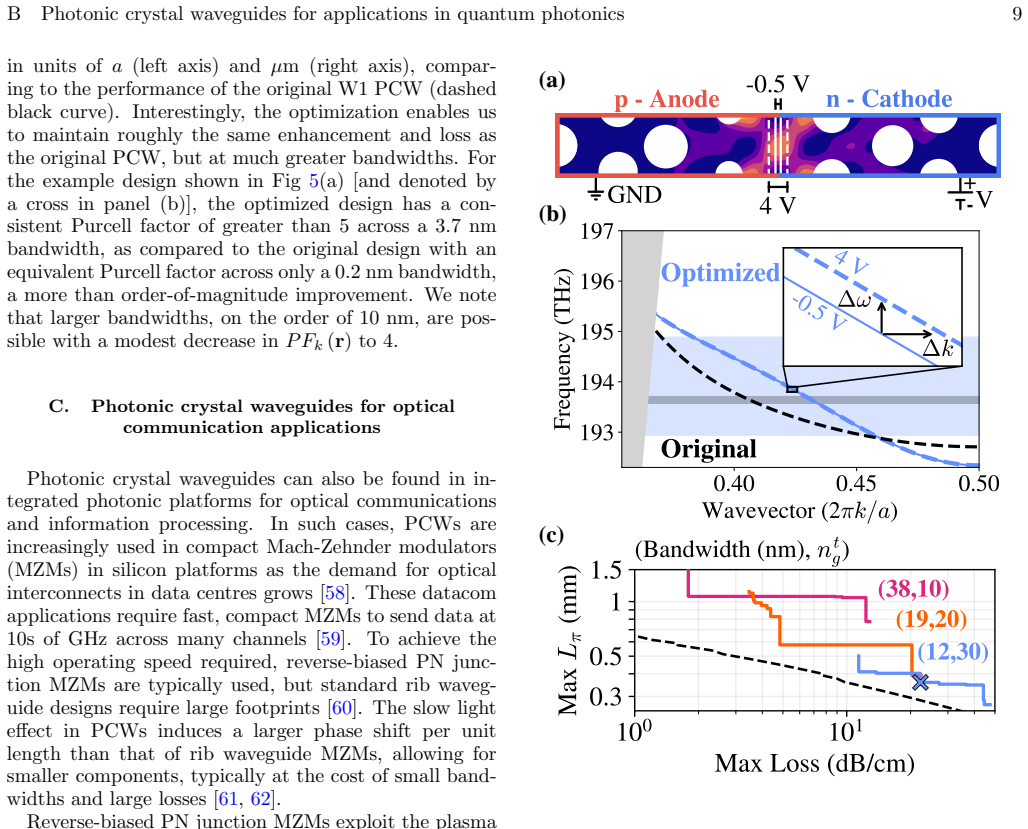
By combining inverse design with an efficient mode solver and physics based formulas, we reduce the computational time of PCW designs by more than 100 times, allowing for the realization of PCWs with up to an order of magnitude increase in bandwidth and up to 4 times decrease in loss. We then explore the trade-offs between bandwidth, disorder-induced loss, group index, and dispersion. As examples, we apply this approach to two active and practical areas of research for PCWs design: broadband, position-tolerant Purcell enhancement, and compact phase shifters for optical communications.
What carries the argument
Inverse design optimization that uses an efficient mode solver and physics-based formulas to control dispersion, losses, and light-matter interactions in photonic crystal waveguides.
Load-bearing premise
The physics-based formulas and efficient mode solver accurately predict performance of the final fabricated devices without full 3D simulations or experimental checks.
What would settle it
Fabricate one of the optimized PCW designs and directly measure its transmission bandwidth, group-velocity dispersion, and propagation loss to test whether they reach the predicted tenfold bandwidth gain and fourfold loss reduction.
Figures
read the original abstract
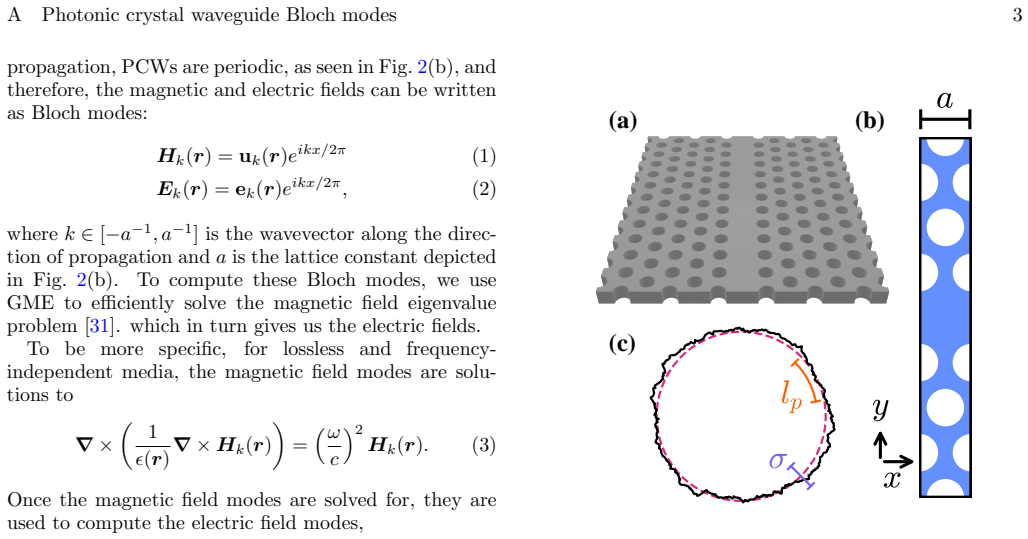
Photonic crystal waveguides (PCWs) are a powerful platform for optical technologies because they can spatially confine light on sub-wavelength scales and manipulate the group velocity of propagation modes, both of which enhance light-matter interactions. Many applications in photonics require a large bandwidth of low-loss and constant-velocity slow light, a significant challenge for previous dispersion and Bloch mode engineering techniques. By combining inverse design with an efficient mode solver and physics based formulas, we reduce the computational time of PCW designs by more than 100 times, allowing for the realization of PCWs with up to an order of magnitude increase in bandwidth and up to 4 times decrease in loss. We then explore the trade-offs between bandwidth, disorder-induce loss, group index, and dispersion. As examples, we apply this approach to two active and practical areas of research for PCWs design: broadband, position-tolerant Purcell enhancement, and compact phase shifters for optical communications. Our results significantly improve state-of-the-art PCW designs and provide a general method to optimize PCWs integrated technologies.
Editorial analysis
A structured set of objections, weighed in public.
Referee Report
Summary. The manuscript presents an inverse-design framework for photonic crystal waveguides that integrates an efficient mode solver with physics-based formulas for dispersion and disorder-induced loss. It claims this reduces design computation time by more than 100× relative to prior methods, enabling PCWs with up to 10× larger bandwidth and 4× lower loss while exploring trade-offs among bandwidth, loss, group index, and dispersion. The approach is demonstrated on two applications: broadband position-tolerant Purcell enhancement and compact phase shifters for optical communications.
Significance. If the reduced-fidelity models remain quantitatively accurate for the heavily optimized geometries, the work would supply a practical route to high-performance PCW designs, substantially improving slow-light bandwidth and loss metrics that have limited prior dispersion-engineering approaches. The reported computational speedup and the concrete application examples would be of direct interest to the photonics community.
major comments (2)
- [Results] Abstract and Results section: The central quantitative claims—an order-of-magnitude bandwidth increase and 4× loss reduction—are obtained exclusively from the efficient mode solver plus physics-based formulas. No side-by-side comparison of any final optimized design against full 3D FDTD is reported, even though disorder-induced loss formulas are known to be sensitive to out-of-plane radiation and precise field overlap with fabrication imperfections that are typically under-resolved in 2D or approximate models.
- [Methods] Methods section: The physics-based loss formulas are used inside the inverse-design loop without an explicit validation study showing that their accuracy is preserved once the geometry is allowed to vary freely under optimization; this assumption is load-bearing for the claimed performance gains.
minor comments (2)
- [Figures] Figure captions: several panels lack explicit labels for the wavelength range or the precise definition of the plotted loss metric (e.g., whether it includes only in-plane or also out-of-plane contributions).
- [Notation] Notation: the symbol for group index is used interchangeably with normalized group velocity in the trade-off plots without a clarifying sentence in the text.
Simulated Author's Rebuttal
We thank the referee for the constructive feedback. The comments correctly identify the need for explicit validation of the reduced-fidelity models on the optimized geometries. We address each major comment below and will incorporate the requested comparisons and validation study into the revised manuscript.
read point-by-point responses
-
Referee: [Results] Abstract and Results section: The central quantitative claims—an order-of-magnitude bandwidth increase and 4× loss reduction—are obtained exclusively from the efficient mode solver plus physics-based formulas. No side-by-side comparison of any final optimized design against full 3D FDTD is reported, even though disorder-induced loss formulas are known to be sensitive to out-of-plane radiation and precise field overlap with fabrication imperfections that are typically under-resolved in 2D or approximate models.
Authors: We agree that the absence of direct 3D FDTD comparisons for the final optimized designs limits the strength of the quantitative claims. The disorder-induced loss formulas can indeed be affected by out-of-plane radiation and field overlap details not fully captured in 2D models. In the revised manuscript we will add a new subsection in Results that reports full 3D FDTD simulations for at least two representative optimized waveguides (one broadband and one low-loss design). These simulations will be compared side-by-side with the mode-solver plus formula predictions for bandwidth, group index, and loss, with explicit discussion of any discrepancies attributable to out-of-plane effects. revision: yes
-
Referee: [Methods] Methods section: The physics-based loss formulas are used inside the inverse-design loop without an explicit validation study showing that their accuracy is preserved once the geometry is allowed to vary freely under optimization; this assumption is load-bearing for the claimed performance gains.
Authors: We acknowledge that the load-bearing assumption requires an explicit validation study once geometries are allowed to vary freely. Although the formulas are derived from established perturbation theory and have been tested on conventional PCWs, their behavior under inverse design has not been checked in the current manuscript. In the revised Methods section we will add a dedicated validation subsection that applies the loss formulas to a set of ten inverse-designed waveguides spanning the explored parameter space and compares the predictions against 3D FDTD disorder simulations. This will quantify the accuracy retained after optimization and will be referenced in the Results when presenting the performance gains. revision: yes
Circularity Check
No circularity: claims rest on modeling assumptions, not self-referential derivations
full rationale
The paper presents an inverse-design workflow that combines an efficient mode solver with physics-based formulas for dispersion and loss to achieve reported speedups and performance gains in PCW designs. No equations, fitting procedures, or self-citations are described that would make any 'prediction' or result equivalent to its inputs by construction. The central claims concern computational efficiency and design improvements; these depend on the external validity of the reduced-fidelity tools rather than any definitional loop or renamed fit. The derivation chain is therefore self-contained against external benchmarks.
Axiom & Free-Parameter Ledger
Reference graph
Works this paper leans on
-
[1]
Ohtaka, Energy band of photons and low-energy pho- ton diffraction, Physical Review B19, 5057–5067 (1979)
K. Ohtaka, Energy band of photons and low-energy pho- ton diffraction, Physical Review B19, 5057–5067 (1979)
1979
-
[2]
Yablonovitch, Inhibited spontaneous emission in solid- state physics and electronics, Physical Review Letters58, 2059–2062 (1987)
E. Yablonovitch, Inhibited spontaneous emission in solid- state physics and electronics, Physical Review Letters58, 2059–2062 (1987)
2059
-
[3]
John, Strong localization of photons in certain dis- ordered dielectric superlattices, Physical Review Letters 58, 2486–2489 (1987)
S. John, Strong localization of photons in certain dis- ordered dielectric superlattices, Physical Review Letters 58, 2486–2489 (1987)
1987
-
[4]
Notomi, K
M. Notomi, K. Yamada, A. Shinya, J. Takahashi, C. Takahashi, and I. Yokohama, Extremely large group- velocity dispersion of line-defect waveguides in photonic crystal slabs, Physical Review Letters87, 253902 (2001)
2001
-
[5]
T. F. Krauss, Slow light in photonic crystal waveguides, Journal of Physics D: Applied Physics40, 2666–2670 (2007)
2007
-
[6]
Baba, Slow light in photonic crystals, Nature Photon- ics2, 465–473 (2008)
T. Baba, Slow light in photonic crystals, Nature Photon- ics2, 465–473 (2008)
2008
-
[7]
T. F. Krauss, Why do we need slow light?, Nature Pho- tonics2, 448–450 (2008)
2008
-
[8]
Solja ˇCi´C and J
M. Solja ˇCi´C and J. D. Joannopoulos, Enhancement of nonlinear effects using photonic crystals, Nature Materi- als3, 211–219 (2004)
2004
-
[9]
W.-C. Lai, S. Chakravarty, X. Wang, C. Lin, and R. T. Chen, On-chip methane sensing by near-ir absorption sig- natures in a photonic crystal slot waveguide, Optics Let- ters36, 984 (2011)
2011
-
[10]
(8) Meng, H.; Gao, Y.; Wang, X.; Li, X.; Wang, L.; Zhao, X.; Sun, B
K. Zheng, Z. Peng, H. Liao, Y. Huang, H. Bao, S. Zhao, Y. Zhang, C. Zheng, Y. Wang, and W. Jin, Dual slow- light enhanced photothermal gas spectroscopy on a sil- icon chip, Nature Communications16, 10.1038/s41467- 025-65583-5 (2025)
-
[11]
Hughes, Enhanced single-photon emission from quan- tum dots in photonic crystal waveguides and nanocavi- ties, Optics Letters29, 2659 (2004)
S. Hughes, Enhanced single-photon emission from quan- tum dots in photonic crystal waveguides and nanocavi- ties, Optics Letters29, 2659 (2004)
2004
-
[12]
V. S. C. Manga Rao and S. Hughes, Single quantum-dot Purcell factor andβfactor in a photonic crystal waveg- uide, Physical Review B75, 205437 (2007)
2007
-
[13]
V. S. C. M. Rao and S. Hughes, Single quantum dot spon- taneous emission in a finite-size photonic crystal waveg- uide: Proposal for an efficient “on chip” single photon gun, Phys. Rev. Lett.99, 193901 (2007)
2007
-
[14]
Lodahl, S
P. Lodahl, S. Mahmoodian, and S. Stobbe, Interfacing single photons and single quantum dots with photonic nanostructures, Rev. Mod. Phys.87, 347 (2015)
2015
-
[15]
Laucht, S
A. Laucht, S. P¨ utz, T. G¨ unthner, N. Hauke, R. Saive, S. Fr´ ed´ erick, M. Bichler, M.-C. Amann, A. W. Holleitner, M. Kaniber, and J. J. Finley, A waveguide-coupled on- chip single-photon source, Phys. Rev. X2, 011014 (2012)
2012
-
[16]
Gerace and L
D. Gerace and L. C. Andreani, Disorder-induced losses in photonic crystal waveguides with line defects, Optics Letters29, 1897 (2004)
2004
-
[17]
Hughes, L
S. Hughes, L. Ramunno, J. F. Young, and J. E. Sipe, Ex- trinsic optical scattering loss in photonic crystal waveg- uides: Role of fabrication disorder and photon group ve- locity, Physical Review Letters94(2005)
2005
-
[18]
Kuramochi, M
E. Kuramochi, M. Notomi, S. Hughes, A. Shinya, T. Watanabe, and L. Ramunno, Disorder-induced scat- tering loss of line-defect waveguides in photonic crystal slabs, Physical Review B72, 161318(R) (2005)
2005
-
[19]
Patterson, S
M. Patterson, S. Hughes, S. Schulz, D. M. Beggs, T. P. White, L. O’Faolain, and T. F. Krauss, Disorder-induced incoherent scattering losses in photonic crystal waveg- uides: Bloch mode reshaping, multiple scattering, and breakdown of the beer-lambert law, Phys. Rev. B80, 195305 (2009)
2009
-
[20]
Patterson, S
M. Patterson, S. Hughes, S. Combri´ e, N.-V.-Q. Tran, A. De Rossi, R. Gabet, and Y. Jaou¨ en, Disorder-induced coherent scattering in slow-light photonic crystal waveg- uides, Phys. Rev. Lett.102, 253903 (2009)
2009
-
[21]
N. Mann, M. Patterson, and S. Hughes, Role of bloch mode reshaping and disorder correlation length on scat- tering losses in slow-light photonic crystal waveguides, Physical Review B91, 245151 (2015)
2015
-
[22]
J. Li, T. P. White, L. O’Faolain, A. Gomez-Iglesias, and T. F. Krauss, Systematic design of flat band slow light in photonic crystal waveguides, Optics Express16, 6227 (2008)
2008
-
[23]
L. H. Frandsen, A. V. Lavrinenko, J. Fage-Pedersen, and P. I. Borel, Photonic crystal waveguides with semi-slow light and tailored dispersion properties, Optics Express 14, 9444 (2006)
2006
-
[24]
Hirotani, R
K. Hirotani, R. Shiratori, and T. Baba, Si photonic crys- tal slow-light waveguides optimized through informatics technology, Optics Letters46, 4422 (2021)
2021
-
[25]
H. Yan, R. Hao, B. Ye, and S. Jin, Exploring high- performance photonic crystal slow light waveguides through deep reinforcement learning, Optics Communi- cations569, 130830 (2024)
2024
-
[26]
J. Chen, R. Hao, I. Nasidi, H. Zhang, X. Wang, and S. Jin, Deep learning-based modelling of complex pho- tonic crystal slow light waveguides, IEEE Journal of Se- lected Topics in Quantum Electronics29, 1–6 (2023)
2023
-
[27]
Thompson, A
D. Thompson, A. Neill, N. Rotenberg, and S. Hughes, Re- ducing disorder-induced backscattering in photonic crys- tal waveguides through inverse design, Physical Review A113, 023515 (2026)
2026
-
[28]
Nussbaum, E
E. Nussbaum, E. Sauer, and S. Hughes, Inverse design of broadband and lossless topological photonic crystal waveguide modes, Optics Letters46, 1732 (2021)
2021
-
[29]
Nussbaum, N
E. Nussbaum, N. Rotenberg, and S. Hughes, Optimizing the chiral Purcell factor for unidirectional single-photon emitters in topological photonic crystal waveguides using inverse design, Phys. Rev. A106, 033514 (2022)
2022
-
[30]
N. J. Martin, M. Jalali Mehrabad, X. Chen, R. Dost, E. Nussbaum, D. Hallett, L. Hallacy, A. Foster, E. Clarke, P. K. Patil, S. Hughes, M. Hafezi, A. M. Fox, M. S. Skolnick, and L. R. Wilson, Topological and conventional nanophotonic waveguides for directional in- tegrated quantum optics, Phys. Rev. Res.6, L022065 (2024)
2024
-
[31]
L. C. Andreani and D. Gerace, Photonic-crystal slabs with a triangular lattice of triangular holes investigated using a guided-mode expansion method, Phys. Rev. B 73, 235114 (2006). 12
2006
-
[32]
Zanotti, M
S. Zanotti, M. Minkov, D. Nigro, D. Gerace, S. Fan, and L. C. Andreani, Legume: A free implementation of the guided-mode expansion method for photonic crystal slabs, Computer Physics Communications304, 109286 (2024)
2024
-
[33]
Minkov, I
M. Minkov, I. A. D. Williamson, L. C. Andreani, D. Ger- ace, B. Lou, A. Y. Song, T. W. Hughes, and S. Fan, In- verse design of photonic crystals through automatic dif- ferentiation, ACS Photonics7, 1729–1741 (2020)
2020
-
[34]
Zhang, Q
Y. Zhang, Q. Ji, and Q. Zhou, A new nonmonotone adap- tive trust region method, Journal of Applied Mathemat- ics and Physics09, 3102–3114 (2021)
2021
-
[35]
J. P. Vasco and S. Hughes, Anderson localization in dis- ordered LN photonic crystal slab cavities, ACS Photonics 5, 1262–1272 (2018)
2018
-
[36]
J. P. Vasco and S. Hughes, Statistics of anderson- localized modes in disordered photonic crystal slab waveguides, Phys. Rev. B95, 224202 (2017)
2017
-
[37]
Crane, O
T. Crane, O. J. Trojak, J. P. Vasco, S. Hughes, and L. Sapienza, Anderson localization of visible light on a nanophotonic chip, ACS Photonics4, 2274–2280 (2017)
2017
-
[38]
N. V. Hauff, H. Le Jeannic, P. Lodahl, S. Hughes, and N. Rotenberg, Chiral quantum optics in broken- symmetry and topological photonic crystal waveguides, Physical Review Research4, 023082 (2022)
2022
-
[39]
S. G. Johnson, M. Ibanescu, M. A. Skorobogatiy, O. Weisberg, J. D. Joannopoulos, and Y. Fink, Perturba- tion theory for maxwell’s equations with shifting material boundaries, Physical Review E65, 066611 (2002)
2002
-
[40]
N. Mann, S. Combri´ e, P. Colman, M. Patterson, A. D. Rossi, and S. Hughes, Reducing disorder-induced losses for slow light photonic crystal waveguides through bloch mode engineering, Opt. Lett.38, 4244 (2013)
2013
-
[41]
F. Wang, J. S. Jensen, J. Mørk, and O. Sigmund, Sys- tematic design of loss-engineered slow-light waveguides, J. Opt. Soc. Am. A29, 2657 (2012)
2012
-
[42]
O’Faolain, S
L. O’Faolain, S. A. Schulz, D. M. Beggs, T. P. White, M. Spasenovi´ c, L. Kuipers, F. Morichetti, A. Melloni, S. Mazoyer, J. P. Hugonin, P. Lalanne, and T. F. Krauss, Loss engineered slow light waveguides, Opt. Express18, 27627 (2010)
2010
-
[43]
Hamachi, S
Y. Hamachi, S. Kubo, and T. Baba, Slow light with low dispersion and nonlinear enhancement in a lattice- shifted photonic crystal waveguide, Optics Letters34, 1072 (2009)
2009
-
[44]
Vercruysse, N
D. Vercruysse, N. V. Sapra, L. Su, and J. Vuckovic, Dis- persion engineering with photonic inverse design, IEEE Journal of Selected Topics in Quantum Electronics26, 1–6 (2020)
2020
-
[45]
Skorobogatiy, G
M. Skorobogatiy, G. B´ egin, and A. Talneau, Statistical analysis of geometrical imperfections from the images of 2d photonic crystals, Opt. Express13, 2487 (2005)
2005
-
[46]
A. B. Young, A. C. T. Thijssen, D. M. Beggs, P. An- drovitsaneas, L. Kuipers, J. G. Rarity, S. Hughes, and R. Oulton, Polarization engineering in photonic crystal waveguides for spin-photon entanglers, Phys. Rev. Lett. 115, 153901 (2015)
2015
-
[47]
Riedrich-M¨ oller, C
J. Riedrich-M¨ oller, C. Arend, C. Pauly, F. M¨ ucklich, M. Fischer, S. Gsell, M. Schreck, and C. Becher, Deter- ministic coupling of a single silicon-vacancy color center to a photonic crystal cavity in diamond, Nano Letters 14, 5281–5287 (2014)
2014
-
[48]
Dobinson, C
M. Dobinson, C. Bowness, S. A. Meynell, C. Chartrand, E. Hoffmann, M. Gascoine, I. MacGilp, F. Afzal, C. Dan- gel, N. Jahed, M. L. W. Thewalt, S. Simmons, and D. B. Higginbottom, Electrically triggered spin–photon devices in silicon, Nature Photonics19, 1132–1137 (2025)
2025
-
[49]
Q. Wang, S. Stobbe, and P. Lodahl, Mapping the local density of optical states of a photonic crystal with sin- gle quantum dots, Physical Review Letters107, 167404 (2011)
2011
-
[50]
Iles-Smith, D
J. Iles-Smith, D. P. S. McCutcheon, A. Nazir, and J. Mørk, Phonon scattering inhibits simultaneous near- unity efficiency and indistinguishability in semiconduc- tor single-photon sources, Nature Photonics11, 521–526 (2017)
2017
-
[51]
Gustin and S
C. Gustin and S. Hughes, Pulsed excitation dynamics in quantum-dot–cavity systems: Limits to optimizing the fidelity of on-demand single-photon sources, Phys. Rev. B98, 045309 (2018)
2018
-
[52]
Albrechtsen, S
M. Albrechtsen, S. Kr¨ uger, J. C. Loredo, L. Stefan, Z. Liu, Y. Meng, L. L. Niekamp, B. F. Seyschab, N. Spitzer, R. J. Warburton, P. Lodahl, A. Ludwig, and L. Midolo, A quantum-coherent photon–emitter interface in the original telecom band, Nature Nanotechnology21, 642–647 (2026)
2026
-
[53]
R. Uppu, F. T. Pedersen, Y. Wang, C. T. Olesen, C. Pa- pon, X. Zhou, L. Midolo, S. Scholz, A. D. Wieck, A. Lud- wig, and P. Lodahl, Scalable integrated single-photon source, Science Advances6, eabc8268 (2020)
2020
-
[54]
Pregnolato, X.-L
T. Pregnolato, X.-L. Chu, T. Schr¨ oder, R. Schott, A. D. Wieck, A. Ludwig, P. Lodahl, and N. Rotenberg, Deter- ministic positioning of nanophotonic waveguides around single self-assembled quantum dots, APL Photonics5, 086101 (2020)
2020
-
[55]
M. Gschrey, F. Gericke, A. Sch¨ ußler, R. Schmidt, J.-H. Schulze, T. Heindel, S. Rodt, A. Strittmatter, and S. Re- itzenstein, In situ electron-beam lithography of deter- ministic single-quantum-dot mesa-structures using low- temperature cathodoluminescence spectroscopy, Applied Physics Letters 10.1063/1.4812343 (2013)
-
[56]
Y.-M. He, J. Liu, S. Maier, M. Emmerling, S. Gerhardt, M. Davan¸ co, K. Srinivasan, C. Schneider, and S. H¨ ofling, Deterministic implementation of a bright, on-demand single-photon source with near-unity indistinguishability via quantum dot imaging, Optica4, 802 (2017)
2017
-
[57]
Schr¨ oder, M
T. Schr¨ oder, M. E. Trusheim, M. Walsh, L. Li, J. Zheng, M. Schukraft, A. Sipahigil, R. E. Evans, D. D. Sukachev, C. T. Nguyen, J. L. Pacheco, R. M. Camacho, E. S. Biele- jec, M. D. Lukin, and D. Englund, Scalable focused ion beam creation of nearly lifetime-limited single quantum emitters in diamond nanostructures, Nature Communi- cations8, 15376 (2017)
2017
-
[58]
C. Han, M. Jin, Y. Tao, B. Shen, and X. Wang, Recent progress in silicon-based slow-light electro-optic modula- tors, Micromachines13, 400 (2022)
2022
-
[59]
Roadmapping the next generation of silicon photonics,
S. Shekhar, W. Bogaerts, L. Chrostowski, J. E. Bowers, M. Hochberg, R. Soref, and B. J. Shastri, Roadmapping the next generation of silicon photonics, Nature Commu- nications15, 10.1038/s41467-024-44750-0 (2024)
-
[60]
G. T. Reed, G. Mashanovich, F. Y. Gardes, and D. J. Thomson, Silicon optical modulators, Nature Photonics 4, 518–526 (2010)
2010
-
[61]
Kawahara, T
K. Kawahara, T. Tsuchizawa, N. Yamamoto, Y. Maegami, K. Yamada, S. Hara, and T. Baba, High-speed, low-voltage, low-bit-energy silicon photonic crystal slow-light modulator with impedance-engineered distributed electrodes, Optica11, 1212 (2024). 13
2024
-
[62]
Kawahara, T
K. Kawahara, T. Tsuchizawa, N. Yamamoto, Y. Maegami, K. Yamada, S. Hara, and T. Baba, High-efficiency compact optical transmitter with a total bit energy of 0.78 pj/bit including silicon slow-light modulator and open-collector current-mode driver, IEEE Journal of Selected Topics in Quantum Electronics32, 1–11 (2026)
2026
-
[63]
Terada, H
Y. Terada, H. Ito, H. C. Nguyen, and T. Baba, Theoret- ical and experimental investigation of low-voltage and low-loss 25-gbps si photonic crystal slow light mach– zehnder modulators with interleaved p/n junction, Fron- tiers in Physics2, 2:61 (2014)
2014
-
[64]
Ramunno and S
L. Ramunno and S. Hughes, Disorder-induced resonance shifts in high-index-contrast photonic crystal nanocavi- ties, Physical Review B79, 161303(R) (2009)
2009
-
[65]
Nedeljkovic, R
M. Nedeljkovic, R. Soref, and G. Z. Mashanovich, Free- carrier electrorefraction and electroabsorption modula- tion predictions for silicon over the 1–14-µm infrared wavelength range, IEEE Photonics Journal3, 1171 (2011)
2011
-
[66]
N. A. Mortensen and S. Xiao, Slow-light enhancement of beer-lambert-bouguer absorption, Applied Physics Let- ters90, 141108 (2007)
2007
discussion (0)
Sign in with ORCID, Apple, or X to comment. Anyone can read and Pith papers without signing in.