Second-order effective renormalized Hamiltonian of Quantum Chromodynamics
Pith reviewed 2026-06-25 23:21 UTC · model grok-4.3
The pith
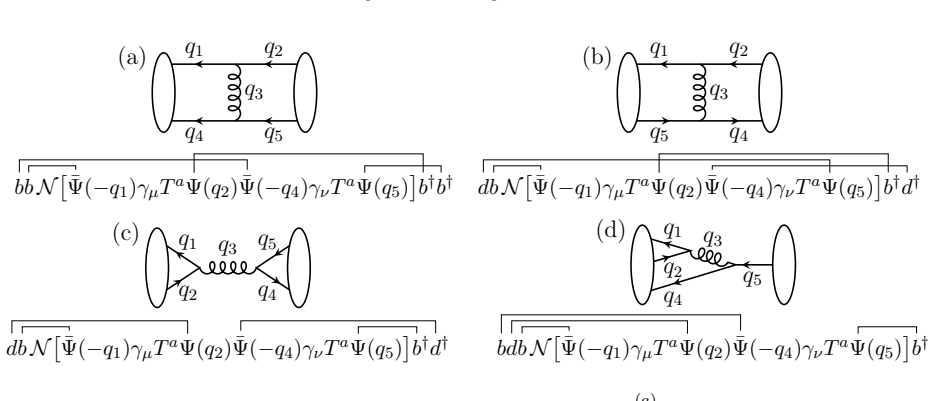
The effective renormalized Hamiltonian of QCD in the front form is finite in the color singlet subspace as the gluon mass approaches zero.
A machine-rendered reading of the paper's core claim, the machinery that carries it, and where it could break.
Core claim
The interplay between self-energy terms and gluon exchange effective terms generates a term proportional to the quadratic SU(3) Casimir operator times the logarithm of the gluon mass. Therefore, the matrix elements are logarithmically divergent in the color nonsinglet subspace, but finite in the color singlet subspace, because the Casimir operator vanishes in the color singlet subspace.
What carries the argument
The renormalization group procedure for effective particles up to second order in the coupling constant, which generates the necessary counterterms for renormalization.
If this is right
- The effective Hamiltonians are well-defined symmetric forms on a dense subspace of the Fock space.
- No divergences appear in the color singlet subspace in the limit of vanishing gluon mass after ultraviolet renormalization.
- The Hamiltonians can be used for nonperturbative numerical calculations on classical or quantum computers.
Where Pith is reading between the lines
- The color-dependent finiteness may explain why only singlet states are observed as physical particles.
- Higher-order terms in the coupling could be checked to see if the cancellation of divergences holds beyond second order.
- The procedure might extend to other non-Abelian gauge theories to examine similar regulator effects.
Load-bearing premise
The renormalization-group procedure for effective particles, truncated at second order in the coupling, produces counterterms that fully cancel all ultraviolet divergences once the gluon-mass regulator is removed, without residual cutoff dependence or higher-order contributions that would reintroduce divergences in the color-singlet sector.
What would settle it
Numerical evaluation of the matrix elements of the effective Hamiltonian between color-singlet states as the gluon mass is taken to zero, checking for the absence of logarithmic divergences.
Figures




read the original abstract
The effective Hamiltonian of quantum chromodynamics in the front form of Hamiltonian dynamics is calculated and renormalized. The renormalization group procedure for effective particles up to the second order in the coupling constant is used. Small gluon mass is used to regulate infrared singularities of the theory. The counterterms necessary to renormalize the theory are determined by computing matrix elements of the effective Hamiltonian. The effective Hamiltonians are well-defined symmetric forms on a dense subspace of the Fock space. The zero modes are cut off but, once ultraviolet renormalization is performed, no divergences are found in the color singlet subspace in the limit of the gluon mass approaching zero. A major result is that the interplay between self-energy terms and gluon exchange effective terms generates a term proportional to the quadratic SU(3) Casimir operator times the logarithm of the gluon mass. Therefore, the matrix elements are logarithmically divergent in the color nonsinglet subspace, but finite in the color singlet subspace, because the Casimir operator vanishes in the color singlet subspace. The effective Hamiltonians are suitable for nonperturbative numerical calculations using either classical or quantum computers.
Editorial analysis
A structured set of objections, weighed in public.
Referee Report
Summary. The manuscript calculates the second-order effective renormalized Hamiltonian of QCD in light-front Hamiltonian dynamics using the renormalization group procedure for effective particles. A small gluon mass regulates infrared singularities, and counterterms are determined from matrix elements of the effective Hamiltonian. The key result is that after UV renormalization, the effective Hamiltonians are finite in the color-singlet subspace as the gluon mass approaches zero, due to the quadratic SU(3) Casimir operator vanishing in that subspace, while logarithmically divergent in nonsinglet subspaces. The effective Hamiltonians are presented as suitable for nonperturbative numerical calculations.
Significance. If the central result holds, this provides a renormalized effective Hamiltonian for QCD that is finite in the physical color-singlet sector after removal of the gluon-mass regulator, enabling nonperturbative studies on classical or quantum computers. The explicit demonstration that the interplay of self-energy and gluon-exchange terms produces a C_2 log(m_g) contribution (which vanishes for singlets) is a concrete technical advance in constructing well-defined operators on Fock space via the RG procedure for effective particles.
major comments (1)
- [Abstract and RG procedure description] Abstract (paragraph on RG procedure and m_g -> 0 limit): the central claim that second-order counterterms fully cancel all ultraviolet divergences in the color-singlet subspace, leaving no residual m_g-dependent or cutoff-dependent terms after the gluon-mass regulator is removed, is load-bearing. The manuscript must supply an explicit argument or calculation demonstrating that the truncation does not allow higher-order contributions to reintroduce divergences in the singlet sector, beyond the Casimir term identified at this order.
Simulated Author's Rebuttal
We thank the referee for the careful reading and for highlighting the significance of the result. We respond to the major comment below.
read point-by-point responses
-
Referee: Abstract (paragraph on RG procedure and m_g -> 0 limit): the central claim that second-order counterterms fully cancel all ultraviolet divergences in the color-singlet subspace, leaving no residual m_g-dependent or cutoff-dependent terms after the gluon-mass regulator is removed, is load-bearing. The manuscript must supply an explicit argument or calculation demonstrating that the truncation does not allow higher-order contributions to reintroduce divergences in the singlet sector, beyond the Casimir term identified at this order.
Authors: The calculation is performed at second order in the coupling using the RGPEP. At this order the counterterms are determined explicitly from matrix elements and cancel all UV divergences; the remaining m_g dependence appears only through a term proportional to the quadratic Casimir operator C_2, which vanishes identically in the color-singlet sector. The RGPEP constructs the effective Hamiltonian order by order, so each perturbative order is renormalized independently. The color algebra responsible for the C_2 factor is representation-theoretic and appears in the same form at higher orders, suggesting the cancellation persists, but an explicit verification at third order or beyond is not performed in the present work and would constitute a separate calculation. revision: partial
- Explicit demonstration that the second-order truncation prevents higher-order contributions from reintroducing divergences requires a calculation beyond second order, which is outside the scope of this manuscript.
Circularity Check
No circularity; result follows from explicit second-order matrix-element computation
full rationale
The derivation applies the renormalization-group procedure for effective particles at second order in the coupling, determines counterterms directly from matrix elements of the effective Hamiltonian, and obtains the C_2 log(m_g) term as an explicit outcome of the interplay between self-energy and gluon-exchange contributions. Finiteness in the color-singlet subspace is a direct algebraic consequence of the Casimir operator vanishing there, not a fitted parameter or self-referential definition. No load-bearing self-citation chain or ansatz smuggling is required for the central claim; the procedure is applied to the regulated theory and the limit m_g -> 0 is taken after renormalization, yielding a self-contained result on the Fock-space subspace.
Axiom & Free-Parameter Ledger
free parameters (1)
- gluon mass regulator m_g
axioms (2)
- domain assumption Light-front quantization of QCD with standard SU(3) color algebra
- domain assumption Renormalization-group procedure for effective particles is valid through second order in the coupling
Forward citations
Cited by 1 Pith paper
-
Gluon mass and small-x dynamics in hadrons
Introduces a gluon mass and auxiliary scalar field to cancel small-x divergences in the front-form QCD Hamiltonian, yielding confinement for heavy quarks as the mass parameter is sent to zero.
Reference graph
Works this paper leans on
-
[1]
S. J. Brodsky, H.-C. Pauli, and S. S. Pinsky, Phys. Rept.301, 299 (1998), arXiv:hep- ph/9705477
arXiv 1998
-
[2]
B. L. G. Bakker et al., Nucl. Phys. B Proc. Suppl.251-252, 165 (2014), arXiv:1309.6333 [hep-ph]
Pith/arXiv arXiv 2014
-
[3]
S. D. Glazek, Nucl. Phys. B Proc. Suppl.90, 175 (2000)
2000
-
[4]
S. D. Glazek, Acta Phys. Polon. B43, 1843 (2012), arXiv:1204.4760 [hep-th]
Pith/arXiv arXiv 2012
-
[5]
S. P. Jordan, K. S. M. Lee, and J. Preskill, Science336, 1130 (2012), arXiv:1111.3633 [quant- ph]. 45
Pith/arXiv arXiv 2012
-
[6]
S. P. Jordan, K. S. M. Lee, and J. Preskill, Quant. Inf. Comput.14, 1014 (2014), arXiv:1112.4833 [hep-th]
Pith/arXiv arXiv 2014
-
[7]
S. P. Jordan, K. S. M. Lee, and J. Preskill, (2014), arXiv:1404.7115 [hep-th]
Pith/arXiv arXiv 2014
-
[8]
T. Maslowski and M. Wieckowski, Phys. Rev. D57, 4976 (1998), arXiv:hep-th/9707057
Pith/arXiv arXiv 1998
-
[9]
Serafin, Model of renormalization of masses and coupling constants, Master’s thesis, Uni- versity of Warsaw, Warsaw (2015), (in Polish)
K. Serafin, Model of renormalization of masses and coupling constants, Master’s thesis, Uni- versity of Warsaw, Warsaw (2015), (in Polish)
2015
-
[10]
Wieckowski, (2005), arXiv:hep-th/0511148
M. Wieckowski, (2005), arXiv:hep-th/0511148
Pith/arXiv arXiv 2005
-
[11]
Collins, (2018), arXiv:1801.03960 [hep-ph]
J. Collins, (2018), arXiv:1801.03960 [hep-ph]
Pith/arXiv arXiv 2018
-
[12]
Chang and S.-K
S.-J. Chang and S.-K. Ma, Phys. Rev.180, 1506 (1969)
1969
-
[13]
P. D. Mannheim, P. Lowdon, and S. J. Brodsky, Phys. Rept.891, 1 (2021), arXiv:2005.00109 [hep-ph]
arXiv 2021
- [14]
-
[15]
K.Hornbostel, The Application of Light Cone Quantization to Quantum Chromodynamics in One-Plus-One Dimensions, Other thesis (1988)
1988
-
[16]
Hornbostel, S
K. Hornbostel, S. J. Brodsky, and H. C. Pauli, Phys. Rev. D41, 3814 (1990)
1990
-
[17]
S. Xu, Y. Liu, C. Mondal, J. Lan, X. Zhao, Y. Li, and J. P. Vary (BLFQ), Phys. Lett. B867, 139599 (2025), arXiv:2408.11298 [hep-ph]
arXiv 2025
-
[18]
S. S. Chabysheva and J. R. Hiller, Eur. Phys. J. ST235, 1451 (2026), arXiv:2502.01775 [hep- th]
arXiv 2026
-
[19]
Tomboulis, Phys
E. Tomboulis, Phys. Rev. D8, 2736 (1973)
1973
-
[20]
Casher, Phys
A. Casher, Phys. Rev. D14, 452 (1976)
1976
-
[21]
G. P. Lepage and S. J. Brodsky, Phys. Rev. D22, 2157 (1980)
1980
-
[22]
W.-M. Zhang and A. Harindranath, Phys. Rev. D48, 4868 (1993), arXiv:hep-th/9302119
Pith/arXiv arXiv 1993
-
[23]
Zhang and A
W.-M. Zhang and A. Harindranath, Phys. Rev. D48, 4881 (1993)
1993
-
[24]
Harindranath and W.-M
A. Harindranath and W.-M. Zhang, Phys. Rev. D48, 4903 (1993)
1993
-
[25]
R. J. Perry, A. Harindranath, and W.-M. Zhang, Phys. Lett. B300, 8 (1993)
1993
-
[26]
X. Zhao, K. Fu, H. Zhao, and J. P. Vary, PoSLC2019, 090 (2020), arXiv:2103.06719 [hep-ph]
arXiv 2020
-
[27]
J. P. Vary, C. Mondal, S. Xu, X. Zhao, and Y. Li (BLFQ), Eur. Phys. J. ST235, 1557 (2026), arXiv:2512.08283 [hep-ph]
arXiv 2026
-
[28]
R. J. Perry, A. Harindranath, and K. G. Wilson, Phys. Rev. Lett.65, 2959 (1990)
1990
-
[29]
R. J. Perry and A. Harindranath, Phys. Rev. D43, 4051 (1991). 46
1991
-
[30]
V. A. Karmanov, J. F. Mathiot, and A. V. Smirnov, Phys. Rev. D77, 085028 (2008), arXiv:0801.4507 [hep-th]
Pith/arXiv arXiv 2008
-
[31]
J. R. Hiller, Prog. Part. Nucl. Phys.90, 75 (2016), arXiv:1606.08348 [hep-ph]
Pith/arXiv arXiv 2016
-
[32]
S. A. Paston, V. A. Franke, and E. V. Prokhvatilov, Theor. Math. Phys.120, 1164 (1999), arXiv:hep-th/0002062
Pith/arXiv arXiv 1999
-
[33]
S. Dalley and G. McCartor, Annals Phys.321, 402 (2006), arXiv:hep-ph/0406287
Pith/arXiv arXiv 2006
-
[34]
S. D. Glazek and K. G. Wilson, Phys. Rev. D48, 5863 (1993)
1993
-
[35]
S. D. Glazek and K. G. Wilson, Phys. Rev. D49, 4214 (1994)
1994
-
[36]
K. G. Wilson, T. S. Walhout, A. Harindranath, W.-M. Zhang, R. J. Perry, and S. D. Glazek, Phys. Rev. D49, 6720 (1994), arXiv:hep-th/9401153
Pith/arXiv arXiv 1994
-
[37]
R.J.Perry,in 4th International Workshop on Light Cone Quantization and Non-Perturbative Dynamics (1994) arXiv:hep-th/9411037
Pith/arXiv arXiv 1994
-
[38]
D. Chakrabarti and A. Harindranath, Phys. Rev. D65, 045001 (2002), arXiv:hep-th/0110156
Pith/arXiv arXiv 2002
-
[39]
M. M. Brisudova and R. Perry, Phys. Rev. D54, 1831 (1996), arXiv:hep-ph/9511443
Pith/arXiv arXiv 1996
-
[40]
M. M. Brisudova, R. J. Perry, and K. G. Wilson, Phys. Rev. Lett.78, 1227 (1997), arXiv:hep- ph/9607280
arXiv 1997
-
[41]
R. J. Perry and K. G. Wilson, Nucl. Phys. B403, 587 (1993)
1993
-
[42]
R. J. Perry, Phys. Rept.348, 33 (2001)
2001
-
[43]
B. H. Allen and R. J. Perry, Phys. Rev. D62, 025005 (2000), arXiv:hep-th/9908124
Pith/arXiv arXiv 2000
-
[44]
S. D. Glazek, Phys. Rev. D69, 065002 (2004), arXiv:hep-th/0307064
Pith/arXiv arXiv 2004
-
[45]
S. D. Glazek and J. Mlynik, Phys. Rev. D74, 105015 (2006), arXiv:hep-th/0606235
Pith/arXiv arXiv 2006
-
[46]
S. D. Głazek, M. Gómez-Rocha, J. More, and K. Serafin, Phys. Lett. B773, 172 (2017), arXiv:1705.07629 [hep-ph]
Pith/arXiv arXiv 2017
-
[47]
K. Serafin, M. Gómez-Rocha, J. More, and S. D. Głazek, Eur. Phys. J. C78, 964 (2018), arXiv:1805.03436 [hep-ph]
Pith/arXiv arXiv 2018
-
[48]
Masłowski,Relativistic description of gluonium using effective gluons in QCD, Phd thesis, University of Warsaw, Warsaw (2005), (in Polish)
T. Masłowski,Relativistic description of gluonium using effective gluons in QCD, Phd thesis, University of Warsaw, Warsaw (2005), (in Polish)
2005
-
[49]
K. Serafin, M. Gómez-Rocha, J. More, and S. D. Głazek, Phys. Rev. D109, 016017 (2024), arXiv:2310.00365 [hep-ph]
arXiv 2024
-
[50]
M. Gómez-Rocha and S. D. Głazek, Phys. Rev. D92, 065005 (2015), arXiv:1505.06688 [hep- ph]. 47
Pith/arXiv arXiv 2015
-
[51]
K. Serafin, C. M. Gustin, and P. J. Love, Phys. Rev. D112, 096003 (2025), arXiv:2508.02972 [hep-ph]
arXiv 2025
-
[52]
Burkardt, Phys
M. Burkardt, Phys. Rev. D47, 4628 (1993)
1993
-
[53]
Burkardt, Nucl
M. Burkardt, Nucl. Phys. A670, 72 (2000)
2000
- [54]
-
[55]
C. M. Gustin, K. Serafin, W. A. Simon, A. Ralli, G. R. Goldstein, and P. J. Love, Physical Review D113, 016018 (2026). 48
2026
discussion (0)
Sign in with ORCID, Apple, or X to comment. Anyone can read and Pith papers without signing in.