Gluon mass and small-x dynamics in hadrons
Pith reviewed 2026-06-30 02:22 UTC · model grok-4.3
The pith
A gluon mass parameter and auxiliary color-octet scalar field cancel small-x divergences in front-form QCD, yielding effective Hamiltonians that exhibit confinement as the mass is removed.
A machine-rendered reading of the paper's core claim, the machinery that carries it, and where it could break.
Core claim
The auxiliary color-octet scalar field that represents the longitudinally polarized gluons decouples from the hadronic constituent dynamics when the gluon mass parameter is sent to zero, as required by gauge theory; the same regularization simultaneously removes the quadratic ultraviolet divergences, and the resulting effective Hamiltonians already at second order display the concept of confinement for heavy quarks in the zero-mass limit.
What carries the argument
auxiliary color-octet scalar field corresponding to longitudinally polarized gluons, introduced together with a gluon mass parameter to cancel small-x and quadratic UV divergences
If this is right
- Second-order effective Hamiltonians for heavy quarks already incorporate confinement once the gluon mass is removed.
- The regularization procedure extends directly from scattering amplitudes to bound-state eigenvalue problems.
- The same auxiliary-field construction supplies a heuristic route toward the dynamics of light quarks.
- Logarithmically scale-dependent Hamiltonian eigenstates for hadrons become accessible after the stronger divergences are tamed.
Where Pith is reading between the lines
- If the decoupling holds, the approach may allow systematic inclusion of higher-order terms without reintroducing power divergences.
- The effective-theory limit with vanishing gluon mass could be compared directly with lattice calculations of heavy-quark potentials.
- Extension to light quarks would require checking whether the auxiliary field remains decoupled at higher orders in the light-quark sector.
Load-bearing premise
The auxiliary color-octet scalar field decouples properly and the chosen regularization cancels all relevant small-x and quadratic divergences without introducing new inconsistencies once the mass parameter is removed.
What would settle it
An explicit computation of the effective Hamiltonian at second order that either retains uncancelled small-x divergences or fails to produce a confining potential when the gluon mass parameter is taken to zero.
Figures


read the original abstract
Precise derivation of the logarithmically scale-dependent Hamiltonian eigenstate picture for hadrons in the space of virtual quark and gluon states of the canonical front form of QCD requires addressing first the problem of divergences stronger than logarithmic, and especially the small-x divergences in the dynamics of gluons. We propose to facilitate the regularization and cancellation of these divergences using a gluon mass parameter and an auxiliary color-octet scalar field corresponding to the longitudinally polarized gluons. The auxiliary field decouples from the hadronic constituent dynamics when the mass parameter tends to zero, as required in the gauge theory. The same method applies in the cancellation of the quadratic ultraviolet transverse divergences in the self-interactions. After explaining how the method works in computations of the scattering amplitudes, we describe its application to the bound-state eigenvalue problems. We focus on the results it leads to already in the second-order weak-coupling expansion for effective Hamiltonians of heavy quarks. They include the concept of confinement in an effective theory with the gluon mass parameter sent to zero and a heuristic scenario concerning extension of the Hamiltonian approach to the dynamics of light quarks.
Editorial analysis
A structured set of objections, weighed in public.
Referee Report
Summary. The manuscript proposes using a gluon mass parameter together with an auxiliary color-octet scalar field (representing longitudinal gluons) to regularize and cancel small-x divergences and quadratic UV divergences in the canonical front-form QCD Hamiltonian. It asserts that the auxiliary field decouples from hadronic dynamics as the mass parameter m tends to zero, consistent with gauge theory requirements. The method is illustrated first for scattering amplitudes and then applied to bound-state eigenvalue problems, yielding an effective Hamiltonian for heavy quarks at second order in weak coupling that exhibits confinement once m is sent to zero; a heuristic scenario is sketched for extending the approach to light quarks.
Significance. If the decoupling and cancellation can be shown to hold without residual m-dependent or gauge-dependent terms, the construction would supply a concrete regularization tool for non-logarithmic divergences that have long obstructed light-front Hamiltonian treatments of QCD. The attempt to carry the same regulator from scattering amplitudes into bound-state problems is a positive step, and the emergence of confinement in the m=0 heavy-quark effective theory is a noteworthy outcome if demonstrated explicitly. The work is still limited by the second-order restriction for heavy quarks and the heuristic status of the light-quark case.
major comments (3)
- [bound-state eigenvalue problems] The central claim that the auxiliary field decouples in the m→0 limit inside the bound-state eigenvalue problem (rather than only in scattering amplitudes) is load-bearing, yet the manuscript provides no explicit operator-level cancellation or residual-term analysis for the heavy-quark Hamiltonian at second order; without this, it is impossible to confirm that the claimed confinement is free of m-dependent artifacts.
- [scattering amplitudes and regularization procedure] The regularization is asserted to remove all small-x and quadratic UV divergences simultaneously when m→0, but no concrete cancellation (e.g., of the relevant matrix elements or self-energy contributions) is exhibited for the canonical front-form Hamiltonian; this omission directly affects verifiability of the decoupling statement.
- [light-quark extension] The extension to light quarks is labeled a 'heuristic scenario' while the overall framing is a 'precise derivation' for hadrons; because the light-quark dynamics are part of the stated goal, the absence of even a schematic derivation or consistency check constitutes a load-bearing gap.
minor comments (2)
- The abstract and introduction alternate between 'precise derivation' and 'heuristic scenario'; a short clarifying paragraph distinguishing the two regimes would improve readability.
- Notation for the auxiliary scalar field and the gluon mass parameter should be introduced with an explicit definition or Lagrangian term at first appearance.
Simulated Author's Rebuttal
We thank the referee for the careful reading and constructive comments on our manuscript. We address each major comment below. Where the points identify gaps in explicit demonstrations, we agree to strengthen the presentation in revision.
read point-by-point responses
-
Referee: The central claim that the auxiliary field decouples in the m→0 limit inside the bound-state eigenvalue problem (rather than only in scattering amplitudes) is load-bearing, yet the manuscript provides no explicit operator-level cancellation or residual-term analysis for the heavy-quark Hamiltonian at second order; without this, it is impossible to confirm that the claimed confinement is free of m-dependent artifacts.
Authors: We agree that an explicit operator-level analysis of residual terms in the second-order heavy-quark effective Hamiltonian would make the decoupling statement fully verifiable. The current text derives the effective Hamiltonian and states the m→0 limit, but does not tabulate the cancellation of all m-dependent pieces. In the revised manuscript we will add this operator-level cancellation, confirming that the confining term survives without m-dependent artifacts. revision: yes
-
Referee: The regularization is asserted to remove all small-x and quadratic UV divergences simultaneously when m→0, but no concrete cancellation (e.g., of the relevant matrix elements or self-energy contributions) is exhibited for the canonical front-form Hamiltonian; this omission directly affects verifiability of the decoupling statement.
Authors: The manuscript outlines the cancellation mechanism for scattering amplitudes and self-interactions, but does not display explicit matrix-element cancellations. We will insert concrete calculations of the relevant self-energy and interaction matrix elements in the revised version to exhibit the simultaneous removal of small-x and quadratic UV divergences as m→0. revision: yes
-
Referee: The extension to light quarks is labeled a 'heuristic scenario' while the overall framing is a 'precise derivation' for hadrons; because the light-quark dynamics are part of the stated goal, the absence of even a schematic derivation or consistency check constitutes a load-bearing gap.
Authors: The core results concern the regularization procedure and its second-order application to heavy quarks, where the derivation is precise. The light-quark discussion is intentionally labeled heuristic because a full treatment lies beyond weak-coupling perturbation theory. We will expand the existing schematic into a short consistency check that verifies the auxiliary-field decoupling property carries over, thereby clarifying the scope without altering the framing. revision: partial
Circularity Check
No significant circularity; decoupling asserted without reduction to inputs by construction
full rationale
The provided abstract asserts that the auxiliary color-octet scalar field decouples as the gluon mass parameter tends to zero and that the method cancels divergences while yielding confinement in the m=0 limit, but no equations, self-citations, or fitted parameters are quoted that reduce the central claim to its own inputs by definition. The derivation chain for scattering amplitudes and second-order heavy-quark Hamiltonians is described at a high level without visible self-definitional loops or load-bearing self-citations. The bound-state extension is labeled heuristic, but this does not constitute circularity. The paper appears self-contained against external benchmarks in the given text.
Axiom & Free-Parameter Ledger
free parameters (1)
- gluon mass parameter
axioms (1)
- domain assumption The auxiliary field decouples from hadronic dynamics as the gluon mass tends to zero, consistent with gauge theory requirements.
invented entities (1)
-
auxiliary color-octet scalar field
no independent evidence
Reference graph
Works this paper leans on
-
[1]
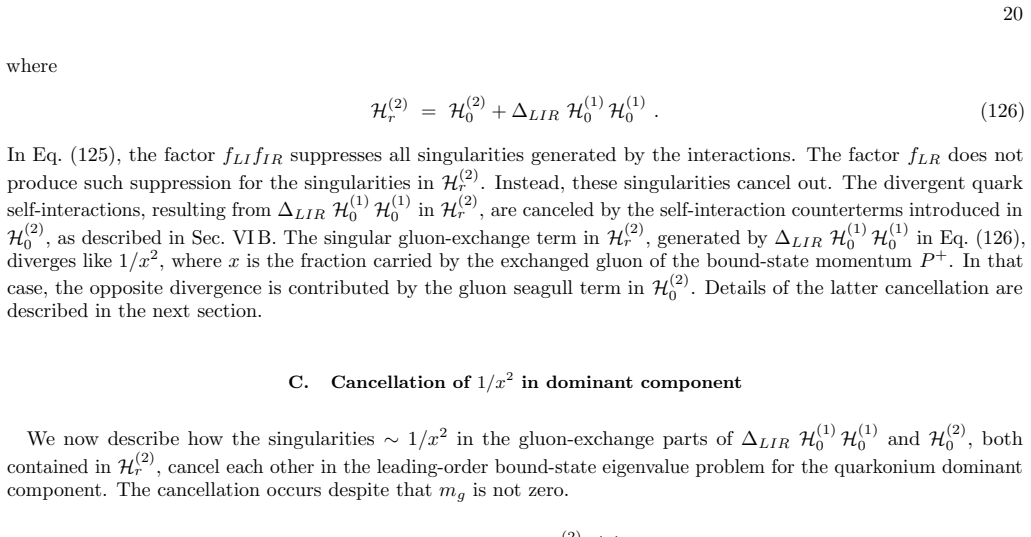
(109) impllies fLR = 1
Therefore, Eq. (109) impllies fLR = 1. In contrast, the momenta p2 and p1′ of the contracted quark and gluon operators yieldf LI =f IR = exp −(s/p+ 1 )2[m2 1 −(p 2 +p 1′)2]2 , which results in fLI fIR = exp −2(sD/p+ 1 )2/[x(1−x)] 2 .(117) This factor vanishes for small x and large k⊥. Therefore, the integrand involving fLI fIR contributes a finite quantit...
-
[2]
+γ E/2 .(119) Consequently, the Hamiltonian H(2) 0 is further supplied with a logarithmic mass-squared counterterm δm2 1 ln. This means that not only the self-interaction divergence is removed from the effective Hamiltonian with finite s but also that a choice is made for the finite part of the counterterm. The choice made here is adopted to obtain the re...
-
[3]
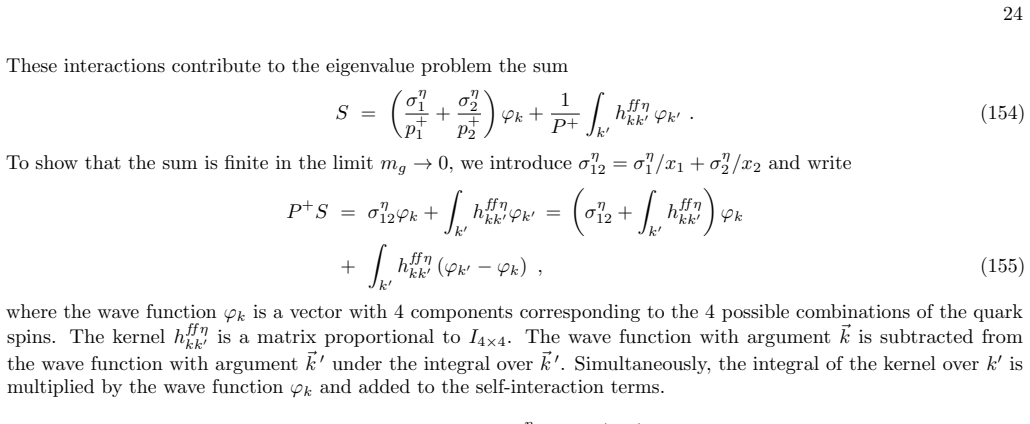
155), ˜σ= ˜σ1 + ˜σ2 =σ η 12 + Z k′ hf f η kk′ .(156) Integration of the kernel over ⃗k′ is split into two parts corresponding to the two self-interaction terms, ˜σ1 and ˜σ2
Self-interaction We now discuss the resulting self-interaction terms including the kernel integrals, which multiply the wave function φk on the right-hand side of Eq. 155), ˜σ= ˜σ1 + ˜σ2 =σ η 12 + Z k′ hf f η kk′ .(156) Integration of the kernel over ⃗k′ is split into two parts corresponding to the two self-interaction terms, ˜σ1 and ˜σ2. The quark self-i...
-
[4]
(155), hf f η∆φ= Z k′ hf f η kk′ (φk′ −φ k),(167) 26 in the limit mg → 0
Exchange Now we describe the second term on the right-hand side of Eq. (155), hf f η∆φ= Z k′ hf f η kk′ (φk′ −φ k),(167) 26 in the limit mg → 0. Quark spins are conserved. The integration over x1′ and k⊥ 1′2′ is carried out using the variables z andq ⊥, x1′ =x 1 +z , k ⊥ 1′2′ =k ⊥ 12 +q ⊥ ,(168) for fixedx 1 andk ⊥
-
[5]
The integral in Eq
We introduces P =s/P + and write hf f η∆φ= −g2CF 2(2π)3 Z x2 −x1 dz Z d2q⊥ e−s2 P (ρ2 1+ρ2 2)/z2 × (ρ1 +ρ 2)2 4ρ1ρ2 4√x1x1′x2x2′ x1′x2′ z2 (φk′ −φ k).(169) Usingp ⊥ 1 =x 1P ⊥ +k ⊥ 12,p ⊥ 1′ =x 1′P ⊥ +k ⊥ 1′2′ etc., and introducing q⊥ = p |z|k ⊥ ,(170) we obtain ρ1 |z| = m2 g |z| + m2 1|z|/x2 1 + (k⊥ −k ⊥ 12sz p |z|/x1)2 1 +z/x 1 ,(171) ρ2 |z| = m2 g |z| +...
-
[6]
(177) in the limit mg → 0, is discussed following the steps made in Sec
InteractionV φ s The interaction V φs of Eq. (177) in the limit mg → 0, is discussed following the steps made in Sec. VIII B, where it is shown that the terms ∼lnm g cancel out in the full relativistic formula. Knowing that the singular terms cancel out, we can identify elements of the remaining finite terms. We take advantage of the simplifications occur...
-
[7]
P. A. M. Dirac, Rev. Mod. Phys.21, 392 (1949)
1949
-
[8]
R. L. Workman and Others (Particle Data Group), PTEP2022, 083C01 (2022)
2022
-
[9]
Navas et al
S. Navas et al. (Particle Data Group), Phys. Rev. D110, 030001 (2024)
2024
-
[10]
K. G. Wilson, T. S. Walhout, A. Harindranath, W.-M. Zhang, R. J. Perry, and S. D. Glazek, Phys. Rev. D49, 6720 (1994), arXiv:hep-th/9401153
work page internal anchor Pith review Pith/arXiv arXiv 1994
-
[11]
R. J. Perry, in Hadrons 94 Workshop (1994) arXiv:hep-th/9407056
work page internal anchor Pith review Pith/arXiv arXiv 1994
-
[12]
K. Serafin, M. G´ omez-Rocha, J. More, and S. D. G lazek, Phys. Rev. D109, 016017 (2024), arXiv:2310.00365 [hep-ph]
-
[13]
S. D. Glazek, Phys. Rev. D63, 116006 (2001), arXiv:hep-th/0012012
work page internal anchor Pith review Pith/arXiv arXiv 2001
-
[14]
D. E. Soper, Phys. Rev. D4, 1620 (1971)
1971
-
[15]
Yan, Phys
T.-M. Yan, Phys. Rev. D7, 1760 (1973)
1973
-
[16]
J. B. Kogut and L. Susskind, Phys. Rept.8, 75 (1973)
1973
-
[17]
Yan, Phys
T.-M. Yan, Phys. Rev. D7, 1780 (1973)
1973
-
[18]
G. P. Lepage and S. J. Brodsky, Phys. Rev. D22, 2157 (1980)
1980
-
[19]
J. M. Namyslowski, Prog. Part. Nucl. Phys.14, 49 (1985)
1985
-
[20]
M. Burkardt, Adv. Nucl. Phys.23, 1 (1996), arXiv:hep-ph/9505259
work page internal anchor Pith review Pith/arXiv arXiv 1996
-
[21]
S. J. Brodsky, H.-C. Pauli, and S. S. Pinsky, Phys. Rept.301, 299 (1998), arXiv:hep-ph/9705477
work page internal anchor Pith review Pith/arXiv arXiv 1998
-
[22]
Explicitly Covariant Light-Front Dynamics and Relativistic Few-Body Systems
J. Carbonell, B. Desplanques, V. A. Karmanov, and J. F. Mathiot, Phys. Rept.300, 215 (1998), arXiv:nucl-th/9804029
work page internal anchor Pith review Pith/arXiv arXiv 1998
-
[23]
S. J. Brodsky, G. F. de Teramond, H. G. Dosch, and J. Erlich, Phys. Rept.584, 1 (2015), arXiv:1407.8131 [hep-ph]
work page internal anchor Pith review Pith/arXiv arXiv 2015
- [24]
-
[25]
G. P. Lepage, S. J. Brodsky, T. Huang, and P. B. Mackenzie, inBanff Summer Institute in Particles and Fields: QCD, Gauge Theories and Grand Unification Schemes (1982) pp. 83–141
1982
-
[26]
E. C. G. Stueckelberg, Helv. Phys. Acta11, 299 (1938)
1938
- [27]
-
[28]
Kunimasa and T
T. Kunimasa and T. Goto, Prog. Theor. Phys.37, 452 (1967)
1967
-
[29]
Current Algebra: Quarks and What Else?
H. Fritzsch and M. Gell-Mann, eConfC720906V2, 135 (1972), arXiv:hep-ph/0208010
work page internal anchor Pith review Pith/arXiv arXiv 1972
-
[30]
Gell-Mann and M
M. Gell-Mann and M. L. Goldberger, Phys. Rev.91, 398 (1953)
1953
-
[31]
Weinberg, The Quantum theory of fields
S. Weinberg, The Quantum theory of fields. Vol. 1, Foundations (Cambridge University Press, 1995)
1995
-
[32]
Harindranath and J
A. Harindranath and J. P. Vary, Phys. Rev. D37, 3010 (1988)
1988
-
[33]
E. A. Bartnik and S. D. Glazek, Phys. Rev. D39, 1249 (1989)
1989
-
[34]
S. D. Glazek, Phys. Rev. D38, 3277 (1988)
1988
-
[35]
S. D. Glazek, Acta Phys. Polon. B29, 1979 (1998), arXiv:hep-th/9712188
work page internal anchor Pith review Pith/arXiv arXiv 1979
-
[36]
S. D. Glazek, Acta Phys. Polon. B41, 1937 (2010), arXiv:1006.4132 [hep-th]
work page internal anchor Pith review Pith/arXiv arXiv 1937
-
[37]
S. D. Glazek, Acta Phys. Polon. B41, 2669 (2010)
2010
-
[38]
S. D. Glazek, Few Body Syst.55, 535 (2014), arXiv:1312.1174 [hep-th]
work page internal anchor Pith review Pith/arXiv arXiv 2014
-
[39]
J. D. Bjorken, Prog. Math. Phys.4, 423 (1979)
1979
-
[40]
K. G. Wilson, Phys. Rev.140, B445 (1965)
1965
-
[41]
K. G. Wilson, Phys. Rev. D2, 1438 (1970)
1970
-
[42]
S. D. G lazek, The European Physical Journal Special Topics 10.1140/epjs/s11734-026-02127-y (2026)
-
[43]
S. D. Glazek and K. G. Wilson, Phys. Rev. D48, 5863 (1993)
1993
-
[44]
S. D. Glazek and K. G. Wilson, Phys. Rev. D49, 4214 (1994)
1994
-
[45]
S. D. Glazek and K. G. Wilson, Phys. Rev. D57, 3558 (1998), arXiv:hep-th/9707028. 39
work page internal anchor Pith review Pith/arXiv arXiv 1998
-
[46]
S. D. Glazek, Phys. Rev. D75, 025005 (2007), arXiv:hep-th/0611015
work page internal anchor Pith review Pith/arXiv arXiv 2007
-
[47]
Wegner, Annalen Phys.506, 77 (1994)
F. Wegner, Annalen Phys.506, 77 (1994)
1994
-
[48]
Flow equations for band--matrices
A. Mielke, Eur. Phys. J. B5, 605 (1998), arXiv:quant-ph/9803040
work page internal anchor Pith review Pith/arXiv arXiv 1998
-
[49]
Wegner, Journal of Physics A: Mathematical and General39, 8221 (2006)
F. Wegner, Journal of Physics A: Mathematical and General39, 8221 (2006)
2006
-
[50]
Kehrein, The flow equation approach to many-particle systems, Vol
S. Kehrein, The flow equation approach to many-particle systems, Vol. 217 (Springer, 2006)
2006
-
[51]
M. Vogl, P. Laurell, A. D. Barr, and G. A. Fiete, Phys. Rev. X9, 021037 (2019)
2019
-
[52]
Deift, T
P. Deift, T. R. Nanda, and C. Tomei, SIAM Journal on Numerical Analysis20, 1 (1983)
1983
-
[53]
M. T. Chu, SIAM Review30, 375 (1988), https://doi.org/10.1137/1030090
-
[54]
Brockett, Linear Algebra and its Applications146, 79 (1991)
R. Brockett, Linear Algebra and its Applications146, 79 (1991)
1991
-
[55]
S. D. Glazek and J. Mlynik, Phys. Rev. D67, 045001 (2003), arXiv:hep-th/0210110
work page internal anchor Pith review Pith/arXiv arXiv 2003
-
[56]
S. D. Glazek and J. Mlynik, Acta Phys. Polon. B35, 723 (2004), arXiv:hep-th/0307207
work page internal anchor Pith review Pith/arXiv arXiv 2004
- [57]
-
[58]
S. D. Glazek, Acta Phys. Polon. B43, 1843 (2012), arXiv:1204.4760 [hep-th]
work page internal anchor Pith review Pith/arXiv arXiv 2012
-
[59]
Appelquist and H
T. Appelquist and H. D. Politzer, Phys. Rev. Lett.34, 43 (1975)
1975
-
[60]
Appelquist, A
T. Appelquist, A. De Rujula, H. D. Politzer, and S. L. Glashow, Phys. Rev. Lett.34, 365 (1975)
1975
-
[61]
Eichten, K
E. Eichten, K. Gottfried, T. Kinoshita, K. D. Lane, and T.-M. Yan, Phys. Rev. D17, 3090 (1978), [Erratum: Phys.Rev.D 21, 313 (1980)]
1978
-
[62]
Eichten, K
E. Eichten, K. Gottfried, T. Kinoshita, K. D. Lane, and T.-M. Yan, Phys. Rev. D21, 203 (1980)
1980
-
[63]
K. G. Wilson, Phys. Rev. D10, 2445 (1974)
1974
-
[64]
G. T. Bodwin, E. Braaten, and G. P. Lepage, Phys. Rev. D51, 1125 (1995), [Erratum: Phys.Rev.D 55, 5853 (1997)], arXiv:hep-ph/9407339
work page internal anchor Pith review Pith/arXiv arXiv 1995
-
[65]
Heavy quarkonium: progress, puzzles, and opportunities
N. Brambilla et al., Eur. Phys. J. C71, 1534 (2011), arXiv:1010.5827 [hep-ph]
work page internal anchor Pith review Pith/arXiv arXiv 2011
-
[66]
S. D. Glazek, Phys. Rev. D90, 045020 (2014), arXiv:1406.0127 [hep-th]
work page internal anchor Pith review Pith/arXiv arXiv 2014
-
[67]
Second-order effective renormalized Hamiltonian of Quantum Chromodynamics
K. Serafin, C. M. Gustin, and P. J. Love, arXiv (2026), arXiv:2606.24699 [hep-ph]
work page internal anchor Pith review Pith/arXiv arXiv 2026
-
[68]
Approximate Hamiltonian for baryons in heavy-flavor QCD
K. Serafin, M. G´ omez-Rocha, J. More, and S. D. G lazek, Eur. Phys. J. C78, 964 (2018), arXiv:1805.03436 [hep-ph]
work page internal anchor Pith review Pith/arXiv arXiv 2018
- [69]
-
[70]
A. P. Trawi´ nski, S. D. G lazek, S. J. Brodsky, G. F. de T´ eramond, and H. G. Dosch, Phys. Rev. D90, 074017 (2014), arXiv:1403.5651 [hep-ph]
work page internal anchor Pith review Pith/arXiv arXiv 2014
-
[71]
Bloch and A
F. Bloch and A. Nordsieck, Phys. Rev.52, 54 (1937)
1937
- [72]
-
[73]
M. M. Brisudova, R. J. Perry, and K. G. Wilson, Phys. Rev. Lett.78, 1227 (1997), arXiv:hep-ph/9607280
work page internal anchor Pith review Pith/arXiv arXiv 1997
-
[74]
M. M. Brisudova, S. Szpigel, and R. J. Perry, Phys. Lett. B421, 334 (1998), arXiv:hep-ph/9709479
work page internal anchor Pith review Pith/arXiv arXiv 1998
-
[75]
I. Tamm, J. Phys. (USSR)9, 449 (1945)
1945
-
[76]
S. M. Dancoff, Phys. Rev.78, 382 (1950)
1950
-
[77]
R. J. Perry, A. Harindranath, and K. G. Wilson, Phys. Rev. Lett.65, 2959 (1990)
1990
-
[78]
R. J. Perry and A. Harindranath, Phys. Rev. D43, 4051 (1991)
1991
-
[79]
Casher and L
A. Casher and L. Susskind, Phys. Lett. B44, 171 (1973)
1973
-
[80]
M. A. Shifman, A. I. Vainshtein, and V. I. Zakharov, Nucl. Phys. B147, 385 (1979)
1979
discussion (0)
Sign in with ORCID, Apple, or X to comment. Anyone can read and Pith papers without signing in.