Dirac-Frenkel dynamics with inertia for nonlinearly parametrized solutions of evolution problems
Pith reviewed 2026-06-25 22:46 UTC · model grok-4.3
The pith
Adding inertia to Dirac-Frenkel dynamics yields well-posed parameter evolution for nonlinear parametrizations.
A machine-rendered reading of the paper's core claim, the machinery that carries it, and where it could break.
Core claim
By augmenting the Dirac-Frenkel variational principle with inertia, the resulting parameter dynamics become well-posed for redundant nonlinear parametrizations. In directions that are well-informed the dynamics coincide with the original Dirac-Frenkel equations, while in weakly informed directions the previous parameter velocity is carried forward as an anchor. The formulation admits a posteriori error bounds, and time discretization leads to the same type of regularized least-squares problem with the previous velocity appearing explicitly.
What carries the argument
The inertial term added to the Dirac-Frenkel dynamics, which acts as an anchor for parameter velocity in under-determined directions while preserving the projection in informed ones.
If this is right
- The parameter dynamics are well-posed even when the parametrization is redundant.
- Velocity information persists from the trajectory in weakly informed directions.
- Time-discretized version requires solving a regularized least-squares problem with previous velocity as anchor.
- A posteriori error bounds hold for the inertial formulation.
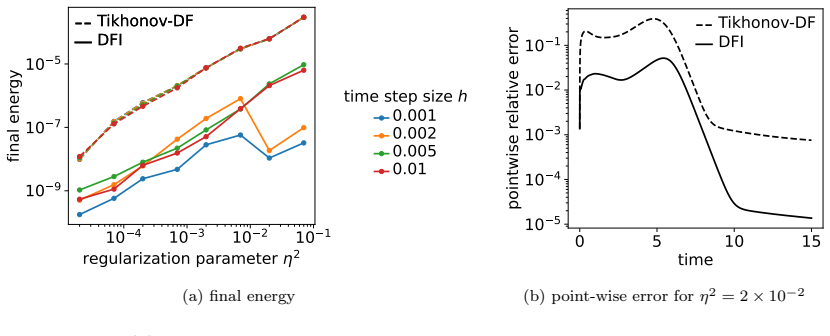
- Numerical tests demonstrate increased robustness over the non-inertial version.
Where Pith is reading between the lines
- This could extend to other time-dependent reduced-order modeling techniques beyond Dirac-Frenkel.
- The method might allow adaptive time-stepping by leveraging the carried velocity.
- Similar inertia ideas could apply to optimization problems with redundant parameters.
- Further analysis might connect this to momentum-based methods in machine learning training.
Load-bearing premise
That adding the inertial term preserves the essential projection property of Dirac-Frenkel dynamics without introducing uncontrolled instabilities in the well-informed directions.
What would settle it
Observe whether the inertial method produces non-unique or divergent parameter trajectories on a test problem with known redundant parametrization where the standard method fails, or check if the computed a posteriori error bounds are violated in practice.
Figures





read the original abstract
Even when Dirac-Frenkel dynamics determine a well-defined evolution in function space, the corresponding parameter dynamics can be non-unique or ill-conditioned for redundant nonlinear parametrizations such as neural networks or mixture models. We propose to add inertia to the Dirac-Frenkel dynamics and show that this allows useful parameter velocity information to persist from the past trajectory in directions that are weakly informed, while well-informed parameter velocity directions continue to follow the Dirac-Frenkel dynamics. We prove that the inertial formulation yields well-posed parameter dynamics and provide a posteriori error bounds. After time discretization, the method requires the solution of the same type of regularized linear least-squares problem as standard Dirac-Frenkel dynamics, but with the previous velocity appearing as an anchor. Numerical experiments demonstrate the increased robustness obtained with inertia.
Editorial analysis
A structured set of objections, weighed in public.
Referee Report
Summary. The manuscript develops an inertial variant of the Dirac-Frenkel variational dynamics for nonlinearly parametrized approximations to evolution equations. The inertia allows velocity information to carry over in poorly conditioned parameter directions while the dynamics in well-informed directions remain unchanged from the standard projection. Well-posedness is proved by viewing the inertia as a bounded perturbation on the orthogonal complement of the Jacobian range, and a posteriori bounds are obtained via Gronwall's inequality. The time-discretized method solves the same regularized least-squares problem as the original but anchored by the prior velocity. Experiments on neural networks and Gaussian mixtures confirm greater robustness for redundant parametrizations.
Significance. This provides a targeted fix for ill-conditioning in parameter space for redundant nonlinear parametrizations without compromising the variational structure or introducing uncontrolled changes in well-conditioned directions. The subspace decomposition and perturbation analysis are rigorous, and the numerical results support the theoretical claims. It strengthens the applicability of Dirac-Frenkel methods in contexts like neural network reduced-order modeling. The absence of additional assumptions on manifold curvature in the error bounds is a positive feature.
Simulated Author's Rebuttal
We thank the referee for the positive assessment and recommendation to accept the manuscript. The report accurately captures the main contributions regarding well-posedness, a posteriori bounds, and improved robustness for redundant parametrizations.
Circularity Check
No significant circularity
full rationale
The paper introduces inertia as an explicit additive modification to the Dirac-Frenkel variational principle. Well-posedness follows from a standard perturbation argument on the orthogonal complement of the Jacobian range, and a-posteriori bounds are obtained via Gronwall after absorbing the inertia term; neither step reduces the claimed result to a fitted quantity or to a self-citation. The numerical scheme re-uses the same regularized least-squares solve with an added anchor term, which is a genuine algorithmic extension rather than a renaming or self-definition. No load-bearing self-citation or ansatz smuggling is present in the provided text.
Axiom & Free-Parameter Ledger
axioms (1)
- domain assumption Dirac-Frenkel dynamics determine a well-defined evolution in function space even for redundant parametrizations
Reference graph
Works this paper leans on
-
[1]
Aghili, J
J. Aghili, J. Z. Atokple, M. Billaud-Friess, G. Garnier, O. Mula, and N. Tognon. A dynamical neural galerkin scheme for filtering problems.ESAIM: ProcS, 81:2–15, 2025
2025
-
[2]
Anderson and M
W. Anderson and M. Farazmand. Evolution of nonlinear reduced-order solutions for PDEs with conserved quantities.SIAM J. Sci. Comput., 44(1):A176–A197, 2022
2022
-
[3]
Attouch, X
H. Attouch, X. Goudou, and P. Redont. The heavy ball with friction method, i. the continuous dynamical system: Global exploration of the local minima of a real-valued function by asymptotic analysis of a dissipative dynamical system.Communications in Contemporary Mathematics, 02(01):1–34, 2000
2000
-
[4]
Berman and B
J. Berman and B. Peherstorfer. Randomized sparse Neural Galerkin schemes for solving evolution equations with deep networks. In A. Oh, T. Naumann, A. Globerson, K. Saenko, M. Hardt, and S. Levine, editors,Advances in Neural Information Processing Systems, volume 36, pages 4097–4114, New Orleans, Louisiana, USA, 2023. Curran Associates, Inc
2023
- [5]
-
[6]
Bruna, B
J. Bruna, B. Peherstorfer, and E. Vanden-Eijnden. Neural Galerkin schemes with active learning for high-dimensional evolution equations.Journal of Computational Physics, 496:112588, Jan. 2024
2024
-
[7]
B. Carrel. Randomized methods for dynamical low-rank approximation.Journal of Computational Physics, 544:114421, 2026
2026
-
[8]
H. Chen, R. Wu, E. Grinspun, C. Zheng, and P. Y. Chen. Implicit neural spatial repre- sentations for time-dependent PDEs. In A. Krause, E. Brunskill, K. Cho, B. Engelhardt, S. Sabato, and J. Scarlett, editors,Proceedings of the 40th International Conference on Machine Learning, volume 202 ofProceedings of Machine Learning Research, pages 5162–5177. PMLR, ...
2023
-
[9]
Z. Chen, J. Mccarran, E. Vizcaino, M. Soljacic, and D. Luo. TENG: Time-evolving natural gradient for solving PDEs with deep neural nets toward machine precision. In R. Salakhutdinov, Z. Kolter, K. Heller, A. Weller, N. Oliver, J. Scarlett, and F. Berkenkamp, editors,Proceedings of the 41st International Conference on Machine Learning, volume 235 ofProceed...
2024
-
[10]
Dahmen, W
W. Dahmen, W. Li, Y. Teng, and Z. Wang. Expansive natural neural gradient flows for energy minimization, 2025
2025
-
[11]
P. A. M. Dirac. Note on exchange phenomena in the thomas atom.Mathematical Proceedings of the Cambridge Philosophical Society, 26(3):376–385, 1930
1930
- [12]
-
[13]
Du and T
Y. Du and T. A. Zaki. Evolutional deep neural network.Phys. Rev. E, 104:045303, Oct 2021
2021
-
[14]
M. Feischl, C. Lasser, C. Lubich, and J. Nick. Regularized dynamical parametric approximation.arXiv, 2403.19234, 2024
-
[15]
M. A. Finzi, A. Potapczynski, M. Choptuik, and A. G. Wilson. A stable and scal- able method for solving initial value PDEs with neural networks. InThe Eleventh International Conference on Learning Representations, 2023
2023
-
[16]
Frenkel.Wave Mechanics, Advanced General Theory
J. Frenkel.Wave Mechanics, Advanced General Theory. Clarendon Press, Oxford, 1934
1934
-
[17]
Haegeman, J
J. Haegeman, J. I. Cirac, T. J. Osborne, I. Pizorn, H. Verschelde, and F. Verstraete. Time-dependent variational principle for quantum lattices.Physical Review Letters, 107:070601, 2011
2011
-
[18]
J. S. Hesthaven, B. Peherstorfer, and B. Unger. Nonlinear model reduction for transport- dominated problems.Acta Numerica, 35:173–272, 2026
2026
-
[19]
Z. Hu, C. Liu, Y. Wang, and Z. Xu. Energetic variational neural network discretizations of gradient flows.SIAM Journal on Scientific Computing, 46(4):A2528–A2556, 2024
2024
-
[20]
Kast and J
M. Kast and J. S. Hesthaven. Positional embeddings for solving PDEs with evolutional deep neural networks.Journal of Computational Physics, 508:112986, 2024
2024
-
[21]
K. G. Kay. The matrix singularity problem in the time-dependent variational method. Chem. Phys., 137(1):165–175, 1989
1989
-
[22]
Koch and C
O. Koch and C. Lubich. Dynamical low-rank approximation.SIAM Journal on Matrix Analysis and Applications, 29(2):434–454, 2007
2007
-
[23]
Noneedforagrid: Adaptivefully- flexible gaussians for the time-dependent Schrödinger equation.arXiv, 2207(00271):1–8, 2023
S.Kvaal, C.Lasser, T.B.Pedersen, andL.Adamowicz. Noneedforagrid: Adaptivefully- flexible gaussians for the time-dependent Schrödinger equation.arXiv, 2207(00271):1–8, 2023. 31
2023
-
[24]
H. Y. Lam, G. Ceruti, and D. Kressner. Randomized low-rank Runge–Kutta methods. SIAM J. Matrix Anal. Appl., 46(2):1587–1615, 2025
2025
-
[25]
C. Lubich. On variational approximations in quantum molecular dynamics.Mathematics of Computation, 74(250):765–779, 2005
2005
-
[26]
Lubich.From Quantum to Classical Molecular Dynamics: Reduced Models and Numerical Analysis
C. Lubich.From Quantum to Classical Molecular Dynamics: Reduced Models and Numerical Analysis. EMS Press, Berlin, Germany, 2008
2008
-
[27]
C. Lubich and J. Nick. Regularized dynamical parametric approximation of stiff evolution problems.arXiv, 2501.12118, 2025
-
[28]
B. Polyak. Some methods of speeding up the convergence of iteration methods.USSR Computational Mathematics and Mathematical Physics, 4(5):1–17, 1964
1964
-
[29]
Raviola and B
M. Raviola and B. Peherstorfer. A Dirac-Frenkel-Onsager principle: Instantaneous residual minimization with gauge momentum for nonlinear parametrizations of PDE solutions. InInternational Conference on Machine Learning (ICML), 2026
2026
-
[30]
Teschl.Ordinary Differential Equations and Dynamical Systems, volume 140 of Graduate Studies in Mathematics
G. Teschl.Ordinary Differential Equations and Dynamical Systems, volume 140 of Graduate Studies in Mathematics. American Mathematical Society, Providence, RI, 2012
2012
-
[31]
Y. Wang, J. Chen, C. Liu, and L. Kang. Particle-based energetic variational inference. Statistics and Computing, 31:1–17, 2021
2021
-
[32]
Zhang, Y
H. Zhang, Y. Chen, E. Vanden-Eijnden, and B. Peherstorfer. Sequential-in-time training of nonlinear parametrizations for solving time-dependent partial differential equations. SIAM Review, 2025. (accepted). 32
2025
discussion (0)
Sign in with ORCID, Apple, or X to comment. Anyone can read and Pith papers without signing in.