Using SKAO to Understand the Clustering of Gravitational Wave Sources
Pith reviewed 2026-06-25 23:03 UTC · model grok-4.3
The pith
Cross-correlating gravitational wave sources with SKA-Mid can constrain the time-delay distribution of binary black hole mergers.
A machine-rendered reading of the paper's core claim, the machinery that carries it, and where it could break.
Core claim
SKA-Mid×ET2CE cross-correlations, using a semi-analytic model of GW events as a function of time-delay distribution, will allow extraction of the GW clustering bias and foster understanding of the time-delay distribution.
What carries the argument
The semi-analytic model for GW events hosted by SKAO galaxies as a function of the time-delay distribution between binary formation and merger, used to forecast cross-correlation signal-to-noise ratios.
If this is right
- Measurements of GW clustering bias will indicate whether progenitors formed through stellar evolution or as primordial black holes.
- Cross-correlations will probe the epochs and environments where stellar BBHs form most efficiently.
- The approach mitigates uncertainties in individual GW detections by leveraging large-scale structure data.
Where Pith is reading between the lines
- Similar cross-correlation techniques could be applied to other upcoming LSS surveys to study additional GW properties.
- Success here might motivate more detailed simulations of binary formation in different galactic environments to refine the model.
Load-bearing premise
The semi-analytic model for GW events hosted by SKAO galaxies as a function of the time-delay distribution, together with the adopted number density and bias prescriptions for the three tracers, accurately represents the underlying astrophysics.
What would settle it
A measured cross-correlation signal-to-noise ratio that does not match the predicted values for any reasonable time-delay distribution would falsify the model's applicability.
Figures

read the original abstract
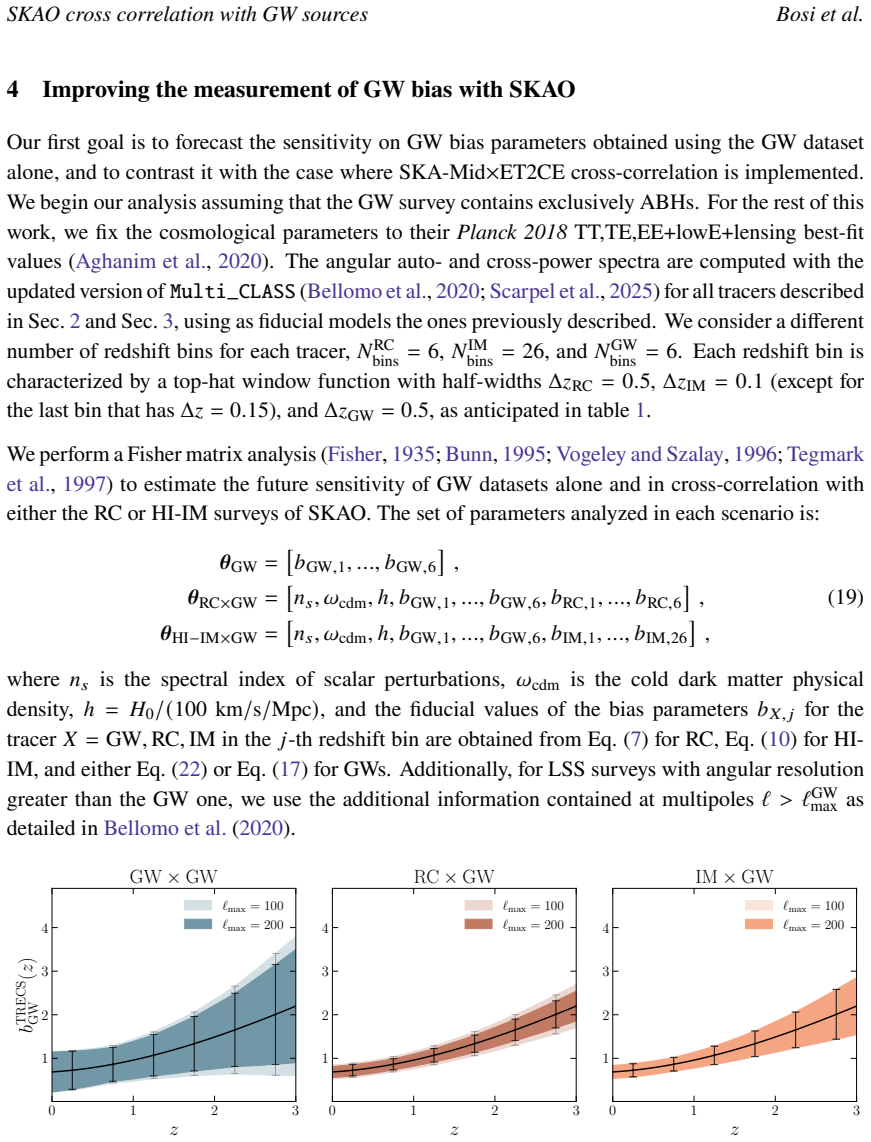
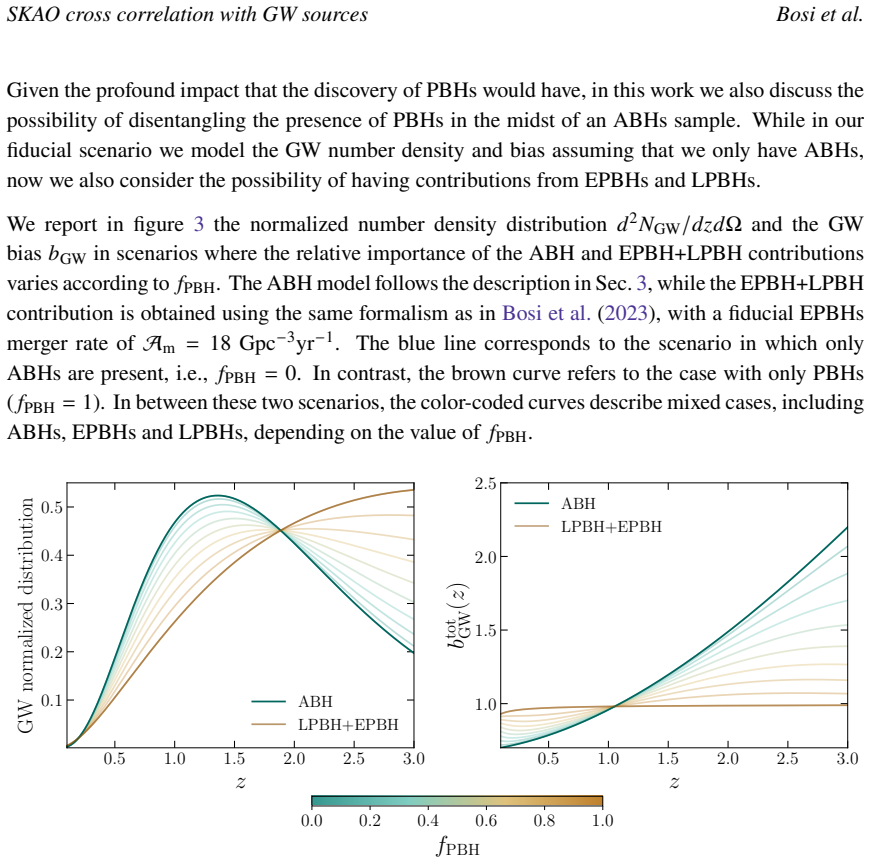
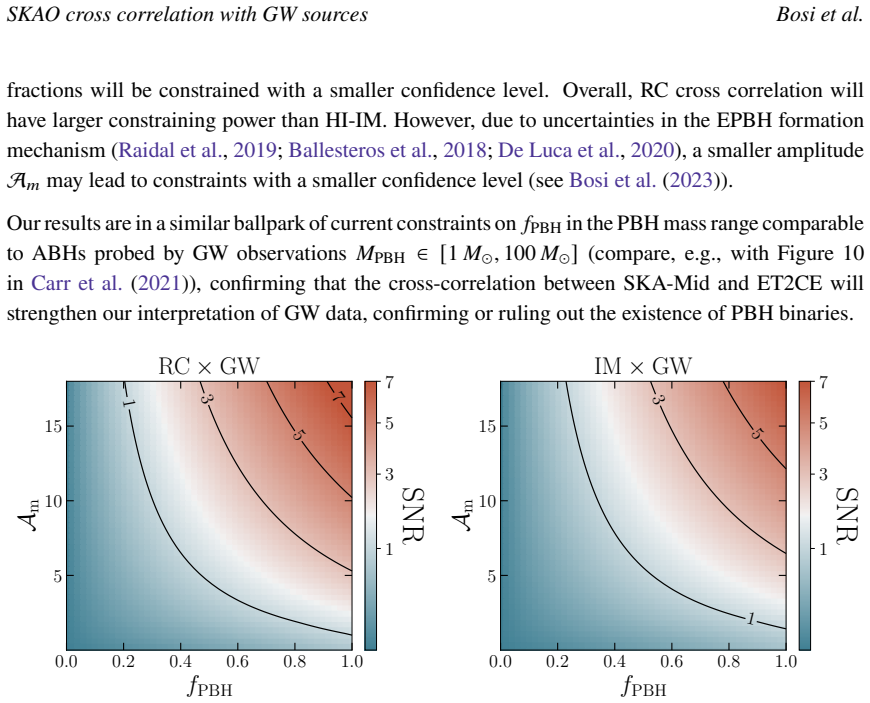
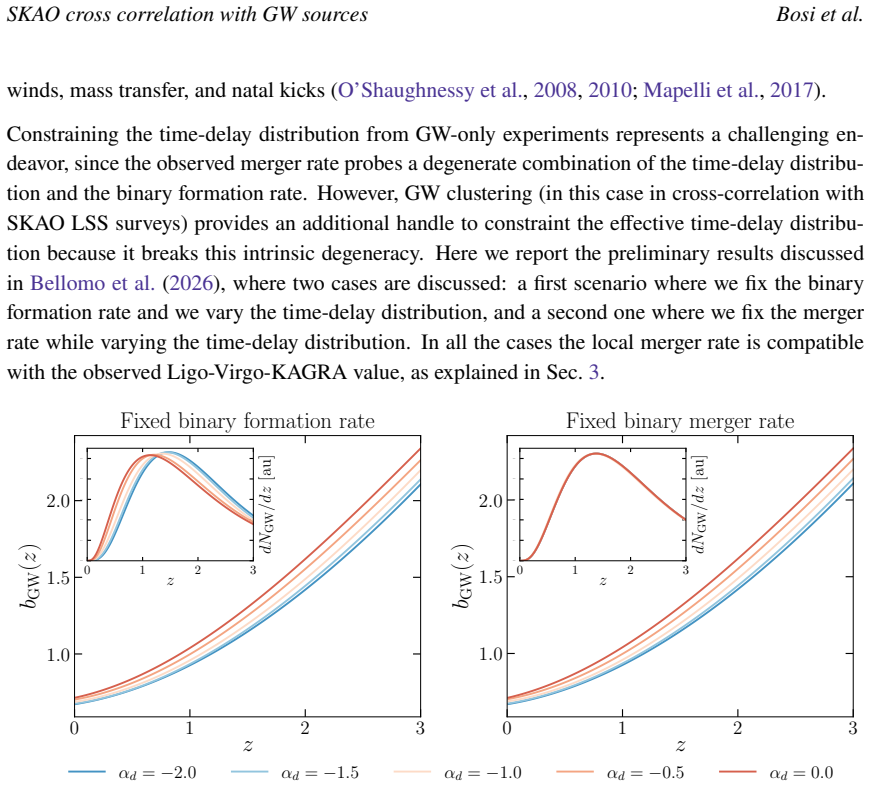
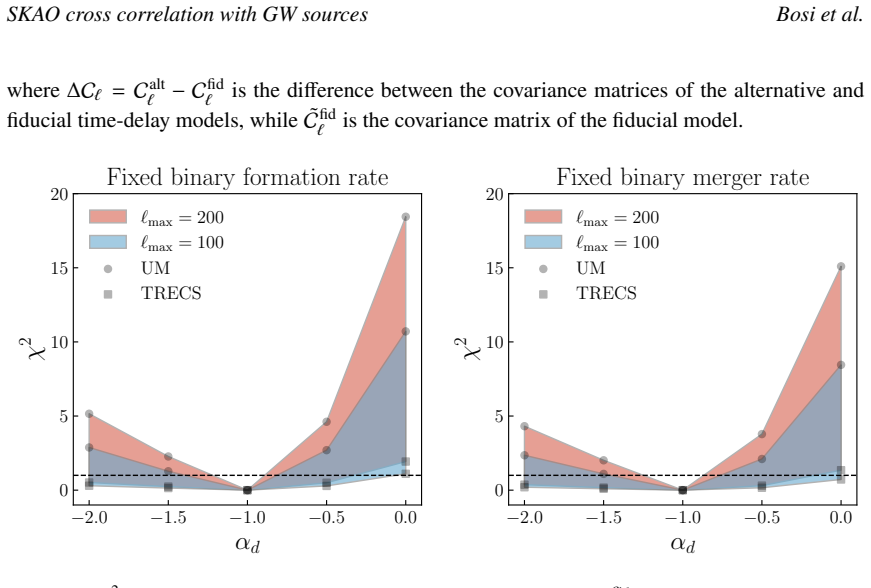
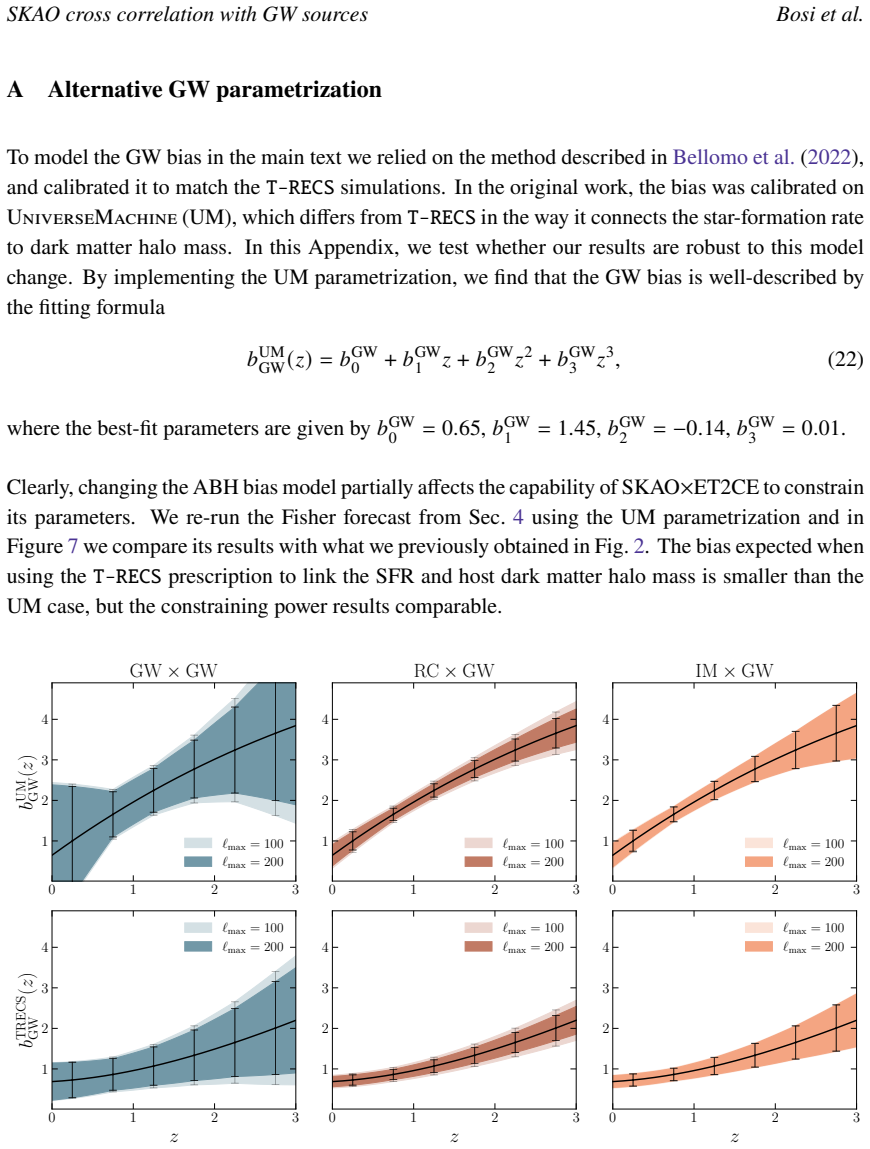
Coalescing Binary Black Holes (BBHs) trace the Large-Scale Structure (LSS) of the Universe, and their clustering properties can be extracted from Gravitational Wave (GW) data. Next-generation detectors, such as the Einstein Telescope and Cosmic Explorer, will enable statistical studies of GW sources thanks to the massive number of detected events. However, such events will still suffer from significant instrumental and theoretical uncertainties. Cross-correlating GW maps with other LSS surveys provides a promising strategy to mitigate these limitations. The SKA-Mid intensity mapping and radio continuum surveys offer ideal datasets for cross-correlation studies with GWs (SKAO$\times$ET2CE). Their wide sky coverage and deep redshift sensitivity will allow precise probing of the epochs and environments where stellar BBHs form most efficiently. In this chapter, we forecast the potential of cross-correlation angular power spectra to extract information on the distribution and clustering properties of GW events. First, we model the number density and bias of three independent tracers: GW sources, neutral hydrogen intensity maps, and radio galaxies. We estimate the constraining power of SKA-Mid$\times$ET2CE on the GW clustering bias, which carries information on the origin of GW progenitors, e.g., whether they formed through stellar evolution or are primordial black holes. Finally, we develop a semi-analytic model for GW events hosted by SKAO galaxies as a function of the time-delay distribution between the binary formation and merger, which is still largely uncertain to date. We forecast the signal-to-noise ratio of their cross-correlation with SKA-Mid, and demonstrate that SKA-Mid$\times$ET2CE will foster our understanding of the time-delay distribution.
Editorial analysis
A structured set of objections, weighed in public.
Referee Report
Summary. The paper models the number density and bias of three tracers (GW sources, HI intensity maps, radio galaxies), develops a semi-analytic model linking GW events hosted by SKAO galaxies to the time-delay distribution, and forecasts the SNR of SKA-Mid × ET2CE angular cross-power spectra to constrain the GW clustering bias and time-delay distribution parameters.
Significance. If the forecasts hold under the stated assumptions, the work shows that SKAO×ET2CE cross-correlations can help constrain the uncertain time-delay distribution and distinguish GW progenitor channels via bias measurements. The explicit functional forms, redshift kernels, and bias parametrizations supplied in the full manuscript allow the SNR calculation to be reproduced under those inputs.
major comments (2)
- [§3] §3 (semi-analytic model): the SNR forecast for the time-delay distribution depends on the specific parametrization of the delay-time kernel and the assumed host-galaxy occupation; the manuscript should report how the SNR changes when the delay-time parameters are varied over their prior range, as this directly tests the central claim that the cross-correlation constrains the distribution.
- [§4] §4 (bias and number-density prescriptions): the adopted bias factors and number densities for the GW, HI, and radio-galaxy tracers are fixed inputs to the SNR calculation; if these are not marginalized or varied, the reported constraining power on the time-delay distribution may be overstated, and an explicit error budget or sensitivity test is needed.
minor comments (3)
- [Abstract] Abstract: the phrase 'in this chapter' appears to be a thesis remnant and should be replaced with 'in this work' for journal submission.
- [Throughout] Notation: ensure consistent abbreviation of SKA-Mid versus SKAO throughout the text and figures.
- [Figures] Figure captions: add explicit mention of the redshift range and k-range used for the SNR integration to improve clarity.
Simulated Author's Rebuttal
We thank the referee for the careful reading and constructive suggestions. We address the two major comments below. Both can be addressed with targeted additions to the manuscript that test the robustness of the reported forecasts without altering the core methodology.
read point-by-point responses
-
Referee: [§3] §3 (semi-analytic model): the SNR forecast for the time-delay distribution depends on the specific parametrization of the delay-time kernel and the assumed host-galaxy occupation; the manuscript should report how the SNR changes when the delay-time parameters are varied over their prior range, as this directly tests the central claim that the cross-correlation constrains the distribution.
Authors: We agree that demonstrating robustness to the choice of delay-time kernel is important for supporting the central claim. In the revised manuscript we will add a short subsection (or appendix) that recomputes the SNR for the cross-power spectrum while sampling the delay-time parameters across their prior ranges (log-uniform in t_min and power-law index). The resulting range of SNR values will be reported explicitly, confirming that the forecast remains informative over the plausible parameter space. revision: yes
-
Referee: [§4] §4 (bias and number-density prescriptions): the adopted bias factors and number densities for the GW, HI, and radio-galaxy tracers are fixed inputs to the SNR calculation; if these are not marginalized or varied, the reported constraining power on the time-delay distribution may be overstated, and an explicit error budget or sensitivity test is needed.
Authors: The bias and number-density models are taken from the literature values cited in the manuscript and are treated as fixed for the baseline forecast, as is standard in such forecasting studies. To address the concern we will add a sensitivity test in §4 that varies each tracer’s bias and number density within the 1σ uncertainties quoted in the source references and recomputes the SNR on the time-delay parameters. The resulting variation will be presented as an explicit error budget on the forecasted constraints. revision: yes
Circularity Check
No significant circularity in derivation chain
full rationale
The paper's core outputs are forecasts of SNR for SKA-Mid × ET2CE cross-power spectra, constructed from explicitly stated inputs: modeled number densities, bias prescriptions for GW sources, HI intensity maps and radio galaxies, plus a semi-analytic mapping from time-delay distribution to host-galaxy occupation. These functional forms, redshift kernels and bias parametrizations are supplied as assumptions rather than derived quantities; the SNR calculation is a forward propagation under those assumptions and does not reduce algebraically to the inputs by construction. No self-citation load-bearing steps, fitted-parameter renamings, or uniqueness theorems appear in the provided derivation outline. The forecast therefore remains internally consistent and non-circular under the stated modeling choices.
Axiom & Free-Parameter Ledger
free parameters (2)
- time-delay distribution parameters
- bias and number-density parameters for GW, HI, and radio-galaxy tracers
axioms (2)
- standard math Standard flat LCDM cosmology governs the large-scale structure traced by all three populations.
- domain assumption The adopted prescriptions for BBH formation rates and host-galaxy associations are sufficiently accurate for forecasting purposes.
Reference graph
Works this paper leans on
-
[1]
2019 , eprint=
Anticipated Performance of the Square Kilometre Array -- Phase 1 (SKA1) , author=. 2019 , eprint=
2019
-
[2]
2015 , publisher=
Advancing Astrophysics with the Square Kilometre Array (AASKA14) , author=. 2015 , publisher=
2015
-
[3]
1967 , month =
The Hypothesis of Cores Retarded during Expansion and the Hot Cosmological Model , journal =. 1967 , month =
1967
-
[4]
Monthly Notices of the Royal Astronomical Society , volume =
Hawking, Stephen , title =. Monthly Notices of the Royal Astronomical Society , volume =. 1971 , doi =
1971
-
[5]
B. J. Carr and S. W. Hawking , title =. doi:10.1093/mnras/168.2.399 , year =
-
[6]
Chapline, G. F. , title =. Nature , year =
-
[7]
Sasaki, Misao and Suyama, Teruaki and Tanaka, Takahiro and Yokoyama, Shuichiro , title =. Class. Quant. Grav. , volume =. 2018 , archivePrefix =. doi:10.1088/1361-6382/aaa7b4
-
[8]
Alonso, David and Bull, Philip and Ferreira, Pedro G. and Santos, Mário G. , title =. Monthly Notices of the Royal Astronomical Society , volume =. 2014 , month =. arXiv:1409.8667
Pith/arXiv arXiv 2014
-
[9]
Camera, Stefano and Harrison, Ian and Bonaldi, Anna and Brown, Michael L. , title =. Monthly Notices of the Royal Astronomical Society , volume =. 2016 , month =. arXiv:1606.03451
Pith/arXiv arXiv 2016
-
[10]
GW LSS: chasing the progenitors of merging binary black holes
Scelfo, Giulio and Bellomo, Nicola and Raccanelli, Alvise and Matarrese, Sabino and Verde, Licia. GW LSS: chasing the progenitors of merging binary black holes. JCAP. 2018. doi:10.1088/1475-7516/2018/09/039. arXiv:1809.03528
-
[11]
Ragavendra, H. V. and author2 and author3 and author4 and author5 , title =. 2026 , publisher =
2026
-
[12]
Ragavendra and author2 and author3 and author4 and author5 , title =
H.V. Ragavendra and author2 and author3 and author4 and author5 , title =. 2026 , publisher =
2026
-
[13]
Monthly Notices of the Royal Astronomical Society , volume =
Behroozi, Peter and Wechsler, Risa H and Hearin, Andrew P and Conroy, Charlie , title =. Monthly Notices of the Royal Astronomical Society , volume =. 2019 , month =. doi:10.1093/mnras/stz1182 , archiveprefix =
-
[14]
Exploring galaxies-gravitational waves cross-correlations as an astrophysical probe
Scelfo, Giulio and Boco, Lumen and Lapi, Andrea and Viel, Matteo. Exploring galaxies-gravitational waves cross-correlations as an astrophysical probe. JCAP. 2020. doi:10.1088/1475-7516/2020/10/045. arXiv:2007.08534
-
[15]
Gravitational waves HI intensity mapping: cosmological and astrophysical applications
Scelfo, Giulio and Spinelli, Marta and Raccanelli, Alvise and Boco, Lumen and Lapi, Andrea and Viel, Matteo. Gravitational waves HI intensity mapping: cosmological and astrophysical applications. JCAP. 2022. doi:10.1088/1475-7516/2022/01/004. arXiv:2106.09786
-
[16]
Libanore, S. and Artale, M. C. and Karagiannis, D. and Liguori, M. and Bartolo, N. and Bouffanais, Y. and Giacobbo, N. and Mapelli, M. and Matarrese, S. Gravitational Wave mergers as tracers of Large Scale Structures. JCAP. 2021. doi:10.1088/1475-7516/2021/02/035. arXiv:2007.06905
-
[17]
Libanore, Sarah and Artale, Maria Celeste and Karagiannis, Dionysios and Liguori, Michele and Bartolo, Nicola and Bouffanais, Yann and Mapelli, Michela and Matarrese, Sabino. Clustering of Gravitational Wave and Supernovae events: a multitracer analysis in Luminosity Distance Space. JCAP. 2022. doi:10.1088/1475-7516/2022/02/003. arXiv:2109.10857
-
[18]
Signatures of primordial black holes in gravitational wave clustering
Libanore, Sarah and Liguori, Michele and Raccanelli, Alvise. Signatures of primordial black holes in gravitational wave clustering. JCAP. 2023. doi:10.1088/1475-7516/2023/08/055. arXiv:2306.03087
-
[19]
Bosi, M. and Bellomo, N. and Raccanelli, A. Constraining extended cosmologies with GW LSS cross-correlations. JCAP. 2023. doi:10.1088/1475-7516/2023/11/086. arXiv:2306.03031
-
[20]
Mukherjee, Suvodip and Moradinezhad Dizgah, Azadeh. Toward a Precision Measurement of Binary Black Holes Formation Channels Using Gravitational Waves and Emission Lines. Astrophys. J. Lett. 2022. doi:10.3847/2041-8213/ac903b. arXiv:2111.13166
-
[21]
Oguri, Masamune. Measuring the distance-redshift relation with the cross-correlation of gravitational wave standard sirens and galaxies. Phys. Rev. D. 2016. doi:10.1103/PhysRevD.93.083511. arXiv:1603.02356
work page internal anchor Pith review Pith/arXiv arXiv doi:10.1103/physrevd.93.083511 2016
-
[22]
Cross-correlating galaxy catalogs and gravitational waves: a tomographic approach
Calore, Francesca and Cuoco, Alessandro and Regimbau, Tania and Sachdev, Surabhi and Serpico, Pasquale Dario. Cross-correlating galaxy catalogs and gravitational waves: a tomographic approach. Phys. Rev. Res. 2020. doi:10.1103/PhysRevResearch.2.023314. arXiv:2002.02466
-
[23]
Determining the progenitors of merging black-hole binaries
Raccanelli, Alvise and Kovetz, Ely D. and Bird, Simeon and Cholis, Ilias and Munoz, Julian B. Determining the progenitors of merging black-hole binaries. Phys. Rev. D. 2016. doi:10.1103/PhysRevD.94.023516. arXiv:1605.01405
work page internal anchor Pith review Pith/arXiv arXiv doi:10.1103/physrevd.94.023516 2016
-
[24]
Mukherjee, Suvodip and Wandelt, Benjamin D. and Nissanke, Samaya M. and Silvestri, Alessandra. Accurate precision Cosmology with redshift unknown gravitational wave sources. Phys. Rev. D. 2021. doi:10.1103/PhysRevD.103.043520. arXiv:2007.02943
-
[25]
Gagnon, E. L. and Anbajagane, D. and Prat, J. and Chang, C. and Frieman, J. Cosmological Constraints from Combining Photometric Galaxy Surveys and Gravitational Wave Observatories. The Open Journal of Astrophysics , month = "12", volume=. doi:10.33232/001c.127131. arXiv:2312.16289
-
[26]
Clustering of binary black hole mergers: a detailed analysis of the eagle + mobse simulation
Peron, Matteo and Ravenni, Andrea and Libanore, Sarah and Liguori, Michele and Artale, Maria Celeste. Clustering of binary black hole mergers: a detailed analysis of the eagle + mobse simulation. Mon. Not. Roy. Astron. Soc. 2024. doi:10.1093/mnras/stae893. arXiv:2305.18003
-
[27]
and Bacon, David and Blake, Chris and Brown, Michael L
Jarvis, Matt J. and Bacon, David and Blake, Chris and Brown, Michael L. and Lindsay, Sam N. and Raccanelli, Alvise and Santos, Mario and Schwarz, Dominik. Cosmology with SKA Radio Continuum Surveys. PoS. 2015. arXiv:1501.03825
Pith/arXiv arXiv 2015
-
[28]
The Tiered Radio Extragalactic Continuum Simulation (T-RECS)
Bonaldi, Anna and Bonato, Matteo and Galluzzi, Vincenzo and Harrison, Ian and Massardi, Marcella and Kay, Scott and De Zotti, Gianfranco and Brown, Michael L. The Tiered Radio Extragalactic Continuum Simulation (T-RECS). Mon. Not. Roy. Astron. Soc. 2019. doi:10.1093/mnras/sty2603. arXiv:1805.05222
work page internal anchor Pith review Pith/arXiv arXiv doi:10.1093/mnras/sty2603 2019
-
[29]
Constraining ultra large-scale cosmology with multiple tracers in optical and radio surveys
Alonso, D. and Ferreira, P.G. , year=. Constraining ultralarge-scale cosmology with multiple tracers in optical and radio surveys , volume=. Physical Review D , publisher=. doi:10.1103/physrevd.92.063525 , number=. arXiv:1507.03550
work page internal anchor Pith review Pith/arXiv arXiv doi:10.1103/physrevd.92.063525
-
[30]
Testing General Relativity with 21 cm intensity mapping
Hall, Alex and Bonvin, Camille and Challinor, Anthony , year=. Testing general relativity with 21-cm intensity mapping , volume=. Physical Review D , publisher=. doi:10.1103/physrevd.87.064026 , number=. arXiv:1212.0728
work page internal anchor Pith review Pith/arXiv arXiv doi:10.1103/physrevd.87.064026
-
[31]
Crighton, Neil H. M. and Murphy, Michael T. and Prochaska, J. Xavier and Worseck, Gábor and Rafelski, Marc and Becker, George D. and Ellison, Sara L. and Fumagalli, Michele and Lopez, Sebastian and Meiksin, Avery and O’Meara, John M. , year=. The neutral hydrogen cosmological mass density at z= 5 , volume=. Monthly Notices of the Royal Astronomical Societ...
work page internal anchor Pith review Pith/arXiv arXiv doi:10.1093/mnras/stv1182
-
[32]
Battye, R. A. and Browne, I. W. A. and Dickinson, C. and Heron, G. and Maffei, B. and Pourtsidou, A. , year=. HI intensity mapping: a single dish approach , volume=. Monthly Notices of the Royal Astronomical Society , publisher=. doi:10.1093/mnras/stt1082 , number=. arXiv:1209.0343
work page internal anchor Pith review Pith/arXiv arXiv doi:10.1093/mnras/stt1082
-
[33]
The atomic hydrogen content of the post-reionization Universe , volume=
Spinelli, Marta and Zoldan, Anna and De Lucia, Gabriella and Xie, Lizhi and Viel, Matteo , year=. The atomic hydrogen content of the post-reionization Universe , volume=. Monthly Notices of the Royal Astronomical Society , publisher=. doi:10.1093/mnras/staa604 , number=. arXiv:1909.02242
-
[34]
Ingredients for 21cm intensity mapping
Villaescusa-Navarro, Francisco and Genel, Shy and Castorina, Emanuele and Obuljen, Andrej and Spergel, David N. and Hernquist, Lars and Nelson, Dylan and Carucci, Isabella P. and Pillepich, Annalisa and Marinacci, Federico and Diemer, Benedikt and Vogelsberger, Mark and Weinberger, Rainer and Pakmor, Rüdiger , year=. Ingredients for 21 cm Intensity Mappin...
work page internal anchor Pith review Pith/arXiv arXiv doi:10.3847/1538-4357/aadba0
-
[36]
Santos, Mario G. and others. MeerKLASS: MeerKAT Large Area Synoptic Survey. MeerKAT Science : On the Pathway to the SKA. 2017. arXiv:1709.06099
Pith/arXiv arXiv 2017
-
[37]
The ALFALFA HI mass function: A dichotomy in the low-mass slope and a locally suppressed 'knee' mass
Jones, Michael G and Haynes, Martha P and Giovanelli, Riccardo and Moorman, Crystal , title =. 2018 , month =. doi:10.1093/mnras/sty521 , journal =. arXiv:1802.00053
work page internal anchor Pith review Pith/arXiv arXiv doi:10.1093/mnras/sty521 2018
-
[38]
Monthly Notices of the Royal Astronomical Society , doi =
Bonaldi, Anna and Hartley, Philippa and Ronconi, Tommaso and De Zotti, Gianfranco and Bonato, Matteo , title =. Monthly Notices of the Royal Astronomical Society , doi =. 2023 , month =. arXiv:2305.10175
arXiv 2023
-
[39]
2025 , eprint=
Exploring future synergies for large-scale structure between gravitational waves and radio sources , author=. 2025 , eprint=
2025
-
[40]
and Bull, P
Yahya, S. and Bull, P. and Santos, M. G. and Silva, M. and Maartens, R. and Okouma, P. and Bassett, B. , title =. Monthly Notices of the Royal Astronomical Society , eprint=. 2015 , month =
2015
-
[41]
Monthly Notices of the Royal Astronomical Society , eprint =
Naluminsa, E and Elson, E C and Jarrett, T H , title =. Monthly Notices of the Royal Astronomical Society , eprint =. 2021 , month =
2021
-
[42]
Aversa, R. and Lapi, A. and Zotti, G. de and Shankar, F. and Danese, L. , title =. The Astrophysical Journal , doi =. 2015 , month =. 1507.07318 , archivePrefix=
Pith/arXiv arXiv 2015
-
[43]
Bagla, J. S. and Khandai, Nishikanta and Datta, Kanan K. HI as a Probe of the Large Scale Structure in the Post-Reionization Universe. Mon. Not. Roy. Astron. Soc. 2010. doi:10.1111/j.1365-2966.2010.16933.x. arXiv:0908.3796
-
[44]
Cosmology with a SKA HI intensity mapping survey
Santos, Mario G. and others. Cosmology from a SKA HI intensity mapping survey. PoS. 2015. doi:10.22323/1.215.0019. arXiv:1501.03989
work page internal anchor Pith review Pith/arXiv arXiv doi:10.22323/1.215.0019 2015
-
[45]
Nicola Bellomo and Daniele Bertacca and Alexander C. Jenkins and Sabino Matarrese and Alvise Raccanelli and Tania Regimbau and Angelo Ricciardone and Mairi Sakellariadou , title =. Journal of Cosmology and Astroparticle Physics , archiveprefix =. doi:10.1088/1475-7516/2022/06/030 , year =
-
[46]
Measuring primordial non-gaussianity without cosmic variance
Seljak, Uros. Extracting primordial non-gaussianity without cosmic variance. Phys. Rev. Lett. 2009. doi:10.1103/PhysRevLett.102.021302. arXiv:0807.1770
work page internal anchor Pith review Pith/arXiv arXiv doi:10.1103/physrevlett.102.021302 2009
-
[47]
Fourier analysis of multi-tracer cosmological surveys
Fourier analysis of multitracer cosmological surveys , volume=. Monthly Notices of the Royal Astronomical Society , author=. 2015 , month=dec, pages=. doi:10.1093/mnras/stv2588 , number=. arXiv:1505.04106
work page internal anchor Pith review Pith/arXiv arXiv doi:10.1093/mnras/stv2588 2015
-
[48]
Hamaus, Nico and Seljak, Uros and Desjacques, Vincent. Optimal Constraints on Local Primordial Non-Gaussianity from the Two-Point Statistics of Large-Scale Structure. Phys. Rev. D. 2011. doi:10.1103/PhysRevD.84.083509. arXiv:1104.2321
work page internal anchor Pith review Pith/arXiv arXiv doi:10.1103/physrevd.84.083509 2011
-
[49]
How to measure redshift-space distortions without sample variance
How to evade the sample variance limit on measurements of redshift-space distortions. , keywords =. doi:10.1088/1475-7516/2009/10/007 , archivePrefix =. 0810.0323 , primaryClass =
work page internal anchor Pith review Pith/arXiv arXiv doi:10.1088/1475-7516/2009/10/007 2009
-
[50]
On using angular cross-correlations to determine source redshift distributions
McQuinn, Matthew and White, Martin. On using angular cross-correlations to determine source redshift distributions. Mon. Not. Roy. Astron. Soc. 2013. doi:10.1093/mnras/stt914. arXiv:1302.0857
work page internal anchor Pith review Pith/arXiv arXiv doi:10.1093/mnras/stt914 2013
-
[51]
2014 , eprint=
Clustering-based redshift estimation: method and application to data , author=. 2014 , eprint=
2014
-
[52]
Calibrating Redshift Distributions Beyond Spectroscopic Limits with Cross-Correlations
Newman, Jeffrey A. Calibrating Redshift Distributions Beyond Spectroscopic Limits with Cross-Correlations. Astrophys. J. 2008. doi:10.1086/589982. arXiv:0805.1409
work page internal anchor Pith review Pith/arXiv arXiv doi:10.1086/589982 2008
-
[53]
Davis, C. and others. Cross-Correlation Redshift Calibration without Spectroscopic Calibration Samples in DES Science Verification Data. Mon. Not. Roy. Astron. Soc. 2018. doi:10.1093/mnras/sty787. arXiv:1707.08256
work page internal anchor Pith review Pith/arXiv arXiv doi:10.1093/mnras/sty787 2018
-
[54]
Clustering-based Redshift Estimation: Comparison to Spectroscopic Redshifts
Rahman, Mubdi and M \'e nard, Brice and Scranton, Ryan and Schmidt, Samuel J. and Morrison, Christopher B. Clustering-based Redshift Estimation: Comparison to Spectroscopic Redshifts. Mon. Not. Roy. Astron. Soc. 2015. doi:10.1093/mnras/stu2636. arXiv:1407.7860
work page internal anchor Pith review Pith/arXiv arXiv doi:10.1093/mnras/stu2636 2015
-
[55]
Monthly Notices of the Royal Astronomical Society , volume =
Cawthon, R and Elvin-Poole, J and Porredon, A and Crocce, M and Giannini, G and Gatti, M and Ross, A J and Rykoff, E S and Carnero Rosell, A and DeRose, J and Lee, S and Rodriguez-Monroy, M and Amon, A and Bechtol, K and De Vicente, J and Gruen, D and Morgan, R and Sanchez, E and Sanchez, J and Sevilla-Noarbe, I and Abbott, T M C and Aguena, M and Allam, ...
arXiv 2022
-
[56]
Cosmic Near-infrared Background Tomography with SPHEREx Using Galaxy Cross-correlations
Cheng, Yun-Ting and Chang, Tzu-Ching. Cosmic Near-infrared Background Tomography with SPHEREx Using Galaxy Cross-correlations. Astrophys. J. 2022. doi:10.3847/1538-4357/ac3aee. arXiv:2109.10914
-
[57]
Inferring the Redshift Distribution of the Cosmic Infrared Background
Schmidt, Samuel J. and M \'e nard, Brice and Scranton, Ryan and Morrison, Christopher B. and Rahman, Mubdi and Hopkins, Andrew M. Inferring the Redshift Distribution of the Cosmic Infrared Background. Mon. Not. Roy. Astron. Soc. 2015. doi:10.1093/mnras/stu2275. arXiv:1407.0031
work page internal anchor Pith review Pith/arXiv arXiv doi:10.1093/mnras/stu2275 2015
-
[58]
Broadband Intensity Tomography: Spectral Tagging of the Cosmic UV Background
Chiang, Yi-Kuan and M \'e nard, Brice and Schiminovich, David. Broadband Intensity Tomography: Spectral Tagging of the Cosmic UV Background. Astrophys. J. 2019. doi:10.3847/1538-4357/ab1b35. arXiv:1810.00885
work page internal anchor Pith review Pith/arXiv arXiv doi:10.3847/1538-4357/ab1b35 2019
-
[59]
Constraining z 2 ultraviolet emission with the upcoming ULTRASAT satellite
Libanore, Sarah and Kovetz, Ely D. Constraining z 2 ultraviolet emission with the upcoming ULTRASAT satellite. Astron. Astrophys. 2024. doi:10.1051/0004-6361/202449364. arXiv:2401.12285
-
[60]
Cosmological Constraints with Clustering-Based Redshifts
Kovetz, Ely D. and Raccanelli, Alvise and Rahman, Mubdi. Cosmological Constraints with Clustering-Based Redshifts. Mon. Not. Roy. Astron. Soc. 2017. doi:10.1093/mnras/stx691. arXiv:1606.07434
work page internal anchor Pith review Pith/arXiv arXiv doi:10.1093/mnras/stx691 2017
-
[61]
Abbott, B. P. and others. Binary Black Hole Mergers in the first Advanced LIGO Observing Run. Phys. Rev. X. 2016. doi:10.1103/PhysRevX.6.041015. arXiv:1606.04856
work page internal anchor Pith review Pith/arXiv arXiv doi:10.1103/physrevx.6.041015 2016
-
[62]
Abbott, B. P. and others. GWTC-1: A Gravitational-Wave Transient Catalog of Compact Binary Mergers Observed by LIGO and Virgo during the First and Second Observing Runs. Phys. Rev. X. 2019. doi:10.1103/PhysRevX.9.031040. arXiv:1811.12907
work page internal anchor Pith review Pith/arXiv arXiv doi:10.1103/physrevx.9.031040 2019
-
[63]
Abbott, R. and others. GWTC-2: Compact Binary Coalescences Observed by LIGO and Virgo During the First Half of the Third Observing Run. Phys. Rev. X. 2021. doi:10.1103/PhysRevX.11.021053. arXiv:2010.14527
work page internal anchor Pith review Pith/arXiv arXiv doi:10.1103/physrevx.11.021053 2021
-
[64]
Abbott, R. and others. GWTC-2.1: Deep extended catalog of compact binary coalescences observed by LIGO and Virgo during the first half of the third observing run. Phys. Rev. D. 2024. doi:10.1103/PhysRevD.109.022001. arXiv:2108.01045
work page internal anchor Pith review Pith/arXiv arXiv doi:10.1103/physrevd.109.022001 2024
-
[65]
The population of merging compact binaries inferred using gravitational waves through GWTC-3
Abbott, R. and others. Population of Merging Compact Binaries Inferred Using Gravitational Waves through GWTC-3. Phys. Rev. X. 2023. doi:10.1103/PhysRevX.13.011048. arXiv:2111.03634
work page internal anchor Pith review Pith/arXiv arXiv doi:10.1103/physrevx.13.011048 2023
-
[66]
Abac, A. G. and others. GWTC-4.0: Updating the Gravitational-Wave Transient Catalog with Observations from the First Part of the Fourth LIGO-Virgo-KAGRA Observing Run. 2025. arXiv:2508.18082
Pith/arXiv arXiv 2025
-
[67]
Punturo, M. and others. The Einstein Telescope: A third-generation gravitational wave observatory. Class. Quant. Grav. 2010. doi:10.1088/0264-9381/27/19/194002
-
[68]
The Science of the Einstein Telescope
Abac, Adrian and others. The Science of the Einstein Telescope. 2025. arXiv:2503.12263
Pith/arXiv arXiv 2025
-
[69]
A Horizon Study for Cosmic Explorer: Science, Observatories, and Community
Evans, Matthew and others. A Horizon Study for Cosmic Explorer: Science, Observatories, and Community. 2021. arXiv:2109.09882
Pith/arXiv arXiv 2021
-
[70]
Advancing Astrophysics with the Square Kilometre Array
Braun, Robert and Bourke, Tyler and Green, James A and Keane, Evan and Wagg, Jeff. Advancing Astrophysics with the Square Kilometre Array. PoS. 2015. doi:10.22323/1.215.0174
-
[71]
Science with the Square Kilometer Array: Motivation, Key Science Projects, Standards and Assumptions
Carilli, Chris L. and Rawlings, S. Science with the Square Kilometer Array: Motivation, key science projects, standards and assumptions. New Astron. Rev. 2004. doi:10.1016/j.newar.2004.09.001. arXiv:astro-ph/0409274
work page internal anchor Pith review Pith/arXiv arXiv doi:10.1016/j.newar.2004.09.001 2004
-
[72]
Anticipated Performance of the Square Kilometre Array -- Phase 1 (SKA1)
Braun, Robert and Bonaldi, Anna and Bourke, Tyler and Keane, Evan and Wagg, Jeff. Anticipated Performance of the Square Kilometre Array -- Phase 1 (SKA1). 2019. arXiv:1912.12699
arXiv 2019
-
[73]
Exploring future synergies for large-scale structure between gravitational waves and radio sources
Zazzera, Stefano and Fonseca, Jos \'e and Baker, Tessa and Clarkson, Chris. Exploring future synergies for large-scale structure between gravitational waves and radio sources. 2025. arXiv:2505.15645
arXiv 2025
-
[74]
Gravitational waves and galaxies cross-correlations: a forecast on GW biases for future detectors
Zazzera, Stefano and Fonseca, Jos \'e and Baker, Tessa and Clarkson, Chris. Gravitational waves and galaxies cross-correlations: a forecast on GW biases for future detectors. Mon. Not. Roy. Astron. Soc. 2025. doi:10.1093/mnras/staf150. arXiv:2412.01678
-
[75]
Pedrotti, Alessandro and Mancarella, Michele and Bel, Julien and Gerosa, Davide. Cosmology with the angular cross-correlation of gravitational-wave and galaxy catalogs: forecasts for next-generation interferometers and the Euclid survey. 2025. arXiv:2504.10482
Pith/arXiv arXiv 2025
-
[76]
Monthly Notices of the Royal Astronomical Society , volume =
Afroz, Samsuzzaman and Mukherjee, Suvodip , title =. Monthly Notices of the Royal Astronomical Society , volume =. 2024 , month =. arXiv:2407.09262v1
arXiv 2024
-
[77]
Mukherjee, Suvodip and Wandelt, Benjamin D. Beyond the classical distance-redshift test: cross-correlating redshift-free standard candles and sirens with redshift surveys. 2018. arXiv:1808.06615
Pith/arXiv arXiv 2018
-
[78]
Mukherjee, Suvodip and Krolewski, Alex and Wandelt, Benjamin D. and Silk, Joseph. Cross-correlating dark sirens and galaxies: constraints on H_0 from GWTC-3 of LIGO-Virgo-KAGRA. Astrophys. J. 2024. doi:10.3847/1538-4357/ad7d90. arXiv:2203.03643
-
[79]
Balaudo, Anna and Pantiri, Mattia and Silvestri, Alessandra. Number count of gravitational waves and supernovae in luminosity distance space for CDM and scalar-tensor theories. JCAP. 2024. doi:10.1088/1475-7516/2024/02/023. arXiv:2311.17904
-
[80]
Andrew and Mingarelli, Chiara M
Semenzato, Federico and Casey-Clyde, J. Andrew and Mingarelli, Chiara M. F. and Raccanelli, Alvise and Bellomo, Nicola and Bartolo, Nicola and Bertacca, Daniele. Cross-Correlating the Universe: The Gravitational Wave Background and Large-Scale Structure. 2024. arXiv:2411.00532
arXiv 2024
-
[81]
Sah, Mohit Raj and Mukherjee, Suvodip. The Route to Unveil the Cosmic Genealogy of Supermassive Black Hole Binaries Using Nano-Hertz Gravitational Waves and Galaxy Surveys. 2025. arXiv:2504.05387
arXiv 2025
discussion (0)
Sign in with ORCID, Apple, or X to comment. Anyone can read and Pith papers without signing in.