What Do Language Priors Contribute to Darcy-Flow Inversion? A Mechanistic Audit
Pith reviewed 2026-06-26 00:25 UTC · model grok-4.3
The pith
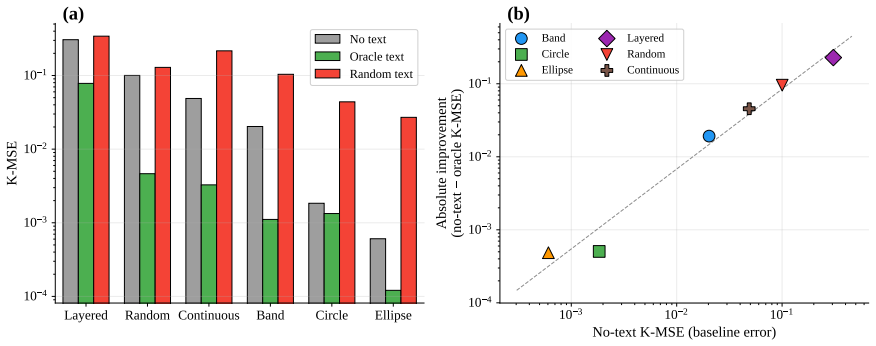
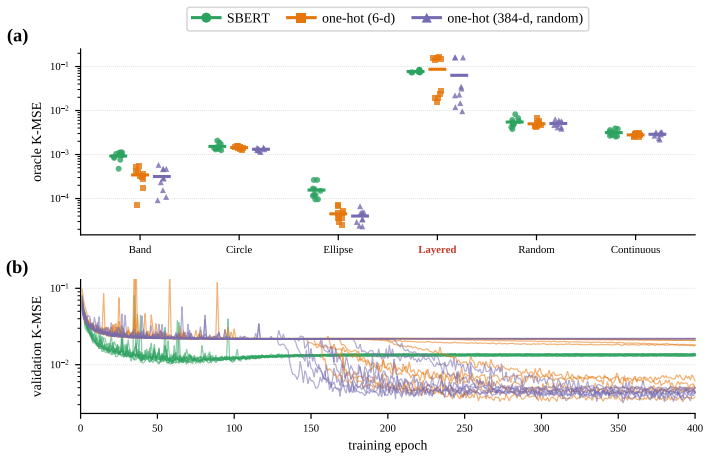
Text conditioning reduces Darcy-flow inversion error by 81 percent, mostly through class-level constraints where data is underdetermined.
A machine-rendered reading of the paper's core claim, the machinery that carries it, and where it could break.
Core claim
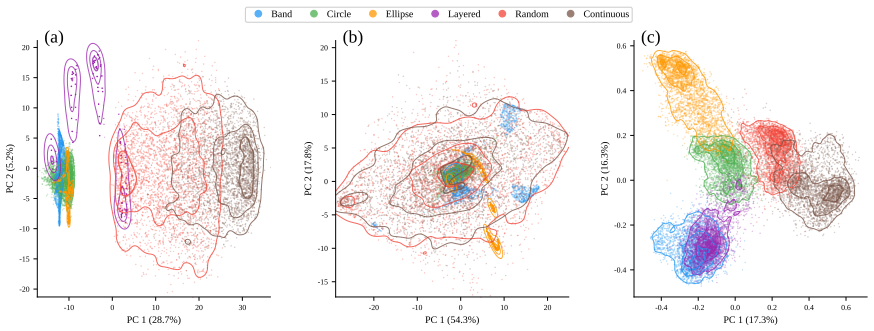
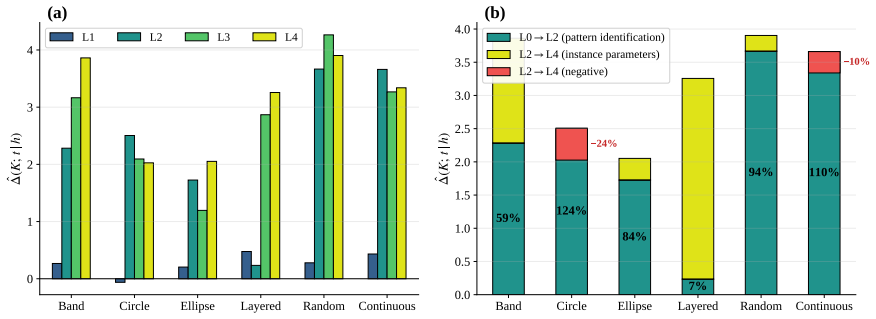
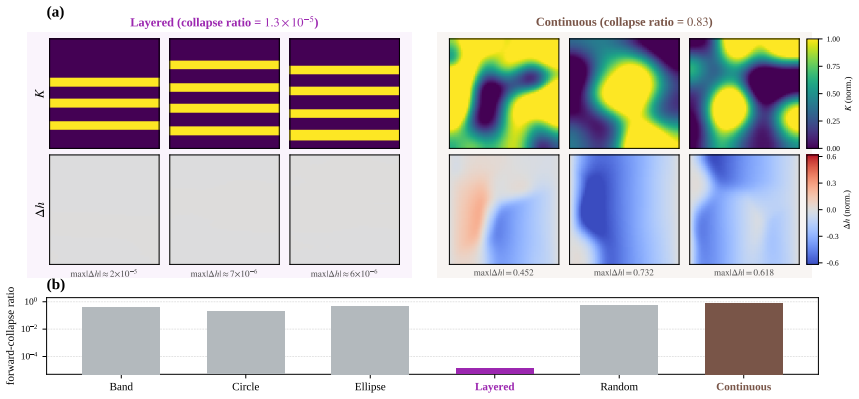
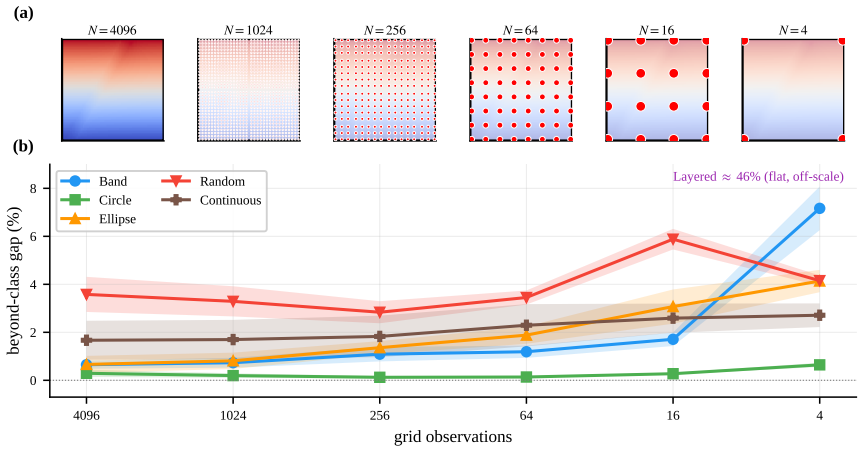
Sentence embeddings can act as an inference-time interface for injecting geological descriptions into a learned Darcy-flow inverse solver. Across six synthetic geological classes and an exploratory transfer to a benchmark reservoir model (SPE10), text conditioning reduces reconstruction error by 81 percent relative to a no-text counterfactual. Most of this gain comes from a categorical, class-level constraint whose value concentrates where the hydraulic head leaves the conductivity field underdetermined, while within-class geometric detail is secondary and pattern-dependent.
What carries the argument
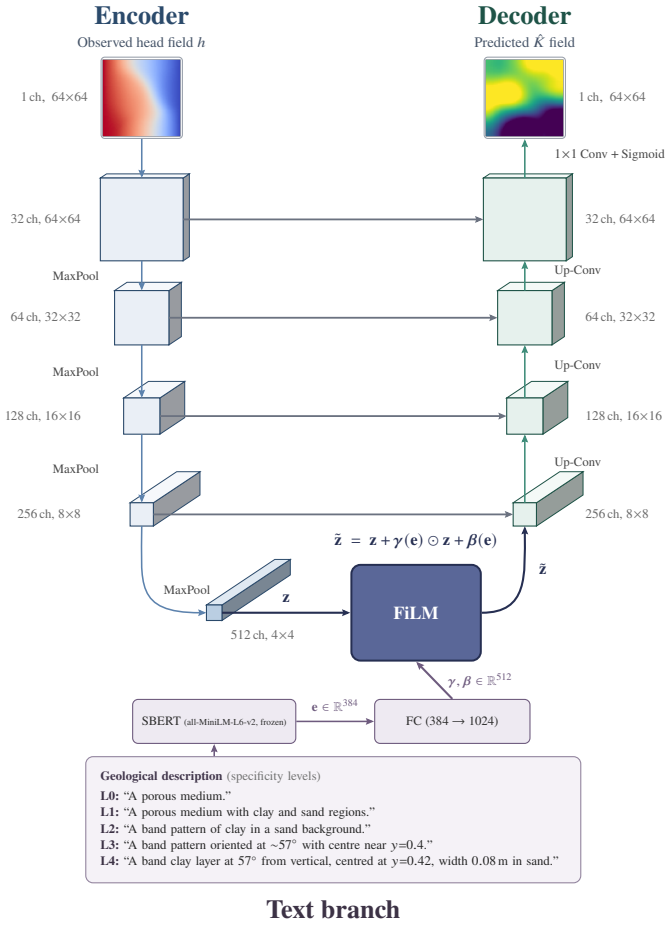
Sentence embeddings supplied as conditioning input, which supply a categorical class-level constraint on the recovered conductivity field.
If this is right
- Within-class geometric detail from text contributes only secondary and pattern-dependent gains.
- Sentence embeddings add little dense-observation accuracy beyond discrete class labels.
- Embeddings improve training stability relative to label-only conditioning.
- The embeddings enable paraphrase-based sensitivity analysis and open-vocabulary inputs.
Where Pith is reading between the lines
- The same conditioning approach could be tested on other ill-posed inverse problems that mix quantitative measurements with qualitative expert descriptions.
- If the class-level signal dominates, simpler discrete labels might suffice for many accuracy-critical tasks while embeddings are reserved for stability or flexibility needs.
- Paraphrase sensitivity experiments could serve as a practical audit tool for checking whether the prior encodes intended geological knowledge.
Load-bearing premise
The six synthetic geological classes and the SPE10 transfer case represent the real-world settings where language priors would be used, and the observed error reduction stems from the semantic content of the embeddings rather than incidental correlations.
What would settle it
Re-running the inversion on real field data or replacing the embeddings with random vectors of matching dimension and checking whether the 81 percent error reduction disappears.
Figures




read the original abstract
In ill-posed inverse problems, the recovered solution depends as much on the prior as on the data, yet much of the engineering knowledge that could serve as that prior is recorded qualitatively rather than in formal mathematical form. Here we test whether sentence embeddings can act as an inference-time interface for injecting geological descriptions into a learned Darcy-flow inverse solver. Across six synthetic geological classes and an exploratory transfer to a benchmark reservoir model (SPE10), we vary only the conditioning representation and find that text conditioning reduces reconstruction error by 81 % relative to a no-text counterfactual. Most of this gain comes from a categorical, class-level constraint whose value concentrates where the hydraulic head leaves the conductivity field underdetermined, while within-class geometric detail is secondary and pattern-dependent. Compared with a discrete class label, sentence embeddings add little dense-observation accuracy but improve training stability and enable paraphrase-based sensitivity analysis and open-vocabulary inputs. These results show that language priors can serve as an engineering-informatics interface for injecting geological knowledge into learned inverse solvers, while clarifying when they help and what signal they actually carry.
Editorial analysis
A structured set of objections, weighed in public.
Referee Report
Summary. The manuscript audits the contribution of language priors (sentence embeddings) to a learned inverse solver for Darcy-flow conductivity reconstruction. Across six synthetic geological classes and an exploratory SPE10 transfer, it reports that text conditioning yields an 81% reduction in reconstruction error relative to a no-text baseline, with the majority of the gain arising from a categorical class-level constraint that is most valuable where hydraulic head data leave the field underdetermined; sentence embeddings add little accuracy over discrete class labels but improve training stability and enable paraphrase sensitivity analysis.
Significance. If the attribution of the error reduction to semantic content rather than incidental class correlations holds, the work provides a concrete mechanistic account of when and how qualitative geological descriptions can be injected into data-driven inverse solvers, with potential implications for incorporating domain knowledge that is not easily formalized mathematically.
major comments (2)
- [Results] Results section (around the 81% claim and the categorical vs. dense comparison): the reported error reduction and the conclusion that 'dense embeddings add little' rest on a comparison to discrete class labels, but the design does not include a control embedding whose statistics correlate with the six classes yet carry no geological semantics; without this, the claim that gains derive from semantic content of the embeddings (rather than class-identity correlation induced by training data generation) remains unisolated.
- [Methods] Methods / experimental setup: the six synthetic classes and the SPE10 transfer case are presented as representative, yet no quantitative characterization is given of how class boundaries or hydraulic-head underdetermination in these cases map to real-world geological settings where language priors would be applied; this weakens the generalizability of the mechanistic audit.
minor comments (2)
- [Abstract] Abstract and introduction: the phrase 'parameter-free' or equivalent claims about the no-text counterfactual should be cross-checked against the precise definition of the baseline architecture to avoid any appearance of circularity.
- [Figures/Tables] Figure captions and table legends: ensure all error metrics (e.g., which norm, relative or absolute) and the exact conditioning variants are defined inline so that the 81% figure can be reproduced from the reported numbers alone.
Simulated Author's Rebuttal
We thank the referee for the constructive comments on our manuscript. We address the major comments point by point below.
read point-by-point responses
-
Referee: [Results] Results section (around the 81% claim and the categorical vs. dense comparison): the reported error reduction and the conclusion that 'dense embeddings add little' rest on a comparison to discrete class labels, but the design does not include a control embedding whose statistics correlate with the six classes yet carry no geological semantics; without this, the claim that gains derive from semantic content of the embeddings (rather than class-identity correlation induced by training data generation) remains unisolated.
Authors: We agree that a control embedding with class-correlated statistics but no geological semantics would more rigorously isolate the role of semantic content. Our current results show that sentence embeddings yield only small accuracy gains over discrete class labels, suggesting that the primary benefit is the categorical constraint rather than within-class semantic detail. Nevertheless, without the proposed control, we cannot completely exclude that the embeddings function primarily as class identifiers learned from the training distribution. We will add a paragraph in the discussion section acknowledging this limitation and qualifying our claims about semantic contributions accordingly. revision: partial
-
Referee: [Methods] Methods / experimental setup: the six synthetic classes and the SPE10 transfer case are presented as representative, yet no quantitative characterization is given of how class boundaries or hydraulic-head underdetermination in these cases map to real-world geological settings where language priors would be applied; this weakens the generalizability of the mechanistic audit.
Authors: The experiments are intentionally conducted in a synthetic setting to permit exact quantification of reconstruction error against known ground truth, which is essential for the mechanistic audit. The six classes were designed to vary in the degree of underdetermination from hydraulic head data. We will revise the introduction and conclusions to emphasize the synthetic and exploratory nature of the study and to state that quantitative extrapolation to specific field cases would require additional validation against real geological data. revision: yes
Circularity Check
No circularity; empirical comparison is self-contained
full rationale
The paper reports an empirical result: text conditioning yields an 81% error reduction relative to an explicit no-text counterfactual, with the gain localized to class-level constraints in underdetermined regions. This is measured by training and evaluating separate models that differ only in conditioning input, not derived from any self-referential definition, fitted parameter renamed as prediction, or self-citation chain. No equations, uniqueness theorems, or ansatzes are invoked that would make the reported improvement tautological by construction. The evaluation uses held-out synthetic classes and an exploratory SPE10 transfer, providing independent benchmarks.
Axiom & Free-Parameter Ledger
Reference graph
Works this paper leans on
-
[1]
Tarantola, Inverse Problem Theory and Methods for Model Parameter Estimation, SIAM, 2005
A. Tarantola, Inverse Problem Theory and Methods for Model Parameter Estimation, SIAM, 2005
2005
-
[2]
D. S. Oliver, A. C. Reynolds, N. Liu, Inverse Theory for Petroleum Reservoir Characterization and History Matching, Cambridge University Press, 2008
2008
-
[3]
A. M. Stuart, Inverse problems: A Bayesian perspective, Acta Numerica 19 (2010) 451–559. doi:10.1017/S0962492910000061. 24
-
[4]
R. C. Aster, B. Borchers, C. H. Thurber, Parameter Estimation and Inverse Problems, 3rd Edition, Elsevier, 2018
2018
-
[5]
Y. Otake, Y. Honjo, Challenges in geotechnical design revealed by reliability assess- ment: Review and future perspectives, Soils and Foundations 62 (3) (2022) 101129. doi:10.1016/j.sandf.2022.101129
-
[6]
K.-K. Phoon, F. H. Kulhawy, Characterization of geotechnical variability, Canadian Geotechnical Journal 36 (4) (1999) 612–624. doi:10.1139/t99-038
-
[7]
K.-K. Phoon, F. H. Kulhawy, Evaluation of geotechnical property variability, Canadian Geotech- nical Journal 36 (4) (1999) 625–639. doi:10.1139/t99-039
-
[8]
G. B. Baecher, J. T. Christian, Reliability and Statistics in Geotechnical Engineering, John Wiley & Sons, 2003
2003
-
[9]
K.-K. Phoon, J. Ching, T. Shuku, Challenges in data-driven site characterization, Georisk: Assessment and Management of Risk for Engineered Systems and Geohazards 16 (1) (2022) 114–126. doi:10.1080/17499518.2021.1896005
-
[10]
J. Ching, K.-K. Phoon, Transformations and correlations among some clay parameters—the global database, Canadian Geotechnical Journal 51 (6) (2014) 663–685. doi:10.1139/cgj-2013-0262
-
[11]
J. Ching, S. Wu, K.-K. Phoon, Constructing quasi-site-specific multivariate probability distribution using hierarchical Bayesian model, Journal of Engineering Mechanics 147 (10) (2021) 04021069. doi:10.1061/(ASCE)EM.1943-7889.0001964
-
[12]
L. I. Rudin, S. Osher, E. Fatemi, Nonlinear total variation based noise removal algorithms, Physica D: Nonlinear Phenomena 60 (1–4) (1992) 259–268. doi:10.1016/0167-2789(92)90242-F
-
[13]
P. K. Kitanidis, Introduction to Geostatistics: Applications in Hydrogeology, Cambridge University Press, 1997
1997
-
[14]
H. Zhou, J. J. G´ omez-Hern´ andez, L. Li, Inverse methods in hydrogeology: Evolution and recent trends, Advances in Water Resources 63 (2014) 22–37. doi:10.1016/j.advwatres.2013.10.014
-
[15]
T. Enemark, L. J. M. Peeters, D. Mallants, O. Batelaan, Hydrogeological conceptual model building and testing: A review, Journal of Hydrology 569 (2019) 310–329. doi:10.1016/j.jhydrol.2018.12.007
-
[16]
N. Linde, P. Renard, T. Mukerji, J. Caers, Geological realism in hydrogeological and geophysical inverse modeling: A review, Advances in Water Resources 86 (2015) 86–101. doi:10.1016/j.advwatres.2015.09.019
-
[17]
Y. Zhu, N. Zabaras, Bayesian deep convolutional encoder–decoder networks for surrogate mod- eling and uncertainty quantification, Journal of Computational Physics 366 (2018) 415–447. doi:10.1016/j.jcp.2018.04.018
-
[18]
S. Mo, Y. Zhu, N. Zabaras, X. Shi, J. Wu, Deep convolutional encoder–decoder networks for uncertainty quantification of dynamic multiphase flow in heterogeneous media, Water Resources Research 55 (1) (2019) 703–728. doi:10.1029/2018WR023528
-
[19]
E. Laloy, R. H´ erault, D. Jacques, N. Linde, Training-image based geostatistical inversion using a spatial generative adversarial neural network, Water Resources Research 54 (1) (2018) 381–406. doi:10.1002/2017WR022148
-
[20]
I. J. Goodfellow, J. Pouget-Abadie, M. Mirza, B. Xu, D. Warde-Farley, S. Ozair, A. Courville, Y. Bengio, Generative adversarial nets, in: Advances in Neural Information Processing Systems (NeurIPS), Vol. 27, 2014, pp. 2672–2680. 25
2014
-
[21]
Journal of Computational Physics , author =
M. Raissi, P. Perdikaris, G. E. Karniadakis, Physics-informed neural networks: A deep learning framework for solving forward and inverse problems involving nonlinear partial differential equations, Journal of Computational Physics 378 (2019) 686–707. doi:10.1016/j.jcp.2018.10.045
-
[22]
A. M. Tartakovsky, C. Ortiz Marrero, P. Perdikaris, G. D. Tartakovsky, D. Barajas-Solano, Physics-informed deep neural networks for learning parameters and constitutive relation- ships in subsurface flow problems, Water Resources Research 56 (5) (2020) e2019WR026731. doi:10.1029/2019WR026731
-
[23]
H. Du, Z. Zhao, H. Cheng, J. Yan, Q. Z. He, Modeling density-driven flow in porous media by physics-informed neural networks for CO 2 sequestration, Computers and Geotechnics 159 (2023) 105433. doi:10.1016/j.compgeo.2023.105433
-
[24]
Y. Chen, Y. Xu, L. Wang, T. Li, Modeling water flow in unsaturated soils through physics- informed neural network with principled loss function, Computers and Geotechnics 161 (2023) 105546. doi:10.1016/j.compgeo.2023.105546
-
[25]
Q. Wu, Z. Xie, Y. Zhao, M. Tian, X. Zhang, Q. Qiu, Multi-type and multi-scale geological three-dimensional modeling using entity-relationship networks, Advanced Engineering Informatics 72 (2026) 104436. doi:10.1016/j.aei.2026.104436
-
[26]
X. Zhou, B. Sheil, S. Suryasentana, P. Shi, Graph attention neural network for subsurface stratigraphy on spatial and feature level using multiple-source sparse exploration data, Advanced Engineering Informatics 70 (2026) 104108. doi:10.1016/j.aei.2025.104108
-
[27]
X. Diao, M. R. Rownak, S. Olatubosun, P. K. Vaddi, C. Smidts, A multiple-criteria sensor selection framework based on qualitative physical models, Advanced Engineering Informatics 65 (2025) 103228. doi:10.1016/j.aei.2025.103228
-
[28]
W. Qin, Y. Pan, X. Ye, D. Yang, Y. Tan, H. Ouyang, H. Zhong, PTC-diffusion: A partitioned modeling with diffusion-based uncertainty evaluation for blasting silt displacement method reconstruction, Advanced Engineering Informatics 70 (2026) 104123. doi:10.1016/j.aei.2025.104123
-
[29]
Y. Zhang, G. Ma, T. Qu, Z. Wang, K. Xiong, W. Zhou, MoE-D 2AN: A mixture-of-experts surrogate and dual-branch data assimilation network for spatiotemporal dam deformation modeling, Advanced Engineering Informatics 69 (2026) 104122. doi:10.1016/j.aei.2025.104122
-
[30]
OpenAI, GPT-4 technical report, arXiv preprint arXiv:2303.08774 (2023)
Pith/arXiv arXiv 2023
-
[31]
Radford, J
A. Radford, J. W. Kim, C. Hallacy, A. Ramesh, G. Goh, S. Agarwal, G. Sastry, A. Askell, P. Mishkin, J. Clark, G. Krueger, I. Sutskever, Learning transferable visual models from natural language supervision, in: Proceedings of the 38th International Conference on Machine Learning (ICML), Vol. 139 of Proceedings of Machine Learning Research, 2021, pp. 8748–8763
2021
-
[32]
Rombach, A
R. Rombach, A. Blattmann, D. Lorenz, P. Esser, B. Ommer, High-resolution image synthesis with latent diffusion models, in: Proceedings of the IEEE/CVF Conference on Computer Vision and Pattern Recognition (CVPR), 2022, pp. 10684–10695
2022
-
[33]
H. Liu, J. C. P. Cheng, V. J. L. Gan, S. Zhou, A novel data-driven framework based on BIM and knowledge graph for automatic model auditing and quantity take-off, Advanced Engineering Informatics 54 (2022) 101757. doi:10.1016/j.aei.2022.101757
-
[34]
T. Shan, F. Zhang, A. P. C. Chan, S. Zhu, K. Li, Large language models-empowered automatic knowledge graph development based on multi-modal data for building health resilience, Advanced Engineering Informatics 68 (2025) 103655. doi:10.1016/j.aei.2025.103655
-
[35]
Z. Qian, C. Shi, Uncertainty-aware multi-agent system for automated and real-time geotechnical analysis in tunneling, Computer-Aided Civil and Infrastructure Engineering 49 (2026) 100079. doi:10.1016/j.cacaie.2026.100079. 26
-
[36]
M. Jia, Q. Cheng, C. Tao, Y. Hu, Q. Hong, W. Cheng, Z. Liu, A physics-informed train on synthetic and test on real method for evaluating large language model-generated safety-critical traffic scenarios, Computer-Aided Civil and Infrastructure Engineering 40 (28) (2025) 5153–5169. doi:10.1111/mice.70071
-
[37]
K. Areerob, V.-Q. Nguyen, X. Li, S. Inadomi, T. Shimada, H. Kanasaki, Z. Wang, M. Suganuma, K. Nagatani, P.-j. Chun, T. Okatani, Multimodal artificial intelligence approaches using large language models for expert-level landslide image analysis, Computer-Aided Civil and Infrastructure Engineering 40 (19) (2025) 2900–2921. doi:10.1111/mice.13482
-
[38]
S. Wu, Y. Otake, Y. Higo, I. Yoshida, Pathway to a fully data-driven geotechnics: Lessons from materials informatics, Soils and Foundations 64 (3) (2024) 101471. doi:10.1016/j.sandf.2024.101471
-
[39]
S. Wu, Y. Otake, D. Mizutani, C. Liu, K. Asano, N. Sato, H. Baba, Y. Fukunaga, Y. Higo, A. Kamura, S. Kodama, M. Metoki, T. Nakamura, Y. Nakazato, T. Saito, A. Shioi, M. Takenobu, K. Tsukioka, R. Yoshikawa, Future-proofing geotechnics workflows: accelerating problem-solving with large language models, Georisk: Assessment and Management of Risk for Enginee...
-
[40]
Compositional dependence of the fragility in metallic glass forming liquids,
H. Zhang, Y. Chen, Z. Wang, T. J. Cui, P. del Hougne, L. Li, Semantic regularization of electromagnetic inverse problems, Nature Communications 15 (2024) 3869. doi:10.1038/s41467- 024-48115-5
-
[41]
Y. Chen, H. Zhang, J. Ma, T. J. Cui, P. del Hougne, L. Li, Semantic–electromagnetic inver- sion with pretrained multimodal generative model, Advanced Science 11 (42) (2024) 2406793. doi:10.1002/advs.202406793
-
[42]
OpenAI, GPT-4o system card, arXiv preprint arXiv:2410.21276 (2024)
Pith/arXiv arXiv 2024
-
[43]
Sentence- BERT : Sentence Embeddings using S iamese BERT -Networks
N. Reimers, I. Gurevych, Sentence-BERT: Sentence embeddings using Siamese BERT-networks, in: Proceedings of the 2019 Conference on Empirical Methods in Natural Language Processing and the 9th International Joint Conference on Natural Language Processing (EMNLP-IJCNLP), 2019, pp. 3982–3992. doi:10.18653/v1/D19-1410
-
[44]
M. A. Christie, M. J. Blunt, Tenth SPE comparative solution project: A comparison of upscaling techniques, SPE Reservoir Evaluation & Engineering 4 (4) (2001) 308–317. doi:10.2118/72469-PA
-
[45]
O. Ronneberger, P. Fischer, T. Brox, U-Net: Convolutional networks for biomedical image segmentation, in: Medical Image Computing and Computer-Assisted Intervention (MICCAI), Vol. 9351 of Lecture Notes in Computer Science, 2015, pp. 234–241. doi:10.1007/978-3-319-24574-4 28
-
[46]
E. Perez, F. Strub, H. de Vries, V. Dumoulin, A. Courville, FiLM: Visual reasoning with a general conditioning layer, in: Proceedings of the AAAI Conference on Artificial Intelligence, Vol. 32, 2018, pp. 3942–3951. doi:10.1609/aaai.v32i1.11671
-
[47]
Holm, A simple sequentially rejective multiple test procedure, Scandinavian Journal of Statistics 6 (2) (1979) 65–70
S. Holm, A simple sequentially rejective multiple test procedure, Scandinavian Journal of Statistics 6 (2) (1979) 65–70
1979
-
[48]
Journal of the American Statistical Association , author =
B. Efron, Better bootstrap confidence intervals, Journal of the American Statistical Association 82 (397) (1987) 171–185. doi:10.1080/01621459.1987.10478410
-
[49]
D. V. Lindley, On a measure of the information provided by an experiment, Annals of Mathematical Statistics 27 (4) (1956) 986–1005. doi:10.1214/aoms/1177728069
-
[50]
E. G. Ryan, C. C. Drovandi, J. M. McGree, A. N. Pettitt, A review of modern computational algorithms for Bayesian optimal design, International Statistical Review 84 (1) (2016) 128–154. doi:10.1111/insr.12107. 27
-
[51]
T. Fu, Q. Hu, J. Zhao, G. Jiang, P. Wang, L. Shan, Y. Yao, Y. Rong, Optimal placement design of pressure and electric sensors for enhanced underwater source sensing, Advanced Engineering Informatics 72 (2026) 104435. doi:10.1016/j.aei.2026.104435
-
[52]
I. Yoshida, Y. Tomizawa, Y. Otake, Estimation of trend and random components of conditional random field using Gaussian process regression, Computers and Geotechnics 136 (2021) 104179. doi:10.1016/j.compgeo.2021.104179
-
[53]
J.-A. Goulet, I. F. C. Smith, Structural identification with systematic errors and unknown uncertainty dependencies, Computers & Structures 128 (2013) 251–258. doi:10.1016/j.compstruc.2013.07.009
-
[54]
R. Pasquier, I. F. C. Smith, Robust system identification and model predictions in the pres- ence of systematic uncertainty, Advanced Engineering Informatics 29 (4) (2015) 1096–1109. doi:10.1016/j.aei.2015.07.007
-
[55]
M. Y¨ uksekg¨ on¨ ul, F. Bianchi, J. Boen, S. Liu, P. Lu, Z. Huang, C. Guestrin, J. Zou, Optimiz- ing generative AI by backpropagating language model feedback, Nature 639 (2025) 609–616. doi:10.1038/s41586-025-08661-4
-
[56]
Z. Qian, C. Shi, Large language model-empowered paradigm for automated geotechnical site planning and geological characterization, Automation in Construction 173 (2025) 106103. doi:10.1016/j.autcon.2025.106103
-
[57]
S. Vyas, S. Cheruku, V. R. Krishnamurthy, How does contextual fidelity impact how we think, talk, and act in AI-assisted engineering design?, Advanced Engineering Informatics 72 (2026) 104456. doi:10.1016/j.aei.2026.104456. 28
discussion (0)
Sign in with ORCID, Apple, or X to comment. Anyone can read and Pith papers without signing in.