Multi-Stream Temporal Fusion for Financial Fraud Detection
Pith reviewed 2026-06-25 23:46 UTC · model grok-4.3
The pith
A multi-stream transformer fuses separate encodings of banking event streams with time-aware positional encoding to reach 0.9961 AUROC in fraud detection.
A machine-rendered reading of the paper's core claim, the machinery that carries it, and where it could break.
Core claim
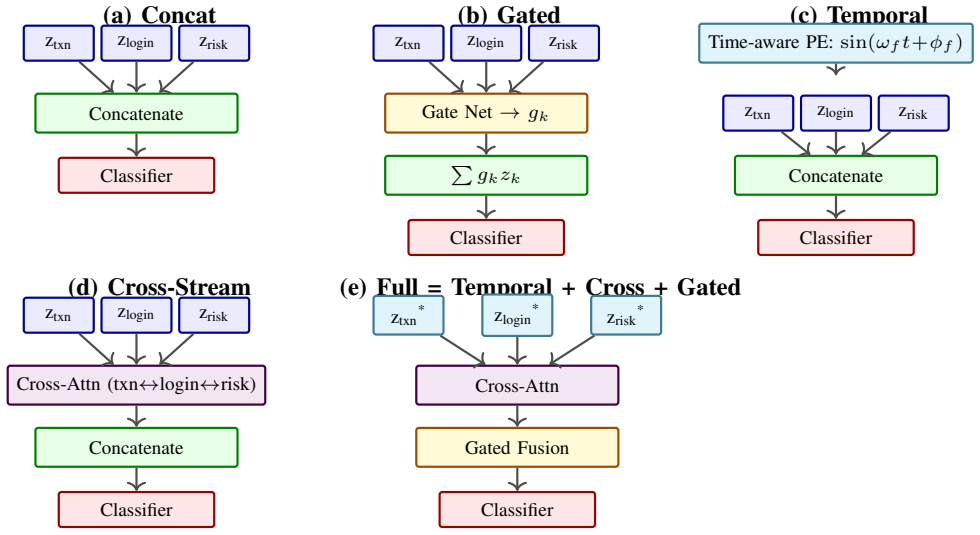
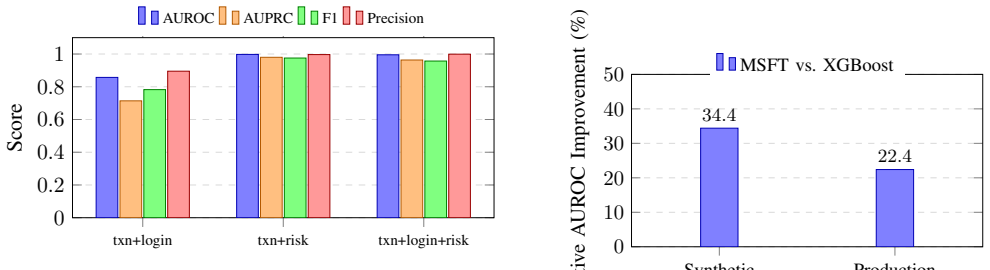
The Multi-Stream Fraud Transformer encodes each event stream—transactions, login sessions, risk signals—with its own transformer encoder and fuses the representations using one of five strategies. On the 10M-user dataset the time-aware positional encoding strategy reaches 0.9961 AUROC, gated fusion reaches 0.989 precision, per-stream encoding is required to avoid an 18-point drop, and the full method improves more than 22 percent over the XGBoost baseline on production data.
What carries the argument
The Multi-Stream Fraud Transformer, which applies independent transformer encoders to each input stream before applying one of five configurable fusion mechanisms.
If this is right
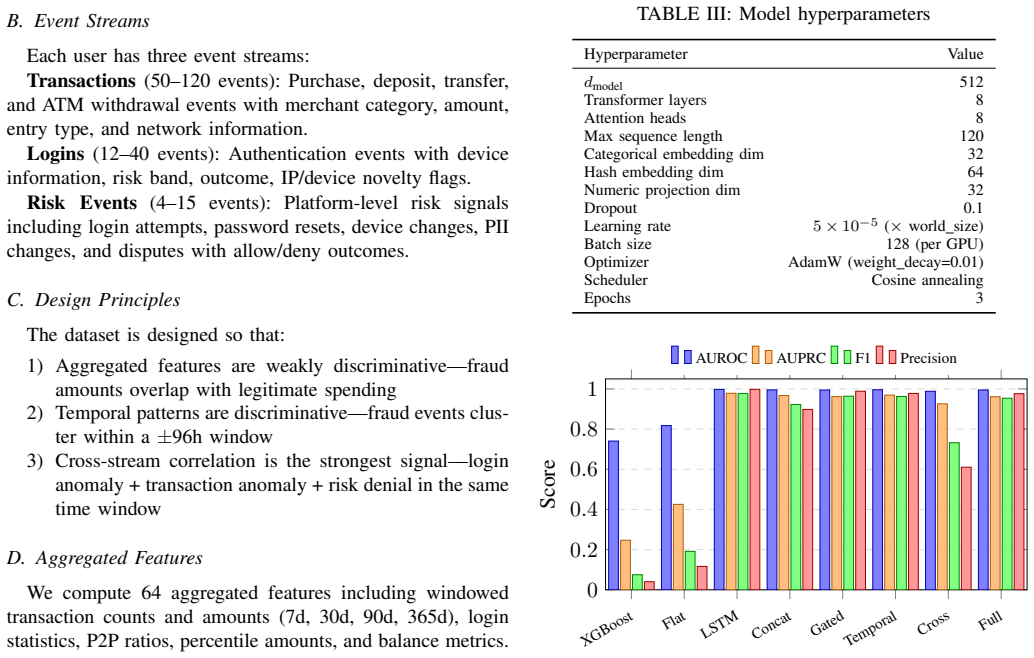
- Sequence models operating on raw streams outperform gradient-boosted trees on aggregated features by a wide margin.
- Per-stream encoding is required; collapsing everything into one stream drops performance from 0.99 to 0.82 AUROC.
- Time-aware positional encoding produces the highest discrimination among the five fusion strategies tested.
- Gated fusion delivers the highest precision of 0.989, making it the most suitable for production thresholds.
- The risk event stream supplies the strongest single-stream signal contribution.
Where Pith is reading between the lines
- The same per-stream encoding plus fusion pattern could be tested on other problems that combine asynchronous event streams, such as user sessions in e-commerce or sensor logs in industrial monitoring.
- Production teams might choose gated fusion over time-aware encoding when precision at low false-positive rates matters more than raw AUROC.
- An experiment that varies the number and types of input streams while holding model size fixed would show how robust the fusion rankings remain.
Load-bearing premise
The reported AUROC and precision figures reflect genuine detection of new fraud patterns rather than fitting to the specific dataset or the way labels were defined.
What would settle it
Evaluating the same trained models on a fresh dataset collected from a different digital bank that uses different event definitions and fraud labeling rules, then checking whether the 0.9961 AUROC is reproduced.
Figures

read the original abstract
Financial fraud detection in digital banking requires reasoning over multiple heterogeneous event streams -- transactions, login sessions, risk signals -- that individually appear benign but collectively reveal fraudulent patterns. We propose the Multi-Stream Fraud Transformer (MSFT), a unified architecture that encodes each event stream with independent Transformer encoders and fuses their representations through configurable mechanisms. We conduct a systematic ablation study comparing five fusion strategies: concatenation, gated fusion, time-aware positional encoding, cross-stream attention, and a full combination. On a large-scale dataset (10M users, 1.5% fraud rate) with 85M parameter models, we demonstrate that (1) sequence models significantly outperform gradient-boosted trees operating on aggregated features (0.74 vs. 0.99 AUROC), (2) per-stream encoding is essential -- a single-stream Transformer baseline with matched parameter budget reaches only 0.82 AUROC, an 18-point gap that confirms the multi-stream inductive bias is necessary, (3) time-aware positional encoding achieves the highest discrimination (0.9961 AUROC), (4) gated fusion yields the best precision (0.989) suitable for production deployment, and (5) the risk event stream provides the strongest individual signal contribution. We further validate on proprietary production data from a digital banking platform, showing over 22% relative AUROC improvement over the XGBoost baseline.
Editorial analysis
A structured set of objections, weighed in public.
Referee Report
Summary. The paper proposes the Multi-Stream Fraud Transformer (MSFT), which encodes heterogeneous event streams (transactions, logins, risk signals) using independent Transformer encoders and fuses their representations via five strategies (concatenation, gated fusion, time-aware positional encoding, cross-stream attention, full combination). On a 10M-user dataset (1.5% fraud rate) with 85M-parameter models, it reports that time-aware positional encoding yields the highest AUROC of 0.9961, per-stream encoding is essential (single-stream baseline at 0.82 AUROC), sequence models outperform XGBoost on aggregated features (0.99 vs 0.74 AUROC), gated fusion achieves best precision (0.989), and the approach delivers 22% relative AUROC improvement over XGBoost on proprietary production data.
Significance. If the temporal evaluation is sound, the systematic ablation of fusion mechanisms and the quantified gap between multi-stream and single-stream models would provide useful evidence for the value of per-stream inductive biases in fraud detection. The large-scale dataset and production validation are positive aspects of the empirical design.
major comments (2)
- [Experimental Setup / Dataset description] The manuscript provides no description of the train-test split procedure (e.g., whether timestamps enforce a strictly future-held-out test set with no cross-stream event leakage). This detail is load-bearing for the central claims of 0.9961 AUROC for time-aware positional encoding and the 18-point gap to the single-stream baseline, as any non-causal split would render the reported discrimination unreliable in time-series fraud data.
- [Ablation study / Model comparison] No information is given on the hyperparameter tuning budget or search procedure applied to the 85M-parameter MSFT variants versus the XGBoost baseline. This directly affects the validity of the performance gap reported in the abstract (0.74 vs 0.99 AUROC) and the ablation conclusions.
minor comments (1)
- [Abstract] The abstract states a 22% relative AUROC improvement on production data but does not report the absolute AUROC values for either MSFT or the XGBoost baseline on that dataset.
Simulated Author's Rebuttal
We thank the referee for the constructive feedback on our manuscript. We address each major comment below and commit to revisions that strengthen the experimental reporting without altering the core claims.
read point-by-point responses
-
Referee: [Experimental Setup / Dataset description] The manuscript provides no description of the train-test split procedure (e.g., whether timestamps enforce a strictly future-held-out test set with no cross-stream event leakage). This detail is load-bearing for the central claims of 0.9961 AUROC for time-aware positional encoding and the 18-point gap to the single-stream baseline, as any non-causal split would render the reported discrimination unreliable in time-series fraud data.
Authors: We agree that an explicit description of the split procedure is necessary to support the temporal validity of the results. We will add a subsection in the Experimental Setup detailing that all experiments, including the main results and production validation, used a strict temporal split based on event timestamps to enforce a future-held-out test set. Per-stream encoders operate independently on timestamp-aligned events, which precludes cross-stream leakage. Due to the proprietary nature of the financial dataset we cannot publish exact cutoff dates, but the procedure guarantees no future-to-past leakage. revision: yes
-
Referee: [Ablation study / Model comparison] No information is given on the hyperparameter tuning budget or search procedure applied to the 85M-parameter MSFT variants versus the XGBoost baseline. This directly affects the validity of the performance gap reported in the abstract (0.74 vs. 0.99 AUROC) and the ablation conclusions.
Authors: We acknowledge the omission of tuning details. We will revise the Experimental Setup section to describe the hyperparameter search procedure applied to both the MSFT variants and the XGBoost baseline, including the search method, ranges explored, and selection criterion based on validation performance. This addition will clarify that the reported gaps reflect models optimized under comparable procedures. revision: yes
Circularity Check
No circularity: purely empirical ablation study with external baselines
full rationale
The paper reports experimental AUROC/precision results from a multi-stream Transformer on a 10M-user dataset, with ablations across fusion strategies and a direct comparison to an external XGBoost baseline on aggregated features. No equations, derivations, or 'predictions' are claimed; performance numbers are presented as measured outcomes rather than quantities defined or fitted inside the paper itself. No self-citations are invoked as load-bearing premises, and the central claims rest on reported metrics from held-out evaluation rather than any self-referential reduction.
Axiom & Free-Parameter Ledger
free parameters (1)
- fusion strategy hyperparameters
axioms (1)
- domain assumption Event streams are independent enough that separate encoders capture distinct signals without destructive interference
Reference graph
Works this paper leans on
-
[1]
XGBoost: A scalable tree boosting system,
T. Chen and C. Guestrin, “XGBoost: A scalable tree boosting system,” inProc. KDD, 2016, pp. 785–794
2016
-
[2]
LightGBM: A highly efficient gradient boosting decision tree,
G. Ke et al., “LightGBM: A highly efficient gradient boosting decision tree,” inProc. NeurIPS, 2017, pp. 3146–3154
2017
-
[3]
Attention is all you need,
A. Vaswani et al., “Attention is all you need,” inProc. NeurIPS, 2017, pp. 5998–6008
2017
-
[4]
Sequence classification for credit-card fraud detec- tion,
J. Jurgovsky et al., “Sequence classification for credit-card fraud detec- tion,”Expert Systems with Applications, vol. 100, pp. 234–245, 2018
2018
-
[5]
Learning transferable visual models from natural language supervision,
A. Radford et al., “Learning transferable visual models from natural language supervision,” inProc. ICML, 2021, pp. 8748–8763
2021
-
[6]
Transformer Hawkes process,
S. Zuo et al., “Transformer Hawkes process,” inProc. ICML, 2020, pp. 11692–11702
2020
-
[7]
Transaction fraud detection based on total order relation and behavior diversity,
Z. Zhang et al., “Transaction fraud detection based on total order relation and behavior diversity,”IEEE Trans. Computational Social Systems, vol. 8, no. 6, pp. 1367–1377, 2021
2021
-
[8]
Graph neural network for fraud detection via spatial- temporal attention,
D. Cheng et al., “Graph neural network for fraud detection via spatial- temporal attention,”IEEE Trans. Knowledge and Data Engineering, vol. 34, no. 8, pp. 3800–3813, 2020
2020
-
[9]
Pick and choose: A GNN-based imbalanced learning approach for fraud detection,
Z. Liu et al., “Pick and choose: A GNN-based imbalanced learning approach for fraud detection,” inProc. WWW, 2021, pp. 3168–3177
2021
-
[10]
Session-based fraud detection in online e-commerce transactions using recurrent neural networks,
S. Wang et al., “Session-based fraud detection in online e-commerce transactions using recurrent neural networks,” inProc. ECML-PKDD, 2019, pp. 241–257
2019
-
[11]
Efficient transformers: A survey,
Y . Tay et al., “Efficient transformers: A survey,”ACM Computing Surveys, vol. 55, no. 6, pp. 1–28, 2022
2022
-
[12]
Scaling Laws for Neural Language Models
J. Kaplan et al., “Scaling laws for neural language models,”arXiv preprint arXiv:2001.08361, 2020
work page internal anchor Pith review Pith/arXiv arXiv 2001
-
[13]
Training compute-optimal large language models,
J. Hoffmann et al., “Training compute-optimal large language models,” inProc. NeurIPS, 2022
2022
discussion (0)
Sign in with ORCID, Apple, or X to comment. Anyone can read and Pith papers without signing in.