Ab initio calculations of parity-violating electron scattering off ⁴⁸Ca and ²⁰⁸Pb
Pith reviewed 2026-06-25 21:35 UTC · model grok-4.3
The pith
Ab initio calculations using chiral forces yield a neutron skin for 208Pb of 0.187 fm, smaller than the PREX II value.
A machine-rendered reading of the paper's core claim, the machinery that carries it, and where it could break.
Core claim
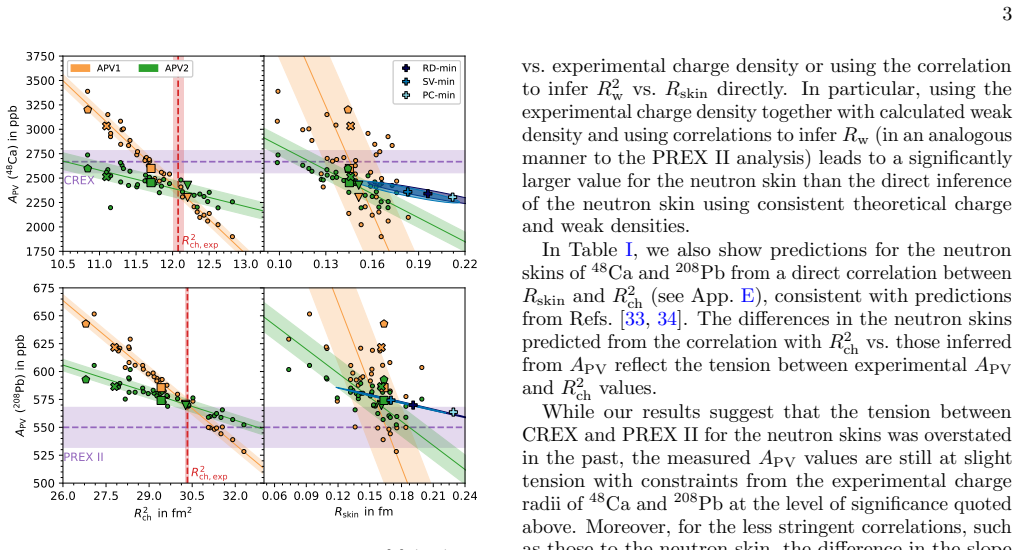
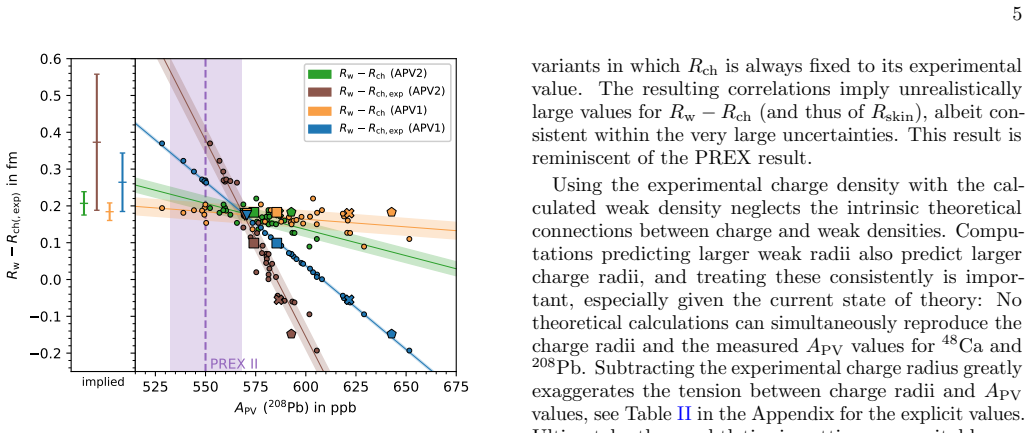
Ab initio calculations based on chiral effective field theory nuclear forces, including Coulomb distortions, produce parity-violating asymmetries A_PV that are slightly smaller than observed for 48Ca and slightly larger than observed for 208Pb, at a global significance of 1.9 sigma. Using these theoretically consistent charge and weak densities, the experimental A_PV data imply a neutron skin thickness R_n - R_p = 0.187(25)(18) fm for 208Pb.
What carries the argument
Ab initio evaluation of the parity-violating asymmetry A_PV from chiral effective field theory forces together with full Coulomb corrections, supplying consistent charge and weak densities for radius extraction.
If this is right
- The neutron skin of 208Pb is smaller than the PREX II extraction, tightening constraints on the equation of state of neutron-rich matter.
- Correlation analyses that link weak radii to A_PV must be reexamined in light of the 1.9 sigma tension.
- Ab initio methods can now be applied to additional nuclei to test electroweak interactions at low energy.
- The smaller skin thickness affects predictions for the properties of neutron stars.
Where Pith is reading between the lines
- The reduced skin thickness may align better with other ab initio predictions for heavy nuclei that were previously in tension with PREX II.
- Repeating the same consistent-density analysis for future parity-violation measurements on additional nuclei would test whether the 1.9 sigma offset is systematic.
- The framework could be extended to compute A_PV for deformed nuclei where experimental data are still absent.
Load-bearing premise
The chiral effective field theory forces and ab initio methods supply charge and weak densities that are accurate enough to convert measured A_PV into a neutron skin thickness without large unaccounted systematic errors.
What would settle it
An independent determination of the 208Pb neutron skin that matches the larger PREX II value while remaining consistent with the measured A_PV would contradict the ab initio preference.
Figures

read the original abstract
Parity-violating electron scattering off nuclei both serves as a low-energy precision probe to test electroweak interactions and allows one to access neutron distributions inside nuclei. It has implications for strong interactions in dense neutron-rich environments, also providing constraints for the properties of matter in neutron stars. Precision measurements are available for $^{48}$Ca and $^{208}$Pb by the CREX and PREX collaborations, respectively, and their interpretation requires advanced nuclear-structure calculations to draw firm conclusions. We perform the first ab initio calculations of the parity-violating asymmetry $A_\text{PV}$ based on nuclear forces from chiral effective field theory, fully including corrections due to Coulomb distortion effects. Based on these results, we critically reexamine correlation analyses employed to infer weak radii and quantify the resulting tensions between ab initio and experimental results. We find that ab initio calculations prefer values of $A_\text{PV}$ slightly smaller and larger than observed for $^{48}$Ca and $^{208}$Pb, respectively, with a global significance of $1.9\sigma$. Using theoretically consistent inputs for charge and weak densities, we infer from the experimental $A_\text{PV}$ a neutron skin of $^{208}$Pb of $R_n-R_p = 0.187(25)(18)$ fm, substantially smaller than that reported by PREX II.
Editorial analysis
A structured set of objections, weighed in public.
Referee Report
Summary. The manuscript performs the first ab initio calculations of the parity-violating asymmetry A_PV for 48Ca and 208Pb using chiral EFT nuclear forces, fully incorporating Coulomb distortion corrections. It reports that the computed A_PV values are slightly smaller than experiment for 48Ca and larger for 208Pb, yielding a global 1.9σ tension, and uses theoretically consistent charge and weak densities to infer a neutron skin thickness R_n - R_p = 0.187(25)(18) fm for 208Pb, substantially smaller than the PREX II result.
Significance. If the central results hold after uncertainty quantification, the work is significant because it supplies the first parameter-free ab initio inputs for interpreting CREX and PREX data with consistent densities, directly challenging the PREX II neutron-skin extraction and supplying falsifiable predictions for neutron-star equation-of-state constraints. The inclusion of Coulomb distortions and the reexamination of correlation analyses are clear strengths.
major comments (2)
- [Results section] Results section (near the 1.9σ claim): the global significance is presented without an explicit propagation of theoretical uncertainties on the computed A_PV for 208Pb arising from many-body truncation, model-space convergence, and chiral-EFT parameter variations; if these uncertainties are comparable to the experimental precision, the reported tension cannot be considered robust.
- [Neutron-skin inference paragraph] Neutron-skin inference paragraph: the second uncertainty (18) fm on R_n - R_p = 0.187(25)(18) fm is not traced to a specific source (e.g., variation of the chiral forces or Coulomb corrections), making it impossible to judge whether the quoted value fully accounts for the dominant theoretical systematics that the skeptic note identifies as load-bearing.
minor comments (1)
- [Abstract] The abstract states 'first ab initio calculations' but does not cite prior non-ab-initio or hybrid calculations for context; a brief comparison sentence would improve clarity.
Simulated Author's Rebuttal
We thank the referee for the careful review and constructive feedback on our manuscript. The comments have prompted us to strengthen the presentation of theoretical uncertainties. We have revised the manuscript to include explicit propagation of uncertainties into A_PV and to trace the sources of the quoted errors on the neutron skin. Our responses to the major comments are given below.
read point-by-point responses
-
Referee: [Results section] Results section (near the 1.9σ claim): the global significance is presented without an explicit propagation of theoretical uncertainties on the computed A_PV for 208Pb arising from many-body truncation, model-space convergence, and chiral-EFT parameter variations; if these uncertainties are comparable to the experimental precision, the reported tension cannot be considered robust.
Authors: We agree that explicit propagation is necessary for a robust assessment of the tension. In the revised manuscript we have added a new paragraph and accompanying table in the Results section that quantifies each contribution: many-body truncation (via order-by-order convergence of the chiral expansion), model-space convergence (basis-size variations up to N_max=14), and chiral-EFT parameter variations (spread across the N2LO and N3LO interactions employed). The combined theoretical uncertainty on A_PV(208Pb) is 0.12 ppm, which remains smaller than the experimental uncertainty. Propagating this uncertainty yields a global tension of 1.9σ, confirming the original claim. The text near the 1.9σ statement now references this table. revision: yes
-
Referee: [Neutron-skin inference paragraph] Neutron-skin inference paragraph: the second uncertainty (18) fm on R_n - R_p = 0.187(25)(18) fm is not traced to a specific source (e.g., variation of the chiral forces or Coulomb corrections), making it impossible to judge whether the quoted value fully accounts for the dominant theoretical systematics that the skeptic note identifies as load-bearing.
Authors: We have revised the neutron-skin inference paragraph to explicitly attribute the second uncertainty. The (25) fm component arises from the experimental uncertainty on A_PV, while the (18) fm component is obtained from the spread in R_n - R_p across the chiral interactions (N2LO vs. N3LO) after including the Coulomb-distortion corrections. A short breakdown is now provided in the text and in a footnote, showing that the dominant theoretical systematics are covered by this variation. No additional sources were found to exceed this envelope. revision: yes
Circularity Check
No circularity: ab initio A_PV from chiral EFT forces compared to external data; neutron-skin inference uses independent mapping
full rationale
The paper's chain begins with chiral EFT forces fitted to independent NN scattering and few-body data, applies ab initio methods to compute charge and weak densities for 48Ca and 208Pb, calculates A_PV with Coulomb distortions, and compares the resulting values directly to external CREX/PREX measurements, finding 1.9σ tension. The neutron-skin extraction for 208Pb solves for R_n-R_p using the experimental A_PV together with the theory's consistent densities as a mapping; this is not a fit to the target A_PV data and introduces no definitional reduction or self-citation load-bearing step. All load-bearing elements remain externally falsifiable against the cited experiments and prior force calibrations.
Axiom & Free-Parameter Ledger
free parameters (1)
- chiral EFT low-energy constants
axioms (1)
- domain assumption Chiral effective field theory provides a systematic and accurate expansion for nuclear forces at the relevant energies
Reference graph
Works this paper leans on
-
[1]
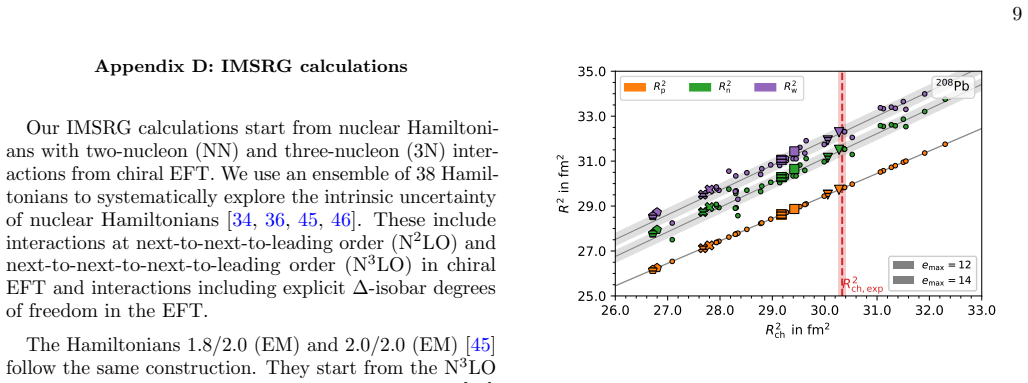
We start from an ensemble of 38 Hamiltonians [ 34, 36, 45, 46] with two- and three-nucleon interactions from chiral EFT [47, 48], covering various sources of uncertainty in nuclear Hamiltonians
-
[2]
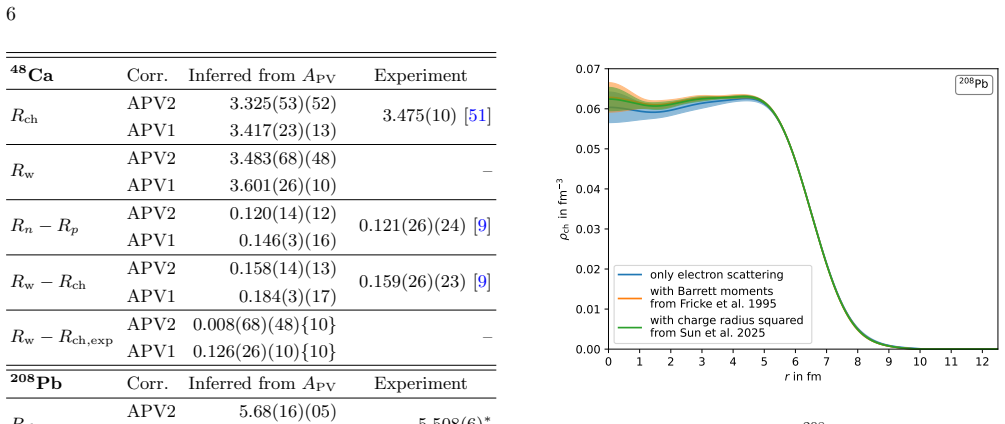
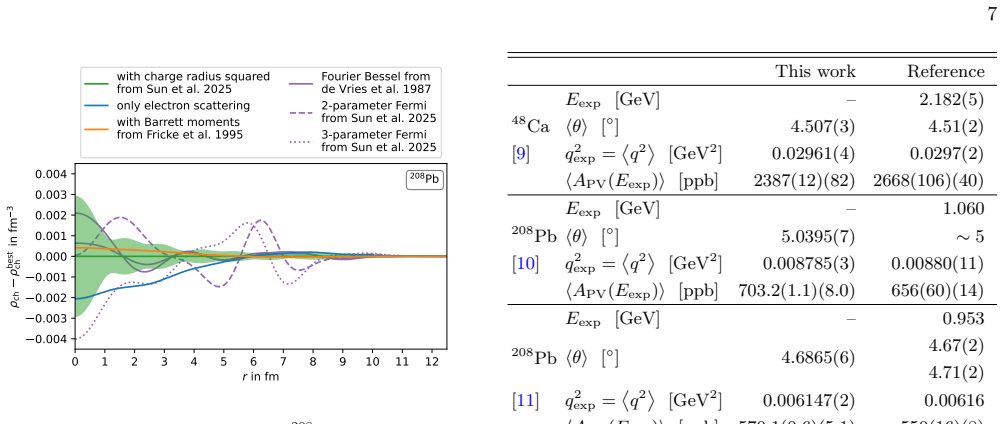
For each Hamiltonian, we compute the ground-state radii and charge/weak densities of 48Ca and 208Pb using the ab initio in-medium similarity renormal- ization group (IMSRG) [ 49, 50]. We also consider experimental charge densities from electron scat- tering, for which we reanalyze electron scattering data in 208Pb to properly account for data and fit unce...
-
[3]
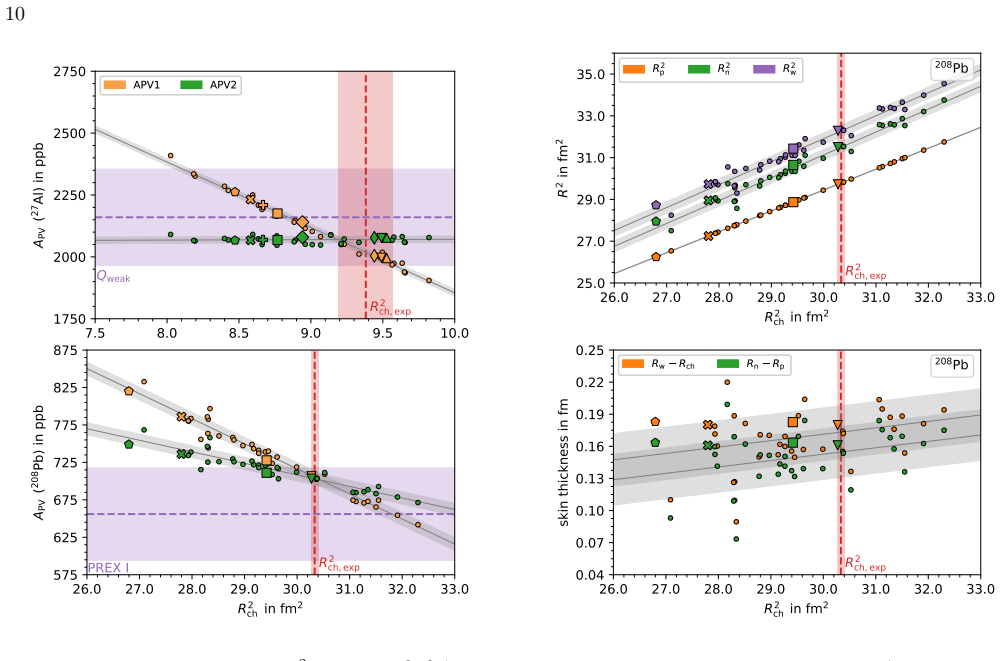
APV1,” we use the charge distributions from electron scat- tering, while for “APV2
From these densities, we compute APV at the kine- matics of the CREX and PREX II experiments, fully including Coulomb-distortion effects [53]. 2100 2300 2500 2700 2900 APV (48Ca) in ppb 525 550 575 600 625APV (208Pb) in ppb CREX PREX IIEDF RD-min SV-min PC-min IMSRG Calib. on R2 ch, exp NNLOGO 1.8/2.0 (EM) 2.0/2.0 (EM) 1.8/2.0 (EM7.5) Samples from Hu et a...
2022
-
[4]
K. Hebeler, J. D. Holt, J. Men´ endez, and A. Schwenk, Nuclear forces and their impact on neutron-rich nuclei and neutron-rich matter, Ann. Rev. Nucl. Part. Sci.65, 457 (2015), arXiv:1508.06893
Pith/arXiv arXiv 2015
- [5]
-
[6]
J. M. Lattimer, Constraints on Nuclear Symme- try Energy Parameters, Particles6, 30 (2023), arXiv:2301.03666
arXiv 2023
-
[7]
J. M. Mammei, C. J. Horowitz, J. Piekarewicz, B. T. Reed, and C. Sfienti, Neutron Skins: Weak Elastic Scat- tering and Neutron Stars, Ann. Rev. Nucl. Part. Sci.74, 321 (2024), arXiv:2311.06146
arXiv 2024
-
[8]
K. Chatziioannou, H. T. Cromartie, S. Gandolfi, I. Tews, D. Radice, A. W. Steiner, and A. L. Watts, Neutron stars and the dense matter equation of state, Rev. Mod. Phys.97, 045007 (2025), arXiv:2407.11153
arXiv 2025
-
[9]
M. Mendes, H. G¨ ottling, A. Hensel, I. Svens- son, K. Hebeler, A. Schwenk, N. Rutherford, and A. Watts, Astrophysics equation of state inference with Bayesian chiral effective field theory uncertainties (2026), arXiv:2605.18560
Pith/arXiv arXiv 2026
-
[10]
T. W. Donnelly, J. Dubach, and I. Sick, Isospin depen- dences in parity-violating electron scattering, Nucl. Phys. A503, 589 (1989)
1989
-
[11]
V. Tishchenkoet al.(MuLan), Detailed Report of the MuLan Measurement of the Positive Muon Lifetime and Determination of the Fermi Constant, Phys. Rev. D87, 052003 (2013), arXiv:1211.0960
Pith/arXiv arXiv 2013
-
[12]
Adhikariet al.(CREX), Precision Determination of the Neutral Weak Form Factor of 48Ca, Phys
D. Adhikariet al.(CREX), Precision Determination of the Neutral Weak Form Factor of 48Ca, Phys. Rev. Lett. 129, 042501 (2022), arXiv:2205.11593
arXiv 2022
-
[13]
S. Abrahamyanet al.(PREX), Measurement of the Neutron Radius of 208Pb Through Parity-Violation in Electron Scattering, Phys. Rev. Lett.108, 112502 (2012), arXiv:1201.2568
Pith/arXiv arXiv 2012
-
[14]
D. Adhikariet al.(PREX), Accurate Determination of the Neutron Skin Thickness of 208Pb through Parity- Violation in Electron Scattering, Phys. Rev. Lett.126, 172502 (2021), arXiv:2102.10767
arXiv 2021
-
[15]
D. Androi´ cet al.( Qweak), Determination of the 27Al Neutron Distribution Radius from a Parity-Violating Electron Scattering Measurement, Phys. Rev. Lett.128, 132501 (2022), arXiv:2112.15412
arXiv 2022
-
[16]
de Vries, C
H. de Vries, C. W. de Jager, and C. de Vries, Nuclear charge and magnetization density distribution parame- ters from elastic electron scattering, Atom. Data Nucl. Data Tabl.36, 495 (1987)
1987
-
[17]
C. J. Horowitz, Parity violating elastic electron scattering and Coulomb distortions, Phys. Rev. C57, 3430 (1998), arXiv:nucl-th/9801011
Pith/arXiv arXiv 1998
-
[18]
C. J. Horowitz, S. J. Pollock, P. A. Souder, and R. Michaels, Parity violating measurements of neutron densities, Phys. Rev. C63, 025501 (2001), arXiv:nucl- th/9912038
arXiv 2001
-
[19]
C. J. Horowitzet al., Weak charge form factor and radius of 208Pb through parity violation in electron scattering, Phys. Rev. C85, 032501 (2012), arXiv:1202.1468
Pith/arXiv arXiv 2012
-
[20]
C. J. Horowitz, Parity violating elastic electron scattering from 27Al and the Qweak measurement, Phys. Rev. C 89, 045503 (2014), arXiv:1401.6898
Pith/arXiv arXiv 2014
-
[21]
P.-G. Reinhard, X. Roca-Maza, and W. Nazarewicz, Combined Theoretical Analysis of the Parity-Violating Asymmetry for 48Ca and 208Pb, Phys. Rev. Lett.129, 232501 (2022), arXiv:2206.03134
arXiv 2022
-
[22]
E. Y¨ uksel and N. Paar, Implications of parity-violating electron scattering experiments on 48Ca (CREX) and 208Pb (PREX-II) for nuclear energy density functionals, Phys. Lett. B836, 137622 (2023), arXiv:2206.06527
arXiv 2023
-
[23]
Z. Zhang and L.-W. Chen, Bayesian inference of the symmetry energy and the neutron skin in 48Ca and 208Pb from CREX and PREX-2, Phys. Rev. C108, 024317 (2023), arXiv:2207.03328
arXiv 2023
-
[24]
C. Mondal and F. Gulminelli, Nucleonic metamodeling in light of multimessenger, PREX-II, and CREX data, Phys. Rev. C107, 015801 (2023), arXiv:2209.05177
arXiv 2023
-
[25]
P. Papakonstantinou, Nuclear Symmetry Energy and the PREX-CREX Neutron Skin Puzzle within the KIDS Framework, Nucl. Theor.39, 36 (2022), 12 arXiv:2210.02696
arXiv 2022
-
[26]
T. Miyatsu, M.-K. Cheoun, K. Kim, and K. Saito, Can the PREX-2 and CREX results be understood by relativistic mean-field models with the astrophys- ical constraints?, Phys. Lett. B843, 138013 (2023), arXiv:2303.14763
arXiv 2023
-
[27]
B. T. Reed, F. J. Fattoyev, C. J. Horowitz, and J. Piekarewicz, Density dependence of the symmetry energy in the post–PREX-CREX era, Phys. Rev. C109, 035803 (2024), arXiv:2305.19376
arXiv 2024
-
[28]
F. Sammarruca, The Neutron Skin of 48Ca and 208Pb: A Critical Analysis, Symmetry16, 34 (2024), arXiv:2311.02539
arXiv 2024
-
[29]
T. Zhao, Z. Lin, B. Kumar, A. W. Steiner, and M. Prakash, Characterizing the nuclear models informed by PREX and CREX: A view from Bayesian inference, Phys. Rev. Res.7, 043335 (2025), arXiv:2406.05267
arXiv 2025
-
[30]
X. Roca-Maza and D. H. Jakubassa-Amundsen, QED Corrections to the Parity-Violating Asymmetry in High- Energy Electron-Nucleus Collisions, Phys. Rev. Lett. 134, 192501 (2025), arXiv:2501.14375
arXiv 2025
-
[31]
A. Kunjipurayil, J. Piekarewicz, and M. Salinas, Role of the isovector spin-orbit potential in mitigating the CREX-PREX dilemma, Phys. Rev. C112, 014310 (2025), arXiv:2503.07405
arXiv 2025
-
[32]
B. T. Reed, M. Heinz, P. Arthuis, A. Schwenk, and I. Tews, Connecting relativistic density functional theory to microscopic calculations, Phys. Rev. C112, 034331 (2025), arXiv:2505.00828
arXiv 2025
-
[33]
B. T. Reed and C. J. Horowitz, Comment on QED Corrections to the Parity Violating Asymme- try in High-Energy Electron-Nucleus Scattering (2026), arXiv:2601.01615
arXiv 2026
-
[34]
Piekarewicz, The Matter Radius of 132Sn and the CREX-PREX Dilemma (2026), arXiv:2603.11983
J. Piekarewicz, The Matter Radius of 132Sn and the CREX-PREX Dilemma (2026), arXiv:2603.11983
arXiv 2026
-
[35]
B. T. Reed and C. J. Horowitz, Electroweak Radiative Corrections to Parity-Violating Electron-Nucleus Scat- tering (2026), arXiv:2603.22581
arXiv 2026
-
[36]
Hagenet al., Neutron and weak-charge distribu- tions of the 48Ca nucleus, Nat
G. Hagenet al., Neutron and weak-charge distribu- tions of the 48Ca nucleus, Nat. Phys.12, 186 (2015), arXiv:1509.07169
Pith/arXiv arXiv 2015
-
[37]
B. S. Huet al., Ab initio predictions link the neutron skin of 208Pb to nuclear forces, Nat. Phys.18, 1196 (2022), arXiv:2112.01125
arXiv 2022
-
[38]
K. Hebeler, V. Durant, J. Hoppe, M. Heinz, A. Schwenk, J. Simonis, and A. Tichai, Normal ordering of three- nucleon interactions for ab initio calculations of heavy nu- clei, Phys. Rev. C107, 024310 (2023), arXiv:2211.16262
arXiv 2023
-
[39]
P. Arthuis, K. Hebeler, and A. Schwenk, Neutron-rich nuclei and neutron skins from chiral low-resolution in- teractions (2024), arXiv:2401.06675
arXiv 2024
-
[40]
F. Bonaiti, G. Hagen, and T. Papenbrock, Structure of the doubly magic nuclei 208Pb and 266Pb from ab initio computations (2025), arXiv:2508.14217
arXiv 2025
- [41]
- [42]
-
[43]
M. Hoferichter, P. Klos, J. Men´ endez, and A. Schwenk, Analysis strategies for general spin-independent WIMP- nucleus scattering, Phys. Rev. D94, 063505 (2016), arXiv:1605.08043
Pith/arXiv arXiv 2016
-
[44]
M. Hoferichter, P. Klos, J. Men´ endez, and A. Schwenk, Nuclear structure factors for general spin-independent WIMP-nucleus scattering, Phys. Rev. D99, 055031 (2019), arXiv:1812.05617
Pith/arXiv arXiv 2019
-
[45]
C. G. Payne, S. Bacca, G. Hagen, W. G. Jiang, and T. Papenbrock, Coherent elastic neutrino-nucleus scat- tering on 40Ar from first principles, Phys. Rev. C100, 061304 (2019), arXiv:1908.09739
arXiv 2019
-
[46]
M. Hoferichter, J. Men´ endez, and A. Schwenk, Coherent elastic neutrino-nucleus scattering: EFT analysis and nuclear responses, Phys. Rev. D102, 074018 (2020), arXiv:2007.08529
arXiv 2020
-
[47]
M. Hoferichter, J. Men´ endez, and F. No¨ el, Improved Limits on Lepton-Flavor-Violating Decays of Light Pseudoscalars via Spin-Dependent µ→e Conver- sion in Nuclei, Phys. Rev. Lett.130, 131902 (2023), arXiv:2204.06005
arXiv 2023
-
[48]
K. Hebeler, S. K. Bogner, R. J. Furnstahl, A. Nogga, and A. Schwenk, Improved nuclear matter calculations from chiral low-momentum interactions, Phys. Rev. C 83, 031301 (2011), arXiv:1012.3381
Pith/arXiv arXiv 2011
-
[49]
W. G. Jiang, A. Ekstr¨ om, C. Forss´ en, G. Hagen, G. R. Jansen, and T. Papenbrock, Accurate bulk properties of nuclei from A = 2 to ∞ from potentials with ∆ isobars, Phys. Rev. C102, 054301 (2020), arXiv:2006.16774
arXiv 2020
-
[50]
E. Epelbaum, H.-W. Hammer, and U.-G. Meißner, Mod- ern Theory of Nuclear Forces, Rev. Mod. Phys.81, 1773 (2009), arXiv:0811.1338
Pith/arXiv arXiv 2009
-
[51]
R. Machleidt and D. R. Entem, Chiral effective field theory and nuclear forces, Phys. Rep.503, 1 (2011), arXiv:1105.2919
Pith/arXiv arXiv 2011
-
[52]
H. Hergert, S. K. Bogner, T. D. Morris, A. Schwenk, and K. Tsukiyama, The In-Medium Similarity Renor- malization Group: A Novel Ab Initio Method for Nuclei, Phys. Rep.621, 165 (2016), arXiv:1512.06956
Pith/arXiv arXiv 2016
- [53]
-
[54]
F. No¨ el and M. Hoferichter, Uncertainty quantification for µ →e conversion in nuclei: charge distributions, J. High Energy Phys.08(2024), 052, arXiv:2406.06677
arXiv 2024
-
[55]
No¨ el,µ →e conversion in nuclei: EFT description, charge densities, and pseudo-scalar decays, Ph.D
F. No¨ el,µ →e conversion in nuclei: EFT description, charge densities, and pseudo-scalar decays, Ph.D. thesis, Bern U. (2024)
2024
-
[56]
No¨ el,https://pypi.org/project/phasr/(2025)
F. No¨ el,https://pypi.org/project/phasr/(2025)
2025
-
[57]
P. Kl¨ upfel, P.-G. Reinhard, T. J. B¨ urvenich, and J. A. Maruhn, Variations on a theme by Skyrme: A systematic study of adjustments of model parameters, Phys. Rev. C79, 034310 (2009), arXiv:0804.3385
Pith/arXiv arXiv 2009
-
[58]
J. Erler, P. Kl¨ upfel, and P.-G. Reinhard, Exploration of a modified density dependence in the Skyrme functional, Phys. Rev. C82, 044307 (2010), arXiv:1009.0624
Pith/arXiv arXiv 2010
-
[59]
W. Nazarewicz, P.-G. Reinhard, W. Satu la, and D. Vrete- nar, Symmetry energy in nuclear density functional the- ory, Eur. Phys. J. A50, 20 (2014), arXiv:1307.5782
Pith/arXiv arXiv 2014
-
[60]
Fricke, C
G. Fricke, C. Bernhardt, K. Heilig, L. A. Schaller, L. Schellenberg, E. B. Shera, and C. W. de Jager, Nuclear Ground State Charge Radii from Electromagnetic Inter- actions, Atom. Data Nucl. Data Tabl.60, 177 (1995)
1995
-
[61]
Z. Sun, K. A. Beyer, Z. A. Mandrykina, I. A. Val- uev, C. H. Keitel, and N. S. Oreshkina, 208Pb Nuclear 13 Charge Radius Revisited: Closing the Fine-Structure- Anomaly Gap, Phys. Rev. Lett.135, 163002 (2025), arXiv:2504.19977
arXiv 2025
-
[62]
Beckeret al., The P2 experiment, Eur
D. Beckeret al., The P2 experiment, Eur. Phys. J. A 54, 208 (2018), arXiv:1802.04759
Pith/arXiv arXiv 2018
- [63]
-
[64]
J. B. Bellicard and K. J. van Oostrum, Elastic Electron Scattering from Lead-208 at 175 and 250 MeV, Phys. Rev. Lett.19, 242 (1967)
1967
-
[65]
G. J. C. Van Niftrik, Elastic scattering of electrons from lead and bismuth at 40 to 60 MeV, Nucl. Phys. A131, 574 (1969)
1969
-
[66]
Heisenberg, R
J. Heisenberg, R. Hofstadter, J. S. McCarthy, I. Sick, B. C. Clark, R. Herman, and D. G. Ravenhall, Elas- tic Electron Scattering by 208Pb And New Information About the Nuclear Charge Distribution, Phys. Rev. Lett. 23, 1402 (1969)
1969
-
[67]
Nagao and Y
M. Nagao and Y. Torizuka, Electron excitation of low- lying states in 208Pb, Phys. Lett. B37, 383 (1971)
1971
-
[68]
Friedrich and F
J. Friedrich and F. Lenz, Elastic electron scattering from 208Pb at moderate momentum transfers and model- independent description of the nuclear charge distribu- tion, Nucl. Phys. A183, 523 (1972)
1972
-
[69]
J. L. Friar and J. W. Negele, The determination of the nuclear charge distribution of 208Pb from elastic electron scattering and muonic X-rays, Nucl. Phys. A212, 93 (1973)
1973
-
[70]
Dreher, J
B. Dreher, J. Friedrich, K. Merle, H. Rothhaas, and G. L¨ uhrs, The determination of the nuclear ground state and transition charge density from measured electron scattering data, Nucl. Phys. A235, 219 (1974)
1974
-
[71]
C. W. de Jager, H. de Vries, and C. de Vries, Nuclear charge and magnetization density distribution parame- ters from elastic electron scattering, Atom. Data Nucl. Data Tabl.14, 479 (1974), [Erratum: Atom. Data Nucl. Data Tabl.16, 580 (1975)]
1974
-
[72]
Euteneuer, J
H. Euteneuer, J. Friedrich, and N. Voegler, Charge Dis- tribution of 208Pb and the Difference in ρ(r) for Pb and Tl Investigated by by Elastic Electron Scattering, Phys. Rev. Lett.36, 129 (1976)
1976
-
[73]
H. Euteneuer,Elastische Elektronenstreuung an 208Pb und seinen Nachbarkernen 209Bi, 207,206,204Pb sowie 205,203Tl zur Bestimmung der Grundzustand- sladungsverteilung dieser Nuklide, Ph.D. thesis, Johannes-Gutenberg-Universit¨ at Mainz (1976)
1976
-
[74]
Frois, J
B. Frois, J. B. Bellicard, J. M. Cavedon, M. Huet, P. Leconte, P. Ludeau, A. Nakada, X. H. Phan, and I. Sick, High Momentum Transfer electron Scattering from 208Pb, Phys. Rev. Lett.38, 152 (1977)
1977
-
[75]
Euteneuer, J
H. Euteneuer, J. Friedrich, and N. Voegler, What can be learnt about nuclear polarization from a consistency analysis of e−cross sections and muonic X-rays for 208Pb and the isotone pair 209Bi/208Pb?, Z. Physik A280, 165 (1977)
1977
-
[76]
Euteneuer, J
H. Euteneuer, J. Friedrich, and N. Vogler, The Charge Distribution Differences of 209Bi, 208,207,206,204Pb and 205,203Tl Investigated by Elastic electron Scattering and Muonic X-Ray Data, Nucl. Phys. A298, 452 (1978)
1978
-
[77]
P. Mazanek,Gemeinsame Auswertung von Messun- gen myonischer Atome, optischer Isotopieverschiebun- gen und elastischer Elektronenstreuung zur Festlegung von Radien stabiler und instabiler Kerne unterhalb von N = 126sowie Bestimmung von Kernradien aus µ- Atom-Messungen f¨ ur Erbium- und Wolframisotope, Ph.D. thesis, Johannes-Gutenberg-Universit¨ at Mainz (1992)
1992
-
[78]
M. Gorchtein and C. J. Horowitz, Dispersion γZ-box correction to the weak charge of the proton, Phys. Rev. Lett.102, 091806 (2009), arXiv:0811.0614
Pith/arXiv arXiv 2009
-
[79]
M. Gorchtein, C. J. Horowitz, and M. J. Ramsey-Musolf, Model-dependence of the γZ dispersion correction to the parity-violating asymmetry in elastic ep scattering, Phys. Rev. C84, 015502 (2011), arXiv:1102.3910
Pith/arXiv arXiv 2011
-
[80]
D. Androi´ cet al.( Qweak), Precision measurement of the weak charge of the proton, Nature557, 207 (2018), arXiv:1905.08283
Pith/arXiv arXiv 2018
discussion (0)
Sign in with ORCID, Apple, or X to comment. Anyone can read and Pith papers without signing in.