Evolution of AGN Across Cosmic Epochs with the SKAO
Pith reviewed 2026-06-25 23:29 UTC · model grok-4.3
The pith
SKA-Mid multi-tiered surveys will characterize the bulk of radio AGN down to 10^23 W Hz^{-1} up to redshift 6.
A machine-rendered reading of the paper's core claim, the machinery that carries it, and where it could break.
Core claim
Using SKAO simulated radio source catalogues, the SKA-Mid multi-tiered surveys reaching sub-μJy depths will allow characterisation of the bulk of the radio-AGN population complete down to L_1.4GHz ~ 10^23 W Hz^{-1} and enable probing the evolution of radio-AGN across a wide range of luminosities and all galaxy environments up to z ~ 6.
What carries the argument
The SKAO simulated radio source catalogues that generate predicted radio luminosity functions, source counts, and detection rates for AGN.
If this is right
- Radio AGN evolution can be tracked across the full luminosity range rather than only the brightest objects.
- Studies will include AGN in all galaxy environments out to redshift 6.
- Multi-tiered survey strategy is required to achieve this complete view at sub-μJy sensitivity.
- Radio selection will provide an unbiased sample relative to dust-obscured or X-ray faint AGN.
Where Pith is reading between the lines
- The resulting AGN samples could be cross-matched with optical and infrared data to measure the fraction of obscured systems as a function of redshift.
- Feedback models of galaxy formation could be tested against the observed space density of radio AGN in different environments.
Load-bearing premise
The simulated catalogues correctly reproduce the real numbers, host properties, and detection chances of AGN at every luminosity and redshift the surveys will reach.
What would settle it
Once SKAO data are taken, a direct count of detected AGN at faint luminosities and redshifts above 3 compared against the simulation predictions would confirm or refute the claimed completeness.
Figures



read the original abstract
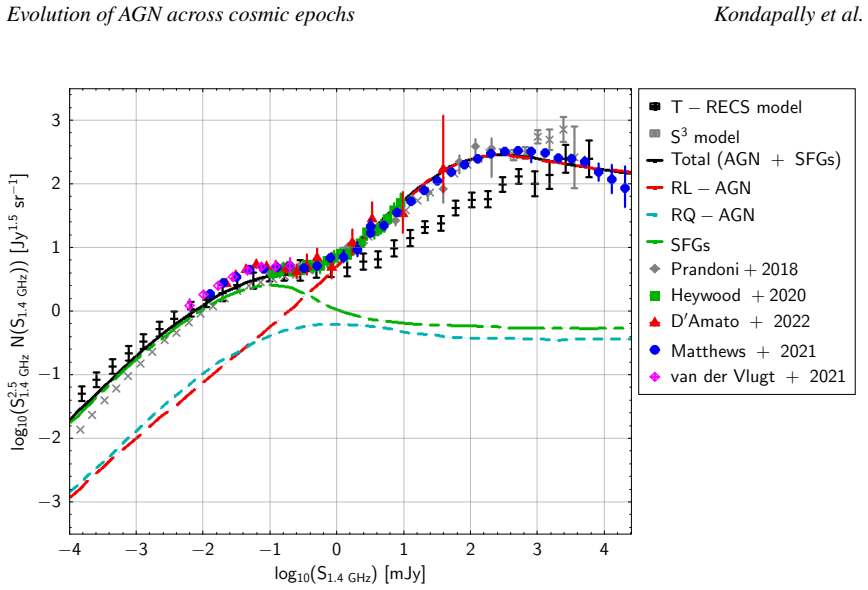
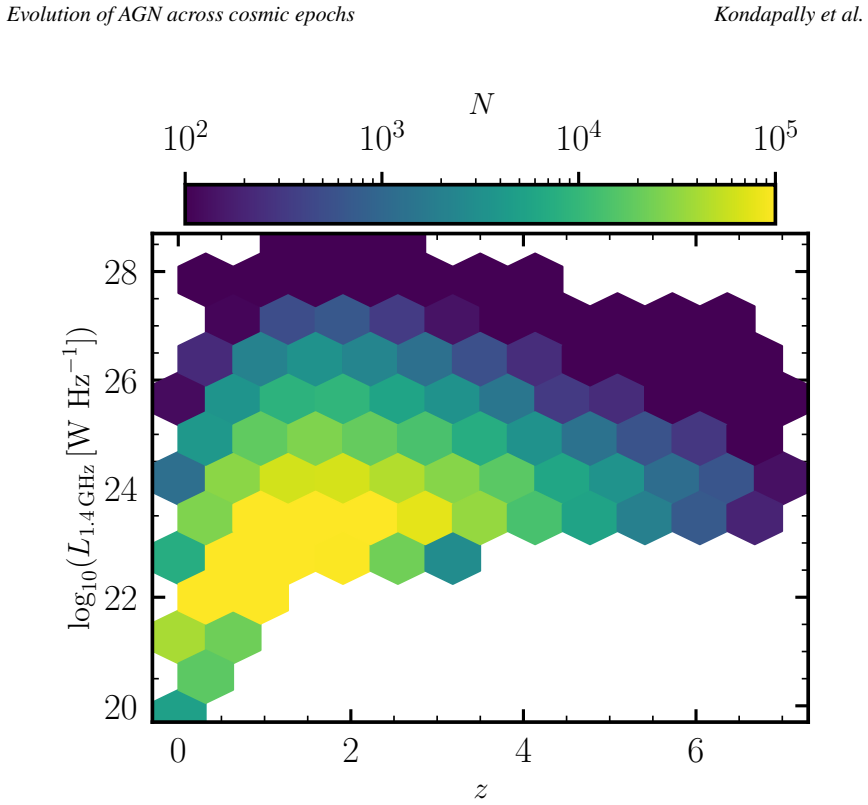
Understanding the evolution of active galactic nuclei (AGN) and their host galaxies across cosmic epochs is one of the key science drivers of extragalactic astronomy. The detection of AGN residing in dusty environments and at high redshifts is difficult due to obscuration and faintness which poses a challenge in understanding AGN evolution across cosmic time. Deep radio continuum surveys (rms noise $<$ 1 $\mu$Jy~beam$^{-1}$) from the Square Kilometre Array Observatory (SKAO) will be an efficient means to detect and study a broad population of AGN across cosmic history. In this chapter, we present radio luminosity functions, source counts, and detection rates of AGN based on the SKAO simulated radio source catalogues. We demonstrate that the SKA-Mid multi-tiered surveys, in particular, reaching sub-$\mu$Jy depths, will allow us to characterise the bulk of the radio-AGN complete down to $L_{\rm{1.4\,GHz}} \sim 10^{23}\,\rm{W\,Hz^{-1}}$ and enable us to probe the evolution of radio-AGN across a wide range of luminosities and all galaxy environments up to $z \sim 6$. Overall, our work highlights the importance of deep multi-tiered SKAO radio continuum surveys for studying the evolution of radio-AGN activity across cosmic time.
Editorial analysis
A structured set of objections, weighed in public.
Referee Report
Summary. The manuscript uses SKAO simulated radio source catalogues to compute radio luminosity functions, source counts and detection rates for AGN. It concludes that the SKA-Mid multi-tiered surveys reaching sub-μJy depths will characterise the bulk of the radio-AGN population complete down to L_1.4GHz ~ 10^23 W Hz^{-1} and enable probing of radio-AGN evolution across luminosities and environments up to z ~ 6.
Significance. If the underlying simulations are shown to be reliable, the forecasts would provide concrete guidance for SKAO survey design and highlight the unique capability of deep radio continuum observations for AGN evolution studies. The work supplies specific numerical targets (luminosity threshold, redshift reach, completeness) that could be tested once real data arrive.
major comments (2)
- [Abstract / §3–5] The completeness claim at L_1.4GHz ~ 10^23 W Hz^{-1} up to z ~ 6 (abstract and presumably §4–5) is load-bearing and rests entirely on the fidelity of the input simulated catalogues. No section describes the adopted AGN luminosity-function evolution, obscuration model, host-galaxy properties, or any cross-check against existing deep-field data at comparable depths; without this information the claimed completeness cannot be evaluated.
- [Abstract] The statement that the surveys will probe 'all galaxy environments' up to z ~ 6 requires the simulations to include realistic environment dependence. No equation or table shows how environment is implemented or validated, so the reach across environments is not demonstrated.
minor comments (1)
- [Abstract] The abstract refers to 'this chapter'; ensure the manuscript is self-contained or clearly cross-references the simulation paper that supplies the catalogues.
Simulated Author's Rebuttal
We thank the referee for these constructive comments, which correctly identify that the manuscript's key claims rest on simulation inputs that are not adequately described in the current text. We will undertake major revisions to add the missing methodological details, model descriptions, and validations so that the completeness and environment claims can be properly evaluated.
read point-by-point responses
-
Referee: [Abstract / §3–5] The completeness claim at L_1.4GHz ~ 10^23 W Hz^{-1} up to z ~ 6 (abstract and presumably §4–5) is load-bearing and rests entirely on the fidelity of the input simulated catalogues. No section describes the adopted AGN luminosity-function evolution, obscuration model, host-galaxy properties, or any cross-check against existing deep-field data at comparable depths; without this information the claimed completeness cannot be evaluated.
Authors: We agree that the manuscript does not currently contain a self-contained description of the input models. The results are derived from the publicly released SKAO simulated radio source catalogues (referenced in §2), which adopt a specific AGN luminosity-function evolution, obscuration prescription, and host properties. In the revised version we will insert a new subsection (in §3) that explicitly states the adopted luminosity-function form and evolution parameters, the obscuration model (including Compton-thick fraction), the host-galaxy stellar-mass and SFR distributions, and direct comparisons of the simulated source counts and luminosity functions against existing deep-field observations (e.g., VLA-COSMOS, LOFAR deep fields) at comparable depths. This will allow readers to assess the fidelity of the completeness limit. revision: yes
-
Referee: [Abstract] The statement that the surveys will probe 'all galaxy environments' up to z ~ 6 requires the simulations to include realistic environment dependence. No equation or table shows how environment is implemented or validated, so the reach across environments is not demonstrated.
Authors: The simulations underlying the catalogues do incorporate environment dependence through the dark-matter halo occupation distribution and density-field triggering of AGN activity. However, we acknowledge that this implementation is not shown or validated in the present manuscript. We will add a concise description (with reference to the simulation methodology paper) of how local environment is modelled, together with any available validation against observed AGN–environment trends at z < 3. If the simulations do not span the full range of environments, we will revise the abstract wording from 'all galaxy environments' to 'a wide range of galaxy environments' to reflect the actual coverage. revision: yes
Circularity Check
No circularity; results are direct outputs from input simulations with no internal derivation loop
full rationale
The paper explicitly states that luminosity functions, source counts and detection rates are presented 'based on the SKAO simulated radio source catalogues' and that the survey capabilities 'will allow' certain characterizations follow from those catalogues. No equations, fitted parameters renamed as predictions, self-citations, or ansatzes are shown that reduce the central claim to itself by construction. The exercise is a transparent model-based forecast, self-contained against the stated simulation inputs. This is the normal non-circular case.
Axiom & Free-Parameter Ledger
Reference graph
Works this paper leans on
-
[1]
doi: 10.3847/1538-4357/ade984. M. I. Arnaudova et al.MNRAS, 542(3):2245–2268, Sept
-
[2]
doi: 10.1093/mnras/staf1347. P. N. Best and T. M. Heckman.MNRAS, 421:1569–1582, Apr
-
[3]
doi: 10.1111/j.1365-2966. 2012.20414.x. P. N. Best et al.MNRAS, 362:25–40, Sept
-
[4]
doi: 10.1111/j.1365-2966.2005.09192.x. P. N. Best et al.MNRAS, 445(1):955–969, Nov
-
[5]
doi: 10.1093/mnras/stu1776. P. N. Best et al.MNRAS, 523(2):1729–1755, Aug
-
[6]
doi: 10.1093/mnras/stad1308. L. Bîrzan et al.ApJ, 686(2):859–880, Oct
-
[7]
doi: 10.1086/591416. L. Bîrzan et al.MNRAS, 496(3):2613–2635, Aug
-
[8]
doi: 10.1093/mnras/staa1594. R. Blandford, D. Meier, and A. Readhead.ARA&A, 57:467–509, Aug
-
[9]
doi: 10.1093/mnras/sty2603. M. Bondi et al.ApJ, 681(2):1129–1135, July
-
[10]
doi: 10.1086/589324. M. Bonzini et al.MNRAS, 436(4):3759–3771, Dec
-
[11]
doi: 10.1093/mnras/stt1879. M. Boquien et al.A&A, 622:A103, Feb
-
[12]
doi: 10.1051/0004-6361/201834156. R. G. Bower et al.MNRAS, 370(2):645–655, Aug
work page internal anchor Pith review doi:10.1051/0004-6361/201834156
-
[13]
doi: 10.1111/j.1365-2966.2006.10519.x. W. N. Brandt et al.arXiv e-prints, art. arXiv:1811.06542, Nov
-
[14]
doi: 10.48550/arXiv.1811. 06542. A. Butler et al.A&A, 625:A111, May
-
[15]
19 Evolution of AGN across cosmic epochs Kondapally et al
doi: 10.1051/0004-6361/201834581. 19 Evolution of AGN across cosmic epochs Kondapally et al. A.Cattaneoetal.MNRAS,370(4):1651–1665,Aug.2006.doi: 10.1111/j.1365-2966.2006.10608.x. A. Cattaneo et al.Nature, 460(7252):213–219, Jul
-
[16]
K.W.Cavagnoloetal.ApJ,720(2):1066–1072, Sept.2010
doi: 10.1038/nature08135. K.W.Cavagnoloetal.ApJ,720(2):1066–1072, Sept.2010. doi: 10.1088/0004-637X/720/2/1066. J. H. Y. Ching et al.MNRAS, 464(2):1306–1332, Jan
-
[17]
doi: 10.1093/mnras/stw2396. J. J. Condon et al.ApJ, 758(1):23, Oct
-
[18]
doi: 10.1088/0004-637X/758/1/23. J. H. Croston et al.A&A, 622:A10, Feb
-
[19]
doi: 10.1051/0004-6361/201834019. D. J. Croton et al.MNRAS, 365(1):11–28, Jan
-
[20]
doi: 10.1111/j.1365-2966.2005.09675.x. M. Cruise et al.Nature Astronomy, 9:36–44, Jan
-
[21]
doi: 10.1038/s41550-024-02416-3. Q. D’Amato et al.A&A, 668:A133, Dec
-
[22]
doi: 10.1051/0004-6361/202244452. R. Davé et al.MNRAS, 486(2):2827–2849, Jun
-
[23]
doi: 10.1093/mnras/stz937. F. de Gasperin et al.A&A, 673:A165, May
work page internal anchor Pith review doi:10.1093/mnras/stz937
-
[24]
doi: 10.1051/0004-6361/202245389. G. de Zotti, M. Massardi, M. Negrello, and J. Wall.A&ARv, 18(1-2):1–65, Feb
-
[25]
doi: 10.1007/s00159-009-0026-0. R. P. Deane et al.MNRAS, 529(3):2428–2442, Apr
-
[26]
doi: 10.1093/mnras/stae253. I. Delvecchio et al.A&A, 647:A123, Mar
-
[27]
doi: 10.1051/0004-6361/202039647. I. Delvecchio et al.A&A, 668:A81, Dec
-
[28]
doi: 10.1051/0004-6361/202244639. A. Dey et al.ApJ, 677(2):943–956, Apr
-
[29]
doi: 10.1086/529516. S. Dey, A. Goyal, K. Małek, and T. Díaz-Santos.ApJ, 966(1):61, May
-
[30]
doi: 10.1088/0004-637X/748/2/142. K. Duncan et al.The Messenger, 190:25–27, Mar
-
[31]
doi: 10.18727/0722-6691/5306. K. J. Duncan et al.A&A, 648:A4, Apr
-
[32]
doi: 10.1051/0004-6361/202038809. K. J. Duncan et al. InAdvancing Astrophysics with the SKA – II (AASKAII)
-
[33]
Euclid Collaboration et al.A&A, 697:A1, May
doi: 10.3847/1538-4357/ad9584. Euclid Collaboration et al.A&A, 697:A1, May
-
[34]
doi: 10.1051/0004-6361/202450810. A. C. Fabian.ARA&A, 50:455–489, Sept
-
[35]
doi: 10.1146/annurev-astro-081811-125521. V. A. Fawcett et al.MNRAS, 494(4):4802–4818, June
work page internal anchor Pith review doi:10.1146/annurev-astro-081811-125521
-
[36]
doi: 10.1093/mnras/staa954. F. Fiore et al.A&A, 601:A143, May
-
[37]
doi: 10.1051/0004-6361/201629478. K. É. Gabányi, S. Frey, and K. Perger.MNRAS, 506(3):3641–3647, Sept
-
[38]
doi: 10.1086/312840. M. A. Gendre, P. N. Best, J. V. Wall, and L. M. Ker.MNRAS, 430(4):3086–3101, Apr
-
[39]
doi: 10.1093/mnras/stt116. R. Gilli et al.A&A, 666:A17, Oct
-
[40]
doi: 10.1051/0004-6361/202243708. A. J. Gloudemans et al.ApJ, 986(2):130, June
-
[41]
L.E.H.GodfreyandS.S.Shabala.ApJ,767(1):12,Apr.2013
doi: 10.3847/1538-4357/adddb9. L.E.H.GodfreyandS.S.Shabala.ApJ,767(1):12,Apr.2013. doi: 10.1088/0004-637X/767/1/12. C. L. Hale et al.MNRAS, 536(3):2187–2211, Jan
-
[42]
doi: 10.1093/mnras/stae2528. M. J. Hardcastle, D. A. Evans, and J. H. Croston.MNRAS, 376:1849–1856, Apr
-
[43]
doi: 10.1111/j.1365-2966.2007.11572.x. M. J. Hardcastle et al.A&A, 622:A12, Feb
-
[44]
The lifetimes and environmental impact of jet-driven sources
doi: 10.1051/0004-6361/201833893. 20 Evolution of AGN across cosmic epochs Kondapally et al. M.J.Hardcastleetal. InAdvancingAstrophysicswiththeSKA–II(AASKAII).2026. arXivsearch: Report number AASKAII/Hardcastle01. T. M. Heckman and P. N. Best.ARA&A, 52:589–660, Aug
-
[45]
doi: 10.1051/0004-6361/201731163. I. Heywood et al.MNRAS, 496(3):3469–3481, Aug
-
[46]
doi: 10.1093/mnras/staa1770. I. Heywood et al.MNRAS, 509(2):2150–2168, Jan
-
[47]
doi: 10.1093/mnras/stab3021. R. C. Hickox and D. M. Alexander.ARA&A, 56:625–671, Sept
-
[48]
doi: 10.1086/524362. N. Hurley-Walker et al.MNRAS, 464(1):1146–1167, Jan
work page internal anchor Pith review doi:10.1086/524362
-
[49]
doi: 10.1093/mnras/stw2337. H. T. Intema, P. Jagannathan, K. P. Mooley, and D. A. Frail.A&A, 598:A78, Feb
-
[50]
doi: 10.1051/0004-6361/201628536. S. Kaviraj et al.MNRAS, 467(4):4739–4752, Jun
-
[51]
doi: 10.1093/mnras/stx126. A. Kayal et al.Journal of Astrophysics and Astronomy, 43(2):84, Dec
-
[52]
doi: 10.1093/mnras/stz1771. D. D. Kocevski et al.ApJ, 986(2):126, June
-
[53]
doi: 10.3847/1538-4357/adbc7d. R. Kondapally et al.A&A, 648:A3, Apr
-
[54]
doi: 10.1051/0004-6361/202038813. R. Kondapally et al.MNRAS, 513(3):3742–3767, July
-
[55]
doi: 10.1093/mnras/stac1128. R. Kondapally et al.MNRAS, 523(4):5292–5305, Aug
-
[56]
doi: 10.1093/mnras/stad1813. R. Kondapally et al.MNRAS, 536(1):554–571, Jan
-
[57]
doi: 10.1093/mnras/stae2567. J. Kormendy and L. C. Ho.ARA&A, 51(1):511–653, Aug
-
[58]
doi: 10.1086/422816. M. Lacy et al.PASP, 132(1009):035001, Mar
-
[59]
doi: 10.1088/1538-3873/ab63eb. E. Lambrides et al.arXiv e-prints, art. arXiv:2409.13047, Sept
work page internal anchor Pith review Pith/arXiv arXiv doi:10.1088/1538-3873/ab63eb
-
[60]
doi: 10.48550/arXiv.2409. 13047. J. Lyu, S. Alberts, G. H. Rieke, and W. Rujopakarn.ApJ, 941(2):191, Dec
-
[61]
doi: 10.3847/1538-4357/ad3643. M. Magliocchetti.A&ARv, 30(1):6, Dec
-
[62]
doi: 10.1007/s00159-022-00142-1. R. Maiolino et al.MNRAS, 538(3):1921–1943, Apr
-
[63]
doi: 10.1093/mnras/staf359. C. Mancuso et al.ApJ, 842(2):95, June
-
[64]
doi: 10.3847/1538-4357/aa745d. J. Matthee et al.ApJ, 963(2):129, Mar
-
[65]
doi: 10.3847/1538-4357/ad2345. A. M. Matthews, J. J. Condon, W. D. Cotton, and T. Mauch.ApJ, 909(2):193, Mar
-
[66]
doi: 10.3847/1538-4357/abdd37. G. A. Matzeu et al.A&A, 670:A182, Feb
-
[67]
doi: 10.1051/0004-6361/202245036. G. Mazzolari et al.A&A, 687:A120, July 2024a. doi: 10.1051/0004-6361/202348072. G. Mazzolari et al.arXiv e-prints, art. arXiv:2412.04224, Dec. 2024b. doi: 10.48550/arXiv.2412. 04224. G. Mazzolari et al. InAdvancing Astrophysics with the SKA – II (AASKAII)
-
[68]
Report number AASKAII/Mazzolari01
arXiv search: 21 Evolution of AGN across cosmic epochs Kondapally et al. Report number AASKAII/Mazzolari01. G. Mazzolari et al.arXiv e-prints, art. arXiv:2603.10176, Mar
-
[69]
doi: 10.22323/1.215.0083. D. McConnell et al.PASA, 37:e048, Nov
-
[70]
doi: 10.1017/pasa.2020.41. B. R. McNamara and P. E. J. Nulsen.ARA&A, 45(1):117–175, Sept
-
[71]
Self-healing high-dimensional quantum key distribution using hybrid spin-orbit Bessel states
doi: 10.1146/annurev. astro.45.051806.110625. D.MerrittandL.Ferrarese.MNRAS,320(3):L30–L34,Jan.2001. doi: 10.1046/j.1365-8711.2001. 04165.x. B. Mingo et al.MNRAS, 440(1):269–297, May
work page internal anchor Pith review Pith/arXiv arXiv doi:10.1146/annurev 2001
-
[72]
doi: 10.1093/mnras/stu263. B. Mingo et al.MNRAS, 511(3):3250–3271, Apr
-
[73]
doi: 10.1093/mnras/stac140. L. K. Morabito et al.A&A, 658:A1, Feb
-
[74]
doi: 10.1051/0004-6361/202140649. L. K. Morabito et al.MNRAS, 536(1):L32–L37, Jan
-
[75]
A.Moulletetal.PRIMAGeneralObserverScienceBook
doi: 10.1093/mnrasl/slae104. A.Moulletetal.PRIMAGeneralObserverScienceBook
-
[76]
doi: 10.48550/arXiv.2310.20572. R. Narayan and I. Yi.ApJ, 452:710, Oct
-
[77]
doi: 10.1086/176343. Y. Ni et al.MNRAS, 495(2):2135–2151, June
-
[78]
doi: 10.1093/mnras/staa1313. R. P. Norris et al.PASA, 28(3):215–248, Aug
-
[79]
doi: 10.1071/AS11021. C. P. O’Dea and D. J. Saikia.A&ARv, 29(1):3, Dec
-
[80]
doi: 10.1007/s00159-021-00131-w. P. Padovani.Nature Astronomy, 1:0194, Aug
discussion (0)
Sign in with ORCID, Apple, or X to comment. Anyone can read and Pith papers without signing in.