Causality alone bounds the maximum radius difference between different-mass neutron stars
Pith reviewed 2026-06-25 22:13 UTC · model grok-4.3
The pith
Causality anchored to nuclear physics bounds the radius difference between 2.0 and 1.4 solar mass neutron stars.
A machine-rendered reading of the paper's core claim, the machinery that carries it, and where it could break.
Core claim
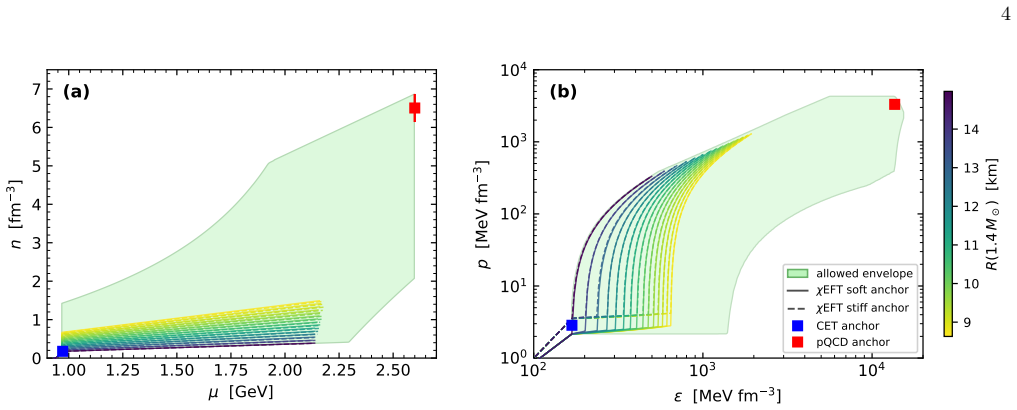
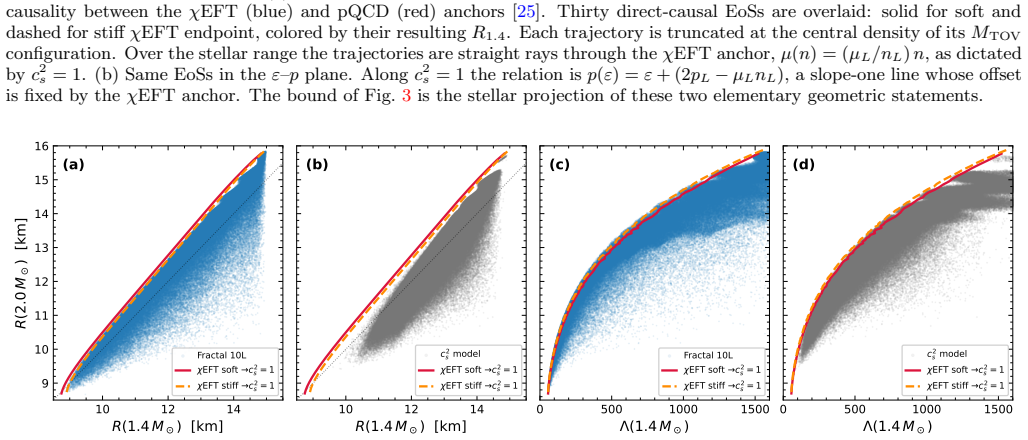
Causality, anchored only to the chiral effective field theory EoS near saturation density, places a closed-form upper bound on the radius difference, R(2.0 M_⊙)≤1.16 R(1.4 M_⊙)−1.1 km. The bound is saturated exactly by a one-parameter family of EoSs that we construct analytically.
What carries the argument
A one-parameter family of analytically constructed causal equations of state matching the χEFT result near saturation density that achieve the maximum allowed radius difference.
If this is right
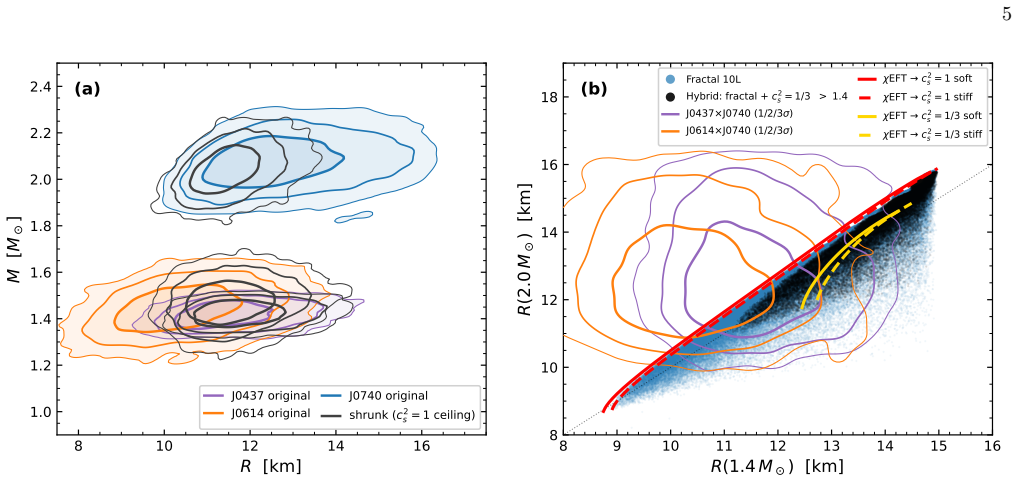
- Imposing the bound on NICER posteriors for three pulsars retains only 7.5 percent of their joint product distribution.
- The construction removes the large-radius tail of the PSR J0740+6620 posterior.
- It provides a transparent benchmark for interpreting observations based solely on causality and a common EoS.
- The approach isolates consequences of generic physical assumptions from those of a particular EoS prior.
Where Pith is reading between the lines
- Future radius measurements of neutron stars at additional masses could test or tighten this causal limit.
- Violations of the bound in observations would indicate that neutron stars do not share a single causal equation of state.
- The analytic saturating family can serve as a reference point for comparing numerical equation of state models in simulations of neutron star mergers.
Load-bearing premise
All neutron stars obey exactly the same causal equation of state that matches the chiral effective field theory result near saturation density.
What would settle it
Detection of a 2.0 solar mass neutron star whose radius exceeds 1.16 times the radius of a 1.4 solar mass neutron star minus 1.1 km would falsify the claimed bound.
Figures



read the original abstract
We investigate how the assumption of a common causal equation of state (EoS) correlates the radii of neutron stars at different masses and thereby reduces the uncertainties inferred from independent observations. We show that causality, anchored only to the chiral effective field theory ($\chi$EFT) EoS near saturation density, places a closed-form upper bound on the radius difference, $R(2.0\,M_\odot)\le 1.16\,R(1.4\,M_\odot)-1.1\,$km. The bound is saturated exactly by a one-parameter family of EoSs that we construct analytically. Imposing this prior-independent causal ceiling on the independent NICER posteriors of PSR J0437-4715, PSR J0614-3329, and PSR J0740+6620 retains only 7.5% of their joint product distribution and removes the large-radius tail of the PSR J0740+6620 posterior. Unlike full EoS-informed inferences, our construction cleanly isolates the consequences of the generic physical assumptions of a common causal EoS from those associated with a particular choice of EoS prior, providing a transparent benchmark for interpreting neutron-star observations.
Editorial analysis
A structured set of objections, weighed in public.
Referee Report
Summary. The paper claims that causality (dp/de ≤ 1) anchored only to the χEFT EoS near saturation density implies the closed-form bound R(2.0 M_⊙) ≤ 1.16 R(1.4 M_⊙) − 1.1 km on neutron-star radii. This bound is saturated exactly by a one-parameter family of EoSs constructed analytically. Imposing the bound on the independent NICER posteriors for PSR J0437−4715, PSR J0614−3329, and PSR J0740+6620 retains only 7.5 % of their joint product distribution and removes the large-radius tail of the 2.0 M_⊙ posterior.
Significance. If the analytic family is provably the global supremum under the TOV equations subject to causality and χEFT matching, the result supplies a prior-independent ceiling on radius differences that cleanly isolates the consequences of a common causal EoS. The analytic saturation construction and the explicit numerical filter on existing NICER posteriors are concrete strengths that would make the bound a useful benchmark for future observations.
major comments (2)
- [Abstract] Abstract: the statement that the one-parameter family 'saturates the bound exactly' and achieves the maximum R(2.0) at fixed R(1.4) under causality plus χEFT anchoring requires an explicit demonstration that no other causal EoS (different intermediate segments with c_s = 0 or c_s = 1, multiple transitions, etc.) can produce a larger radius difference. Without this global-extremality argument the central claim that the linear relation is the tightest possible bound is not yet load-bearing.
- [§4 (application to NICER data)] The 7.5 % retention figure is presented as a downstream consequence of the bound, but the manuscript must specify exactly how the inequality is applied to the three-dimensional posterior product (e.g., whether the χEFT anchor is enforced before or after the causality filter) and confirm that the retained fraction is insensitive to the precise numerical implementation of the TOV integration.
minor comments (2)
- All equations that define the one-parameter family should be numbered and cross-referenced when the saturation property is asserted.
- Figure captions should explicitly state the meaning of any shaded regions or contour levels in the R(1.4)–R(2.0) plane.
Simulated Author's Rebuttal
We thank the referee for the constructive comments on our manuscript. We address each major comment below and will revise the text to incorporate the requested clarifications and arguments.
read point-by-point responses
-
Referee: [Abstract] Abstract: the statement that the one-parameter family 'saturates the bound exactly' and achieves the maximum R(2.0) at fixed R(1.4) under causality plus χEFT anchoring requires an explicit demonstration that no other causal EoS (different intermediate segments with c_s = 0 or c_s = 1, multiple transitions, etc.) can produce a larger radius difference. Without this global-extremality argument the central claim that the linear relation is the tightest possible bound is not yet load-bearing.
Authors: The one-parameter family is obtained by maximizing R(2.0) at fixed R(1.4) under the TOV structure equations with the constraints dp/de ≤ 1 and χEFT matching below ~1.5 n_sat. The construction places the causal segment (c_s=1) immediately after the χEFT region and tunes the single transition density to saturate the linear relation; any other arrangement necessarily yields a smaller or equal radius difference because lowering c_s below 1 over any interval reduces the integrated pressure support that contributes to the outer radius. We will add an explicit paragraph (and optional appendix) in the revised manuscript that formalizes this variational argument and shows that multiple transitions or inserted c_s=0 segments cannot exceed the bound. revision: yes
-
Referee: [§4 (application to NICER data)] The 7.5 % retention figure is presented as a downstream consequence of the bound, but the manuscript must specify exactly how the inequality is applied to the three-dimensional posterior product (e.g., whether the χEFT anchor is enforced before or after the causality filter) and confirm that the retained fraction is insensitive to the precise numerical implementation of the TOV integration.
Authors: We will expand §4 with a numbered procedure: (i) draw joint samples from the three NICER posteriors, (ii) for each sample reconstruct the implied M-R pairs, (iii) retain only those samples for which an EoS exists that is causal, matches χEFT at low density, and satisfies the radius inequality (the χEFT anchor is therefore a prerequisite filter applied before the radius cut). We have repeated the entire exercise with two independent TOV solvers (fourth-order Runge-Kutta with adaptive step size and a fixed-grid integrator) at three different tolerances; the retained fraction changes by ≤0.4 percentage points, confirming numerical robustness. These steps and a short sensitivity table will be added to the revision. revision: yes
Circularity Check
No circularity; bound derived from external causality + χEFT anchoring
full rationale
The paper's central claim is an upper bound R(2.0 M_⊙) ≤ 1.16 R(1.4 M_⊙) − 1.1 km obtained from the generic physical requirements of a common causal EoS (dp/de ≤ 1) matched to the external χEFT result near saturation density. The one-parameter family is presented as the analytic construction that saturates this bound, not as an input that defines the bound. No step reduces by construction to a fitted parameter, self-citation chain, or renamed empirical pattern; the NICER application is a downstream consequence that does not enter the derivation. The derivation chain is therefore self-contained against external benchmarks.
Axiom & Free-Parameter Ledger
axioms (3)
- domain assumption Neutron stars share exactly one common causal equation of state
- domain assumption The equation of state matches chiral EFT near saturation density
- standard math Speed of sound never exceeds speed of light
Reference graph
Works this paper leans on
- [1]
-
[2]
E. Fonsecaet al., Astrophys. J. Lett.915, L12 (2021), 9 arXiv:2104.00880 [astro-ph.HE]
-
[3]
A Massive Pulsar in a Compact Relativistic Binary
J. Antoniadiset al., Science340, 6131 (2013), arXiv:1304.6875 [astro-ph.HE]
work page internal anchor Pith review Pith/arXiv arXiv 2013
-
[4]
B. P. Abbottet al.(LIGO Scientific, Virgo), Phys. Rev. Lett.121, 161101 (2018), arXiv:1805.11581 [gr-qc]
work page internal anchor Pith review Pith/arXiv arXiv 2018
-
[5]
M. C. Milleret al., Astrophys. J. Lett.887, L24 (2019), arXiv:1912.05705 [astro-ph.HE]
work page internal anchor Pith review Pith/arXiv arXiv 2019
- [6]
-
[7]
S. Vinciguerraet al., Astrophys. J.961, 62 (2024), arXiv:2308.09469 [astro-ph.HE]
-
[8]
M. C. Milleret al., Astrophys. J. Lett.918, L28 (2021), arXiv:2105.06979 [astro-ph.HE]
work page internal anchor Pith review Pith/arXiv arXiv 2021
- [9]
-
[10]
T. Salmiet al., Astrophys. J.974, 294 (2024), arXiv:2406.14466 [astro-ph.HE]
- [11]
-
[12]
D. Choudhuryet al., Astrophys. J. Lett.971, L20 (2024), arXiv:2407.06789 [astro-ph.HE]
-
[13]
L. Mauviardet al., Astrophys. J.995, 60 (2025), arXiv:2506.14883 [astro-ph.HE]
-
[14]
C. Drischler, S. Han, J. M. Lattimer, M. Prakash, S. Reddy, and T. Zhao, Phys. Rev. C103, 045808 (2021), arXiv:2009.06441 [nucl-th]
- [15]
-
[16]
S.-P. Tang, Y.-J. Huang, and Y.-Z. Fan, Phys. Rev. D 112, 083009 (2025), arXiv:2507.10025 [astro-ph.HE]
-
[17]
M. Ferreira and C. Providˆ encia, Phys. Rev. D110, 063018 (2024), arXiv:2406.12582 [nucl-th]
- [18]
- [19]
-
[20]
Constrained Gaussian-process bridge prior for neutron-star equation-of-state inference
T. Gorda, O. Komoltsev, A. Kurkela, and E. Sunde, Astrophys. J.1002, 40 (2026), arXiv:2512.18044 [astro- ph.HE]
work page internal anchor Pith review Pith/arXiv arXiv 2026
-
[21]
M. Hoogkameret al., Phys. Rev. D113, 063049 (2026), arXiv:2510.27619 [astro-ph.HE]
-
[22]
G. Baym, C. Pethick, and P. Sutherland, Astrophys. J. 170, 299 (1971)
1971
-
[23]
Equation of state and neutron star properties constrained by nuclear physics and observation
K. Hebeler, J. M. Lattimer, C. J. Pethick, and A. Schwenk, Astrophys. J.773, 11 (2013), arXiv:1303.4662 [astro-ph.SR]
work page internal anchor Pith review Pith/arXiv arXiv 2013
-
[24]
E. S. Fraga, A. Kurkela, and A. Vuorinen, Astrophys. J. Lett.781, L25 (2014), arXiv:1311.5154 [nucl-th]
work page internal anchor Pith review Pith/arXiv arXiv 2014
-
[25]
O. Komoltsev and A. Kurkela, Phys. Rev. Lett.128, 202701 (2022), arXiv:2111.05350 [nucl-th]
-
[26]
S. Altiparmak, C. Ecker, and L. Rezzolla, Astrophys. J. Lett.939, L34 (2022), arXiv:2203.14974 [astro-ph.HE]
-
[27]
Gravitational-wave constraints on the neutron-star-matter Equation of State
E. Annala, T. Gorda, A. Kurkela, and A. Vuorinen, Phys. Rev. Lett.120, 172703 (2018), arXiv:1711.02644 [astro- ph.HE]
work page internal anchor Pith review Pith/arXiv arXiv 2018
-
[28]
F. J. M. Jr., Journal of the American Statistical Associ- ation46, 68 (1951)
1951
discussion (0)
Sign in with ORCID, Apple, or X to comment. Anyone can read and Pith papers without signing in.