A Detailed Model Atmosphere Analysis of Cool White Dwarfs in DESI DR1
Pith reviewed 2026-06-25 20:38 UTC · model grok-4.3
The pith
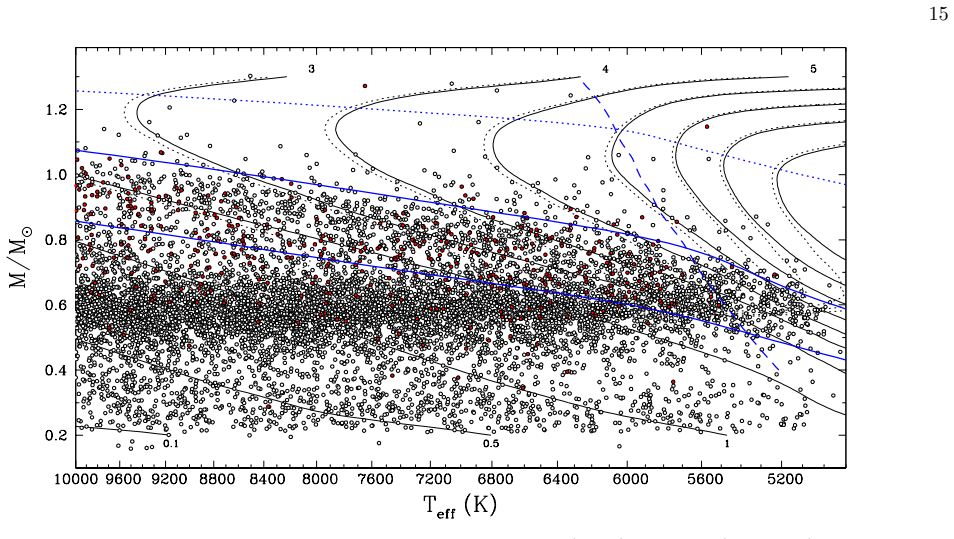
Cool white dwarf analysis shows the hydrogen-to-helium ratio in helium atmospheres must rise at lower temperatures to preserve the standard 0.6 solar mass average.
A machine-rendered reading of the paper's core claim, the machinery that carries it, and where it could break.
Core claim
A detailed model atmosphere analysis of cool DC and DZ white dwarfs indicates that the H/He abundance ratio in He-atmosphere white dwarfs increases at lower temperatures. Based on the currently available models, this is the only way to keep the DC masses consistent with the average white dwarf mass of 0.6 solar masses. The sample is also used to show that the He-atmosphere fraction increases significantly below 10,000 K due to convective mixing.
What carries the argument
Model atmosphere fits to DC and DZ spectra that solve simultaneously for effective temperature, surface gravity, and H/He abundance ratio while enforcing mass consistency at 0.6 solar masses.
If this is right
- The helium-atmosphere fraction rises sharply below 10,000 K.
- Magnetic DA white dwarfs occur at all temperatures, not only near the crystallization sequence.
- Cool DA stars show no significant photometric versus spectroscopic mass discrepancy.
- The full DESI DR1 white-dwarf sample of nearly 45,000 objects is now analyzed uniformly.
Where Pith is reading between the lines
- Convective mixing appears to be the dominant process that alters surface composition once white dwarfs cool below 10,000 K.
- The same models that enforce mass consistency may be used to predict the location of the DA-to-non-DA transition in population studies.
- Rare DA+DB and DA+DQ binaries identified here offer direct tests of whether mixing episodes can produce hybrid atmospheres.
Load-bearing premise
The model atmospheres remain accurate enough at low temperatures to yield reliable masses and abundances, and the canonical 0.6 solar mass average applies to white dwarfs of all atmospheric compositions.
What would settle it
Spectroscopic or photometric masses for a large sample of cool DC white dwarfs that remain near 0.6 solar masses even when the H/He ratio is held fixed at a constant low value would remove the need for an increasing hydrogen fraction.
Figures

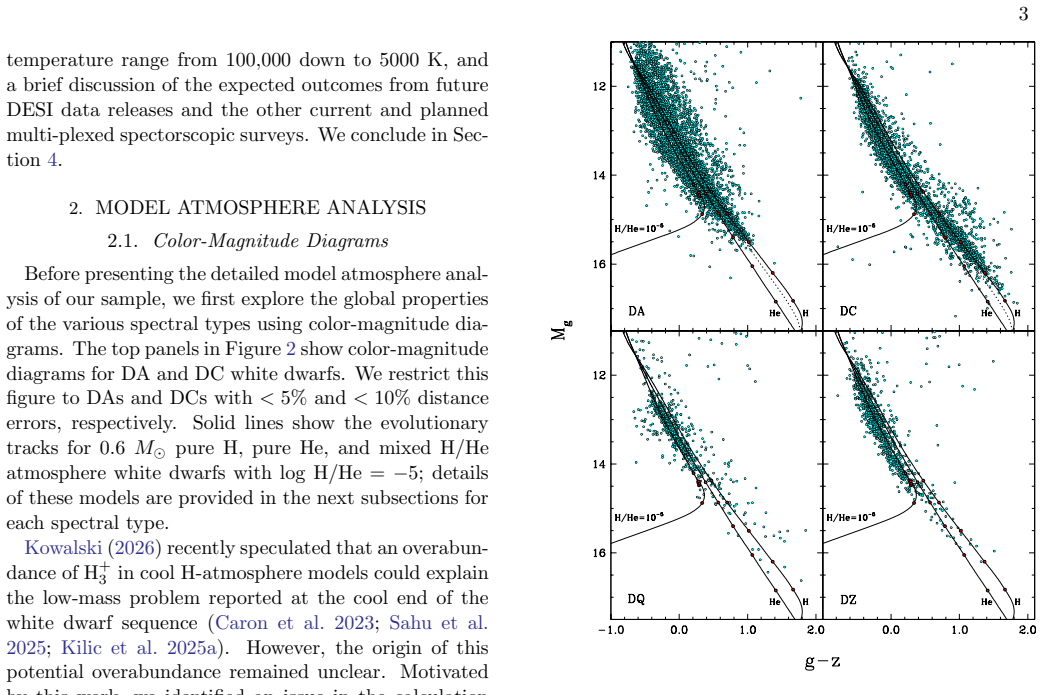






read the original abstract
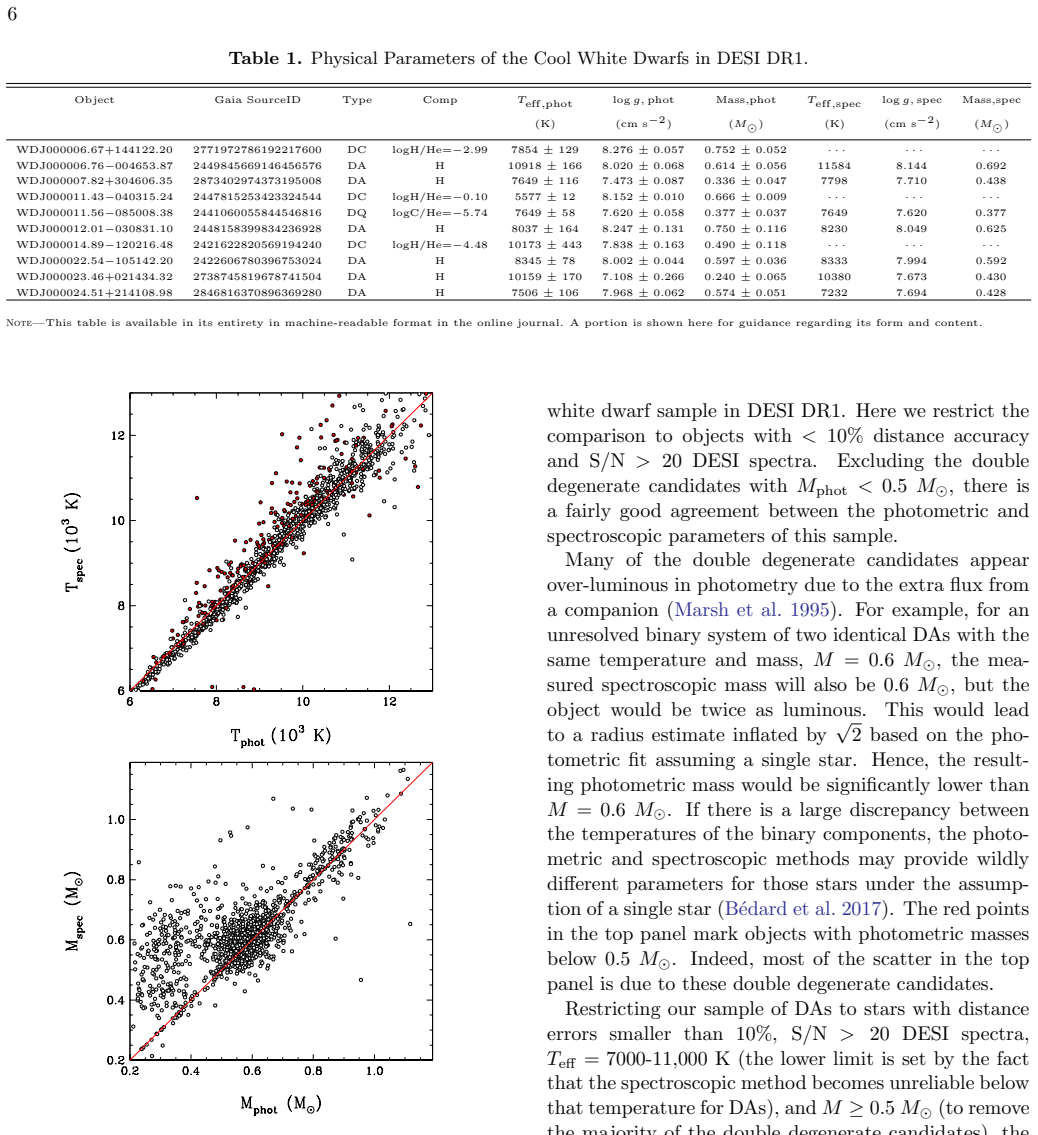
We present a detailed model atmosphere analysis of cool white dwarfs in the Dark Energy Spectroscopic Instrument Data Release 1 (DESI DR1). Our sample includes 25,642 unique targets with $G_{\rm BP}-G_{\rm RP}>0$. Unlike the hot DA white dwarf sample in DESI DR1, we do not find a significant discrepancy between the photometric and spectroscopic masses for cool DAs. Hence, DESI's calibration problems for broad lines have a negligible effect for cooler DAs with narrower lines. Magnetic DAs are found everywhere, and not just on the crystallization sequence, indicating that crystallization induced dynamos cannot solely explain the origin of magnetism in white dwarfs. A detailed analysis of cool DC and DZ white dwarfs indicates that the H/He abundance ratio in He-atmosphere white dwarfs increases at lower temperatures. Based on the currently available models, this is the only way to keep the DC masses consistent with the average white dwarf mass of $0.6~M_\odot$. Combined with the analysis of the hot white dwarfs presented previously, this paper completes the analysis of 44,963 white dwarf candidates with DESI DR1 spectra. We use this sample to constrain the fraction of He-atmosphere white dwarfs as a function of temperature, and demonstrate that the He-fraction increases significantly below 10,000 K due to convective mixing. We also highlight rare systems, including new extremely low-mass, DA+DB, and DA+DQ binaries.
Editorial analysis
A structured set of objections, weighed in public.
Referee Report
Summary. The paper presents a model atmosphere analysis of 25,642 cool white dwarfs (G_BP - G_RP > 0) from DESI DR1 spectra. Key claims include the absence of a photometric-spectroscopic mass discrepancy for cool DAs (unlike hotter ones), magnetic DAs occurring across all temperatures rather than only on the crystallization sequence, an increase in the H/He abundance ratio for He-atmosphere (DC/DZ) white dwarfs at lower effective temperatures as the only way to maintain consistency with the canonical 0.6 M_⊙ average mass using current models, and a resulting rise in the He-atmosphere fraction below 10,000 K due to convective mixing. The work completes the DESI DR1 white dwarf sample analysis (total 44,963 candidates) and notes rare binary systems.
Significance. A sample of this size enables statistically robust trends in atmospheric composition and magnetism for cool white dwarfs. If the model-dependent mass and abundance inferences hold, the results provide concrete constraints on the temperature dependence of the He-atmosphere fraction and the limitations of crystallization-induced dynamos, completing a large homogeneous survey that can be compared to population synthesis models.
major comments (2)
- [DC/DZ analysis and mass consistency section] DC/DZ analysis and mass consistency section: the central inference that H/He must increase at low T_eff to enforce DC masses at 0.6 M_⊙ is constructed by selecting the abundance ratio that restores the assumed mean mass; this creates a direct dependence on the external 0.6 M_⊙ benchmark rather than an independent derivation, and the manuscript does not report an external anchor (e.g., Gaia parallax plus photometric radius) for the cool DC/DZ subset.
- [Section on cool DC and DZ white dwarfs] Section on cool DC and DZ white dwarfs: at T_eff ≲ 6000 K the DC spectra are nearly featureless, so mass and abundance determinations rest entirely on the accuracy of pre-existing model atmospheres (opacity, convection, line broadening); no test or sensitivity analysis against possible systematic errors in these models is presented, leaving the H/He trend and He-fraction increase vulnerable to being an artifact that restores the assumed mean mass.
minor comments (2)
- The abstract states that magnetic DAs are found 'everywhere' but does not quantify the temperature or mass distribution of the magnetic subsample relative to the full cool DA population.
- Clarify the exact number and temperature binning of the DC/DZ objects entering the H/He ratio trend and the convective-mixing fraction plot.
Simulated Author's Rebuttal
We thank the referee for their thorough and constructive review. We address the two major comments point by point below, providing our honest assessment of the analysis and indicating where revisions will be made.
read point-by-point responses
-
Referee: [DC/DZ analysis and mass consistency section] DC/DZ analysis and mass consistency section: the central inference that H/He must increase at low T_eff to enforce DC masses at 0.6 M_⊙ is constructed by selecting the abundance ratio that restores the assumed mean mass; this creates a direct dependence on the external 0.6 M_⊙ benchmark rather than an independent derivation, and the manuscript does not report an external anchor (e.g., Gaia parallax plus photometric radius) for the cool DC/DZ subset.
Authors: The canonical 0.6 M_⊙ mean mass is a standard benchmark drawn from extensive prior literature on the white dwarf mass distribution, independent of this work. For cool, nearly featureless DC/DZ stars, spectroscopic masses are inherently model-dependent, and the analysis determines the H/He ratios required under current models to maintain consistency with this established average. We agree that an independent anchor (such as Gaia-based photometric masses) is not provided for the full cool DC/DZ subset, as the focus is on the spectroscopic trends from DESI spectra. We will revise the relevant section to more explicitly state the reliance on the literature mass benchmark and note the absence of a fully independent mass check for this subset. revision: partial
-
Referee: [Section on cool DC and DZ white dwarfs] Section on cool DC and DZ white dwarfs: at T_eff ≲ 6000 K the DC spectra are nearly featureless, so mass and abundance determinations rest entirely on the accuracy of pre-existing model atmospheres (opacity, convection, line broadening); no test or sensitivity analysis against possible systematic errors in these models is presented, leaving the H/He trend and He-fraction increase vulnerable to being an artifact that restores the assumed mean mass.
Authors: We acknowledge that below ~6000 K the analysis depends on the fidelity of existing model atmospheres without an explicit sensitivity study presented in the manuscript. The models represent the current best available treatment of opacities, convection, and line broadening. The derived H/He trend is required specifically to recover the canonical mass, and the increase in He-atmosphere fraction aligns with expectations from convective mixing. To address the concern, we will add a paragraph discussing potential systematic uncertainties in the models and their possible impact on the inferred trends. revision: yes
Circularity Check
H/He abundance ratio adjusted by construction to enforce DC masses at assumed 0.6 M⊙ average
specific steps
-
fitted input called prediction
[Abstract]
"A detailed analysis of cool DC and DZ white dwarfs indicates that the H/He abundance ratio in He-atmosphere white dwarfs increases at lower temperatures. Based on the currently available models, this is the only way to keep the DC masses consistent with the average white dwarf mass of 0.6 M_⊙."
The reported increase in H/He is the specific adjustment performed so that spectroscopic masses equal the assumed 0.6 M⊙ mean; the trend is therefore the output of enforcing the mass constraint rather than a prediction tested against independent data.
full rationale
The central claim that H/He must increase at low T to maintain mass consistency is presented as a model-derived result, but the abstract explicitly states this adjustment is required to match the external 0.6 M⊙ benchmark. This matches the fitted-input-called-prediction pattern: the abundance trend is the parameter varied to restore the assumed mean mass rather than an independent spectroscopic derivation. No other load-bearing self-citations or self-definitional loops are evident from the provided text; the remainder of the analysis (DA mass consistency, He-fraction vs T) follows from the adjusted models without further reduction to inputs.
Axiom & Free-Parameter Ledger
free parameters (1)
- average white dwarf mass =
0.6 M_sun
axioms (1)
- domain assumption Model atmospheres for cool white dwarfs accurately predict observed spectra and photometry for mass and abundance determination.
Reference graph
Works this paper leans on
-
[1]
Abel, M., Frommhold, L., Li, X., & Hunt, K. L. C. 2012, JChPh, 136, 044319, doi: 10.1063/1.3676405 Adamane Pallathadka, G., Chandra, V., G¨ ansicke, B. T., et al. 2026, ApJ, 999, 251, doi: 10.3847/1538-4357/ae3c9f
-
[2]
Althaus, L. G., Miller Bertolami, M. M., & C´ orsico, A. H. 2013, A&A, 557, A19, doi: 10.1051/0004-6361/201321868
-
[3]
Bagnulo, S., & Landstreet, J. D. 2022, ApJL, 935, L12, doi: 10.3847/2041-8213/ac84d3
-
[4]
Demleitner, M., & Andrae, R. 2021, AJ, 161, 147, doi: 10.3847/1538-3881/abd806
work page internal anchor Pith review doi:10.3847/1538-3881/abd806 2021
-
[5]
Barrientos, M., Kilic, M., Brown, W. R., et al. 2025, ApJ, 991, 65, doi: 10.3847/1538-4357/adf743
-
[6]
Becker, A., Lorenzen, W., Fortney, J. J., et al. 2014, ApJS, 215, 21, doi: 10.1088/0067-0049/215/2/21 B´ edard, A. 2024, Ap&SS, 369, 43, doi: 10.1007/s10509-024-04307-5 B´ edard, A., Bergeron, P., & Brassard, P. 2022, ApJ, 930, 8, doi: 10.3847/1538-4357/ac609d B´ edard, A., Bergeron, P., Brassard, P., & Fontaine, G. 2020, ApJ, 901, 93, doi: 10.3847/1538-4...
-
[7]
2019, ApJ, 876, 67, doi: 10.3847/1538-4357/ab153a
Bergeron, P., Dufour, P., Fontaine, G., et al. 2019, ApJ, 876, 67, doi: 10.3847/1538-4357/ab153a
-
[8]
2022, ApJ, 934, 36, doi: 10.3847/1538-4357/ac76c7
Bergeron, P., Kilic, M., Blouin, S., et al. 2022, ApJ, 934, 36, doi: 10.3847/1538-4357/ac76c7
-
[9]
Bergeron, P., Saffer, R. A., & Liebert, J. 1992, ApJ, 394, 228, doi: 10.1086/171575
-
[10]
, archivePrefix = "arXiv", eprint =
Bergeron, P., Wesemael, F., Dufour, P., et al. 2011, ApJ, 737, 28, doi: 10.1088/0004-637X/737/1/28
-
[11]
2020, MNRAS, 496, 1881, doi: 10.1093/mnras/staa1689
Blouin, S. 2020, MNRAS, 496, 1881, doi: 10.1093/mnras/staa1689
-
[12]
2023a, MNRAS, 523, 3363, doi: 10.1093/mnras/stad1574
Blouin, S., B´ edard, A., & Tremblay, P.-E. 2023a, MNRAS, 523, 3363, doi: 10.1093/mnras/stad1574
-
[13]
2019, MNRAS, 490, 4166, doi: 10.1093/mnras/stz2915
Blouin, S., & Dufour, P. 2019, MNRAS, 490, 4166, doi: 10.1093/mnras/stz2915
-
[14]
Blouin, S., Dufour, P., & Allard, N. F. 2018a, ApJ, 863, 184, doi: 10.3847/1538-4357/aad4a9
-
[15]
Blouin, S., Dufour, P., Allard, N. F., & Kilic, M. 2018b, ApJ, 867, 161, doi: 10.3847/1538-4357/aae53a
-
[16]
Blouin, S., Dufour, P., Thibeault, C., & Allard, N. F. 2019, ApJ, 878, 63, doi: 10.3847/1538-4357/ab1f82
-
[17]
2024, ApJ, 976, 218, doi: 10.3847/1538-4357/ad863b
Dufour, P. 2024, ApJ, 976, 218, doi: 10.3847/1538-4357/ad863b
-
[18]
2023b, MNRAS, 525, L112, doi: 10.1093/mnrasl/slad105
Blouin, S., Kilic, M., B´ edard, A., & Tremblay, P.-E. 2023b, MNRAS, 525, L112, doi: 10.1093/mnrasl/slad105
-
[19]
2022, MNRAS, 510, 1059, doi: 10.1093/mnras/stab3446
Blouin, S., & Xu, S. 2022, MNRAS, 510, 1059, doi: 10.1093/mnras/stab3446
-
[20]
Borysow, A., Jorgensen, U. G., & Fu, Y. 2001, Journal of Quantitative Spectroscopy & Radiative Transfer, 68, 235, doi: 10.1016/S0022-4073(00)00023-6
-
[21]
R., Kilic, M., Allende Prieto, C., & Kenyon, S
Brown, W. R., Kilic, M., Allende Prieto, C., & Kenyon, S. J. 2010, ApJ, 723, 1072, doi: 10.1088/0004-637X/723/2/1072
-
[22]
Brown, W. R., Kilic, M., & Gianninas, A. 2017, ApJ, 839, 23, doi: 10.3847/1538-4357/aa67e4
-
[23]
Brown, W. R., Kilic, M., Hermes, J. J., et al. 2011, ApJL, 737, L23, doi: 10.1088/2041-8205/737/1/L23
-
[24]
R., Kilic, M., Kosakowski, A., & Gianninas, A
Brown, W. R., Kilic, M., Kosakowski, A., & Gianninas, A. 2022, ApJ, 933, 94, doi: 10.3847/1538-4357/ac72ac
-
[25]
Burdge, K. B., Prince, T. A., Fuller, J., et al. 2020a, ApJ, 905, 32, doi: 10.3847/1538-4357/abc261
-
[26]
Burdge, K. B., Coughlin, M. W., Fuller, J., et al. 2020b, ApJL, 905, L7, doi: 10.3847/2041-8213/abca91
-
[27]
Camisassa, M., Fuentes, J. R., Schreiber, M. R., et al. 2024, A&A, 691, L21, doi: 10.1051/0004-6361/202452539 26
-
[28]
2023, A&A, 674, A213, doi: 10.1051/0004-6361/202346628
Camisassa, M., Torres, S., Hollands, M., et al. 2023, A&A, 674, A213, doi: 10.1051/0004-6361/202346628
-
[29]
Caron, A., Bergeron, P., Blouin, S., & Leggett, S. K. 2023, MNRAS, 519, 4529, doi: 10.1093/mnras/stac3733
-
[30]
1995, ApJS, 101, 309, doi: 10.1086/192242
Charbonneau, P. 1995, ApJS, 101, 309, doi: 10.1086/192242
-
[31]
Cheng, S., Cummings, J. D., & M´ enard, B. 2019, ApJ, 886, 100, doi: 10.3847/1538-4357/ab4989
-
[32]
Chickles, E. T., Burdge, K. B., Chakraborty, J., et al. 2025, ApJ, 987, 206, doi: 10.3847/1538-4357/add34c
-
[33]
2019, ApJ, 885, 74, doi: 10.3847/1538-4357/ab46b9
Coutu, S., Dufour, P., Bergeron, P., et al. 2019, ApJ, 885, 74, doi: 10.3847/1538-4357/ab46b9
-
[34]
2021, MNRAS, 501, 5274, doi: 10.1093/mnras/staa3684
Cukanovaite, E., Tremblay, P.-E., Bergeron, P., et al. 2021, MNRAS, 501, 5274, doi: 10.1093/mnras/staa3684
-
[35]
2019, MNRAS, 488, 2503, doi: 10.1093/mnras/stz1759
Cunningham, T., Tremblay, P.-E., Freytag, B., Ludwig, H.-G., & Koester, D. 2019, MNRAS, 488, 2503, doi: 10.1093/mnras/stz1759
-
[36]
2020, MNRAS, 492, 3540, doi: 10.1093/mnras/stz3638 de Jong, R
Hollands, M., & Cukanovaite, E. 2020, MNRAS, 492, 3540, doi: 10.1093/mnras/stz3638 de Jong, R. S. 2019, Nature Astronomy, 3, 574, doi: 10.1038/s41550-019-0808-x
-
[37]
, archivePrefix = "arXiv", eprint =
Debes, J. H., Walsh, K. J., & Stark, C. 2012, ApJ, 747, 148, doi: 10.1088/0004-637X/747/2/148 DESI Collaboration, Abdul Karim, M., Adame, A. G., et al. 2026, AJ, 171, 285, doi: 10.3847/1538-3881/ae4c43
-
[38]
Dufour, P., Bergeron, P., & Fontaine, G. 2005, ApJ, 627, 404, doi: 10.1086/430373
-
[39]
, archivePrefix = "arXiv", eprint =
Dufour, P., Kilic, M., Fontaine, G., et al. 2012, ApJ, 749, 6, doi: 10.1088/0004-637X/749/1/6
-
[40]
H., & Clemens, J
Dunlap, B. H., & Clemens, J. C. 2015, in Astronomical Society of the Pacific Conference Series, Vol. 493, 19th European Workshop on White Dwarfs, ed. P. Dufour, P. Bergeron, & G. Fontaine, 547
2015
-
[41]
Einramhof, L., Bugnet, L., Calcaferro, L. M., Barrault, L., & Das, S. B. 2026, A&A, 708, L14, doi: 10.1051/0004-6361/202659069
-
[42]
Eisenstein, D. J., Liebert, J., Harris, H. C., et al. 2006, ApJS, 167, 40, doi: 10.1086/507110
-
[43]
2020, Advances in Space Research, 66, 1025, doi: 10.1016/j.asr.2019.11.012
Ferrario, L., Wickramasinghe, D., & Kawka, A. 2020, Advances in Space Research, 66, 1025, doi: 10.1016/j.asr.2019.11.012
-
[44]
2001, PASP, 113, 409, doi: 10.1086/319535 Gaia Collaboration, Babusiaux, C., van Leeuwen, F., et al
Fontaine, G., Brassard, P., & Bergeron, P. 2001, PASP, 113, 409, doi: 10.1086/319535 Gaia Collaboration, Babusiaux, C., van Leeuwen, F., et al. 2018, A&A, 616, A10, doi: 10.1051/0004-6361/201832843 Gaia Collaboration, Brown, A. G. A., Vallenari, A., et al. 2021, A&A, 649, A1, doi: 10.1051/0004-6361/202039657
-
[45]
Gates, E., Gyuk, G., Harris, H. C., et al. 2004, ApJL, 612, L129, doi: 10.1086/424568
-
[46]
2019, ApJ, 882, 106, doi: 10.3847/1538-4357/ab379e Gentile Fusillo, N
Genest-Beaulieu, C., & Bergeron, P. 2019, ApJ, 882, 106, doi: 10.3847/1538-4357/ab379e Gentile Fusillo, N. P., Tremblay, P. E., Cukanovaite, E., et al. 2021, MNRAS, 508, 3877, doi: 10.1093/mnras/stab2672
-
[47]
2012, ApJS, 199, 29, doi: 10.1088/0067-0049/199/2/29
Giammichele, N., Bergeron, P., & Dufour, P. 2012, ApJS, 199, 29, doi: 10.1088/0067-0049/199/2/29
-
[48]
2022, MNRAS, 514, 4111, doi: 10.1093/mnras/stac1363
Ginzburg, S., Fuller, J., Kawka, A., & Caiazzo, I. 2022, MNRAS, 514, 4111, doi: 10.1093/mnras/stac1363
-
[49]
Hansen, B. M. S. 1998, Nature, 394, 860, doi: 10.1038/29710
-
[50]
Harris, G. J., Lynas-Gray, A. E., Miller, S., & Tennyson, J. 2004, ApJL, 617, L143, doi: 10.1086/427391
-
[51]
Harris, H. C., Dahn, C. C., Vrba, F. J., et al. 1999, ApJ, 524, 1000, doi: 10.1086/307856
-
[52]
Hermes, J. J., Kilic, M., Brown, W. R., et al. 2012, ApJL, 757, L21, doi: 10.1088/2041-8205/757/2/L21
-
[53]
Hollands, M. A., G¨ ansicke, B. T., & Koester, D. 2018, MNRAS, 477, 93, doi: 10.1093/mnras/sty592
-
[54]
Iglesias, C. A., Rogers, F. J., & Saumon, D. 2002, ApJL, 569, L111, doi: 10.1086/340689
-
[55]
2017, ApJL, 836, L28, doi: 10.3847/2041-8213/aa5eae
Isern, J., Garc´ ıa-Berro, E., K¨ ulebi, B., & Lor´ en-Aguilar, P. 2017, ApJL, 836, L28, doi: 10.3847/2041-8213/aa5eae
-
[56]
2024, ApJ, 974, 12, doi: 10.3847/1538-4357/ad6905 Jim´ enez-Esteban, F
Jewett, G., Kilic, M., Bergeron, P., et al. 2024, ApJ, 974, 12, doi: 10.3847/1538-4357/ad6905 Jim´ enez-Esteban, F. M., Torres, S., Rebassa-Mansergas, A., et al. 2023, MNRAS, 518, 5106, doi: 10.1093/mnras/stac3382
-
[57]
Jin, S., Trager, S. C., Dalton, G. B., et al. 2024, MNRAS, 530, 2688, doi: 10.1093/mnras/stad557 Jørgensen, U. G., Hammer, D., Borysow, A., &
-
[58]
2000, A&A, 361, 283
Falkesgaard, J. 2000, A&A, 361, 283
2000
-
[59]
O., Pelisoli, I., Koester, D., et al
Kepler, S. O., Pelisoli, I., Koester, D., et al. 2016, MNRAS, 455, 3413, doi: 10.1093/mnras/stv2526
-
[60]
2025a, ApJ, 979, 157, doi: 10.3847/1538-4357/ad9bb3
Kilic, M., Bergeron, P., Blouin, S., et al. 2025a, ApJ, 979, 157, doi: 10.3847/1538-4357/ad9bb3
-
[61]
Kilic, M., Bergeron, P., Brown, W. R., et al. 2025b, ApJ, 990, 62, doi: 10.3847/1538-4357/adf1a4
-
[62]
2020, ApJ, 898, 84, doi: 10.3847/1538-4357/ab9b8d
Kilic, M., Bergeron, P., Kosakowski, A., et al. 2020, ApJ, 898, 84, doi: 10.3847/1538-4357/ab9b8d
-
[63]
R., Allende Prieto, C., Kenyon, S
Kilic, M., Brown, W. R., Allende Prieto, C., Kenyon, S. J., & Panei, J. A. 2010a, ApJ, 716, 122, doi: 10.1088/0004-637X/716/1/122
-
[64]
Kilic, M., Leggett, S. K., Tremblay, P. E., et al. 2010b, ApJS, 190, 77, doi: 10.1088/0067-0049/190/1/77
-
[65]
2026, ApJ, 1000, 216, doi: 10.3847/1538-4357/ae43ee
Kilic, M., Bergeron, P., Moss, A., et al. 2026, ApJ, 1000, 216, doi: 10.3847/1538-4357/ae43ee
-
[66]
Kleinman, S. J., Kepler, S. O., Koester, D., et al. 2013, ApJS, 204, 5, doi: 10.1088/0067-0049/204/1/5
-
[67]
Koester, D., & Kepler, S. O. 2019, A&A, 628, A102, doi: 10.1051/0004-6361/201935946 27
-
[68]
F., Blanc, G
Kollmeier, J., Anderson, S. F., Blanc, G. A., et al. 2019, in Bulletin of the American Astronomical Society, Vol. 51, 274
2019
-
[69]
Kosakowski, A., Brown, W. R., Kilic, M., et al. 2023, ApJ, 950, 141, doi: 10.3847/1538-4357/acd187
-
[70]
Kosakowski, A., Dorsch, M., Brown, W. R., et al. 2025, ApJ, 987, 205, doi: 10.3847/1538-4357/add1cf
-
[71]
Kosakowski, A., Kilic, M., Brown, W. R., & Gianninas, A. 2020, ApJ, 894, 53, doi: 10.3847/1538-4357/ab8300
-
[72]
Kowalski, P. M. 2010, A&A, 519, L8, doi: 10.1051/0004-6361/201015238 —. 2026, A&A, 708, A26, doi: 10.1051/0004-6361/202558312
-
[73]
M., Mazevet, S., Saumon, D., & Challacombe, M
Kowalski, P. M., Mazevet, S., Saumon, D., & Challacombe, M. 2007, PhRvB, 76, 075112, doi: 10.1103/PhysRevB.76.075112
-
[74]
Kupfer, T., Korol, V., Littenberg, T. B., et al. 2024, ApJ, 963, 100, doi: 10.3847/1538-4357/ad2068 L´ opez-Sanjuan, C., Tremblay, P. E., Ederoclite, A., et al. 2022, A&A, 658, A79, doi: 10.1051/0004-6361/202141746
-
[75]
Manser, C. J., G¨ ansicke, B. T., Inight, K., et al. 2023, MNRAS, doi: 10.1093/mnras/stad727
-
[76]
J., Izquierdo, P., G¨ ansicke, B
Manser, C. J., Izquierdo, P., G¨ ansicke, B. T., et al. 2024, MNRAS, 535, 254, doi: 10.1093/mnras/stae2205
-
[77]
Marsh, T. R., Dhillon, V. S., & Duck, S. R. 1995, MNRAS, 275, 828, doi: 10.1093/mnras/275.3.828
-
[78]
McCook, G. P., & Sion, E. M. 1987, ApJS, 65, 603, doi: 10.1086/191238
-
[79]
2024, MNRAS, 527, 10111, doi: 10.1093/mnras/stad3825
Moss, A., Bergeron, P., Kilic, M., et al. 2024, MNRAS, 527, 10111, doi: 10.1093/mnras/stad3825
-
[80]
Moss, A., Kilic, M., Bergeron, P., Jewett, G., & Brown, W. R. 2025, ApJ, 983, 14, doi: 10.3847/1538-4357/adbd3a
discussion (0)
Sign in with ORCID, Apple, or X to comment. Anyone can read and Pith papers without signing in.