Kom8ndor: An IEEE 802.11bn-Oriented Simulator for Wi-Fi 8 and Beyond
Pith reviewed 2026-06-25 20:27 UTC · model grok-4.3
The pith
Kom8ndor extends the Komondor simulator with 802.11bn features for Wi-Fi 8 research.
A machine-rendered reading of the paper's core claim, the machinery that carries it, and where it could break.
Core claim
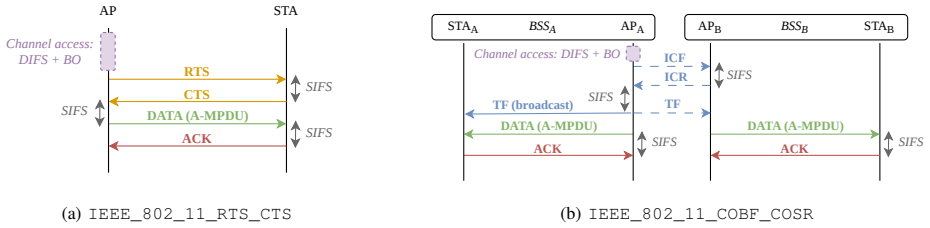
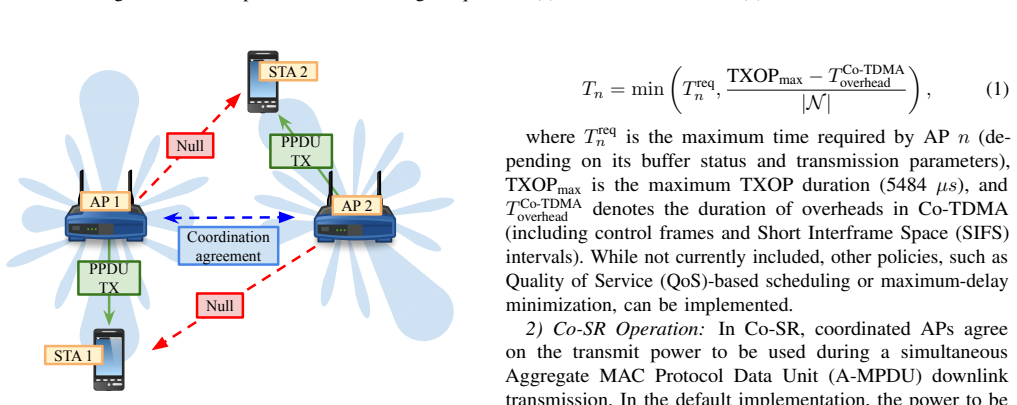
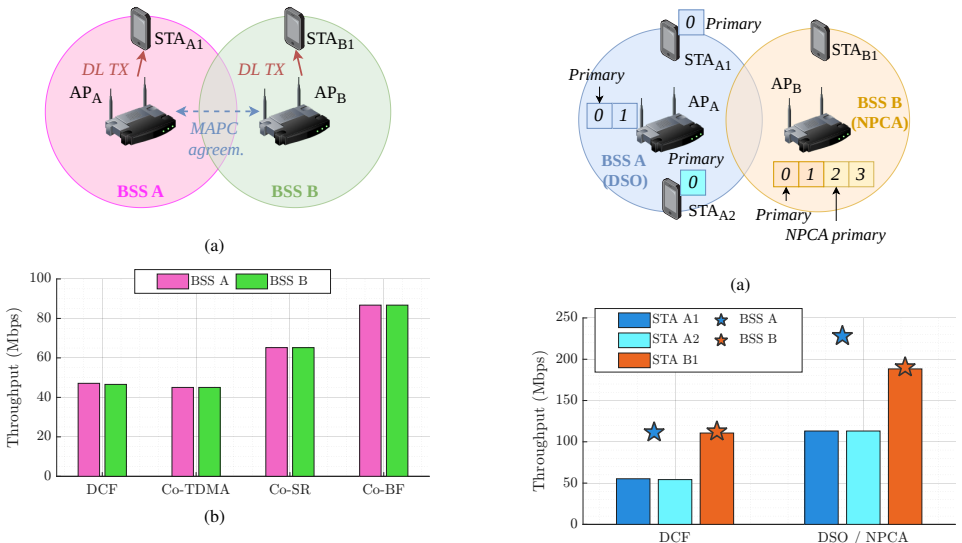
Kom8ndor is a discrete-event network simulator that extends the validated Komondor platform with 802.11bn features such as Multi-Access Point Coordination (Co-TDMA, Co-SR, Co-BF), Non-Primary Channel Access (NPCA), and Dynamic Subband Operation (DSO), plus a machine learning wrapper, to support research on Wi-Fi 8 and beyond.
What carries the argument
The Kom8ndor simulator, which adds modular implementations of 802.11bn mechanisms to the base Komondor platform.
If this is right
- Researchers gain an open platform to test coordinated multi-AP protocols before Wi-Fi 8 devices ship.
- Early evaluation of ultra-high reliability targets becomes feasible through the added coordination and channel access features.
- AI-driven protocol design can be prototyped using the included machine learning wrapper.
- The modular structure supports incremental addition of later Wi-Fi amendments.
Where Pith is reading between the lines
- Community contributions could expand the feature set to cover post-802.11bn ideas more quickly than closed simulators.
- Cross-validation against ns-3 implementations of the same 802.11bn features would strengthen confidence in the new code.
- The simulator could serve as a testbed for studying interactions between 802.11bn mechanisms and emerging spectrum-sharing rules.
Load-bearing premise
The newly added 802.11bn features correctly match the amendment specifications and integrate without errors into the base Komondor platform.
What would settle it
Running a standard multi-AP coordination scenario in Kom8ndor and comparing the resulting throughput or latency statistics against measurements from real 802.11bn testbeds or another validated simulator.
Figures

read the original abstract
The upcoming IEEE 802.11bn amendment marks a paradigm shift in Wi-Fi, which will pose ambitious performance targets under the paradigm of Ultra-High Reliability (UHR). To understand the implications of such a new technology and to support early research and protocol design for Wi-Fi~8, we present \texttt{Kom8ndor}. This discrete-event network simulator extends the open-source Komondor platform (a simulator validated against ns-3 and other analytical tools) with 802.11bn features. Among the newly added functionalities, we highlight Multi-Access Point Coordination (MAPC) -- including Coordinated Time-Division Multiple Access (Co-TDMA), Coordinated Spatial Reuse (Co-SR), and Coordinated Beamforming (Co-BF) -- , Non-Primary Channel Access (NPCA), and Dynamic Subband Operation (DSO). Beyond Wi-Fi~8 implementations, \texttt{Kom8ndor} introduces novel functionalities (e.g., a machine learning wrapper for building AI-based protocols) and a modular design to boost the prototyping and research of future Wi-Fi technologies. \texttt{Kom8ndor} is open-source (GNU GPLv3) and available at https://github.com/wn-upf/Komondor.
Editorial analysis
A structured set of objections, weighed in public.
Referee Report
Summary. The paper presents Kom8ndor, a discrete-event simulator extending the validated open-source Komondor platform with IEEE 802.11bn (Wi-Fi 8) features for Ultra-High Reliability operation. The new functionalities include Multi-Access Point Coordination mechanisms (Co-TDMA, Co-SR, Co-BF), Non-Primary Channel Access (NPCA), Dynamic Subband Operation (DSO), plus a machine learning wrapper for AI-based protocols. The code is released under GNU GPLv3 at a public GitHub repository.
Significance. If the new 802.11bn implementations are shown to be correct, the work supplies a reusable, open-source platform that lowers the barrier for early protocol research on MAPC and related UHR mechanisms. The reuse of a previously cross-validated base simulator and the explicit public release constitute concrete strengths for reproducibility.
major comments (1)
- [Abstract; Implementation of 802.11bn features] Abstract and the sections describing the new 802.11bn components: the manuscript asserts that Co-TDMA, Co-SR, Co-BF, NPCA and DSO have been added and integrate with the base platform, yet supplies no validation results, packet-level error checks, or quantitative comparison against the 802.11bn draft or against ns-3 for any of these features. This verification step is load-bearing for the central claim that the extensions are functional and faithful to the amendment.
minor comments (1)
- [Novel functionalities] The modular design and ML wrapper are mentioned only at a high level; a short usage example or API sketch would clarify how researchers are expected to attach new AI policies.
Simulated Author's Rebuttal
We thank the referee for the detailed review and the recognition of the open-source release and reuse of the validated Komondor base. We address the major comment on validation of the new 802.11bn features below.
read point-by-point responses
-
Referee: [Abstract; Implementation of 802.11bn features] Abstract and the sections describing the new 802.11bn components: the manuscript asserts that Co-TDMA, Co-SR, Co-BF, NPCA and DSO have been added and integrate with the base platform, yet supplies no validation results, packet-level error checks, or quantitative comparison against the 802.11bn draft or against ns-3 for any of these features. This verification step is load-bearing for the central claim that the extensions are functional and faithful to the amendment.
Authors: We agree that explicit validation strengthens the central claim. The base Komondor simulator was previously cross-validated against ns-3 and analytical models; the new modules were implemented directly from the 802.11bn draft text and inherit the same event-driven engine and channel models. Because the amendment remains in draft form, a definitive quantitative match against a finalized standard is not yet feasible. We will add, in the revised manuscript, (i) a description of the internal consistency checks performed during implementation (e.g., frame-format and timing verification against the draft), (ii) packet-level trace excerpts for each new mechanism, and (iii) a basic performance comparison against the legacy Komondor behavior under equivalent scenarios to demonstrate functional integration. These additions will be placed in a new subsection of the implementation section. revision: yes
Circularity Check
No significant circularity; simulator extension is additive and externally benchmarked
full rationale
The paper presents Kom8ndor as an extension of the authors' prior Komondor simulator, adding 802.11bn features (Co-TDMA, Co-SR, Co-BF, NPCA, DSO) plus an ML wrapper. No equations, fitted parameters, predictions, or derivations appear in the provided text. The base platform is described as already validated against ns-3 and analytical tools (external), and the new work is a factual account of implemented functionality rather than a claim that reduces to self-referential inputs or self-citation chains. This matches the default case of a self-contained tool paper with no load-bearing circular steps.
Axiom & Free-Parameter Ledger
Reference graph
Works this paper leans on
-
[1]
Wi-Fi: 25 Years and Counting,
G. Geraciet al., “Wi-Fi: 25 Years and Counting,”Proc. IEEE, 2026
2026
-
[2]
Komondor: A wireless network simulator for next-generation high-density WLANs,
S. Barrachina-Munozet al., “Komondor: A wireless network simulator for next-generation high-density WLANs,” inWireless Days. IEEE, 2019, pp. 1–8
2019
-
[3]
The ns-3 network simulator,
G. F. Riley and T. R. Henderson, “The ns-3 network simulator,” in Modeling and tools for network simulation. Springer, 2010, pp. 15–34
2010
-
[4]
R-TWT in Wi-Fi 7 and Beyond: Enabling Bounded Latency, Energy Efficiency, and Reliability,
E. Mozaffariahraret al., “R-TWT in Wi-Fi 7 and Beyond: Enabling Bounded Latency, Energy Efficiency, and Reliability,” inETFA. IEEE, 2025, pp. 1–8
2025
-
[5]
Ns-3 meets openai gym: The playground for machine learning in networking research,
P. Gawłowicz and A. Zubow, “Ns-3 meets openai gym: The playground for machine learning in networking research,” inMSWiM, 2019, pp. 113–120
2019
-
[6]
ns3-ai: Fostering artificial intelligence algorithms for networking research,
H. Yinet al., “ns3-ai: Fostering artificial intelligence algorithms for networking research,” inWorkshop on ns-3, 2020, pp. 57–64
2020
-
[7]
An overview of the OMNeT++ simulation environment,
A. Varga and R. Hornig, “An overview of the OMNeT++ simulation environment,” inSIMUtools, 2008, pp. 1–10
2008
-
[8]
WLAN Toolbox,
MathWorks, “WLAN Toolbox,” R2026a. [Online]. Available: https: //www.mathworks.com/products/wlan.html
-
[9]
An Open Source Implementation of Wi-Fi 7 Multi-Link Operation in OMNeT++,
D. Ergenc ¸and F. Dressler, “An Open Source Implementation of Wi-Fi 7 Multi-Link Operation in OMNeT++,” inWONS. IEEE, 2025, pp. 1–4
2025
-
[10]
Performance evaluation of MLO for XR streaming: Can Wi-Fi 7 meet the expectations?
M. Carrascosa-Zamacoiset al., “Performance evaluation of MLO for XR streaming: Can Wi-Fi 7 meet the expectations?” inCAMAD. IEEE, 2024, pp. 1–6
2024
-
[11]
Performance of 802.11 be Wi-Fi 7 with multi-link operation on AR applications,
M. Alsakatiet al., “Performance of 802.11 be Wi-Fi 7 with multi-link operation on AR applications,” inWCNC. IEEE, 2023, pp. 1–6
2023
-
[12]
Development steps that brought to Wi-Fi 7,
A. Jekni ´c and E. Ko ˇcan, “Development steps that brought to Wi-Fi 7,” ETF Journal of Electrical Engineering, vol. 29, no. 1, pp. 65–79, 2023
2023
-
[13]
Overview and performance evaluation of Wi-Fi 7,
C. Chenet al., “Overview and performance evaluation of Wi-Fi 7,”IEEE Commun. Standards Mag., vol. 6, no. 2, pp. 12–18, 2022
2022
-
[14]
Enabling reliable latency in Wi-Fi 8 through multi-AP joint scheduling,
D. Nunezet al., “Enabling reliable latency in Wi-Fi 8 through multi-AP joint scheduling,”OJCOMS, 2025
2025
-
[15]
Wi-Fi 8: Embracing the millimeter-wave era,
X. Liuet al., “Wi-Fi 8: Embracing the millimeter-wave era,”IEEE Commun. Mag., vol. 63, no. 3, pp. 69–75, 2024
2024
-
[16]
Spatial Reuse in IEEE 802.11 ax WLANs,
F. Wilhelmi Rocaet al., “Spatial Reuse in IEEE 802.11 ax WLANs,” Comp. Comm. 2021, 170: 65-83, 2021
2021
-
[17]
Dynamic channel bonding in spatially distributed high-density WLANs,
S. Barrachina-Munoz, F. Wilhelmi, and B. Bellalta, “Dynamic channel bonding in spatially distributed high-density WLANs,”IEEE Trans. Mobile Comp., vol. 19, no. 4, pp. 821–835, 2019
2019
-
[18]
Cost: A component-oriented discrete event simulator,
G. Chen and B. K. Szymanski, “Cost: A component-oriented discrete event simulator,” inProc. of the Winter Simulation Conf., vol. 1. IEEE, 2002, pp. 776–782
2002
-
[19]
F. Wilhelmiet al., “A Tutorial on IEEE 802.11bn Multi-AP Coordination for Wi-Fi 8: From Standardization to Performance Evaluation,”arXiv preprint arXiv:2606.13759, 2026
Pith/arXiv arXiv 2026
-
[20]
Coordinated multi-armed bandits for improved spatial reuse in Wi-Fi,
F. Wilhelmiet al., “Coordinated multi-armed bandits for improved spatial reuse in Wi-Fi,” inICMLCN. IEEE, 2025, pp. 1–6
2025
-
[21]
Modeling the IEEE 802.11 e EDCA for MAC parameter optimization,
B. Bellaltaet al., “Modeling the IEEE 802.11 e EDCA for MAC parameter optimization,” inHet-Nets, 2006
2006
-
[22]
A Deterministic Backoff Approach for Wi-Fi and NR-U Coexistence in Shared Bands,
I. Tinnirelloet al., “A Deterministic Backoff Approach for Wi-Fi and NR-U Coexistence in Shared Bands,”IEEE Trans. Mobile Comp., 2025
2025
-
[23]
It’s Your Turn: A Novel Channel Contention Mechanism for Improving Wi-Fi’s Reliability,
F. Wilhelmi, L. Galati-Giordano, and G. Fontanesi, “It’s Your Turn: A Novel Channel Contention Mechanism for Improving Wi-Fi’s Reliability,” inWCNC. IEEE, 2025, pp. 1–6
2025
-
[24]
A high efficiency MAC protocol for WLANs: Providing fairness in dense scenarios,
L. Sanabria-Russoet al., “A high efficiency MAC protocol for WLANs: Providing fairness in dense scenarios,”IEEE/ACM Trans. on Networking, vol. 25, no. 1, pp. 492–505, 2016
2016
-
[25]
Pytorch: An imperative style, high-performance deep learning library,
A. Paszkeet al., “Pytorch: An imperative style, high-performance deep learning library,”NeurIPS, vol. 32, 2019
2019
-
[26]
Potential and pitfalls of multi-armed bandits for decentralized spatial reuse in WLANs,
F. Wilhelmiet al., “Potential and pitfalls of multi-armed bandits for decentralized spatial reuse in WLANs,”JNCA, vol. 127, pp. 26–42, 2019
2019
-
[27]
Decentralized Spatial Reuse Optimization in Wi-Fi: An Internal Regret Minimization Approach,
F. Wilhelmiet al., “Decentralized Spatial Reuse Optimization in Wi-Fi: An Internal Regret Minimization Approach,”arXiv preprint arXiv:2602.08456, 2026. 8
arXiv 2026
discussion (0)
Sign in with ORCID, Apple, or X to comment. Anyone can read and Pith papers without signing in.