Exploring Activity Across the Stellar Main Sequence with the Sun as a Benchmark
Pith reviewed 2026-06-25 20:26 UTC · model grok-4.3
The pith
Multiwaveband solar imaging defines Sun-as-a-star diagnostics extendable to other cool stars.
A machine-rendered reading of the paper's core claim, the machinery that carries it, and where it could break.
Core claim
The active atmospheres of cool main-sequence stars release magnetic energy in flares and space weather events, but only the Sun allows detailed imaging of active regions and CMEs plus in-situ particle measurements. Multiwaveband solar imaging datasets therefore let us define robust disk-integrated Sun-as-a-star diagnostics of active region and space weather that can be extended to stellar datasets. Radio waveband observations in particular supply diagnostics of particle acceleration, CMEs and energetic particle events needed to model flare events and their impacts. The Square Kilometre Array telescopes will enable sub-second spectropolarimetric imaging of the solar corona and detection of em
What carries the argument
Disk-integrated Sun-as-a-star diagnostics extracted from multiwaveband solar imaging data
If this is right
- Radio observations will provide key diagnostics for modeling flare events and space weather impacts on stars.
- SKA telescopes will permit detailed vertical tomographic studies of active regions across coronal heights in the Sun.
- High sensitivity of SKA will allow detection of both quiescent and active radio emissions from several nearby stars.
- Comparative solar-stellar studies using these diagnostics will advance understanding of activity across the cool main sequence.
- Combined high-energy and radio data will enable definition of robust Sun-as-a-star diagnostics for diverse active phenomena.
Where Pith is reading between the lines
- These diagnostics could provide a template for scaling solar space weather models to stars with different parameters.
- Validation on nearby stars observed by SKA would test whether solar-derived metrics capture the full range of stellar activity behaviors.
- Adoption of the approach might standardize how activity levels are compared between the Sun and other stars in population studies.
Load-bearing premise
The disk-integrated diagnostics derived from solar data will remain valid and directly interpretable when applied to unresolved stellar observations without major systematic differences arising from stellar parameters or viewing geometry.
What would settle it
Applying the solar-derived Sun-as-a-star diagnostics to a star whose activity level is measured independently by multiple other methods and finding large, unexplained discrepancies in the inferred active region coverage or space weather intensity.
Figures

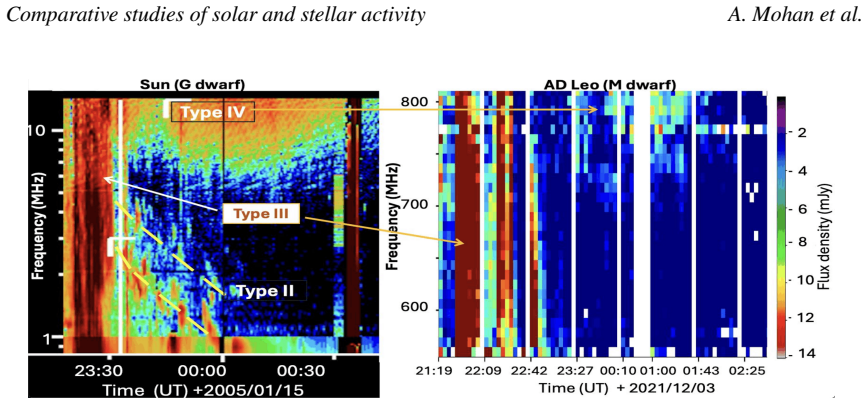
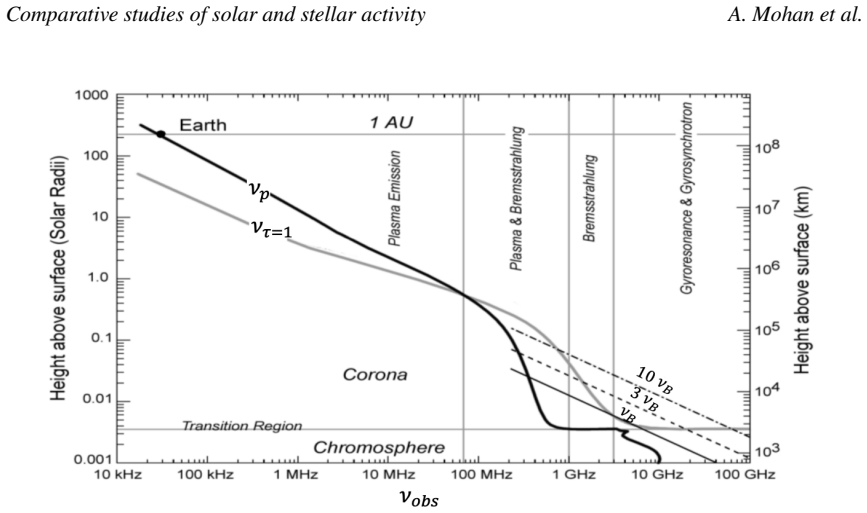
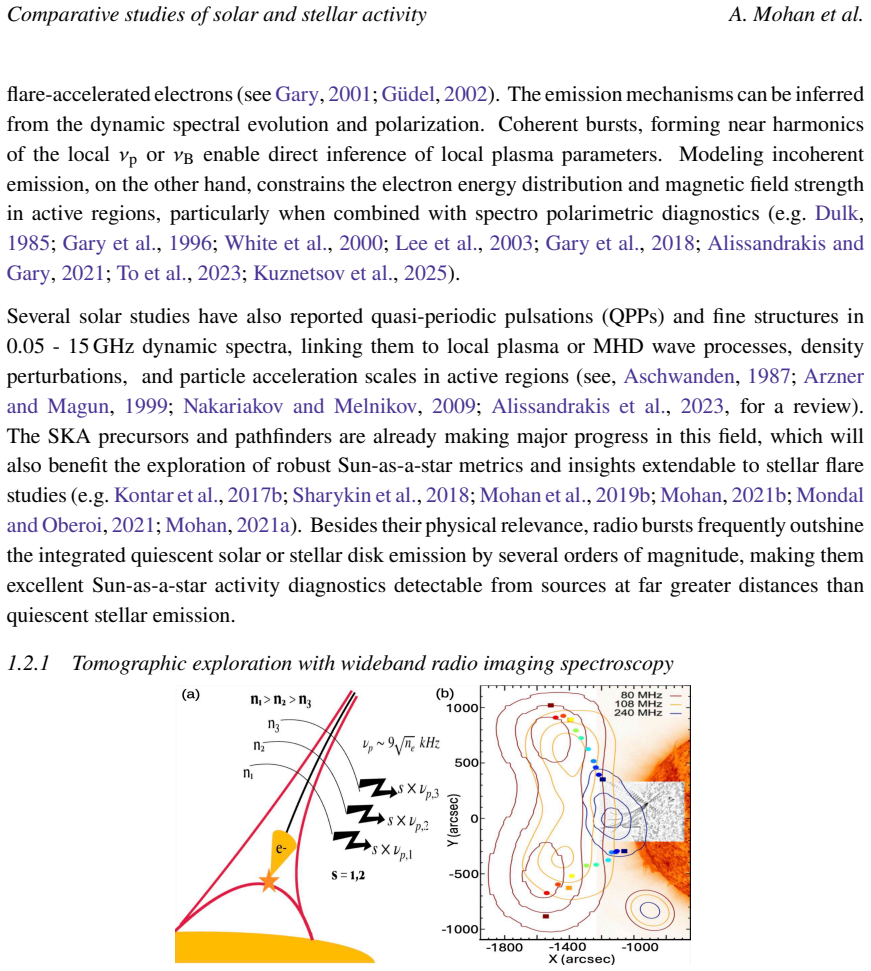


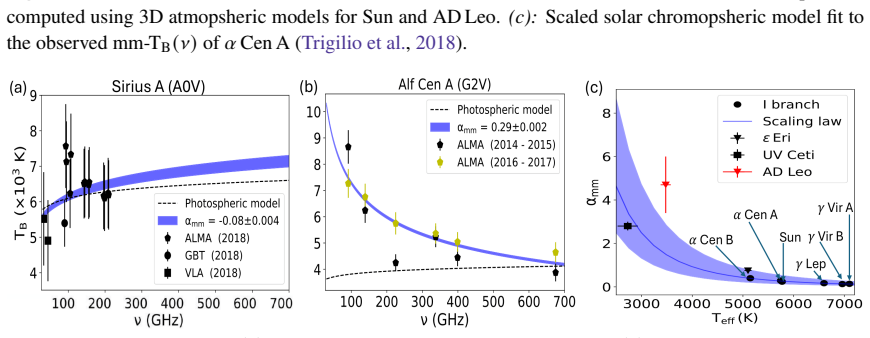
read the original abstract
The active atmospheres of cool main-sequence stars (F-M type) often release a fraction of their stored magnetic energy, producing enhanced emissions (flares) across radio to X-ray wavelengths and associated space weather events like coronal mass ejections (CMEs) and energetic particle events (EPEs). Detailed imaging of active regions and CMEs, and in-situ EPE measurements are possible only in our Sun, making it a benchmark for stellar activity research. Multiwaveband solar imaging datasets let us define robust disk-integrated Sun-as-a-star diagnostics of active region and space weather, extendable to stellar datasets. Radio waveband provide diagnostics of particle acceleration, CMEs and EPEs, essential to model flare events and their space weather impacts. The Square Kilometre Array (SKA) telescopes will facilitate sub-second scale spectropolarimetric imaging of the solar corona across 0.05 - 15GHz, enabling detailed vertical tomographic studies of the active region across a range of coronal heights. Coupled with high energy instruments, the SKA telescopes will allow well-constrained modeling of large samples of diverse active phenomena and the defintion of robust Sun-as-a-star diagnostics of active region and space weather. Besides, the supreme sensitivity and angular resolution of the SKA telescopes will help detect quiescent and active emissions from several nearby stars. This chapter discusses the importance of comparative solar-stellar studies using Sun-as-a-star diagnostics in understanding activity and associated space weather conditions in stars across the cool main-sequence, and presents some research avenues that will benefit solar and stellar astrophysics.
Editorial analysis
A structured set of objections, weighed in public.
Referee Report
Summary. The manuscript is a review chapter arguing that multiwaveband solar imaging datasets enable definition of robust disk-integrated Sun-as-a-star diagnostics for active regions, flares, CMEs, and space weather events. These diagnostics are presented as extendable to unresolved stellar observations of cool main-sequence stars. The text emphasizes the diagnostic power of radio observations for particle acceleration and space weather, highlights the capabilities of the Square Kilometre Array (SKA) for sub-second spectropolarimetric imaging and stellar detections, and outlines research avenues for comparative solar-stellar studies.
Significance. If the proposed transfer of solar diagnostics holds, the chapter would usefully frame a research program linking solar physics with stellar activity studies, particularly by identifying SKA-enabled radio diagnostics that could constrain flare energetics and space weather across spectral types. As a perspective piece rather than a data or derivation paper, its value lies in synthesizing existing solar-stellar literature and flagging observational opportunities rather than in new empirical results.
minor comments (4)
- [Abstract] Abstract: 'Radio waveband provide diagnostics' contains a subject-verb agreement error; should read 'provides'.
- [Abstract] Abstract: 'defintion of robust Sun-as-a-star diagnostics' is a typographical error; correct to 'definition'.
- [Introduction (inferred from abstract framing)] The manuscript repeatedly uses 'Sun-as-a-star' without an initial definition or reference to the standard usage in the solar-stellar literature; a brief clarifying sentence in the introduction would improve accessibility.
- [Abstract and concluding discussion] The central claim that solar-derived diagnostics are 'extendable to stellar datasets' is stated prospectively but lacks even a schematic discussion of potential systematic differences (e.g., inclination effects, spectral-type dependence of coronal structure). While this is acceptable for a review chapter, a short paragraph acknowledging these issues would strengthen the argument.
Simulated Author's Rebuttal
We thank the referee for their positive summary of the manuscript and for recommending minor revision. The chapter is intended as a perspective piece that synthesizes existing solar-stellar literature and identifies SKA-enabled opportunities for comparative studies. No major comments were raised, so we will incorporate any minor suggestions in the revised version.
Circularity Check
No significant circularity
full rationale
The manuscript is a review chapter that outlines the importance of solar-stellar comparisons and future SKA research avenues without advancing any new derivation, model, or empirical claim. No equations, fitted parameters, or load-bearing self-citations appear; the text is prospective and relies on established solar imaging capabilities and external literature rather than reducing any result to its own inputs by construction.
Axiom & Free-Parameter Ledger
Reference graph
Works this paper leans on
-
[1]
2019 , eprint=
Anticipated Performance of the Square Kilometre Array -- Phase 1 (SKA1) , author=. 2019 , eprint=
2019
-
[2]
Earth-Affecting Coronal Mass Ejections Without Obvious Low Coronal Signatures. , keywords =. doi:10.1007/s11207-017-1147-7 , adsurl =
-
[3]
Quasi-Periodic Pulsations in Solar Flares. , keywords =. doi:10.1007/s11214-009-9536-3 , adsurl =
-
[4]
Theory of radio pulsations in coronal loops. , keywords =. doi:10.1007/BF00145445 , adsurl =
-
[5]
Type II and Type III Radio Bursts and their Correlation with Solar Energetic Proton Events
Type II and Type III Radio Bursts and their Correlation with Solar Energetic Proton Events. , keywords =. doi:10.1088/0004-637X/809/1/105 , archivePrefix =. 1507.01620 , primaryClass =
work page internal anchor Pith review Pith/arXiv arXiv doi:10.1088/0004-637x/809/1/105
-
[6]
Journal of Geophysical Research (Space Physics) , keywords =
Solar flares, type III radio bursts, coronal mass ejections, and energetic particles. Journal of Geophysical Research (Space Physics) , keywords =. doi:10.1029/2001JA000320 , adsurl =
-
[7]
Long-duration Low-frequency Type III Bursts and Solar Energetic Particle Events. , keywords =. doi:10.1088/2041-8205/721/1/L62 , adsurl =
-
[8]
Reviews of Modern Plasma Physics , keywords =
Atmospheric escape from exoplanets: recent observations and theoretical models. Reviews of Modern Plasma Physics , keywords =. doi:10.1007/s41614-025-00195-6 , archivePrefix =. 2502.18124 , primaryClass =
-
[9]
2015 , publisher=
Advancing Astrophysics with the Square Kilometre Array (AASKA14) , author=. 2015 , publisher=
2015
-
[10]
Magnetic fields of non-degenerate stars
Magnetic Fields of Nondegenerate Stars. , keywords =. doi:10.1146/annurev-astro-082708-101833 , archivePrefix =. 0904.1938 , primaryClass =
work page internal anchor Pith review Pith/arXiv arXiv doi:10.1146/annurev-astro-082708-101833 1938
-
[11]
Planetary, Solar and Heliospheric Radio Emissions IX , year = 2023, editor =
Solar/stellar atmospheric tomography with mm-radio snapshot spectroscopic imaging. Planetary, Solar and Heliospheric Radio Emissions IX , year = 2023, editor =. doi:10.25546/104051 , adsurl =
-
[12]
Open Research Europe , keywords =
Atacama Large Aperture Submillimeter Telescope (AtLAST) science: Probing the transient and time-variable sky. Open Research Europe , keywords =. doi:10.12688/openreseurope.17686.2 , archivePrefix =. 2404.13133 , primaryClass =
-
[13]
Searching for star-planet interactions in GJ 486 at radio wavelengths with the uGMRT. , keywords =. doi:10.1051/0004-6361/202451835 , archivePrefix =. 2411.17689 , primaryClass =
-
[14]
Role of Nonthermal Processes in the Quiescent and Active Millimeter Spectrum of a Young M Dwarf. , keywords =. doi:10.3847/1538-4357/ade9bf , archivePrefix =. 2506.19779 , primaryClass =
-
[15]
A catalog of multi-vantage point observations of type-II bursts: Statistics and correlations. arXiv e-prints , keywords =. doi:10.48550/arXiv.2410.00814 , archivePrefix =. 2410.00814 , primaryClass =
-
[16]
CME-associated type-IV radio bursts: The solar paradigm and the unique case of AD Leo. arXiv e-prints , keywords =. doi:10.48550/arXiv.2410.00787 , archivePrefix =. 2410.00787 , primaryClass =
-
[17]
Novel scaling laws to derive spatially resolved flare and CME parameters from sun-as-a-star observables. , keywords =. doi:10.1051/0004-6361/202451072 , archivePrefix =. 2409.19145 , primaryClass =
-
[18]
Open Research Europe , keywords =
Science development study for the Atacama Large Aperture Submillimeter Telescope (AtLAST): Solar and stellar observations. Open Research Europe , keywords =. doi:10.12688/openreseurope.17453.1 , archivePrefix =. 2403.00920 , primaryClass =
-
[19]
Energetic particle activity in AD Leo: Detection of a solar-like type-IV burst. , keywords =. doi:10.1051/0004-6361/202347924 , archivePrefix =. 2402.00185 , primaryClass =
-
[21]
Journal of Physics Conference Series , year = 2019, series =
On the Shock Source of Sustained Gamma-Ray Emission from the Sun. Journal of Physics Conference Series , year = 2019, series =. doi:10.1088/1742-6596/1332/1/012004 , archivePrefix =. 1907.13318 , primaryClass =
-
[22]
and Arsenovic, P
Maliniemi, V. and Arsenovic, P. and Sepp\"al\"a, A. and Nesse Tyss. The influence of energetic particle precipitation on Antarctic stratospheric chlorine and ozone over the 20th century , JOURNAL =. 2022 , NUMBER =
2022
-
[23]
Evolution of Coronal Mass Ejections and the Corresponding Forbush Decreases: Modeling vs. Multi-Spacecraft Observations. , keywords =. doi:10.1007/s11207-020-01671-7 , archivePrefix =. 2006.02253 , primaryClass =
-
[24]
Journal of Geophysical Research (Space Physics) , keywords =
Type II radio bursts and energetic solar eruptions. Journal of Geophysical Research (Space Physics) , keywords =. doi:10.1029/2005JA011158 , adsurl =
-
[25]
Type II radio bursts and their association with coronal mass ejections in solar cycles 23 and 24. , keywords =. doi:10.1051/0004-6361/202244015 , archivePrefix =. 2305.18992 , primaryClass =
-
[26]
Polarization Observations of a Split-band Type II Radio Burst from the Solar Corona. , keywords =. doi:10.3847/1538-4357/ac9c65 , adsurl =
-
[27]
Proceedings of the Astronomical Society of Australia , year = 1970, month = sep, volume = 1, pages =
Some Investigations of the Solar Corona: The First Two Years of Observation With the Culgoora Radioheliograph. Proceedings of the Astronomical Society of Australia , year = 1970, month = sep, volume = 1, pages =. doi:10.1017/S1323358000012364 , adsurl =
-
[28]
McLean,D.J and Labrum,N.R , title="
-
[29]
Flares detected in ALMA single-dish images of the Sun. , keywords =. doi:10.1051/0004-6361/202244532 , archivePrefix =. 2211.16935 , primaryClass =
-
[30]
, archivePrefix = "arXiv", eprint =
First Spectroscopic Imaging Observations of the Sun at Low Radio Frequencies with the Murchison Widefield Array Prototype. , archivePrefix = "arXiv", eprint =. doi:10.1088/2041-8205/728/2/L27 , adsurl =
-
[31]
Preparing for Solar and Heliospheric Science with the SKAO: An Indian Perspective. arXiv e-prints , keywords =. doi:10.48550/arXiv.2211.03791 , archivePrefix =. 2211.03791 , primaryClass =
-
[32]
Living Reviews in Solar Physics , keywords =
Extreme solar events. Living Reviews in Solar Physics , keywords =. doi:10.1007/s41116-022-00033-8 , archivePrefix =. 2205.09265 , primaryClass =
-
[33]
Charles R. Harris and K. Jarrod Millman and St. Array programming with. 2020 , month = sep, journal =. doi:10.1038/s41586-020-2649-2 , publisher =
-
[34]
Computing in science & engineering , volume=
Matplotlib: A 2D graphics environment , author=. Computing in science & engineering , volume=. 2007 , publisher=
2007
-
[35]
Eric Jones and Travis Oliphant and Pearu Peterson and others , title =
-
[36]
Astropy: A Community Python Package for Astronomy
Astropy: A community Python package for astronomy. , keywords =. 2013. doi:10.1051/0004-6361/201322068 , archivePrefix =. 1307.6212 , primaryClass =
work page internal anchor Pith review Pith/arXiv arXiv doi:10.1051/0004-6361/201322068 2013
-
[37]
Astronomische Nachrichten , keywords =
Coronal mass ejections and exoplanets: A numerical perspective. Astronomische Nachrichten , keywords =. doi:10.1002/asna.20210100 , archivePrefix =. 2111.09704 , primaryClass =
-
[38]
The Stellar CME-flare relation: What do historic observations reveal?
The Stellar CME-Flare Relation: What Do Historic Observations Reveal?. , keywords =. doi:10.3847/1538-4357/ab1b37 , archivePrefix =. 1904.09598 , primaryClass =
work page internal anchor Pith review Pith/arXiv arXiv doi:10.3847/1538-4357/ab1b37 1904
-
[39]
Flux measurements of Ca II and K emission. , keywords =. doi:10.1086/130324 , adsurl =
-
[40]
, year = 1968, month = jul, volume =
Flux Measurements at the Centers of Stellar H- and K-Lines. , year = 1968, month = jul, volume =. doi:10.1086/149652 , adsurl =
-
[41]
Rotation, convection, and magnetic activity in lower main-sequence stars. , keywords =. doi:10.1086/161945 , adsurl =
-
[42]
$\alpha$ Centauri A in the far infrared
Centauri A in the far infrared. First measurement of the temperature minimum of a star other than the Sun. , keywords =. doi:10.1051/0004-6361/201220776 , archivePrefix =. 1212.3954 , primaryClass =
work page internal anchor Pith review Pith/arXiv arXiv doi:10.1051/0004-6361/201220776
-
[43]
ALMA's view of the nearest neighbors to the Sun. The submm/mm SEDs of the Centauri binary and a new source. , keywords =. doi:10.1051/0004-6361/201629135 , archivePrefix =. 1608.02384 , primaryClass =
work page internal anchor Pith review Pith/arXiv arXiv doi:10.1051/0004-6361/201629135
-
[44]
IV - Rotation and CA II H and K emission of main-sequence stars
Magnetic structure in cool stars. IV - Rotation and CA II H and K emission of main-sequence stars. , keywords =
-
[45]
& Barniol Duran, R.\ 2010, , 409, 226
Large-scale magnetic topologies of late M dwarfs*. , keywords =. doi:10.1111/j.1365-2966.2010.17101.x , archivePrefix =. 1005.5552 , primaryClass =
-
[46]
154 MHz detection of faint, polarized flares from UV Ceti
154 MHz Detection of Faint, Polarized Flares from UV Ceti. , keywords =. doi:10.3847/2041-8213/aa5ffd , archivePrefix =. 1702.03030 , primaryClass =
work page internal anchor Pith review Pith/arXiv arXiv doi:10.3847/2041-8213/aa5ffd 2041
-
[47]
Spatially resolved imaging of the two-component eta Crv debris disk with Herschel
Spatially Resolved Imaging of the Two-component Crv Debris Disk with Herschel. , keywords =. doi:10.1088/0004-637X/784/2/148 , archivePrefix =. 1402.1184 , primaryClass =
work page internal anchor Pith review Pith/arXiv arXiv doi:10.1088/0004-637x/784/2/148
-
[48]
Limits on Chromospheres and Convection among the Main-Sequence A Stars. , keywords =. doi:10.1086/342941 , adsurl =
-
[49]
Frontiers in Astronomy and Space Sciences , keywords =
Radio Observations of Coronal Mass Ejections: Space Weather Aspects. Frontiers in Astronomy and Space Sciences , keywords =. doi:10.3389/fspas.2020.00043 , adsurl =
-
[50]
Philosophical Transactions of the Royal Society of London Series A , keywords =
Characterization of shock wave signatures at millimetre wavelengths from Bifrost simulations. Philosophical Transactions of the Royal Society of London Series A , keywords =. doi:10.1098/rsta.2020.0185 , archivePrefix =. 2008.05324 , primaryClass =
-
[51]
Tracing shock waves from the corona to 1 AU: Type II radio emission and relationship with CMEs. , keywords =. doi:10.1029/2000JA000260 , adsurl =
-
[52]
Structure of the solar chromosphere. III. Models of the EUV brightness components of the quiet sun. , keywords =. doi:10.1086/190731 , adsurl =
-
[53]
The MESAS Project: ALMA Observations of the F-type Stars Lep, Vir A, and Vir B. , keywords =. doi:10.3847/1538-4357/ab8467 , archivePrefix =. 2003.12284 , primaryClass =
-
[54]
Inter-network regions of the Sun at millimetre wavelengths
Inter-network regions of the Sun at millimetre wavelengths. , keywords =. doi:10.1051/0004-6361:20077588 , archivePrefix =. 0705.2304 , primaryClass =
work page internal anchor Pith review Pith/arXiv arXiv doi:10.1051/0004-6361:20077588
-
[55]
Erratum: Stellar Evolution. I. The Approach to the Main Sequence. , year = 1965, month = jul, volume =. doi:10.1086/148308 , adsurl =
-
[56]
First Detection of Thermal Radio Emission from Solar-type Stars with the Karl G. Jansky Very Large Array. , keywords =. doi:10.1088/0004-637X/788/2/112 , archivePrefix =. 1405.2341 , primaryClass =
work page internal anchor Pith review Pith/arXiv arXiv doi:10.1088/0004-637x/788/2/112
-
[57]
Leitzinger, M. and Odert, P. and Greimel, R. and Korhonen, H. and Guenther, E. W. and Hanslmeier, A. and Lammer, H. and Khodachenko, M. L. , title = ". Monthly Notices of the Royal Astronomical Society , volume =. 2014 , month =. doi:10.1093/mnras/stu1161 , url =
-
[58]
, year = 2001, month = oct, volume = 203, pages =
Plasma Beta above a Solar Active Region: Rethinking the Paradigm. , year = 2001, month = oct, volume = 203, pages =. doi:10.1023/A:1012722021820 , adsurl =
-
[59]
Theory of Low-Mass Stars and Substellar Objects
Theory of Low-Mass Stars and Substellar Objects. , keywords =. doi:10.1146/annurev.astro.38.1.337 , archivePrefix =. astro-ph/0006383 , primaryClass =
work page internal anchor Pith review Pith/arXiv arXiv doi:10.1146/annurev.astro.38.1.337
-
[60]
D. J. Mullan and R. R. Paudel , title =. 2019 , month =. doi:10.3847/1538-4357/ab041b , url =
-
[61]
Ultra-Wideband Detection of 22 Coherent Radio Bursts on M Dwarfs
Ultra-wideband Detection of 22 Coherent Radio Bursts on M Dwarfs. ApJ , keywords =. doi:10.3847/1538-4357/aaf88e , archivePrefix =. 1810.00855 , primaryClass =
work page internal anchor Pith review Pith/arXiv arXiv doi:10.3847/1538-4357/aaf88e
-
[62]
Occurrence rates of small planets from HARPS. Focus on the Galactic context. , keywords =. doi:10.1051/0004-6361/202038881 , archivePrefix =. 2010.03237 , primaryClass =
-
[63]
The evolution of surface magnetic fields in young solar-type stars I: the first 250 Myr
The evolution of surface magnetic fields in young solar-type stars - I. The first 250 Myr. , keywords =. doi:10.1093/mnras/stv2924 , archivePrefix =. 1601.00684 , primaryClass =
work page internal anchor Pith review Pith/arXiv arXiv doi:10.1093/mnras/stv2924
-
[64]
The evolution of surface magnetic fields in young solar-type stars II: the early main sequence (250-650 Myr). , keywords =. doi:10.1093/mnras/stx3021 , archivePrefix =. 1711.08636 , primaryClass =
work page internal anchor Pith review Pith/arXiv arXiv doi:10.1093/mnras/stx3021
-
[65]
Measuring stellar magnetic helicity density. , keywords =. doi:10.1093/mnras/staa297 , archivePrefix =. 2001.11749 , primaryClass =
-
[66]
Weakened magnetic braking as the origin of anomalously rapid rotation in old field stars
Weakened magnetic braking as the origin of anomalously rapid rotation in old field stars. , keywords =. doi:10.1038/nature16168 , archivePrefix =. 1601.02631 , primaryClass =
work page internal anchor Pith review Pith/arXiv arXiv doi:10.1038/nature16168
-
[67]
James R. A. Davenport , title =. doi:10.3847/0004-637x/829/1/23 , url =
-
[68]
Chromospheric activity catalogue of 4454 cool stars. Questioning the active branch of stellar activity cycles. , keywords =. doi:10.1051/0004-6361/201629518 , archivePrefix =. 1803.11123 , primaryClass =
work page internal anchor Pith review Pith/arXiv arXiv doi:10.1051/0004-6361/201629518
-
[69]
Flares in open clusters with K2 . I. M 45 (Pleiades), M 44 (Praesepe), and M 67. , keywords =. doi:10.1051/0004-6361/201834400 , archivePrefix =. 1812.06725 , primaryClass =
work page internal anchor Pith review Pith/arXiv arXiv doi:10.1051/0004-6361/201834400
-
[70]
Stellar magnetism: empirical trends with age and rotation
Stellar magnetism: empirical trends with age and rotation. , keywords =. doi:10.1093/mnras/stu728 , archivePrefix =. 1404.2733 , primaryClass =
work page internal anchor Pith review Pith/arXiv arXiv doi:10.1093/mnras/stu728
-
[71]
Millimeter radiation from a 3D model of the solar atmosphere. I. Diagnosing chromospheric thermal structure. , keywords =. doi:10.1051/0004-6361/201425238 , archivePrefix =. 1501.02898 , primaryClass =
work page internal anchor Pith review Pith/arXiv arXiv doi:10.1051/0004-6361/201425238
-
[72]
Chromospheric Activity, Kinematics, and Metallicities of Nearby M Dwarfs. , keywords =. doi:10.1086/191123 , adsurl =
-
[73]
Age Determination for 346 Nearby Stars in the Herschel DEBRIS Survey
Age Determination for 346 Nearby Stars in the Herschel DEBRIS Survey. , keywords =. doi:10.1088/0004-6256/143/6/135 , archivePrefix =. 1203.1966 , primaryClass =
work page internal anchor Pith review Pith/arXiv arXiv doi:10.1088/0004-6256/143/6/135 1966
-
[74]
Chromospheric H alpha emission in F8-G3 dwarfs and its connection with the T Tauri stars. , keywords =. doi:10.1086/162887 , adsurl =
-
[75]
Evolution of 0.7-3.0 M stars having -1.0 <= Fe/H 0.0. , keywords =. doi:10.1086/191055 , adsurl =
-
[76]
Rotation and H Emission Activity in F8-G3 Dwarfs. , keywords =. doi:10.1007/BF00650163 , adsurl =
-
[77]
, keywords =
Applicability of the Rossby number in activity-rotation relations for dwarfs and giants. , keywords =
-
[78]
Chromospheric activity as age indicator
Chromospheric activity as age indicator. An L-shaped chromospheric-activity versus age diagram. , keywords =. doi:10.1051/0004-6361/201220364 , archivePrefix =. 1301.5651 , primaryClass =
work page internal anchor Pith review Pith/arXiv arXiv doi:10.1051/0004-6361/201220364
-
[79]
Chromospheric Variations in Main-Sequence Stars. II. , keywords =. doi:10.1086/175072 , adsurl =
-
[80]
Cool Stars, Stellar Systems, and the Sun , year = 1998, editor =
Activity Cycles in Lower Main Sequence and POST Main Sequence Stars: The HK Project. Cool Stars, Stellar Systems, and the Sun , year = 1998, editor =
1998
-
[81]
Living Reviews in Solar Physics , keywords =
Stellar Chromospheric Activity. Living Reviews in Solar Physics , keywords =. doi:10.12942/lrsp-2008-2 , adsurl =
discussion (0)
Sign in with ORCID, Apple, or X to comment. Anyone can read and Pith papers without signing in.