Two-dimensional Hyperbolic RNN Neural Quantum State
Pith reviewed 2026-06-25 21:19 UTC · model grok-4.3
The pith
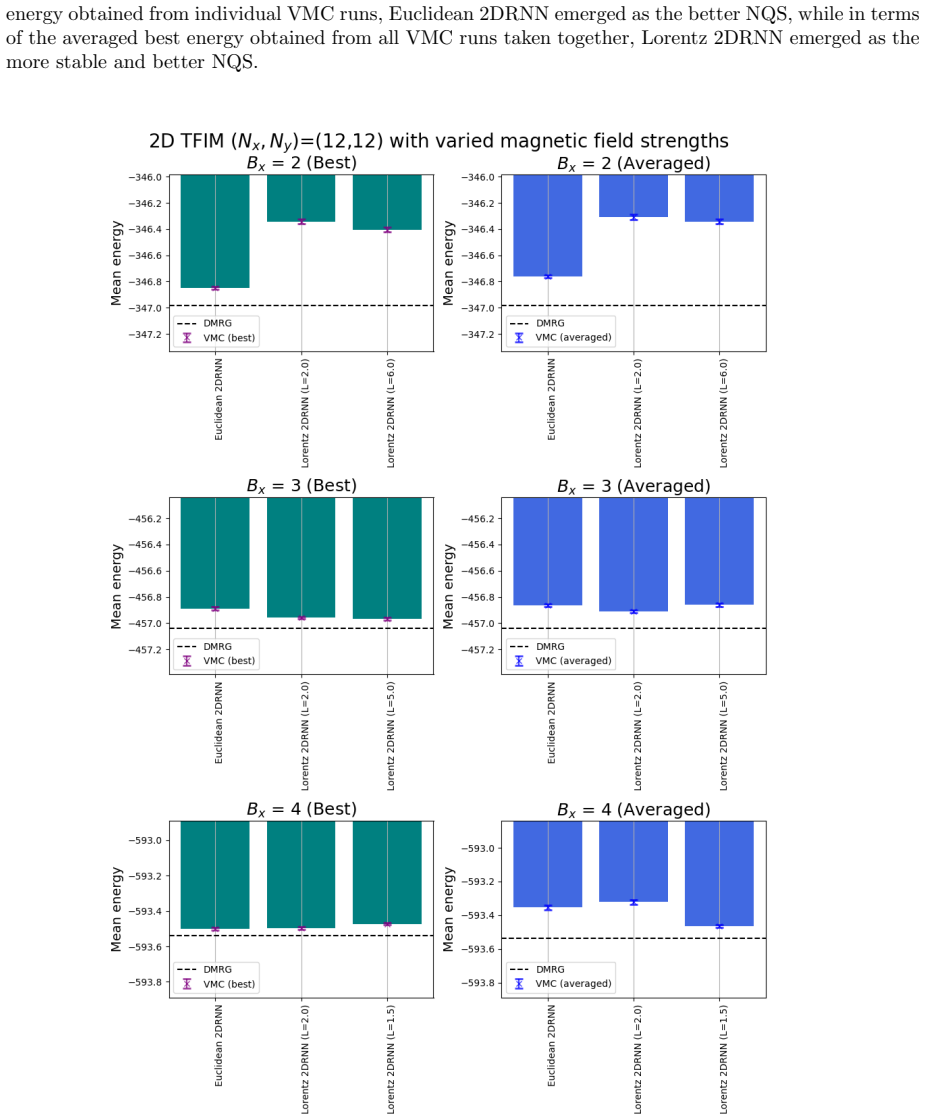
Hyperbolic Lorentz 2DRNN neural quantum states outperform Euclidean 2DRNN at the critical point of the 2D transverse-field Ising model.
A machine-rendered reading of the paper's core claim, the machinery that carries it, and where it could break.
Core claim
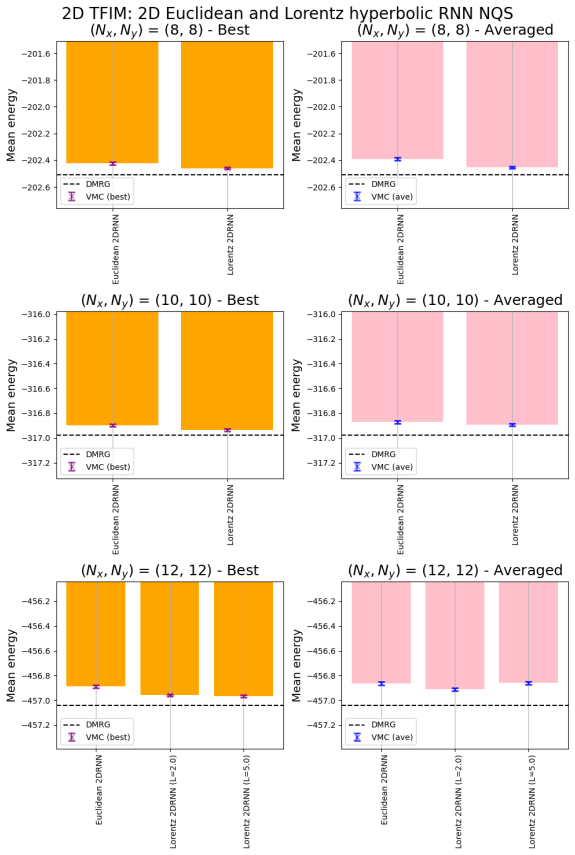
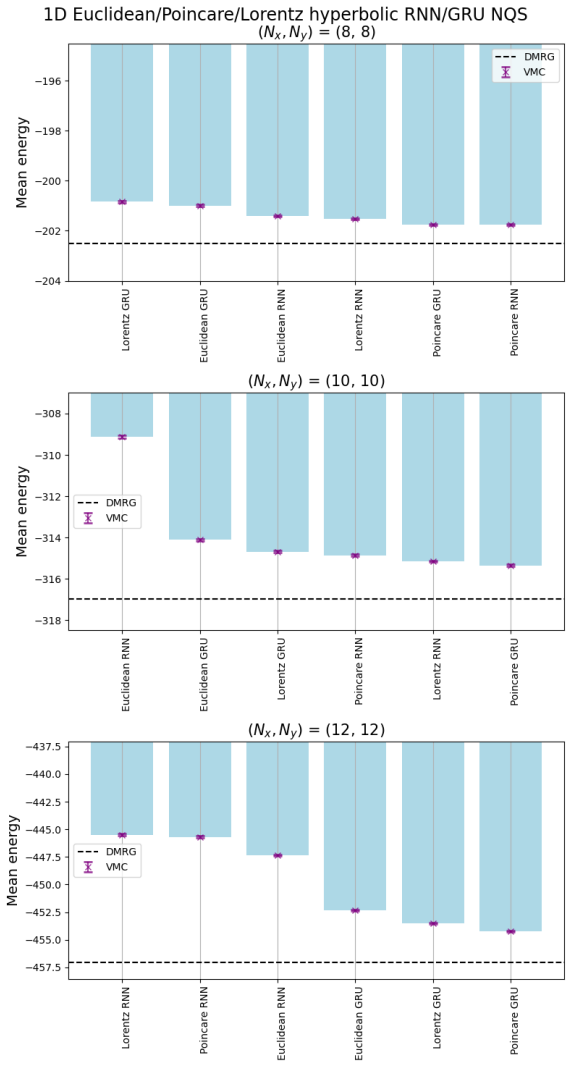
The Lorentz 2DRNN neural quantum state in two dimensions outperforms its Euclidean counterpart in the N by N 2D transverse field Ising model exactly at the critical transverse field, where the ground state is described by a conformal field theory whose holographic dual is an Anti-de-Sitter space with hyperbolic spatial geometry. This outperformance is presented as evidence for the utility of hyperbolic geometries in neural quantum states for systems at criticality. The same pattern holds when one-dimensional hyperbolic RNN and GRU networks are applied to the 2D model after mapping it to one dimension.
What carries the argument
The Lorentz 2DRNN, a two-dimensional recurrent neural network whose parameters and states are defined in the Lorentz model of hyperbolic geometry, used as the variational wavefunction ansatz for the neural quantum state.
Load-bearing premise
The performance difference is caused by the hyperbolic geometry corresponding to the AdS dual of the CFT rather than by unrelated differences in how the networks are constructed or trained.
What would settle it
Measuring the relative performance of hyperbolic and Euclidean 2DRNN NQS in the same model but at transverse field values away from the critical point, or performing controlled experiments that equalize network expressivity.
Figures





read the original abstract
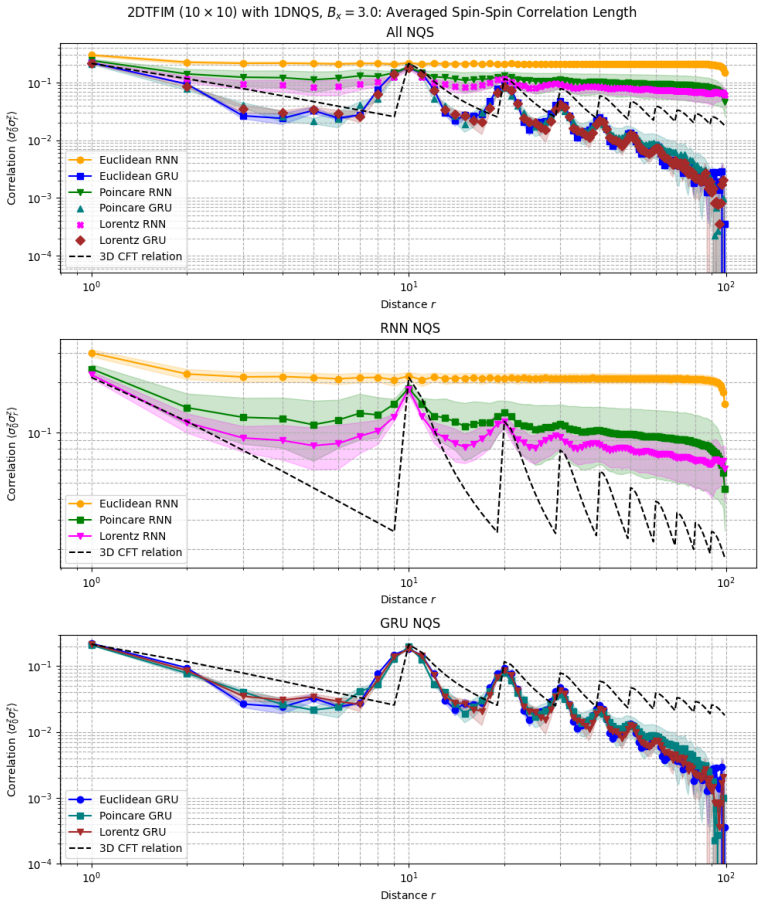
In the first part of this work, we construct the first type of two-dimensional (2D) hyperbolic neural quantum state (NQS) in the form of the Lorentz 2DRNN (Recurrent Neural Network) and benchmark its performance against the Euclidean 2DRNN in the paradigmatic $N\times N$ 2D Transverse Field Ising Model (2DTFIM) setting with different lattice sizes up to $N=12$ and at different transverse magnetic field strengths. We find that hyperbolic Lorentz 2DRNN NQS definitively outperform Euclidean 2DRNN NQS when the system is at the phase transition point when the physics can be described by a conformal field theory (CFT), which is known to be dual to an Anti-de-Sitter (AdS) space whose spatial geometry is hyperbolic. In the second part of this work, we benchmark the performances of the recently introduced one-dimensional (1D) hyperbolic NQS including Poincar\'e RNN/GRU and Lorentz RNN/GRU against their Euclidean NQS versions in $N\times N$ 2DTFIM, which has to be converted to a one-dimensional setting to allow for the use of 1D NQS. The findings in this case extend our previous results that 1D hyperbolic NQS definitively outperform 1D Euclidean NQS, thanks to the combined effects of the hierarchical structure comprising the first and $N^{th}$ neighbor interactions present in the 1D system arising from the 2D lattice and the CFT physics at the critical point. While more studies with larger system sizes are required, our work serves as a proof-of-concept for the utility, effectiveness as well as the superior performances of one- and two-dimensional hyperbolic NQS ansatzes compared to the existing Euclidean NQS in many-body quantum physics systems, especially when these systems exhibit structural hierarchy or when they are at criticality, or a combination of both.
Editorial analysis
A structured set of objections, weighed in public.
Referee Report
Summary. The manuscript constructs the first 2D hyperbolic neural quantum state ansatz in the form of a Lorentz 2DRNN and benchmarks it against the Euclidean 2DRNN on the N×N 2D transverse-field Ising model (2DTFIM) for lattices up to N=12 at multiple transverse-field values. It reports that the hyperbolic version outperforms the Euclidean version at the critical point, attributing the advantage to the match between hyperbolic geometry and the AdS space dual to the CFT description of the critical theory. The work also benchmarks 1D hyperbolic NQS (Poincaré and Lorentz RNN/GRU) against Euclidean versions on the 2D model mapped to 1D, extending prior 1D results and linking gains to hierarchical neighbor interactions plus criticality.
Significance. If the performance advantage can be shown to arise specifically from the hyperbolic geometry rather than other factors, the result would supply a concrete proof-of-concept that AdS/CFT-inspired geometries can improve NQS expressivity for critical many-body systems. The explicit acknowledgment that larger lattices are required and the direct comparison on the same Hamiltonian are positive features, but the current evidence base remains too preliminary for strong claims about holographic utility in quantum simulation.
major comments (3)
- [Abstract] Abstract: the claim that hyperbolic Lorentz 2DRNN NQS 'definitively outperform' Euclidean 2DRNN NQS at the phase transition supplies no numerical metrics, error bars, training protocols, or statistical tests, so the magnitude and reliability of the reported advantage cannot be assessed.
- [Benchmark comparisons] Benchmark section (2D Lorentz 2DRNN vs. Euclidean 2DRNN): no information is given on parameter counts, hidden-state dimensions, optimizer settings, initialization, or any ablation that holds all other architectural elements fixed while toggling only the hyperbolic versus Euclidean metric; without these controls the attribution of the gap to AdS/CFT geometry matching remains unsupported.
- [1D hyperbolic NQS extension] 1D hyperbolic NQS benchmarks on the mapped 2D system: the attribution of improvement to 'the combined effects of the hierarchical structure comprising the first and Nth neighbor interactions ... and the CFT physics' likewise lacks controlled experiments that isolate geometry from expressivity or optimization differences.
minor comments (1)
- [Abstract] Abstract: the phrasing 'when the physics can be described by a conformal field theory (CFT)' would benefit from an explicit statement of the critical transverse-field value used for the 2DTFIM.
Simulated Author's Rebuttal
We thank the referee for the constructive feedback, which highlights opportunities to strengthen the presentation of our results and experimental controls. We address each major comment below and will revise the manuscript to improve clarity, add missing details, and qualify claims where appropriate.
read point-by-point responses
-
Referee: [Abstract] Abstract: the claim that hyperbolic Lorentz 2DRNN NQS 'definitively outperform' Euclidean 2DRNN NQS at the phase transition supplies no numerical metrics, error bars, training protocols, or statistical tests, so the magnitude and reliability of the reported advantage cannot be assessed.
Authors: We agree that the abstract should be more quantitative to allow assessment of the advantage. In the revised version we will replace the phrasing 'definitively outperform' with a qualified statement that includes representative metrics (e.g., relative energy error reductions at criticality), mention of error bars obtained from multiple independent runs, and a brief reference to the shared training protocol (Adam optimizer, fixed hidden dimension, same number of epochs). This will be done without altering the underlying data or conclusions. revision: yes
-
Referee: [Benchmark comparisons] Benchmark section (2D Lorentz 2DRNN vs. Euclidean 2DRNN): no information is given on parameter counts, hidden-state dimensions, optimizer settings, initialization, or any ablation that holds all other architectural elements fixed while toggling only the hyperbolic versus Euclidean metric; without these controls the attribution of the gap to AdS/CFT geometry matching remains unsupported.
Authors: We will add a new table (or expanded methods subsection) that reports, for both models: hidden-state dimension, total trainable parameters, optimizer (Adam with learning-rate schedule), weight initialization, batch size, and number of training steps. The architectures are identical except for the metric tensor used in the recurrent update; we will explicitly state this and discuss why the comparison isolates the geometric contribution. We acknowledge that a full factorial ablation isolating every possible factor is not present and will qualify the geometric interpretation accordingly while noting that the observed gap is reproducible across the reported lattice sizes. revision: partial
-
Referee: [1D hyperbolic NQS extension] 1D hyperbolic NQS benchmarks on the mapped 2D system: the attribution of improvement to 'the combined effects of the hierarchical structure comprising the first and Nth neighbor interactions ... and the CFT physics' likewise lacks controlled experiments that isolate geometry from expressivity or optimization differences.
Authors: We will expand the corresponding methods paragraph to list the identical hyper-parameters (hidden dimension, optimizer settings, initialization) used for the Poincaré/Lorentz and Euclidean 1D models. We will clarify that the hierarchical neighbor structure is an unavoidable consequence of the 2D-to-1D mapping and that performance differences appear most pronounced at the critical point. The attribution will be rephrased as an interpretation consistent with the data rather than a definitive causal claim, and we will note the absence of exhaustive ablations that would fully disentangle geometry from other factors. revision: partial
Circularity Check
No circularity: empirical benchmarks only
full rationale
The manuscript reports direct empirical performance comparisons between Lorentz 2DRNN NQS and Euclidean 2DRNN NQS (and 1D variants) on the 2DTFIM Hamiltonian across lattice sizes up to N=12 and varying transverse fields. The central finding—that hyperbolic versions outperform at the critical point—is presented as an observed benchmark result rather than a derived prediction or first-principles claim. No equations, fitted parameters, or self-citations are invoked in a manner that reduces any reported advantage to an input defined by the authors themselves. The work is therefore self-contained against external benchmarks with no load-bearing circular steps.
Axiom & Free-Parameter Ledger
axioms (2)
- domain assumption Recurrent neural networks can serve as variational ansatzes for quantum many-body wavefunctions
- domain assumption The 2DTFIM at criticality is described by a CFT whose spatial geometry is dual to hyperbolic AdS space
Reference graph
Works this paper leans on
-
[1]
G. Carleo and M. Troyer, Solving the Quantum Many-Body Problem with Artificial Neural Networks, Science 355, 602 (2017), arXiv:1606.02318 [cond-mat.dis-nn]
Pith/arXiv arXiv 2017
-
[2]
L. Huang and L. Wang, Accelerate Monte Carlo Simulations with Restricted Boltzmann Machines, arXiv:1610.02746v2
-
[3]
Z. Cai and J. Liu, Approximating quantum many-body wave-functions using artificial neural networks,Phys. Rev. B 97, 035116 (2018), arXiv:1704.05148 [cond-mat.str-el]
Pith/arXiv arXiv 2018
-
[4]
H. Saito and M. Kato, Machine learning technique to find quantum many-body ground states of bosons on a lattice, J. Phys. Soc. Jpn. 87, 014001 (2018), arXiv:1709.05468 [cond-mat.dis-nn]
Pith/arXiv arXiv 2018
-
[5]
X. Liang, Wen-Yuan Liu, Pei-Ze Lin, Guang-Can Guo, Yong-Sheng Zhang, and Lixin He, Solving frustrated quantum many-particle models with convolutional neural networks, arXiv: 1807.09422v2
-
[6]
C. Roth, A. Szab´ o, and A. H. MacDonald, High-accuracy variational Monte Carlo for frustrated magnets with deep neural networks, Phys. Rev. B 108, 054410 (2023), arXiv:2211.07749v2 [cond-mat.str-el]
arXiv 2023
-
[7]
Hibat-Allah, M
M. Hibat-Allah, M. Ganahl, L. E. Hayward, R. G. Melko, and J. Carrasquill, Recurrent neural network wave functions, Physical Review Research 2, 023358 (2020)
2020
-
[8]
M. Hibat-Allah, R. G. Melko, J. Carrasquilla, Supplementing Recurrent Neural Network Wave Functions with Symmetry and Annealing to Improve Accuracy, Machine Learning and the Physical Sciences, NeurIPS 2021, arXiv:2207.14314v2 [cond-mat.dis-nn]
arXiv 2021
-
[9]
M. Hibat-Allah, E. Merali, G. Torlai, R. G. Melko and J. Carrasquilla, Recurrent neural network wave functions for Rydberg atom arrays on kagome lattice, arXiv:2405.20384v1 [cond-mat.quant-gas]
-
[10]
K. Sprague and S. Czischek, Variational Monte Carlo with Large Patched Transformers, Commun Phys 7, 90 (2024), arXiv:2306.03921 [quant-ph]
arXiv 2024
- [11]
-
[12]
H. L. Dao, Hyperbolic recurrent neural network as the first type of non-Euclidean neural quantum state ansatz, Eur. Phys. J. Plus 141:199, arXiv:2505.22083 [quant-ph, cond-mat.dis-nn, cs.LG, physics.comp-ph] (2026)
arXiv 2026
-
[13]
H. L. Dao, New non-Euclidean neural quantum state ansatzes from additional types of hyperbolic neural networks, arXiv:2604.2337 [quant-ph, cs.LG, cond-mat.dis-nn]
-
[14]
O.-E. Ganea, G. Becigneul, and T. Hofmann, Hyperbolic Neural Networks, Advances in Neural Information Processing Systems 31, pages 5345–5355. Curran Associates, Inc. arXiv: 1805.09112 [cs.LG]
-
[15]
N. He, M. Yang and Rex Ying, HyperCore: The Core Framework for Building Hyperbolic Foundation Models with Comprehensive Modules, arXiv:2504.08912 [cs.LG]
-
[16]
F. Becca and S. Sorella, Quantum Monte Carlo approaches for correlated systems, Cambridge University Press 2017, DOI: 10.1017/9781316417041
-
[17]
Chung, C
J. Chung, C. Gulcehre, K. Cho, Y. Bengio, Gated feedback recurrent neural networks, in: ICML, 2015
2015
-
[18]
H. L. Dao, Deep Learning Calabi-Yau four folds with hybrid and recurrent neural network architectures, Nucl. Phys. B 1013 (2025) 116832, arXiv:2405.17406 [hep-th, cs.LG, math.AG]
arXiv 2025
-
[19]
W. Chen, X. Han, Y. Lin, H. Zhao, Z. Liu, P. Li, M. Sun, J. Zhou, Fully Hyperbolic Neural Networks, in ACL 2022 Main Conference, arXiv:2105.14686 [cs.CL]
arXiv 2022
-
[20]
W. Peng, T. Varanka, A. Mostafa, H. Shi, G. Zhao, Hyperbolic Deep Neural Networks: A Survey, arXiv:2101.04562 [cs.LG, cs.CV]
-
[21]
C. Gulcehre, M. Denil, M. Malinowski, A. Razavi, R. Pascanu, et. al., Hyperbolic Attention Networks, arXiv:1805.09786v1 [cs.NE]
-
[22]
F.Lopez and M. Strube, A Fully Hyperbolic Neural Model for Hierarchical Multi-Class Classification, Findings of EMNLP2020, arXiv:2010.02053 [cs.CL]. 32
arXiv 2010
-
[23]
R. Shimizu, Y. Mukuta and T. Harada, Hyperbolic Neural Networks++, The Ninth International Confer- ence on Learning Representations (ICLR 2021), arXiv:2006.08210 [cs.LG]
arXiv 2021
-
[24]
E. Mathieu, C. Le Lan, C. J. Maddison, R. Tomioka, and Y. W. Teh, Continuous Hierarchical Represen- tations with Poincar´ e Variational Auto-Encoders, arXiv:1901.06033
arXiv 1901
-
[25]
G. Bachmann, G. Becigneul, O.-E. Ganea, Constant Curvature Graph Convolutional Networks, arXiv:1911.05076v3
arXiv 1911
-
[26]
Linial, E
N. Linial, E. London, and Y. Rabinovich. The geometry of graphs and some of its algorithmic applications, Combinatorica, 15(2):215–245, 1995
1995
-
[27]
Krioukov, F
D. Krioukov, F. Papadopoulos, A. Vahdat, and M. Bogun´ a, Curvature and temperature of complex net- works, Physical Review E, 80(3):035101, 2009
2009
-
[28]
Krioukov, F
D. Krioukov, F. Papadopoulos, M. Kitsak, A. Vahdat, and M. Bogun´ a, Hyperbolic geometry of complex networks, Physical Review E, 82(3):036106, 2010
2010
-
[29]
H. W. J. Bl¨ ote and Y. Deng, Cluster Monte Carlo simulation of the transverse Ising model, Phys. Rev. E 66, 066110 (2002)
2002
-
[30]
R. Sarkar. Low distortion Delaunay embedding of trees in hyperbolic plane, In Proc. of the International Symposium on Graph Drawing (GD 2011), pages 355–366, Eindhoven, Netherlands, 2011
2011
-
[31]
F. Sala, C. De Sa, A. Gu, and C. R´ e. 2018. Representation tradeoffs for hyperbolic embeddings. In Inter- national Conference on Machine Learning, pages 4457–4466
2018
-
[32]
Bonnabel, Stochastic gradient descent on riemannian manifolds, IEEE Transactions on Automatic Con- trol, 58(9):2217–2229, Sept 2013
S. Bonnabel, Stochastic gradient descent on riemannian manifolds, IEEE Transactions on Automatic Con- trol, 58(9):2217–2229, Sept 2013
2013
-
[33]
Ganea, G
O.-E. Ganea, G. B´ ecigneul, and T. Hofmann. Hyperbolic entailment cones for learning hierarchical embed- dings. In Proceedings of the thirty-fifth international conference on machine learning (ICML), 2018
2018
-
[34]
G. B´ ecigneul and O.-E Ganea, Riemannian Adaptive Optimization Methods, International Conference on Learning Representations (ICLR) (2019), arXiv:1810.00760 [cs.LG]
Pith/arXiv arXiv 2019
-
[35]
M. Nickel and D. Kiela, Poincar´ e embeddings for learning hierarchical representations, arXiv:1705.08039 [cs.AI]
-
[36]
M. Nickel and D. Kiela, Learning Continuous Hierarchies, in the Lorentz Model of Hyperbolic Geometry, ICML 2018, arXiv:1806.03417 [cs.AI]
Pith/arXiv arXiv 2018
-
[37]
H. L. Dao, Exploring new variational quantum circuit ansatzes for solvingSU(2) matrix models, Eur. Phys. J. C (2025) 85:705, arXiv:2503.13368 [quant-ph, hep-th, physics.comp-ph]
arXiv 2025
-
[38]
S. El-Showk, M. F. Paulos, D. Poland, S. Rychkov, D. Simmons-Duffin, A. Vichi, Solving the 3d Ising Model with the Conformal Bootstrap II. c-Minimization and Precise Critical Exponents, J. Stat. Phys. 157, 869-914 (2014), arXiv:1403.4545 [hep-th]
Pith/arXiv arXiv 2014
-
[39]
Vidal, Entanglement renormalization, Phys
G. Vidal, Entanglement renormalization, Phys. Rev. Lett. 99, 220405 (2007), arXiv:cond-mat/0512165 [cond-mat.str-el]
Pith/arXiv arXiv 2007
-
[40]
Vidal, A class of quantum many-body states that can be efficiently simulated, Phys
G. Vidal, A class of quantum many-body states that can be efficiently simulated, Phys. Rev. Lett. 101, 110501 (2008) (2007), arXiv:quant-ph/0610099
Pith/arXiv arXiv 2008
-
[41]
G. Evenbly and G. Vidal, Entanglement renormalization in two spatial dimensions, Phys. Rev. Lett. 102, 180406 (2009), arXiv:0811.0879 [cond-mat.str-el]
Pith/arXiv arXiv 2009
-
[42]
Swingle, Entanglement Renormalization and Holography, Phys
B. Swingle, Entanglement Renormalization and Holography, Phys. Rev. D 86, 065007 (2012), arXiv:0905.1317 [cond-mat.str-el]
Pith/arXiv arXiv 2012
-
[43]
B. Swingle, Constructing holographic spacetimes using entanglement renormalization, arXiv:1209.3304 [hep-th]
-
[44]
Rinaldi, X
E. Rinaldi, X. Han, M. Hassan, Y. Feng, F. Nori, M. McGuigan, M. Hanada, Matrix-model simulations using quantum computing, deep learning, and lattice Monte Carlo. PRX Quantum 3, 010324 (2022)
2022
-
[45]
J. M. Maldacena, The large N limit of superconformal field theories and supergravity, Adv. Theor. Math. Phys. 2 (1998) 231 [Int. J. Theor. Phys. 38 (1999) 1113] [arXiv:hep- th/9711200]. 33
arXiv 1998
-
[46]
Di Francesco, P
P. Di Francesco, P. Mathieu, D. S´ en´ echal, Conformal Field Theory, Springer-Verlag (1997)
1997
-
[47]
Sachdev, Quantum Phase Transitions, Cambridge University Press (2011)
S. Sachdev, Quantum Phase Transitions, Cambridge University Press (2011)
2011
-
[48]
D. J. Watts and S. H. Strogatz. Collective dynamics of ‘small-world’ networks. Nature, 393(6684):440, 1998
1998
-
[49]
Q.Liu, M. Nickel and D. Kiela, Hyperbolic Graph Neural Networks, arxiv:1910.12892 [cs.LG] 34
arXiv 1910
discussion (0)
Sign in with ORCID, Apple, or X to comment. Anyone can read and Pith papers without signing in.