Position Spaces and Graphs
Pith reviewed 2026-06-25 20:25 UTC · model grok-4.3
The pith
Position graphs using two strict partial orders keep induced subgraph isomorphism NP-complete.
A machine-rendered reading of the paper's core claim, the machinery that carries it, and where it could break.
Core claim
Position graphs are defined by two strict partial orders on a set of tokens that satisfy a chain condition together with row and column compatibility requirements; the paper gives necessary and sufficient conditions for consistency of such graphs and proves that the induced subgraph isomorphism problem on position graphs is NP-complete.
What carries the argument
Position graph: a pair of strict partial orders (horizontal and vertical) obeying a chain condition and row/column compatibility constraints that together represent spatial precedence and alignment of discrete tokens.
If this is right
- Consistency of any position graph can be decided by checking the stated chain and compatibility conditions.
- Structural pattern discovery in position-based data remains NP-hard even after the restrictions to partial orders and chains.
- The framework supplies an algebraic consistency layer that is independent of any specific extraction or parsing technique.
- Results apply directly to any discrete tokens whose positions are described by the two-order model.
Where Pith is reading between the lines
- The retained NP-completeness implies that practical pattern search on position data will still require heuristics or restrictions beyond the graph model itself.
- The same two-order representation could be tested on other domains that involve row-column layouts, such as table extraction or circuit placement.
- If the chain condition is relaxed, the consistency characterization would no longer hold, but the hardness result might still apply to the broader class.
Load-bearing premise
All relevant position constraints in the domain can be captured exactly by two strict partial orders that obey the chain condition and the row/column compatibility requirements.
What would settle it
A polynomial-time algorithm that solves induced subgraph isomorphism on arbitrary position graphs would falsify the NP-completeness result.
Figures

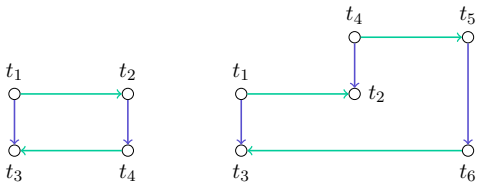


read the original abstract
In this paper, we introduce position graphs, a graph-based reasoning framework based on the formalization of position spaces. This framework utilizes two strict partial orders, representing horizontal and vertical alignment and precedence, to model the relative positions of discrete tokens. Unlike general qualitative spatial calculi, position graphs are constrained by a chain condition and compatibility requirements that focus on rows and columns. We provide a comprehensive theoretical analysis of this representation, beginning with a characterization of graph consistency. Conditions to ensure the consistency of position graphs are established. Furthermore, we investigate the computational complexity of structural pattern discovery, modeled as the induced subgraph isomorphism problem. We demonstrate that this problem remains NP-complete even within the restricted class of position graphs. While initially motivated by document processing, this work focuses on the underlying mathematical properties and algebraic consistency of position-based constraints, providing a formal logical layer that is independent of specific data extraction techniques.
Editorial analysis
A structured set of objections, weighed in public.
Referee Report
Summary. The paper introduces position graphs, a representation using two strict partial orders (horizontal and vertical) subject to a chain condition and row/column compatibility requirements. It claims to characterize the consistency of such graphs via necessary and sufficient conditions and to prove that induced subgraph isomorphism remains NP-complete when restricted to this class of graphs. The work is motivated by document processing but emphasizes the underlying algebraic and complexity properties.
Significance. If the consistency characterization is correct and the NP-completeness reduction preserves the chain condition and compatibility constraints, the result supplies a formally grounded, restricted qualitative spatial framework whose complexity is pinned down precisely. This could support downstream algorithmic work on positional pattern matching in discrete token arrangements.
major comments (2)
- [computational complexity section] The section on computational complexity (following the consistency characterization): the claimed polynomial-time reduction from general induced subgraph isomorphism must be shown to produce only valid position graphs obeying the chain condition and row/column compatibility. If any constructed instance violates these extra constraints, the reduction establishes hardness only for a superclass, not for the restricted class stated in the abstract.
- [consistency characterization section] Consistency characterization section: the manuscript states that conditions ensuring consistency are established, yet provides no proof sketch, lemma statement, or verification that the stated conditions are both necessary and sufficient for graphs obeying the two partial orders plus chain/compatibility requirements. This is load-bearing for the subsequent complexity claim.
minor comments (1)
- [abstract] The abstract is dense and could more explicitly separate the consistency result from the complexity result.
Simulated Author's Rebuttal
We thank the referee for the careful review and constructive comments on the manuscript. We address each major comment below.
read point-by-point responses
-
Referee: [computational complexity section] The section on computational complexity (following the consistency characterization): the claimed polynomial-time reduction from general induced subgraph isomorphism must be shown to produce only valid position graphs obeying the chain condition and row/column compatibility. If any constructed instance violates these extra constraints, the reduction establishes hardness only for a superclass, not for the restricted class stated in the abstract.
Authors: We agree that the reduction must be shown to produce instances satisfying the chain condition and row/column compatibility to establish NP-completeness for position graphs specifically. The current manuscript describes the reduction but does not include an explicit verification that the constructed graphs obey these constraints. We will revise the computational complexity section to add a lemma or detailed argument proving that all instances generated by the reduction are valid position graphs. revision: yes
-
Referee: [consistency characterization section] Consistency characterization section: the manuscript states that conditions ensuring consistency are established, yet provides no proof sketch, lemma statement, or verification that the stated conditions are both necessary and sufficient for graphs obeying the two partial orders plus chain/compatibility requirements. This is load-bearing for the subsequent complexity claim.
Authors: The referee correctly identifies that the manuscript states the consistency conditions without providing a lemma, proof sketch, or verification of necessity and sufficiency under the full set of constraints. We will revise the consistency characterization section to include a formal lemma with a proof establishing that the conditions are necessary and sufficient for position graphs. revision: yes
Circularity Check
No circularity: new framework definitions yield independent consistency characterization and standard NP-completeness reduction
full rationale
The paper defines position graphs from two strict partial orders plus chain/compatibility constraints, then derives a consistency characterization directly from those definitions and proves NP-completeness of induced subgraph isomorphism via reduction to the restricted class. No equations reduce a claimed result to a fitted parameter or self-referential definition. No load-bearing self-citations appear. The derivation chain is self-contained against the stated axioms; the skeptic concern addresses reduction validity rather than circularity.
Axiom & Free-Parameter Ledger
axioms (2)
- domain assumption Relative positions of discrete tokens can be modeled by two strict partial orders (horizontal and vertical).
- ad hoc to paper Position graphs obey a chain condition and compatibility requirements focused on rows and columns.
invented entities (2)
-
position spaces
no independent evidence
-
position graphs
no independent evidence
Reference graph
Works this paper leans on
-
[1]
barticle Saout , T. , Lardeux , F. , Saubion , F. : An overview of data extraction from invoices . IEEE Access 12 , 19872 -- 19886 ( 2024 ) 10.1109/ACCESS.2024.3360528 barticle
-
[2]
A Framework for Formally Verifying Software Transactional Memory Algorithms
bchapter Knight , S. , Palamidessi , C. , Panangaden , P. , Valencia , F.D. : Spatial and epistemic modalities in constraint-based process calculi . In: Koutny , M. , Ulidowski , I. (eds.) CONCUR 2012 -- Concurrency Theory -- 23rd International Conference, CONCUR 2012, Newcastle upon Tyne, UK, September 4--7, 2012. Proceedings . Lecture Notes in Computer ...
-
[3]
barticle Chen , J. , Cohn , A.G. , Liu , D. , Wang , S. , Ouyang , J. , Yu , Q. : A survey of qualitative spatial representations . Knowl. Eng. Rev. 30 ( 1 ), 106 -- 136 ( 2015 ) 10.1017/S0269888913000350 barticle
-
[4]
bchapter Buck , A.R. , Anderson , D.T. , Keller , J.M. , Luke , R.H. , Scott , G. : A comparison of relative position descriptors for 3d objects . In: 2022 IEEE International Conference on Fuzzy Systems (FUZZ-IEEE) , pp. 1 -- 10 ( 2022 ). 10.1109/FUZZ-IEEE55066.2022.9882693 bchapter
-
[5]
barticle Tian , Z. : A new representation method of the relative position between objects in the image based on the histogram of position sensing forces . Scientific Reports 14 , 764 ( 2024 ) 10.1038/s41598-024-51396-x barticle
-
[6]
, Cui , Z
bchapter Randell , D.A. , Cui , Z. , Cohn , A.G. : A spatial logic based on regions and connection . In: Proceedings of the Third International Conference on Principles of Knowledge Representation and Reasoning . KR'92 , pp. 165 -- 176 . Morgan Kaufmann Publishers Inc. , San Francisco, CA, USA ( 1992 ) bchapter
1992
-
[7]
barticle Cohn , A.G. , Bennett , B. , Gooday , J. , Gotts , N.M. : Qualitative spatial representation and reasoning with the region connection calculus . GeoInformatica 1 ( 3 ), 275 -- 316 ( 1997 ) 10.1023/A:1009712514511 barticle
-
[8]
barticle Renz , J. , Nebel , B. : On the complexity of qualitative spatial reasoning: A maximal tractable fragment of the region connection calculus . Artif. Intell. 108 ( 1-2 ), 69 -- 123 ( 1999 ) 10.1016/S0004-3702(99)00002-8 barticle
-
[9]
bchapter Glorian , G. , Lagniez , J.-M. , Montmirail , V. , Sioutis , M. : An incremental SAT -based approach to reason efficiently on qualitative constraint networks . In: Hooker , J.N. (ed.) Principles and Practice of Constraint Programming -- 24th International Conference, CP 2018, Lille, France, August 27--31, 2018, Proceedings . Lecture Notes in Comp...
-
[10]
, Lardeux , F
bchapter Saout , T. , Lardeux , F. , Saubion , F. : A two-stage approach for tables extraction in invoices . In: 35th IEEE International Conference on Tools with Artificial Intelligence, ICTAI 2023, Atlanta, GA, USA, November 6-8, 2023 , pp. 10 -- 15 . IEEE , Los Alamitos, CA ( 2023 ) bchapter
2023
-
[11]
: Über die Klassenzahl Abelscher Zahlkörper
bbook Hasse , H. : Über die Klassenzahl Abelscher Zahlkörper . De Gruyter , Berlin, Boston ( 1952 ). 10.1515/9783112471388 bbook
-
[12]
bchapter Cook , S.A. : The complexity of theorem-proving procedures . In: Proceedings of the Third Annual ACM Symposium on Theory of Computing . STOC '71 , pp. 151 -- 158 . Association for Computing Machinery , New York, NY, USA ( 1971 ). 10.1145/800157.805047 bchapter
-
[13]
: The complexity of comparability graph recognition and coloring
barticle Golumbic , M.C. : The complexity of comparability graph recognition and coloring . Computing 18 ( 3 ), 199 -- 208 ( 1977 ) barticle
1977
-
[14]
: Algorithmic Graph Theory and Perfect Graphs
bbook Golumbic , M.C. : Algorithmic Graph Theory and Perfect Graphs . Academic Press , New York ( 1980 ). Classic reference on comparability graphs and transitive orientations bbook
1980
-
[15]
: Combinatorics and Partially Ordered Sets: Dimension Theory
bbook Trotter , W.T. : Combinatorics and Partially Ordered Sets: Dimension Theory . Johns Hopkins University Press , Baltimore ( 1992 ) bbook
1992
-
[16]
: Combinatorics of Permutations
bbook B \'o na , M. : Combinatorics of Permutations . Chapman & Hall/CRC , Boca Raton ( 2004 ) bbook
2004
-
[17]
, Tardos , G
barticle Marcus , A. , Tardos , G. : Excluded permutation matrices and the stanley--wilf conjecture . Journal of Combinatorial Theory, Series A 107 ( 1 ), 153 -- 160 ( 2004 ) barticle
2004
-
[18]
, Prosser , P
barticle McCreesh , C. , Prosser , P. , Solnon , C. , Trimble , J. : When subgraph isomorphism is really hard, and why this matters for graph databases . Journal of Artificial Intelligence Research 61 , 723 -- 759 ( 2018 ) barticle
2018
-
[19]
barticle Asiler , M. , Yazici , A. , George , R. : Hygraph: a subgraph isomorphism algorithm for efficiently querying big graph databases . J. Big Data 9 ( 1 ), 40 ( 2022 ) 10.1186/S40537-022-00589-0 barticle
-
[20]
barticle Lu , Y. , Zhang , Z. , Zheng , W. , Zou , L. : Accelerating subgraph matching through fine-grained and powerful equivalences . Proc. VLDB Endow. 18 ( 11 ), 3896 -- 3909 ( 2025 ) 10.14778/3749646.3749662 barticle
-
[21]
bchapter McCreesh , C. , Prosser , P. , Trimble , J. : The glasgow subgraph solver: Using constraint programming to tackle hard subgraph isomorphism problem variants . In: Gadducci , F. , Kehrer , T. (eds.) Graph Transformation -- 13th International Conference, ICGT 2020, Bergen, Norway, June 25--26, 2020, Proceedings . Lecture Notes in Computer Science ,...
-
[22]
: Lad2025, A constraint-based solver for the subgraph isomorphism problem
barticle Solnon , C. : Lad2025, A constraint-based solver for the subgraph isomorphism problem . Artif. Intell. 352 , 104474 ( 2026 ) 10.1016/J.ARTINT.2025.104474 barticle
-
[23]
, Johnson , D.S
bbook Garey , M.R. , Johnson , D.S. : Computers and Intractability: A Guide to the Theory of NP-Completeness . W. H. Freeman , San Francisco ( 1979 ) bbook
1979
-
[24]
: Qualitative spatial reasoning about distances and directions in geographic space
barticle Frank , A.U. : Qualitative spatial reasoning about distances and directions in geographic space . J. Vis. Lang. Comput. 3 ( 4 ), 343 -- 371 ( 1992 ) 10.1016/1045-926X(92)90007-9 barticle
-
[25]
, Joe , G
bchapter Mukerjee , A. , Joe , G. : A qualitative model for space . In: Proceedings of the Eighth National Conference on Artificial Intelligence (AAAI-90) , pp. 721 -- 727 . AAAI Press , Menlo Park, CA ( 1990 ). https://aaai.org/papers/00721-aaai90-108-a-qualitative-model-for-space/ bchapter
1990
-
[26]
, Li , S
bchapter Liu , W. , Li , S. , Renz , J. : Combining RCC-8 with qualitative direction calculi: Algorithms and complexity . In: Boutilier , C. (ed.) IJCAI 2009, Proceedings of the 21st International Joint Conference on Artificial Intelligence, Pasadena, California, USA, July 11-17, 2009 , pp. 854 -- 859 ( 2009 ). http://ijcai.org/Proceedings/09/Papers/146.p...
2009
-
[27]
: A theory for qualitative spatial reasoning based on order relations
bchapter R \" o hrig , R. : A theory for qualitative spatial reasoning based on order relations . In: Hayes - Roth , B. , Korf , R.E. (eds.) Proceedings of the 12th National Conference on Artificial Intelligence, Seattle, WA, USA, July 31 - August 4, 1994, Volume 2 , pp. 1418 -- 1423 . AAAI Press / The MIT Press , Menlo Park, CA ( 1994 ). http://www.aaai....
1994
discussion (0)
Sign in with ORCID, Apple, or X to comment. Anyone can read and Pith papers without signing in.