Event-Aware Loss Design for Forecasting of Convective Precipitation and Lightning
Pith reviewed 2026-06-25 19:32 UTC · model grok-4.3
The pith
A lightning-derived spatial weight map multiplied into the MSE loss improves deep learning forecasts of intense convective rain and lightning.
A machine-rendered reading of the paper's core claim, the machinery that carries it, and where it could break.
Core claim
The central claim is that a lightning-informed loss-weighting strategy, which element-wisely multiplies the MSE component by a spatial weight map derived from observed lightning strikes, guides the shared-backbone Patch-cGAN to prioritize accuracy in convective regions and thereby yields superior forecasts of extreme precipitation and lightning occurrence compared with standard loss functions and conventional methods.
What carries the argument
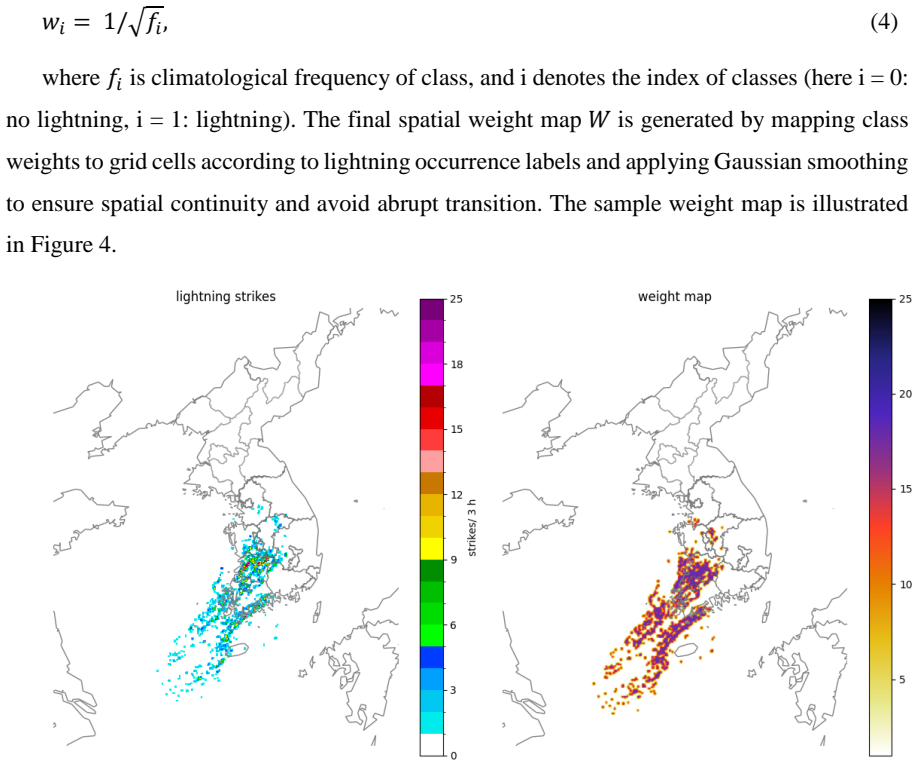
The lightning-informed loss-weighting strategy, which creates a spatial weight map from observed lightning strikes and multiplies it element-wise into the MSE loss to emphasize convective areas during training.
If this is right
- The framework outperforms standard AI benchmarks and conventional NWP models at intense rainfall thresholds such as 40 mm/6 h.
- Lightning occurrence predictions exceed the skill of conventional lightning parameterization and instability-index-based methods.
- Integrating physical event indicators into the loss formulation guides the model to learn meteorological signatures of deep convection.
- The multi-task setup with shared backbone enables joint improvement across precipitation amount, probability, and lightning without separate models.
Where Pith is reading between the lines
- The same weighting idea could be applied to other rare-event targets by substituting different physical indicators for lightning strikes.
- Loss redesign of this type might serve as a lightweight complement to more complex architectural changes in operational forecasting systems.
- The method raises the question of whether similar event-aware weighting would transfer to other geographic domains or seasons with different convective regimes.
Load-bearing premise
That a spatial weight map derived solely from observed lightning strikes can be multiplied element-wise into the MSE loss to force the model to prioritize convective regions without causing overfitting or degrading performance on non-convective areas.
What would settle it
Train identical models with and without the lightning-derived weighting on the same data and check whether the weighted version fails to show higher skill scores at the 40 mm/6 h rainfall threshold or lower lightning prediction skill than the unweighted version.
Figures
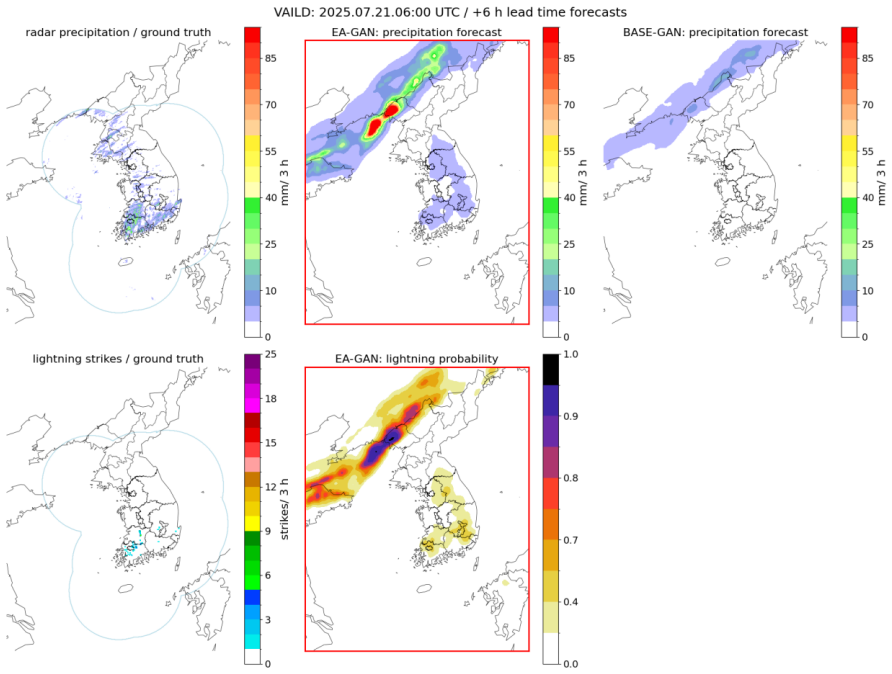
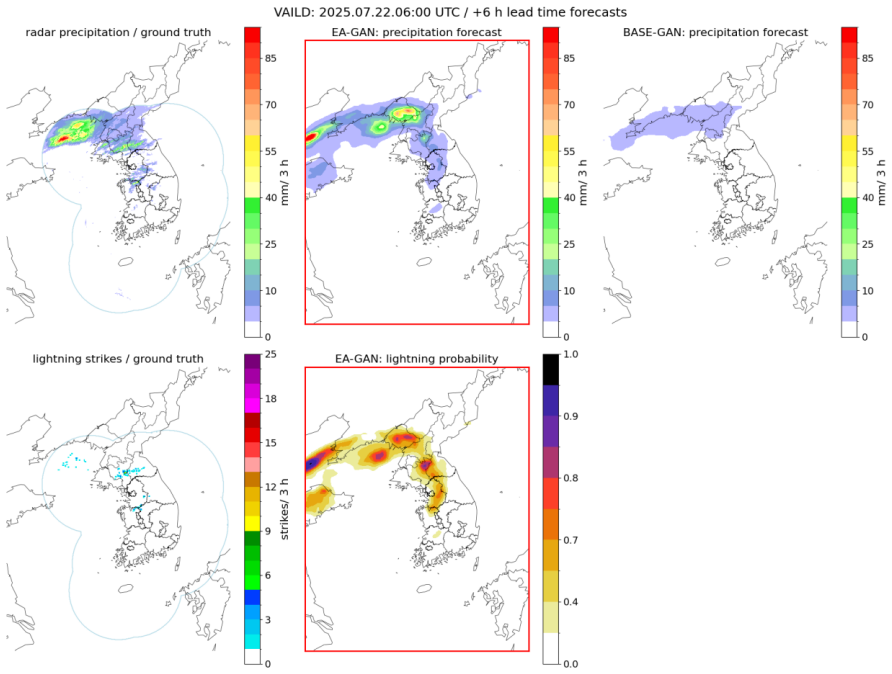
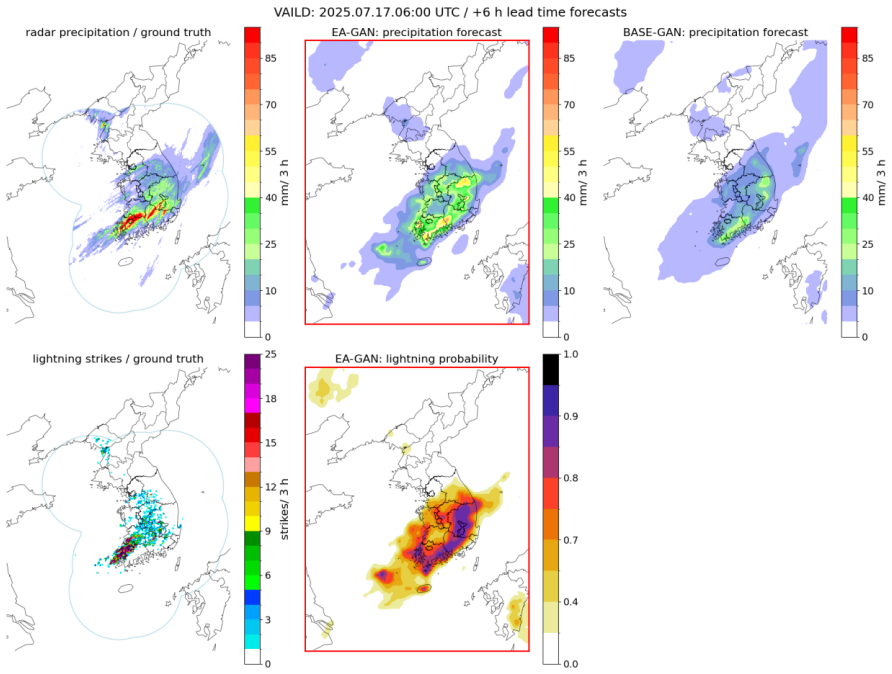

read the original abstract
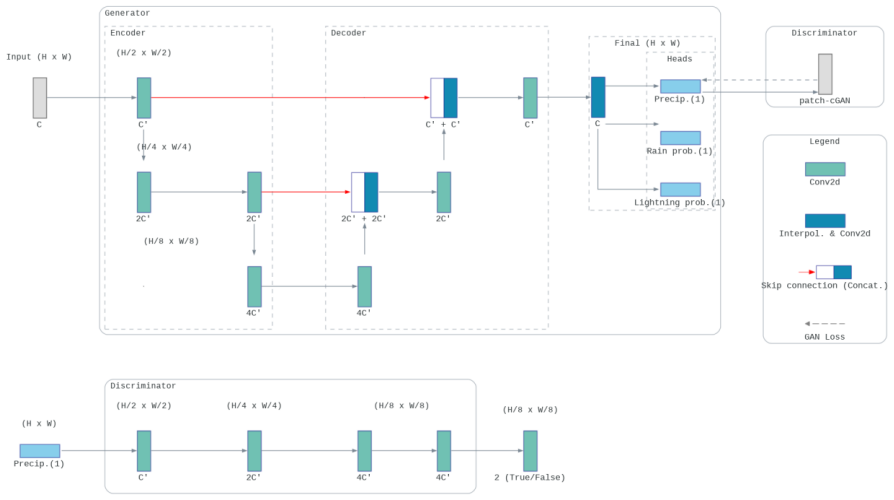
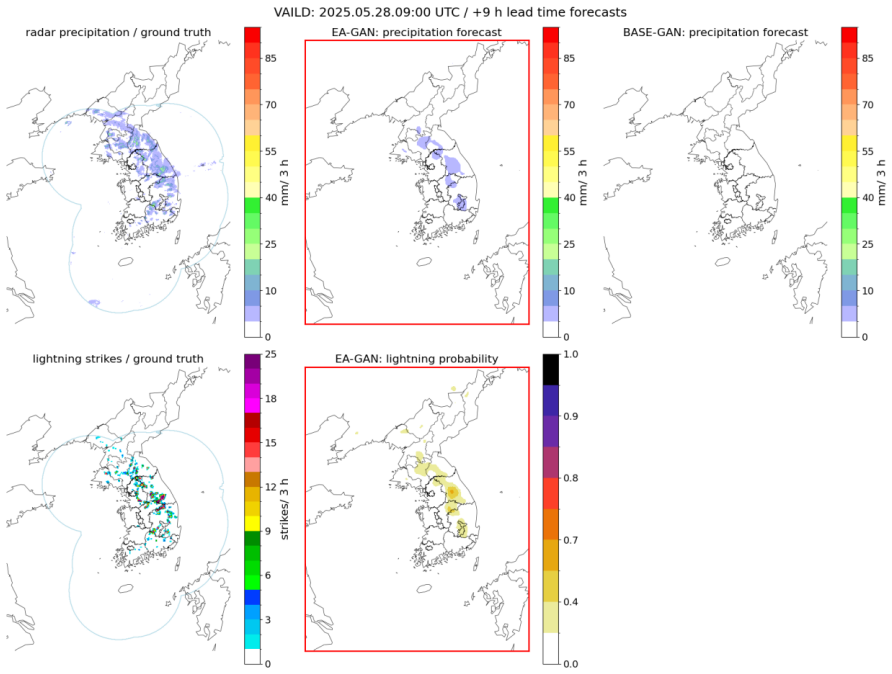
Accurate forecasting of high-impact weather, specifically extreme precipitation and lightning, remains a significant challenge in numerical weather prediction (NWP) due to the complexity of atmospheric microphysics. While deep-learning models have shown promise in large-scale forecasting, they often suffer from systematic under-prediction of rare, high-intensity events and localized convective showers when optimized with conventional loss functions like Mean Squared Error (MSE). This study proposes an Event-Aware multi-task deep-learning post-processing framework designed to improve the representation of convective processes by leveraging lightning observations. The model jointly predicts precipitation amount, rainfall probability, and lightning occurrence using a shared-backbone Patch-cGAN (Conditional Generative Adversarial Network) architecture. To address the rare event problem, we introduce a lightning-informed loss-weighting strategy that element-wisely multiplies the MSE component by a spatial weight map derived from observed lightning strikes, forcing the model to prioritize accuracy in convective regions during training. Evaluations conducted over the Korean Peninsula during the 2025 Summer demonstrate that our framework outperforms standard AI benchmarks and conventional NWP models, particularly at intense rainfall thresholds (40 mm/6 h). Furthermore, the model exhibits superior skill in predicting lightning compared to conventional lightning parameterization and instability-index-based methods. These results indicate that integrating physical event indicators into the loss formulation effectively guides models to learn the meteorological signatures of deep convection, offering a pathway toward more reliable extreme weather forecasting.
Editorial analysis
A structured set of objections, weighed in public.
Referee Report
Summary. The manuscript introduces an Event-Aware multi-task Patch-cGAN post-processing framework that jointly predicts precipitation amount, rainfall probability, and lightning occurrence. It proposes a lightning-informed loss-weighting strategy that element-wise multiplies a spatial weight map (derived from observed lightning strikes) into the MSE loss term to prioritize convective regions. The central claim is that this framework outperforms standard AI benchmarks and conventional NWP models at intense rainfall thresholds (40 mm/6 h) and shows superior lightning prediction skill over parameterization and instability-index methods, based on evaluations over the Korean Peninsula in summer 2025.
Significance. If the performance gains can be isolated to the proposed loss design and supported by quantitative metrics with statistical controls, the work would demonstrate a concrete way to embed physical event indicators (lightning strikes) directly into DL training objectives for better representation of rare convective extremes. This could be relevant for operational post-processing pipelines where conventional losses under-predict high-impact events.
major comments (3)
- [Abstract] Abstract and Evaluation section: The central performance claims (outperformance at 40 mm/6 h and superior lightning skill) are stated without any quantitative scores, error bars, baseline definitions, or statistical significance tests. This absence makes the claims unverifiable and prevents assessment of whether the reported deltas are practically meaningful.
- [Method and Evaluation] The manuscript attributes superior skill at intense rainfall and lightning to the lightning-informed loss-weighting strategy, yet provides no ablation that holds the Patch-cGAN backbone, multi-task heads, and training data fixed while comparing the weighted MSE against uniform MSE (or alternative weightings). Without this isolation, the performance delta cannot be attributed to the proposed loss design rather than the architecture or joint prediction setup.
- [Loss formulation] The spatial weight map is constructed from observed lightning strikes and multiplied element-wise into the MSE loss. No analysis is supplied on potential overfitting to convective regions, degradation on non-convective areas, or sensitivity of results to the exact construction of the weight map (e.g., temporal aggregation or normalization choices).
minor comments (1)
- [Abstract] The abstract refers to 'standard AI benchmarks' and 'conventional NWP models' without naming the specific models or providing references to their implementations.
Simulated Author's Rebuttal
We thank the referee for the constructive and detailed comments, which highlight important aspects of clarity, attribution, and robustness. We address each major comment below and commit to revisions that strengthen the manuscript without altering its core contributions.
read point-by-point responses
-
Referee: [Abstract] Abstract and Evaluation section: The central performance claims (outperformance at 40 mm/6 h and superior lightning skill) are stated without any quantitative scores, error bars, baseline definitions, or statistical significance tests. This absence makes the claims unverifiable and prevents assessment of whether the reported deltas are practically meaningful.
Authors: We agree that the absence of specific quantitative metrics in the abstract and evaluation section limits verifiability. In the revised manuscript we will insert the key scores (e.g., CSI, POD, and FAR at the 40 mm/6 h threshold), standard-error bars from ensemble runs, explicit baseline definitions (standard Patch-cGAN and NWP), and results of paired statistical tests. revision: yes
-
Referee: [Method and Evaluation] The manuscript attributes superior skill at intense rainfall and lightning to the lightning-informed loss-weighting strategy, yet provides no ablation that holds the Patch-cGAN backbone, multi-task heads, and training data fixed while comparing the weighted MSE against uniform MSE (or alternative weightings). Without this isolation, the performance delta cannot be attributed to the proposed loss design rather than the architecture or joint prediction setup.
Authors: The referee is correct that an ablation isolating the loss-weighting is required. We will add a controlled ablation experiment that keeps the Patch-cGAN architecture, multi-task heads, and training data identical while replacing the lightning-informed weighting with uniform MSE; the resulting skill differences will be reported to support attribution to the proposed loss design. revision: yes
-
Referee: [Loss formulation] The spatial weight map is constructed from observed lightning strikes and multiplied element-wise into the MSE loss. No analysis is supplied on potential overfitting to convective regions, degradation on non-convective areas, or sensitivity of results to the exact construction of the weight map (e.g., temporal aggregation or normalization choices).
Authors: We acknowledge the lack of supporting analysis on the weight map. The revision will include (i) separate skill scores for convective versus non-convective grid cells to check for degradation outside weighted regions and (ii) sensitivity experiments that vary the temporal aggregation window and normalization of the lightning-derived weights, with results presented in a new supplementary figure. revision: yes
Circularity Check
No significant circularity detected
full rationale
The paper proposes an empirical loss-weighting method (lightning-strike spatial map multiplied element-wise into MSE) inside a Patch-cGAN multi-task model and reports performance gains from direct evaluation against external benchmarks on 2025 Korean Peninsula data. No equations, derivations, or self-citations reduce any claimed result to a fitted quantity defined by the same inputs; the weighting map is constructed from independent observations, and superiority at 40 mm/6 h thresholds is presented as an outcome of training and testing rather than a definitional or self-referential reduction. The central claims rest on external comparisons, satisfying the criteria for a self-contained, non-circular derivation chain.
Axiom & Free-Parameter Ledger
Reference graph
Works this paper leans on
-
[1]
Betz, H. D., K. Schmidt, P. Laroche, P. Blanchet, W. P. Oettinger, E. Defer, Z. Dziewit, and J. Konarski, 2009: LINET—An international lightning detection network in Europe. Atmos. Res., 91, 564–573, https://doi.org/10.1016/j.atmosres.2008.06.012
-
[2]
Bright, D. R., M. S. Wandishin, R. E. Jewell, and S. J. Weiss, 2004: A physically based parameter for lightning prediction and its calibration in ensemble forecasts. Preprints, 22nd Conf. on Severe Local Storms, Hyannis, MA, Amer. Meteor. Soc., 4.3. [Available online at http://ams.confex.com/ams/pdfpapers/84173.pdf.]
2004
-
[3]
In: Proceedings of the IEEE/CVF Conference on Computer Vision and Pattern Recognition, pp
Cui, Y., M. Jia, T.-Y. Lin, Y. Song, and S. Belongie, 2019: Class-Balanced Loss Based on Effective Number of Samples. 2019 IEEE/CVF Conference on Computer Vision and Pattern Recognition (CVPR), 9260–9269, https://doi.org/10.1109/CVPR.2019.00949
-
[4]
Deierling, W., and W. A. Petersen, 2008: Total lightning activity as an indicator of updraft characteristics. J. Geophys. Res.:Atmos., 113, https://doi.org/10.1029/2007JD009598
-
[5]
Farr, T. G., P. A. Rosen, E. Caro, R. Crippen, R. Duren, S. Hensley, M. Kobrick, M. Paller, E. Rodriguez, L. Roth, D. Seal, S. Shaffer, J. Shimada, J. Umland, M. Werner, M. Oskin, D. Burbank, and D. Alsdorf, 2007: The Shuttle Radar Topography Mission. Rev. Geophys., 45, https://doi.org/10.1029/2005RG000183
-
[6]
Communications of the ACM63(11), 139–144 (2020),https://doi.org/10.1145/3422622
Goodfellow, I., J. Pouget-Abadie, M. Mirza, B. Xu, D. Warde-Farley, S. Ozair, A. Courville, and Y. Bengio, 2020: Generative adversarial networks. Commun. ACM, 63, 139–144, https://doi.org/10.1145/3422622. 34 This Work has been submitted to Artificial Intelligence for the Earth Systems. Copyright in this Work may be transferred without further notice
-
[7]
Atmospheric Research , author =
Schultz, M. Bateman, E. McCaul, and G. Stano, 2013: The GOES-R Geostationary Lightning Mapper (GLM). Atmos. Res., 125–126, 34–49, https://doi.org/10.1016/j.atmosres.2013.01.006
-
[8]
Laser Scintillation Measurements of the Temperature Spectrum in the Atmospheric Surface Layer
Hamill, T. M., 1999: Hypothesis tests for evaluating numerical precipitation forecasts. Wea. Forecasting, 14, 155–167, https://doi.org/10.1175/1520- 0434(1999)014<0155:HTFENP>2.0.CO;2
-
[9]
Harris, L., A. T. T. McRae, M. Chantry, P. D. Dueben, and T. N. Palmer, 2022: A Generative Deep Learning Approach to Stochastic Downscaling of Precipitation Forecasts. Journal of Advances in Modeling Earth Systems, 14, e2022MS003120, https://doi.org/10.1029/2022MS003120
-
[10]
Peubey, R. Radu, and D. Schepers, 2020: The ERA5 global reanalysis. Quart. J. Roy. Meteor. Soc., 146, 1999–2049, https://doi.org/10.1002/qj.3803
-
[11]
Denoising Diffusion Probabilistic Models
Ho, J., A. Jain, and P. Abbeel, 2020: Denoising diffusion probabilistic models. Proceedings of the 34th International Conference on Neural Information Processing Systems, NIPS ’20, Vancouver, BC, Canada, Curran Associates Inc., https://doi.org/10.48550/arXiv.2006.11239
work page internal anchor Pith review Pith/arXiv arXiv doi:10.48550/arxiv.2006.11239 2020
-
[12]
Isola, P., J.-Y. Zhu, T. Zhou, and A. A. Efros, 2017: Image-to-image translation with conditional adversarial networks. 2017 IEEE Conference on Computer Vision and Pattern Recognition (CVPR), 5967-5976, https://doi.org/10.1109/CVPR.2017.632
-
[13]
Learning skillful medium-range global weather forecasting , volume =
Pritzel, S. Mohamed, and P. Battaglia, 2023: GraphCast: Learning skillful medium-range global weather forecasting. Science, 382, 1416–1421, https://doi.org/10.1126/science.adi2336
-
[14]
Lang, S., M. Alexe, M. Chantry, J. Dramsch, F. Pinault, B. Raoult, M. C. A. Clare, C. Lessig, M. M.-Gerber, L. Magnusson, Z. B. Bouallègue, A. P. Nemesio, P. D. Dueben, A. Brown, F. Pappenberger, and F. Rabier, 2024: AIFS -- ECMWF’s data-driven forecasting system. arXiv, https://doi.org/10.48550/arXiv.2406.01465. 35 This Work has been submitted to Artific...
-
[15]
Lee, C., H. Yang, and B. Kim, 2025: Improving a post-processing model for QPF with a deep-learning approach: Learning a precipitation physics from the high-resolution real world observation. arXiv, https://doi.org/10.48550/arXiv.2506.03842
-
[16]
Lopez, P., 2016: A Lightning Parameterization for the ECMWF Integrated Forecasting System. Mon. Wea. Rev., 144, 3057–3075, https://doi.org/10.1175/MWR-D-16-0026.1
-
[17]
Decoupled Weight Decay Regularization
Loshchilov, I., and F. Hutter, 2017: Decoupled Weight Decay Regularization. International Conference on Learning Representations, https://doi.org/10.48550/arXiv.1711.05101
work page internal anchor Pith review Pith/arXiv arXiv doi:10.48550/arxiv.1711.05101 2017
-
[18]
Ma, Z., C. Zhao, J. Gong, J. Zhang, Z. Li, J. Sun, Y. Liu, J. Chen, and Q. Jiang, 2021: Spin- up characteristics with three types of initial fields and the restart effects on forecast accuracy in the GRAPES global forecast system. Geosci. Model Dev., 14, 205–221, https://doi.org/10.5194/gmd-14-205-2021
-
[19]
McClung, B., A. McGovern, A. J. Hill, D. Schvartzman, and M. Stock, 2026: BoltCast: Medium-Range Lightning Prediction with Neural and Long Short-Term Memory Networks. Artif. Intell. Earth Syst., 5, 250044, https://doi.org/10.1175/AIES-D-25- 0044.1
-
[20]
Marzban, C., S. Sandgathe, and E. Kalnay, 2006: MOS, perfect prog, and reanalysis. Mon. Wea. Rev., 134, 657–663, https://doi.org/10.1175/MWR3088.1
-
[21]
URL https://egusphere.copernicus
Magnusson, G. Mertes, F. Pinault, B. Raoult, P. d. Rosnay, R. Forbes, and M. Chantry, 2025: An update to ECMWF's machine-learned weather forecast model AIFS, EGUsphere [preprint], 2025, 1–23, https://doi.org/10.5194/egusphere-2025-4716
-
[22]
Oh, Y.-A., H.-L. Kim, and M.-K. Suk, 2020: Clutter elimination algorithm for non- precipitation echo of radar data considering meteorological and observational properties in polarimetric measurements. Remote Sens., 12, https://doi.org/10.3390/rs12223790
-
[23]
Rasp, S., P. D. Dueben, S. Scher, J. A. Weyn, S. Mouatadid, and N. Thuerey, 2020: WeatherBench: A benchmark data set for data-driven weather forecasting. J. Adv. Model. Earth Syst., 12, e2020MS002203, https://doi.org/10.1029/2020MS002203. 36 This Work has been submitted to Artificial Intelligence for the Earth Systems. Copyright in this Work may be transf...
-
[24]
Bromberg, J. Sisk, L. Barrington, A. Bell, and F. Sha, 2023: WeatherBench 2: A benchmark for the next generation of data-driven global weather models. J. Adv. Model. Earth Syst., 16, e2023MS004019, https://doi.org/10.1029/2023MS004019
-
[25]
J., 2009: Visualizing Multiple Measures of Forecast Quality
Roebber, P. J., 2009: Visualizing Multiple Measures of Forecast Quality. Wea. Forecasting, 24, 601–608, https://doi.org/10.1175/2008WAF2222159.1
-
[26]
Challenges in Survey Re- search
Ronneberger, O., P. Fischer, and T. Brox, 2015: U-Net: Convolutional networks for biomedical image segmentation. Medical Image Computing and Computer-Assisted Intervention – MICCAI 2015, N. Navab, J. Hornegger, W.M. Wells, and A.F. Frangi, Eds., Cham, Springer International Publishing, 234–241, https://doi.org/10.1007/978-3- 319-24574-4_28
-
[27]
J., 2007: Parameterization Schemes: Keys to Understanding Numerical Weather Prediction Models
Stensrud, D. J., 2007: Parameterization Schemes: Keys to Understanding Numerical Weather Prediction Models. Cambridge University Press, https://doi.org/10.1017/CBO9780511812590
-
[28]
Vicens-Miquel, M., A. McGovern, A. J. Hill, E. Foufoula-Georgiou, C. Guilloteau, and S. S. P. Shen, 2025: A Diffusion-Based Framework for High-Resolution Precipitation Forecasting over CONUS. arXiv, https://doi.org/10.48550/arXiv.2512.09059
-
[29]
S., 1995: Statistical Methods in the Atmospheric Sciences: An Introduction
Wilks, D. S., 1995: Statistical Methods in the Atmospheric Sciences: An Introduction. Academic Press
1995
-
[30]
Zhou, K. H., J. S. Sun, Y. G. Zheng, and Y. T. Zhang, 2022: Quantitative precipitation forecast experiment based on basic NWP variables using deep learning. Adv. Atmos. Sci., 39, 1472–1486, https://doi.org/10.1007/s00376-021-1207-7
discussion (0)
Sign in with ORCID, Apple, or X to comment. Anyone can read and Pith papers without signing in.