Spin modulations in the Rashba-Hubbard chain -- a tensor network study
Pith reviewed 2026-06-25 19:40 UTC · model grok-4.3
The pith
A site-dependent spin rotation removes the Rashba term from the open Hubbard chain Hamiltonian while rotating the local spin basis to produce linear-order sidebands in the spin structure factor.
A machine-rendered reading of the paper's core claim, the machinery that carries it, and where it could break.
Core claim
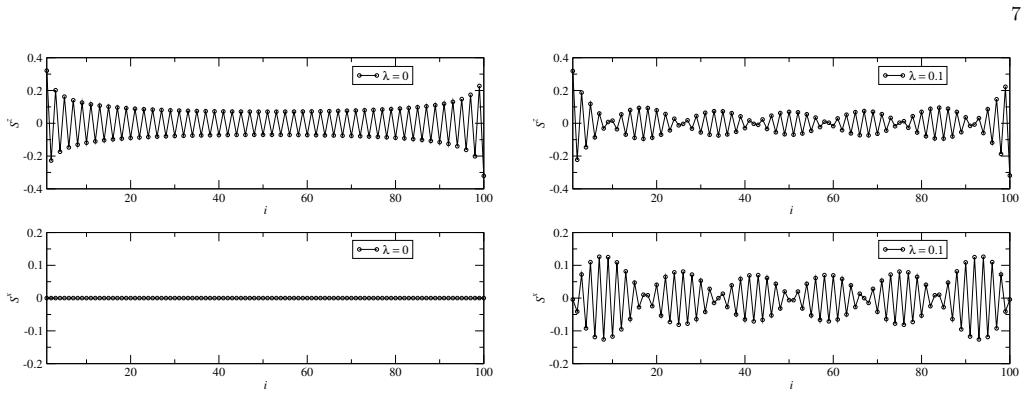
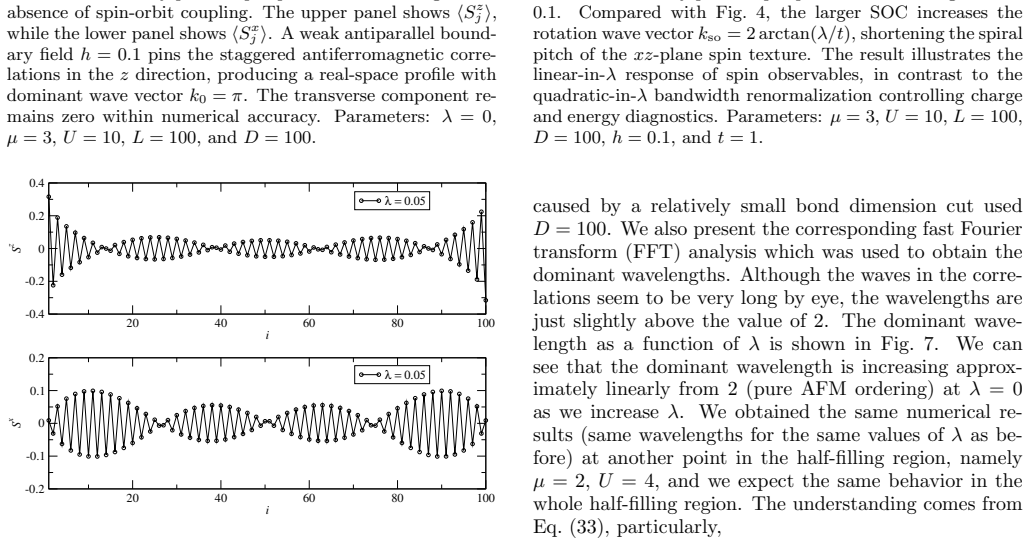
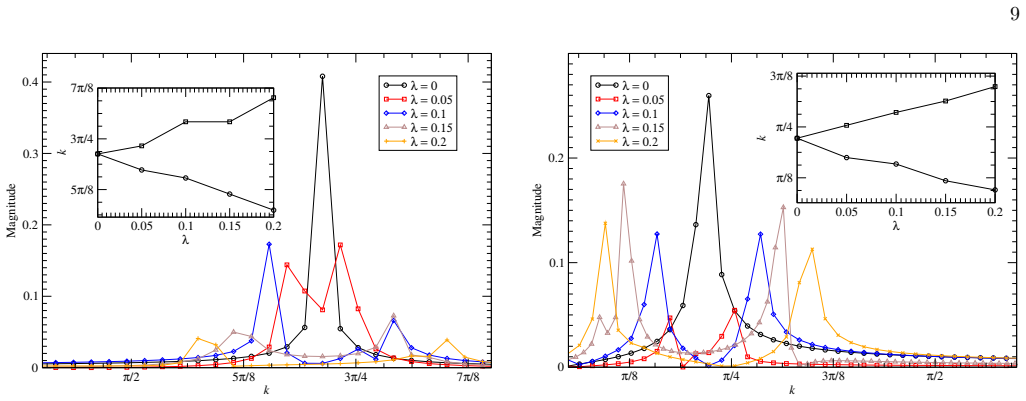
For open boundary conditions, a site-dependent spin rotation maps the Rashba-Hubbard model with hopping t and Rashba strength λ onto the ordinary Hubbard chain with renormalized hopping t_λ = sqrt(t² + λ²); consequently spin correlations respond already at linear order because the local spin basis is rotated by the wave vector k_so = 2 arctan(λ/t), producing sidebands at k0 ± k_so in the spin structure factor.
What carries the argument
Site-dependent spin rotation that removes the Rashba term from the Hamiltonian but rotates the local spin basis for correlation functions.
If this is right
- Charge and energy diagnostics respond only through quadratic bandwidth renormalization.
- The spin structure factor develops sidebands at k0 ± k_so folded into the open-chain Brillouin zone.
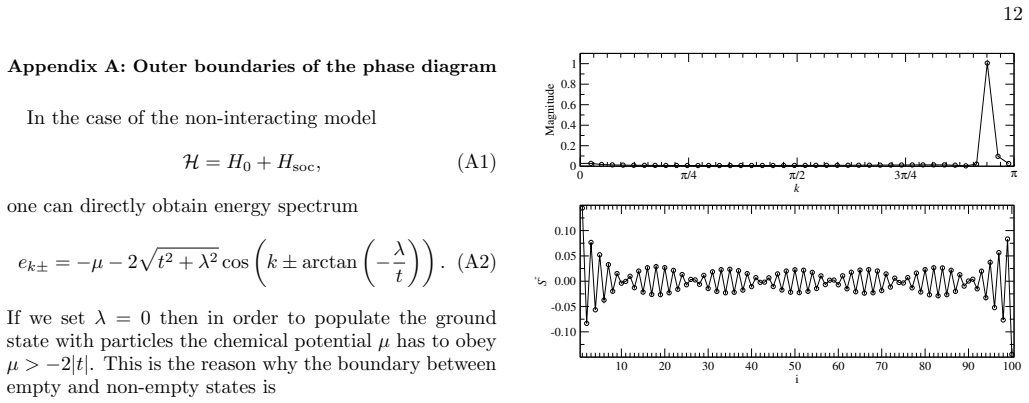
- At half filling the two sidebands coincide on a single in-plane spin spiral with wave vector π - k_so.
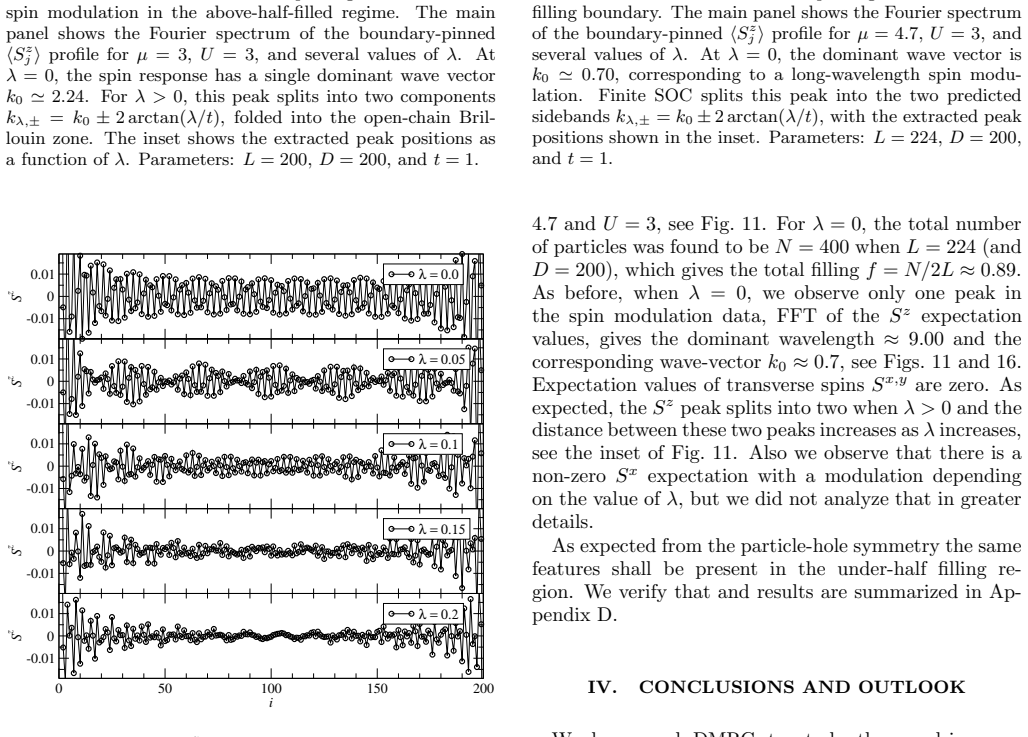
- Away from half filling the incommensurate Hubbard response splits into two distinct spin-orbit-shifted components that produce a real-space beating pattern.
Where Pith is reading between the lines
- The exact mapping supplies a controlled benchmark for tensor-network studies of ladders and multiorbital chains where uniform spin-orbit coupling can no longer be gauged away.
- Similar local rotations may be testable in ring geometries or proximitized wires by comparing spin and charge response functions.
- The linear-order spin modulation suggests that spin-structure-factor measurements could detect weak Rashba coupling even when charge transport shows only small quadratic corrections.
Load-bearing premise
DMRG on finite open chains accurately resolves the long-distance spin structure factor without significant finite-size or truncation artifacts obscuring the predicted linear-order sidebands.
What would settle it
Absence of k0 ± k_so sidebands in the spin structure factor for small λ/t on large open chains, or observation that spin correlations change only quadratically rather than linearly with λ.
Figures
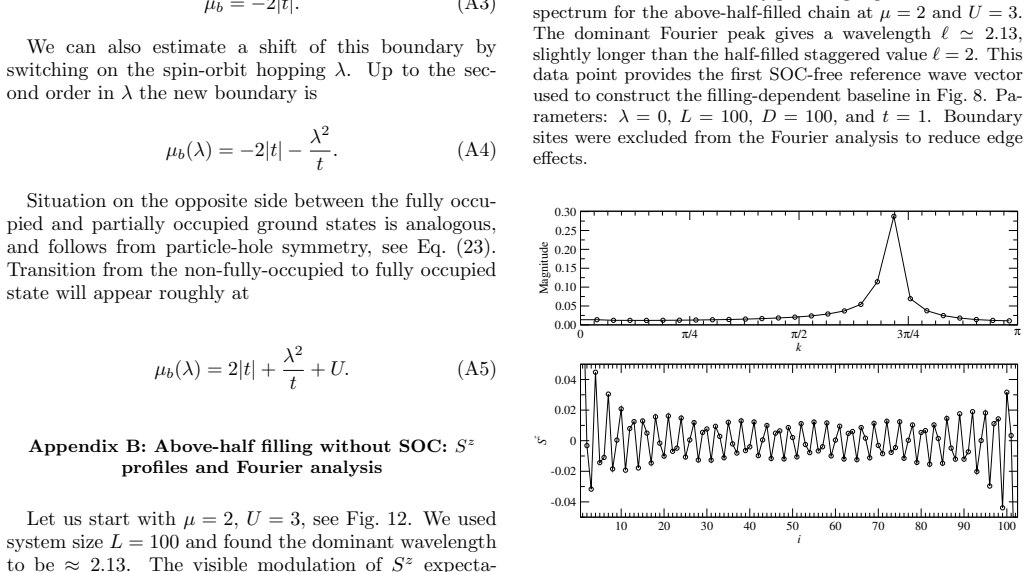
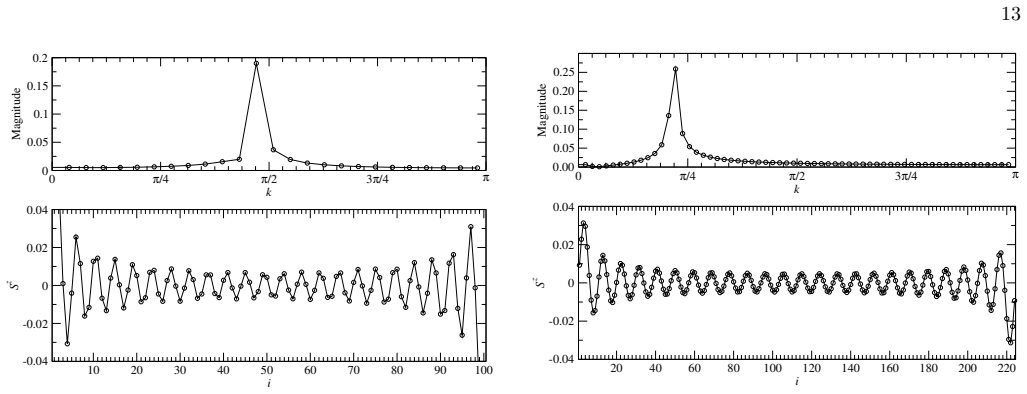
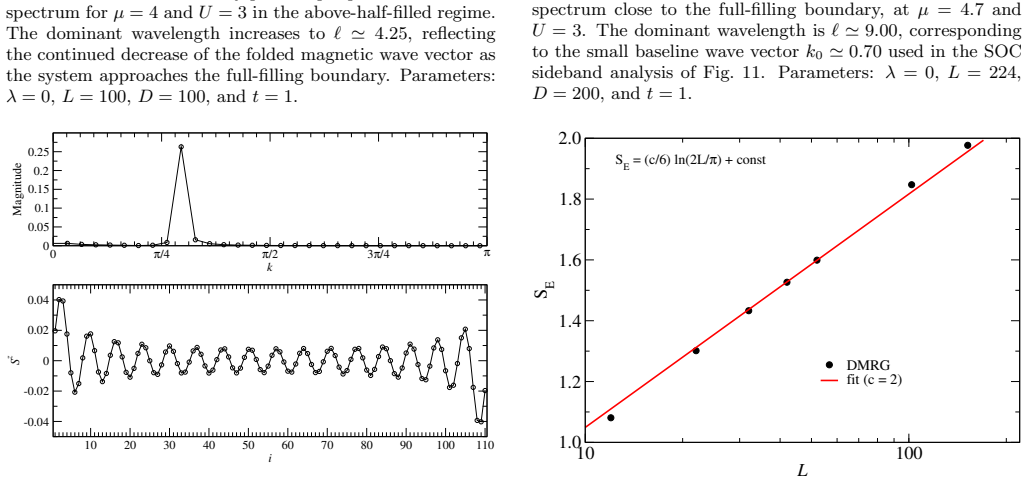
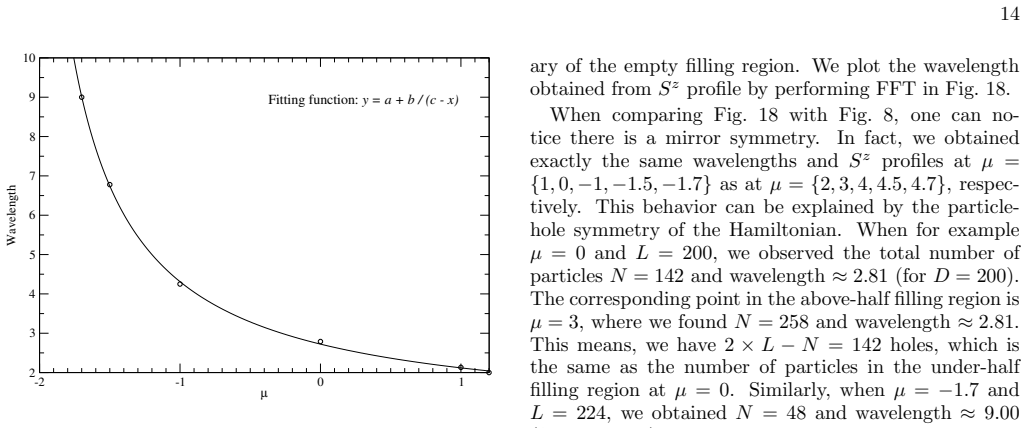
read the original abstract
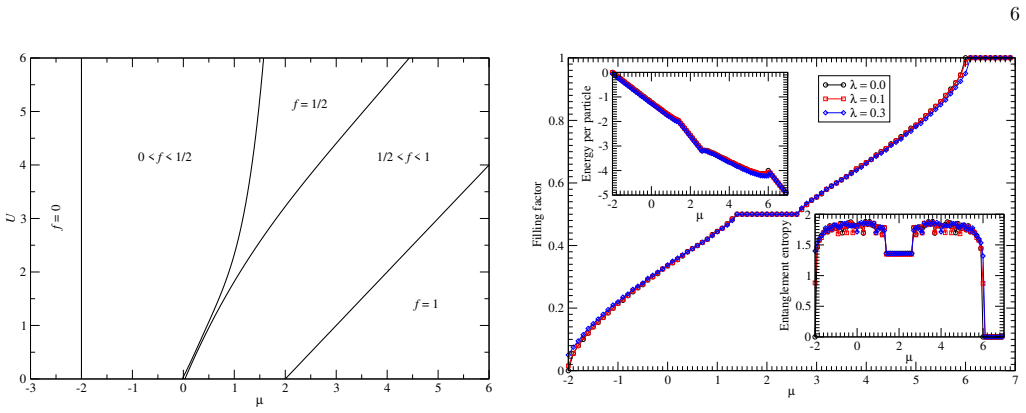
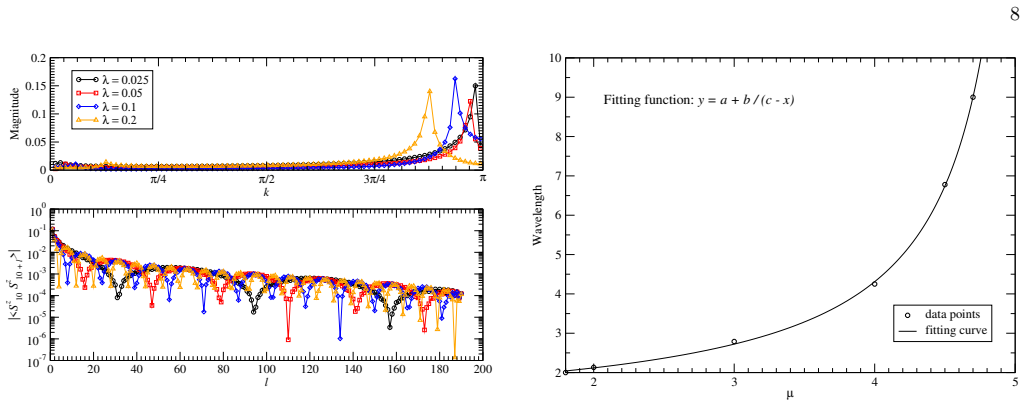
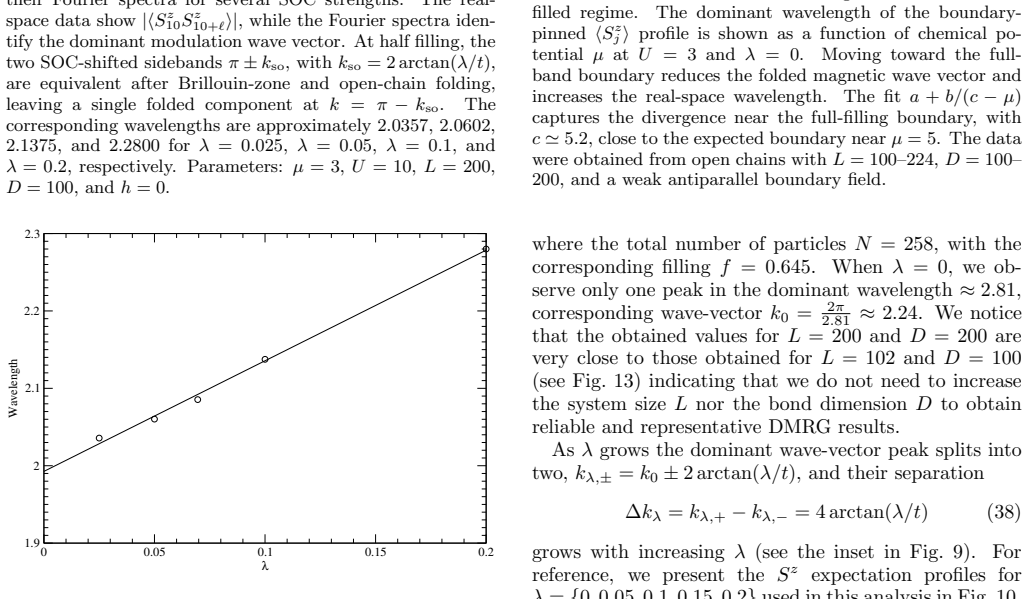
Uniform spin-orbit coupling in an open single-band Hubbard chain is an exactly removable \(SU(2)\) gauge field at the Hamiltonian level, but not at the level of laboratory-frame spin correlations. We study this separation using density matrix renormalization group calculations for the repulsive one-dimensional Rashba-Hubbard chain. For open boundary conditions, a site-dependent spin rotation maps the model with hopping \(t\) and Rashba spin-orbit strength \(\lambda\) onto the ordinary Hubbard chain with renormalized hopping \(t_\lambda=\sqrt{t^2+\lambda^2}\). Consequently, charge and energy diagnostics are affected only through the bandwidth renormalization, which is quadratic in weak \(\lambda/t\). Spin correlations, however, respond already at linear order because the same transformation rotates the local spin basis by the wave vector \(k_{\rm so}=2\arctan(\lambda/t)\). We use DMRG to verify this observable consequence across the filling diagram of finite open chains. The filling structure follows the gauge-equivalent Hubbard model, whereas the spin structure factor shows the predicted spin-orbit sidebands. A dominant Hubbard-chain magnetic wave vector \(k_0\) is transformed into components at \(k_0\pm k_{\rm so}\), folded into the open-chain Brillouin zone. At half filling, where \(k_0=\pi\), the two sidebands fold onto a single, in-plane, spin spiral wave with \(k=\pi-k_{\rm so}<\pi\). Away from half filling, the incommensurate Hubbard spin response splits into two distinct spin-orbit-shifted components, producing a real-space beating pattern. Our results provide a filling-resolved tensor-network benchmark for the exactly removable limit of one-dimensional spin-orbit coupling, and establish a controlled reference point for ladders, multiorbital chains, rings, proximitized wires, and higher-dimensional Hubbard systems where spin-orbit coupling can no longer be gauged away.
Editorial analysis
A structured set of objections, weighed in public.
Referee Report
Summary. The paper claims that for the 1D Rashba-Hubbard model with open boundaries, a site-dependent SU(2) spin rotation exactly maps the Hamiltonian onto the ordinary Hubbard chain with renormalized hopping t_λ = sqrt(t² + λ²). Charge and energy observables are affected only at quadratic order in λ/t, while laboratory-frame spin correlations acquire a linear-order modulation: the local spin basis is rotated by k_so = 2 arctan(λ/t), shifting the dominant Hubbard wave vector k0 into sidebands at k0 ± k_so (folded into the open-chain Brillouin zone). DMRG calculations are presented to verify this filling dependence, with the spin structure factor exhibiting the predicted sidebands and real-space beating patterns.
Significance. If the numerical verification is robust, the work supplies a clean, parameter-free benchmark for the exactly gaugeable limit of 1D spin-orbit coupling in the Hubbard model. The analytic separation between Hamiltonian-level equivalence and observable spin response, together with the tensor-network confirmation across fillings, provides a controlled reference for extensions to ladders, rings, multiorbital chains, and higher-dimensional systems where SOC cannot be removed by a local rotation.
major comments (2)
- [Methods] Methods / Numerical details: No bond dimension, truncation-error threshold, discarded weight, or finite-size scaling with chain length L is reported. Because the central claim is that DMRG resolves the linear-order sidebands in the spin structure factor S(k) without boundary-induced or truncation artifacts, explicit convergence data are required to substantiate that the observed k0 ± k_so features are not numerical artifacts.
- [Results] Results on spin structure factor: The abstract states that sidebands appear across the filling diagram, yet without the controls above it remains unclear whether the open-chain Fourier transform (sensitive to discrete k-grid and boundary oscillations) reliably captures the long-distance modulations or whether insufficient entanglement cutoff could suppress or spuriously generate incommensurate peaks.
minor comments (1)
- [Theory] Notation: the definition k_so = 2 arctan(λ/t) is clear, but a brief remark on how the open-boundary Brillouin-zone folding is implemented numerically would aid reproducibility.
Simulated Author's Rebuttal
We thank the referee for the careful reading and constructive comments on our manuscript. We address each major point below and will revise the manuscript to incorporate the requested numerical details.
read point-by-point responses
-
Referee: [Methods] Methods / Numerical details: No bond dimension, truncation-error threshold, discarded weight, or finite-size scaling with chain length L is reported. Because the central claim is that DMRG resolves the linear-order sidebands in the spin structure factor S(k) without boundary-induced or truncation artifacts, explicit convergence data are required to substantiate that the observed k0 ± k_so features are not numerical artifacts.
Authors: We agree that explicit documentation of the DMRG parameters is necessary to substantiate the robustness of the sidebands. In the revised manuscript we will add a dedicated paragraph in the Methods section reporting the bond dimensions used (D = 1000–4000 depending on filling and L), truncation-error threshold (kept below 10^{-8}), discarded weight, and finite-size scaling performed for L = 24, 48, 96, and 128. We will also include supplementary figures demonstrating that the positions and relative intensities of the k0 ± k_so peaks remain stable under these variations. revision: yes
-
Referee: [Results] Results on spin structure factor: The abstract states that sidebands appear across the filling diagram, yet without the controls above it remains unclear whether the open-chain Fourier transform (sensitive to discrete k-grid and boundary oscillations) reliably captures the long-distance modulations or whether insufficient entanglement cutoff could suppress or spuriously generate incommensurate peaks.
Authors: We acknowledge the referee’s concern regarding possible artifacts in the open-chain Fourier transform. The revised version will clarify the discrete k-grid employed and will add real-space correlation plots together with structure-factor comparisons at multiple bond dimensions and system sizes. These data will show that the sidebands persist with increasing entanglement cutoff and are not generated or suppressed by boundary oscillations or truncation. revision: yes
Circularity Check
No significant circularity; analytic mapping is independent and verified numerically
full rationale
The paper states an exact site-dependent SU(2) rotation that removes the Rashba term for open boundaries, yielding t_λ = sqrt(t² + λ²) and k_so = 2 arctan(λ/t) as a direct consequence of the transformation. Charge diagnostics shift only quadratically while spin operators acquire the linear k_so shift, producing sidebands at k0 ± k_so. DMRG is then used as an external numerical check across fillings; no parameters are fitted to the target observables, no self-citation chain supports the mapping, and the structure-factor prediction is not equivalent to the input by construction. The derivation chain remains self-contained against external benchmarks.
Axiom & Free-Parameter Ledger
axioms (2)
- domain assumption Uniform Rashba spin-orbit coupling in an open 1D Hubbard chain is exactly removable by a site-dependent SU(2) spin rotation at the Hamiltonian level.
- domain assumption DMRG on finite open chains can resolve the momentum-space spin structure factor sufficiently to distinguish linear-order sidebands from the Hubbard background.
Reference graph
Works this paper leans on
-
[1]
Particle-hole symmetry On a bipartite lattice (including a chain), the particle– hole transformation P:c j,s 7→(−1) jc† j,s andc † j,s 7→(−1) jcj,s (19) maps nj,s =c † j,scj,s 7→1−n j,s, N= X j,s nj,s 7→2L−N, (20) and hence fillingf= N 2L 7→1−f. ApplyingPto theµ andUterms gives −µ X j,s nj,s +U X j nj,+nj,− 7→ −(U−µ) X j,s nj,s +U X j nj,+nj,− +L(U−2µ), (...
-
[2]
Gauging out
“Gauging out” spin-orbit coupling symmetry Defining the spin-dependent, lattice-site resolved, uni- tary transformationU θλ that acts on the ladder opera- tors [7]: Uθλ :c j,s =e −isjθλ ˜cj,s andc † j,s =e isjθλ ˜c† j,s ,(24) the original complex hopping stratifies tλ eisθλ c† j,scj+1,s =t λ eis(θλ−θλ) ˜c† j,s˜cj+1,s,(25) yielding H(t, λ, µ, U) =U θλ H(t ...
-
[3]
(24), applies to cre- ation and annihilation operators with spin projections alongyaxis
Spin beating and spiral phase Unitary transformationU θλ, Eq. (24), applies to cre- ation and annihilation operators with spin projections alongyaxis. Returning back to the original spin quan- tization axis alongzdirection, the spin operatorsS x,y,z j transform underU θλ as U † θλ Sx j Uθλ = cos(2jθλ)S x j + sin(2jθλ)S z j , U † θλ Sy j Uθλ =S y j , U † θ...
2021
-
[4]
Governale and U
M. Governale and U. Z¨ ulicke, Physical Review B66, 073311 (2002)
2002
-
[5]
Y. Oreg, G. Refael, and F. von Oppen, Physical Review Letters105, 177002 (2010)
2010
-
[6]
R. M. Lutchyn, J. D. Sau, and S. Das Sarma, Physical Review Letters105, 077001 (2010)
2010
-
[7]
Y.-J. Lin, K. Jim´ enez-Garc´ ıa, and I. B. Spielman, Nature 471, 83 (2011)
2011
-
[8]
Galitski and I
V. Galitski and I. B. Spielman, Nature494, 49 (2013)
2013
-
[9]
Zhai, Reports on Progress in Physics78, 026001 (2015)
H. Zhai, Reports on Progress in Physics78, 026001 (2015)
2015
-
[10]
T. A. Kaplan, Zeitschrift f¨ ur Physik B Condensed Matter 49, 313 (1983)
1983
-
[11]
Goth and F
F. Goth and F. F. Assaad, Physical Review B90, 195103 (2014)
2014
-
[12]
Fujimoto and N
S. Fujimoto and N. Kawakami, Phys. Rev. B48, 17406 (1993)
1993
-
[13]
E. H. Lieb and F. Y. Wu, Physical Review Letters20, 1445 (1968)
1968
-
[14]
F. H. L. Essler, H. Frahm, F. G¨ ohmann, A. Kl¨ umper, and V. E. Korepin,The One-Dimensional Hubbard Model (Cambridge University Press, 2005)
2005
-
[15]
Giamarchi,Quantum Physics in One Dimension, In- ternational Series of Monographs on Physics (Oxford University Press, Oxford, 2003)
T. Giamarchi,Quantum Physics in One Dimension, In- ternational Series of Monographs on Physics (Oxford University Press, Oxford, 2003)
2003
-
[16]
M. Boll, T. A. Hilker, G. Salomon, A. Omran, J. Ne- spolo, L. Pollet, I. Bloch, and C. Gross, Science353, 1257 (2016)
2016
-
[17]
T. A. Hilker, G. Salomon, F. Grusdt, A. Omran, M. Boll, E. Demler, I. Bloch, and C. Gross, Science357, 484 11 (2017)
2017
-
[18]
Brand, H
C. Brand, H. Pfn¨ ur, G. Landolt, B. Slomski, S. Muff, M. Fanciulli, J. H. Dil, P. K. Das, E. F. Schwier, H. Iwa- sawa, K. Shimada, and C. Tegenkamp, Nature Commu- nications6, 8118 (2015)
2015
-
[19]
Kaushal, J
N. Kaushal, J. Herbrych, A. Nocera, G. Alvarez, A. Moreo, F. A. Reboredo, and E. Dagotto, Physical Re- view B96, 155111 (2017)
2017
-
[20]
S. Li, N. Kaushal, Y. Wang, Y. Tang, G. Alvarez, A. No- cera, T. A. Maier, E. Dagotto, and S. Johnston, Physical Review B94, 235126 (2016)
2016
-
[21]
Kennedy, S
W. Kennedy, S. A. Sousa-J´ unior, N. C. Costa, and R. R. dos Santos, Physical Review B106, 165121 (2022)
2022
-
[22]
Kawano and C
M. Kawano and C. Hotta, Phys. Rev. B107, 045123 (2023)
2023
-
[23]
E. W. Hodt, J. A. Ouassou, and J. Linder, Phys. Rev. B 107, 224427 (2023)
2023
-
[24]
Mendieta-Alvarez, V
P. Mendieta-Alvarez, V. Bedoya, E. Medina, and D. Kochan, The Journal of Chemical Physics164, 164115 (2026)
2026
-
[25]
S. R. White, Physical Review Letters69, 2863 (1992)
1992
-
[26]
S. R. White, Physical Review B48, 10345 (1993)
1993
-
[27]
Schollw¨ ock, Annals of Physics326, 96 (2011)
U. Schollw¨ ock, Annals of Physics326, 96 (2011)
2011
-
[28]
Fishman, S
M. Fishman, S. R. White, and E. M. Stoudenmire, Sci- Post Physics Codebases , 4 (2022)
2022
-
[29]
P. Calabrese and J. Cardy, Journal of Statistical Me- chanics: Theory and Experiment2004, P06002 (2004), arXiv:hep-th/0405152 [hep-th]. 12 Appendix A: Outer boundaries of the phase diagram In the case of the non-interacting model H=H 0 +H soc,(A1) one can directly obtain energy spectrum ek± =−µ−2 p t2 +λ 2 cos k±arctan − λ t .(A2) If we setλ= 0 then in or...
Pith/arXiv arXiv 2004
discussion (0)
Sign in with ORCID, Apple, or X to comment. Anyone can read and Pith papers without signing in.