Glossy Silicate Clouds on the Scorched Dayside of LTT9779b
Pith reviewed 2026-06-25 19:00 UTC · model grok-4.3
The pith
Reflective silicate clouds on the dayside of LTT9779b explain its high albedo better than extreme metallicity.
A machine-rendered reading of the paper's core claim, the machinery that carries it, and where it could break.
Core claim
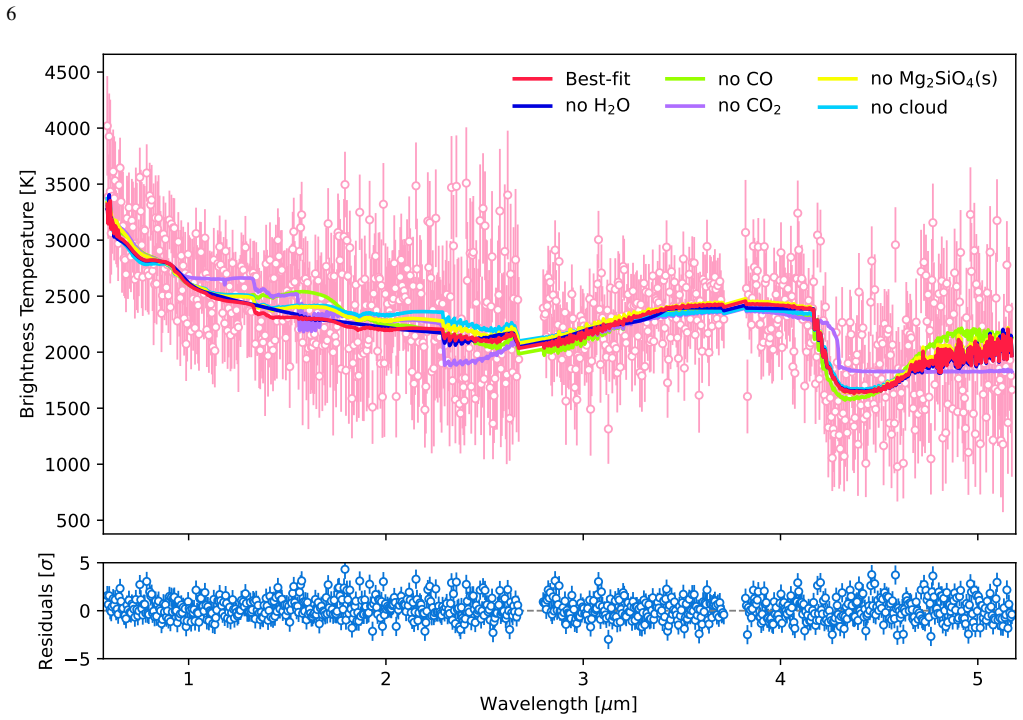
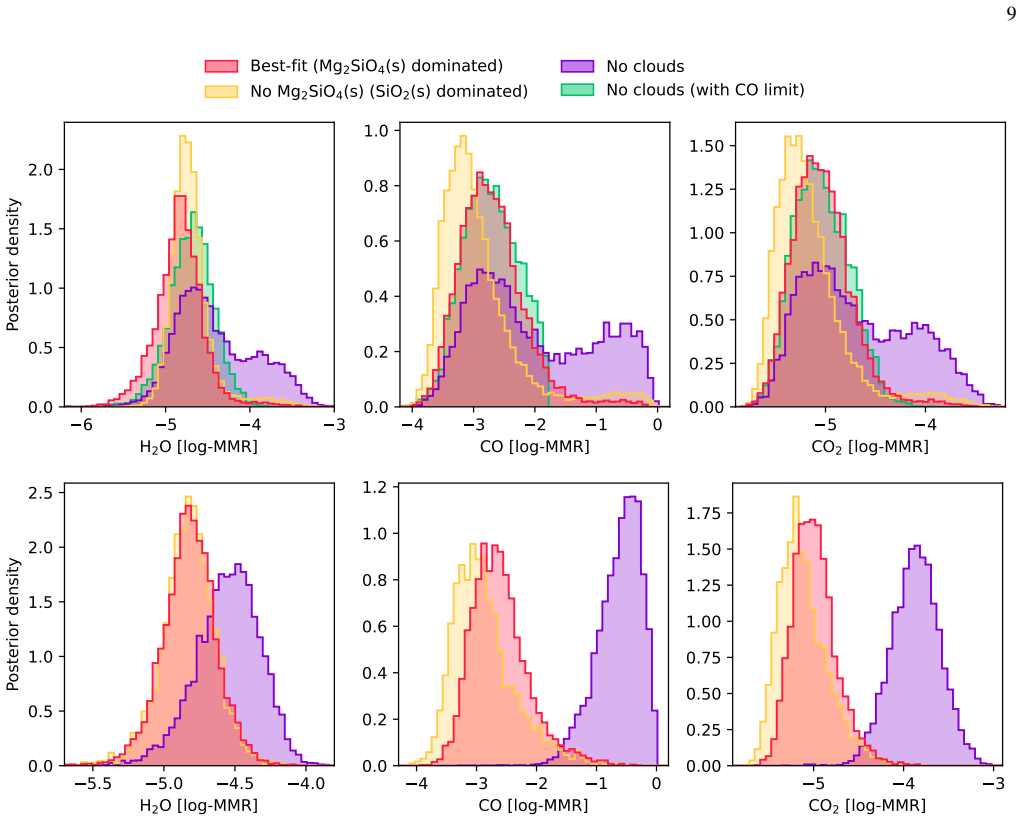
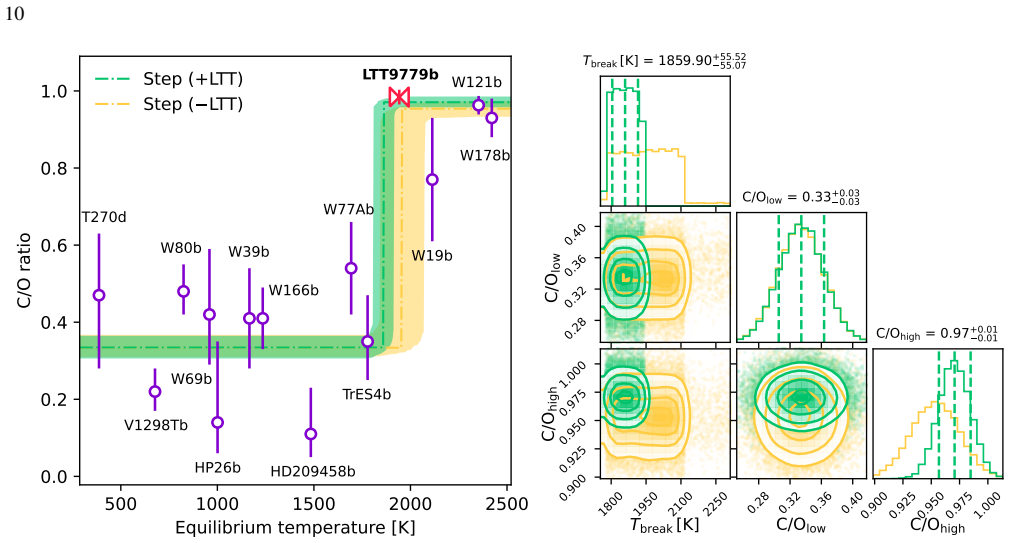
A comprehensive panchromatic analysis of LTT9779b's dayside atmosphere using JWST NIRISS and NIRSpec/G395H observations reveals a 3-to-5σ detection of dayside clouds with strong evidence for Mg2SiO4(s) condensation. This is the first statistically significant detection of clouds on the dayside of a Neptunian-mass exoplanet. The data show that a highly reflective cloud deck is the most likely explanation for the anomalously high optical albedo, rather than an extremely high-metallicity atmosphere. Robust detections of CO (~4.88σ) and CO2 (~8.76σ) are reported along with a C/O ratio of 0.984 ± 0.019.
What carries the argument
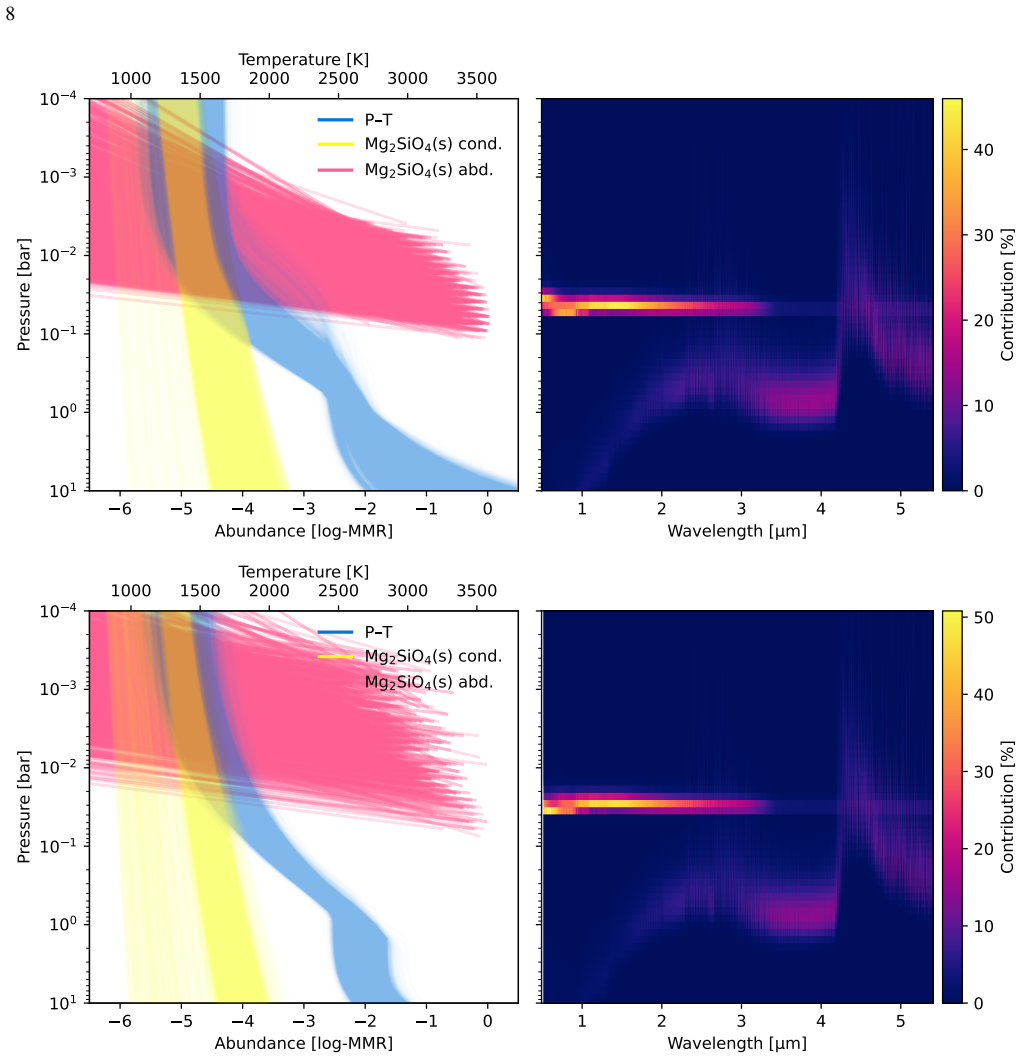
Atmospheric retrievals on panchromatic JWST spectra that separate the spectral signature of a reflective Mg2SiO4 cloud deck from metallicity effects.
If this is right
- A highly reflective cloud deck rather than extreme metallicity explains the high geometric albedo.
- CO and CO2 are present with detections at 4.88σ and 8.76σ respectively.
- The C/O ratio is 0.984 ± 0.019 and aligns with super-solar values seen in ultra-hot Jupiters.
- Silicate condensation occurs on the dayside of this Neptunian-mass planet.
Where Pith is reading between the lines
- Oxygen sequestration by clouds may drive high C/O ratios across many ultra-hot atmospheres.
- Similar JWST observations of other hot Neptunes could test whether dayside silicate clouds are common in this mass range.
Load-bearing premise
Atmospheric retrieval models can reliably separate the effects of a reflective cloud deck from those of extreme atmospheric metallicity without major degeneracies.
What would settle it
Higher-resolution or extended-wavelength spectra that allow an extreme-metallicity cloud-free model to fit the albedo and features as well as the cloud model would undermine the preference for silicate clouds.
Figures

read the original abstract
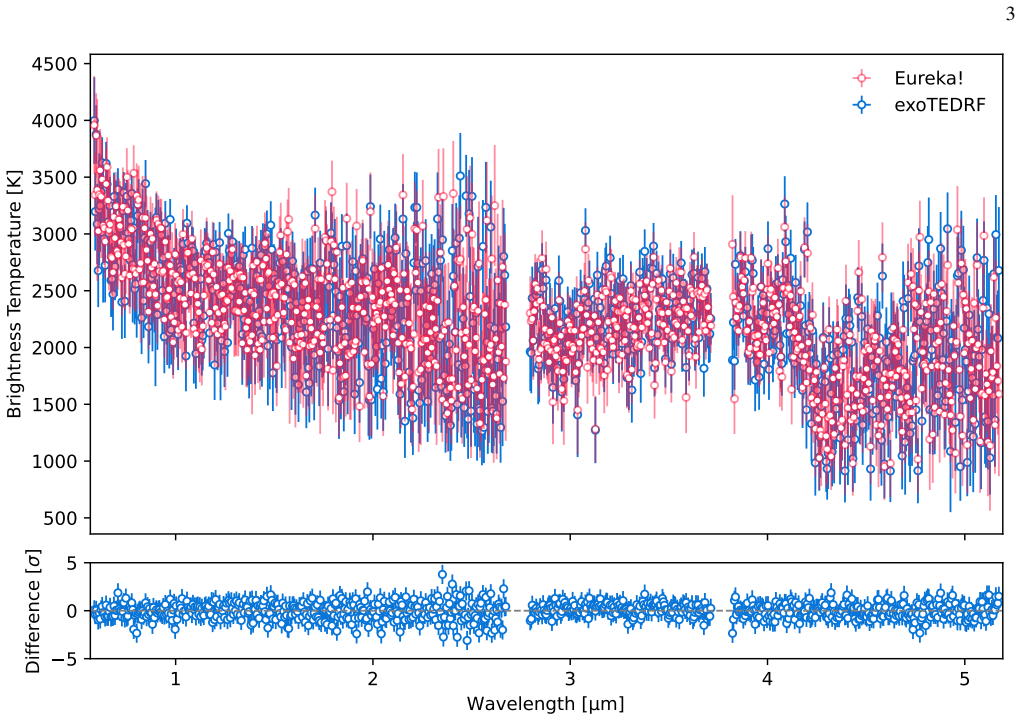
Discovered deep within the "Neptunian desert", LTT9779b remains the only known ultra-hot Neptune, prompting significant speculation regarding its unique formation and evolutionary history. Its exceptionally high geometric albedo has previously been attributed either to the presence of clouds or to an extremely metal-rich atmosphere. Here, we present a comprehensive panchromatic analysis of its dayside atmosphere using JWST NIRISS and NIRSpec/G395H observations to characterize its atmospheric structure and composition. Leveraging the exceptional signal-to-noise ratio (S/N) in the observed spectra, we report a 3-to-5$\sigma$ detection of dayside clouds, with strong evidence for Mg$_2$SiO$_4$(s) (silicate) condensation. This constitutes the first statistically significant detection of clouds on the dayside of a Neptunian-mass exoplanet. We demonstrate that a highly reflective cloud deck, rather than an extremely high-metallicity atmosphere, is the most likely explanation for the planet's anomalously high optical albedo. Furthermore, our atmospheric retrievals yield robust detections of both CO ($\sim$4.88$\sigma$) and CO$_2$ ($\sim$8.76$\sigma$), while providing tentative constraints on the H$_2$O abundance and upper limits on SiO, TiO, and VO. Finally, our analysis places a robust constraint on the C/O ratio of 0.984 $\pm$ 0.019. This aligns LTT9779b with other known ultra-hot Jupiters exhibiting super-solar C/O ratios, suggesting a broader trend driven by the sequestration of oxygen-bearing condensates in ultra-hot atmospheres.
Editorial analysis
A structured set of objections, weighed in public.
Referee Report
Summary. The manuscript analyzes JWST NIRISS and NIRSpec/G395H panchromatic dayside spectra of the ultra-hot Neptune LTT9779b. It reports a 3–5σ detection of reflective silicate clouds (Mg₂SiO₄(s)), argues that these clouds (rather than extreme metallicity) explain the planet’s high optical albedo, presents ~4.88σ and ~8.76σ detections of CO and CO₂ respectively, and derives a C/O ratio of 0.984 ± 0.019 that aligns with other ultra-hot giants.
Significance. If the retrieval results hold, the work supplies the first statistically significant dayside cloud detection for any Neptunian-mass exoplanet and resolves the albedo puzzle for an object in the Neptunian desert. The reported C/O constraint and its comparison to ultra-hot Jupiters constitute a falsifiable trend that can be tested with additional targets.
major comments (1)
- [Atmospheric retrieval section (methods and results)] The central claim that a reflective cloud deck is preferred over extreme metallicity rests on the atmospheric retrieval’s ability to break the degeneracy between cloud optical depth/albedo and atmospheric metallicity. The manuscript should include explicit posterior corner plots or Bayes-factor comparisons between the two families of models (with and without the Mg₂SiO₄ cloud deck) to demonstrate that the separation is not driven by prior volume or parameterization choices.
minor comments (2)
- The abstract states “strong evidence for Mg₂SiO₄(s) condensation” but does not quote the precise detection significance or the Bayes factor relative to other condensates; the main text should tabulate these quantities for each species considered.
- Notation for the C/O ratio (0.984 ± 0.019) should be accompanied by the exact number of free parameters and the prior range used in the retrieval to allow direct comparison with other ultra-hot Jupiter studies.
Simulated Author's Rebuttal
We thank the referee for their constructive review and positive assessment of the manuscript. We address the single major comment below.
read point-by-point responses
-
Referee: The central claim that a reflective cloud deck is preferred over extreme metallicity rests on the atmospheric retrieval’s ability to break the degeneracy between cloud optical depth/albedo and atmospheric metallicity. The manuscript should include explicit posterior corner plots or Bayes-factor comparisons between the two families of models (with and without the Mg₂SiO₄ cloud deck) to demonstrate that the separation is not driven by prior volume or parameterization choices.
Authors: We agree that explicit model comparisons would strengthen the presentation. In the revised manuscript we will add (i) Bayes-factor comparisons between the fiducial retrieval (with Mg₂SiO₄ cloud deck) and an otherwise identical retrieval without the cloud deck, and (ii) corner plots of the joint posteriors for metallicity, cloud optical depth, and cloud albedo to demonstrate that the data, rather than prior volume, drive the preference for the cloudy solution. revision: yes
Circularity Check
No significant circularity identified
full rationale
The paper's claims of cloud detection, preference for a reflective Mg2SiO4 deck over high metallicity, molecular detections, and C/O ratio constraint are obtained via atmospheric retrievals on JWST NIRISS/NIRSpec spectra. These steps use observed spectral data as input and report posterior preferences without reducing to self-definition, fitted parameters renamed as independent predictions, or load-bearing self-citations. The derivation chain remains self-contained against the external spectral observations.
Axiom & Free-Parameter Ledger
free parameters (1)
- C/O ratio =
0.984 ± 0.019
axioms (1)
- domain assumption Atmospheric retrieval models assume equilibrium chemistry and specific cloud optical properties that allow separation from metallicity effects.
Reference graph
Works this paper leans on
-
[1]
Ackerman, A. S., & Marley, M. S. 2001, ApJ, 556, 872, doi: 10.1086/321540
-
[2]
Alderson, L., Wakeford, H. R., Alam, M. K., et al. 2023, Nature, 614, 664, doi: 10.1038/s41586-022-05591-3
-
[3]
2026, AJ, 171, 215, doi: 10.3847/1538-3881/ae4494
Ashtari, R., Collins, S., Splinter, J., et al. 2026, AJ, 171, 215, doi: 10.3847/1538-3881/ae4494
-
[4]
2025, AJ, 170, 165, doi: 10.3847/1538-3881/adec89
Barat, S., D´esert, J.-M., Mukherjee, S., et al. 2025, AJ, 170, 165, doi: 10.3847/1538-3881/adec89
-
[5]
Barton, E. J., Yurchenko, S. N., & Tennyson, J. 2013, MNRAS, 434, 1469, doi: 10.1093/mnras/stt1105
-
[6]
J., Ahrer, E.-M., Brande, J., et al
Bell, T. J., Ahrer, E.-M., Brande, J., et al. 2022, Journal of Open Source Software, 7, 4503, doi: 10.21105/joss.04503
-
[7]
2024, arXiv e-prints, arXiv:2403.03325, doi: 10.48550/arXiv.2403.03325
Benneke, B., Roy, P.-A., Coulombe, L.-P., et al. 2024, arXiv e-prints, arXiv:2403.03325, doi: 10.48550/arXiv.2403.03325
-
[8]
2024, A&A, 690, A63, doi: 10.1051/0004-6361/202450767
Blain, D., Landman, R., Molli`ere, P., & Dittmann, J. 2024, A&A, 690, A63, doi: 10.1051/0004-6361/202450767
-
[9]
2002, A&A, 390, 779, doi: 10.1051/0004-6361:20020555
Borysow, A. 2002, A&A, 390, 779, doi: 10.1051/0004-6361:20020555
-
[10]
1989, ApJ, 336, 495, doi: 10.1086/167027
Borysow, A., Frommhold, L., & Moraldi, M. 1989, ApJ, 336, 495, doi: 10.1086/167027
-
[11]
Borysow, A., Jorgensen, U. G., & Fu, Y . 2001, JQSRT, 68, 235, doi: 10.1016/S0022-4073(00)00023-6
-
[12]
Borysow, J., Frommhold, L., & Birnbaum, G. 1988, ApJ, 326, 509, doi: 10.1086/166112
-
[13]
Brande, J., Crossfield, I. J. M., Ashtari, R., et al. 2026, Under review
2026
-
[14]
Buchner, J., Georgakakis, A., Nandra, K., et al. 2014, A&A, 564, A125, doi: 10.1051/0004-6361/201322971
work page internal anchor Pith review doi:10.1051/0004-6361/201322971 2014
-
[15]
2022, JWST Calibration Pipeline, 1.7.0, Zenodo, doi: 10.5281/zenodo.7071140
Bushouse, H., Eisenhamer, J., Dencheva, N., et al. 2022, JWST Calibration Pipeline, 1.7.0, Zenodo, doi: 10.5281/zenodo.7071140
-
[16]
Calamari, E., Faherty, J. K., Visscher, C., et al. 2024, ApJ, 963, 67, doi: 10.3847/1538-4357/ad1f6d
-
[17]
Proceedings of the Physical Society , year = 1965, month = feb, volume =
Chan, Y . M., & Dalgarno, A. 1965, Proceedings of the Physical Society, 85, 227, doi: 10.1088/0370-1328/85/2/304
-
[18]
Costa, G. C. C., Jacobson, N. S., & Fegley, Jr., B. 2017, Icarus, 289, 42, doi: 10.1016/j.icarus.2017.02.006
-
[19]
2025, Nature Astronomy, 9, 512, doi: 10.1038/s41550-025-02488-9
Coulombe, L.-P., Radica, M., Benneke, B., et al. 2025, Nature Astronomy, 9, 512, doi: 10.1038/s41550-025-02488-9
-
[20]
Crossfield, I. J. M., Dragomir, D., Cowan, N. B., et al. 2020, ApJL, 903, L7, doi: 10.3847/2041-8213/abbc71
-
[21]
Dalgarno, A., & Williams, D. A. 1962, ApJ, 136, 690, doi: 10.1086/147428
-
[22]
2025, arXiv e-prints, arXiv:2510.27223, doi: 10.48550/arXiv.2510.27223
Deka, T., Majumdar, L., Basra Khan, T., et al. 2025, arXiv e-prints, arXiv:2510.27223, doi: 10.48550/arXiv.2510.27223
-
[23]
Doyon, R., Willott, C. J., Hutchings, J. B., et al. 2023, PASP, 135, 098001, doi: 10.1088/1538-3873/acd41b
-
[24]
Dragomir, D., Crossfield, I. J. M., Benneke, B., et al. 2020, ApJL, 903, L6, doi: 10.3847/2041-8213/abbc70
-
[25]
2024, ApJL, 962, L30, doi: 10.3847/2041-8213/ad2000
Edwards, B., & Changeat, Q. 2024, ApJL, 962, L30, doi: 10.3847/2041-8213/ad2000
-
[26]
D., Radica, M., Welbanks, L., et al
Feinstein, A. D., Radica, M., Welbanks, L., et al. 2023, Nature, 614, 670, doi: 10.1038/s41586-022-05674-1
-
[27]
Feroz, F., Hobson, M. P., & Bridges, M. 2009, MNRAS, 398, 1601, doi: 10.1111/j.1365-2966.2009.14548.x
-
[28]
2023, MNRAS, 520, 4683, doi: 10.1093/mnras/stad245
Fonte, S., Turrini, D., Pacetti, E., et al. 2023, MNRAS, 520, 4683, doi: 10.1093/mnras/stad245
-
[29]
2018, Research Notes of the American Astronomical Society, 2, 31, doi: 10.3847/2515-5172/aaaf6c
Foreman-Mackey, D. 2018, Research Notes of the American Astronomical Society, 2, 31, doi: 10.3847/2515-5172/aaaf6c
-
[30]
2017, AJ, 154, 220, doi: 10.3847/1538-3881/aa9332
Foreman-Mackey, D., Agol, E., Ambikasaran, S., & Angus, R. 2017, AJ, 154, 220, doi: 10.3847/1538-3881/aa9332
-
[31]
Gressier, A., Batalha, N. E., Wogan, N., et al. 2025, AJ, 170, 292, doi: 10.3847/1538-3881/ae0929
-
[32]
2010, A&A, 520, A27, doi: 10.1051/0004-6361/200913396
Guillot, T. 2010, A&A, 520, A27, doi: 10.1051/0004-6361/200913396
-
[33]
Hargreaves, R. J., Gordon, I. E., Rey, M., et al. 2020, ApJS, 247, 55, doi: 10.3847/1538-4365/ab7a1a
-
[34]
Jones, H. R. A. 2006, MNRAS, 367, 400, doi: 10.1111/j.1365-2966.2005.09960.x 12
-
[35]
1997, A&A, 327, 743
Henning, T., & Mutschke, H. 1997, A&A, 327, 743
1997
-
[36]
Hoyer, S., Jenkins, J. S., Parmentier, V ., et al. 2023, A&A, 675, A81, doi: 10.1051/0004-6361/202346117
-
[37]
Inglis, J., Batalha, N. E., Lewis, N. K., et al. 2024, ApJL, 973, L41, doi: 10.3847/2041-8213/ad725e
-
[38]
Ionov, D. E., Pavlyuchenkov, Y . N., & Shematovich, V . I. 2018, MNRAS, 476, 5639, doi: 10.1093/mnras/sty626
-
[39]
1994, A&A, 292, 641
Henning, T. 1994, A&A, 292, 641
1994
-
[40]
2022, A&A, 661, A80, doi: 10.1051/0004-6361/202142663
Jakobsen, P., Ferruit, P., Alves de Oliveira, C., et al. 2022, A&A, 661, A80, doi: 10.1051/0004-6361/202142663
work page internal anchor Pith review doi:10.1051/0004-6361/202142663 2022
-
[41]
Jenkins, J. S., D´ıaz, M. R., Kurtovic, N. T., et al. 2020, Nature Astronomy, 4, 1148, doi: 10.1038/s41550-020-1142-z
-
[42]
Kass, R. E., & Raftery, A. E. 1995, Journal of the American Statistical Association, 90, 773, doi: 10.1080/01621459.1995.10476572
-
[43]
Khorshid, N., Min, M., Polman, J., & Waters, L. B. F. M. 2024, A&A, 685, A64, doi: 10.1051/0004-6361/202347124
-
[44]
2018, MNRAS, 475, 94, doi: 10.1093/mnras/stx3141
Kitzmann, D., & Heng, K. 2018, MNRAS, 475, 94, doi: 10.1093/mnras/stx3141
-
[45]
1995, Icarus, 114, 203, doi: 10.1006/icar.1995.1055
Koike, C., Kaito, C., Yamamoto, T., et al. 1995, Icarus, 114, 203, doi: 10.1006/icar.1995.1055
-
[46]
batman: BAsic Transit Model cAlculatioN in Python
Kreidberg, L. 2015, PASP, 127, 1161, doi: 10.1086/683602
work page internal anchor Pith review doi:10.1086/683602 2015
-
[47]
Lustig-Yaeger, J., Fu, G., May, E. M., et al. 2023, Nature Astronomy, 7, 1317, doi: 10.1038/s41550-023-02064-z
-
[48]
2009, ApJ, 707, 24, doi: 10.1088/0004-637X/707/1/24
Madhusudhan, N., & Seager, S. 2009, ApJ, 707, 24, doi: 10.1088/0004-637X/707/1/24
-
[49]
Madhusudhan, N., Harrington, J., Stevenson, K. B., et al. 2011, Nature, 469, 64, doi: 10.1038/nature09602
-
[50]
Mayo, A. W., Fortenbach, C. D., Louie, D. R., et al. 2025, AJ, 170, 50, doi: 10.3847/1538-3881/adda2e
-
[51]
2016, A&A, 589, A75, doi: 10.1051/0004-6361/201528065
Mazeh, T., Holczer, T., & Faigler, S. 2016, A&A, 589, A75, doi: 10.1051/0004-6361/201528065
-
[52]
Meech, A., Claringbold, A. B., Ahrer, E.-M., et al. 2025, MNRAS, 539, 1381, doi: 10.1093/mnras/staf530
-
[53]
Molli`ere, P., Wardenier, J. P., van Boekel, R., et al. 2019, A&A, 627, A67, doi: 10.1051/0004-6361/201935470
-
[54]
2024, The Journal of Open Source Software, 9, 5875, doi: 10.21105/joss.05875
Nasedkin, E., Molli`ere, P., & Blain, D. 2024, The Journal of Open Source Software, 9, 5875, doi: 10.21105/joss.05875
-
[55]
Petz, S., Johnson, M. C., Asnodkar, A. P., et al. 2024, MNRAS, 527, 7079, doi: 10.1093/mnras/stad3481
-
[56]
Pollack, J. B., Hollenbach, D., Beckwith, S., et al. 1994, ApJ, 421, 615, doi: 10.1086/173677
-
[57]
Polyansky, O. L., Kyuberis, A. A., Zobov, N. F., et al. 2018, MNRAS, 480, 2597, doi: 10.1093/mnras/sty1877
-
[58]
2003, ApJS, 149, 437, doi: 10.1086/379167
Posch, T., Kerschbaum, F., Fabian, D., et al. 2003, ApJS, 149, 437, doi: 10.1086/379167
-
[59]
Powell, D., Feinstein, A. D., Lee, E. K. H., et al. 2024, Nature, 626, 979, doi: 10.1038/s41586-024-07040-9
-
[60]
2024, The Journal of Open Source Software, 9, 6898, doi: 10.21105/joss.06898
Radica, M. 2024, The Journal of Open Source Software, 9, 6898, doi: 10.21105/joss.06898
-
[61]
2024, ApJL, 962, L20, doi: 10.3847/2041-8213/ad20e4 Ram´ırez Reyes, R., Jenkins, J
Radica, M., Coulombe, L.-P., Taylor, J., et al. 2024, ApJL, 962, L20, doi: 10.3847/2041-8213/ad20e4 Ram´ırez Reyes, R., Jenkins, J. S., Sedaghati, E., et al. 2025, A&A, 695, A26, doi: 10.1051/0004-6361/202451044
-
[62]
Journal of Astronomical Telescopes, Instruments, and Systems , year = 2015, month = jan, volume =
Ricker, G. R., Winn, J. N., Vanderspek, R., et al. 2015, Journal of Astronomical Telescopes, Instruments, and Systems, 1, 014003, doi: 10.1117/1.JATIS.1.1.014003
work page internal anchor Pith review doi:10.1117/1.jatis.1.1.014003 2015
-
[63]
, year = 2010, month = oct, volume =
Rothman, L. S., Gordon, I. E., Barber, R. J., et al. 2010, JQSRT, 111, 2139, doi: 10.1016/j.jqsrt.2010.05.001
-
[64]
Rothman, L. S., Gordon, I. E., Babikov, Y ., et al. 2013, JQSRT, 130, 4, doi: 10.1016/j.jqsrt.2013.07.002
-
[65]
2023, ApJS, 268, 2, doi: 10.3847/1538-4365/acdb6b —
Saha, S. 2023, ApJS, 268, 2, doi: 10.3847/1538-4365/acdb6b —. 2024, ApJS, 274, 13, doi: 10.3847/1538-4365/ad6a60 —. 2025, MNRAS, 539, 928, doi: 10.1093/mnras/staf550
-
[66]
2021, AJ, 162, 18, doi: 10.3847/1538-3881/ac01dd
Saha, S., Chakrabarty, A., & Sengupta, S. 2021, AJ, 162, 18, doi: 10.3847/1538-3881/ac01dd
-
[67]
Saha, S., & Jenkins, J. S. 2025a, ApJL, 994, L39, doi: 10.3847/2041-8213/ae1c1c —. 2025b, arXiv e-prints, arXiv:2510.11479, doi: 10.48550/arXiv.2510.11479 —. 2026, AJ, 171, 295, doi: 10.3847/1538-3881/ae5481
-
[68]
2021, AJ, 162, 221, doi: 10.3847/1538-3881/ac294d
Saha, S., & Sengupta, S. 2021, AJ, 162, 221, doi: 10.3847/1538-3881/ac294d
-
[69]
Saha, S., Jenkins, J. S., Parmentier, V ., et al. 2025, A&A, 700, A45, doi: 10.1051/0004-6361/202554303
-
[70]
Servoin, J. L., & Piriou, B. 1973, Physica Status Solidi B Basic Research, 55, 677, doi: 10.1002/pssb.2220550224
-
[71]
Shornikov, S. I. 2019, Russian Journal of Physical Chemistry A, 93, 1024, doi: 10.1134/S0036024419060293
-
[72]
Siefke, T., Kroker, S., Pfeiffer, K., et al. 2016, arXiv e-prints, arXiv:1607.04866, doi: 10.48550/arXiv.1607.04866
work page internal anchor Pith review Pith/arXiv arXiv doi:10.48550/arxiv.1607.04866 2016
-
[73]
F., Tennyson, J., & Yurchenko, S
Sousa-Silva, C., Al-Refaie, A. F., Tennyson, J., & Yurchenko, S. N. 2015, MNRAS, 446, 2337, doi: 10.1093/mnras/stu2246
-
[74]
Speagle, J. S. 2020, MNRAS, 493, 3132, doi: 10.1093/mnras/staa278
-
[75]
Stull, D. R. 1947, Industrial & Engineering Chemistry, 39, 517, doi: 10.1021/ie50448a022
-
[76]
2008, Contemporary Physics, 49, 71, doi: 10.1080/00107510802066753 36
Trotta, R. 2008, Contemporary Physics, 49, 71, doi: 10.1080/00107510802066753
-
[77]
Ueda, K., Yanagi, H., Noshiro, R., Hosono, H., & Kawazoe, H. 1998, Journal of Physics Condensed Matter, 10, 3669, doi: 10.1088/0953-8984/10/16/018 Weiner Mansfield, M., Line, M. R., Wardenier, J. P., et al. 2024, AJ, 168, 14, doi: 10.3847/1538-3881/ad4a5f
-
[78]
Wiser, L. S., Bell, T. J., Line, M. R., et al. 2025, arXiv e-prints, arXiv:2506.01800, doi: 10.48550/arXiv.2506.01800
-
[79]
Xue, Q., Bean, J. L., Zhang, M., et al. 2024, ApJL, 963, L5, doi: 10.3847/2041-8213/ad2682 13
-
[80]
Zeidler, S., Posch, T., Mutschke, H., Richter, H., & Wehrhan, O. 2011, A&A, 526, A68, doi: 10.1051/0004-6361/201015219 A1 APPENDIX Table A1.Priors of the free parameters used in the atmospheric retrievals. Parameter Prior Tint [K]U(0,2000) Teq [K]U(0,5000) [γ]U(−2,2) [κIR]U(−4,0) T0 [K]U(500,3000) δP1 U(0,0.8) δP2 U(0,1) δP3 U(0,1) [γ1]U(−4,1) [γ2]U(−4,1)...
discussion (0)
Sign in with ORCID, Apple, or X to comment. Anyone can read and Pith papers without signing in.