Images of Braneworld black holes with radiatively inefficient accretion flows
Pith reviewed 2026-06-26 01:41 UTC · model grok-4.3
The pith
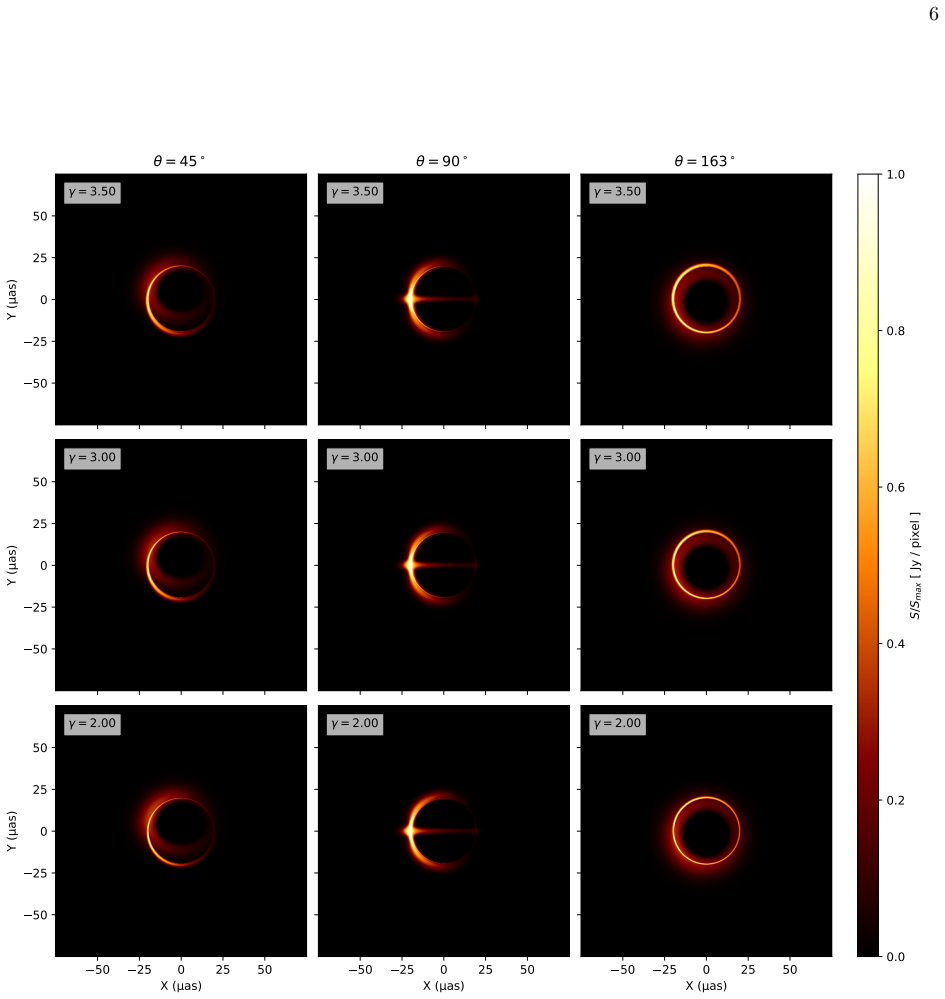
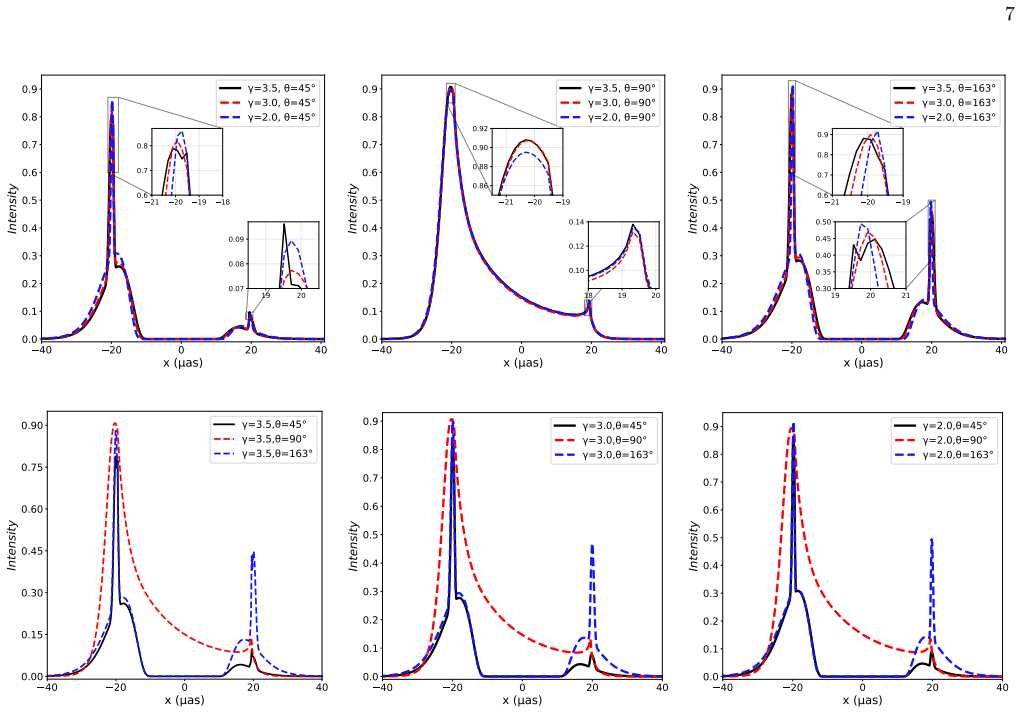
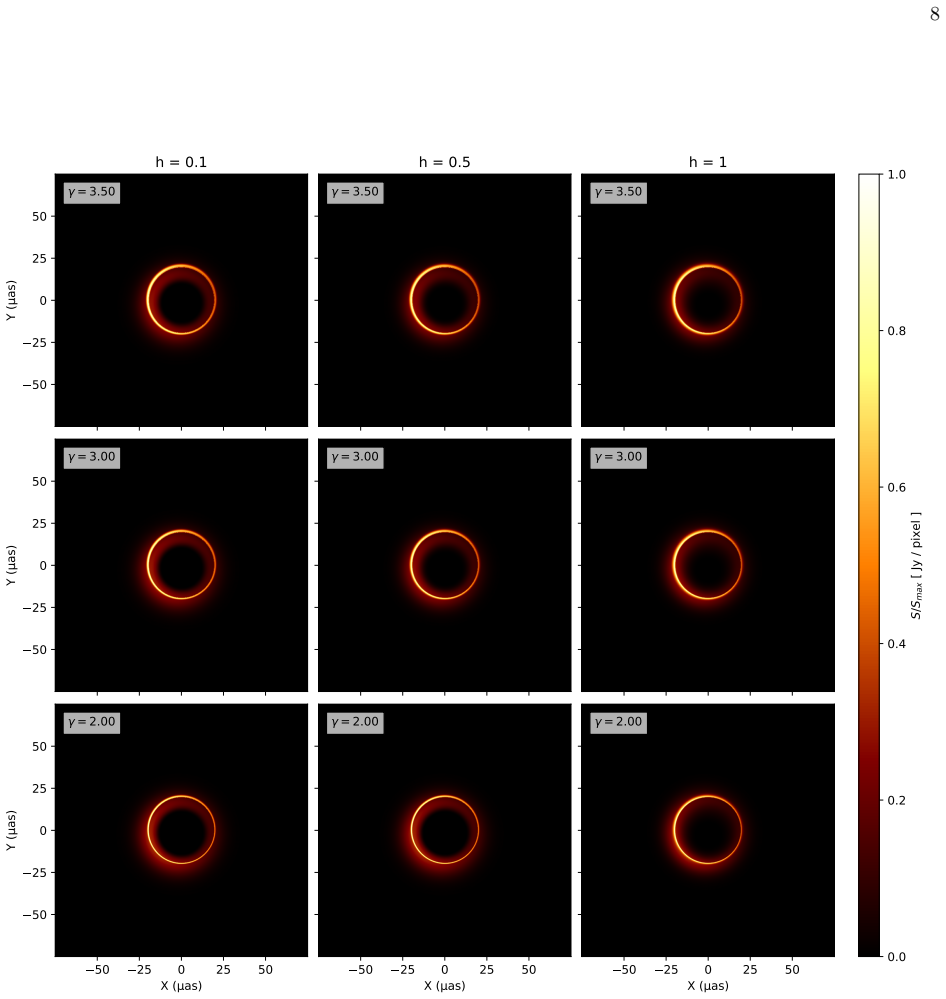
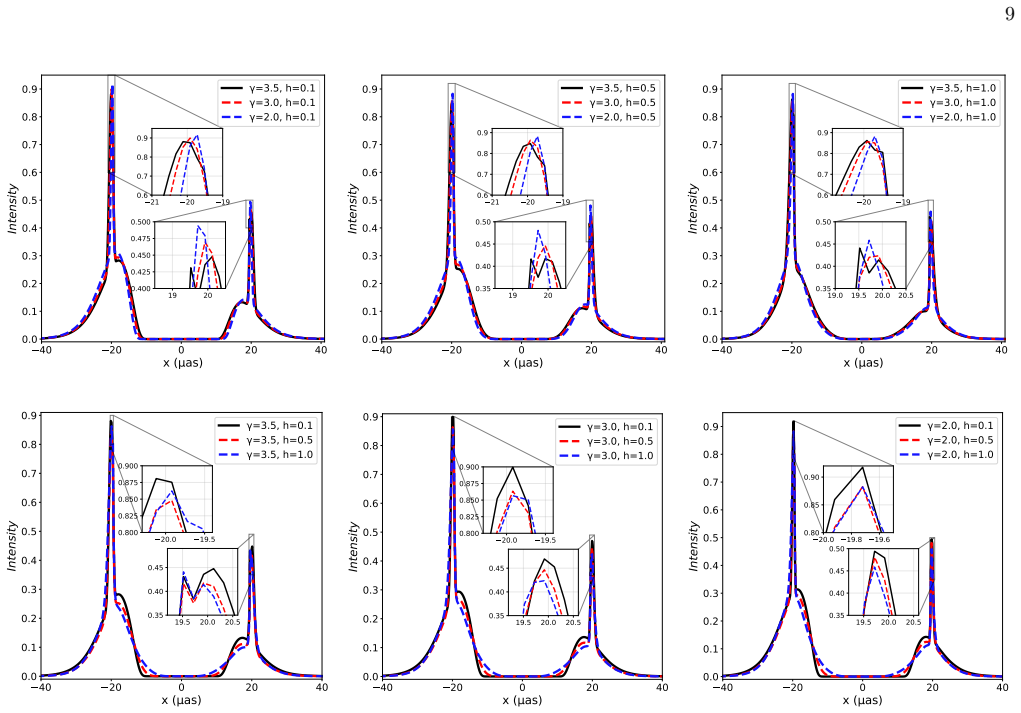
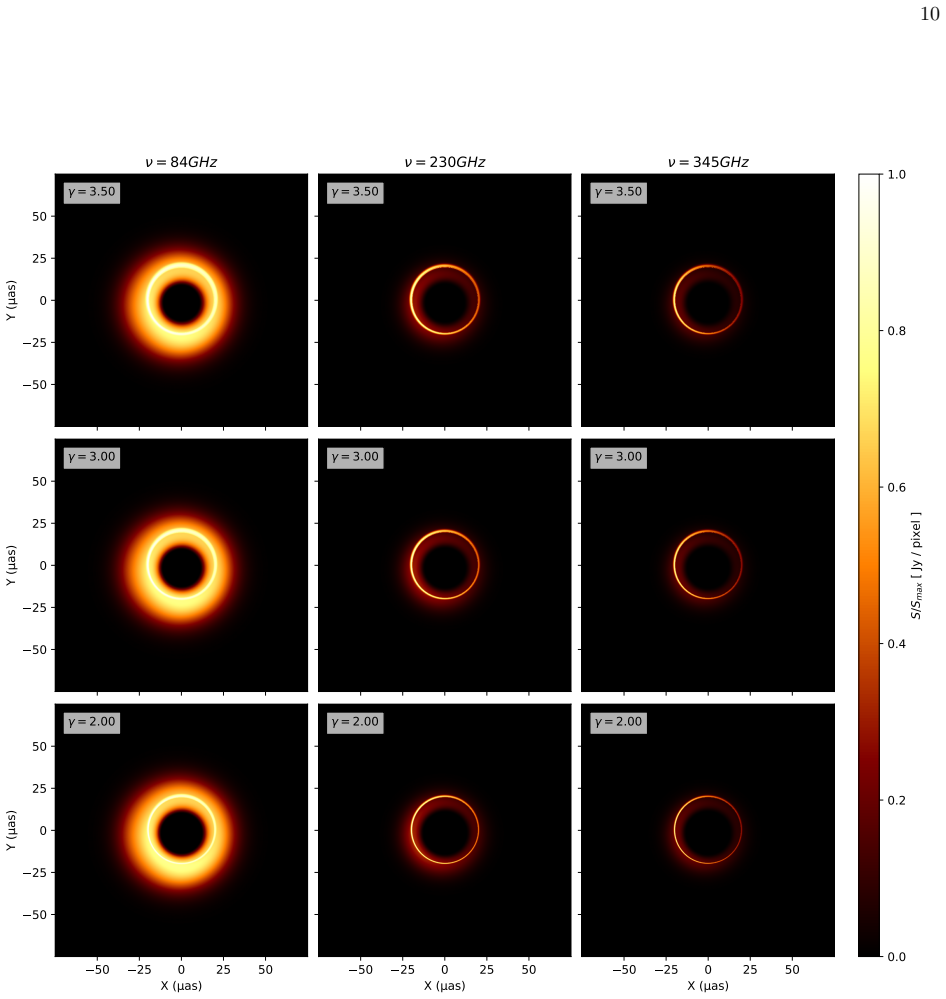
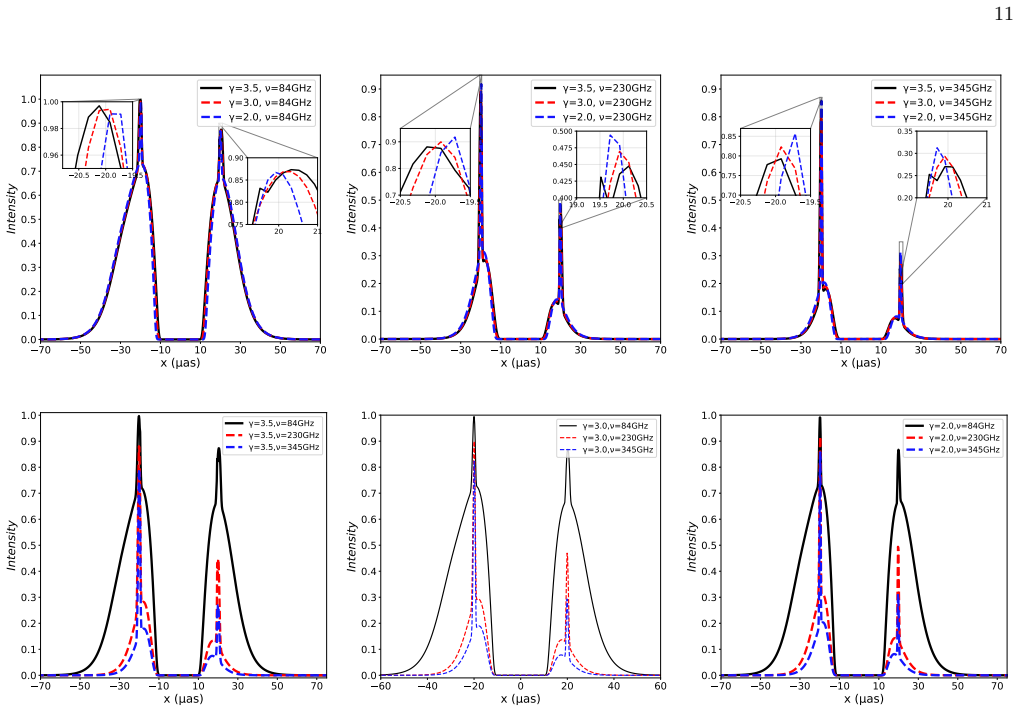
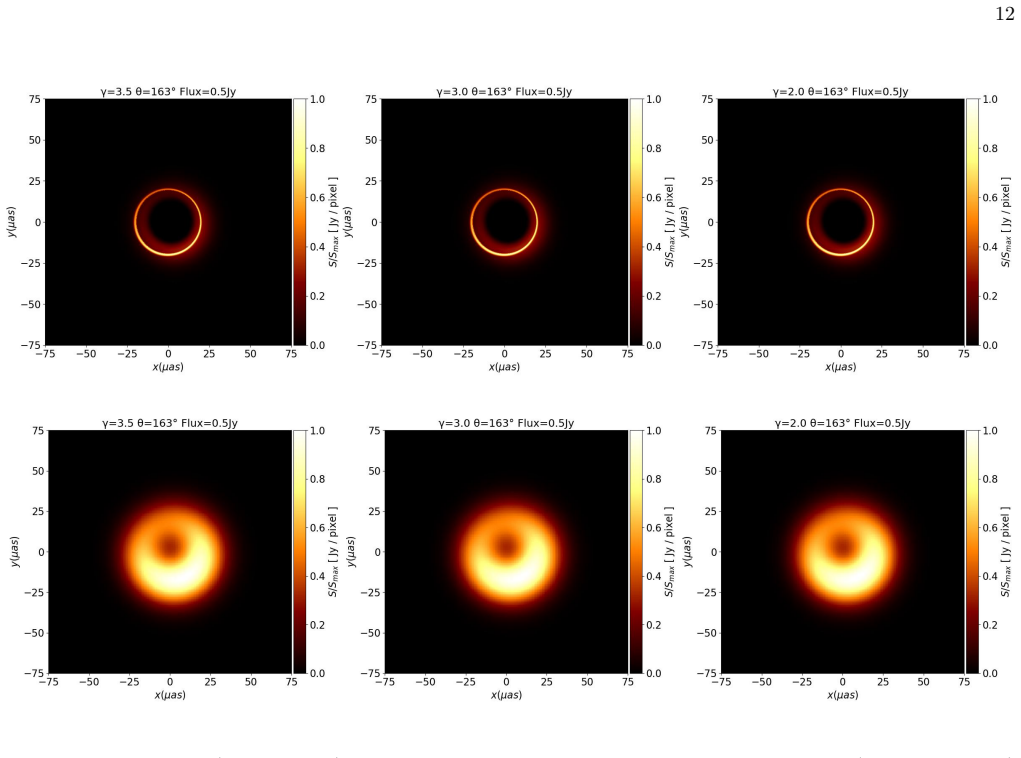
The tidal parameter in Casadio-Fabbri-Mazzacurati black holes alters image morphology nonmonotonically but produces mismatches too small for detection.
A machine-rendered reading of the paper's core claim, the machinery that carries it, and where it could break.
Core claim
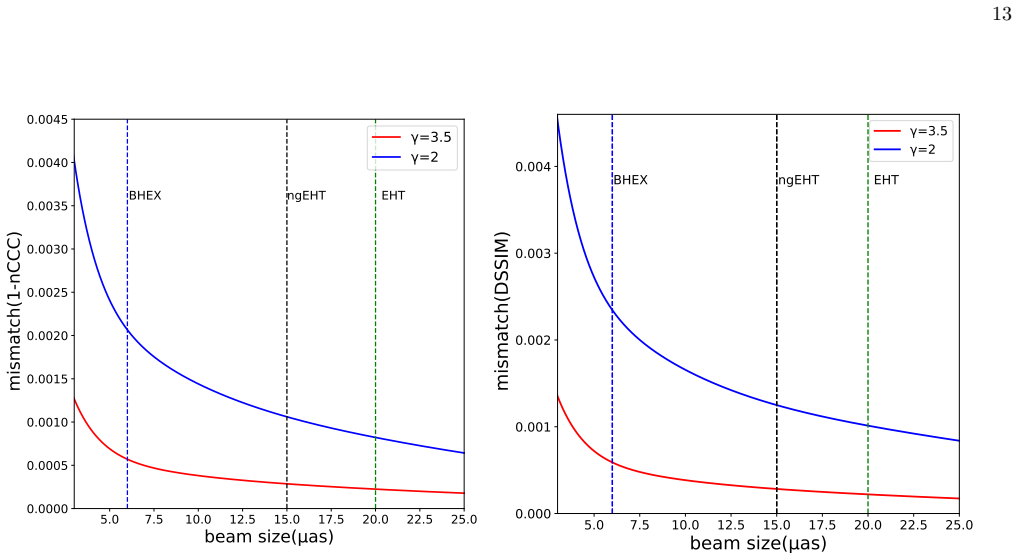
The tidal parameter in the CFM braneworld black hole imprints nonmonotonic changes on the image morphology through intricate coupling with the accreting plasma radiation. Analysis of image-comparison metrics using normalized cross-correlation coefficients and the DSSIM index shows mismatches on the order of 10^3, indicating that identifying braneworld black holes through black hole images remains challenging even with future ngEHT and BHEX observations.
What carries the argument
General relativistic radiative transfer applied to the Casadio-Fabbri-Mazzacurati metric, whose single extra tidal parameter encodes bulk-geometry effects on the horizon-scale spacetime.
If this is right
- The extra tidal parameter couples with plasma radiation to produce nonmonotonic image changes.
- Current EHT data on M87* remain compatible with the simulated braneworld images.
- Image differences stay modest enough that identification of braneworld signatures is difficult.
- Even next-generation instruments are expected to leave the distinction challenging.
Where Pith is reading between the lines
- Polarization maps or variability data could provide additional handles on the tidal parameter beyond total-intensity images.
- The nonmonotonic response implies that certain tidal values may produce nearly degenerate images, complicating parameter recovery.
- Applying the same simulation pipeline to Sgr A* could check whether the mismatch scale depends on the target black hole.
Load-bearing premise
The chosen radiatively inefficient accretion flow model and its plasma parameters correctly describe the environment around M87* and the CFM metric is the right braneworld solution to compare against.
What would settle it
High-resolution images from ngEHT or BHEX that exhibit mismatches with standard Kerr predictions either far larger or far smaller than order 10^3 for plausible tidal-parameter values would directly test the claim.
Figures
read the original abstract
Horizon-scale imaging acts as a transformative tool for probing spacetime geometry, enabling stringent tests of gravitational theories in the strong-field regime. The Casadio-Fabbri-Mazzacurati(CFM) black hole in braneworld contains an extra parameter that characterizes the tidal effects from the bulk geometry, making it highly valuable for this task. We perform general relativistic radiative transfer (GRRT) simulations and generate synthetic images consistent with Event Horizon Telescope observations of M87*. We find that the tidal parameter imprints nonmonotonic changes on the image morphology, underscoring the intricate coupling between spacetime geometry and the observable radiation from the accreting plasma. We also analyze the image-comparison metric using normalized cross-correlation coefficients and the DSSIM index and find that the magnitudes of these mismatches are on the order of 10^3, which implies that identifying braneworld black holes through black hole images remains challenging even with future ngEHT and BHEX observations.
Editorial analysis
A structured set of objections, weighed in public.
Referee Report
Summary. The paper performs general relativistic radiative transfer (GRRT) simulations of radiatively inefficient accretion flows around Casadio-Fabbri-Mazzacurati (CFM) braneworld black holes, generating synthetic images consistent with EHT observations of M87*. It reports that the tidal parameter imprints nonmonotonic changes on image morphology and that normalized cross-correlation (NCC) and DSSIM metrics yield mismatches of order 10^3, concluding that braneworld signatures remain challenging to identify even with ngEHT and BHEX.
Significance. If the metric definitions and numerical results hold after correction, the work would offer a concrete assessment of the observational prospects for extra-dimensional effects in horizon-scale imaging, complementing analytic studies of modified metrics. The choice of GRRT with RIAF is a strength for connecting geometry to observables.
major comments (2)
- [Abstract] Abstract (and the image-comparison analysis): the reported mismatch magnitudes of order 10^3 are incompatible with the standard definitions, where |NCC| ≤ 1 and DSSIM ∈ [0,1]. This directly controls the quantitative support for the claim that identification remains challenging, as the magnitude is used to infer detectability limits. Clarify the precise formula employed or correct the reported values.
- [Methods] The manuscript lacks a methods section or equivalent detailing the GRRT implementation, chosen plasma parameters (density, temperature, magnetic field strength), numerical resolution, and any convergence or error analysis. These details are load-bearing for the nonmonotonic morphology claim and the specific mismatch magnitudes.
minor comments (1)
- Figure captions should explicitly list the tidal-parameter values shown in each panel to aid reproducibility.
Simulated Author's Rebuttal
We thank the referee for the careful review and constructive comments. We address each major comment below and will revise the manuscript accordingly to improve clarity and completeness.
read point-by-point responses
-
Referee: [Abstract] Abstract (and the image-comparison analysis): the reported mismatch magnitudes of order 10^3 are incompatible with the standard definitions, where |NCC| ≤ 1 and DSSIM ∈ [0,1]. This directly controls the quantitative support for the claim that identification remains challenging, as the magnitude is used to infer detectability limits. Clarify the precise formula employed or correct the reported values.
Authors: We acknowledge the inconsistency. The reported order of 10^3 is a typographical error in the abstract; the intended value is 10^{-3}, consistent with the bounded ranges of NCC and DSSIM. The small mismatches support our conclusion that braneworld signatures are difficult to identify. In revision we will correct the abstract, state the exact formulas (NCC = sum((I1 - mean1)(I2 - mean2)) / (sigma1 sigma2) and DSSIM = (1 - SSIM)/2), and confirm that the values remain O(10^{-3}). revision: yes
-
Referee: [Methods] The manuscript lacks a methods section or equivalent detailing the GRRT implementation, chosen plasma parameters (density, temperature, magnetic field strength), numerical resolution, and any convergence or error analysis. These details are load-bearing for the nonmonotonic morphology claim and the specific mismatch magnitudes.
Authors: We agree that explicit methodological details are required for reproducibility. The revised manuscript will add a dedicated Methods section specifying the GRRT code, the RIAF plasma parameters (electron density normalization, temperature profile, magnetic field strength), grid resolution, and results of convergence tests with respect to resolution and integration tolerances. revision: yes
Circularity Check
No significant circularity; forward numerical modeling only
full rationale
The paper's chain consists of GRRT simulations of RIAF images in the CFM metric followed by direct computation of image-comparison metrics. No parameter is fitted to a data subset and then relabeled as a prediction, no self-citation supplies a load-bearing uniqueness theorem, and no ansatz or definition is smuggled in via prior work. The reported mismatch magnitudes are outputs of the forward model, not reductions of the inputs by construction. This matches the expected non-circular outcome for pure simulation studies.
Axiom & Free-Parameter Ledger
Reference graph
Works this paper leans on
-
[1]
K. Akiyama et al. (Event Horizon Telescope), First M87 Event Horizon Telescope Results. II. Array and Instrumentation, Astrophys. J. Lett. 875, L2 (2019) , arXiv:1906.11239 [astro-ph.IM]
Pith/arXiv arXiv 2019
-
[2]
K. Akiyama et al. (Event Horizon Telescope), First Sagittarius A* Event Horizon Telescope Results. I. The Shadow of the Supermassive Black Hole in the Center of the Milky Way, Astrophys. J. Lett. 930, L12 (2022) , arXiv:2311.08680 [astro-ph.HE]
Pith/arXiv arXiv 2022
-
[3]
K. Akiyama et al. (Event Horizon Telescope), First M87 Event Horizon Telescope Results. VI. The Shadow and Mass of the Central Black Hole, Astrophys. J. Lett. 875, L6 (2019) , arXiv:1906.11243 [astro-ph.GA]
Pith/arXiv arXiv 2019
-
[4]
K. Akiyama et al. (Event Horizon Telescope), First Sagittarius A* Event Horizon Telescope Results. V. Testing Astro- physical Models of the Galactic Center Black Hole, Astrophys. J. Lett. 930, L16 (2022) , arXiv:2311.09478 [astro-ph.HE]
arXiv 2022
-
[5]
B. P. Abbott et al. (LIGO Scientific, Virgo), Observation of Gravitational Waves from a Binary Black Hole Merger, Phys. Rev. Lett. 116, 061102 (2016) , arXiv:1602.03837 [gr-qc]
Pith/arXiv arXiv 2016
- [6]
-
[7]
C. M. Will, The Confrontation between General Relativity and Experiment, Living Rev. Rel. 17, 4 (2014) , arXiv:1403.7377 [gr-qc]
Pith/arXiv arXiv 2014
-
[8]
N. Dadhich, R. Maartens, P. Papadopoulos, and V. Rezania, Black holes on the brane, Phys. Lett. B 487, 1 (2000) , arXiv:hep-th/0003061. 15
Pith/arXiv arXiv 2000
-
[9]
Ponce de Leon, Static exteriors for nonstatic braneworld stars, Class
J. Ponce de Leon, Static exteriors for nonstatic braneworld stars, Class. Quant. Grav. 25, 075012 (2008) , arXiv:0711.4415 [gr-qc]
Pith/arXiv arXiv 2008
-
[10]
C. Molina, A. B. Pavan, and T. E. Medina Torrejón, Electromagnetic perturbations in new brane world scenarios, Phys. Rev. D 93, 124068 (2016) , arXiv:1604.02461 [gr-qc]
Pith/arXiv arXiv 2016
-
[11]
M. Heydar-Fard, H. Razmi, and H. R. Sepangi, Brane-World Black Hole Solutions via a Confining Potential, Phys. Rev. D 76, 066002 (2007) , arXiv:0707.3558 [gr-qc]
Pith/arXiv arXiv 2007
-
[12]
L. Randall and R. Sundrum, A Large mass hierarchy from a small extra dimension, Phys. Rev. Lett. 83, 3370 (1999) , arXiv:hep-ph/9905221
Pith/arXiv arXiv 1999
-
[13]
Lin, On the nature of cosmic strings in the brane world, Chin
C.-M. Lin, On the nature of cosmic strings in the brane world, Chin. J. Phys. 83, 86 (2023) , arXiv:2208.09589 [hep-th]
arXiv 2023
-
[14]
P. Tadros and M. A. Abdel-Raouf, Eliminating Black Holes Singularity in Brane World Cosmology, JHEP Grav. Cosmol. 08, 259 (2022) , arXiv:2203.15785 [gr-qc]
arXiv 2022
-
[15]
T. Harko and M. K. Mak, Vacuum solutions of the gravitational field equations in the brane world model, Phys. Rev. D 69, 064020 (2004) , arXiv:gr-qc/0401049
Pith/arXiv arXiv 2004
-
[16]
M. K. Mak and T. Harko, Can the galactic rotation curves be explained in brane world models?, Phys. Rev. D 70, 024010 (2004), arXiv:gr-qc/0404104
Pith/arXiv arXiv 2004
-
[17]
T. Harko and M. K. Mak, Conformally symmetric vacuum solutions of the gravitational field equations in the brane-world models, Annals Phys. 319, 471 (2005) , arXiv:gr-qc/0503072
Pith/arXiv arXiv 2005
-
[18]
T. Harko and K. S. Cheng, Galactic metric, dark radiation, dark pressure and gravitational lensing in brane world models, Astrophys. J. 636, 8 (2005) , arXiv:astro-ph/0509576
Pith/arXiv arXiv 2005
-
[19]
L. Amarilla and E. F. Eiroa, Shadow of a rotating braneworld black hole, Phys. Rev. D 85, 064019 (2012) , arXiv:1112.6349 [gr-qc]
Pith/arXiv arXiv 2012
-
[20]
E. F. Eiroa and C. M. Sendra, Shadow cast by rotating braneworld black holes with a cosmological constant, Eur. Phys. J. C 78, 91 (2018) , arXiv:1711.08380 [gr-qc]
Pith/arXiv arXiv 2018
-
[21]
Abdujabbarov, B
A. Abdujabbarov, B. Ahmedov, N. Dadhich, and F. Atamurotov, Optical properties of a braneworld black hole: Gravita- tional lensing and retrolensing, Phys. Rev. D 96, 084017 (2017)
2017
-
[22]
I. Banerjee, S. Chakraborty, and S. SenGupta, Silhouette of M87*: A New Window to Peek into the World of Hidden Dimensions, Phys. Rev. D 101, 041301 (2020) , arXiv:1909.09385 [gr-qc]
arXiv 2020
-
[23]
Y. Hou, M. Guo, and B. Chen, Revisiting the shadow of braneworld black holes, Phys. Rev. D 104, 024001 (2021) , arXiv:2103.04369 [gr-qc]
arXiv 2021
-
[24]
K. Akiyama et al. (Event Horizon Telescope), First Sagittarius A* Event Horizon Telescope Results. VI. Testing the Black Hole Metric, Astrophys. J. Lett. 930, L17 (2022) , arXiv:2311.09484 [astro-ph.HE]
arXiv 2022
-
[25]
K. Akiyama et al. (Event Horizon Telescope), First M87 Event Horizon Telescope Results. IV. Imaging the Central Supermassive Black Hole, Astrophys. J. Lett. 875, L4 (2019) , arXiv:1906.11241 [astro-ph.GA]
Pith/arXiv arXiv 2019
-
[26]
F. Yuan, E. Quataert, and R. Narayan, Nonthermal electrons in radiatively inefficient accretion flow models of Sagittarius A*, Astrophys. J. 598, 301 (2003) , arXiv:astro-ph/0304125
Pith/arXiv arXiv 2003
-
[27]
H.-Y. Pu and A. E. Broderick, Probing the innermost accretion flow geometry of Sgr A* with Event Horizon Telescope, Astrophys. J. 863, 148 (2018) , arXiv:1807.01817 [astro-ph.HE]
Pith/arXiv arXiv 2018
- [28]
-
[29]
J.-M. Yan, Q. Wu, and T. Zhu, The effects of asymptotically flat R2 spacetime on black hole image of Sagittarius A*, JCAP 11, 069 , arXiv:2504.10956 [gr-qc]
-
[30]
H.-Y. Pu, K. Akiyama, and K. Asada, The Effects of Accretion Flow Dynamics on the Black Hole Shadow of Sagittarius A∗, Astrophys. J. 831, 4 (2016) , arXiv:1608.03035 [astro-ph.HE]
Pith/arXiv arXiv 2016
-
[31]
H. Yin, S. Chen, and J. Jing, Bright ring features and polarization structures in Kerr-Sen black hole images illuminated by radiatively inefficient accretion flows, JCAP 04, 071 , arXiv:2507.03857 [gr-qc]
-
[32]
R. Casadio, A. Fabbri, and L. Mazzacurati, New black holes in the brane world?, Phys. Rev. D 65, 084040 (2002) , arXiv:gr-qc/0111072. 16
Pith/arXiv arXiv 2002
-
[33]
C. S. J. Pun, Z. Kovacs, and T. Harko, Thin accretion disks onto brane world black holes, Phys. Rev. D 78, 084015 (2008) , arXiv:0809.1284 [gr-qc]
Pith/arXiv arXiv 2008
-
[34]
Y. Wei, S. Chen, and J. Jing, Thick accretion disk configurations around a compact object in the brane-world scenario, Commun. Theor. Phys. 75, 115401 (2023) , arXiv:2308.13131 [gr-qc]
arXiv 2023
-
[35]
K. A. Bronnikov, V. N. Melnikov, and H. Dehnen, On a general class of brane world black holes, Phys. Rev. D 68, 024025 (2003), arXiv:gr-qc/0304068
Pith/arXiv arXiv 2003
-
[36]
Israel, Singular hypersurfaces and thin shells in general relativity, Nuovo Cim
W. Israel, Singular hypersurfaces and thin shells in general relativity, Nuovo Cim. B 44S10, 1 (1966) , [Erratum: Nuovo Cim.B 48, 463 (1967)]
1966
-
[37]
L.-h. Liu, B. Wang, and G.-h. Yang, The Energy absorption problem of a brane-world black hole, Phys. Rev. D 76, 064014 (2007), arXiv:hep-th/0701166
Pith/arXiv arXiv 2007
- [38]
-
[39]
F. Ozel, D. Psaltis, and Z. Younsi, Black Hole Images as Tests of General Relativity: Effects of Plasma Physics, Astrophys. J. 941, 88 (2022) , arXiv:2111.01123 [astro-ph.HE]
arXiv 2022
-
[40]
S. C. Noble, P. K. Leung, C. F. Gammie, and L. G. Book, Simulating the Emission and Outflows from Accretion Disks, Class. Quant. Grav. 24, S259 (2007) , arXiv:astro-ph/0701778
Pith/arXiv arXiv 2007
-
[41]
M. Moscibrodzka and C. F. Gammie, ipole – semi-analytic scheme for relativistic polarized radiative transport, Mon. Not. Roy. Astron. Soc. 475, 43 (2018) , arXiv:1712.03057 [astro-ph.HE]
Pith/arXiv arXiv 2018
-
[42]
S. Saurabh, M. Wielgus, A. Tursunov, A. P. Lobanov, and R. Emami, Semi-analytic studies of the accretion disk and magnetic field geometry in M 87*, Astron. Astrophys. 705, A166 (2026) , arXiv:2508.11760 [astro-ph.HE]
arXiv 2026
-
[43]
S. Saurabh, P. Bambhaniya, and P. S. Joshi, Imaging ultracompact objects with radiatively inefficient accretion flows, Astron. Astrophys. 682, A113 (2024) , arXiv:2308.14519 [astro-ph.HE]
arXiv 2024
-
[44]
A. E. Broderick, P. Tiede, D. W. Pesce, and R. Gold, Measuring Spin from Relative Photon-ring Sizes, Astrophys. J. 927, 6 (2022) , arXiv:2105.09962 [astro-ph.HE]
arXiv 2022
-
[45]
R. Takahashi and S. Mineshige, Constraining the size of the dark region around the M87 black hole by space-VLBI observations, Astrophys. J. 729, 86 (2011) , arXiv:1102.3583 [astro-ph.HE]
Pith/arXiv arXiv 2011
- [46]
-
[47]
R. Craig Walker, P. E. Hardee, F. B. Davies, C. Ly, and W. Junor, The Structure and Dynamics of the Subparsec Jet in M87 Based on 50 VLBA Observations over 17 Years at 43 GHz, Astrophys. J. 855, 128 (2018) , arXiv:1802.06166 [astro-ph.HE]
Pith/arXiv arXiv 2018
-
[48]
K. Akiyama et al. (Event Horizon Telescope), First M87 Event Horizon Telescope Results. VII. Polarization of the Ring, Astrophys. J. Lett. 910, L12 (2021) , arXiv:2105.01169 [astro-ph.HE]
arXiv 2021
-
[49]
C. R. Mann, H. Richer, J. Heyl, J. Anderson, J. Kalirai, I. Caiazzo, S. Möhle, A. Knee, and H. Baumgardt, A Multimass Velocity Dispersion Model of 47 Tucanae Indicates No Evidence for an Intermediate-mass Black Hole, Astrophys. J. 875, 1 (2019) , arXiv:1807.03307 [astro-ph.GA]
Pith/arXiv arXiv 2019
- [50]
-
[51]
Z. Wang, A. C. Bovik, H. R. Sheikh, and E. P. Simoncelli, Image quality assessment: From error visibility to structural similarity, IEEE Transactions on Image Processing 13, 600 (2004)
2004
-
[52]
Y. Mizuno, Z. Younsi, C. M. Fromm, O. Porth, M. De Laurentis, H. Olivares, H. Falcke, M. Kramer, and L. Rezzolla, The Current Ability to Test Theories of Gravity with Black Hole Shadows, Nature Astron. 2, 585 (2018) , arXiv:1804.05812 [astro-ph.GA]
Pith/arXiv arXiv 2018
discussion (0)
Sign in with ORCID, Apple, or X to comment. Anyone can read and Pith papers without signing in.