Sensitivity of evolutionary entropy in Lefkovitch matrices
Pith reviewed 2026-06-26 01:08 UTC · model grok-4.3
The pith
Closed-form expressions for evolutionary entropy and its partial derivatives are obtained for irreducible Lefkovitch matrices via Perron-Frobenius eigenvectors.
A machine-rendered reading of the paper's core claim, the machinery that carries it, and where it could break.
Core claim
Using the Perron-Frobenius representation of the Markov chain associated with an irreducible Lefkovitch matrix, explicit closed-form expressions are obtained for the stationary distribution, generation time, evolutionary entropy, and the partial derivatives of entropy with respect to fertility, transition, and retention parameters. The resulting identities are expressed directly in terms of demographic coefficients, Perron eigenvectors, the dominant eigenvalue and the reproductive potential. The entropy representation decomposes naturally into transition and retention components and the theory specializes immediately to open-group Leslie matrices.
What carries the argument
The Perron-Frobenius eigenvectors and dominant eigenvalue of the Lefkovitch matrix, which define the stationary distribution and permit direct expression of evolutionary entropy and its sensitivities in terms of the matrix entries.
If this is right
- Evolutionary entropy decomposes into distinct transition and retention components that identify separate mechanisms generating demographic uncertainty.
- The sensitivity expressions extend immediately from age-structured Leslie matrices to general stage-structured Lefkovitch matrices.
- The formulas specialize without change to open-group Leslie matrices that comprise a large fraction of empirical demographic models.
- Explicit partial derivatives supply practical tools for perturbation analysis, demographic robustness studies, and comparison of life-history strategies.
Where Pith is reading between the lines
- The closed-form derivatives allow direct computation of entropy sensitivities from demographic tables without Monte-Carlo simulation of population trajectories.
- The transition-retention split may be used to isolate which life-history parameters most affect long-term population predictability in conservation models.
- Because the expressions are algebraic in the matrix entries, they can be embedded in symbolic or automatic-differentiation pipelines for large stage-classified datasets.
Load-bearing premise
The Lefkovitch matrices are irreducible and non-negative, allowing the Perron-Frobenius theorem to guarantee a unique dominant eigenvalue and positive eigenvectors.
What would settle it
Direct numerical computation of the partial derivatives of entropy on a concrete irreducible Lefkovitch matrix that fails to match the closed-form expressions given by the Perron eigenvectors.
Figures
read the original abstract
Evolutionary entropy, introduced by Demetrius, is a demographic invariant that quantifies the temporal organization of structured populations. Explicit sensitivity expressions for this quantity were derived by Demetrius, Gundlach and Ziehe for age-structured Leslie matrices, establishing the foundations of entropy-based perturbation theory. In this paper we develop a complete sensitivity theory for evolutionary entropy in irreducible Lefkovitch matrices. Using the Perron--Frobenius representation of the associated Markov chain, we derive explicit closed-form expressions for the stationary distribution, generation time, evolutionary entropy and its partial derivatives with respect to fertility, transition and retention parameters. The resulting identities are expressed directly in terms of demographic coefficients, Perron eigenvectors, the dominant eigenvalue and the reproductive potential. The entropy representation obtained here gives a natural decomposition into transition and retention components and clarifies the distinct mechanisms through which demographic uncertainty is generated in stage-structured populations. We further show that the theory specializes immediately to open-group Leslie matrices, a class that has been shown to comprise a large fraction of empirical demographic models. The results extend the entropy sensitivity theory of Demetrius--Gundlach--Ziehe from age-structured to general stage-structured populations and provide practical tools for comparative demographic analysis, perturbation studies, demographic robustness, and the investigation of life-history strategies. Several biological examples are presented, illustrating how entropy decomposition and sensitivity analysis reveal complementary aspects of population organization.
Editorial analysis
A structured set of objections, weighed in public.
Referee Report
Summary. The paper extends entropy sensitivity theory from Leslie to Lefkovitch matrices by deriving explicit closed-form expressions, via the Perron-Frobenius representation of the induced Markov chain, for the stationary distribution, generation time, evolutionary entropy, and its partial derivatives with respect to fertility, transition, and retention entries. The expressions are given directly in terms of demographic coefficients, Perron eigenvectors, the dominant eigenvalue, and reproductive potential; the entropy is decomposed into transition and retention components. The theory specializes to open-group Leslie matrices, and biological examples are provided to illustrate applications to perturbation analysis and life-history strategies.
Significance. If the derivations hold, the work supplies a complete sensitivity theory for evolutionary entropy in general irreducible stage-structured populations, extending the Demetrius-Gundlach-Ziehe framework. The explicit, closed-form character of the identities (parameterized only by standard demographic quantities and Perron data) and the transition/retention decomposition constitute concrete strengths that enable direct comparative demographic studies, robustness analysis, and falsifiable predictions without numerical approximation.
minor comments (2)
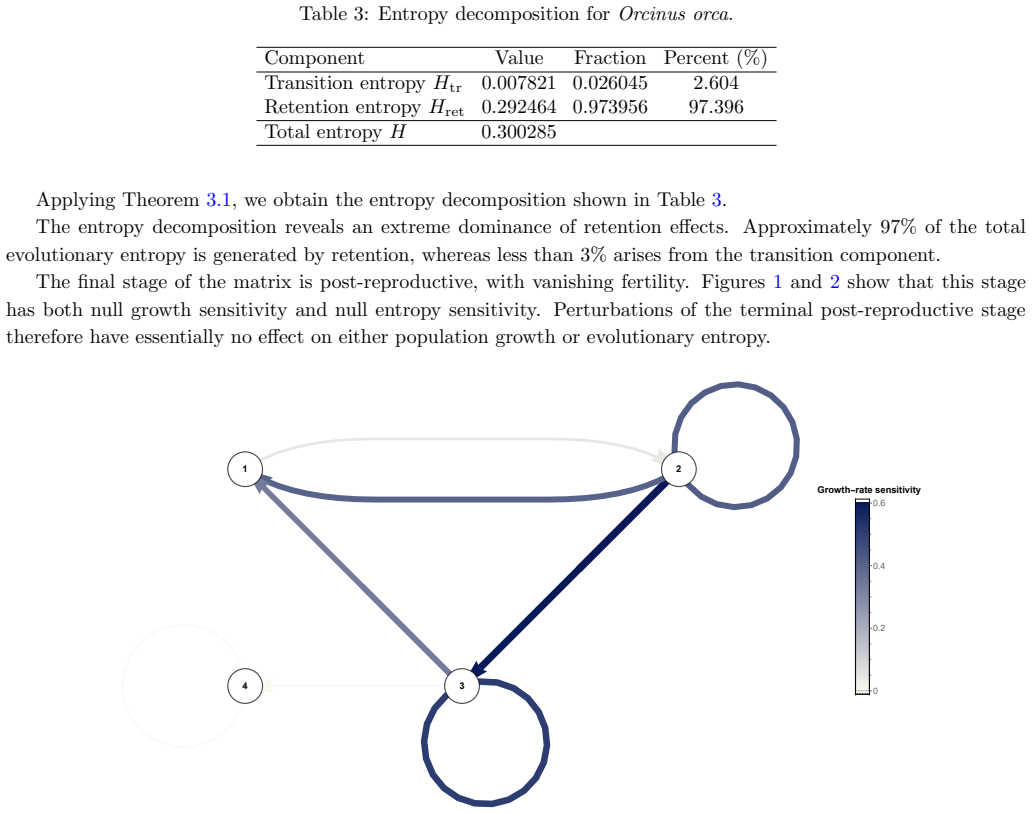
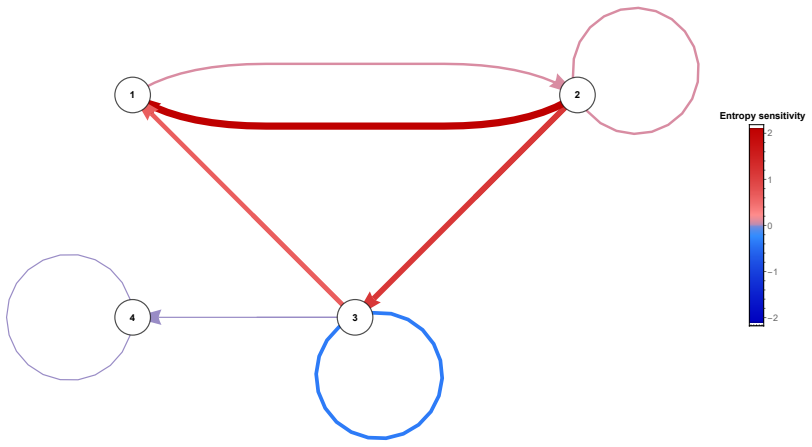
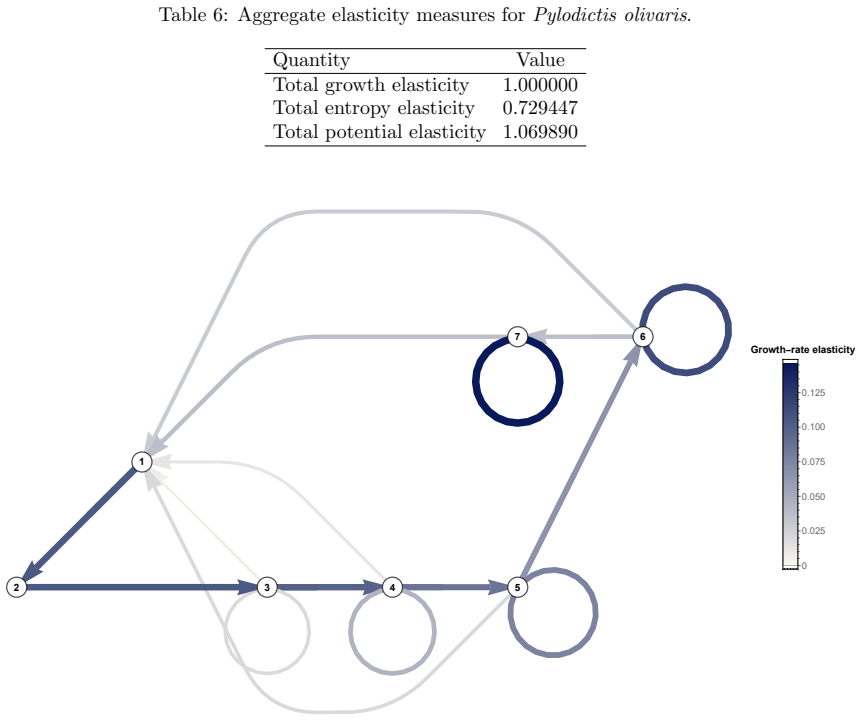
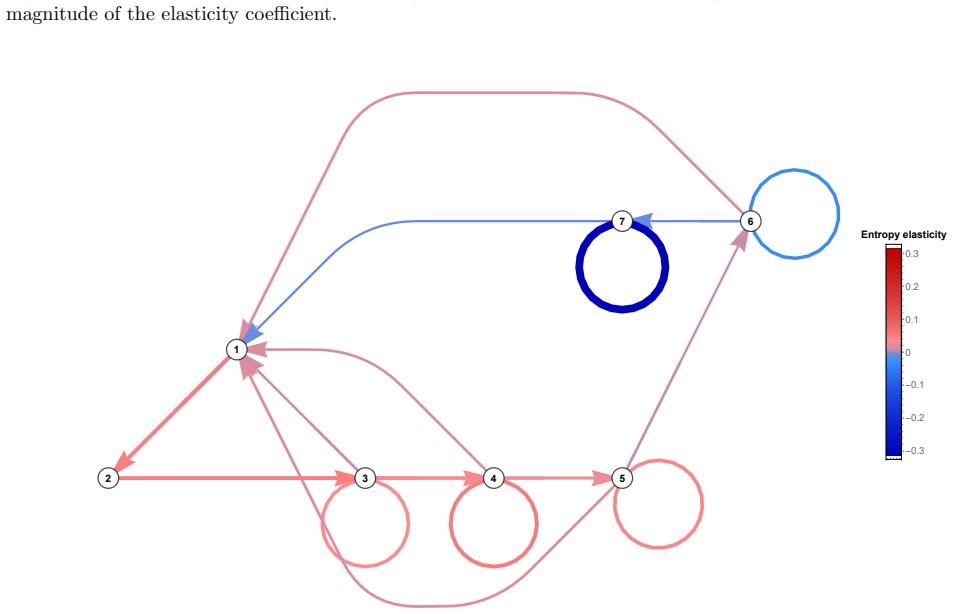
- [Abstract / §4] The abstract states that 'several biological examples are presented' illustrating entropy decomposition; §4 or the corresponding results section would benefit from an explicit table or figure summarizing the numerical values of the transition versus retention contributions for each example to make the claimed complementarity immediately verifiable.
- [Methods / Notation] Notation for the reproductive potential is introduced without an equation number in the main text; adding an explicit definition (e.g., Eq. (X)) would improve traceability when the sensitivity formulas are later expressed in terms of this quantity.
Simulated Author's Rebuttal
We thank the referee for the positive evaluation of the manuscript, the recognition of its contributions to entropy sensitivity theory for stage-structured populations, and the recommendation to accept.
Circularity Check
No significant circularity detected
full rationale
The paper applies the standard Perron-Frobenius theorem to irreducible non-negative Lefkovitch matrices to derive closed-form expressions for the stationary distribution, generation time, evolutionary entropy, and its sensitivities with respect to matrix entries. The stated assumptions (irreducibility and non-negativity) are exactly the hypotheses of the theorem guaranteeing a unique positive dominant eigenvalue and positive eigenvectors; the resulting identities are algebraic consequences of these eigenvectors and the eigenvalue, expressed in terms of demographic coefficients. No self-definitional loops, fitted parameters renamed as predictions, or load-bearing self-citations appear. Prior work by Demetrius et al. is cited for context on age-structured cases but is independent of the present derivations. The specialization to open-group Leslie matrices is a direct algebraic restriction with no additional circular content.
Axiom & Free-Parameter Ledger
axioms (1)
- standard math Perron-Frobenius theorem applies to irreducible non-negative matrices to guarantee a simple dominant eigenvalue and positive left and right eigenvectors
Reference graph
Works this paper leans on
-
[1]
J. F. Alves and H. M. Oliveira. Similarity of general population matrices and pseudo-Leslie matrices.Applied Mathematics and Information Sciences, 9(5):2239–2244, 2015
2015
-
[2]
Buescu, S
J. Buescu, S. Elaydi, and H. Oliveira. Evolutionary entropy shapes reproductive lifespan in age-structured populations, 2026
2026
-
[3]
Caswell.Matrix Population Models: Construction, Analysis, and Interpretation
H. Caswell.Matrix Population Models: Construction, Analysis, and Interpretation. Sinauer Associates, 2001
2001
-
[4]
Caswell.Sensitivity Analysis: Matrix Methods in Demography and Ecology
H. Caswell.Sensitivity Analysis: Matrix Methods in Demography and Ecology. Springer, Cham, 2019. 23
2019
-
[5]
T. M. Cover and J. A. Thomas.Elements of Information Theory. Wiley-Interscience, Hoboken, New Jersey, 2 edition, 2006
2006
-
[6]
Demetrius
L. Demetrius. The sensitivity of population growth rate to perturbations in the life cycle components.Mathe- matical Biosciences, 4(1-2):129–136, 1969
1969
-
[7]
Demetrius
L. Demetrius. Multiplicative processes II.Mathematical Biosciences, 20(3):345–357, 1974
1974
-
[8]
Demetrius
L. Demetrius. Natural selection and age-structured populations.Genetics, 79(3):535–544, 1975
1975
-
[9]
Demetrius
L. Demetrius. Adaptive value, entropy and survivorship curves.Nature, (275):213 – 214, 1978
1978
-
[10]
Demetrius, V
L. Demetrius, V. M. Gundlach, and M. Ziehe. Darwinian fitness and the intensity of natural selection: studies in sensitivity analysis.Journal of Theoretical Biology, 249(4):641–653, 2007
2007
-
[11]
S. N. Elaydi and J. Cushing.Discrete Mathematical Models in Population Biology. Springer Undergraduate Texts in Mathematics and Technology. Springer, New York, 2024
2024
-
[12]
L. P. Lefkovitch. The study of population growth in organisms grouped by stages.Biometrics, 21(1):1–18, 1965
1965
-
[13]
P. H. Leslie. On the use of matrices in certain population mathematics.Biometrika, 33(3):183–212, 1945
1945
-
[14]
P. H. Leslie. Some further notes on the use of matrices in population mathematics.Biometrika, 35(3/4):213–245, 1948
1948
-
[15]
W. F. Morris and D. F. Doak.Quantitative Conservation Biology: Theory and Practice of Population Viability Analysis. Sinauer Associates, Sunderland, MA, 2002
2002
-
[16]
Salguero-G´ omez, O
R. Salguero-G´ omez, O. R. Jones, C. R. Archer, C. Bein, H. de Buhr, C. Farack, F. Gottschalk, A. Hartmann, A. Henning, G. Hoppe, G. R¨ omer, J. Runge, T. Ruoff, V. Sommer, J. Wille, J. Voigt, D. Vieregg, Y. C. Buckley, J. Che-Castaldo, D. Hodgson, A. Scheuerlein, H. Caswell, J. W. Vaupel, and A. Baudisch. Comadre: A global database of animal demography.J...
2016
-
[17]
Salguero-G´ omez, O
R. Salguero-G´ omez, O. R. Jones, C. R. Archer, Y. C. Buckley, J. Che-Castaldo, H. Caswell, D. Hodgson, A. Scheuerlein, D. A. Conde, E. Brinks, H. de Buhr, C. Farack, F. Gottschalk, A. Hartmann, A. Henning, G. Hoppe, G. R¨ omer, J. Runge, T. Ruoff, J. Wille, S. Zeh, D. Vieregg, A. Baudisch, and J. W. Vaupel. The com- padre plant matrix database: An open o...
2015
-
[18]
C. E. Shannon. A mathematical theory of communication.Bell System Technical Journal, 27:379–423, 623–656, 1948
1948
-
[19]
R. P. Shefferson, S. Kurokawa, and J. Ehrl´ en. lefko3: Analysing individual history through size-classified matrix population models.Methods in Ecology and Evolution, 12(2):364–378, 2021
2021
-
[20]
Stubben and B
C. Stubben and B. Milligan. Estimating and analyzing demographic models using the popbio package in R. Journal of Statistical Software, 22(11):1–23, 2007
2007
-
[21]
Tuljapurkar.Population Dynamics in Variable Environments, volume 85 ofLecture Notes in Biomathematics
S. Tuljapurkar.Population Dynamics in Variable Environments, volume 85 ofLecture Notes in Biomathematics. Springer, New York, 1990. 24
1990
discussion (0)
Sign in with ORCID, Apple, or X to comment. Anyone can read and Pith papers without signing in.