An observer's quantization of 3d de Sitter
Pith reviewed 2026-06-26 01:26 UTC · model grok-4.3
The pith
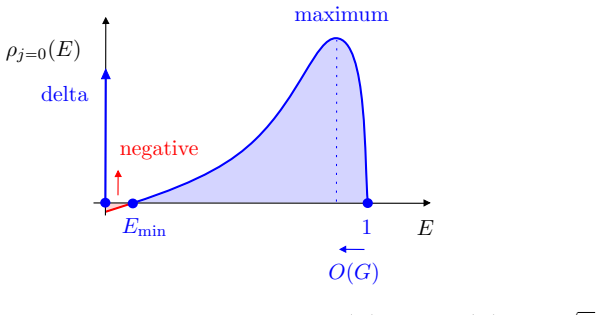
Holographic duality to complex Liouville strings computes the density of states in 3d de Sitter gravity exactly.
A machine-rendered reading of the paper's core claim, the machinery that carries it, and where it could break.
Core claim
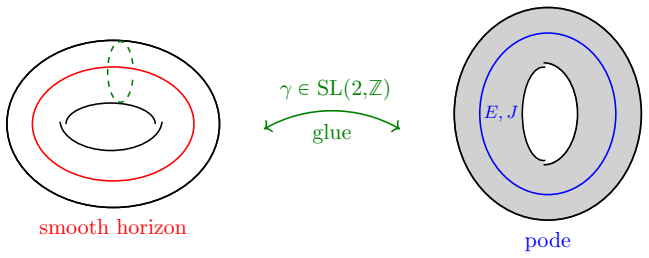
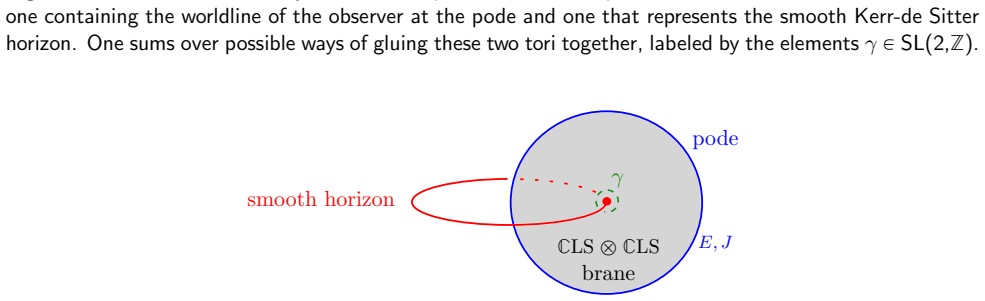
The spectral density in the 3d dS static patch is defined via a sum over SL(2,Z) Euclidean no-boundary Kerr-lens spacetimes sourced by a line-defect. Under the holographic duality to two copies of the complex Liouville string these geometries map to an SL(2,Z) family of generalized crosscap geometries whose amplitudes are computed exactly and match the semi-classical gravity prediction. The simplest case further dualizes to two copies of the GΣ theory on the observer's worldline.
What carries the argument
The holographic duality between dS3 gravity and two copies of the complex Liouville string, which maps the SL(2,Z) Kerr-lens spacetimes to generalized crosscap geometries whose amplitudes can be computed exactly.
If this is right
- The crosscap amplitudes in the complex Liouville string theory match the semi-classical gravity prediction for the spectral density.
- The simplest non-trivial Kerr-lens geometry is dual to two copies of the GΣ effective field theory of the double-scaled SYK model living on the observer's worldline.
- The setup provides a concrete starting point for constructing a microscopic worldline hologram of 3d de Sitter.
Where Pith is reading between the lines
- If the duality holds, further observables in the static patch could be computed by evaluating additional string amplitudes on the same crosscap geometries.
- The link to the SYK effective theory suggests that random-matrix or matrix-model techniques might be imported to study the observer's degrees of freedom.
- The same duality framework might be tested by checking whether other Euclidean de Sitter geometries admit consistent crosscap interpretations.
Load-bearing premise
A holographic duality exists between 3d de Sitter gravity and two copies of the complex Liouville string such that the Kerr-lens geometries map to generalized crosscap geometries whose amplitudes can be compared directly to gravity.
What would settle it
A concrete mismatch between the computed complex Liouville string crosscap amplitudes and the semi-classical gravity prediction for the spectral density of any Kerr-lens geometry would falsify the proposal.
Figures


read the original abstract
What is the density of states of the de Sitter static patch? We propose a definition and calculation of such a density in 3d dS. Our proposal involves a sum over an SL(2,$\mathbb{Z}$) set of Euclidean no-boundary Kerr-lens spacetimes sourced by a line-defect with given energy and spin - which in Lorentzian time represents an observer's worldline at the center of the dS static patch. We develop an exact quantum computation of the spectral density using a holographic duality between dS$_3$ gravity and two copies of $\mathbb{C}$LS, the complex Liouville string. The SL(2,$\mathbb{Z}$) Kerr-lens spacetimes map under the duality to an SL(2,$\mathbb{Z}$) family of generalized crosscap geometries. We compute the $\mathbb{C}$LS $\otimes$ $\mathbb{C}$LS crosscap amplitudes and show that they match the semi-classical gravity prediction. For the simplest non-trivial Kerr-lens space, the $\mathbb{C}$LS $\otimes$ $\mathbb{C}$LS description is, in turn, dual to two copies of the $G\Sigma$ effective field theory of the double scaled SYK model. The $G\Sigma\otimes G\Sigma$ theory lives on an observer's worldline in the static patch, setting the stage for developing a microscopic worldline hologram of 3d de Sitter.
Editorial analysis
A structured set of objections, weighed in public.
Referee Report
Summary. The paper proposes a definition of the density of states for the 3d de Sitter static patch as a sum over an SL(2,ℤ) family of Euclidean no-boundary Kerr-lens spacetimes sourced by a line defect (representing an observer worldline). It invokes a holographic duality between dS₃ gravity and two copies of the complex Liouville string (ℂLS) under which these geometries map to generalized crosscap states; the ℂLS ⊗ ℂLS crosscap amplitudes are computed and asserted to reproduce the semi-classical gravity result. The simplest case is further reduced to a GΣ ⊗ GΣ effective theory living on the observer worldline.
Significance. If the duality and geometry-to-crosscap map can be independently justified, the construction would supply an exact quantum computation of the dS₃ spectral density together with a candidate microscopic worldline hologram, which would be a substantial advance for quantum gravity in de Sitter space.
major comments (2)
- [Abstract] Abstract and §1: the central claim that the ℂLS ⊗ ℂLS amplitudes furnish an 'exact quantum computation' matching semi-classical gravity rests on an assumed holographic duality whose derivation and explicit geometry-to-crosscap map are not supplied; the reported match therefore tests internal consistency within the duality rather than deriving the density from 3d gravity alone.
- [Abstract] Abstract: the spectral density is defined by the very sum over SL(2,ℤ) Kerr-lens geometries chosen to represent the observer; without an independent benchmark or parameter-free derivation outside the duality, the circularity noted in the reader's assessment remains load-bearing for the claim of an exact computation.
minor comments (1)
- The acronyms ℂLS and GΣ are used without initial definition; a brief parenthetical expansion at first appearance would improve readability.
Simulated Author's Rebuttal
We thank the referee for their careful reading and constructive comments on the manuscript. We respond point-by-point to the major comments below, clarifying the scope of our claims and indicating revisions.
read point-by-point responses
-
Referee: [Abstract] Abstract and §1: the central claim that the ℂLS ⊗ ℂLS amplitudes furnish an 'exact quantum computation' matching semi-classical gravity rests on an assumed holographic duality whose derivation and explicit geometry-to-crosscap map are not supplied; the reported match therefore tests internal consistency within the duality rather than deriving the density from 3d gravity alone.
Authors: We acknowledge that the holographic duality between dS₃ gravity and ℂLS ⊗ ℂLS is assumed, building on prior literature, and that the explicit geometry-to-crosscap map is proposed in this work rather than derived from first principles. The reported match therefore demonstrates internal consistency of the proposal within the duality. We will add a clarifying paragraph in §1 stating the assumptions explicitly and noting that the computation is exact conditional on the duality. revision: partial
-
Referee: [Abstract] Abstract: the spectral density is defined by the very sum over SL(2,ℤ) Kerr-lens geometries chosen to represent the observer; without an independent benchmark or parameter-free derivation outside the duality, the circularity noted in the reader's assessment remains load-bearing for the claim of an exact computation.
Authors: The SL(2,ℤ) sum is indeed our proposed definition of the spectral density, motivated by the no-boundary prescription with an observer line defect. The duality is then used to evaluate this sum exactly. We do not claim a derivation independent of the duality; the value of the construction lies in the consistency check and the emergence of the GΣ worldline theory. We will revise the abstract to emphasize that this is a duality-based proposal. revision: yes
Circularity Check
Density defined as sum over Kerr-lens geometries; duality match reproduces input by construction
specific steps
-
self definitional
[Abstract]
"Our proposal involves a sum over an SL(2,$\\,mathbb{Z}$) set of Euclidean no-boundary Kerr-lens spacetimes sourced by a line-defect with given energy and spin ... We develop an exact quantum computation of the spectral density using a holographic duality between dS$_3$ gravity and two copies of $\\mathbb{C}$LS ... The SL(2,$\\mathbb{Z}$) Kerr-lens spacetimes map under the duality to an SL(2,$\\mathbb{Z}$) family of generalized crosscap geometries. We compute the $\\mathbb{C}$LS $\\otimes$ $\\mathbb{C}$LS crosscap amplitudes and show that they match the semi-classical gravity prediction."
The density is defined via the sum over geometries. The duality is assumed to map precisely those geometries to crosscaps; the dual amplitudes are then shown to match the gravity prediction obtained from the input sum, reducing the claimed exact result to consistency inside the duality framework.
full rationale
The paper defines the spectral density as a sum over SL(2,Z) Kerr-lens spacetimes. It invokes a duality mapping those geometries to crosscaps, computes amplitudes in the dual, and reports they match the semi-classical gravity result from the defining sum. The match is thus internal to the assumed duality with no independent external benchmark supplied.
Axiom & Free-Parameter Ledger
axioms (1)
- domain assumption A holographic duality exists between 3d de Sitter gravity and two copies of the complex Liouville string that maps SL(2,Z) Kerr-lens geometries to generalized crosscap geometries.
invented entities (2)
-
Kerr-lens spacetime sourced by a line-defect
no independent evidence
-
GΣ effective field theory on the observer worldline
no independent evidence
Reference graph
Works this paper leans on
-
[1]
Cosmological event horizons, thermodynamics, and particle creation,
G. W. Gibbons and S. W. Hawking, “Cosmological event horizons, thermodynamics, and particle creation,”Physical Review D15no. 10, (1977) 2738
1977
-
[2]
An algebra of observables for de Sitter space,
V. Chandrasekaran, R. Longo, G. Penington, and E. Witten, “An algebra of observables for de Sitter space,”JHEP02(2023) 082,arXiv:2206.10780 [hep-th]
Pith/arXiv arXiv 2023
-
[3]
D. Anninos, F. Denef, Y. T. A. Law, and Z. Sun, “Quantum de Sitter horizon entropy from quasicanonical bulk, edge, sphere and topological string partition functions,”JHEP01(2022) 088,arXiv:2009.12464 [hep-th]
arXiv 2022
-
[4]
The two-sphere partition function in two-dimensional quantum gravity,
D. Anninos, T. Bautista, and B. M¨ uhlmann, “The two-sphere partition function in two-dimensional quantum gravity,”JHEP09(2021) 116,arXiv:2106.01665 [hep-th]
arXiv 2021
-
[5]
D. Anninos, C. Baracco, V. A. Letsios, and B. M¨ uhlmann, “dS4 Metamorphosis,” arXiv:2602.19812 [hep-th]
-
[6]
D. Anninos, P. Benetti Genolini, and B. M¨ uhlmann, “dS2 supergravity,”JHEP11(2023) 145, arXiv:2309.02480 [hep-th]
arXiv 2023
-
[7]
Static Patch Solipsism: Conformal Symmetry of the de Sitter Worldline,
D. Anninos, S. A. Hartnoll, and D. M. Hofman, “Static Patch Solipsism: Conformal Symmetry of the de Sitter Worldline,”Class. Quant. Grav.29(2012) 075002,arXiv:1109.4942 [hep-th]
Pith/arXiv arXiv 2012
-
[8]
The gravitational path integral from an observer’s point of view,
A. I. Abdalla, S. Antonini, L. V. Iliesiu, and A. Levine, “The gravitational path integral from an observer’s point of view,”arXiv:2501.02632 [hep-th]. 61
-
[9]
Quantum mechanics and observers for gravity in a closed universe,
D. Harlow, M. Usatyuk, and Y. Zhao, “Quantum mechanics and observers for gravity in a closed universe,”arXiv:2501.02359 [hep-th]
-
[10]
On observers in holographic maps,
C. Akers, G. Bueller, O. DeWolfe, K. Higginbotham, J. Reinking, and R. Rodriguez, “On observers in holographic maps,”arXiv:2503.09681 [hep-th]
-
[11]
Absolute entropy and the observer’s no-boundary state,
A. Blommaert, J. Kudler-Flam, and E. Y. Urbach, “Absolute entropy and the observer’s no-boundary state,”JHEP11(2025) 113,arXiv:2505.14771 [hep-th]
arXiv 2025
-
[12]
Algebraic Observational Cosmology,
J. Kudler-Flam, S. Leutheusser, and G. Satishchandran, “Algebraic Observational Cosmology,” arXiv:2406.01669 [hep-th]
-
[13]
Norm of the no-boundary state,
J. Cotler and K. Jensen, “Norm of the no-boundary state,”JHEP03(2026) 180, arXiv:2506.20547 [hep-th]
arXiv 2026
-
[14]
Real observers solving imaginary problems,
J. Maldacena, “Real observers solving imaginary problems,”arXiv:2412.14014 [hep-th]
-
[15]
Physical instabilities and the phase of the Euclidean path integral,
V. Ivo, J. Maldacena, and Z. Sun, “Physical instabilities and the phase of the Euclidean path integral,”arXiv:2504.00920 [hep-th]
-
[16]
On the phase of the de Sitter density of states,
Y. Chen, D. Stanford, H. Tang, and Z. Yang, “On the phase of the de Sitter density of states,” JHEP05(2026) 068,arXiv:2511.01400 [hep-th]
arXiv 2026
-
[17]
The phase of the gravitational path integral,
X. Shi and G. J. Turiaci, “The phase of the gravitational path integral,”arXiv:2504.00900 [hep-th]
-
[18]
A clock is just a way to tell the time: gravitational algebras in cosmological spacetimes,
C.-H. Chen and G. Penington, “A clock is just a way to tell the time: gravitational algebras in cosmological spacetimes,”arXiv:2406.02116 [hep-th]
-
[19]
Sphere amplitudes and observing the universe’s size,
A. Blommaert and A. Levine, “Sphere amplitudes and observing the universe’s size,” arXiv:2505.24633 [hep-th]
-
[20]
Generalized Free Fields in de Sitter from 1D CFT,
K. Goto, A. Milekhin, H. Verlinde, and J. Xu, “Generalized Free Fields in de Sitter from 1D CFT,”arXiv:2605.03037 [hep-th]
-
[21]
A microscopic model of de Sitter spacetime with an observer,
D. Tietto and H. Verlinde, “A microscopic model of de Sitter spacetime with an observer,” arXiv:2502.03869 [hep-th]
-
[22]
Wave function of the universe,
J. B. Hartle and S. W. Hawking, “Wave function of the universe,”Physical Review D28no. 12, (1983) 2960
1983
-
[23]
Solving 3d Gravity with Virasoro TQFT,
S. Collier, L. Eberhardt, and M. Zhang, “Solving 3d Gravity with Virasoro TQFT,” arXiv:2304.13650 [hep-th]
-
[24]
Quantum Gravity Partition Functions in Three Dimensions,
A. Maloney and E. Witten, “Quantum Gravity Partition Functions in Three Dimensions,” JHEP02(2010) 029,arXiv:0712.0155 [hep-th]
Pith/arXiv arXiv 2010
-
[25]
Poincare Series, 3D Gravity and CFT Spectroscopy,
C. A. Keller and A. Maloney, “Poincare Series, 3D Gravity and CFT Spectroscopy,”JHEP02 (2015) 080,arXiv:1407.6008 [hep-th]. 62
Pith/arXiv arXiv 2015
-
[26]
A. Castro, N. Lashkari, and A. Maloney, “A de Sitter Farey Tail,”Phys. Rev. D83(2011) 124027,arXiv:1103.4620 [hep-th]
Pith/arXiv arXiv 2011
-
[27]
Holography in de Sitter Space via Chern-Simons Gauge Theory,
Y. Hikida, T. Nishioka, T. Takayanagi, and Y. Taki, “Holography in de Sitter Space via Chern-Simons Gauge Theory,”Phys. Rev. Lett.129no. 4, (2022) 041601,arXiv:2110.03197 [hep-th]
arXiv 2022
-
[28]
A. Strominger, “The dS / CFT correspondence,”JHEP10(2001) 034,arXiv:hep-th/0106113
Pith/arXiv arXiv 2001
-
[29]
Quantum gravity in de Sitter space,
E. Witten, “Quantum gravity in de Sitter space,” inStrings 2001: International Conference. 6, 2001.arXiv:hep-th/0106109
Pith/arXiv arXiv 2001
-
[30]
Higher Spin Realization of the dS/CFT Correspondence,
D. Anninos, T. Hartman, and A. Strominger, “Higher Spin Realization of the dS/CFT Correspondence,”Class. Quant. Grav.34no. 1, (2017) 015009,arXiv:1108.5735 [hep-th]
Pith/arXiv arXiv 2017
-
[31]
The spectrum of pure dS 3 gravity in the static patch,
J. Chakravarty, A. Maloney, K. Namjou, and S. F. Ross, “The spectrum of pure dS 3 gravity in the static patch,”JHEP10(2025) 021,arXiv:2505.06420 [hep-th]
arXiv 2025
-
[32]
The Wave Function of Quantum de Sitter,
A. Castro and A. Maloney, “The Wave Function of Quantum de Sitter,”JHEP11(2012) 096, arXiv:1209.5757 [hep-th]
Pith/arXiv arXiv 2012
-
[33]
A microscopic realization of dS 3,
S. Collier, L. Eberhardt, and B. M¨ uhlmann, “A microscopic realization of dS 3,” arXiv:2501.01486 [hep-th]
-
[34]
S. Collier, L. Eberhardt, B. M¨ uhlmann, and V. A. Rodriguez, “The complex Liouville string,” arXiv:2409.17246 [hep-th]
-
[35]
M¨ obius randomness in the Hartle-Hawking state,
V. Godet, “M¨ obius randomness in the Hartle-Hawking state,”arXiv:2505.03068 [hep-th]
-
[36]
Low-dimensional de Sitter quantum gravity,
J. Cotler, K. Jensen, and A. Maloney, “Low-dimensional de Sitter quantum gravity,”JHEP06 (2020) 048,arXiv:1905.03780 [hep-th]
arXiv 2020
-
[37]
A Background Independent Algebra in Quantum Gravity,
E. Witten, “A Background Independent Algebra in Quantum Gravity,”arXiv:2308.03663 [hep-th]
-
[38]
R. Dijkgraaf, J. M. Maldacena, G. W. Moore, and E. P. Verlinde, “A Black hole Farey tail,” arXiv:hep-th/0005003
-
[39]
Reduction of the Einstein equations in (2+1)-dimensions to a Hamiltonian system over Teichmuller space,
V. Moncrief, “Reduction of the Einstein equations in (2+1)-dimensions to a Hamiltonian system over Teichmuller space,”J. Math. Phys.30(1989) 2907–2914
1989
-
[40]
6-dimensional Quantum Town: (2+1)-dimensional Quantum Cosmology,
A. Hosoya and K.-i. Nakao, “6-dimensional Quantum Town: (2+1)-dimensional Quantum Cosmology,”Prog. Theor. Phys.82(1989) 163–174
1989
-
[41]
Comparative quantizations of (2+1)-dimensional gravity,
S. Carlip and J. E. Nelson, “Comparative quantizations of (2+1)-dimensional gravity,”Phys. Rev. D51(1995) 5643–5653,arXiv:gr-qc/9411031
Pith/arXiv arXiv 1995
-
[42]
Quantum gravity in 2+1 dimensions,
S. Carlip, “Quantum gravity in 2+1 dimensions,”World Sci. Ser. 20th Cent. Phys.33(2004) 1–21,arXiv:gr-qc/0409039. 63
Pith/arXiv arXiv 2004
-
[43]
Boundary conformal field theory,
R. Blumenhagen and E. Plauschinn, “Boundary conformal field theory,” inIntroduction to Conformal Field Theory: With Applications to String Theory, pp. 205–256. Springer, 2009
2009
-
[44]
SYK collective field theory as complex Liouville gravity,
A. Blommaert, D. Tietto, and H. Verlinde, “SYK collective field theory as complex Liouville gravity,”arXiv:2509.18462 [hep-th]
-
[45]
Double-scaled SYK and de Sitter Holography,
V. Narovlansky and H. Verlinde, “Double-scaled SYK and de Sitter Holography,” arXiv:2310.16994 [hep-th]
-
[46]
Double-scaled SYK, Chords and de Sitter Gravity,
H. Verlinde, “Double-scaled SYK, Chords and de Sitter Gravity,”arXiv:2402.00635 [hep-th]
-
[47]
Entanglement and Chaos in De Sitter Space Holography: An SYK Example,
L. Susskind, “Entanglement and Chaos in De Sitter Space Holography: An SYK Example,” JHAP1no. 1, (2021) 1–22,arXiv:2109.14104 [hep-th]
arXiv 2021
-
[48]
Towards a microscopic description of de Sitter dynamics,
V. Narovlansky, “Towards a microscopic description of de Sitter dynamics,”arXiv:2506.02109 [hep-th]
-
[49]
3D near-de Sitter gravity and the soft mode of DSSYK,
T. Marini, X.-L. Qi, and H. Verlinde, “3D near-de Sitter gravity and the soft mode of DSSYK,” arXiv:2604.21014 [hep-th]
-
[50]
SYK-Schur duality: Double scaled SYK correlators fromN“2 supersymmetric gauge theory,
D. Gaiotto and H. Verlinde, “SYK-Schur duality: Double scaled SYK correlators fromN“2 supersymmetric gauge theory,”arXiv:2409.11551 [hep-th]
-
[51]
Chord diagrams, exact correlators in spin glasses and black hole bulk reconstruction,
M. Berkooz, P. Narayan, and J. Simon, “Chord diagrams, exact correlators in spin glasses and black hole bulk reconstruction,”JHEP08(2018) 192,arXiv:1806.04380 [hep-th]
Pith/arXiv arXiv 2018
-
[52]
The dilaton gravity hologram of double-scaled SYK,
A. Blommaert, T. G. Mertens, and J. Papalini, “The dilaton gravity hologram of double-scaled SYK,”arXiv:2404.03535 [hep-th]
-
[53]
Wormholes, branes and finite matrices in sine dilaton gravity,
A. Blommaert, A. Levine, T. G. Mertens, J. Papalini, and K. Parmentier, “Wormholes, branes and finite matrices in sine dilaton gravity,”arXiv:2501.17091 [hep-th]
-
[54]
The q-Schwarzian and Liouville gravity,
A. Blommaert, T. G. Mertens, and S. Yao, “The q-Schwarzian and Liouville gravity,”JHEP11 (2024) 054,arXiv:2312.00871 [hep-th]
arXiv 2024
-
[55]
Towards a full solution of the large n double-scaled syk model,
M. Berkooz, M. Isachenkov, V. Narovlansky, and G. Torrents, “Towards a full solution of the large n double-scaled syk model,”Journal of High Energy Physics2019no. 3, (2019) 1–72
2019
-
[56]
Infinite Temperature’s Not So Hot,
H. Lin and L. Susskind, “Infinite Temperature’s Not So Hot,”arXiv:2206.01083 [hep-th]
-
[57]
The bulk Hilbert space of double scaled SYK,
H. W. Lin, “The bulk Hilbert space of double scaled SYK,”JHEP11(2022) 060, arXiv:2208.07032 [hep-th]
arXiv 2022
-
[58]
A symmetry algebra in double-scaled SYK,
H. W. Lin and D. Stanford, “A symmetry algebra in double-scaled SYK,”arXiv:2307.15725 [hep-th]
-
[59]
Quantum group origins of edge states in double-scaled SYK,
A. Belaey, T. G. Mertens, and T. Tappeiner, “Quantum group origins of edge states in double-scaled SYK,”JHEP02(2026) 184,arXiv:2503.20691 [hep-th]. 64
arXiv 2026
-
[60]
Quantum symmetry and geometry in double-scaled SYK,
J. van der Heijden, E. Verlinde, and J. Xu, “Quantum symmetry and geometry in double-scaled SYK,”JHEP05(2026) 148,arXiv:2511.08743 [hep-th]
arXiv 2026
-
[61]
The von Neumann algebraic quantum group SU qp1,1q ¸Z 2 and the DSSYK model,
K. Schouten and M. Isachenkov, “The von Neumann algebraic quantum group SU qp1,1q ¸Z 2 and the DSSYK model,”arXiv:2512.10101 [math-ph]
-
[62]
Jt gravity with matter, generalized eth, and random matrices,
D. L. Jafferis, D. K. Kolchmeyer, B. Mukhametzhanov, and J. Sonner, “Jt gravity with matter, generalized eth, and random matrices,”arXiv preprint arXiv:2209.02131(2022)
arXiv 2022
-
[63]
Discrete analogue of the Weil-Petersson volume in double scaled SYK,
K. Okuyama, “Discrete analogue of the Weil-Petersson volume in double scaled SYK,”JHEP 09(2023) 133,arXiv:2306.15981 [hep-th]
arXiv 2023
-
[64]
Krylov spread complexity as holographic complexity beyond JT gravity,
M. P. Heller, J. Papalini, and T. Schuhmann, “Krylov spread complexity as holographic complexity beyond JT gravity,”arXiv:2412.17785 [hep-th]
-
[65]
An entropic puzzle in periodic dilaton gravity and DSSYK,
A. Blommaert, A. Levine, T. G. Mertens, J. Papalini, and K. Parmentier, “An entropic puzzle in periodic dilaton gravity and DSSYK,”arXiv:2411.16922 [hep-th]
-
[66]
Dynamical actions and q-representation theory for double-scaled SYK,
A. Blommaert, T. G. Mertens, and S. Yao, “Dynamical actions and q-representation theory for double-scaled SYK,”JHEP02(2024) 067,arXiv:2306.00941 [hep-th]
arXiv 2024
-
[67]
Geometry of chord intertwiner, multiple shocks and switchback in double-scaled SYK,
S. E. Aguilar-Gutierrez and J. Xu, “Geometry of chord intertwiner, multiple shocks and switchback in double-scaled SYK,”JHEP02(2026) 246,arXiv:2506.19013 [hep-th]
arXiv 2026
-
[68]
q-Askey Deformations of Double-Scaled SYK,
S. E. Aguilar-Gutierrez, T. Kukolj, and J. Seitz, “q-Askey Deformations of Double-Scaled SYK,”arXiv:2605.13956 [hep-th]
-
[69]
Splitting and gluing in sine-dilaton gravity: matter correlators and the wormhole Hilbert space,
C. Cui and M. Rozali, “Splitting and gluing in sine-dilaton gravity: matter correlators and the wormhole Hilbert space,”JHEP02(2026) 160,arXiv:2509.01680 [hep-th]
arXiv 2026
-
[70]
Quantum gravity of the Heisenberg algebra,
A. Almheiri, A. Goel, and X.-Y. Hu, “Quantum gravity of the Heisenberg algebra,” arXiv:2403.18333 [hep-th]
-
[71]
Finite features of quantum de Sitter space,
D. Anninos, D. A. Galante, and B. M¨ uhlmann, “Finite features of quantum de Sitter space,” Class. Quant. Grav.40no. 2, (2023) 025009,arXiv:2206.14146 [hep-th]
arXiv 2023
-
[72]
D. Anninos, D. A. Galante, and C. Maneerat, “Cosmological observatories,”Class. Quant. Grav.41no. 16, (2024) 165009,arXiv:2402.04305 [hep-th]
arXiv 2024
-
[73]
The initial boundary value problem and quasi-local Hamiltonians in General Relativity,
Z. An and M. T. Anderson, “The initial boundary value problem and quasi-local Hamiltonians in General Relativity,”arXiv:2103.15673 [gr-qc]
-
[74]
On boundary value problems for einstein metrics,
M. T. Anderson, “On boundary value problems for einstein metrics,”Geometry & Topology12 no. 4, (2008) 2009–2045
2008
-
[75]
Gravitational Wilson Lines in 3D de Sitter,
A. Castro, P. Sabella-Garnier, and C. Zukowski, “Gravitational Wilson Lines in 3D de Sitter,” JHEP07(2020) 202,arXiv:2001.09998 [hep-th]. 65
arXiv 2020
-
[76]
(2+1)-Dimensional Gravity as an Exactly Soluble System,
E. Witten, “(2+1)-Dimensional Gravity as an Exactly Soluble System,”Nucl. Phys. B311 (1988) 46
1988
-
[77]
Quantization of Chern-Simons Gauge Theory With Complex Gauge Group,
E. Witten, “Quantization of Chern-Simons Gauge Theory With Complex Gauge Group,” Commun. Math. Phys.137(1991) 29–66
1991
-
[78]
SYK Correlators from 2D Liouville-de Sitter Gravity,
H. Verlinde and M. Zhang, “SYK Correlators from 2D Liouville-de Sitter Gravity,” arXiv:2402.02584 [hep-th]
-
[79]
Quantum field theory and the jones polynomial,
E. Witten, “Quantum field theory and the jones polynomial,”Communications in Mathematical Physics121no. 3, (1989) 351–399
1989
-
[80]
Towards a full solution of the large N double-scaled SYK model,
M. Berkooz, M. Isachenkov, V. Narovlansky, and G. Torrents, “Towards a full solution of the large N double-scaled SYK model,”JHEP03(2019) 079,arXiv:1811.02584 [hep-th]
Pith/arXiv arXiv 2019
discussion (0)
Sign in with ORCID, Apple, or X to comment. Anyone can read and Pith papers without signing in.