DKIST Unveils Four-Lobed Stokes U Profiles in a Magnetically Complex Sunspot Penumbra
Pith reviewed 2026-06-26 00:53 UTC · model grok-4.3
The pith
Four-lobed Stokes U profiles arise from line-of-sight magnetic azimuth variation in sunspot penumbrae.
A machine-rendered reading of the paper's core claim, the machinery that carries it, and where it could break.
Core claim
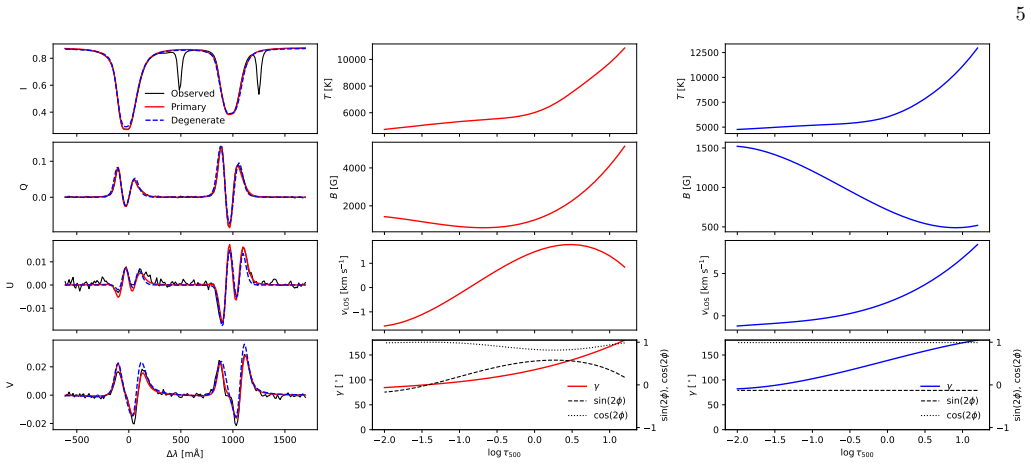
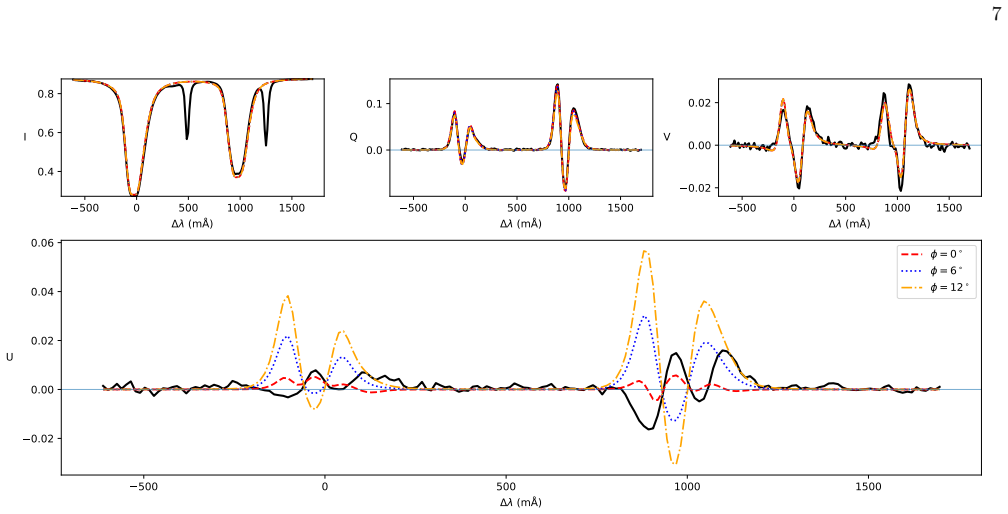
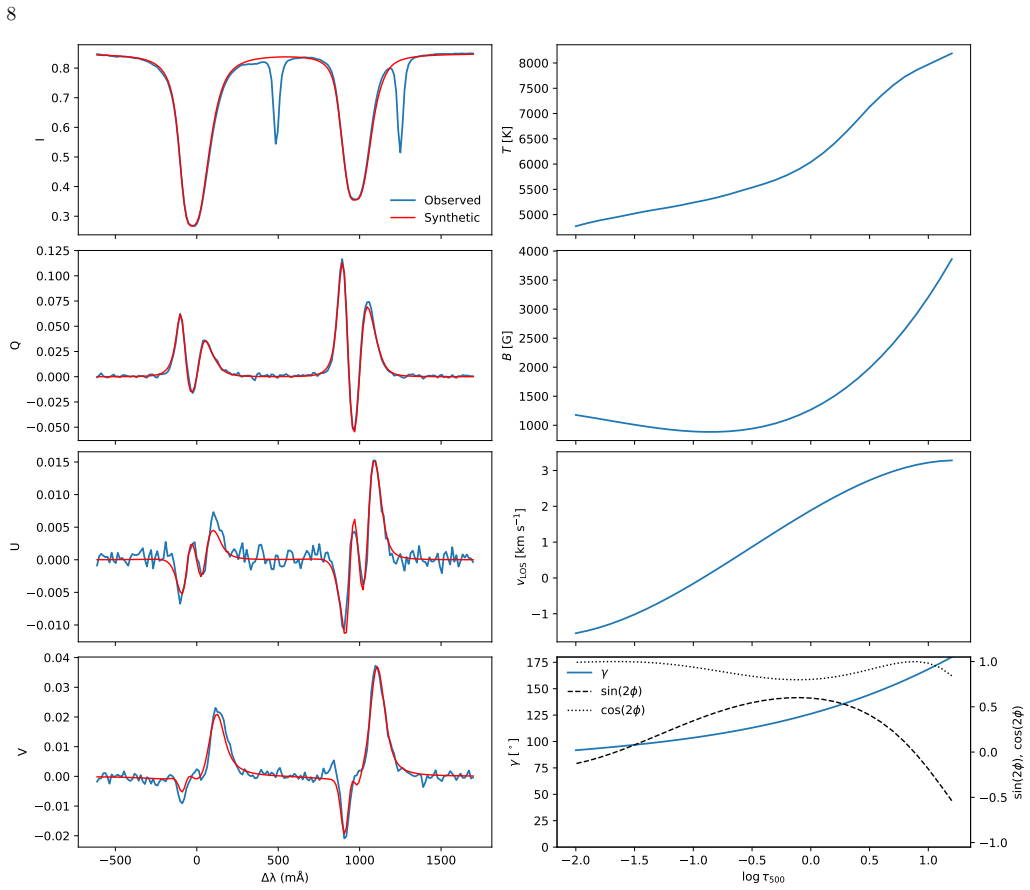
Stratified inversions containing line-of-sight gradients in magnetic azimuth reproduce the observed four-lobed Stokes U profiles. When the azimuth is artificially held constant with optical depth, the Stokes U morphology changes substantially while Stokes I, Q, and V remain comparatively unaffected, indicating that azimuthal variation is an important contributor within the tested one-component atmospheres. Two-component models generally converge to pathological solutions, whereas constant-azimuth one-component models supply a plausible but degenerate alternative explanation for much of the four-lobed morphology.
What carries the argument
Line-of-sight variation of magnetic azimuth inside one-component stratified atmospheres, which generates the four-lobed Stokes U signatures.
If this is right
- Azimuthal variation along the line of sight contributes significantly to the observed linear polarization signatures.
- The magnetic complexity producing these profiles is spatially confined to the penumbra-light-bridge boundary.
- Reverse-polarity fields accompany the four-lobed U profiles in the same locations.
- Constant-azimuth one-component models can serve as a degenerate but viable explanation for the observed Stokes vectors.
Where Pith is reading between the lines
- The same four-lobed U signature may appear in other solar regions that possess complex line-of-sight magnetic fields, extending the diagnostic beyond penumbrae.
- Existing penumbral magnetic models may require additional vertical structuring to reproduce these polarization shapes.
- Machine-learning classification of Stokes V profiles offers a scalable way to locate similar magnetic complexity in future large datasets.
Load-bearing premise
One-component stratified atmospheres that vary magnetic azimuth along the line of sight are sufficient to explain the four-lobed Stokes U profiles rather than multi-component structures.
What would settle it
A multi-component inversion that reproduces the observed four-lobed U profiles without converging to pathological solutions, or a constant-azimuth one-component model that fully matches the four-lobed U morphology after all other parameters are adjusted.
Figures

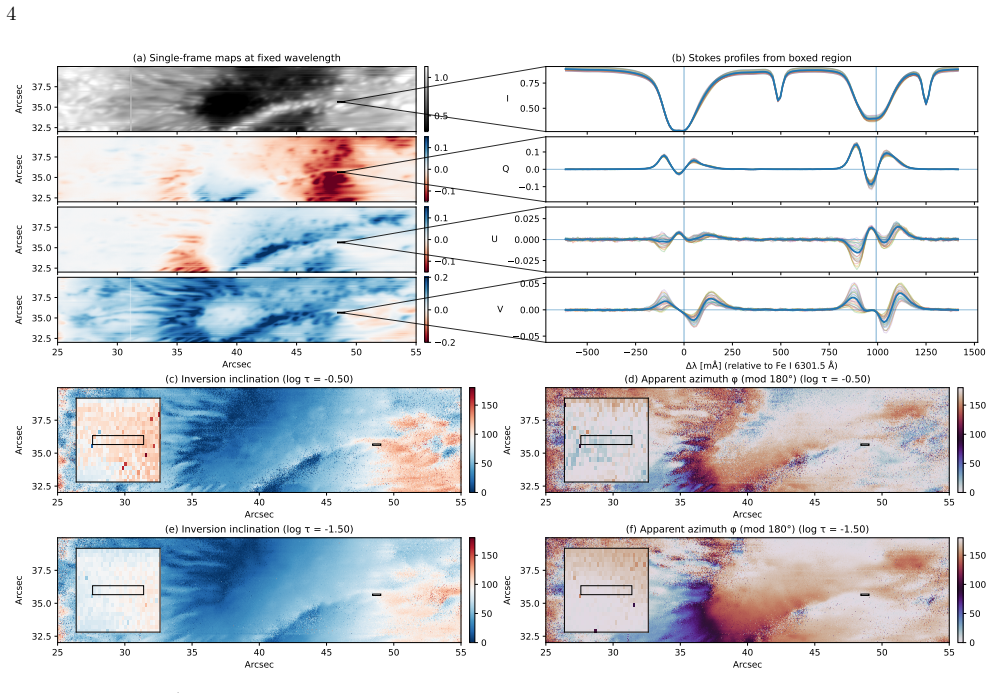
read the original abstract
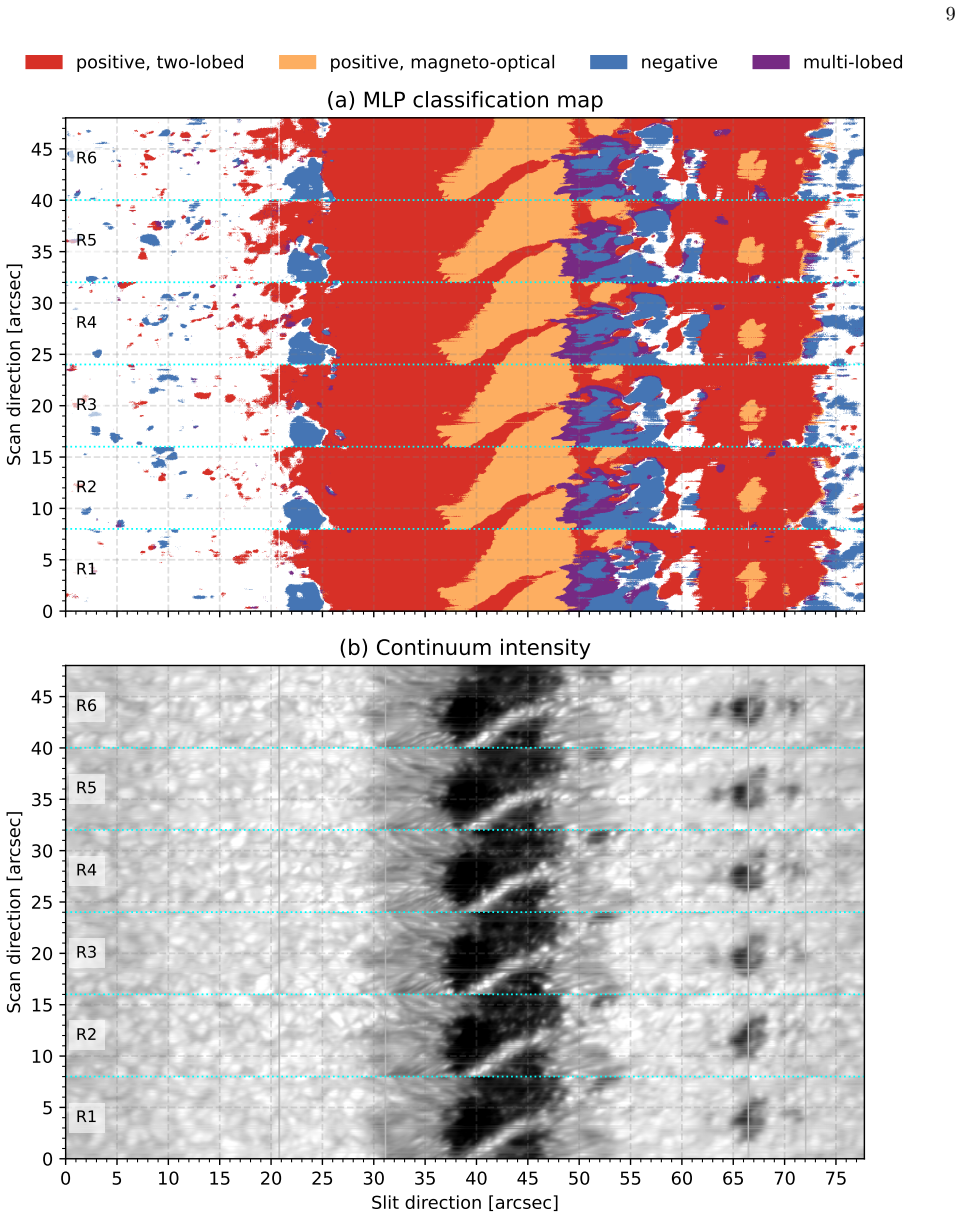
We present DKIST spectropolarimetric observations of a sunspot penumbra revealing spatially coherent four-lobed Stokes U profiles that persist after polarimetric crosstalk correction. The observed Stokes vectors are well reproduced by stratified inversions containing gradients in velocity and magnetic parameters, including line-of-sight variation of the magnetic azimuth. Forward synthesis experiments in which the magnetic azimuth is artificially held constant with optical depth substantially modify the Stokes U morphology while leaving Stokes I, Q, and V comparatively unchanged, indicating that azimuthal variation is an important contributor to the observed linear polarisation signatures within the tested one-component atmospheres. We explored degeneracies using both two-component atmospheres and one-component constant-azimuth models: the former generally converged toward pathological solutions, while the latter provided a plausible degenerate explanation for much of the observed four-lobed Stokes U morphology. A supervised machine-learning classifier applied to Stokes V profiles shows that the associated magnetic complexity is spatially confined to the penumbra-light-bridge boundary where the four-lobed Stokes U profiles and reverse-polarity fields are observed. These results identify four-lobed Stokes U profiles as a potential spectropolarimetric signature of complex line-of-sight magnetic structuring in sunspot penumbrae, providing new observational constraints on fine-scale penumbral magnetic topology.
Editorial analysis
A structured set of objections, weighed in public.
Referee Report
Summary. The paper reports DKIST spectropolarimetric observations of a sunspot penumbra that reveal spatially coherent four-lobed Stokes U profiles persisting after crosstalk correction. These are reproduced by stratified one-component inversions that include line-of-sight gradients in velocity and magnetic azimuth. Forward synthesis experiments holding azimuth constant modify the U morphology while leaving I, Q, and V largely unchanged, and a supervised ML classifier on Stokes V associates the features with the penumbra-light-bridge boundary. Degeneracies are explored with two-component models (which converge to pathological solutions) and constant-azimuth one-component models (which provide a plausible explanation for much of the observed U morphology). The central claim is that four-lobed U profiles constitute a spectropolarimetric signature of complex LOS magnetic structuring.
Significance. If the interpretation that LOS azimuthal variation is required can be made robust against the reported degeneracy, the result would supply new observational constraints on fine-scale penumbral magnetic topology. The combination of forward synthesis experiments and the ML classifier on Stokes V constitutes a clear methodological strength that grounds the spatial association.
major comments (2)
- [Abstract] Abstract: The forward-synthesis result that holding magnetic azimuth constant 'substantially modify[s] the Stokes U morphology' is presented as evidence that azimuthal variation is 'an important contributor,' yet the same paragraph states that constant-azimuth one-component models 'provided a plausible degenerate explanation for much of the observed four-lobed Stokes U morphology.' This internal tension directly affects the load-bearing claim that the four-lobed profiles are a signature specifically of LOS azimuthal gradients rather than reproducible by constant-azimuth atmospheres.
- [Abstract] Abstract: The statement that two-component atmospheres 'generally converged toward pathological solutions' is used to favor the one-component stratified model, but no quantitative criteria (e.g., χ^{2} thresholds, unphysical parameter ranges, or failure to fit specific Stokes lobes) are supplied. Without these criteria the dismissal cannot be evaluated and leaves open whether multi-component or other LOS structures could equally reproduce the four-lobed U without invoking azimuthal gradients.
Simulated Author's Rebuttal
We thank the referee for their thorough review and insightful comments on our manuscript. We address the major comments point by point below and propose revisions to clarify the presentation of our results.
read point-by-point responses
-
Referee: [Abstract] Abstract: The forward-synthesis result that holding magnetic azimuth constant 'substantially modify[s] the Stokes U morphology' is presented as evidence that azimuthal variation is 'an important contributor,' yet the same paragraph states that constant-azimuth one-component models 'provided a plausible degenerate explanation for much of the observed four-lobed Stokes U morphology.' This internal tension directly affects the load-bearing claim that the four-lobed profiles are a signature specifically of LOS azimuthal gradients rather than reproducible by constant-azimuth atmospheres.
Authors: We agree that the wording in the abstract creates an apparent tension that could confuse readers regarding the strength of our claim. The forward synthesis experiments show that constant azimuth modifies the U profiles substantially, while the constant-azimuth inversions indicate that much (but not all) of the morphology can be reproduced without gradients. To resolve this, we will revise the abstract to state more clearly that while constant-azimuth models provide a plausible explanation for a significant portion of the observed profiles, the inclusion of azimuthal gradients in the stratified one-component model is required to fully account for the four-lobed structure in the forward synthesis tests. This maintains the central claim while acknowledging the degeneracy. revision: yes
-
Referee: [Abstract] Abstract: The statement that two-component atmospheres 'generally converged toward pathological solutions' is used to favor the one-component stratified model, but no quantitative criteria (e.g., χ^{2} thresholds, unphysical parameter ranges, or failure to fit specific Stokes lobes) are supplied. Without these criteria the dismissal cannot be evaluated and leaves open whether multi-component or other LOS structures could equally reproduce the four-lobed U without invoking azimuthal gradients.
Authors: The referee correctly identifies that the manuscript lacks quantitative details on why the two-component solutions were deemed pathological. In the revised version, we will include specific information such as the χ² values obtained, the ranges of unphysical parameters (e.g., negative filling factors or extreme velocities), and how the fits failed to reproduce particular Stokes U lobes. This will allow readers to better assess the comparison between models. revision: yes
Circularity Check
No circularity; derivation rests on independent observations and forward-modeling experiments
full rationale
The paper's chain consists of direct DKIST spectropolarimetric data, standard stratified inversions, and explicit forward-synthesis tests that hold azimuth constant to isolate its effect on Stokes U. These steps are falsifiable against the observed profiles and do not reduce to fitted parameters renamed as predictions, self-definitional relations, or load-bearing self-citations. Degeneracies with constant-azimuth models are explicitly noted rather than hidden, confirming the analysis remains externally grounded.
Axiom & Free-Parameter Ledger
Reference graph
Works this paper leans on
-
[1]
Asplund, M., Grevesse, N., Sauval, A. J., & Scott, P. 2009, ARA&A, 47, 481, doi: 10.1146/annurev.astro.46.060407.145222
-
[2]
Borrero, J. M., & Ichimoto, K. 2011, Living Reviews in Solar Physics, 8, 4, doi: 10.12942/lrsp-2011-4
-
[3]
Keys, P. H., & Orozco Su´ arez, D. 2025, ApJ, 988, 9, doi: 10.3847/1538-4357/addb49
-
[4]
Campbell, R. J., Keys, P. H., Mathioudakis, M., et al. 2023, ApJL, 955, L36, doi: 10.3847/2041-8213/acf85d da Silva Santos, J. M., Reardon, K., Cauzzi, G., et al. 2023, ApJL, 954, L35, doi: 10.3847/2041-8213/acf21f de Wijn, A. G., Casini, R., Carlile, A., et al. 2022, SoPh, 297, 22, doi: 10.1007/s11207-022-01954-1
-
[5]
2013, A&A, 550, A97, doi: 10.1051/0004-6361/201220708
Franz, M., & Schlichenmaier, R. 2013, A&A, 550, A97, doi: 10.1051/0004-6361/201220708
-
[6]
Jaeggli, S. A., Schad, T. A., Tarr, L. A., & Harrington, D. M. 2022, ApJ, 930, 132, doi: 10.3847/1538-4357/ac6506
-
[7]
Lites, B. W., Elmore, D. F., Seagraves, P., & Skumanich, A. P. 1993, ApJ, 418, 928, doi: 10.1086/173450
-
[8]
1986, SoPh, 106, 269, doi: 10.1007/BF00158497
Makita, M. 1986, SoPh, 106, 269, doi: 10.1007/BF00158497
-
[9]
P., Bello Gonz´ alez, N., Bellot Rubio, L., et al
Rast, M. P., Bello Gonz´ alez, N., Bellot Rubio, L., et al. 2021, SoPh, 296, 70, doi: 10.1007/s11207-021-01789-2
-
[10]
2012, ApJ, 750, 62, doi: 10.1088/0004-637X/750/1/62
Rempel, M. 2012, ApJ, 750, 62, doi: 10.1088/0004-637X/750/1/62
-
[11]
Rimmele, T. R., Warner, M., Keil, S. L., et al. 2020, SoPh, 295, 172, doi: 10.1007/s11207-020-01736-7 11 Ruiz Cobo, B., & Asensio Ramos, A. 2013, A&A, 549, L4, doi: 10.1051/0004-6361/201220373 Ruiz Cobo, B., Quintero Noda, C., Gafeira, R., et al. 2022, A&A, 660, A37, doi: 10.1051/0004-6361/202140877 Sanchez Almeida, J., & Lites, B. W. 1992, ApJ, 398, 359,...
-
[12]
Henriques, V. M. J. 2013, A&A, 553, A63, doi: 10.1051/0004-6361/201220899
discussion (0)
Sign in with ORCID, Apple, or X to comment. Anyone can read and Pith papers without signing in.