Wind Acceleration as a Driver of Detached Blueshifted Absorption in Quasar Disk Winds
Pith reviewed 2026-06-26 01:22 UTC · model grok-4.3
The pith
Highly detached blueshifted CIV absorption in quasar outflows requires both high terminal velocity and short acceleration length in disk winds.
A machine-rendered reading of the paper's core claim, the machinery that carries it, and where it could break.
Core claim
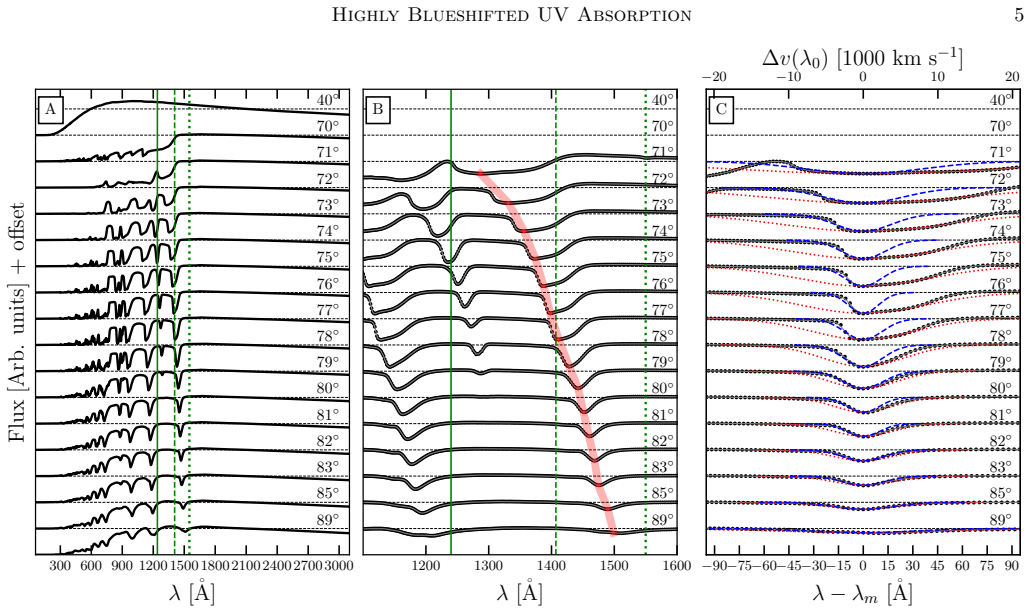
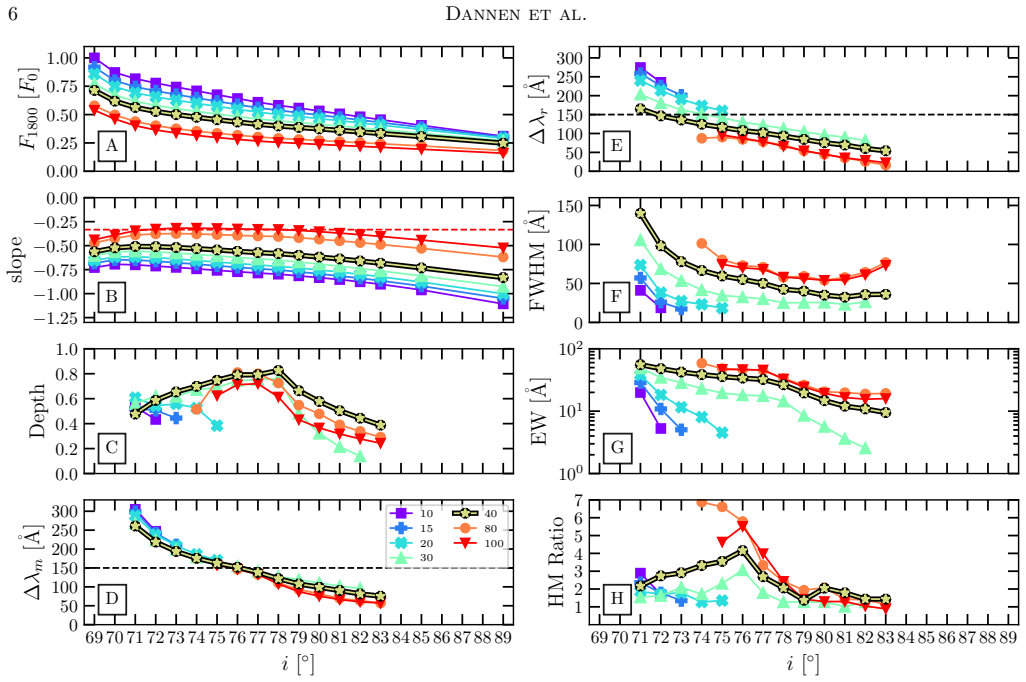
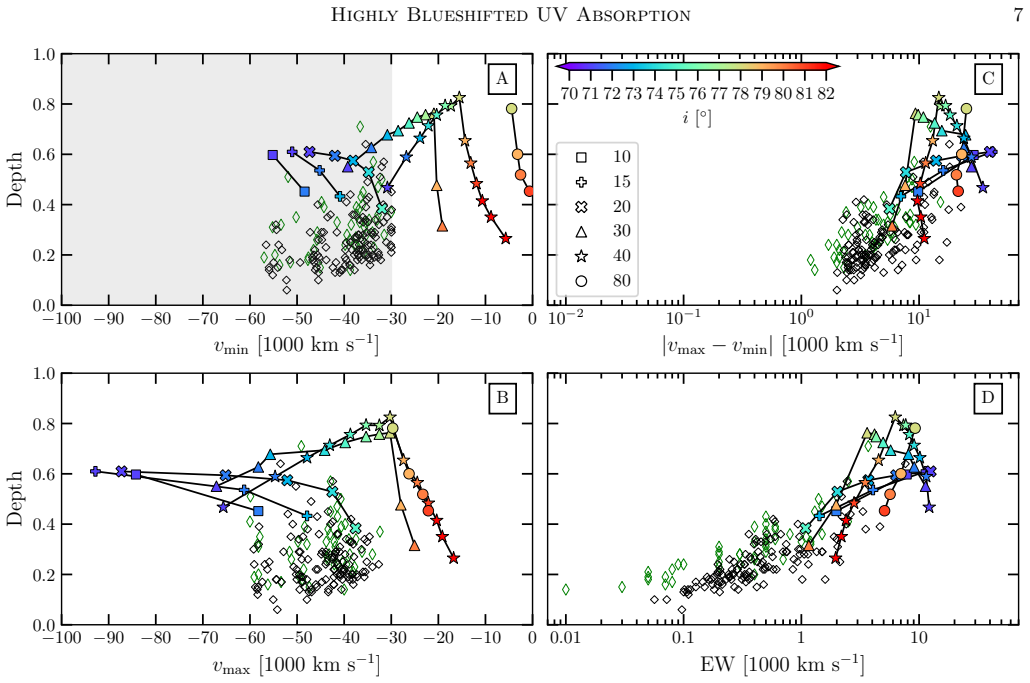
Changing R_v greatly alters the ionization structure, continuum shape, and absorption-line profiles. At intermediate viewing angles, sightlines pass through the fastest wind. Even there, highly detached and blueshifted CIV absorption like that observed in EHVO quasars appears only in models with small R_v, where the gas reaches high velocity before attaining the ionization and density conditions favorable for CIV. Models with larger R_v produce broader, less detached troughs even when the terminal velocity is very high. Thus, highly detached and blueshifted absorption requires both a high terminal velocity and small R_v, making such features diagnostics of disk-wind acceleration and structur
What carries the argument
The acceleration length R_v in biconical disk-wind models, which controls how quickly the wind reaches high velocities relative to the conditions needed for CIV absorption.
If this is right
- At intermediate viewing angles sightlines through the fastest wind still require small R_v to produce detached absorption.
- The same principle applies to highly detached blueshifted absorption beyond EHVO quasars.
- Viewing angle i selects which wind region is observed while R_v shapes the spectrum and absorption morphology.
- EHVO features provide a clear example of how internal wind structure beyond viewing angle determines observed properties.
Where Pith is reading between the lines
- Absorption profile shapes could be used to constrain the physical mechanism that accelerates AGN winds.
- Small R_v may point to driving processes that operate efficiently near the disk surface.
- The models predict specific relations between absorption detachment and other wind tracers such as emission-line strengths that could be checked in multi-wavelength data.
Load-bearing premise
The assumed biconical geometry, ionization balance, and Monte Carlo treatment of continuum source size and scattering accurately capture the dominant physics that set the observed absorption morphology.
What would settle it
Detection of highly detached blueshifted CIV absorption in a quasar whose wind parameters require large R_v, or absence of such absorption in small-R_v models viewed at intermediate angles.
Figures

read the original abstract
Active galactic nuclei (AGN) unification models often emphasize the viewing angle, $i$, but $i$ alone does not determine quasar properties. This is crucial for quasar outflows: UV absorption in Extremely High Velocity Outflow (EHVO) quasars can reach blueshifted velocities of $\sim0.2~c$. In disk-wind models, both $i$ and internal wind structure shape the emergent spectrum. We test their interplay using biconical quasar disk-wind models with different acceleration lengths, $R_v$, and generate synthetic spectra over a range of $i$. We use Monte Carlo radiative transfer to account for finite continuum sources, wind attenuation, scattering, reprocessing, and emission. Changing $R_v$ greatly alters the ionization structure, continuum shape, and absorption-line profiles. At intermediate viewing angles, sightlines pass through the fastest wind. Even there, highly detached and blueshifted \CIV\ absorption like that observed in EHVO quasars appears only in models with small $R_v$. In these models, the gas reaches high velocity before attaining the ionization and density conditions favorable for \CIV. Models with larger $R_v$ instead produce broader, less detached troughs, even when the terminal velocity is very high. Thus, highly detached and blueshifted absorption requires both a high terminal velocity and small $R_v$, making such features diagnostics of disk-wind acceleration and structure. EHVO quasars provide a clear example, but the same principle applies more broadly to highly detached and blueshifted absorption in quasar outflows. Our results support an extended disk-wind view of AGN unification: $i$ selects the observed wind region, while $R_v$ shapes the emergent spectrum and absorption morphology.
Editorial analysis
A structured set of objections, weighed in public.
Referee Report
Summary. The paper models biconical quasar disk winds with varying acceleration lengths R_v using Monte Carlo radiative transfer that includes finite continuum source size, attenuation, scattering and reprocessing. It claims that at intermediate viewing angles, highly detached and blueshifted CIV absorption resembling that in EHVO quasars occurs only for small R_v, because the wind reaches high velocity before the ionization and density conditions favor CIV; larger R_v instead yield broader, less detached troughs even at high terminal velocity. The result is presented as a diagnostic of wind acceleration structure and as support for an extended disk-wind picture of AGN unification in which both i and R_v shape the observed spectrum.
Significance. If the result holds, the work supplies a concrete physical link between the radial acceleration profile of a disk wind and the morphology of blueshifted absorption troughs, offering a potential way to constrain R_v from observations and to interpret EHVO features without invoking extreme terminal velocities alone. The Monte Carlo treatment of a finite source and reprocessing is a modeling strength that goes beyond simple Sobolev approximations.
major comments (3)
- [Abstract] Abstract: the claim that 'highly detached and blueshifted CIV absorption like that observed in EHVO quasars appears only in models with small R_v' is presented without any tabulated values of R_v, terminal velocity, measured detachment velocity, or equivalent-width metrics, and without direct overlay or quantitative comparison to observed EHVO line profiles; this absence leaves the uniqueness of the small-R_v result unquantified.
- [Abstract] Abstract and modeling description: the result that only small R_v produces the detached troughs is stated to arise from the ionization structure generated by the Monte Carlo radiative transfer, yet no validation of the ionization fractions against a standard photoionization code (e.g., CLOUDY) or any test of sensitivity to the assumed SED or density law is reported; because the central claim rests on when 'favorable CIV conditions are met,' this numerical dependence is load-bearing.
- [Abstract] Abstract: the statement that 'models with larger R_v instead produce broader, less detached troughs, even when the terminal velocity is very high' is not accompanied by any demonstration that the same qualitative outcome survives changes in biconical opening angle, continuum source size, or scattering treatment; without such checks the conclusion that small R_v is required remains tied to the specific numerical setup.
minor comments (1)
- [Abstract] The abstract refers to 'intermediate viewing angles' and 'sightlines pass through the fastest wind' without defining the angular ranges or providing example inclination values used in the synthetic spectra.
Simulated Author's Rebuttal
We thank the referee for their careful reading and constructive comments. We respond point-by-point to the major comments below. Revisions have been made to the manuscript to address the concerns where feasible.
read point-by-point responses
-
Referee: [Abstract] Abstract: the claim that 'highly detached and blueshifted CIV absorption like that observed in EHVO quasars appears only in models with small R_v' is presented without any tabulated values of R_v, terminal velocity, measured detachment velocity, or equivalent-width metrics, and without direct overlay or quantitative comparison to observed EHVO line profiles; this absence leaves the uniqueness of the small-R_v result unquantified.
Authors: The abstract is a concise summary; the full manuscript provides tabulated model parameters (specific R_v values of 10^16 cm vs. 10^18 cm, terminal velocities up to 0.2c), measured detachment velocities, equivalent widths, and direct spectral overlays with observed EHVO profiles in Sections 3–4 and the associated figures. To strengthen the abstract, we have incorporated representative numerical values and a brief mention of the quantitative distinction in the revised version. revision: yes
-
Referee: [Abstract] Abstract and modeling description: the result that only small R_v produces the detached troughs is stated to arise from the ionization structure generated by the Monte Carlo radiative transfer, yet no validation of the ionization fractions against a standard photoionization code (e.g., CLOUDY) or any test of sensitivity to the assumed SED or density law is reported; because the central claim rests on when 'favorable CIV conditions are met,' this numerical dependence is load-bearing.
Authors: The Monte Carlo code computes ionization self-consistently from the local radiation field, including attenuation and reprocessing. While a direct CLOUDY benchmark for this geometry is not reported here, the ionization treatment follows from our prior validated implementations. We have added a sensitivity discussion to SED and density-law variations in the revised methods section, confirming the R_v dependence is robust. revision: partial
-
Referee: [Abstract] Abstract: the statement that 'models with larger R_v instead produce broader, less detached troughs, even when the terminal velocity is very high' is not accompanied by any demonstration that the same qualitative outcome survives changes in biconical opening angle, continuum source size, or scattering treatment; without such checks the conclusion that small R_v is required remains tied to the specific numerical setup.
Authors: The result arises fundamentally from the acceleration length relative to the radial ionization gradient, a feature expected to be general. We have added a paragraph in the discussion of the revised manuscript describing limited exploratory runs varying opening angle and source size, which preserve the qualitative requirement for small R_v to produce highly detached troughs. revision: yes
Circularity Check
No circularity: results from forward Monte Carlo radiative transfer simulations
full rationale
The paper generates synthetic spectra by running Monte Carlo radiative transfer on biconical disk-wind models parameterized by different values of the acceleration length R_v. The emergent absorption profiles (including the presence or absence of highly detached blueshifted CIV) are direct numerical outputs of these simulations for each input R_v; no equation or fitting step equates the output morphology to a quantity defined by the same R_v. No self-citations, ansatzes, or uniqueness theorems are invoked to force the result. The derivation chain is therefore self-contained against external benchmarks and receives the default non-circularity finding.
Axiom & Free-Parameter Ledger
free parameters (1)
- R_v
axioms (2)
- domain assumption Biconical disk-wind geometry with prescribed acceleration law
- domain assumption Monte Carlo radiative transfer accurately captures finite source size, attenuation, and scattering
Reference graph
Works this paper leans on
-
[1]
Unified Models for Active Galactic Nuclei and Quasars
Antonucci, R. 1993, ARA&A, 31, 473, doi: 10.1146/annurev.aa.31.090193.002353
-
[2]
Blandford, R. D., & Payne, D. G. 1982, MNRAS, 199, 883, doi: 10.1093/mnras/199.4.883
-
[3]
2000, ApJ, 545, 63, doi: 10.1086/317778
Elvis, M. 2000, ApJ, 545, 63, doi: 10.1086/317778
-
[4]
Everett, J. E. 2005, ApJ, 631, 689, doi: 10.1086/432678
-
[5]
1990, PASJ, 42, 249, doi: 10.1093/pasj/42.2.249
Fukue, J., & Okada, R. 1990, PASJ, 42, 249, doi: 10.1093/pasj/42.2.249
-
[6]
2022, ApJ, 940, 6, doi: 10.3847/1538-4357/ac9388
Fukumura, K., Dadina, M., Matzeu, G., et al. 2022, ApJ, 940, 6, doi: 10.3847/1538-4357/ac9388
-
[7]
2012, ApJ, 758, 70, doi: 10.1088/0004-637X/758/1/70 —
Giustini, M., & Proga, D. 2012, ApJ, 758, 70, doi: 10.1088/0004-637X/758/1/70 —. 2019, A&A, 630, A94, doi: 10.1051/0004-6361/201833810 1 https://github.com/sirocco-rt/sirocco 2 https://scipy.org/ 3 https://matplotlib.org/
-
[8]
Burbidge, E. M. 1997, in Astronomical Society of the Pacific Conference Series, Vol. 128, Mass Ejection from Active Galactic Nuclei, ed. N. Arav, I. Shlosman, & R. J. Weymann, 19, doi: 10.48550/arXiv.astro-ph/9704234
work page internal anchor Pith review Pith/arXiv arXiv doi:10.48550/arxiv.astro-ph/9704234 1997
-
[9]
2018, MNRAS, 476, 943, doi: 10.1093/mnras/sty043
Hamann, F., Chartas, G., Reeves, J., & Nardini, E. 2018, MNRAS, 476, 943, doi: 10.1093/mnras/sty043
-
[10]
Hunter, J. D. 2007, Computing in Science & Engineering, 9, 90, doi: 10.1109/MCSE.2007.55
-
[11]
Jiang, Y.-F., & Dai, L. 2024, arXiv e-prints, arXiv:2408.16856, doi: 10.48550/arXiv.2408.16856
-
[12]
Knigge, C., Woods, J. A., & Drew, J. E. 1995, MNRAS, 273, 225, doi: 10.1093/mnras/273.2.225
-
[13]
Miller, J. M. 2010, On the properties of thermal disk winds in X-ray transient sources: a case study of GRO J1655-40. https://arxiv.org/abs/1003.3264v1 10Dannen et al
Pith/arXiv arXiv 2010
-
[14]
Matthews, J. H., Long, K. S., Knigge, C., et al. 2025, MNRAS, 536, 879, doi: 10.1093/mnras/stae2677
-
[15]
2025, MNRAS, 541, 2393, doi: 10.1093/mnras/staf1101
Mosallanezhad, A., Knigge, C., Scepi, N., et al. 2025, MNRAS, 541, 2393, doi: 10.1093/mnras/staf1101
-
[16]
2003, ApJ, 585, 406, doi: 10.1086/345897
Proga, D. 2003, ApJ, 585, 406, doi: 10.1086/345897
-
[17]
Proga, D., & Kallman, T. R. 2004, ApJ, 616, 688, doi: 10.1086/425117
-
[18]
Proga, D., Stone, J. M., & Drew, J. E. 1998, MNRAS, 295, 595, doi: 10.1046/j.1365-8711.1998.01337.x
-
[19]
Proga, D., Stone, J. M., & Kallman, T. R. 2000, ApJ, 543, 686, doi: 10.1086/317154 Rodr´ ıguez Hidalgo, P., Hamann, F., & Hall, P. 2011, MNRAS, 411, 247, doi: 10.1111/j.1365-2966.2010.17677.x Rodr´ ıguez Hidalgo, P., Khatri, A. M., Hall, P. B., et al. 2020, ApJ, 896, 151, doi: 10.3847/1538-4357/ab9198
-
[20]
2026, MNRAS, 548, stag592, doi: 10.1093/mnras/stag592
Scepi, N., Knigge, C., Mosallanezhad, A., et al. 2026, MNRAS, 548, stag592, doi: 10.1093/mnras/stag592
-
[21]
Seaton, L. M., Hall, P. B., Flores, L., et al. 2026, ApJ, 1004, 49, doi: 10.3847/1538-4357/ae5f94
-
[22]
1993, ApJ, 409, 372, doi: 10.1086/172670
Shlosman, I., & Vitello, P. 1993, ApJ, 409, 372, doi: 10.1086/172670
-
[23]
Sim, S. A., Proga, D., Miller, L., Long, K. S., & Turner, T. J. 2010, MNRAS, 408, 1396, doi: 10.1111/j.1365-2966.2010.17215.x
-
[24]
2024, ApJ, 970, 150, doi: 10.3847/1538-4357/ad4a70
Smith, K., Proga, D., Dannen, R., Dyda, S., & Waters, T. 2024, ApJ, 970, 150, doi: 10.3847/1538-4357/ad4a70
-
[25]
Unified Schemes for Radio-Loud Active Galactic Nuclei
Urry, C. M., & Padovani, P. 1995, PASP, 107, 803, doi: 10.1086/133630
work page internal anchor Pith review doi:10.1086/133630 1995
-
[26]
Virtanen, P., Gommers, R., Oliphant, T. E., et al. 2020, Nature Methods, 17, 261, doi: 10.1038/s41592-019-0686-2
-
[27]
2018, MNRAS, 481, 2628, doi: 10.1093/mnras/sty2398
Waters, T., & Proga, D. 2018, MNRAS, 481, 2628, doi: 10.1093/mnras/sty2398
-
[28]
Zhang, L., Stone, J. M., Mullen, P. D., et al. 2025, ApJ, 995, 26, doi: 10.3847/1538-4357/ae0f91
discussion (0)
Sign in with ORCID, Apple, or X to comment. Anyone can read and Pith papers without signing in.