An Investigation of Additional Food Models with Generalised Functional Response
Pith reviewed 2026-06-26 00:39 UTC · model grok-4.3
The pith
Additional food models with generalized responses have globally stable coexistence equilibria under stated conditions and exhibit a codimension-3 Bogdanov-Takens bifurcation for Holling type IV.
A machine-rendered reading of the paper's core claim, the machinery that carries it, and where it could break.
Core claim
For a general class of additional food models, conditions are established under which the coexistence equilibrium is globally stable. Focusing on Holling type IV functional response with additional food, the existence of a Bogdanov-Takens bifurcation of codimension 3 is shown. The introduction of additional food increases the deficiency of the underlying reaction network, suggesting a link between higher deficiency and complex bifurcations.
What carries the argument
Generalized functional response that includes an additional food term, with global stability proved via Lyapunov functions and deficiency computed via chemical reaction network theory.
If this is right
- When the stated conditions on the response hold, every positive initial condition converges to the coexistence equilibrium.
- The Holling type IV additional-food system admits a Bogdanov-Takens bifurcation of codimension exactly 3 at certain parameter values.
- Adding the food source strictly increases the deficiency index of the underlying reaction network.
- Higher deficiency is offered as the structural reason for the appearance of the codimension-3 bifurcation.
Where Pith is reading between the lines
- If the deficiency-bifurcation link is general, then other structural modifications that raise deficiency should likewise produce higher-codimension bifurcations.
- Pest-control strategies that add food might be tuned to stay inside the globally stable regime and thereby avoid unwanted oscillations.
- Numerical continuation software could be used to track the codimension-3 point as the amount of additional food is varied.
Load-bearing premise
The functional responses and additional food terms must satisfy the positivity, monotonicity and boundedness properties needed for the Lyapunov arguments and the standard deficiency formulas to apply directly.
What would settle it
A concrete parameter set in the Holling type IV additional-food model for which either the coexistence equilibrium fails to be globally stable or no codimension-3 Bogdanov-Takens point exists would falsify the respective claims.
Figures
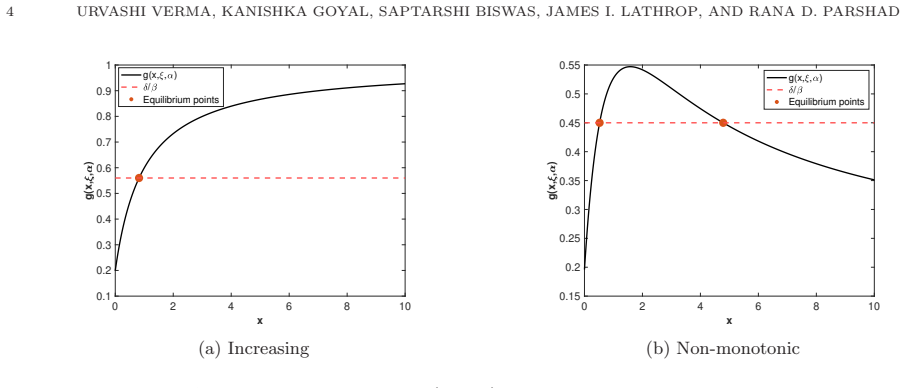
read the original abstract
Additional food sources are often used to improve the effectiveness of predators in controlling pest populations. However, the non-symmetric structure of additional food predator-prey models can cause certain aspects of their dynamics challenging to analyze. In this work, we study a general class of additional food models and establish conditions under which the coexistence equilibrium is globally stable. We then focus on a Holling type IV functional response with AF and show the existence of a Bogdanov-Takens bifurcation of codimension 3. We also study these models through the lens of deterministic chemical reaction network theory. Our analysis shows that the introduction of additional food increases the deficiency of the underlying reaction network and suggests a possible link between higher deficiency and complex bifurcations.
Editorial analysis
A structured set of objections, weighed in public.
Referee Report
Summary. The paper examines a general class of additional food (AF) predator-prey models with generalised functional responses. It derives conditions under which the coexistence equilibrium is globally stable. For the specific Holling type IV response with AF, it establishes the existence of a codimension-3 Bogdanov-Takens bifurcation. The models are also analysed via deterministic chemical reaction network theory (CRNT), where the introduction of AF is shown to increase network deficiency, with a suggested link between higher deficiency and the appearance of complex bifurcations.
Significance. If the global-stability conditions and the codim-3 BT result are rigorously derived, the work supplies concrete analytic tools for a class of models used in biological control. The CRNT perspective offers a potentially novel explanatory angle, but only if the deficiency calculations are shown to be well-defined for the non-mass-action kinetics employed.
major comments (3)
- [CRNT analysis section (and abstract)] The central CRNT claim (that AF increases deficiency and thereby promotes complex bifurcations) is load-bearing for the interpretive part of the paper. Generalised functional responses such as Holling type IV are not mass-action; the manuscript must specify exactly how the effective reaction network is constructed (auxiliary species, effective rates, etc.) and confirm that the standard deficiency theorems still apply. Without this, the suggested link between deficiency and the observed BT bifurcation lacks rigorous grounding.
- [Global stability section] The abstract asserts the existence of global-stability conditions for the general class, yet supplies no derivation outline, Lyapunov function, or statement of the precise technical hypotheses (positivity, monotonicity, boundedness) required for the proof. These hypotheses are listed as the weakest assumption in the reader’s report; the manuscript must state them explicitly and verify that the chosen generalised responses satisfy them.
- [Bifurcation analysis section] The codimension-3 Bogdanov-Takens bifurcation for the Holling type IV + AF model is a strong claim. The paper must exhibit the normal-form coefficients, the transversality conditions, and the parameter values at which the degeneracy occurs; merely stating existence without these calculations leaves the result unverifiable from the given information.
minor comments (2)
- [Notation and model formulation] Notation for the generalised functional response should be introduced once and used consistently; any re-definition in later sections should be cross-referenced.
- [Figures] Figure captions for phase portraits or bifurcation diagrams should explicitly list the parameter values used so that the codim-3 point can be reproduced.
Simulated Author's Rebuttal
We thank the referee for the careful reading and constructive suggestions. We agree that additional details are needed to make the CRNT construction, global-stability hypotheses, and bifurcation calculations fully rigorous and verifiable. We will revise the manuscript accordingly.
read point-by-point responses
-
Referee: [CRNT analysis section (and abstract)] The central CRNT claim (that AF increases deficiency and thereby promotes complex bifurcations) is load-bearing for the interpretive part of the paper. Generalised functional responses such as Holling type IV are not mass-action; the manuscript must specify exactly how the effective reaction network is constructed (auxiliary species, effective rates, etc.) and confirm that the standard deficiency theorems still apply. Without this, the suggested link between deficiency and the observed BT bifurcation lacks rigorous grounding.
Authors: We accept that the network construction for non-mass-action kinetics must be stated explicitly. In the revision we will add a dedicated subsection describing the auxiliary species, the effective rate functions used to embed the generalised responses, and the verification that the deficiency is well-defined and that the standard CRNT deficiency theorems remain applicable. We will also clarify that the link to the BT bifurcation is suggestive rather than a direct theorem. revision: yes
-
Referee: [Global stability section] The abstract asserts the existence of global-stability conditions for the general class, yet supplies no derivation outline, Lyapunov function, or statement of the precise technical hypotheses (positivity, monotonicity, boundedness) required for the proof. These hypotheses are listed as the weakest assumption in the reader’s report; the manuscript must state them explicitly and verify that the chosen generalised responses satisfy them.
Authors: The referee correctly notes that the abstract and main text lack an explicit outline of the proof. We will insert a new subsection that states the precise technical hypotheses (positivity, monotonicity, boundedness), presents the Lyapunov function, and verifies that all generalised responses considered in the paper satisfy the hypotheses. A brief derivation sketch will also be added. revision: yes
-
Referee: [Bifurcation analysis section] The codimension-3 Bogdanov-Takens bifurcation for the Holling type IV + AF model is a strong claim. The paper must exhibit the normal-form coefficients, the transversality conditions, and the parameter values at which the degeneracy occurs; merely stating existence without these calculations leaves the result unverifiable from the given information.
Authors: We agree that the codimension-3 claim requires the explicit normal-form coefficients, transversality conditions, and the concrete parameter values at which the degeneracy is attained. In the revised version we will include these calculations (currently performed but not displayed) together with the numerical parameter set, rendering the result verifiable. revision: yes
Circularity Check
No significant circularity; derivations are self-contained
full rationale
The paper establishes global stability conditions for the coexistence equilibrium via Lyapunov or similar methods and demonstrates a codimension-3 Bogdanov-Takens bifurcation through standard bifurcation analysis. These steps rely on technical assumptions about the generalized functional responses (positivity, monotonicity, boundedness) that are stated as inputs rather than derived from the outputs. The CRNT deficiency observation is presented only as a separate suggestion of a possible link, not as a load-bearing premise that derives the stability or bifurcation results. No self-definitional reductions, fitted parameters renamed as predictions, or load-bearing self-citation chains appear in the claims. The central results remain independent of the CRNT interpretation and are grounded in external mathematical techniques.
Axiom & Free-Parameter Ledger
Reference graph
Works this paper leans on
-
[1]
C. S. Holling. “Some Characteristics of Simple Types of Predation a nd Parasitism”. In: The Canadian Entomologist 91.7 (1959), pp. 385–398. doi: 10.4039/Ent91385-7
-
[2]
C. S. Holling. “The Components of Predation as Revealed by a Stud y of Small-Mammal Predation of the European Pine Sawfly”. In: The Canadian Entomologist 91.5 (1959), pp. 293–320. doi: 10.4039/Ent91293-5
-
[3]
Crawford Stanley Holling. “The functional response of predato rs to prey density and its role in mimicry and population regulation”. In: The Memoirs of the Entomological Society of Canada 97.S45 (1965), pp. 5–60. doi: 10.4039/entm9745fv
-
[4]
J.H.P. Dawes and M.O. Souza. “A derivation of Holling’s type I, II and III functional responses in predator–prey systems”. In: Journal of Theoretical Biology 327 (2013), pp. 11–22. issn: 0022-5193. doi: 10.1016/j.jtbi.2013.02.017
-
[5]
Pest origins, pesticides, and the histor y of biological control
Roy G Van Driesche et al. “Pest origins, pesticides, and the histor y of biological control”. In: Biological Control (1996), pp. 3–20. doi: 10.1007/978-1-4613-1157-7_1
-
[6]
Predator interference and the e stablishment of generalist predator populations for biocontrol
William E Snyder and David H Wise. “Predator interference and the e stablishment of generalist predator populations for biocontrol”. In: Biological Control 15.3 (1999), pp. 283–292. doi: 10.1006/bcon.1999.0723
-
[7]
Mark R Wade et al. “Conservation biological control of arthropo ds using artificial food sprays: current sta- tus and future challenges”. In: Biological control 45.2 (2008), pp. 185–199. doi: 10.1016/j.biocontrol.2007.10.024
-
[8]
Nutritional aspects of non-prey food s in the life histories of predaceous Coccinel- lidae
Jonathan G Lundgren. “Nutritional aspects of non-prey food s in the life histories of predaceous Coccinel- lidae”. In: Biological Control 51.2 (2009), pp. 294–305. doi: 10.1016/j.biocontrol.2009.05.016
-
[9]
Pollen as an altern ative or supplementary food for the mirid predator Macrolophus pygmaeus
Bjorn Vandekerkhove and Patrick De Clercq. “Pollen as an altern ative or supplementary food for the mirid predator Macrolophus pygmaeus”. In: Biological Control 53.2 (2010), pp. 238–242. doi: 10.1016/j.biocontrol.2010.0
-
[10]
When does alternative food promote biological pest control?
Maurice W Sabelis, Paul CJ Van Rijn, et al. “When does alternative food promote biological pest control?” In: IOBC WPRS BULLETIN 29.4 (2006), p. 195. url: https://www.cabidigitallibrary.org/doi/pdf/10.5555/200
work page doi:10.5555/200 2006
-
[11]
Sugar provisioning maximizes the biocontr ol service of parasitoids
Alejandro Tena et al. “Sugar provisioning maximizes the biocontr ol service of parasitoids”. In: Journal of Applied Ecology 52.3 (2015), pp. 795–804. doi: 10.1111/1365-2664.12426
-
[12]
Alternative food, switching predators, and the persistence of predator-prey systems
Minus Van Baalen et al. “Alternative food, switching predators, and the persistence of predator-prey systems”. In: The American Naturalist 157.5 (2001), pp. 512–524. doi: 10.1086/319933
-
[13]
H ow plants benefit from providing food to predators even when it is also edible to herbivores
Paul CJ van Rijn, Yvonne M van Houten, and Maurice W Sabelis. “H ow plants benefit from providing food to predators even when it is also edible to herbivores”. In: Ecology 83.10 (2002), pp. 2664–2679. doi: 10.1890/0012-9658(2002)083[2664:HPBFPF]2.0.CO;2
-
[14]
Biological con trol through provision of additional food to predators: a theoretical study
PDN Srinivasu, BSR V Prasad, and M Venkatesulu. “Biological con trol through provision of additional food to predators: a theoretical study”. In: Theoretical Population Biology 72.1 (2007), pp. 111–120. doi: 10.1016/j.tpb.2007.03.011
-
[15]
PDN Srinivasu and BSR V Prasad. “Time optimal control of an add itional food provided predator–prey system with applications to pest management and biological conserv ation”. In: Journal of mathematical biology 60.4 (2010), pp. 591–613. doi: 10.1007/s00285-009-0279-2
-
[16]
PDN Srinivasu and BSR V Prasad. “Role of quantity of additional f ood to predators as a control in predator–prey systems with relevance to pest management and b iological conservation”. In: Bulletin of mathematical biology 73.10 (2011), pp. 2249–2276. doi: 10.1007/s11538-010-9601-9
-
[17]
PDN Srinivasu, DKK Vamsi, and I Aditya. “Biological conservation of living systems by providing ad- ditional food supplements in the presence of inhibitory effect: a the oretical study using predator–prey mod- els”. In: Differential Equations and Dynamical Systems 26 (2018), pp. 213–246. doi: 10.1007/s12591-016-0344-4
-
[18]
PDN Srinivasu, DKK Vamsi, and VS Ananth. “Additional food supp lements as a tool for biological con- servation of predator-prey systems involving type III functiona l response: A qualitative and quantitative in- vestigation”. In: Journal of theoretical biology 455 (2018), pp. 303–318. doi: 10.1016/j.jtbi.2018.07.019
-
[19]
Dynamics of additional food provided predator–prey system with mutually interfering predators
BSR V Prasad, Malay Banerjee, and PDN Srinivasu. “Dynamics of additional food provided predator–prey system with mutually interfering predators”. In: Mathematical biosciences 246.1 (2013), pp. 176–190. doi: 10.1016/j.mbs.2013.08.013
-
[20]
Moitri Sen, PDN Srinivasu, and Malay Banerjee. “Global dynamic s of an additional food provided predator–prey system with constant harvest in predators”. In : Applied Mathematics and Computation 250 (2015), pp. 193–211. doi: 10.1016/j.amc.2014.10.085. 14 REFERENCES
-
[21]
T(w )o Patch or Not T(w)o Patch: A Novel Biocontrol Model
Urvashi Verma, Aniket Banerjee, and Rana D. Parshad. “T(w )o Patch or Not T(w)o Patch: A Novel Biocontrol Model”. In: Mathematical Methods in the Applied Sciences (2026). doi: 10.1002/mma.70800
-
[22]
A survey of constructing Lyapunov functions f or mathematical models in population biology
Sze-Bi Hsu. “A survey of constructing Lyapunov functions f or mathematical models in population biology”. In: Taiwanese Journal of Mathematics (2005), pp. 151–173. doi: 10.11650/twjm/1500407791
-
[23]
Global stability of predator-prey interactio ns
Gary W Harrison. “Global stability of predator-prey interactio ns”. In: Journal of Mathematical Biology 8.2 (1979), pp. 159–171. doi: 10.1007/BF00279719
-
[24]
Global Stability for a Class of P redator-Prey Systems
Sze-Bi Hsu and Tzy-Wei Huang. “Global Stability for a Class of P redator-Prey Systems”. In: SIAM Journal on Applied Mathematics 55.3 (1995), pp. 763–783. doi: 10.1137/S0036139993253201
-
[25]
Stability of ecosystem: global propert ies of a general predator–prey model
Andrei Korobeinikov. “Stability of ecosystem: global propert ies of a general predator–prey model”. In: Mathematical medicine and biology: a journal of the IMA 26.4 (2009), pp. 309–321. doi: 10.1093/imammb/dqp009
-
[26]
Global dynamics of a predator– prey model with general Holling type functional responses
Wei Ding and Wenzhang Huang. “Global dynamics of a predator– prey model with general Holling type functional responses”. In: Journal of Dynamics and Differential Equations 32.2 (2020), pp. 965–978. doi: 10.1007/s10884-019-09755-0
-
[27]
Implications of Gen- eral Functional Response on Stability and Bifurcation in Predator– Prey Systems
Miller Cer´ on G´ omez, Johana P Romero-Leiton, and Eduardo Ib arguen Mondrag´ on. “Implications of Gen- eral Functional Response on Stability and Bifurcation in Predator– Prey Systems”. In: Journal of Applied Mathematics 2025.1 (2025), p. 9931893. doi: 10.1155/jama/9931893
-
[28]
Elements of applied bifurcation theory
Yuri A Kuznetsov. Elements of applied bifurcation theory. Springer, 1998. doi: 10.1007/978-1-4757-3978-7
-
[29]
Differential equations and dynamical systems
Lawrence Perko. Differential equations and dynamical systems . Vol. 7. Springer Science & Business Media,
-
[30]
doi: 10.1007/978-1-4613-0003-8
-
[31]
VS Ananth and DKK Vamsi. “Influence of quantity of additional f ood in achieving biological conservation and pest management in minimum-time for prey-predator systems in volving Holling type III response”. In: Heliyon 7.8 (2021). doi: 10.1016/j.heliyon.2021.e07699
-
[32]
VS Ananth and DKK Vamsi. “An optimal control study with quant ity of additional food as control in prey-predator systems involving inhibitory effect”. In: Computational and Mathematical Biophysics 9.1 (2021), pp. 114–145. doi: 10.1515/cmb-2020-0121
-
[33]
Additional food causes predators to ex plode—unless the predators compete
Rana D Parshad et al. “Additional food causes predators to ex plode—unless the predators compete”. In: International Journal of Bifurcation and Chaos 33.03 (2023), p. 2350034. doi: 10.1142/S0218127423500347
-
[34]
An additional food driven biological contr ol patch model, incorporating generalized competition
Urvashi Verma et al. “An additional food driven biological contr ol patch model, incorporating generalized competition”. In: Nonlinear Science (2026), p. 100114. doi: 10.1016/j.nls.2026.100114
-
[35]
D Bhanu Prakash, Ch Chaitanya, and DKK Vamsi. “Role of intra-s pecific competition and additional food on prey-predator systems exhibiting holling type-IV function al response”. In: Franklin Open (2026), p. 100640. doi: 10.1016/j.fraope.2026.100640
-
[36]
Mass Action Laws and the Gibbs Free Energy Function
N. Z. Shapiro and L. S. Shapley. “Mass Action Laws and the Gibbs Free Energy Function”. In: Journal of the Society for Industrial and Applied Mathematics 13.2 (1965), pp. 353–375. issn: 03684245. url: http://www.jstor.org/stable/2946433 (visited on 03/26/2026)
arXiv 1965
-
[37]
Prolegomena to the rational analysis of sys tems of chemical reactions
Rutherford Aris. “Prolegomena to the rational analysis of sys tems of chemical reactions”. In: Archive for Rational Mechanics and Analysis 19.2 (Jan. 1965), pp. 81–99. issn: 1432-0673. doi: 10.1007/BF00282276
-
[38]
The mathematical structure of che mical kinetics in homogeneous single-phase systems
Frederick J. Krambeck. “The mathematical structure of che mical kinetics in homogeneous single-phase systems”. In: Archive for Rational Mechanics and Analysis 38.5 (Jan. 1970), pp. 317–347. issn: 1432-0673. doi: 10.1007/BF00251527
-
[39]
Complex balancing in general kinetic systems
Martin Feinberg. “Complex balancing in general kinetic systems” . In: Archive for Rational Mechanics and Analysis 49.3 (1972), pp. 187–194. issn: 1432-0673. doi: 10.1007/BF00255665
-
[40]
F. Horn and R. Jackson. “General mass action kinetics”. In: Archive for Rational Mechanics and Analysis 47.2 (1972), pp. 81–116. issn: 1432-0673. doi: 10.1007/BF00251225
-
[41]
A Survey on Analog Models of C omputation
Olivier Bournez and Amaury Pouly. “A Survey on Analog Models of C omputation”. In: Handbook of Computability and Complexity in Analysis . Ed. by Vasco Brattka and Peter Hertling. Cham: Springer In- ternational Publishing, 2021, pp. 173–226. isbn: 978-3-030-59234-9. doi: 10.1007/978-3-030-59234-9_6
-
[42]
Irving R Epstein and John A Pojman. An Introduction to Nonlinear Chemical Dynamics: Oscillati ons, Waves, Patterns, and Chaos . Oxford University Press, Nov. 1998. isbn: 9780195096705. doi: 10.1093/oso/97801950967
-
[43]
Robust Signal Restoration in Chemical Reaction Networks
Titus H. Klinge. “Robust Signal Restoration in Chemical Reaction Networks”. In: Proceedings of the 3rd ACM International Conference on Nanoscale Computing and Co mmunication. NANOCOM’16. New York, NY, USA: Association for Computing Machinery, 2016. isbn: 9781450340618. doi: 10.1145/2967446.2967465
-
[44]
Necessary and sufficient conditions for complex balan cing in chemical kinetics
F. Horn. “Necessary and sufficient conditions for complex balan cing in chemical kinetics”. In: Archive for Rational Mechanics and Analysis 49.3 (Jan. 1972), pp. 172–186. issn: 1432-0673. doi: 10.1007/BF00255664
-
[45]
The existence and uniqueness of steady sta tes for a class of chemical reaction net- works
Martin Feinberg. “The existence and uniqueness of steady sta tes for a class of chemical reaction net- works”. In: Archive for Rational Mechanics and Analysis 132.4 (1995), pp. 311–370. issn: 1432-0673. doi: 10.1007/BF00375614
-
[46]
Chemical Oscillations, Multiple Equilibria, and Rea ction Network Structure
Martin Feinberg. “Chemical Oscillations, Multiple Equilibria, and Rea ction Network Structure”. In: Dy- namics and Modelling of Reactive Systems . Ed. by W ARREN E. STEW ART, W. HARMON RAY, and CHARLES C. CONLEY. Academic Press, 1980, pp. 59–130. isbn: 978-0-12-669550-2. doi: 10.1016/B978-0-12-669550 REFERENCES 15
-
[47]
Martin Feinberg. “Chemical reaction network structure and t he stability of complex isothermal reac- tors—I. The deficiency zero and deficiency one theorems”. In: Chemical Engineering Science 42.10 (1987), pp. 2229–2268. issn: 0009-2509. doi: 10.1016/0009-2509(87)80099-4
-
[48]
Mathematics in population biology
Horst R Thieme. Mathematics in population biology. Princeton University Press, 2003. doi: 10.2307/j.ctv301f9v
-
[49]
Bifurcation analysis of a predator–prey system with generalised Holling type III functional response
Yann Lamontagne, Caroline Coutu, and Christiane Rousseau. “ Bifurcation analysis of a predator–prey system with generalised Holling type III functional response”. In: Journal of Dynamics and Differential Equations 20.3 (2008), pp. 535–571. doi: 10.1007/s10884-008-9102-9
-
[50]
Real-time computability of real numbers by ch emical reaction networks
Xiang Huang et al. “Real-time computability of real numbers by ch emical reaction networks”. In: Natural Computing 18.1 (Mar. 2019), pp. 63–73. issn: 1572-9796. doi: 10.1007/s11047-018-9706-x
-
[51]
M. Feinberg. Foundations of Chemical Reaction Network Theory. Applied Mathematical Sciences. Springer International Publishing, 2019. isbn: 9783030038588. doi: 10.1007/978-3-030-03858-8
-
[52]
Singular perturbations of the Holling I predator-prey system with a focus
Andr´ e Zegeling and Robert E Kooij. “Singular perturbations of the Holling I predator-prey system with a focus”. In: Journal of Differential Equations 269.6 (2020), pp. 5434–5462. doi: 10.1016/j.jde.2020.04.011
-
[54]
Uniqueness of limit cycles in Gause -type models of predator-prey sys- tems
Yang Kuang and HI Freedman. “Uniqueness of limit cycles in Gause -type models of predator-prey sys- tems”. In: Mathematical Biosciences 88.1 (1988), pp. 67–84. doi: 10.1137/0512047
-
[55]
Global analysis in Bazykin’s model with Hollin g II functional response and predator competition
Min Lu and Jicai Huang. “Global analysis in Bazykin’s model with Hollin g II functional response and predator competition”. In: Journal of Differential Equations 280 (2021), pp. 99–138. doi: 10.1016/j.jde.2021.01.025
-
[56]
A bifurcation analysis of an additional food assisted biolo gical control model under generalized predator competition
Kanishka Goyal et al. A bifurcation analysis of an additional food assisted biolo gical control model under generalized predator competition. Manuscript in preparation
-
[57]
Bifurcatio n analysis of a predator-prey system with nonmonotonic functional response
Huaiping Zhu, Sue Ann Campbell, and Gail SK Wolkowicz. “Bifurcatio n analysis of a predator-prey system with nonmonotonic functional response”. In: SIAM Journal on Applied Mathematics 63.2 (2003), pp. 636–682. doi: 10.1137/S0036139901397285
-
[58]
Global analysis in a predator-pr ey system with nonmonotonic functional response
Dongmei Xiao and Shigui Ruan. “Global analysis in a predator-pr ey system with nonmonotonic functional response”. In: SIAM Journal on Applied Mathematics 61.4 (2001), pp. 1445–1472. doi: 10.1137/S0036139999361896
-
[59]
Dongmei Xiao and Huaiping Zhu. “Multiple focus and Hopf bifurcat ions in a predator-prey system with nonmonotonic functional response”. In: SIAM Journal on Applied Mathematics 66.3 (2006), pp. 802–819. doi: 10.1137/050623449
-
[60]
Multiple bifurcation in a pred ator–prey system with nonmonotonic predator response
Franz Rothe and Douglas S Shafer. “Multiple bifurcation in a pred ator–prey system with nonmonotonic predator response”. In: Proceedings of the Royal Society of Edinburgh Section A: Mat hematics 120.3-4 (1992), pp. 313–347. doi: 10.1017/S0308210500032169. Department of Mathematics, Iow a State University, Ames, IA, USA Email address : uverma@iastate.edu D...
discussion (0)
Sign in with ORCID, Apple, or X to comment. Anyone can read and Pith papers without signing in.