The Tilted Playing Field for Women in Science
Pith reviewed 2026-06-26 03:01 UTC · model grok-4.3
The pith
Women gain prestige advantages in science only at elite institutions while men benefit across the full hierarchy.
A machine-rendered reading of the paper's core claim, the machinery that carries it, and where it could break.
Core claim
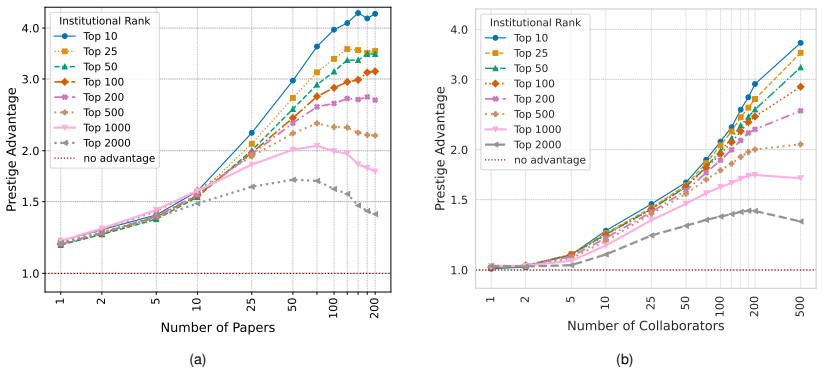
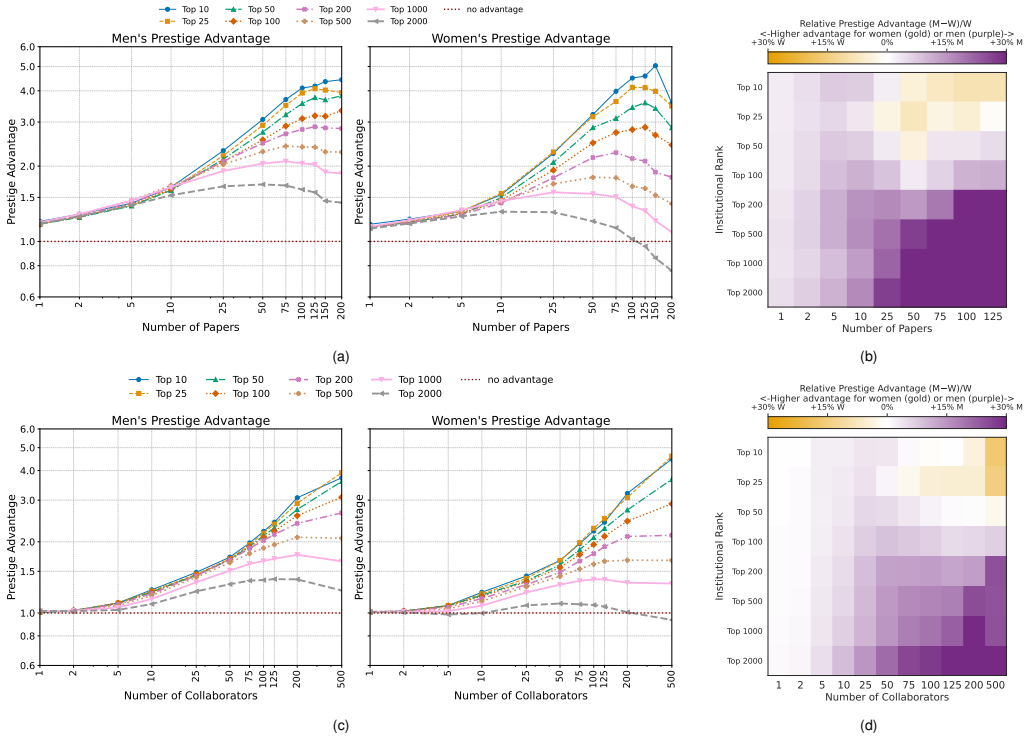
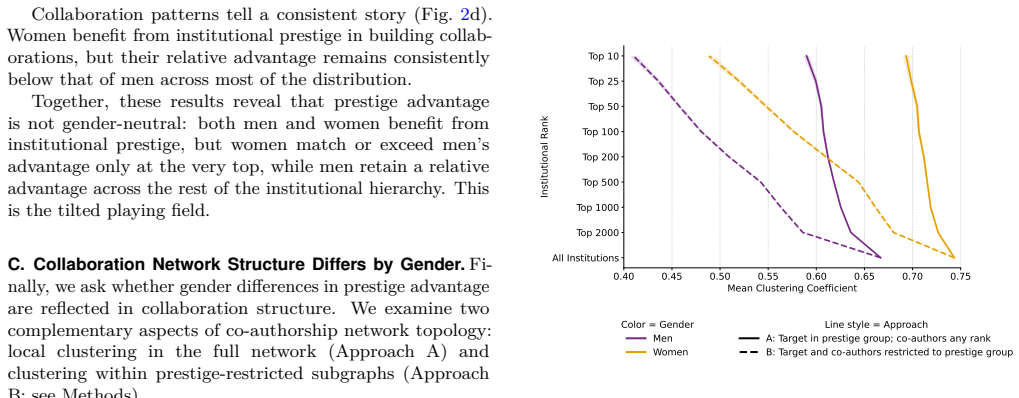
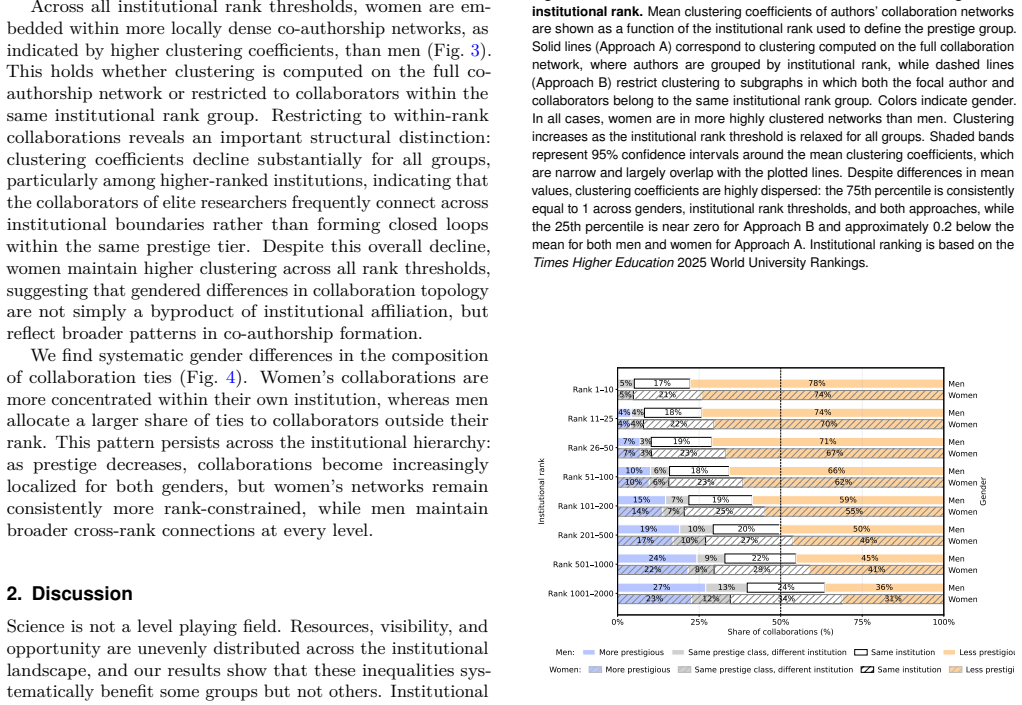
The association between prestige and scientific achievement differs systematically by gender. While both men and women benefit from prestige, the returns are not gender-neutral: women experience comparable advantages only at the most elite institutions, whereas men retain persistent advantages across the broader hierarchy, with disparities widening at higher levels of achievement. Prestige advantage also grows nonlinearly, disproportionately benefiting authors at the most elite institutions. These differences align with collaboration patterns: women's networks are more locally clustered and focused on their own institution, while men collaborate more broadly across institutional strata.
What carries the argument
Prestige advantage, defined as the relative likelihood that researchers at higher-ranked institutions have more collaborators and produce more high-impact papers, compared via a distributional tail-sensitive framework across gender groups.
If this is right
- Prestige amplifies success unevenly by gender at every level below the very top.
- Network structure determines who can turn prestige into additional collaborators and high-impact output.
- Advantages increase nonlinearly, so the biggest gaps appear between top institutions and all others.
- Women's more local collaboration patterns limit their access to prestige benefits compared with men's broader patterns.
Where Pith is reading between the lines
- Efforts to expand women's networks beyond their home institution could narrow the observed gaps if the collaboration difference is a main driver.
- If prestige rankings themselves embed prior gender imbalances in hiring or citation, the measured advantages may partly reflect those earlier patterns.
- Applying the same distributional comparison to other countries or disciplines would test whether the gender tilt in prestige returns is specific to the studied data.
Load-bearing premise
Institutional prestige rankings and counts of collaborators or high-impact papers capture advantage without systematic differences in data coverage or validity between men and women.
What would settle it
Re-running the analysis on the same papers but with alternative prestige rankings or with metrics that include more lower-impact work, and finding equal prestige advantages for men and women at all ranks, would falsify the central claim.
Figures
read the original abstract
Institutional prestige shapes access to resources, visibility, and collaboration opportunities in science. Yet whether prestige benefits researchers equally, and how it relates to differences in scientific productivity and collaboration, remains unclear. Here, we quantify prestige advantage as the relative likelihood that researchers at higher-ranked institutions have more collaborators and produce more high-impact papers compared to their lower-ranked peers. Analyzing nearly 5 million papers by 6.5 million authors across more than 65,000 institutions, we present a distributional, tail-sensitive framework to compare prestige advantage across groups. We find that the association between prestige and scientific achievement differs systematically by gender. While both men and women benefit from prestige, the returns are not gender-neutral: women experience comparable advantages only at the most elite institutions, whereas men retain persistent advantages across the broader hierarchy, with disparities widening at higher levels of achievement. Prestige advantage also grows nonlinearly, disproportionately benefiting authors at the most elite institutions. These differences align with collaboration patterns: women's networks are more locally clustered and focused on their own institution, while men collaborate more broadly across institutional strata. Together, these findings reveal a tilted playing field in science: one where prestige amplifies success unevenly and network structure shapes who can access its benefits.
Editorial analysis
A structured set of objections, weighed in public.
Referee Report
Summary. The manuscript analyzes nearly 5 million papers by 6.5 million authors across more than 65,000 institutions using a distributional, tail-sensitive framework. It quantifies prestige advantage as the relative likelihood that researchers at higher-ranked institutions have more collaborators and produce more high-impact papers. The central claim is that this advantage differs systematically by gender: both benefit from prestige, but women experience comparable advantages only at the most elite institutions while men retain persistent advantages across the broader hierarchy, with disparities widening at higher achievement levels. Prestige advantage grows nonlinearly, and differences align with collaboration patterns where women's networks are more locally clustered around their own institution while men's are broader across strata.
Significance. If the results hold after methodological verification, the work would provide large-scale empirical evidence of non-neutral returns to institutional prestige by gender, with implications for understanding how network structure and prestige interact to shape scientific achievement. The scale of the dataset and the tail-sensitive distributional approach are strengths that allow examination of disparities at high achievement levels, which could inform equity policies if the proxies prove robust.
major comments (2)
- [Abstract] Abstract: The abstract states the findings and describes the scale of the data but provides no details on data sources, cleaning rules, statistical controls, or potential confounds, so it is not possible to verify whether the central claim is supported by the actual analysis.
- [Results/Discussion] Results/Discussion: The claim that prestige returns differ by gender and that disparities widen at higher levels requires that institutional prestige rankings and metrics of collaborators/high-impact papers function as gender-neutral measures. No stratification by field, career stage, or robustness checks on the gender-inference pipeline are described, leaving open whether observed tail differences could arise from systematic differences in database coverage or citation cultures.
minor comments (1)
- [Abstract] The abstract could briefly indicate the specific form of the distributional framework (e.g., quantile comparisons or tail ratios) used to measure prestige advantage.
Simulated Author's Rebuttal
We thank the referee for their constructive comments on our manuscript. We address each major comment below and have revised the manuscript to improve clarity and address methodological concerns where feasible.
read point-by-point responses
-
Referee: [Abstract] Abstract: The abstract states the findings and describes the scale of the data but provides no details on data sources, cleaning rules, statistical controls, or potential confounds, so it is not possible to verify whether the central claim is supported by the actual analysis.
Authors: We agree the abstract is high-level by design. In revision, we have expanded it to briefly note the primary data source (a large-scale bibliographic database), key cleaning steps for author-institution matching, and that analyses include field controls and distributional methods. Full details on data sources, cleaning rules, statistical controls, and discussion of potential confounds remain in the Methods and Supplementary Information. These changes allow better assessment of the claims without exceeding abstract length limits. revision: yes
-
Referee: [Results/Discussion] Results/Discussion: The claim that prestige returns differ by gender and that disparities widen at higher levels requires that institutional prestige rankings and metrics of collaborators/high-impact papers function as gender-neutral measures. No stratification by field, career stage, or robustness checks on the gender-inference pipeline are described, leaving open whether observed tail differences could arise from systematic differences in database coverage or citation cultures.
Authors: Institutional prestige rankings rely on aggregate, gender-blind metrics (e.g., institutional publication and citation totals), and high-impact is defined via field-normalized citation percentiles to mitigate citation culture differences. We have added field-stratified analyses (by broad disciplines) to the supplement, showing patterns hold across fields. Career-stage controls use publication-year proxies, with explicit discussion of data limitations as a caveat. We have also added robustness checks on the gender-inference pipeline, including threshold sensitivity tests and validation against external benchmarks, to address potential database coverage issues. These additions support the gender differences as robust rather than artifactual. revision: partial
Circularity Check
No significant circularity in the derivation chain
full rationale
The paper reports an empirical analysis of large-scale publication data using a distributional, tail-sensitive framework to quantify prestige advantages. No equations, fitted parameters, self-referential definitions, or predictions that reduce to inputs by construction appear in the abstract or described methods. The central claims rest on direct comparison of observed distributions across groups rather than any self-definitional or self-citation load-bearing step. The analysis is therefore self-contained against external benchmarks.
Axiom & Free-Parameter Ledger
Reference graph
Works this paper leans on
-
[1]
Results We analyze nearly 5 million papers published between 1980 and 2024 in the 100 highest-impact academic venues, as ranked by Google Scholar ( 18) (see Methods). These include interdisciplinary journals such as Nature, Science, and JAMA, as well as leading disciplinary venues such as NeurIPS, Cell, Chemical Reviews, and Energy & Environmental Science...
1980
-
[2]
Discussion Science is not a level playing field. Resources, visibility, and opportunity are unevenly distributed across the institutional landscape, and our results show that these inequalities sys- tematically benefit some groups but not others. Institutional prestige acts as a productivity amplifier, one whose effects are strongest in the upper echelons...
2000
-
[3]
We exclude papers with more than 20 authors
We further filter on papers published in the top-100 venues according to Google Scholar Metrics (accessed 1 October 2025) (18, 25). We exclude papers with more than 20 authors. The resulting sample comprises 4,899,176 papers, 6,501,695 authors, and 65,206 institutions (SI Sections 1 and 2). Institutional Prestige.We characterize institutional prestige usi...
2025
-
[4]
Preprint
CCDF (complementary cumulative distribution func- tion).For an author-level variable X (number of papers in top venues or number of collaborators), we evaluate the Rustiet al. Preprint. Under review. —5 empirical CCDF P(X > x) = N>x N ,[1] where N>x is the number of authors with X > x and N is the total number of authors (Fig S4). The CCDF gives the proba...
-
[5]
Prestige advantage.Prestige advantage measures how much more likely it is to find a prolific author at a top- k institution than outside of it. Formally, for a threshold x, it is defined as: A(x, k) = P(X > x|Top-k) P(X > x|non–Top-k).[2] Here P (X > x|·) denotes the probability that a randomly chosen author in the specified group exceeds the threshold x....
-
[6]
2 evaluated for gender g∈ {men,women}
Relative gender gap in prestige advantage.To compare how prestige advantage differs by gender we compute the proportional difference ∆(x, k) = Amen(x, k)−Awomen(x, k) Awomen(x, k) ,[3] where Ag(x, k) is Eq. 2 evaluated for gender g∈ {men,women}. A value of ∆( x, k) = 0 indicates parity between genders. Positive ∆ indicates that institutional prestige bene...
-
[7]
Local clustering coefficient.For each author i we compute the standard clustering coefficient Ci = 2Ti di(di−1), where di is author i’s degree andTi is the number of triangles containing i. The clustering coefficient captures the extent to which an author’s collaborators are also connected to one another and ranges from 0 to 1, with higher values indicati...
-
[8]
Shares are computed from aggregated collaborator counts (not per-author averages), ensuring that results reflect the full volume of collaborative ties
Collaborator prestige.For each focal group (gender ×institutional prestige class) we partition collaborators into four mutually exclusive categories: collaborators at more prestigious institutions, collaborators in the same rank class but at a different institution, collaborators at the same institution (internal), and collaborators at less prestigious in...
-
[9]
advances1, e1400005 (2015)
A Clauset, S Arbesman, DB Larremore, Systematic inequality and hierarchy in faculty hiring networks.Sci. advances1, e1400005 (2015)
2015
-
[10]
SF Way, AC Morgan, DB Larremore, A Clauset, Productivity, prominence, and the effects of academic environment.Proc. Natl. Acad. Sci.116, 10729–10733 (2019)
2019
-
[11]
T Bol, M de Vaan, A van de Rijt, The Matthew effect in science funding.Proc. Natl. Acad. Sci.115, 4887–4890 (2018)
2018
-
[12]
M Strevens, The role of the matthew effect in science.Stud. Hist. Philos. Sci. Part A37, 159–170 (2006)
2006
-
[13]
Undemocracy
Y Xie, “Undemocracy”: inequalities in science.Science344, 809–810 (2014)
2014
-
[14]
sociological review69, 239–264 (2004)
V Burris, The academic caste system: Prestige hierarchies in PhD exchange networks.Am. sociological review69, 239–264 (2004)
2004
-
[15]
SF Way, DB Larremore, A Clauset, Gender, productivity, and prestige in computer science faculty hiring networks inProceedings of the 25th international conference on world wide web. pp. 1169–1179 (2016)
2016
-
[16]
sociological review 55, 469–478 (1990)
PD Allison, JS Long, Departmental effects on scientific productivity.Am. sociological review 55, 469–478 (1990)
1990
-
[17]
JJ Heckman, S Moktan, Publishing and promotion in economics: The tyranny of the top five. J. Econ. Lit.58, 419–470 (2020)
2020
-
[18]
advances8, eabq7056 (2022)
S Zhang, KH Wapman, DB Larremore, A Clauset, Labor advantages drive the greater productivity of faculty at elite universities.Sci. advances8, eabq7056 (2022)
2022
-
[19]
Phys.4, 189 (2021)
KA Burghardt, Z He, AG Percus, K Lerman, The emergence of heterogeneous scaling in research institutions.Commun. Phys.4, 189 (2021)
2021
-
[20]
analysis26, 312–327 (2018)
ML Dion, JL Sumner, SM Mitchell, Gendered citation patterns across political science and social science methodology fields.Polit. analysis26, 312–327 (2018)
2018
-
[21]
K Lerman, Y Yu, F Morstatter, J Pujara, Gendered citation patterns among the scientific elite.Proc. Natl. Acad. Sci.119, e2206070119 (2022)
2022
-
[22]
HO Witteman, M Hendricks, S Straus, C Tannenbaum, Are gender gaps due to evaluations of the applicant or the science? a natural experiment at a national funding agency.The Lancet393, 531–540 (2019)
2019
-
[23]
Forces96, 529–560 (2017)
K Weisshaar, Publish and perish? an assessment of gender gaps in promotion to tenure in academia.Soc. Forces96, 529–560 (2017)
2017
-
[24]
J Huang, AJ Gates, R Sinatra, AL Barab ´asi, Historical comparison of gender inequality in scientific careers across countries and disciplines.Proc. Natl. Acad. Sci.117, 4609–4616 (2020)
2020
-
[25]
advances9, eadi2205 (2023)
K Spoon, et al., Gender and retention patterns among us faculty.Sci. advances9, eadi2205 (2023)
2023
-
[26]
Google Scholar, Google Scholar Top Publications (https://scholar.google.com/citations?view op=top venues&hl=en) (2025) Accessed: Sept 2, 2025
2025
-
[27]
Times Higher Education, The world university rankings 2025 (https://www.timeshighereducation.com/world-university-rankings/2025/world-ranking) (2025) Accessed: Jul 15, 2025
2025
-
[28]
Complex Syst.21, 1750011 (2017)
M Jadidi, F Karimi, H Lietz, C Wagner, Gender disparities in science? dropout, productivity, collaborations and success of male and female computer scientists.Adv. Complex Syst.21, 1750011 (2017)
2017
-
[29]
(Oxford University Press), (2005)
RS Burt,Brokerage and closure: An introduction to social capital. (Oxford University Press), (2005)
2005
-
[30]
J Bachmann, L Esp ´ın-Noboa, G I˜niguez, F Karimi, Cumulative advantage of brokerage in academia.arXiv:2407.11909(2024)
Pith/arXiv arXiv 2024
-
[31]
MW Rossiter, The Matthew Matilda effect in science.Soc. Stud. Sci.23, 325–341 (1993)
1993
-
[32]
J Priem, H Piwowar, R Orr, OpenAlex: A fully-open index of scholarly works, authors, venues, institutions, and concepts.arXiv:2205.01833(2022)
Pith/arXiv arXiv 2022
-
[33]
Google Scholar, Google Scholar Metrics (https://scholar.google.com/intl/en/scholar/metrics.html) (2025) Accessed: Sept 2, 2025
2025
-
[34]
I Van Buskirk, A Clauset, DB Larremore, An open-source cultural consensus approach to name-based gender classification inProceedings of the International AAAI Conference on Web and Social Media. Vol. 17, pp. 866–877 (2023) https://github.com/ianvanbuskirk/nbgc
2023
-
[35]
6— Preprint
A Hagberg, PJ Swart, DA Schult, Exploring network structure, dynamics, and function using networkx, (Los Alamos National Laboratory (LANL)), Technical report (2007). 6— Preprint. Under review. Rustiet al. Supplementary Information
2007
-
[36]
Identification of high-impact publication venues As a proxy of scholarly impact, we consider publication in one of the Google Scholar top-100 venues (accessed on October 1, 2025). Google Scholar ranks venues according to their five-year h-index (h5-index), ∗ defined as the largest number h such that h articles published in a venue during this period each ...
2025
-
[37]
OpenAlex Data Preprocessing We draw bibliometric data from OpenAlex, a public catalog of the global scholarly research system. OpenAlex aggregates and standardizes metadata on scholarly papers, authors, venues, institutions, and citations from a wide range of underlying sources, including Crossref, PubMed, PubMed Central, ORCID, ROR, Unpaywall, and subjec...
2025
-
[38]
last known institution
Institutional Ranking and Author Affiliation To characterize the institutional prestige of author’s affiliation, we use the Times Higher Education (THE) World University Rankings 2025 (19). The THE rankings provide a global comparison of research-intensive universities across multiple dimensions, including teaching, research environment, research quality,...
2025
-
[39]
Last, First
Author gender inference Author gender was inferred using a first name–based classification procedure applied to OpenAlex author metadata. Our starting point was the author dataset described above, containing 6,501,695 unique authors with OpenAlex author identifiers ( author id) and associated bibliometric information. To obtain author name information, we...
2025
-
[40]
Ifg m > g w, the author was assignedmen
-
[41]
Ifg w > g m, the author was assignedwomen
-
[42]
If gm = gw and both categories were present, the classification of the primary display name was used as a tie-breaker when available
-
[43]
If the tie could not be resolved, or if all name classifications wereunknown, the author was assignedunknown. In addition to the inferred gender label, we recorded a binary indicator ( conflicting) identifying authors for whom both male and female classifications were observed among their name variants. This flag allows ambiguous cases to be examined sepa...
-
[44]
Dataset Descriptive Statistics Figure S2 summarizes the temporal evolution of gender representation in the dataset. Panel (a) shows the number of active authors by gender, defined as authors publishing in a given year in the top-100 venues, revealing substantial growth for both men and women over time. Panel (b) reports the ratio of women authors per 100 ...
1980
discussion (0)
Sign in with ORCID, Apple, or X to comment. Anyone can read and Pith papers without signing in.