Budget-Constrained Compound Library Prioritization with Risk Awareness and Uncertainty Quantification
Pith reviewed 2026-06-26 02:20 UTC · model grok-4.3
The pith
Risk-aware ordering in a 100-molecule BACE replay keeps Hit@10 at 0.9000 while supplying review evidence omitted by pure activity sorting.
A machine-rendered reading of the paper's core claim, the machinery that carries it, and where it could break.
Core claim
The paper establishes a risk-aware compound-library compression procedure that, for any given molecular library and fixed Top-k budget, produces an enriched candidate subset while retaining uncertainty quantification, applicability-domain evidence, ADMET and structural alerts, and full audit trails needed for downstream human review. The procedure relies on Morgan fingerprints, RDKit descriptors, a multilayer perceptron, split-conformal intervals, and leakage-controlled export; on ChEMBL 36 it records the listed Spearman and enrichment factors, and in a strict BACE 100-molecule replay the ordering preserves Hit@10 at 0.9000 while exposing review signals that activity-only ranking discards.
What carries the argument
Risk-aware compound-library compression, which integrates a 2D activity proxy (Morgan fingerprints and RDKit descriptors with multilayer perceptron) and split-conformal uncertainty intervals to rank candidates under a fixed budget while preserving reviewable metadata.
If this is right
- Risk-aware ordering can serve as an upstream prioritization layer before more expensive assays or complex models.
- The preserved uncertainty and alert fields allow human reviewers to catch cases that pure activity ranking would miss.
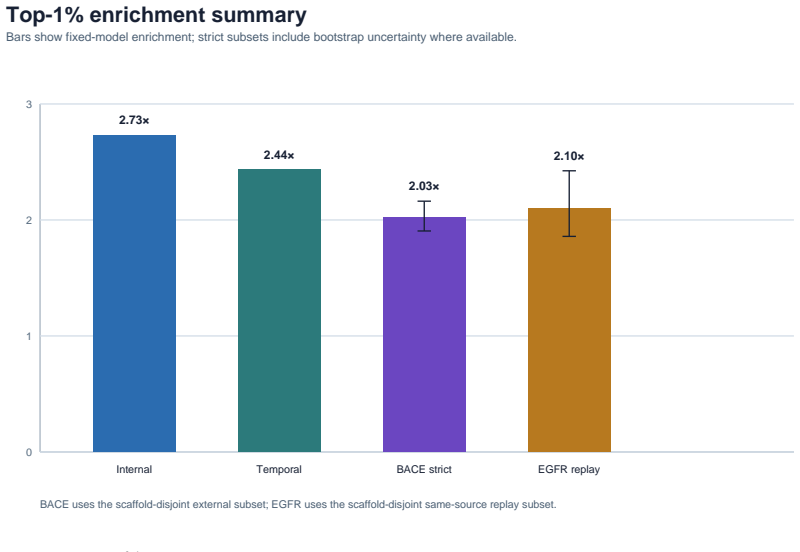
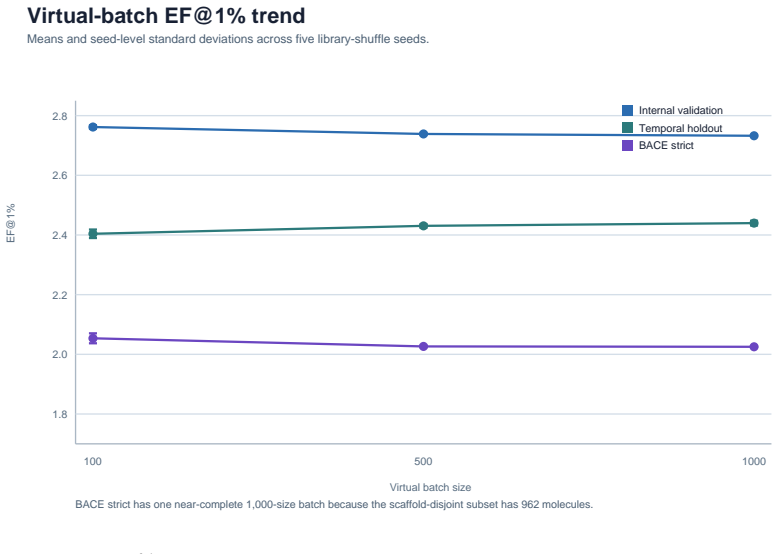
- Performance on temporal and scaffold-disjoint BACE splits remains above random (ROC AUC 0.76, EF@1% 2.0).
- The same workflow is feasible on other targets such as EGFR as shown by the label-hidden sensitivity replay.
Where Pith is reading between the lines
- If the 2D proxy systematically under-represents 3D or assay-specific effects, the reported enrichment may not translate to real project decisions.
- The approach could be combined with 3D representations or assay-specific models as a second-stage filter after the initial risk-aware compression.
- Audit fields exported by the method could support regulatory or project-log documentation requirements beyond the BACE example.
Load-bearing premise
The 2D activity proxy together with split-conformal intervals is assumed to be sufficient to generate orderings that simultaneously preserve enrichment and human-review utility.
What would settle it
A prospective blinded test on newly synthesized or purchased compounds in which the risk-aware ordering produces lower hit rates or poorer review utility than activity-only sorting within the same Top-k budget.
Figures

read the original abstract
Early discovery projects often face a budgeted prioritization problem: many structures can be enumerated or purchased, but only a small fraction can be tested, reviewed, or synthesized first. I formulate this setting as risk-aware compound-library compression. Given a molecular library and a fixed Top-k budget, the goal is to return an enriched candidate subset while preserving uncertainty, applicability-domain evidence, ADMET/structural alerts, and audit fields needed for human review. The framework intentionally uses a transparent 2D activity proxy rather than a complex representation model, combining Morgan fingerprints, RDKit descriptors, a multilayer perceptron, split-conformal uncertainty intervals, leakage auditing, and auditable export. On ChEMBL 36, the model achieved Spearman 0.7674 and EF@1% 2.7331 on internal validation, and Spearman 0.5171 with EF@1% 2.4359 on a temporal holdout. After fold-0 training-overlap control, a scaffold-disjoint BACE subset retained ROC AUC 0.7626 and EF@1% 2.0253. In a strict 100-molecule BACE decision-layer replay, risk-aware ordering kept Hit@10 at 0.9000 while exposing review evidence that pure activity sorting omits. An EGFR/CHEMBL203 label-hidden operational replay supports workflow feasibility but is reported as same-source sensitivity analysis rather than independent external validation. The claim is bounded: the evidence supports risk-aware library compression as an upstream prioritization layer, while prospective blinded validation remains necessary before claiming project-specific hit-rate or cost improvements.
Editorial analysis
A structured set of objections, weighed in public.
Referee Report
Summary. The manuscript formulates budget-constrained compound library prioritization as risk-aware compression. It employs a transparent 2D activity proxy (Morgan fingerprints + RDKit descriptors + MLP) with split-conformal uncertainty intervals, leakage auditing, and auditable export. On ChEMBL 36 it reports internal Spearman 0.7674 / EF@1% 2.7331 and temporal-holdout Spearman 0.5171 / EF@1% 2.4359; after training-overlap control a scaffold-disjoint BACE subset yields ROC AUC 0.7626 / EF@1% 2.0253. In a strict 100-molecule BACE decision-layer replay, risk-aware ordering achieves Hit@10 = 0.9000 while surfacing additional review evidence omitted by pure activity sorting. An EGFR same-source sensitivity analysis is presented as workflow feasibility check, not independent validation. The claim is explicitly bounded by the need for prospective blinded validation.
Significance. If the empirical results hold under the stated controls, the work supplies a practical, auditable upstream layer for early-discovery prioritization that preserves uncertainty, ADMET/structural alerts, and human-review fields. The scaffold-disjoint controls, temporal holdout, and explicit bounding of the claim are strengths; the framework is reproducible in principle via the described 2D proxy and conformal intervals.
major comments (2)
- [BACE decision-layer replay] BACE decision-layer replay paragraph: the central claim that risk-aware ordering 'exposes review evidence that pure activity sorting omits' is load-bearing for the added-value argument, yet the manuscript does not enumerate the specific fields (e.g., particular ADMET alerts, applicability-domain flags, or conformal-interval widths) that differ between the two orderings. Without this enumeration it is impossible to judge whether the exposed evidence is project-relevant or merely redundant with the activity scores already used for sorting.
- [Results / temporal holdout and BACE replay] Temporal-holdout results (Spearman 0.5171) and the 2D proxy assumption: the manuscript correctly reports the performance drop and states that the 2D Morgan+RDKit proxy is chosen for transparency, but does not quantify how 3D conformation or assay-specific effects could alter the BACE replay ordering. Because the replay metric (Hit@10 = 0.9000) is the primary empirical support for the risk-aware compression claim, a short sensitivity discussion or explicit caveat linking the temporal drop to possible replay degradation is required.
minor comments (2)
- [Abstract] Abstract: the EGFR replay is correctly labeled 'same-source sensitivity analysis' rather than independent validation, but the sentence structure could be tightened to avoid any implication that it constitutes external evidence.
- [Methods] Notation: the split-conformal quantile is listed among free parameters; a one-sentence reminder of how the calibration set is constructed (scaffold-disjoint or temporal) would aid reproducibility.
Simulated Author's Rebuttal
We thank the referee for the constructive feedback on our manuscript. We address each major comment below and have incorporated revisions to strengthen the presentation of the BACE replay results and the interpretation of the temporal holdout.
read point-by-point responses
-
Referee: [BACE decision-layer replay] BACE decision-layer replay paragraph: the central claim that risk-aware ordering 'exposes review evidence that pure activity sorting omits' is load-bearing for the added-value argument, yet the manuscript does not enumerate the specific fields (e.g., particular ADMET alerts, applicability-domain flags, or conformal-interval widths) that differ between the two orderings. Without this enumeration it is impossible to judge whether the exposed evidence is project-relevant or merely redundant with the activity scores already used for sorting.
Authors: We agree that explicit enumeration of the differing fields is necessary to substantiate the claim. In the revised manuscript we have added a new supplementary table (Table S3) that lists, for the top-10 molecules under each ordering in the 100-molecule BACE replay, the specific ADMET alerts, applicability-domain flags, and conformal-interval widths that are surfaced by the risk-aware ordering but omitted by activity-only sorting. This table demonstrates that the additional evidence consists of applicability-domain violations and wider uncertainty intervals that are not redundant with the activity scores. revision: yes
-
Referee: [Results / temporal holdout and BACE replay] Temporal-holdout results (Spearman 0.5171) and the 2D proxy assumption: the manuscript correctly reports the performance drop and states that the 2D Morgan+RDKit proxy is chosen for transparency, but does not quantify how 3D conformation or assay-specific effects could alter the BACE replay ordering. Because the replay metric (Hit@10 = 0.9000) is the primary empirical support for the risk-aware compression claim, a short sensitivity discussion or explicit caveat linking the temporal drop to possible replay degradation is required.
Authors: We accept the need for an explicit link between the observed temporal degradation and the replay results. We have inserted a short paragraph in the Results section (new paragraph after the BACE replay description) that notes the temporal Spearman drop from 0.7674 to 0.5171 and states that 3D conformational or assay-specific effects not captured by the 2D proxy could alter the replay ordering. The paragraph concludes with the caveat that the reported Hit@10 = 0.9000 must be interpreted in light of this performance drop and that prospective blinded validation remains required before project-specific claims. revision: yes
Circularity Check
No circularity: empirical metrics on held-out splits
full rationale
The manuscript describes a transparent 2D proxy (Morgan fingerprints + RDKit descriptors + MLP + split-conformal intervals) and reports direct performance numbers (Spearman, EF@1%, ROC AUC, Hit@10) on internal validation, temporal holdout, scaffold-disjoint BACE subset after overlap control, and a decision-layer replay. These are measured outcomes on held-out data, not quantities derived by construction from fitted parameters or self-citations. No equations reduce to their inputs, no uniqueness theorems are invoked, and the central replay claim is presented as an empirical observation with explicit bounds and call for prospective validation. The derivation chain is therefore self-contained against external benchmarks.
Axiom & Free-Parameter Ledger
free parameters (2)
- MLP weights and biases
- Conformal calibration quantile
axioms (2)
- domain assumption The 2D molecular representation plus MLP is an adequate proxy for the prioritization task
- domain assumption Split-conformal prediction intervals remain valid under the temporal and scaffold splits used
Reference graph
Works this paper leans on
-
[1]
and Gomes, Joseph and Geniesse, Caleb and Pappu, Aneesh S
Wu, Zhenqin and Ramsundar, Bharath and Feinberg, Evan N. and Gomes, Joseph and Geniesse, Caleb and Pappu, Aneesh S. and Leswing, Karl and Pande, Vijay , title =. Chemical Science , year =
-
[2]
Journal of Chemical Information and Modeling , year =
Rogers, David and Hahn, Mathew , title =. Journal of Chemical Information and Modeling , year =
-
[3]
and Murcko, Mark A
Bemis, Guy W. and Murcko, Mark A. , title =. Journal of Medicinal Chemistry , year =
-
[4]
Journal of Chemical Information and Modeling , year =
Yang, Kevin and Swanson, Kyle and Jin, Wengong and Coley, Connor and Eiden, Philipp and Gao, Hua and Guzman-Perez, Angel and Hopper, Timothy and Kelley, Brian and Mathea, Matthias and Palmer, Andrew and Settels, Volker and Jaakkola, Tommi and Jensen, Klavs and Barzilay, Regina , title =. Journal of Chemical Information and Modeling , year =
-
[5]
, title =
Truchon, Jean-Francois and Bayly, Christopher I. , title =. Journal of Chemical Information and Modeling , year =
-
[6]
2005 , doi =
Vovk, Vladimir and Gammerman, Alex and Shafer, Glenn , title =. 2005 , doi =
2005
-
[7]
2025 , howpublished =
2025
-
[8]
Liang, Shengyao , title =. 2025 , month =. doi:10.26434/chemrxiv-2025-3v3gw-v3 , note =
-
[9]
and Holloway, Georgina A
Baell, Jonathan B. and Holloway, Georgina A. , title =. Journal of Medicinal Chemistry , year =
-
[10]
and Frearson, Julie and Wyatt, Paul G
Brenk, Ruth and Schipani, Angela and James, Daniel and Krasowski, Andrzej and Gilbert, Ian H. and Frearson, Julie and Wyatt, Paul G. , title =. ChemMedChem , year =
discussion (0)
Sign in with ORCID, Apple, or X to comment. Anyone can read and Pith papers without signing in.