Unveiling the roles of thermal and nonthermal processes in the ISM & IGM structure formation and evolution of galaxies with SKAO
Pith reviewed 2026-06-26 03:40 UTC · model grok-4.3
The pith
SKAO AA4 surveys will trace thermal and nonthermal ISM processes in galaxies beyond cosmic noon.
A machine-rendered reading of the paper's core claim, the machinery that carries it, and where it could break.
Core claim
Our simulations show that the AA4 surveys will make it possible to trace the thermal and nonthermal processes of the ISM in galaxies that are analogs to M51 and NGC6946, traced in continuum beyond cosmic noon (z=2-3) and the gas content traced by HI beyond z=1. Both simulations and precursor observations indicate the importance of nonthermal feedback at cosmic noon.
What carries the argument
Simulations scaling the radio continuum and HI emission of local galaxies to high redshifts.
If this is right
- Nonthermal processes will be traceable in continuum emission beyond z=2-3.
- HI gas content will be traceable beyond z=1.
- Nonthermal feedback will prove important at cosmic noon.
- Effects of nonthermal processes strengthen at higher redshifts due to higher star formation activity.
Where Pith is reading between the lines
- Galaxy formation simulations may need to increase the weight given to magnetic and cosmic-ray feedback at peak star-formation epochs.
- Repeated application of the same scaling method to other local templates could map how magnetic-field strength evolves with redshift.
- Resolved SKAO maps at these redshifts could separate thermal free-free emission from synchrotron to quantify each process's contribution to outflows.
Load-bearing premise
The radio emission properties and ISM structure of local galaxies such as M51 and NGC6946 can be scaled directly to represent high-redshift analogs without major modifications from different cosmic conditions.
What would settle it
Detection or nondetection of the simulated levels of radio continuum emission from z=2-3 galaxy analogs in the AA4 surveys would test whether the local scaling holds.
Figures




read the original abstract
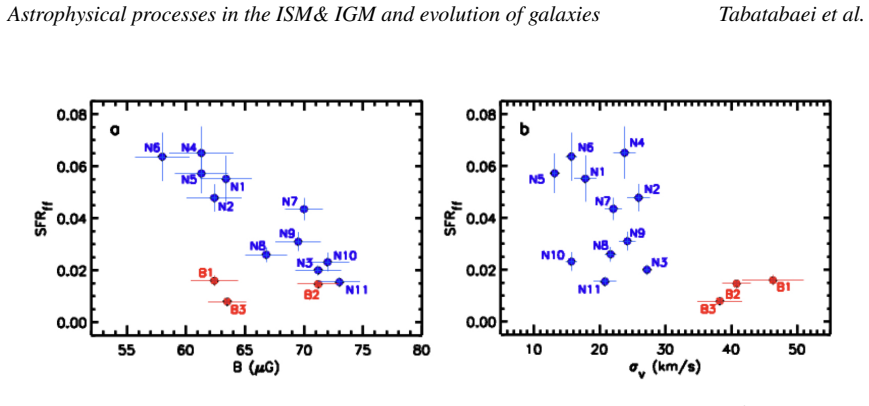
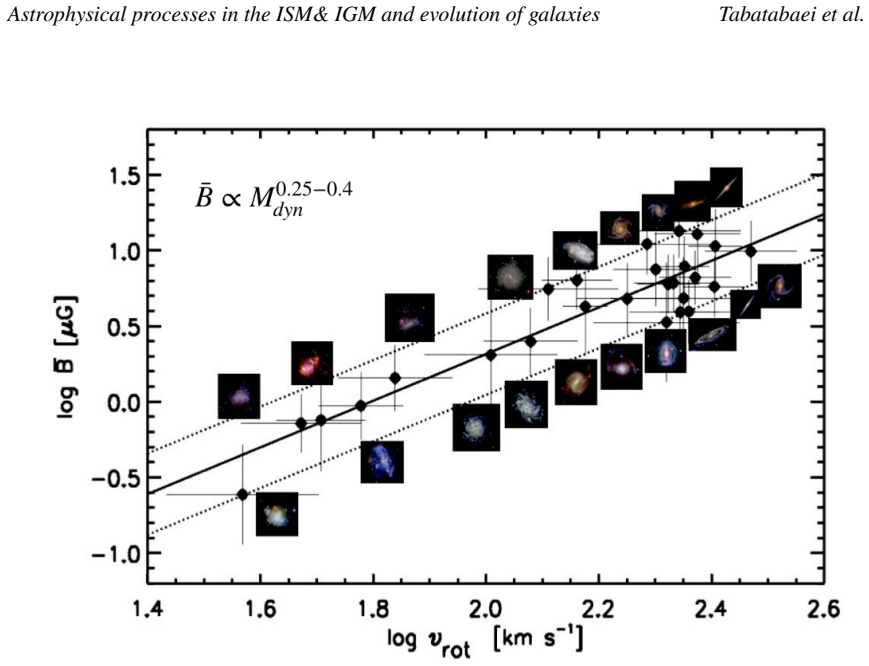
Investigating the thermal and nonthermal processes in the interstellar medium (ISM) and intergalactic medium (IGM) is vital to understanding the evolution of galaxies over cosmic time. Resolved observations with SKA pathfinders show that the nonthermal processes, in which magnetic fields and cosmic rays are involved, can decelerate the formation of massive stars in strongly magnetized regions in nearby galaxies. They can also contribute to the onset of winds and outflows in galaxies. The effects of these processes are stronger at higher redshifts as a result of star formation activities. The SKA Observatory will allow a major breakthrough by mapping the thermal and nonthermal processes in distant universe galaxies, shedding light on the role of the ISM and IGM in the evolution of galaxies. We demonstrate this by simulating the radio continuum and HI emission from local galaxies back to high redshifts. Our simulations show that the AA4 surveys will make it possible to trace the thermal and nonthermal processes of the ISM in galaxies that are analogs to M51 and NGC6946, traced in continuum beyond cosmic noon (z=2-3) and the gas content traced by HI beyond z=1. Both simulations and precursor observations indicate the importance of nonthermal feedback at cosmic noon.
Editorial analysis
A structured set of objections, weighed in public.
Referee Report
Summary. The manuscript claims that simulations projecting radio continuum and HI emission from local galaxies (M51, NGC6946) to high redshifts demonstrate that SKA AA4 surveys can trace thermal and nonthermal ISM processes in high-z analogs beyond z=2-3 (continuum) and z>1 (HI), with both simulations and precursor data indicating the importance of nonthermal feedback at cosmic noon.
Significance. If the simulations prove robust upon detailed description, this would provide useful forward-looking guidance on SKA's capabilities for studying ISM/IGM evolution and nonthermal processes in galaxies, building on resolved local observations.
major comments (2)
- [Abstract] Abstract / simulation description: The detectability claims at z=2-3 rest on unspecified simulations that scale local radio continuum and HI maps to high redshift. No details are provided on methods, input assumptions (including any adjustments for elevated star-formation rates, magnetic field evolution, or cosmic-ray densities), validation against real data, or error estimates, rendering the support for the redshift reach and nonthermal feedback claims difficult to evaluate.
- [Abstract] Abstract: The scaling of local M51/NGC6946 radio properties and ISM structure to represent high-z analogs assumes that thermal/nonthermal emission mechanisms and spatial distributions remain sufficiently similar after only cosmological dimming and frequency shifting, without major modifications from different cosmic conditions. This assumption is load-bearing for the central claims but receives no justification or sensitivity testing.
minor comments (1)
- The abstract would be clearer if it briefly indicated the simulation technique or key parameters employed when projecting local templates.
Simulated Author's Rebuttal
We thank the referee for the constructive comments, which identify key areas where the presentation of our methods and assumptions requires strengthening. We address each point below and will make the corresponding revisions.
read point-by-point responses
-
Referee: [Abstract] Abstract / simulation description: The detectability claims at z=2-3 rest on unspecified simulations that scale local radio continuum and HI maps to high redshift. No details are provided on methods, input assumptions (including any adjustments for elevated star-formation rates, magnetic field evolution, or cosmic-ray densities), validation against real data, or error estimates, rendering the support for the redshift reach and nonthermal feedback claims difficult to evaluate.
Authors: We agree that the current manuscript does not supply sufficient methodological detail to allow full evaluation of the simulation results. In the revised version we will add an expanded methods section that describes the scaling procedure, the specific input assumptions adopted for star-formation rates, magnetic-field evolution and cosmic-ray densities, the validation steps performed against existing data, and quantitative error estimates. revision: yes
-
Referee: [Abstract] Abstract: The scaling of local M51/NGC6946 radio properties and ISM structure to represent high-z analogs assumes that thermal/nonthermal emission mechanisms and spatial distributions remain sufficiently similar after only cosmological dimming and frequency shifting, without major modifications from different cosmic conditions. This assumption is load-bearing for the central claims but receives no justification or sensitivity testing.
Authors: The scaling is presented as a first-order extrapolation that accounts primarily for cosmological surface-brightness dimming and frequency shifting. We acknowledge that explicit justification and sensitivity testing of this assumption are currently absent. The revised manuscript will include a dedicated discussion of the rationale for treating local galaxies as analogs, supported by relevant high-redshift ISM literature, together with sensitivity tests that vary key parameters to quantify the robustness of the reported redshift reach. revision: yes
Circularity Check
No circularity: forward simulation of local templates to high-z detectability
full rationale
The paper describes cosmological projection of resolved local radio continuum and HI maps from galaxies like M51 and NGC6946 to demonstrate SKA AA4 survey reach at z>1-3. No equations, fitted parameters, or derivations are presented that reduce the claimed detection thresholds or nonthermal feedback inferences to quantities fitted from the target high-z data itself. The central method is template scaling under stated assumptions about ISM similarity; this is an external modeling choice, not a self-referential loop. No self-citation chain is invoked to justify uniqueness or forbid alternatives. The work is therefore self-contained as a predictive simulation exercise.
Axiom & Free-Parameter Ledger
axioms (1)
- domain assumption Local galaxies such as M51 and NGC6946 serve as valid structural and emission analogs for high-redshift galaxies
Reference graph
Works this paper leans on
-
[1]
InAdvancingAstrophysicswiththeSKA–II(AASKAII).2026
F.X.Anetal. InAdvancingAstrophysicswiththeSKA–II(AASKAII).2026. arXivsearch: Report number AASKAII/FangxiaAn01. A. Basu and S. Roy.MNRAS, 433(2):1675–1686, Aug
2026
-
[2]
doi: 10.1093/mnras/stt845. R. Beck.A&A, 470(2):539–556, Aug
-
[3]
doi: 10.1051/0004-6361:20066988. R. Beck.A&A, 578:A93, June
-
[4]
doi: 10.1051/0004-6361/201425572. S. Brownson et al.MNRAS, 498(1):L66–L71, Nov
-
[5]
doi: 10.1093/mnrasl/slaa128. M. Brüggen and E. Scannapieco.ApJ, 905(1):19, Dec
-
[6]
doi: 10.3847/1538-4357/abc00f. A. Chowdhury, N. Kanekar, and J. N. Chengalur.ApJ, 937(2):103, Oct
-
[7]
doi: 10.1051/0004-6361/201015393. D. Colombo et al.A&A, 644:A97, Dec
-
[8]
doi: 10.1051/0004-6361/202039005. J. J. Condon.ARA&A, 30:575–611, Jan
-
[9]
doi: 10.1146/annurev.aa.30.090192.003043. 14 Astrophysical processes in the ISM& IGM and evolution of galaxies Tabatabaei et al. C. Dalla Vecchia and J. Schaye.MNRAS, 426(1):140–158, Oct
-
[10]
doi: 10.1111/j.1365-2966. 2012.21704.x. R. Davé, K. Finlator, and B. D. Oppenheimer.MNRAS, 416(2):1354–1376, Sept
-
[11]
doi: 10.1111/j.1365-2966.2011.19132.x. A. Dignan et al.ApJ, 988(2):216, Aug
-
[12]
doi: 10.3847/1538-4357/ade436. S. M. Faber et al.ApJ, 665(1):265–294, Aug
-
[13]
doi: 10.1086/519294. M. Ghasemi-Nodehi et al.MNRAS, 515(1):1158–1174, Sept
-
[14]
doi: 10.1093/mnras/stac1393. P. Girichidis, T. Naab, M. Hanasz, and S. Walch.MNRAS, 479(3):3042–3067, Sept
-
[15]
doi: 10.1093/mnras/sty1653. R. Gobat et al.Nature Astronomy, 2:239–246, Jan
-
[16]
doi: 10.1038/s41550-017-0352-5. R. Gobat, G. Magdis, C. D’Eugenio, and F. Valentino.A&A, 644:L7, Dec
-
[17]
doi: 10.1093/mnras/stab3452. H. Hassani et al.MNRAS, 510(1):11–31, Feb
-
[18]
doi: 10.1093/mnras/stab3202. V. Heesen et al.AJ, 147(5):103, May
-
[19]
doi: 10.1088/0004-6256/147/5/103. V. Heesen et al.MNRAS, 458(1):332–353, May
-
[20]
doi: 10.1093/mnras/stw360. M. Hosseinirad, F. Tabatabaei, M. Raouf, and M. Roshan.MNRAS, 525(1):577–594, Oct
-
[21]
doi: 10.1093/mnras/stad2279. G. Kauffmann, S. D. M. White, and B. Guiderdoni.MNRAS, 264:201–218, Sept
-
[22]
doi: 10.1093/mnras/264.1.201. R. C. Kennicutt et al.PASP, 123(910):1347, Dec
-
[23]
doi: 10.1086/663818. M. J. Koss et al.ApJSS, 252(2):29, Feb
-
[24]
doi: 10.3847/1538-4365/abcbfe. M. Krause. In K. G. Strassmeier, A. G. Kosovichev, and J. E. Beckman, editors,Cosmic Magnetic Fields: From Planets, to Stars and Galaxies, volume 259 ofIAU Symposium, pages 547–548, Apr
-
[25]
doi: 10.1017/S1743921309031263. F. Lelli et al. InAdvancing Astrophysics with the SKA – II (AASKAII)
-
[26]
doi: 10.1038/nature21677. R. Maiolino et al.MNRAS, 538(3):1921–1943, Apr
-
[27]
doi: 10.1093/mnras/staf359. W. G. Mathews.ApJL, 695(1):L49–L52, Apr
-
[28]
15 Astrophysical processes in the ISM& IGM and evolution of galaxies Tabatabaei et al
doi: 10.1088/0004-637X/695/1/L49. 15 Astrophysical processes in the ISM& IGM and evolution of galaxies Tabatabaei et al. F. Mazoochi and F. Tabatabaei. In32nd General Assembly International Union (IAUGA 2024), page 195, Aug
-
[29]
doi: 10.1051/0004-6361/201833931. E. J. Murphy et al.ApJL, 709(2):L108–L113, Feb
-
[30]
doi: 10.1088/2041-8205/709/2/L108. E. J. Murphy et al.ApJ, 737(2):67, Aug
-
[31]
doi: 10.1088/0004-637X/737/2/67. E. J. Murphy et al.ApJ, 839(1):35, Apr
-
[32]
doi: 10.3847/1538-4357/aa62fd. M. R. Nasirzadeh et al.A&A, 691:A199, Nov
-
[33]
doi: 10.1051/0004-6361/202451110. S. Niklas and R. Beck.A&A, 320:54–64, Apr
-
[34]
doi: 10.3847/1538-4365/ac77ff. E. R. Owen et al.A&A, 626:A85, June
-
[35]
doi: 10.1051/0004-6361/201834350. Y. Peng, R. Maiolino, and R. Cochrane.Nature, 521(7551):192–195, May
-
[36]
doi: 10.1093/mnras/stw2941. T. Pillai et al.ApJ, 799(1):74, Jan
-
[37]
doi: 10.1088/0004-637X/799/1/74. I. Prandoni and N. Seymour. InAdvancing Astrophysics with the Square Kilometre Array (AASKA14), page 67, Apr
-
[38]
doi: 10.22323/1.215.0067. I. Prandoni et al. InAdvancing Astrophysics with the SKA – II (AASKAII)
-
[39]
doi: 10.1093/mnras/stab900. T. A. Rintoul et al.arXiv e-prints, art. arXiv:2506.18983, June
-
[41]
doi: 10.1093/mnras/stu2058. E. Schinnerer et al.ApJ, 887(1):49, Dec
-
[42]
doi: 10.3847/1538-4357/ab50c2. C. Schreiber et al.A&A, 575:A74, Mar
-
[43]
doi: 10.1051/0004-6361/201425017. N. Scoville et al.ApJ, 820(2):83, Apr
-
[44]
D.Sijacki,V.Springel,T.DiMatteo,andL.Hernquist.MNRAS,380(3):877–900,Sept.2007
doi: 10.3847/0004-637X/820/2/83. D.Sijacki,V.Springel,T.DiMatteo,andL.Hernquist.MNRAS,380(3):877–900,Sept.2007. doi: 10.1111/j.1365-2966.2007.12153.x. B. Sike et al.ApJ, 987(2):204, July
-
[45]
doi: 10.3847/1538-4357/adda3d. F. Sinigaglia et al.arXiv e-prints, art. arXiv:2506.11280, June
-
[46]
doi: 10.48550/arXiv.2506. 11280. A. Suresh, M. R. Blanton, and D. Rennehan.arXiv e-prints, art. arXiv:2508.04907, Aug
-
[47]
and Rennehan, Douglas , month = aug, year =
doi: 10.48550/arXiv.2508.04907. 16 Astrophysical processes in the ISM& IGM and evolution of galaxies Tabatabaei et al. F. Tabatabaei. InEAS2024, European Astronomical Society Annual Meeting, page 738, July
-
[48]
doi: 10.3847/1538-4357/ade233. F. S. Tabatabaei et al.A&A, 475(1):133–143, Nov
-
[49]
doi: 10.1051/0004-6361:20078174. F. S. Tabatabaei, M. Krause, A. Fletcher, and R. Beck.A&A, 490(3):1005–1017, Nov
-
[50]
F.S.Tabatabaeietal.A&A,557:A129,Sept.2013a
doi: 10.1051/0004-6361:200810590. F.S.Tabatabaeietal.A&A,557:A129,Sept.2013a. doi: 10.1051/0004-6361/20121890910.48550/ arXiv.1307.6253. F. S. Tabatabaei et al.A&A, 552:A19, Apr. 2013b. doi: 10.1051/0004-6361/20122024910.48550/ arXiv.1301.6884. F. S. Tabatabaei et al.ApJL, 818(1):L10, Feb
-
[51]
doi: 10.3847/2041-8205/818/1/L10. F. S. Tabatabaei et al.ApJ, 836(2):185, Feb
-
[52]
doi: 10.3847/1538-4357/836/2/185. F. S. Tabatabaei, P. Minguez, M. A. Prieto, and J. A. Fernández-Ontiveros.Nature Astronomy, 2: 83–89, Nov
-
[53]
doi: 10.1038/s41550-017-0298-7. F. S. Tabatabaei et al.MNRAS, 517(2):2990–3007, Dec
-
[54]
L.J.Tacconietal.TheAstrophysicalJournal,768(1):74, apr2013
doi: 10.1093/mnras/stac2514. L.J.Tacconietal.TheAstrophysicalJournal,768(1):74, apr2013. doi: 10.1088/0004-637X/768/ 1/74. URLhttps://dx.doi.org/10.1088/0004-637X/768/1/74. L. J. Tacconi et al.ApJ, 853(2):179, Feb
-
[55]
doi: 10.3847/1538-4357/aaa4b4. K. Tisanić et al.A&A, 621:A139, Jan
-
[56]
doi: 10.1051/0004-6361/201834002. C. L. Van Eck, J. C. Brown, A. Shukurov, and A. Fletcher.ApJ, 799(1):35, Jan
-
[57]
F.Walteretal.TheAstrophysicalJournal,902(2):111,oct2020
doi: 10.1088/0004-637X/799/1/35. F.Walteretal.TheAstrophysicalJournal,902(2):111,oct2020. doi: 10.3847/1538-4357/abb82e. URLhttps://dx.doi.org/10.3847/1538-4357/abb82e. S. R. Ward, C. M. Harrison, T. Costa, and V. Mainieri.MNRAS, 514(2):2936–2957, Aug
-
[58]
doi: 10.1093/mnras/stac1219. J. Westcott et al.MNRAS, 475(4):5116–5132, Apr
-
[59]
doi: 10.1093/mnras/sty028. J. Xu et al.ApJ, 978(1):5, Jan
-
[60]
doi: 10.3847/1538-4357/ad946e. 17
discussion (0)
Sign in with ORCID, Apple, or X to comment. Anyone can read and Pith papers without signing in.