Type-based information flow analysis for π-calculus with a dynamically extensible security lattice
Pith reviewed 2026-06-26 03:47 UTC · model grok-4.3
The pith
The type system for pi-calculus allows new security levels to be created and added to the lattice during program execution.
A machine-rendered reading of the paper's core claim, the machinery that carries it, and where it could break.
Core claim
We develop a type system for secure information flow where new security levels can be created and inserted into the security lattice dynamically, i.e., even in the middle of an execution of a system. Our system is formalized by extending Kobayashi's type-based secure information flow analysis for Milner's pi-calculus, which is one of the most expressive models supporting both sequential and concurrent computations, with concise syntax, reduction-based semantics, and bisimulation equivalence as a robust formalization of secrecy as non-interference. The development required careful treatment of extensions of lattices themselves as well as deliberate generalization from the simple 2-element lat
What carries the argument
The extended type system that tracks information flow while handling dynamic lattice insertions and preserving bisimulation-based non-interference.
If this is right
- New security levels can be created and inserted into the lattice mid-execution.
- Non-interference defined as bisimulation continues to hold after lattice extensions.
- The type system applies to pi-calculus processes with evolving security policies.
- Generalization beyond the fixed High-Low lattice is achieved while retaining the original guarantees.
Where Pith is reading between the lines
- The method could be tested on examples involving repeated dynamic level creations to check scalability of the extension rules.
- Similar dynamic lattice handling might transfer to other process calculi that use bisimulation for secrecy.
- This opens the possibility of verifying systems where security domains are allocated at runtime rather than fixed in advance.
Load-bearing premise
The careful treatment of lattice extensions and generalization from the 2-element lattice preserves the non-interference property from the original Kobayashi system.
What would settle it
A concrete execution in which a new security level is created, high information flows through it, and a low observer can distinguish the resulting behaviors via bisimulation.
Figures

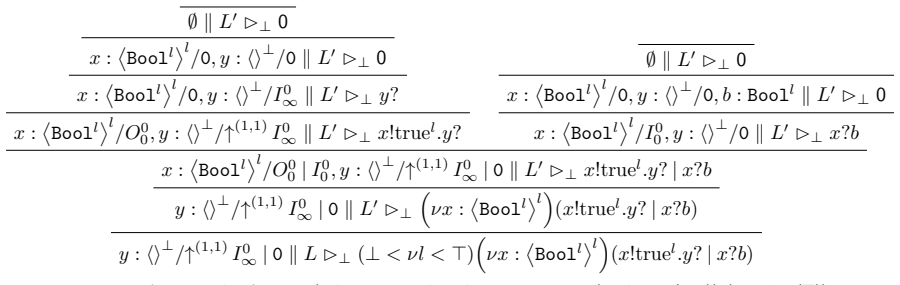
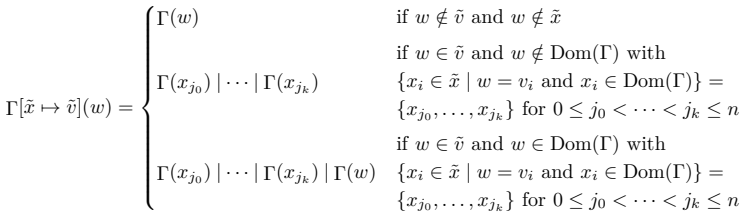
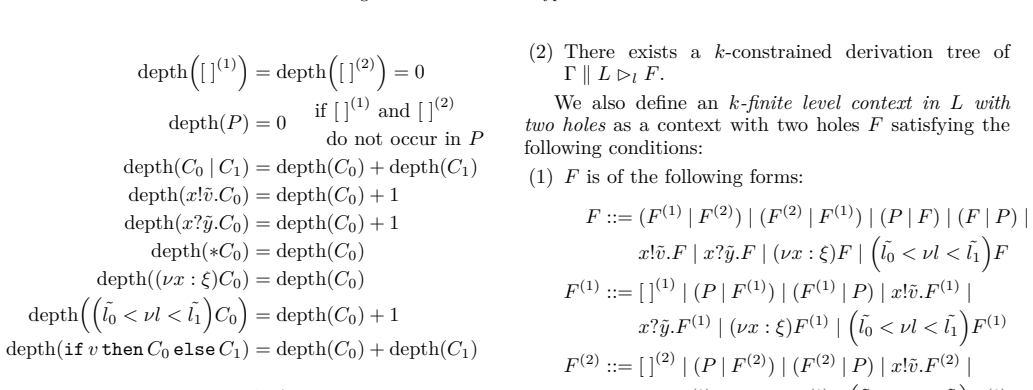
read the original abstract
We develop a type system for secure information flow where new security levels can be created and inserted into the security lattice dynamically, i.e., even in the middle of an execution of a system. Our system is formalized by extending Kobayashi's type-based secure information flow analysis for Milner's pi-calculus, which is one of the most expressive models (or "languages") supporting both sequential and concurrent computations, with concise syntax, reduction-based semantics, and bisimulation equivalence as a robust formalization of secrecy as non-interference. The development required careful treatment of extensions of lattices themselves as well as deliberate generalization from the simple 2-element lattice (consisting of only High and Low) in the original system.
Editorial analysis
A structured set of objections, weighed in public.
Referee Report
Summary. The paper develops a type system for secure information flow in Milner's π-calculus that supports dynamic creation and insertion of new security levels into the lattice during execution. It extends Kobayashi's prior type-based analysis (which encodes secrecy as bisimulation-based non-interference) by generalizing from a static 2-element (High/Low) lattice to handle runtime lattice extensions.
Significance. If the extension preserves the original non-interference property, the result would be a useful step toward type-based IFC for concurrent systems with evolving security policies. The explicit grounding in an existing, expressive calculus and bisimulation semantics is a strength.
major comments (1)
- [Abstract] Abstract: the claim that the system supports dynamic lattice extensions while preserving secrecy as bisimulation rests on 'careful treatment' of lattice operations, but no type rules, reduction semantics for lattice insertion, or proof outline are visible, preventing verification that the generalization from the 2-element lattice avoids introducing new flows.
Simulated Author's Rebuttal
We thank the referee for their review. The major comment focuses on the abstract's level of detail. We respond below and note that the full manuscript contains the requested elements.
read point-by-point responses
-
Referee: [Abstract] Abstract: the claim that the system supports dynamic lattice extensions while preserving secrecy as bisimulation rests on 'careful treatment' of lattice operations, but no type rules, reduction semantics for lattice insertion, or proof outline are visible, preventing verification that the generalization from the 2-element lattice avoids introducing new flows.
Authors: The abstract is a concise summary and does not include technical details such as rules or proofs, which is standard. The full manuscript defines the type rules for dynamic lattice extensions in Section 3 (generalizing Kobayashi's system), the reduction semantics for lattice insertion operations in Section 2.3, and provides a proof outline plus full non-interference argument (via bisimulation) in Section 5. The lattice operations are treated to ensure no new flows are introduced during extension. If desired, we can add one sentence to the abstract referencing these sections. revision: partial
Circularity Check
No significant circularity
full rationale
The paper presents an extension of Kobayashi's independent prior type system for pi-calculus information flow to handle dynamic lattice creation. The abstract and description frame this as a deliberate generalization from the original 2-element lattice with careful treatment of extensions, without any self-definitional equations, fitted inputs renamed as predictions, load-bearing self-citations from overlapping authors, or ansatz smuggling. The derivation chain relies on external prior work by a different author and standard bisimulation-based non-interference, making the result self-contained against external benchmarks.
Axiom & Free-Parameter Ledger
axioms (1)
- standard math Pi-calculus reduction semantics and bisimulation equivalence as formalization of secrecy
Reference graph
Works this paper leans on
-
[1]
Communications of the ACM , volume =
D. E. Denning, “A lattice model of secure information flow,” Commun. ACM , vol. 19, no. 5, pp. 236–243, 1976. [Online]. A vailable:https://doi.org/10.1145/360051.360056
-
[2]
In: 1982 IEEE Symposium on Security and Privacy, 1982, pp
J. A. Goguen and J. Meseguer, “Security policies and security models,” in 1982 IEEE Symposium on Security and Privacy, Oakland, CA, USA, April 26-28, 1982 . IEEE Computer Society, 1982, pp. 11–20. [Online]. A vailable: https://doi.org/10.1109/SP.1982.10014
-
[3]
A sound type system for secure flow analysis,
D. M. Volpano, C. E. Irvine, and G. Smith, “A sound type system for secure flow analysis,” J. Comput. Secur. , vol. 4, no. 2/3, pp. 167–188, 1996. [Online]. A vailable: https://doi.org/10.3233/JCS-1996-42-304
-
[4]
Language-based information- flow security,
A. Sabelfeld and A. C. Myers, “Language-based information- flow security,” IEEE J. Sel. Areas Commun. , vol. 21, no. 1, pp. 5–19, 2003. [Online]. A vailable: https://doi.org/10.1109/ JSAC.2002.806121
arXiv 2003
-
[5]
The slam calculus: Programming with secrecy and integrity,
N. Heintze and J. G. Riecke, “The slam calculus: Programming with secrecy and integrity,” in POPL ’98, Proceedings of the 25th ACM SIGPLAN-SIGACT Symposium on Principles of Programming Languages, San Diego, CA, USA, January 19-21, 1998 , D. B. MacQueen and L. Cardelli, Eds. ACM, 1998, pp. 365–377. [Online]. A vailable:https://doi.org/10.1145/268946.268976
-
[6]
Type-based information flow analysis for the pi-calculus,
N. Kobayashi, “Type-based information flow analysis for the pi-calculus,” Acta Informatica , vol. 42, no. 4-5, pp. 291–347, 2005. [Online]. A vailable: https://doi.org/10.1007/ s00236-005-0179-x
2005
-
[7]
A type system for lock-free processes,
——, “A type system for lock-free processes,” Inf. Comput. , vol. 177, no. 2, pp. 122–159, 2002. [Online]. A vailable: https://doi.org/10.1006/inco.2002.3171
-
[8]
Milner, Communicating and mobile systems - the Pi- calculus
R. Milner, Communicating and mobile systems - the Pi- calculus. Cambridge University Press, 1999
1999
-
[9]
A calculus of mobile processes, I,
R. Milner, J. Parrow, and D. Walker, “A calculus of mobile processes, I,” Inf. Comput. , vol. 100, no. 1, pp. 1–40, 1992. [Online]. A vailable: https://doi.org/10.1016/0890-5401(92) 90008-4
-
[10]
A calculus of mobile processes, II,
——, “A calculus of mobile processes, II,” Inf. Comput. , vol. 100, no. 1, pp. 41–77, 1992. [Online]. A vailable: https://doi.org/10.1016/0890-5401(92)90009-5
-
[11]
R. Milner and D. Sangiorgi, “Barbed bisimulation,” in Automata, Languages and Programming, 19th International Colloquium, ICALP92, Vienna, Austria, July 13-17, 1992, Proceedings, ser. Lecture Notes in Computer Science, W. Kuich, Ed., vol. 623. Springer, 1992, pp. 685–695. [Online]. A vailable: https://doi.org/10.1007/3-540-55719-9_ 114
-
[12]
Bisimulation through probabilistic testing,
K. G. Larsen and A. Skou, “Bisimulation through probabilistic testing,” Inf. Comput. , vol. 94, no. 1, pp. 1–28, 1991. [Online]. A vailable: https://doi.org/10.1016/ 0890-5401(91)90030-6
1991
-
[13]
Probabilistic noninterference through weak probabilistic bisimulation,
G. Smith, “Probabilistic noninterference through weak probabilistic bisimulation,” in 16th IEEE Computer Security Foundations Workshop (CSFW-16 2003), 30 June - 2 July 2003, Pacific Grove, CA, USA . IEEE Computer Society, 2003, pp. 3–13. [Online]. A vailable: https://doi.org/10.1109/ CSFW.2003.1212701
arXiv 2003
-
[14]
Back to the format: A survey on SOS for probabilistic processes,
V. Castiglioni, R. Lanotte, and S. Tini, “Back to the format: A survey on SOS for probabilistic processes,” J. Log. Algebraic Methods Program. , vol. 137, p. 100929,
-
[15]
A vailable: https://doi.org/10.1016/j.jlamp
[Online]. A vailable: https://doi.org/10.1016/j.jlamp. 2023.100929
-
[16]
A spectrum of approximate probabilistic bisimulations,
T. Spork, C. Baier, J. Katoen, J. Piribauer, and T. Quatmann, “A spectrum of approximate probabilistic bisimulations,” in 35th International Conference on Concurrency Theory, CONCUR 2024, September 9-13, 2024, Calgary, Canada , ser. LIPIcs, R. Majumdar and A. Silva, Eds., vol. 311. Schloss Dagstuhl - Leibniz-Zentrum für Informatik, 2024, pp. 37:1–37:19. [...
-
[17]
van Glabbeek (2001):The Linear Time–Branching Time Spectrum I
R. J. van Glabbeek, “The linear time - branching time spectrum I,” in Handbook of Process Algebra , J. A. Bergstra, A. Ponse, and S. A. Smolka, Eds. North- Holland / Elsevier, 2001, pp. 3–99. [Online]. A vailable: https://doi.org/10.1016/b978-044482830-9/50019-9
-
[18]
The linear time - branching time spectrum II,
——, “The linear time - branching time spectrum II,” in CONCUR ’93, 4th International Conference on Concurrency Theory, Hildesheim, Germany, August 23-26, 1993, Proceedings, ser. Lecture Notes in Computer Science, E. Best, Ed., vol. 715. Springer, 1993, pp. 66–81. [Online]. A vailable:https://doi.org/10.1007/3-540-57208-2_6
-
[19]
Concurrent hyperproperties,
B. Finkbeiner and E. Olderog, “Concurrent hyperproperties,” in Theories of Programming and Formal Methods - Essays Dedicated to Jifeng He on the Occasion of His 80th Birthday, ser. Lecture Notes in Computer Science, J. P. Bowen, Q. Li, and Q. Xu, Eds., vol. 14080. Springer, 2023, pp. 211–231. [Online]. A vailable: https://doi.org/10.1007/ 978-3-031-40436-8_8
2023
-
[20]
lattice,
nLab, “lattice,” https://ncatlab.org/nlab/show/lattice, as of July 2025
2025
-
[21]
P. T. Johnstone, Stone Spaces. Cambridge University Press, 1986
1986
-
[22]
A generalized deadlock- free process calculus,
E. Sumii and N. Kobayashi, “A generalized deadlock- free process calculus,” in 3rd International Workshop on High-Level Concurrent Languages, HLCL 1998, Satellite Workshop of CONCUR 1998, Nice, France, September 12, 1998 , ser. Electronic Notes in Theoretical Computer Science, U. Nestmann and B. C. Pierce, Eds., vol. 16, no. 3. Elsevier, 1998, pp. 225–247...
-
[23]
Linear logic,
J. Girard, “Linear logic,” Theor. Comput. Sci. , vol. 50, pp. 1–102, 1987. [Online]. A vailable: https://doi.org/10.1016/ 0304-3975(87)90045-4
1987
-
[24]
Sangiorgi and D
D. Sangiorgi and D. Walker, The Pi-Calculus - a theory of mobile processes. Cambridge University Press, 2001
2001
-
[25]
Type systems for concurrent processes: From deadlock-freedom to livelock-freedom, time-boundedness,
N. Kobayashi, “Type systems for concurrent processes: From deadlock-freedom to livelock-freedom, time-boundedness,” in Theoretical Computer Science, Exploring New Frontiers of Theoretical Informatics, International Conference IFIP TCS 2000, Sendai, Japan, August 17-19, 2000, Proceedings , ser. Lecture Notes in Computer Science, J. van Leeuwen, O. Watanabe...
-
[26]
Lemma A.4
By ( SP-Commut) and ( SP-Par), we see P0 j P1 P 0 0 j P1 (SP-Par) P1 j P 0 0 (SP-Commut) P 0 1 j P 0 0 (SP-Par) P 0 0 j P 0 1 (SP-Commut). Lemma A.4. P0 j (P1 j P2) (P0 j P1) j P2. Proof. By ( SP-Commut), ( SP-Assoc) and ( SP-Par), we see P0 j (P1 j P2) (P1 j P2) j P0 (SP-Commut) (P2 j P1) j P0 (SP-Commut) and ( SP-Par) P2 j (P1 j P0) (SP-Assoc) P2 j (P0 ...
-
[27]
By ( UP-Commut) and ( UP-CongP), we see U0 j U1 U 0 0 j U1 (UP-CongP) U1 j U 0 0 (UP-Commut) U 0 1 j U 0 0 (UP-CongP) U 0 0 j U 0 1 (UP-Commut). (2) By ( UP-Commut), ( UP-Assoc) and ( UP-CongP), we see U0 j (U1 j U2) (U1 j U2) j U0 (UP-Commut) (U2 j U1) j U0 (UP-Commut) and ( UP-CongP) U2 j (U1 j U0) (UP-Assoc) U2 j (U0 j U1) (UP-Commut) and ( UP-CongP) (...
-
[28]
By the induction hypothesis, we have cap α(U1) capα(U 0
We also assume U = U1 j U2 and U 0 = U 0 1 j U2. By the induction hypothesis, we have cap α(U1) capα(U 0
-
[29]
( , )). Assume U =
and ob α(U1) obα(U 0 1). Then capα(U ) = capα(U1 j U2) = min(capα(U1), capα(U2)) min(capα(U 0 1), capα(U2)) = capα(U 0 1 j U2) = capα(U 0) and obα(U ) = obα(U1 j U2) = min(obα(U1), obα(U2)) min(obα(U 0 1), obα(U2)) = obα(U 0 1 j U2) = obα(U 0). Case 7. ( UP-Rep). Assume U = U0 and U 0 = U0 j U0. Then capα(U 0) = capα( U0 j U0) = min(capα( U0), capα(U0)) =...
-
[30]
By the induction hypothesis, we have cap α(U0) capα(U 0
-
[31]
(tI ,tO) U0 = capα(U0) capα(U 0 0) = capα
and ob α(U0) obα(U 0 0). Then capα(U ) = capα "(tI ,tO) U0 = capα(U0) capα(U 0 0) = capα "(tI ,tO) U 0 0 = capα(U 0) and obα(U ) = obα "(tI ,tO) U0 = max(tα, obα(U0)) max(tα, obα(U 0 0)) = obα "(tI ,tO) U 0 0 = obα(U 0). Case 12. ( UP-Commut "( , )). Assume U = "(tI ,tO) "(t′ I ,t′ O) U0 and U 0 = "(t′ I ,t′ O) "(tI ,tO) U0. Then capα(U ) = capα "(tI ,tO)...
-
[32]
By induction and Definition 3.7 (b), we see that there exists a usage U 0 0 such that U0 ! !U 0 0 and U 0 0 <: U 0
-
[33]
By (1) in this proposition, we have con (U 0 1)
Since rel (U0), we have con(U 0 0). By (1) in this proposition, we have con (U 0 1). Thus, rel (U1). (3) Since it is obvious that the identity relation on closed usages satisfies all the conditions of Definition 3.7 , we have the reflexivity of the subusage relation. We show the transitivity of the subusage relation. Let R = 8 < :(U0, U1) U0 <: U1, or the...
-
[34]
By Definition 3.7 (b), there exists U 0 2 such that U2 !U 0 2 and U 0 2 <: U 0
-
[35]
By Definition 3.7 (b), there exists U 0 0 such that U0 !U 0 0 and U 0 0 <: U 0
-
[36]
Then, we see that there exists U 0 0 such that U0 !U 0 0 and (U 0 0, U 0
-
[37]
(to,tc) U < : U for a usage U and to, tc 2 N [ f1g. (8)
2 R. (c) By Definition 3.7 (c), we have cap α(U0) capα(U2) and cap α(U2) capα(U1), for each α 2 f I, Og. Then, we have cap α(U0) capα(U1), for each α 2 fI, Og. (d) Fix α 2 f I, Og. Assume con α(U0). By Proposition 3.8 (1), we have con α(U2). Then, by Definition 3.7 (d), we have ob α(U0) obα(U2) and ob α(U2) obα(U1). Thus, ob α(U0) obα(U1). B.3. Property o...
-
[38]
Since FV (U0) fρg and FV (U 0
= fρ0g. Since FV (U0) fρg and FV (U 0
-
[39]
Hence, (U 0 0[ρ0 7! (U0[ρ 7! U ])], U 0 0[ρ0 7! (U0[ρ 7! U 0])]) 2 R(U,U ′) 1
= fρ0g, we have U 0 0[ρ0 7! (U0[ρ 7! U ])] = ( U 0 0[ρ0 7! U0])[ρ 7! U ] and U 0 0[ρ0 7! (U0[ρ 7! U 0])] = ( U 0 0[ρ0 7! U0])[ρ 7! U 0]. Hence, (U 0 0[ρ0 7! (U0[ρ 7! U ])], U 0 0[ρ0 7! (U0[ρ 7! U 0])]) 2 R(U,U ′) 1 . (b) To show that R(U,U ′) 1 satisfies Definition 3.7 (b), we show that if (U0[ρ 7! U ], U0[ρ 7! U 0]) 2 R(U,U ′) 1 , and U0[ρ 7! U 0] ˆV , t...
-
[40]
( , )). Assume U0 =
fρg, ˇV1 = U 0 1[ρ 7! U ], and ˆV1 = U 0 1[ρ 7! U 0]. Let ˇV = U 0 1[ρ 7! U ] j U2[ρ 7! U ]. Then, we have ˇV , ˆV 2 R(U,U ′) 1 . By ( UP-CongP) and transitivity, we see U1[ρ 7! U ] j U2[ρ 7! U ] U 0 1[ρ 7! U ] j U2[ρ 7! U ]. Case 7. ( UP-Rep). Assume U0 = U1 and ˆV = U1[ρ 7! U 0] j U1[ρ 7! U 0]. Let ˇV = U1[ρ 7! U ] j U1[ρ 7! U 0]. Then, we have U0[ρ 7! ...
-
[41]
( , )). Assume U0 =
f ρg, ˇV1 = U 0 1[ρ 7! U ], and ˆV1 = U 0 1[ρ 7! U 0]. Hence, we see ˇV = U 0 1[ρ 7! U ] j U2[ρ 7! U ] and ˆV = U 0 1[ρ 7! U 0] j U2[ρ 7! U 0]. Then, we have U0[ρ 7! U ] !ˇV and ˇV , ˆV 2 R(U,U ′) 1 . Case 3. Assume that there exist usages ˆV1 and ˆV2 such that U0[ρ 7! U 0] ˆV1, ˆV1 ! ˆV2, and ˆV2 ˆV . Since (U0[ρ 7! U ], U0[ρ 7! U 0]) 2 R(U,U ′) 1 and U0...
-
[42]
( , )). Assume U =
j U 0 2 and ˆV = U 0 0[ρ 7! W1] j (U 0 1[ρ 7! W1] j U 0 2[ρ 7! W1]). Let ˆV = U 0 0[ρ 7! W0] j (U 0 1[ρ 7! W0] j U 0 2[ρ 7! W0]). Then, we have U [ρ 7! W0] ˇV and ˇV , ˆV 2 R(U0,U1) 4 . Case 6. ( UP-CongP). Assume U = U 0 0 j U 0 1, U 0 0[ρ 7! W1] ˆV0, and ˆV = ˆV0 j U 0 1[ρ 7! W1]. By the induction hypoth- esis, there exists a closed usage ˇV0 such that ...
-
[43]
(tI 0,tO 0) U0, . . . , ρn 7!
By Definition 3.7 (a), we have U0 j U1 <: U 0 0 j U1. We also have U 0 0 j U1 <: U 0 0 j U 0 1. By Proposition 3.8 (3), we see U0 j U1 <: U 0 0 j U 0 1. (7) For a tuple of variables ˜ρ = ( ρ0, . . . , ρn) and a tuple of usages ˜U = ( U0, . . . , Un), we abbreviate U [ρ0 7! U0, . . . , ρn 7! Un] for U h ˜ρ 7! ˜U i . Let R5 = 1[ n=0 ( V h ρ0 7! " (tI 0,tO 0...
-
[44]
Assume τ0 = ξ/U0 and τ1 = ξ/U1
Hence, we have τ0 j τ1 <: τ 0 0 j τ 0 1. Assume τ0 = ξ/U0 and τ1 = ξ/U1. Then τ0 j τ1 ξ/U0 j U1. For each i = 0 , 1, because of τi <: τ 0 i , we have τ 0 i = ξ/U 0 i and Ui <: U 0 i . By Proposition B.4 (6), we have U0 j U1 <: U 0 0 j U 0
-
[45]
(tI ,tO) τ < : τ . Assume τ is a base type. Then
Then τ0 j τ1 ξ/U0 j U1 <: ξ/U 0 0 j U 0 1 τ 0 0 j τ 0 1. (4) We show τ0 j (τ1 j τ2) <: (τ0 j τ1) j τ2. By (1), (2), (3), and transitivity of <:, we have τ0 j (τ1 j τ2) <: (τ1 j τ2) j τ0 <: (τ2 j τ1) j τ0 <: τ2 j (τ1 j τ0) <: (τ1 j τ0) j τ2 25 <: (τ0 j τ1) j τ2. Thus, τ0 j (τ1 j τ2) <: (τ0 j τ1) j τ2. (5) Assume ob (τ ) = 1. Assume that τ is a base type. S...
-
[46]
(a) Since Γ0 <: Γ 0 0, we have Dom (Γ0) Dom(Γ0 0)
We show Γ0 j Γ1 <: Γ 0 0 j Γ1. (a) Since Γ0 <: Γ 0 0, we have Dom (Γ0) Dom(Γ0 0). Thus, Dom(Γ0 j Γ1) = Dom(Γ0) [ Dom(Γ1) Dom(Γ0
-
[47]
(b) Let x 2 Dom(Γ0 0 j Γ1)
[ Dom(Γ1) = Dom(Γ0 0 j Γ1). (b) Let x 2 Dom(Γ0 0 j Γ1). Since Dom (Γ0 j Γ1) Dom(Γ0 0 j Γ1), we have x 2 Dom(Γ0 j Γ1). Assume x 2 Dom(Γ0
-
[48]
Then, we have Γ0 0 j Γ1(x) = Γ 0 0(x) j Γ1(x)
\ Dom(Γ1). Then, we have Γ0 0 j Γ1(x) = Γ 0 0(x) j Γ1(x). Since Dom (Γ0) Dom(Γ0 0), we have x 2 Dom(Γ0) \ Dom(Γ1). Then, we see Γ0 j Γ1(x) = Γ 0(x) j Γ1(x). Since Γ0 <: Γ 0 0, we have Γ0(x) <: Γ 0 0(x). By Proposition C.1 (3), Γ0(x) j Γ1(x) <: Γ 0 0(x) j Γ1(x). Thus, Γ0 j Γ1(x) <: Γ 0 0 j Γ1(x). Assume x 2 Dom(Γ0
-
[49]
Then Γ0 0 j Γ1(x) = Γ 0 0(x)
n Dom(Γ1). Then Γ0 0 j Γ1(x) = Γ 0 0(x). Since Dom (Γ0) Dom(Γ0 0), we have x 2 Dom(Γ0
-
[50]
Then Γ0 j Γ1(x) = Γ 0(x)
n Dom(Γ1). Then Γ0 j Γ1(x) = Γ 0(x). Since Γ0 <: Γ 0 0, we have Γ0(x) <: Γ 0 0(x). Thus, Γ0 j Γ1(x) <: Γ0 0 j Γ1(x). Assume x 2 Dom(Γ1) n Dom(Γ0 0). Then Γ0 0 j Γ1(x) = Γ 1(x). Assume x 2 Dom(Γ0). Then Γ0 j Γ1(x) = Γ 0(x) j Γ1(x). Since x 2 Dom(Γ0) n Dom(Γ0 0), and Γ0 <: Γ 0 0, we have ob(Γ0(x)) = 1. By Proposition C.1 (5), we see Γ0(x) j Γ1(x) <: Γ 1(x)....
-
[51]
Hence, x 2 Dom(Γ0) n Dom(Γ0
[ Dom(Γ1)). Hence, x 2 Dom(Γ0) n Dom(Γ0
-
[52]
Therefore, Γ0 j Γ1(x) = Γ 0(x)
and x /2 Dom(Γ1). Therefore, Γ0 j Γ1(x) = Γ 0(x). Since Γ0 <: Γ 0 0, we have ob (Γ0(x)) = 1. Thus, ob (Γ0 j Γ1(x)) = 1. (4) Assume Γ0 <: Γ 0 0 and Γ1 <: Γ 0
-
[53]
From this proposition (1), Γ0 0 j Γ1 <: Γ1 j Γ0
By this proposition (3), Γ0 j Γ1 <: Γ 0 0 j Γ1. From this proposition (1), Γ0 0 j Γ1 <: Γ1 j Γ0
-
[54]
This proposition (3) implies Γ1 j Γ0 0 <: Γ 0 1 j Γ0
-
[55]
From this proposition (1), Γ0 1 j Γ0 0 <: Γ 0 0 j Γ0
-
[56]
(5) By (1), (2), (4), and transitivity of <:, we have (Γ0 j Γ1) j Γ2 <: Γ 2 j (Γ0 j Γ1) <: Γ 2 j (Γ1 j Γ0) <: (Γ 2 j Γ1) j Γ0 <: Γ 0 j (Γ2 j Γ1) <: Γ 0 j (Γ1 j Γ2)
By transitivity, Γ0 j Γ1 <: Γ 0 0 j Γ0 1. (5) By (1), (2), (4), and transitivity of <:, we have (Γ0 j Γ1) j Γ2 <: Γ 2 j (Γ0 j Γ1) <: Γ 2 j (Γ1 j Γ0) <: (Γ 2 j Γ1) j Γ0 <: Γ 0 j (Γ2 j Γ1) <: Γ 0 j (Γ1 j Γ2). Thus, (Γ0 j Γ1) j Γ2 <: Γ 0 j (Γ1 j Γ2). (6) Assume Γ <: Γ 0. We show Γ <: Γ0. 27 (a) Since Γ <: Γ 0, we have Dom (Γ) Dom(Γ0). Since Dom ( Γ) = Dom(Γ)...
-
[57]
(tI ,tO) Γ <: Γ. (a) Since Dom
Thus, ob ((Γ, x : τ )(y)) = 1. (9) Assume (Γ, x : τ ) <: (Γ 0, x : τ ). Then x /2 Dom(Γ) and x /2 Dom(Γ0). We show Γ <: Γ 0. (a) Since (Γ, x : τ ) <: (Γ 0, x : τ ), x /2 Dom(Γ), and x /2 Dom(Γ0), we have Dom (Γ) Dom(Γ0). (b) Let y 2 Dom(Γ0). Since x /2 Dom(Γ0), we have y 6= x. We also see y 2 Dom(Γ0, x : τ ). Since (Γ, x : τ ) <: (Γ 0, x : τ ), we have (Γ...
-
[58]
By Γ <: Γ 0 0 jΓ0 1, we have Γ <: Γ 0
-
[59]
Then, we have an l-secure derivation tree as follows: π0 Γ0 0 k L ▷m′ P 0 Γ <: Γ 0 0 m L m0 (T-Weak) Γ k L ▷m P 0
Let π0 be an l-secure derivation tree of Γ0 0 k L ▷l′ P 0. Then, we have an l-secure derivation tree as follows: π0 Γ0 0 k L ▷m′ P 0 Γ <: Γ 0 0 m L m0 (T-Weak) Γ k L ▷m P 0 . 29 Thus, we see that Γ k L ▷m P 0 is derivable. Case 4. ( SP-Zero2). Assume P 0 and P 0 (νx : ξ)0. By Lemma D.1 (1), Γ <: ;. We have an l-secure derivation tree as follows: (T-Zero) ...
-
[60]
Hence, Γ <: Γ 0 1 j Γ0
-
[61]
Then, we have an l-secure derivation tree as follows: π1 Γ0 1 k L ▷m′ P1 π0 Γ0 0 k L ▷m′ P0 (T-Par) Γ0 1 j Γ0 0 k L ▷m′ P1 j P0 Γ <: Γ 0 1 j Γ0 0 m L m0 (T-Weak) Γ k L ▷m P 0
Let πi be an l-secure derivation tree of Γ0 i k L ▷m′ Pi for each i = 0, 1. Then, we have an l-secure derivation tree as follows: π1 Γ0 1 k L ▷m′ P1 π0 Γ0 0 k L ▷m′ P0 (T-Par) Γ0 1 j Γ0 0 k L ▷m′ P1 j P0 Γ <: Γ 0 1 j Γ0 0 m L m0 (T-Weak) Γ k L ▷m P 0 . Thus, we see that Γ k L ▷m P 0 is l-securely derivable. In case P P1 j P0 and P 0 P0 j P1, we have an l-...
-
[62]
Thus, we see that Γ k L ▷m P 0 is l-securely derivable
k L ▷m′ P0 j (P1 j P2) (T-Weak) Γ k L ▷m P 0 . Thus, we see that Γ k L ▷m P 0 is l-securely derivable. Case 7. ( SP-New). Assume P (νx : ξ)(P0) j P1, P 0 (νx : ξ)(P0 j P1), and x /2 FN(P1). By Lemma D.1 (2), there exist two type environments Γ0 0, Γ0 1, and m0 2 L such that Γ <: Γ 0 0 j Γ0 1, and m L m0 and Γ0 0 k L ▷m′ (νx : ξ)P0 and Γ0 1 k L ▷m′ P1 are ...
-
[63]
(tc+1,tc+1) Γ0 j ˜w :
n fxg). Then (Γ00 0 , x : ξ/U ) j Γ00 1 (Γ00 0 j Γ00 1 ), x : ξ/U . Since Γ0 0 <: Γ 00 0 and Γ0 1 <: Γ 00 1 , Proposition C.2 (4) implies that Γ0 0 j Γ0 1 <: Γ 00 0 j Γ00 1 . By transitivity of <:, we have Γ <: Γ 00 0 j Γ00 1 . Let π0 be an l-secure derivation tree of Γ00 0 , x : ξ/U k L ▷m′′ P0, and π1 be an l-secure derivation tree of Γ00 1 k L ▷m′ P1. ...
-
[64]
By Definition 3.7 (b), there exists a usage U 0 0 such that U0 !U 0 0 and U 0 0 <: U 0
Since Γ0 <: Γ 1, there exists a core channel type ξ, and a usage U0 such that Γ0(x) = ξ/U0 and U0 <: U1. By Definition 3.7 (b), there exists a usage U 0 0 such that U0 !U 0 0 and U 0 0 <: U 0
-
[65]
Then Γ0 !Γ0 0 and Γ0 0 <: Γ 0 1
Let Γ0 0 = Γ 0[x 7! ξ/U 0 0]. Then Γ0 !Γ0 0 and Γ0 0 <: Γ 0 1. Lemma D.7. For type environments Γ0, Γ0 0, and Γ1, if Γ0 !Γ0 0, then Γ0 j Γ1 !Γ0 0 j Γ1. Proof. Since Γ0 !Γ0 0, there exist a name x, a core channel type ξ, and usages U0, U 0 0 such that Γ0(x) = ξ/U0, Γ0 0(x) = ξ/U 0 0, and U0 !U 0 0. Then Γ0 j Γ1(x) = ξ/U0 or Γ0 j Γ1(x) = ξ/U0 j U1 with some...
-
[66]
(tc+1,tc+1) Γ00 0 j ˜v :
Hence, Γ0 j Γ1 !Γ0 0 j Γ1. If Γ0 j Γ1(x) = ξ/U0 j U1 with some usage U1, then we have Γ0 0 j Γ1(x) = ξ/U 0 0 j U1. Hence, Γ0 j Γ1 !Γ0 0 j Γ1. Now, we prove Proposition 4.5 . Proof of Proposition 4.5. Let P and P 0 be processes. Assume that Γ k L ▷m P is l-securely derivable and (P, L) ! (P 0, L0). We show that there exist a type environment Γ0 such that e...
-
[67]
(t′ c+1,t′ c+1) Γ00 1 , x : ˜τ 0 l′′ 10 /I 0 t′c U 0 , l1 L l00 10, and l1 L m00 11,
By Lemma D.1 (4), there exist a type environments Γ00 1 l00 10 2 L, m00 11 2 L, types ˜τ 0, a usage U 0 and t0 c 2 N [ f1g such that Γ00 1 <: "(t′ c+1,t′ c+1) Γ00 1 , x : ˜τ 0 l′′ 10 /I 0 t′c U 0 , l1 L l00 10, and l1 L m00 11, "(t′ c+1,t′ c+1) Γ00 1 , x : ˜τ 0 l′′ 10 /I 0 t′c U 0 k L is ˇl- secure, Γ00 1 , x : ˜τ 0 l′′ 10 /U , ˜y : ˜τ 0 k L ▷m′′ 11 P1 is...
-
[68]
Assume Γ0 0 ! Γ0
Since Γ <: Γ 0 0 jΓ0 1, we see that Γ k L0 ▷m P0 j P1 is l-securely derivable. Assume Γ0 0 ! Γ0
-
[69]
By Lemma D.7 , we have Γ0 0 j Γ0 1 ! Γ0 0 j Γ0
-
[70]
By Lemma D.6 , there exists Γ0 such that Γ !Γ0 and Γ0 <: Γ 0 0 j Γ0
-
[71]
(tc+1,tc+1) Γ0 j ˜v :
Since Γ0 <: Γ 0 0 j Γ0 1, we see that Γ0 k L0 ▷m P0 j P1 is l-securely derivable. Case 4. We consider the case ( R-New). In this case, P = ((νx : ξ)P0, L) and P 0 = ((νx : ξ)P 0 0, L0), where (P0, L) ! (P 0 0, L0). By Lemma D.1 (6), there exist a type environments Γ0, a usage U , and m0 2 L0 such that m L m0, rel (U ) and Γ <: Γ 0, and Γ0, x : ξ/U k L ▷m′...
-
[72]
(1) Assume (P 0 0, L0) ! (P 00 0 , L0 0)
We note R R 0. (1) Assume (P 0 0, L0) ! (P 00 0 , L0 0). We show that there exists (P 00 1 , L0
-
[73]
such that (P 0 1, L1) ! !(P 00 1 , L0
-
[74]
Since P 0 0 ' P0, we have (P0, L0) !(P 00 0 , L0 0)
and ((P 00 0 , L0 0), (P 00 1 , L0 1)) 2 R 0. Since P 0 0 ' P0, we have (P0, L0) !(P 00 0 , L0 0). Since ((P0, L0), (P1, L1)) 2 R, there exists (P 00 1 , L0
-
[75]
such that (P1, L1) ! !(P 00 1 , L0
-
[76]
By P1 ' P 0 1, we have (P 0 1, L1) ! !(P 00 1 , L0 1)
and ((P 00 0 , L0 0), (P 00 1 , L0 1)) 2 R. By P1 ' P 0 1, we have (P 0 1, L1) ! !(P 00 1 , L0 1). By R R 0, we see ((P 00 0 , L0 0), (P 00 1 , L0 1)) 2 R 0. (2) In the same way to (1). (3) By Lemma F.1 , we have Barbs (P 0 0, L) = Barbs(P0, L) and Barbs (P1, L) = Barbs(P 0 1, L). Since ((P0, L0), (P1, L1)) 2 R, we have Barbs (P0, L) = Barbs(P1, L). Hence...
-
[77]
We proceed by induction on the construction of C[P0] P 0
We show that there exists a context C 0 such that P 0 0 = C 0[P0] and C[P1] C 0[P1]. We proceed by induction on the construction of C[P0] P 0
-
[78]
If [ ] does not occur in C, then the required condition holds obviously
We consider cases according to the form of C. If [ ] does not occur in C, then the required condition holds obviously. Assume C = [ ] . Let C 0 = [ ] . Then, the required condition holds. Assume C 6= [ ] . We consider cases according to the last rule of the construction of C[P0] P 0 0. Case 1. Assume P 0 0 = C[P0]. Let C 0 = C. Then, the required conditio...
-
[79]
Then, we have C 00[P0] P 0
By the induction hypothesis, we see that there exists a context C 00 such that Q = C 00[P0] and C[P1] C 00[P1]. Then, we have C 00[P0] P 0
-
[80]
Since C[P1] C 00[P1] and C 00[P1] C 0[P1], we have C[P1] C 0[P1]
By the induction hypothesis, we see that there exists a context C 0 such that C 00[P0] = C 0[P0] and C 00[P1] C 0[P1]. Since C[P1] C 00[P1] and C 00[P1] C 0[P1], we have C[P1] C 0[P1]. Case 3. ( SP-Zero1). Assume P 0 0 = C[P0] j 0. Let C 0 = C j 0. Then C[P1] C 0[P1]. Assume C = C0 j [ ] and P0 = 0 for some context C0. Then P 0 0 = C0[P0]. Let C 0 = C0. T...
discussion (0)
Sign in with ORCID, Apple, or X to comment. Anyone can read and Pith papers without signing in.