Probing Anomalous Microwave Emission with the Square Kilometre Array
Pith reviewed 2026-06-26 03:56 UTC · model grok-4.3
The pith
SKA observations will map anomalous microwave emission morphology and spectra to test spinning dust against magnetic dipole models.
A machine-rendered reading of the paper's core claim, the machinery that carries it, and where it could break.
Core claim
The Square Kilometre Array Observatory will transform AME studies by enabling detailed mapping of its morphology, precise characterisation of its spectral energy distribution, and identification of its carriers across Galactic and extragalactic environments; combining SKA-mid data with higher-frequency observations from ALMA and facilities such as SPHEREx will disentangle competing models and exploit AME as a diagnostic for interstellar grain physics and small-scale interstellar medium structure.
What carries the argument
SKA-mid frequency coverage and angular resolution combined with ALMA and SPHEREx data to separate electric-dipole spinning dust from magnetic-dipole emission and map AME morphology.
If this is right
- AME morphology will be mapped at scales previously inaccessible in both diffuse clouds and dense regions.
- Spectral energy distributions will be measured with enough frequency points to distinguish spinning dust from magnetic dipole models.
- Polarization properties of AME will be constrained, testing electric versus magnetic dipole origins.
- AME will be isolated as a foreground for cosmic microwave background observations.
- Carriers will be identified in protoplanetary disks and external galaxies, linking AME to specific grain populations.
Where Pith is reading between the lines
- If AME spectra vary systematically with local radiation field or density, grain size distributions can be inferred directly from the data.
- High-resolution SKA maps may reveal whether AME traces the smallest-scale turbulent structures in the interstellar medium.
- Detection or non-detection of AME in specific extragalactic targets will test whether the same carriers operate outside the Milky Way.
Load-bearing premise
That SKAO sensitivity, angular resolution, and frequency coverage will prove sufficient to map AME morphology and characterise its spectrum in detail across many different environments.
What would settle it
SKA-mid maps and spectra that still cannot separate AME from free-free or synchrotron emission even after joint modelling with ALMA and SPHEREx data.
Figures
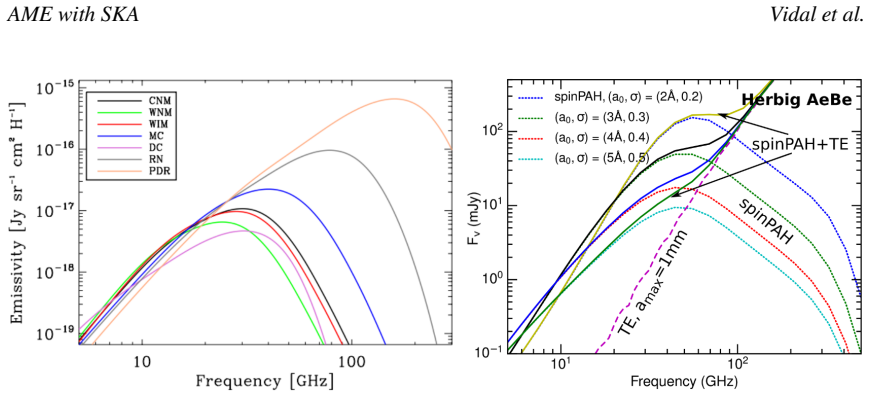
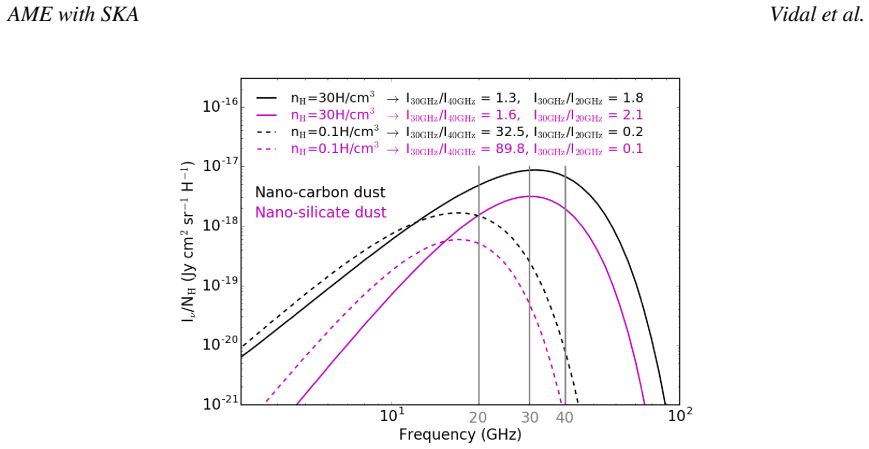
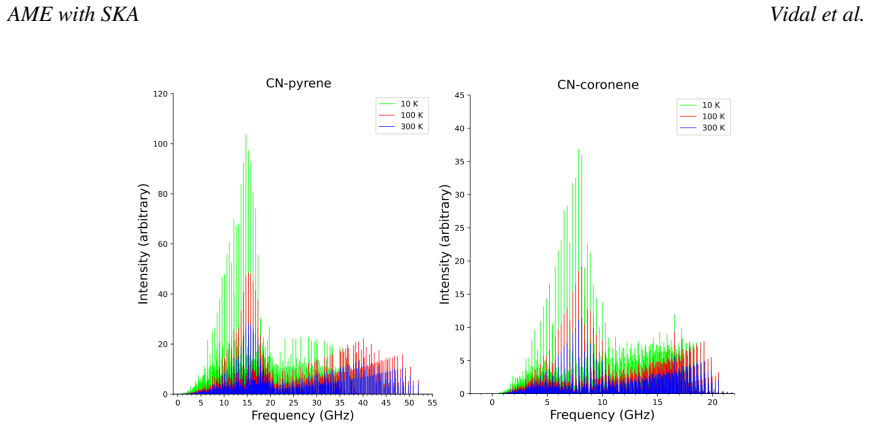
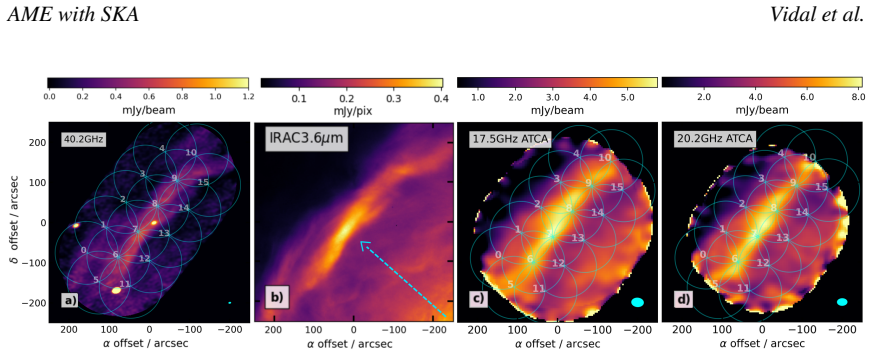


read the original abstract
Anomalous microwave emission (AME) represents an excess of radiation in the 10-60 GHz range, distinct from synchrotron, free-free, or thermal dust emission. Although most commonly attributed to electric dipole radiation from rapidly rotating small dust grains (spinning dust), alternative mechanisms such as magnetic dipole emission (MDE) remain plausible. The detection of AME across diverse environments, from diffuse interstellar clouds to protoplanetary disks and external galaxies, suggests that multiple physical processes or carriers may contribute to its origin. Understanding AME is essential for both Galactic astrophysics and cosmology, as it constitutes a significant foreground for cosmic microwave background (CMB) studies, potentially biasing measurements. This chapter reviews current theoretical frameworks and observational evidence for AME, highlighting the key outstanding questions concerning its emission mechanisms, carriers, and polarization properties. We discuss how the Square Kilometre Array Observatory (SKAO), through its unprecedented sensitivity, angular resolution, and frequency coverage, will transform AME studies. SKA observations will enable detailed mapping of AME morphology, precise characterisation of its spectral energy distribution, and the identification of its carriers in Galactic and extragalactic environments. By combining SKA-mid data with higher-frequency observations from ALMA and other facilities such as SPHEREx, it will be possible to disentangle competing models and exploit AME as a diagnostic probe of interstellar grain physics and the small-scale structure of the interstellar medium.
Editorial analysis
A structured set of objections, weighed in public.
Referee Report
Summary. This manuscript is a review chapter summarizing the observational and theoretical status of Anomalous Microwave Emission (AME) in the 10-60 GHz range. It reviews possible mechanisms (primarily electric-dipole spinning dust, with magnetic-dipole emission as an alternative), detections across Galactic clouds, protoplanetary disks and external galaxies, and open questions on carriers, mechanisms and polarization. The central forward-looking claim is that SKA-mid, through its sensitivity, resolution and frequency coverage, will enable detailed AME morphology mapping and precise SED characterization; when combined with ALMA and SPHEREx data, this will disentangle models and turn AME into a diagnostic of interstellar grain physics and small-scale ISM structure. The review positions AME as both a Galactic astrophysics probe and a CMB foreground.
Significance. If the SKA performance projections hold, the review supplies a useful science-case synthesis that connects existing AME literature to planned SKA observations. It correctly flags the multi-facility strategy (SKA-mid + ALMA/SPHEREx) as essential for model discrimination. The manuscript contains no new derivations, fits or code, but its value lies in collating open questions and mapping them onto SKA capabilities in a manner typical of observatory science-case chapters.
major comments (1)
- [Discussion of SKAO capabilities] The central projection that SKA-mid observations will suffice for 'detailed mapping of AME morphology' and 'precise characterisation of its spectral energy distribution across diverse environments' is load-bearing for the main claim, yet the text provides no quantitative sensitivity, resolution or frequency-coverage calculations, nor direct comparisons to current facilities (e.g., VLA, GBT or Planck), to demonstrate that the required dynamic range and fidelity will be achieved.
minor comments (2)
- [Abstract] The abstract states that AME 'constitutes a significant foreground for cosmic microwave background (CMB) studies'; a specific citation to the most recent foreground-assessment papers would strengthen this statement.
- The manuscript refers to 'this chapter' throughout; if the target is a journal rather than a book, the framing should be adjusted for consistency.
Simulated Author's Rebuttal
We thank the referee for their constructive comments on our review manuscript. We address the single major comment below and will revise the text accordingly.
read point-by-point responses
-
Referee: The central projection that SKA-mid observations will suffice for 'detailed mapping of AME morphology' and 'precise characterisation of its spectral energy distribution across diverse environments' is load-bearing for the main claim, yet the text provides no quantitative sensitivity, resolution or frequency-coverage calculations, nor direct comparisons to current facilities (e.g., VLA, GBT or Planck), to demonstrate that the required dynamic range and fidelity will be achieved.
Authors: We agree that the absence of quantitative benchmarks weakens the central claim. The manuscript is a review and therefore drew its SKA projections from existing SKAO documentation and science-case papers rather than performing new calculations. In revision we will add a short subsection (approximately one page) that tabulates (i) SKA-mid continuum sensitivity and rms noise at 10–30 GHz for typical integration times, (ii) angular-resolution comparisons with the VLA, GBT and Planck, and (iii) frequency-coverage advantages relative to current facilities. We will also cite published SKA performance simulations that quantify the expected improvement in dynamic range and SED fidelity for AME-like signals. These additions will be drawn from publicly available SKAO technical reports and will not require new observational data or modelling. revision: yes
Circularity Check
No significant circularity; forward-looking review with no derivations
full rationale
The manuscript is a literature review chapter that summarizes prior AME observations and theory, then projects SKA capabilities for future mapping and SED characterization. No equations, model fits, or predictions are presented that reduce by construction to the paper's own inputs or self-citations. The central claim relies on external observatory specifications and standard literature, with no load-bearing self-citation chains or self-definitional steps. This is self-contained against external benchmarks and receives the default non-circularity finding.
Axiom & Free-Parameter Ledger
Reference graph
Works this paper leans on
-
[1]
2026 ,publisher =
Ilsang Yoon and author2 and author3 and author4 and author5 ,title =. 2026 ,publisher =
2026
-
[2]
Physical conditions from consistent modeling of nano-grain rotational and vibrational emission
ALMA Band 1 observations of the ρ Oph W filament II. Physical conditions from consistent modeling of nano-grain rotational and vibrational emission. Astronomy & Astrophysics , keywords =. 2026 submitted , month =. doi:, archivePrefix =. , primaryClass =
2026
-
[3]
arXiv preprint arXiv:1912.12699 , year=
Anticipated Performance of the Square Kilometre Array--Phase 1 (SKA1) , author=. arXiv preprint arXiv:1912.12699 , year=
arXiv 1912
-
[4]
Monthly Notices of the Royal Astronomical Society , volume =
Zhang, Zheng and Chluba, Jens and Cepeda-Arroita, Roke and Rubiño-Martín, José Alberto , title =. Monthly Notices of the Royal Astronomical Society , volume =. 2026 , month =. doi:10.1093/mnras/stag509 , url =
-
[5]
Science with an ngVLA: The ngVLA Reference Design
The ngVLA Reference Design. Science with a Next Generation Very Large Array , year = 2018, editor =. doi:10.48550/arXiv.1810.08197 , archivePrefix =. 1810.08197 , primaryClass =
work page internal anchor Pith review Pith/arXiv arXiv doi:10.48550/arxiv.1810.08197 2018
-
[6]
Mechanical alignment of suprathermally rotating grains
Mechanical Alignment of Suprathermally Rotating Grains. , keywords =. doi:10.1086/176252 , archivePrefix =. astro-ph/9505003 , primaryClass =
work page internal anchor Pith review Pith/arXiv arXiv doi:10.1086/176252
-
[7]
Studies of Anomalous Microwave Emission (AME) with the SKA
Studies of Anomalous Microwave Emission (AME) with the SKA. Advancing Astrophysics with the Square Kilometre Array (AASKA14) , year = 2015, month = apr, eid =. doi:10.22323/1.215.0124 , archivePrefix =. 1412.5054 , primaryClass =
work page internal anchor Pith review Pith/arXiv arXiv doi:10.22323/1.215.0124 2015
-
[8]
Hoang, Thiem and Lazarian, A , journal =. 2016 , rating =. doi:10.3847/0004-637x/831/2/159 , abstract =
-
[9]
Hoang, Thiem and Lazarian, A , journal =. 2018 , rating =. doi:10.3847/1538-4357/aac6e7 , abstract =
-
[10]
SPHEREx: Aromatics, Aliphatics, and PAH Size across the Iris Nebula. , keywords =. doi:10.3847/1538-4357/ae2a33 , archivePrefix =. 2510.20919 , primaryClass =
-
[11]
The SPHEREx Satellite Mission. , keywords =. doi:10.3847/1538-4357/ae2be2 , archivePrefix =. 2511.02985 , primaryClass =
-
[12]
Excitation of Polycyclic Aromatic Hydrocarbon Emission: Dependence on Size Distribution, Ionization, and Starlight Spectrum and Intensity. , keywords =. doi:10.3847/1538-4357/abff51 , archivePrefix =. 2011.07046 , primaryClass =
-
[13]
The Potential of the SPHEREx Mission for Characterizing Polycyclic Aromatic Hydrocarbon 3.3 m Emission in Nearby Galaxies. , keywords =. doi:10.3847/1538-4357/adfd5a , archivePrefix =. 2503.21876 , primaryClass =
-
[14]
Hoang, Thiem and Lazarian, A and Martin, P G , journal =. 2014 , rating =. doi:10.1088/0004-637x/790/1/6 , abstract =
-
[15]
Hoang, Thiem and Tram, Le Ngoc and Lee, Hyeseung and Ahn, Sang-Hyeon , journal =. 2019 , rating =. doi:10.1038/s41550-019-0763-6 , abstract =
-
[16]
Poojon, Panomporn and Chung, Aeree and Hoang, Thiem and Baek, Junhyun and Nakanishi, Hiroyuki and Hirota, Tomoya and Tsai, Chao-Wei , journal =. 2024 , title =. doi:10.3847/1538-4357/ad1bc8 , abstract =
-
[19]
COMAP Early Science. I. Overview. , keywords =. doi:10.3847/1538-4357/ac63cc , archivePrefix =. 2111.05927 , primaryClass =
-
[20]
Rennie, Thomas J. and Harper, Stuart E. and Dickinson, Clive and Philip, Liju and Cleary, Kieran A. and Bond, Richard J. and Borowska, Jowita and Breysse, Patrick C. and Catha, Morgan and Cepeda-Arroita, Roke and Chung, Dongwoo T. and Church, Sarah E. and Dunne, Delaney A. and Eriksen, Hans Kristian and Foss, Marie Kristine and Gaier, Todd and Gundersen, ...
-
[21]
Galactic AME sources in the QUIJOTE-MFI northern hemisphere wide survey
QUIJOTE scientific results - VII. Galactic AME sources in the QUIJOTE-MFI northern hemisphere wide survey. , keywords =. doi:10.1093/mnras/stac3151 , archivePrefix =. 2301.05116 , primaryClass =
-
[22]
Spectral properties of Anomalous Microwave Emission in 144 Galactic clouds. , keywords =. doi:10.1051/0004-6361/202557578 , archivePrefix =. 2510.05067 , primaryClass =
-
[23]
Spatial variations of Anomalous Microwave Emission along the Galactic plane
QUIJOTE scientific results - X. Spatial variations of Anomalous Microwave Emission along the Galactic plane. , keywords =. doi:10.1093/mnras/stad2545 , archivePrefix =. 2305.06762 , primaryClass =
-
[24]
The Rhodes/HartRAO 2326-MHz radio continuum survey. , keywords =. doi:10.1046/j.1365-8711.1998.01367.x , adsurl =
-
[25]
Ground-based and Airborne Telescopes IV , year = 2012, editor =
The QUIJOTE-CMB experiment: studying the polarisation of the galactic and cosmological microwave emissions. Society of Photo-Optical Instrumentation Engineers (SPIE) Conference Series , year = 2012, series =. doi:10.1117/12.926581 , adsurl =
-
[26]
A northern sky survey in intensity and polarization at 10-20 GHz with the multifrequency instrument
QUIJOTE scientific results - IV. A northern sky survey in intensity and polarization at 10-20 GHz with the multifrequency instrument. , keywords =. doi:10.1093/mnras/stac3439 , archivePrefix =. 2301.05113 , primaryClass =
-
[27]
The C-Band All-Sky Survey (C-BASS): Design and capabilities
The C-Band All-Sky Survey (C-BASS): design and capabilities. , keywords =. doi:10.1093/mnras/sty1956 , archivePrefix =. 1805.04490 , primaryClass =
work page internal anchor Pith review Pith/arXiv arXiv doi:10.1093/mnras/sty1956
-
[28]
doi:10.1093/mnras/stz806 , eprint =
S-band Polarization All-Sky Survey (S-PASS): survey description and maps. , keywords =. doi:10.1093/mnras/stz806 , archivePrefix =. 1903.09420 , primaryClass =
-
[29]
Bayesian evidence for flux scale errors in Galactic synchrotron maps. , keywords =. doi:10.1093/mnras/staf668 , archivePrefix =. 2409.06770 , primaryClass =
-
[30]
2014 , institution =
C-BASS, the C-Band All Sky Survey , journal-added =. 2014 , institution =
2014
-
[31]
A radio continuum survey of the southern sky at 1420 MHz. The atlas of contour maps. , keywords =. doi:10.1051/0004-6361:20011000 , adsurl =
-
[32]
A survey of the continuum radiation at 820 MHz between declinations -7 and +85 . I. Observations and reductions. Astronomy and Astrophysics Supplement Series , year = 1972, month = Mar, volume =
1972
-
[33]
II - The atlas of contour maps
A 408 MHz all-sky continuum survey. II - The atlas of contour maps. , keywords =
-
[34]
Science with an ngVLA: The ngVLA Science Case and Associated Science Requirements
The ngVLA Science Case and Associated Science Requirements. Science with a Next Generation Very Large Array , year = 2018, editor =. doi:10.48550/arXiv.1810.07524 , archivePrefix =. 1810.07524 , primaryClass =
work page internal anchor Pith review Pith/arXiv arXiv doi:10.48550/arxiv.1810.07524 2018
-
[35]
Journal of Cosmology and Astroparticle Physics , abstract =
Zhang, Zheng and Chluba, Jens , title =. Journal of Cosmology and Astroparticle Physics , abstract =. 2025 , month =. doi:10.1088/1475-7516/2025/03/038 , url =
-
[36]
Thermal emission from the amorphous dust: An alternative possibility of the origin of the anomalous microwave emission. , keywords =. doi:10.1093/pasj/psz124 , archivePrefix =. 1910.07270 , primaryClass =
-
[37]
Iron: A Key Element for Understanding the Origin and Evolution of Interstellar Dust
Iron: A Key Element for Understanding the Origin and Evolution of Interstellar Dust. , keywords =. doi:10.3847/0004-637X/825/2/136 , archivePrefix =. 1605.01957 , primaryClass =
work page internal anchor Pith review Pith/arXiv arXiv doi:10.3847/0004-637x/825/2/136
-
[38]
Interstellar Gas-Phase Abundances and Physical Conditions toward Two Distant High-Latitude Halo Stars. , keywords =. doi:10.1086/177919 , adsurl =
-
[39]
A Unified Representation of Gas-Phase Element Depletions in the Interstellar Medium
A Unified Representation of Gas-Phase Element Depletions in the Interstellar Medium. , keywords =. doi:10.1088/0004-637X/700/2/1299 , archivePrefix =. 0905.3173 , primaryClass =
work page internal anchor Pith review Pith/arXiv arXiv doi:10.1088/0004-637x/700/2/1299
-
[40]
Scattering by Interstellar Dust Grains. I. Optical and Ultraviolet. , keywords =. doi:10.1086/379118 , archivePrefix =. astro-ph/0304060 , primaryClass =
work page internal anchor Pith review Pith/arXiv arXiv doi:10.1086/379118
-
[41]
Large metallicity variations in the Galactic interstellar medium. , keywords =. doi:10.1038/s41586-021-03780-0 , archivePrefix =. 2109.03249 , primaryClass =
-
[42]
Cosmic Amorphous Dust Model as the Origin of Anomalous Microwave Emission. , keywords =. doi:10.3847/2041-8213/abb29d , archivePrefix =. 2009.00137 , primaryClass =
-
[43]
Microwave emission from dust revisited. , keywords =. doi:10.1051/0004-6361/200810621 , adsurl =
-
[44]
The 4 400 GHz Survey for the 32 Class II Disks in the Taurus Molecular Cloud. , keywords =. doi:10.3847/1538-4365/adb717 , archivePrefix =. 2502.14342 , primaryClass =
-
[45]
Detection of spectral variations of Anomalous Microwave Emission with QUIJOTE and C-BASS. , keywords =. doi:10.1093/mnras/stab583 , archivePrefix =. 2001.07159 , primaryClass =
-
[46]
Frontiers in Astronomy and Space Sciences , keywords =
Does processing or formation of water ice mantles affect the capacity of nanosilicates to be the source of the anomalous microwave emission?. Frontiers in Astronomy and Space Sciences , keywords =. doi:10.3389/fspas.2021.676548 , adsurl =
-
[47]
Cosmic Silicates. , year = 2010, month = sep, volume =. doi:10.1146/annurev-astro-081309-130815 , adsurl =
-
[48]
Assessing the viability of silicate nanoclusters as carriers of the anomalous microwave emission: a quantum mechanical study. , keywords =. doi:10.1051/0004-6361/201936419 , adsurl =
-
[49]
Frontiers in Astronomy and Space Sciences , year = 2024, month = dec, volume =
Nanosilicates and molecular silicate dust species: properties and observational prospects. Frontiers in Astronomy and Space Sciences , year = 2024, month = dec, volume =. doi:10.3389/fspas.2024.1523977 , adsurl =
-
[50]
Statistical Analysis of Polycyclic Aromatic Hydrocarbons as a Tracer of Anomalous Microwave Emission Using DIRBE Data. , keywords =. doi:10.3847/1538-4357/adf72e , archivePrefix =. 2509.03611 , primaryClass =
-
[51]
Tracing PAH Emission in -Orionis Using COBE/DIRBE Data. , keywords =. doi:10.3847/1538-4357/ac9b24 , archivePrefix =. 2208.09049 , primaryClass =
-
[52]
Cosmology with the SPHEREX All-Sky Spectral Survey
Cosmology with the SPHEREX All-Sky Spectral Survey. arXiv e-prints , keywords =. doi:10.48550/arXiv.1412.4872 , archivePrefix =. 1412.4872 , primaryClass =
work page internal anchor Pith review Pith/arXiv arXiv doi:10.48550/arxiv.1412.4872
-
[53]
Detection of interstellar 1-cyanopyrene: A four-ring polycyclic aromatic hydrocarbon. Science , keywords =. doi:10.1126/science.adq6391 , archivePrefix =. 2410.00657 , primaryClass =
-
[54]
Classifying Compact Radio Emission in Nearby Galaxies: A 10 GHz Study of Active Galactic Nuclei, Supernovae, Anomalous Microwave Emission, and Star-forming Regions. , keywords =. doi:10.3847/1538-3881/adf8d4 , archivePrefix =. 2507.23332 , primaryClass =
-
[55]
The Star Formation in Radio Survey: 3-33 GHz Imaging of Nearby Galaxy Nuclei and Extranuclear Star-forming Regions. , keywords =. doi:10.3847/1538-4365/ab8a4d , archivePrefix =. 2004.10230 , primaryClass =
-
[56]
Rotational spectra of interstellar N- and CN-PAHs: pyrene and coronene. , keywords =. doi:10.1093/mnras/stac3157 , archivePrefix =. 2211.01636 , primaryClass =
-
[57]
QUIJOTE scientific results - III. Microwave spectrum of intensity and polarization in the Taurus Molecular Cloud complex and L1527. , keywords =. doi:10.1093/mnras/sty3462 , archivePrefix =. 1812.08274 , primaryClass =
work page internal anchor Pith review Pith/arXiv arXiv doi:10.1093/mnras/sty3462
-
[58]
Polycyclic aromatic hydrocarbons and the unidentified infrared emission bands: auto exhaust along the milky way. , keywords =. doi:10.1086/184435 , adsurl =
-
[59]
The near-infrared continuum emission of visual reflection nebulae. , keywords =. doi:10.1086/161733 , adsurl =
-
[60]
Infrared Emission from Interstellar Dust. II. The Diffuse Interstellar Medium. , keywords =. doi:10.1086/323147 , archivePrefix =. astro-ph/0011319 , primaryClass =
work page internal anchor Pith review Pith/arXiv arXiv doi:10.1086/323147
-
[61]
Infrared Emission from Interstellar Dust. I. Stochastic Heating of Small Grains. , keywords =. doi:10.1086/320227 , archivePrefix =. astro-ph/0011318 , primaryClass =
work page internal anchor Pith review Pith/arXiv arXiv doi:10.1086/320227
-
[62]
Astronomy and Computing , keywords =
Multi-GPU maximum entropy image synthesis for radio astronomy. Astronomy and Computing , keywords =. doi:10.1016/j.ascom.2017.11.003 , archivePrefix =. 1703.02920 , primaryClass =
-
[63]
Resolved observations at 31 GHz of spinning dust emissivity variations in Oph. , keywords =. doi:10.1093/mnras/staa1422 , archivePrefix =. 1910.06359 , primaryClass =
-
[64]
Resolved spectral variations of the centimetre-wavelength continuum from the Oph W photodissociation region. , keywords =. doi:10.1093/mnras/staa4016 , archivePrefix =. 2010.00185 , primaryClass =
-
[65]
Enhanced power from excess microwave emission at high spatial frequencies
ALMA Band 1 observations of the Oph W filament: I. Enhanced power from excess microwave emission at high spatial frequencies. , keywords =. doi:10.1051/0004-6361/202557944 , archivePrefix =. 2602.11356 , primaryClass =
-
[66]
Detection of the Aromatic Molecule Benzonitrile ($c$-C$_6$H$_5$CN) in the Interstellar Medium
Detection of the aromatic molecule benzonitrile (c-C _ 6 H _ 5 CN) in the interstellar medium. Science , keywords =. doi:10.1126/science.aao4890 , archivePrefix =. 1801.04228 , primaryClass =
work page internal anchor Pith review Pith/arXiv arXiv doi:10.1126/science.aao4890
-
[67]
Detection of two interstellar polycyclic aromatic hydrocarbons via spectral matched filtering , volume =. Science , author =. 2021 , note =. doi:10.1126/science.abb7535 , abstract =
-
[68]
Astronomy & Astrophysics , author =. 2025 , note =. doi:10.1051/0004-6361/202451768 , abstract =
-
[69]
, archivePrefix = "arXiv", eprint =
The Detection of Anomalous Dust Emission in the Nearby Galaxy NGC 6946. , archivePrefix = "arXiv", eprint =. doi:10.1088/2041-8205/709/2/L108 , adsurl =
-
[70]
Modelling the spinning dust emission from LDN 1780. , keywords =. doi:10.1093/mnras/staa1186 , archivePrefix =. 1901.07458 , primaryClass =
-
[71]
Planck intermediate results. XXX. The angular power spectrum of polarized dust emission at intermediate and high Galactic latitudes. , keywords =. doi:10.1051/0004-6361/201425034 , archivePrefix =. 1409.5738 , primaryClass =
work page internal anchor Pith review Pith/arXiv arXiv doi:10.1051/0004-6361/201425034
-
[72]
Spinning nano-carbon grains: Viable origin for anomalous microwave emission. , keywords =. doi:10.1051/0004-6361/202142825 , archivePrefix =. 2205.01400 , primaryClass =
-
[73]
Quantum Suppression of Alignment in Ultrasmall Grains: Microwave Emission from Spinning Dust will be Negligibly Polarized. , keywords =. doi:10.3847/0004-637X/831/1/59 , archivePrefix =. 1605.06671 , primaryClass =
work page internal anchor Pith review Pith/arXiv arXiv doi:10.3847/0004-637x/831/1/59
-
[74]
Sensitivity and foreground modelling for large-scale CMB B-mode polarization satellite missions
Sensitivity and foreground modelling for large-scale cosmic microwave background B-mode polarization satellite missions. , keywords =. doi:10.1093/mnras/stw441 , archivePrefix =. 1509.04714 , primaryClass =
work page internal anchor Pith review Pith/arXiv arXiv doi:10.1093/mnras/stw441
-
[75]
LiteBIRD Collaboration and Allys, E and Arnold, K and Aumont, J and Aurlien, R and Azzoni, S and Baccigalupi, C and Banday, A J and Banerji, R and Barreiro, R B and Bartolo, N and Bautista, L and Beck, D and Beckman, S and Bersanelli, M and Boulanger, F and Brilenkov, M and Bucher, M and Calabrese, E and Campeti, P and Carones, A and Casas, F J and Catala...
-
[76]
and Adshead, Peter and Ahmed, Zeeshan and Akerib, Daniel and Ali, Aamir and Allen, Steven W
Abazajian, Kevork and Addison, Graeme E. and Adshead, Peter and Ahmed, Zeeshan and Akerib, Daniel and Ali, Aamir and Allen, Steven W. and Alonso, David and Alvarez, Marcelo and Amin, Mustafa A. and Anderson, Adam and Arnold, Kam S. and Ashton, Peter and Baccigalupi, Carlo and Bard, Debbie and Barkats, Denis and Barron, Darcy and Barry, Peter S. and Bartle...
-
[77]
The Simons Observatory: Science goals and forecasts
The Simons Observatory: science goals and forecasts. , keywords =. doi:10.1088/1475-7516/2019/02/056 , archivePrefix =. 1808.07445 , primaryClass =
work page internal anchor Pith review Pith/arXiv arXiv doi:10.1088/1475-7516/2019/02/056 2019
-
[78]
Evidence for supernova-synthesized dust from the rising afterglow of GRB 071025 at z 5. , keywords =. doi:10.1111/j.1365-2966.2010.16772.x , archivePrefix =. 0912.2999 , primaryClass =
-
[79]
The Far-Infrared-Radio Correlation at High Redshifts: Physical Considerations and Prospects for the Square Kilometer Array. , keywords =. doi:10.1088/0004-637X/706/1/482 , archivePrefix =. 0910.0011 , primaryClass =
work page internal anchor Pith review Pith/arXiv arXiv doi:10.1088/0004-637x/706/1/482
-
[80]
The implementation of a Fast-Folding pipeline for long-period pulsar searching in the PALFA survey
The Implementation of a Fast-folding Pipeline for Long-period Pulsar Searching in the PALFA Survey. , keywords =. doi:10.3847/1538-4357/aac5f0 , archivePrefix =. 1805.08247 , primaryClass =
work page internal anchor Pith review Pith/arXiv arXiv doi:10.3847/1538-4357/aac5f0
-
[81]
GW150914: First results from the search for binary black hole coalescence with Advanced LIGO
GW150914: First results from the search for binary black hole coalescence with Advanced LIGO. , keywords =. doi:10.1103/PhysRevD.93.122003 , archivePrefix =. 1602.03839 , primaryClass =
work page internal anchor Pith review Pith/arXiv arXiv doi:10.1103/physrevd.93.122003
-
[82]
Detecting Weak Spectral Lines in Interferometric Data through Matched Filtering
Detecting Weak Spectral Lines in Interferometric Data through Matched Filtering. , keywords =. doi:10.3847/1538-3881/aab604 , archivePrefix =. 1803.04987 , primaryClass =
work page internal anchor Pith review Pith/arXiv arXiv doi:10.3847/1538-3881/aab604
discussion (0)
Sign in with ORCID, Apple, or X to comment. Anyone can read and Pith papers without signing in.