Benign Landscape of Quadratic Programs with Orthogonality Constraints and Its Application to Heteroscedastic Probabilistic PCA
Pith reviewed 2026-06-26 03:15 UTC · model grok-4.3
The pith
Every critical point of homogeneous quadratic programs with orthogonality constraints is either a global maximizer or a strict saddle point.
A machine-rendered reading of the paper's core claim, the machinery that carries it, and where it could break.
Core claim
For homogeneous quadratic programs with orthogonality constraints, every critical point is either a global maximizer or a strict saddle point. The analysis uses a closed-form characterization of the critical point set to derive a necessary and sufficient condition for global optimality and to show that every non-optimal critical point possesses a direction of positive curvature. The population heteroscedastic probabilistic PCA is a special instance of this class and therefore has a benign landscape; the sample version inherits the same properties with high probability once the sample size is sufficiently large.
What carries the argument
Closed-form characterization of the critical point set for homogeneous quadratic programs with orthogonality constraints, used to obtain optimality conditions and curvature directions.
If this is right
- Population heteroscedastic probabilistic PCA has a benign landscape and satisfies local geodesic strong concavity near every global maximizer.
- The sample version of heteroscedastic probabilistic PCA inherits the benign landscape and local concavity properties with high probability for large enough samples.
- Retraction-based optimization methods converge locally linearly to global solutions for both the quadratic programs and heteroscedastic probabilistic PCA.
Where Pith is reading between the lines
- Analogous closed-form critical-point characterizations could be sought for other families of orthogonality-constrained quadratics to test whether the benign landscape persists.
- The curvature result supplies a concrete mechanism that existing strict-saddle avoidance algorithms can exploit in this setting.
- The same landscape analysis may apply to related nonconvex PCA variants once they are rewritten as instances of the homogeneous problem.
Load-bearing premise
A closed-form characterization of all critical points must exist for the homogeneous quadratic programs under study.
What would settle it
An explicit homogeneous quadratic program with orthogonality constraints whose critical-point set contains a point that is neither a global maximizer nor a strict saddle.
Figures

read the original abstract
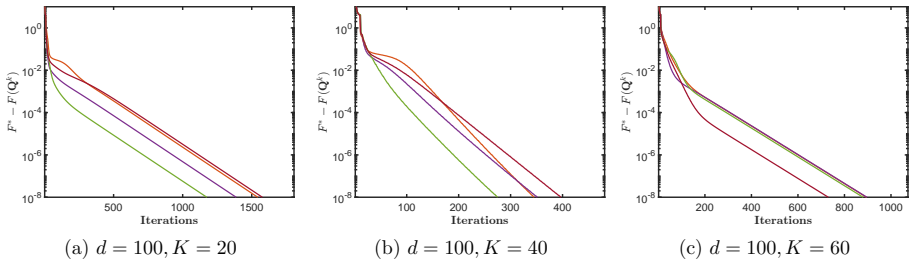
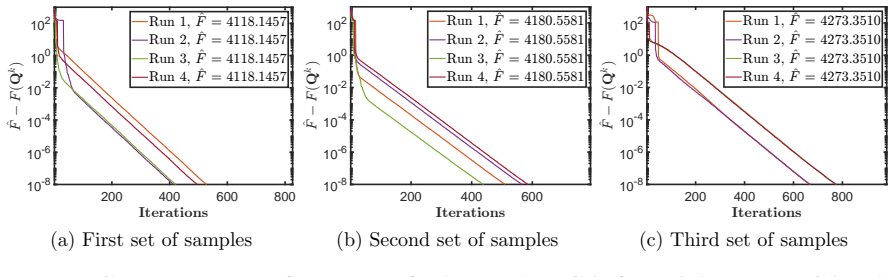
In this work, we study the optimization landscape of homogeneous quadratic programs with orthogonality constraints (QPOC) and apply the resulting theory to heteroscedastic probabilistic PCA (HePPCA). For QPOC, we establish a complete characterization of the benign optimization landscape by showing that every critical point is either a global maximizer or a strict saddle point. Our analysis builds on a closed-form characterization of the critical point set, from which we derive a necessary and sufficient condition for global optimality and show that every non-optimal critical point has a direction of positive curvature. As an application, we show that the population version of HePPCA is a special instance of QPOC and therefore has a benign optimization landscape; moreover, it satisfies local geodesic strong concavity near every global maximizer. We furthermore prove that, when the sample size is sufficiently large, the sample version of HePPCA inherits these favorable properties with high probability. Together with existing theory on avoiding strict saddle points, our results provide a theoretical justification for the observed local linear convergence of retraction-based optimization methods to global solutions for both QPOC and HePPCA. Finally, we present numerical experiments to corroborate our theoretical results.
Editorial analysis
A structured set of objections, weighed in public.
Referee Report
Summary. The manuscript studies the optimization landscape of homogeneous quadratic programs with orthogonality constraints (QPOC). It claims a complete characterization showing every critical point is either a global maximizer or a strict saddle point, obtained via a closed-form characterization of the critical point set on the Stiefel manifold, from which a necessary and sufficient global optimality condition and positive-curvature directions for non-optimal points are derived. The population version of heteroscedastic probabilistic PCA (HePPCA) is shown to be a special case of QPOC with the same benign landscape plus local geodesic strong concavity near global maximizers. For the sample version, these properties are inherited with high probability when the sample size is sufficiently large. The results justify local linear convergence of retraction-based methods, with numerical experiments provided for corroboration.
Significance. If the closed-form critical-point characterization and curvature analysis hold, the result supplies a rigorous, complete description of the landscape for this class of manifold-constrained quadratic programs and directly transfers to HePPCA. The explicit necessary-and-sufficient optimality condition and the strict-saddle property are notable strengths, as is the high-probability transfer from population to sample version. These elements provide theoretical grounding for observed convergence behavior and could support reliable use of first-order retraction methods on related orthogonality-constrained problems.
minor comments (1)
- [Abstract] Abstract, final paragraph: the statement that the sample version 'inherits these favorable properties with high probability' would benefit from an explicit reference to the probability bound or the section containing the concentration argument.
Simulated Author's Rebuttal
We thank the referee for the positive and encouraging review of our manuscript on the optimization landscape of QPOC and its application to HePPCA. The recommendation of minor revision is noted, and we will address any editorial or minor points in the revised version. No specific major comments were provided in the report.
Circularity Check
No significant circularity
full rationale
The derivation begins from an explicit stationarity condition on the Stiefel manifold that yields a closed-form critical-point characterization; global optimality and strict-saddle properties are then obtained by direct eigenvalue analysis of the Hessian. No step equates a fitted parameter to a prediction, renames an input as an output, or relies on a load-bearing self-citation whose own justification is internal to the paper. The HePPCA application is a direct substitution into the same QPOC form. The argument is therefore self-contained against external benchmarks.
Axiom & Free-Parameter Ledger
axioms (2)
- standard math The feasible set is the Stiefel manifold (orthogonality constraints) and the objective is homogeneous quadratic.
- standard math Standard results on Riemannian geometry and retraction maps hold for the constraint manifold.
Reference graph
Works this paper leans on
-
[1]
E. M. Achour, F. Malgouyres, and S. Gerchinovitz. The loss landscape of deep linear neural networks: A second-order analysis.Journal of Machine Learning Research, 25(242):1–76, 2024
2024
-
[2]
Bhojanapalli, B
S. Bhojanapalli, B. Neyshabur, and N. Srebro. Global optimality of local search for low rank matrix recovery. InAdvances in Neural Information Processing Systems, volume 29, 2016. 26
2016
-
[3]
Boumal.An Introduction to Optimization on Smooth Manifolds
N. Boumal.An Introduction to Optimization on Smooth Manifolds. Cambridge University Press, 2023
2023
-
[4]
J. S. Cavazos, J. A. Fessler, and L. Balzano. ALPCAH: Sample-wise heteroscedastic pca with tail singular value regularization. InInternational Conference on Sampling Theory and Applications, pages 1–6. IEEE, 2023
2023
-
[5]
K. H. R. Chan, Y. Yu, C. You, H. Qi, J. Wright, and Y. Ma. Redunet: A white-box deep network from the principle of maximizing rate reduction.Journal of Machine Learning Research, 23(114):1–103, 2022
2022
-
[6]
P. Chen, R. Jiang, and P. Wang. A complete loss landscape analysis of regularized deep matrix factorization.arXiv preprint arXiv:2506.20344, 2025
Pith/arXiv arXiv 2025
-
[7]
Y. Chi, Y. M. Lu, and Y. Chen. Nonconvex optimization meets low-rank matrix factoriza- tion: An overview.IEEE Transactions on Signal Processing, 67(20):5239–5269, 2019
2019
-
[8]
R. Ge, C. Jin, and Y. Zheng. No spurious local minima in nonconvex low rank problems: A unified geometric analysis. InInternational Conference on Machine Learning, pages 1233–1242. PMLR, 2017
2017
-
[9]
Gilman, S
K. Gilman, S. Burer, and L. Balzano. A semidefinite relaxation for sums of heterogeneous quadratic forms on the Stiefel manifold.SIAM Journal on Matrix Analysis and Applica- tions, 46(2):1091–1116, 2025
2025
-
[10]
Gilman, D
K. Gilman, D. Hong, J. A. Fessler, and L. Balzano. Streaming heteroscedastic probabilistic PCA with missing data.Transactions on Machine Learning Research, 2025. ISSN 2835- 8856
2025
-
[11]
W. Givens. Computation of plain unitary rotations transforming a general matrix to triangular form.Journal of the Society for Industrial and Applied Mathematics, 6(1):26– 50, 1958
1958
-
[12]
G. H. Golub and C. F. Van Loan.Matrix Computations. JHU press, 2013
2013
-
[13]
D. Hong, K. Gilman, L. Balzano, and J. A. Fessler. HePPCAT: Probabilistic PCA for data with heteroscedastic noise.IEEE Transactions on Signal Processing, 69:4819–4834, 2021
2021
-
[14]
R. A. Horn and C. R. Johnson.Matrix analysis. Cambridge University Press, 2012
2012
-
[15]
E. L. Lawler. The quadratic assignment problem.Management Science, 9(4):586–599, 1963
1963
-
[16]
J. D. Lee, I. Panageas, G. Piliouras, M. Simchowitz, M. I. Jordan, and B. Recht. First- order methods almost always avoid strict saddle points.Mathematical Programming, 176 (1):311–337, 2019
2019
-
[17]
X. Li, J. Lu, R. Arora, J. Haupt, H. Liu, Z. Wang, and T. Zhao. Symmetry, saddle points, and global optimization landscape of nonconvex matrix factorization.IEEE Transactions on Information Theory, 65(6):3489–3514, 2019. 27
2019
-
[18]
S. Ling. Solving orthogonal group synchronization via convex and low-rank optimization: Tightness and landscape analysis.Mathematical Programming, 200(1):589–628, 2023
2023
-
[19]
S. Ling. Local geometry determines global landscape in low-rank factorization for synchro- nization.Foundations of Computational Mathematics, 26:1553–1585, 2026
2026
-
[20]
H. Liu, A. M.-C. So, and W. Wu. Quadratic optimization with orthogonality constraint: explicit Lojasiewicz exponent and linear convergence of retraction-based line-search and stochastic variance-reduced gradient methods.Mathematical Programming, 178(1):215– 262, 2019
2019
-
[21]
A. D. McRae and N. Boumal. Benign landscapes of low-dimensional relaxations for orthog- onal synchronization on general graphs.SIAM Journal on Optimization, 34(2):1427–1454, 2024
2024
-
[22]
A. D. McRae, P. Abdalla, A. S. Bandeira, and N. Boumal. Nonconvex landscapes forZ 2 synchronization and graph clustering are benign near exact recovery thresholds.Informa- tion and Inference: A Journal of the IMA, 14(2):iaaf012, 2025
2025
-
[23]
S. T. Smith. Optimization techniques on Riemannian manifolds.arXiv preprint arXiv:1407.5965, 2014
Pith/arXiv arXiv 2014
-
[24]
J. Sun, Q. Qu, and J. Wright. A geometric analysis of phase retrieval.Foundations of Computational Mathematics, 18(5):1131–1198, 2018
2018
-
[25]
J. Wang, C. Jiang, H. Liu, and A. M.-C. So. On the estimation performance of the general- ized power method for heteroscedastic probabilistic PCA.arXiv preprint arXiv:2312.03438, 2023
arXiv 2023
-
[26]
P. Wang, H. Liu, D. Pai, Y. Yu, Z. Zhu, Q. Qu, and Y. Ma. A global geometric analysis of maximal coding rate reduction. InInternational Conference on Machine Learning, volume 235, pages 51012–51040. PMLR, 2024
2024
-
[27]
Wen and W
Z. Wen and W. Yin. A feasible method for optimization with orthogonality constraints. Mathematical Programming, 142(1):397–434, 2013
2013
-
[28]
N. Xiao and X. Liu. Solving optimization problems over the stiefel manifold by smooth exact penalty function.arXiv preprint arXiv:2110.08986, 2021
arXiv 2021
-
[29]
N. Xiao, X. Liu, and Y.-x. Yuan. A class of smooth exact penalty function methods for optimization problems with orthogonality constraints.Optimization Methods and Software, 37(4):1205–1241, 2022
2022
-
[30]
A. S. Xu, L. Balzano, and J. A. Fessler. HeMPPCAT: mixtures of probabilistic principal component analysers for data with heteroscedastic noise. InIEEE International Conference on Acoustics, Speech and Signal Processing, pages 1–5. IEEE, 2023
2023
-
[31]
Y. Yan, Y. Chen, and J. Fan. Inference for heteroskedastic PCA with missing data.The Annals of Statistics, 52(2):729–756, 2024. 28
2024
-
[32]
Yaras, P
C. Yaras, P. Wang, Z. Zhu, L. Balzano, and Q. Qu. Neural collapse with normalized features: A geometric analysis over the Riemannian manifold. InAdvances in Neural Information Processing Systems, volume 35, pages 11547–11560, 2022
2022
-
[33]
A. R. Zhang, T. T. Cai, and Y. Wu. Heteroskedastic PCA: Algorithm, optimality, and applications.The Annals of Statistics, 50(1):53–80, 2022
2022
-
[34]
Z. Zhu, T. Ding, J. Zhou, X. Li, C. You, J. Sulam, and Q. Qu. A geometric analysis of neural collapse with unconstrained features. InAdvances in Neural Information Processing Systems, volume 34, pages 29820–29834, 2021. 29
2021
discussion (0)
Sign in with ORCID, Apple, or X to comment. Anyone can read and Pith papers without signing in.