Compositionality and the lexicon in evolutionary semantics
Pith reviewed 2026-06-26 04:26 UTC · model grok-4.3
The pith
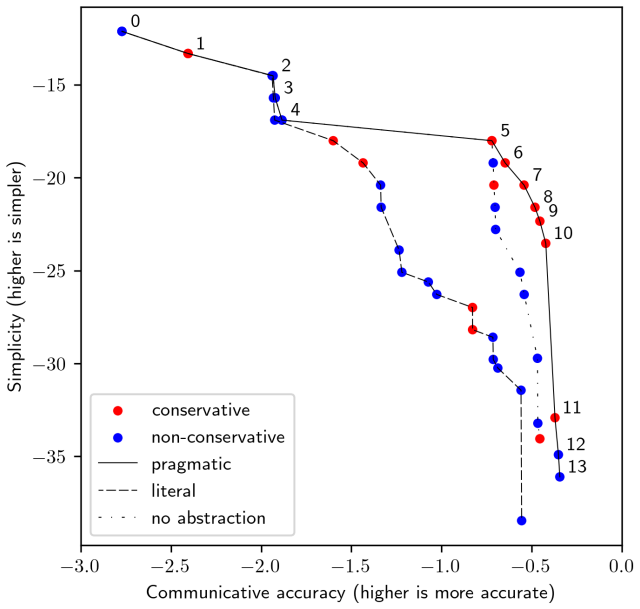
When lexical meanings and composition functions co-evolve under simplicity and accuracy pressures, conservativity emerges as an efficient system-wide abstraction for quantifiers.
A machine-rendered reading of the paper's core claim, the machinery that carries it, and where it could break.
Core claim
By allowing lexical meanings and a composition function to co-evolve under pressures for conceptual simplicity and communicative accuracy, and then analyzing the resulting Pareto frontier for quantificational meaning, the most well-known semantic universal, conservativity, emerges as an efficient system-wide abstraction. The account remains sensitive to syntactic structure and reconciles evidence on quantifier learnability with earlier evolutionary models.
What carries the argument
A framework in which lexical meanings and the composition function co-evolve under pressures for conceptual simplicity and communicative accuracy, applied to quantificational expressions.
If this is right
- Conservativity appears as an efficient system-wide abstraction on the Pareto frontier.
- The account remains sensitive to syntactic structure.
- It reconciles tensions between empirical evidence on quantifier learnability and prior evolutionary models.
- Formal semantics can be productively combined with evolutionary modeling.
- The framework provides a template for studying universals that involve global compression within a grammatical category and the co-evolution of lexical and compositional meaning.
Where Pith is reading between the lines
- The same co-evolutionary pressures might generate other semantic universals if the model is applied to additional grammatical categories.
- Simulations with artificial agents could test whether conservativity reliably appears under varied simplicity-accuracy trade-offs.
- The framework predicts that shifts in communicative demands would alter the position of conservativity on the Pareto frontier.
Load-bearing premise
Pressures for conceptual simplicity and communicative accuracy are the dominant forces shaping the co-evolution of lexical meanings and the composition function for quantificational expressions.
What would settle it
A documented natural language in which quantifiers systematically violate conservativity while showing no measurable increase in conceptual complexity or decrease in communicative accuracy would falsify the emergence claim.
Figures


read the original abstract
Formal semantics has shown that sentence meanings arise by recursively composing lexical meanings, yet much of the literature on semantic universals models either lexicons with fixed signal structures or holistic composition without interpretable lexical parts. We introduce a framework that integrates this fundamental insight of formal semantics in evolutionary modeling, by allowing lexical meanings and a composition function to co-evolve under pressures for conceptual simplicity and communicative accuracy. We apply this framework to the evolution of quantificational meaning. Analyzing the Pareto frontier, we find that the most well-known semantic universal, conservativity, emerges as an efficient system-wide abstraction. The account is sensitive to syntactic structure and helps reconcile tensions between empirical evidence on quantifier learnability and prior evolutionary models. More broadly, the results demonstrate that the picture of sentential meaning developed in formal semantics can be productively combined with evolutionary modeling. The framework offers a template for studying universals that involve global compression within a grammatical category, semantic specialization of syntactic arguments, and the co-evolution of lexical and compositional meaning.
Editorial analysis
A structured set of objections, weighed in public.
Referee Report
Summary. The paper introduces a co-evolutionary framework in which lexical meanings and a composition function for quantificational expressions jointly evolve under explicit pressures for conceptual simplicity and communicative accuracy. It claims that the semantic universal of conservativity emerges as an efficient system-wide abstraction when the resulting systems are analyzed on the Pareto frontier, that the model is sensitive to syntactic structure, and that this helps reconcile empirical evidence on quantifier learnability with prior evolutionary accounts. The work positions itself as a template for combining formal semantics with evolutionary modeling to study universals involving global compression and co-evolution of lexicon and grammar.
Significance. If the central results hold, the work would be significant for integrating the recursive composition insight of formal semantics directly into evolutionary simulations, rather than treating lexicons or composition as fixed. This offers a potential route to explaining semantic universals via joint optimization and Pareto analysis, with explicit sensitivity to syntactic structure as an added strength over holistic or lexicon-only models.
major comments (1)
- [Abstract] Abstract (and provided text): the claim that conservativity 'emerges as an efficient system-wide abstraction' on the Pareto frontier cannot be evaluated because no formal definitions are supplied for the representation of lexical meanings, the composition function, the simplicity and accuracy pressures, the evolutionary dynamics, or the construction of the Pareto frontier itself. Without these, it is impossible to determine whether the reported emergence is a genuine outcome of the co-evolutionary process or an artifact of modeling choices.
Simulated Author's Rebuttal
We thank the referee for highlighting the need for explicit formal definitions to allow evaluation of the central claim. The full manuscript supplies these definitions in Sections 3–5, but we agree the abstract (and any excerpted text) should better foreground them. We will revise accordingly.
read point-by-point responses
-
Referee: [Abstract] Abstract (and provided text): the claim that conservativity 'emerges as an efficient system-wide abstraction' on the Pareto frontier cannot be evaluated because no formal definitions are supplied for the representation of lexical meanings, the composition function, the simplicity and accuracy pressures, the evolutionary dynamics, or the construction of the Pareto frontier itself. Without these, it is impossible to determine whether the reported emergence is a genuine outcome of the co-evolutionary process or an artifact of modeling choices.
Authors: The manuscript defines lexical meanings as model-theoretic functions from pairs of sets to truth values (Section 3.1), the composition function as recursive application of a generalized quantifier to a restrictor and nuclear scope with explicit syntactic sensitivity (Section 3.2), simplicity as the Kolmogorov complexity of the lambda-term representation of the lexicon-plus-composition pair (Section 4.1), accuracy as the expected communicative success rate in a truth-value judgment game (Section 4.2), evolutionary dynamics as a population-based iterated learning process with mutation over meaning representations and selection on the joint simplicity-accuracy objective (Section 5), and the Pareto frontier as the non-dominated set of systems under the two pressures obtained via multi-objective optimization (Section 6). We will add a compact paragraph to the abstract that states these definitions at a high level and points to the relevant sections, so that the emergence claim can be assessed from the abstract alone. revision: yes
Circularity Check
No significant circularity detected
full rationale
The provided abstract and context describe a co-evolutionary model jointly optimizing lexical meanings and a composition function under explicit simplicity and accuracy pressures, with conservativity emerging on the Pareto frontier as an outcome of the process. No equations, definitions, or self-citations are quoted that reduce any prediction or central claim to a fitted parameter, self-referential definition, or load-bearing self-citation chain. The derivation is presented as an independent result of the evolutionary simulation rather than a renaming or smuggling of inputs. This is the expected honest non-finding for a model whose central claim rests on simulation outcomes rather than definitional equivalence.
Axiom & Free-Parameter Ledger
axioms (1)
- domain assumption Pressures for conceptual simplicity and communicative accuracy drive co-evolution of lexical meanings and composition function.
Reference graph
Works this paper leans on
-
[1]
Varieties of Formal Semantics: Proceedings of the 4th Amsterdam Colloquium , pages =
Compositionality , author =. Varieties of Formal Semantics: Proceedings of the 4th Amsterdam Colloquium , pages =
-
[2]
Articulating Reasons: An Introduction to Inferentialism , shorttitle =
Brandom, Robert , year = 2003, edition =. Articulating Reasons: An Introduction to Inferentialism , shorttitle =
2003
-
[3]
Gr. The. doi:10.7551/mitpress/4643.001.0001 , urldate =
-
[4]
Signals: Evolution, Learning, & Information , shorttitle =
-
[5]
Lewis, David , year = 2002, month = jan, edition =. Convention:. doi:10.1002/9780470693711 , urldate =
-
[6]
Program Synthesis , author =
-
[7]
doi: 10.1017/S0140525X22002849
Quilty-Dunn, Jake and Porot, Nicolas and Mandelbaum, Eric , year=. The best game in town: The reemergence of the language-of-thought hypothesis across the cognitive sciences , volume=. doi:10.1017/S0140525X22002849 , journal=
-
[8]
Quantifiers in Language and Logic , author =
-
[9]
Linguistic Semantics , langid =
2-. Linguistic Semantics , langid =
-
[10]
doi:10.1017/CBO9781139236157 , urldate =
The. doi:10.1017/CBO9781139236157 , urldate =
-
[11]
Measuring Compositionality in Representation Learning
Andreas, Jacob , year = 2019, month = apr, number =. Measuring. doi:10.48550/arXiv.1902.07181 , urldate =. arXiv , keywords =:1902.07181 , primaryclass =
work page internal anchor Pith review Pith/arXiv arXiv doi:10.48550/arxiv.1902.07181 2019
-
[12]
Bach, Emmon and Chao, Wynn , year = 2012, month = dec, pages =. 95. 95. doi:10.1515/9783110253382.2537 , urldate =
-
[13]
Baker, Mark and Croft, William , year = 2017, month = jan, journal =. Lexical. doi:10.1146/annurev-linguistics-011516-034134 , urldate =
work page doi:10.1146/annurev-linguistics-011516-034134 2017
-
[14]
Communicative. Linguistic Inquiry , volume =. doi:10.1162/ling_a_00497 , urldate =
-
[15]
Generalized
Barwise, Jon and Cooper, Robin , year = 1981, journal =. Generalized. 25001052 , eprinttype =
1981
-
[16]
Brighton, Henry and Kirby, Simon , year = 2006, month = apr, journal =. Understanding. doi:10.1162/artl.2006.12.2.229 , urldate =
-
[17]
Assertion, Denial, and the Evolution of
Carcassi, Fausto and Sbardolini, Giorgio , year = 2023, journal =. Assertion, Denial, and the Evolution of. doi:10.1111/mila.12448 , urldate =
-
[18]
Carcassi, Fausto and Szymanik, Jakub , year = 2023, month = oct, journal =. The. doi:10.1016/j.cognition.2023.105541 , urldate =
-
[19]
Cultural Evolution of Scalar Categorization:
Carcassi, Fausto , year = 2020, address =. Cultural Evolution of Scalar Categorization:
2020
-
[20]
The Evolution of Adjectival Monotonicity , booktitle =
Carcassi, Fausto and Schouwstra, Marieke and Kirby, Simon , year = 2019, volume =. The Evolution of Adjectival Monotonicity , booktitle =
2019
-
[21]
Carcassi, Fausto and. Monotone. Cognitive Science , volume =. doi:10.1111/cogs.13027 , urldate =
-
[22]
and Smith, Kenny and Cornish, Hannah and Kirby, Simon , year = 2016, month = apr, journal =
Carr, Jon W. and Smith, Kenny and Cornish, Hannah and Kirby, Simon , year = 2016, month = apr, journal =. The. doi:10.1111/cogs.12371 , urldate =
-
[23]
Simplicity and Informativeness in Semantic Category Systems , author =. Cognition , volume =. doi:10.1016/j.cognition.2020.104289 , urldate =
-
[24]
Proceedings of the National Academy of Sciences , volume =
Communicating Artificial Neural Networks Develop Efficient Color-Naming Systems , author =. Proceedings of the National Academy of Sciences , volume =. doi:10.1073/pnas.2016569118 , urldate =
-
[25]
Chaabouni, Rahma and Kharitonov, Eugene and Bouchacourt, Diane and Dupoux, Emmanuel and Baroni, Marco , editor =. Compositionality and. Proceedings of the 58th. doi:10.18653/v1/2020.acl-main.407 , urldate =
-
[26]
An Information-Theoretic Approach to the Typology of Spatial Demonstratives , author =. Cognition , volume =. doi:10.1016/j.cognition.2023.105505 , urldate =
-
[27]
Chung, Sandra and Ladusaw, William A. , year = 2003, publisher =. Restriction and. doi:10.7551/mitpress/5927.001.0001 , urldate =
-
[28]
Situation Theory and Its Applications , editor =
-
[29]
Proceedings of the Annual Meeting of the Cognitive Science Society , volume =
Syntactic Harmony Arises from a Domain-General Learning Bias , author =. Proceedings of the Annual Meeting of the Cognitive Science Society , volume =
-
[30]
Semantics and Linguistic Theory , volume =
Complexity/Informativeness Trade-off in the Domain of Indefinite Pronouns , author =. Semantics and Linguistic Theory , volume =. doi:10.3765/salt.v30i0.4811 , urldate =
-
[31]
Deni. Recursive. Cognitive Science , volume =. doi:10.1111/cogs.13424 , urldate =
-
[32]
and Wall, Robert Eugene and Peters, Stanley , year = 1981, series =
Dowty, David R. and Wall, Robert Eugene and Peters, Stanley , year = 1981, series =. Introduction to
1981
-
[33]
The Language of Thought , author =
-
[34]
Natural Language Semantics , volume =
On the Characterization of Alternatives , author =. Natural Language Semantics , volume =. doi:10.1007/s11050-010-9065-3 , urldate =
-
[35]
Fox, Danny , editor =. Free. Presupposition and. doi:10.1057/9780230210752_4 , urldate =
-
[36]
Probabilistic Pragmatics, or Why
Franke, Michael and J. Probabilistic Pragmatics, or Why. Zeitschrift f\"ur Sprachwissenschaft , volume =. doi:10.1515/zfs-2016-0002 , urldate =
-
[37]
Theory-Driven Statistical Modeling for Semantics and Pragmatics:
Franke, Michael and Bergen, Leon , year = 2020, journal =. Theory-Driven Statistical Modeling for Semantics and Pragmatics:. doi:10.1353/lan.2020.0034 , urldate =
-
[38]
Pragmatics:
Gazdar, Gerald , year = 1979, publisher =. Pragmatics:
1979
-
[39]
Proceedings of the National Academy of Sciences , volume =
Color Naming across Languages Reflects Color Use , author =. Proceedings of the National Academy of Sciences , volume =. doi:10.1073/pnas.1619666114 , urldate =
-
[40]
Gibson, Edward and Futrell, Richard and Piantadosi, Steven P. and Dautriche, Isabelle and Mahowald, Kyle and Bergen, Leon and Levy, Roger , year = 2019, month = may, journal =. How. doi:10.1016/j.tics.2019.02.003 , urldate =
-
[41]
Semantics in Generative Grammar , author =
-
[42]
Herburger, Elena , year = 2001, month = sep, journal =. The. doi:10.1023/A:1014205526722 , urldate =
-
[43]
Heusinger, Klaus and Kempson, Ruth , year = 2004, month = sep, journal =. Choice. doi:10.1007/s11168-004-0903-7 , urldate =
-
[44]
On the Semantic Properties of Logical Operators in Syntax , author =
-
[45]
Hunter, Tim and Lidz, Jeffrey , year = 2013, month = aug, journal =. Conservativity and. doi:10.1093/jos/ffs014 , urldate =
-
[46]
Icard, Thomas F. and Moss, Lawrence S. , year = 2023, month = jun, journal =. A. doi:10.1007/s10992-022-09685-1 , urldate =
-
[47]
Semantics and Linguistic Theory , volume =
Modal Semantic Universals Optimize the Simplicity/Informativeness Trade-Off , author =. Semantics and Linguistic Theory , volume =. doi:10.3765/salt.v1i0.5346 , urldate =
-
[48]
Linguistics and Philosophy , volume =
Structurally-Defined Alternatives , author =. Linguistics and Philosophy , volume =. doi:10.1007/s10988-008-9029-y , urldate =
-
[49]
Linguistics and Philosophy , volume =
A Semantic Characterization of Natural Language Determiners , author =. Linguistics and Philosophy , volume =. doi:10.1007/BF00630273 , urldate =
-
[50]
Kemp, Charles and Regier, Terry , year = 2012, month = may, journal =. Kinship. doi:10.1126/science.1218811 , urldate =
-
[51]
Kemp, Charles and Xu, Yang and Regier, Terry , year = 2018, month = jan, journal =. Semantic. doi:10.1146/annurev-linguistics-011817-045406 , urldate =
work page doi:10.1146/annurev-linguistics-011817-045406 2018
-
[52]
Structured Statistical Models of Inductive Reasoning. , author =. Psychological Review , volume =. doi:10.1037/a0014282 , urldate =
-
[53]
Compression and Communication in the Cultural Evolution of Linguistic Structure , author =. Cognition , volume =. doi:10.1016/j.cognition.2015.03.016 , urldate =
-
[54]
Current Opinion in Neurobiology , volume =
Iterated Learning and the Evolution of Language , author =. Current Opinion in Neurobiology , volume =. doi:10.1016/j.conb.2014.07.014 , abstract =
-
[55]
Spontaneous Evolution of Linguistic Structure-an Iterated Learning Model of the Emergence of Regularity and Irregularity , author =. IEEE Transactions on Evolutionary Computation , volume =. doi:10.1109/4235.918430 , urldate =
-
[56]
Knowlton, Tyler Zarus and Pietroski, Paul and Williams, Alexander and Halberda, Justin and Lidz, Jeffrey , year = 2020, journal =. Determiners Are "Conservative" Because Their Meanings Are Not Relations: Evidence from Verification , shorttitle =. doi:10.3765/salt.v30i0.4815 , urldate =
-
[57]
Linguistics and Philosophy , volume =
The Mental Representation of Universal Quantifiers , author =. Linguistics and Philosophy , volume =. doi:10.1007/s10988-021-09337-8 , urldate =
-
[58]
New Evidence for the Unlearnability of Non-Conservative Quantifiers , author =
-
[59]
Natural Language Semantics , volume =
Psycholinguistic Evidence for Restricted Quantification , author =. Natural Language Semantics , volume =. doi:10.1007/s11050-023-09209-w , urldate =
-
[60]
The Strength of Conservativity: Evidence from Learnability Experiments , shorttitle =
Knowlton, Tyler Zarus and Trueswell, John and Papafragou, Anna , year = 2025, month = may, journal =. The Strength of Conservativity: Evidence from Learnability Experiments , shorttitle =. doi:10.3765/plsa.v10i1.5941 , urldate =
-
[61]
Linguistics and Philosophy , volume =
Common Nouns as Modally Non-Rigid Restricted Variables , author =. Linguistics and Philosophy , volume =. doi:10.1007/s10988-019-09293-4 , urldate =
-
[62]
Emergence of Linguistic Communication from Referential Games with Symbolic and Pixel Input
Lazaridou, Angeliki and Hermann, Karl Moritz and Tuyls, Karl and Clark, Stephen , year = 2018, month = apr, number =. Emergence of. doi:10.48550/arXiv.1804.03984 , urldate =. arXiv , keywords =:1804.03984 , primaryclass =
work page internal anchor Pith review Pith/arXiv arXiv doi:10.48550/arxiv.1804.03984 2018
-
[63]
General Semantics , author =. Synthese , volume =. doi:10.1007/BF00413598 , urldate =
-
[64]
Natural Language Semantics , volume =
Interface Transparency and the Psychosemantics of Most , author =. Natural Language Semantics , volume =. doi:10.1007/s11050-010-9062-6 , urldate =
-
[65]
Language, Form, and Logic: In Pursuit of Natural Logic's
Ludlow, Peter and. Language, Form, and Logic: In Pursuit of Natural Logic's
-
[66]
Maldonado, Mora and Culbertson, Jennifer , year = 2022, month = apr, journal =. Person of. doi:10.1162/ling_a_00406 , urldate =
-
[67]
Martinet, Andr. Function,. Word , volume =. doi:10.1080/00437956.1952.11659416 , urldate =
-
[68]
Review of
Matthewson, Lisa , year = 2007, journal =. Review of. 40070849 , eprinttype =
2007
-
[69]
Mollica, Francis and Piantadosi, Steven T. , year = 2021, journal =. Logical Word Learning:. doi:10.3758/s13423-021-02017-5 , abstract =
-
[70]
Montague, Richard , editor =. The. Approaches to. doi:10.1007/978-94-010-2506-5_10 , urldate =
-
[71]
Mordatch, Igor and Abbeel, Pieter , year = 2018, month = apr, journal =. Emergence of. doi:10.1609/aaai.v32i1.11492 , urldate =
-
[72]
The Evolution of Language , author =. Proceedings of the National Academy of Sciences , volume =. doi:10.1073/pnas.96.14.8028 , urldate =
-
[73]
The Emergence of Word-Internal Repetition through Iterated Learning:
Ota, Mitsuhiko and San Jos. The Emergence of Word-Internal Repetition through Iterated Learning:. Cognition , volume =. doi:10.1016/j.cognition.2021.104585 , urldate =
-
[74]
Events and
Palmarini, Massimo Piattelli , editor =. Events and. Knowledge,
-
[75]
Piantadosi, Steven T. and Tenenbaum, Joshua B. and Goodman, Noah D. , year = 2012, journal =. Bootstrapping in a Language of Thought:. doi:10.1016/j.cognition.2011.11.005 , file =
-
[76]
Piantadosi, Steven T. and Jacobs, Robert A. , year = 2016, month = feb, journal =. Four. doi:10.1177/0963721415609581 , urldate =
-
[77]
Psychological Review , author =
Piantadosi, Steven T. and Tenenbaum, Joshua B. and Goodman, Noah D. , year = 2016, month = jul, journal =. The Logical Primitives of Thought:. doi:10.1037/a0039980 , urldate =
-
[78]
Regier, Terry and Kemp, Charles and Kay, Paul , editor =. Word. The. doi:10.1002/9781118346136.ch11 , urldate =
-
[79]
Semantics and Linguistic Theory , volume =
Searching for a Universal Constraint on the Possible Denotations of Clause-Embedding Predicates , author =. Semantics and Linguistic Theory , volume =. doi:10.3765/salt.v30i0.4834 , urldate =
-
[80]
Romoli, Jacopo , year = 2015, journal =. A
2015
discussion (0)
Sign in with ORCID, Apple, or X to comment. Anyone can read and Pith papers without signing in.