Exact subsystem dynamics in the deterministic Floquet-PXP model
Pith reviewed 2026-06-26 02:03 UTC · model grok-4.3
The pith
Rule 201 in the deterministic Floquet-PXP model has influence matrices given by a finite-dimensional matrix-product operator.
A machine-rendered reading of the paper's core claim, the machinery that carries it, and where it could break.
Core claim
Rule 201 admits influence matrices given by a finite-dimensional matrix-product operator that solves a finite set of algebraic conditions. The paper provides the solution and characterises multi-time autocorrelation functions.
What carries the argument
Influence matrices represented exactly as a finite-dimensional matrix-product operator obeying algebraic conditions.
Load-bearing premise
The influence matrices for this deterministic model remain exactly representable by a finite-dimensional matrix-product operator obeying algebraic conditions rather than growing in complexity with time.
What would settle it
Explicit computation of the influence matrix at successive times that shows the matrix-product operator bond dimension remains bounded and the algebraic conditions continue to hold.
Figures

read the original abstract
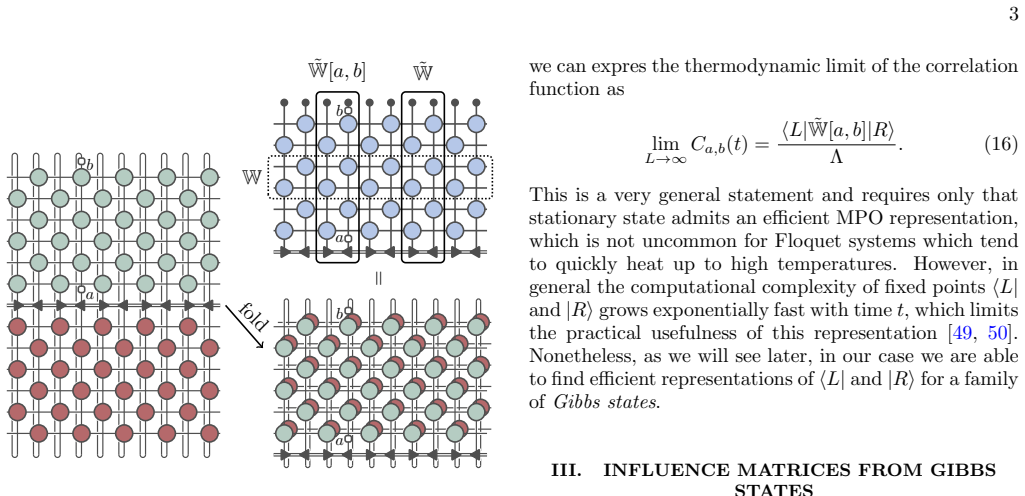
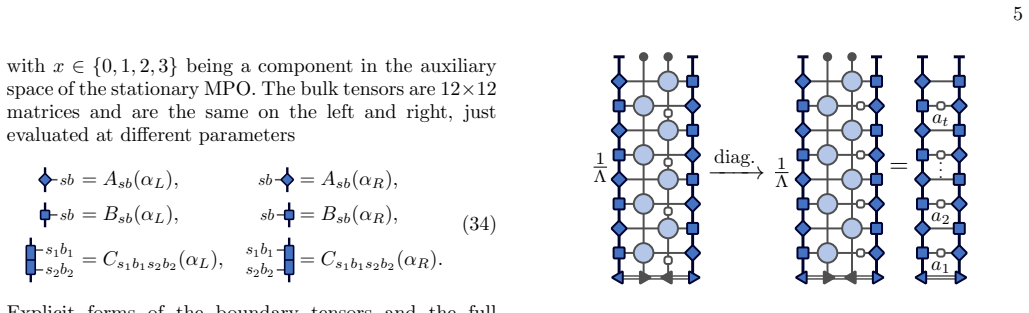
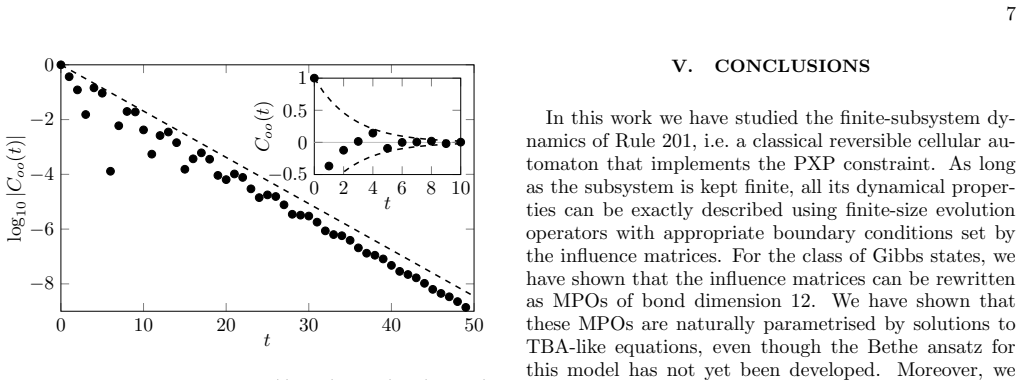
The dynamics of local subsystems in a thermodynamically large quantum many-body system can be understood as effectively open as the system produces its own effective bath. The action of this bath can be characterised in terms of the so-called influence matrices. In generic situations, the complexity of these objects grows unfavourably with time, however, there exist solvable cases where influence matrices can be characterised exactly even in the presence of non-trivial interactions. Here we show that Rule 201, a deterministic version of the Floquet-PXP model, is one of these solvable instances. Indeed, it admits influence matrices given by a finite-dimensional matrix-product operator (MPO) that solves a finite set of algebraic conditions. We provide the solution, and characterise multi-time autocorrelation functions.
Editorial analysis
A structured set of objections, weighed in public.
Referee Report
Summary. The paper claims that Rule 201, a deterministic version of the Floquet-PXP model, admits influence matrices exactly representable by a finite-dimensional matrix-product operator (MPO) that satisfies a finite set of algebraic conditions derived from the local update rules. This representation has time-independent bond dimension, enabling exact computation of multi-time autocorrelation functions for subsystem dynamics.
Significance. If the explicit MPO construction holds, the result identifies a rare exactly solvable case among constrained Floquet systems where influence matrices do not grow in complexity. The provision of the explicit solution and the demonstration that local rules close under contraction constitute a concrete, reproducible advance for characterizing open-system-like subsystem dynamics in many-body models.
minor comments (2)
- The derivation of the algebraic conditions from the deterministic update rule of Rule 201 could be expanded with an explicit step-by-step example in the main text or an appendix to improve accessibility.
- Notation for the MPO tensors and the influence-matrix contraction could be standardized across sections to avoid minor ambiguities in the multi-time correlation expressions.
Simulated Author's Rebuttal
We thank the referee for their careful reading of the manuscript, positive assessment of the results on the exact MPO representation for influence matrices in Rule 201, and recommendation to accept.
Circularity Check
Derivation self-contained: explicit algebraic solution from update rules
full rationale
The manuscript derives a closed set of algebraic conditions for the influence matrices directly from the deterministic local update rule of Rule 201. It then exhibits an explicit finite-dimensional MPO tensor that satisfies those conditions at all times, with bond dimension independent of time because the rules close under contraction. This is a direct constructive proof, not a fit, not a renaming, and not dependent on any self-citation chain. The provided abstract and skeptic summary contain no load-bearing self-citations, no fitted inputs relabeled as predictions, and no imported uniqueness theorems. The central claim therefore rests on independent content derived from the model definition itself.
Axiom & Free-Parameter Ledger
axioms (1)
- domain assumption Local subsystems in a thermodynamically large quantum many-body system can be treated as effectively open, with the remainder acting as a self-generated bath whose action is captured by influence matrices.
Reference graph
Works this paper leans on
-
[1]
We introduce e i,j with 1≤i, j≤4 to denote basis elements in the space of 4×4 matrices ei,j =|i⟩ ⟨j|,(A1) and1 3 to be a 3×3 identity matrix
Main bulk tensors The physical-space components of the bulk tensors are 12×12 matrices, acting on an auxiliary space which we 8 will for compactness represent as a tensor product of a 3 and 4-dimensional vector space. We introduce e i,j with 1≤i, j≤4 to denote basis elements in the space of 4×4 matrices ei,j =|i⟩ ⟨j|,(A1) and1 3 to be a 3×3 identity matri...
-
[2]
Note that with the choice below we have fixed the parameterλin Eq
Boundary tensors We now proceed to boundary tensors. Note that with the choice below we have fixed the parameterλin Eq. (27) to be equal to λ= 1 αR ,(A2) and we have fixed the normalisation so that 1 = 3X x=0 ⟨t|b(L,1) x ⟩ ⟨t|b (R,2) x ⟩ = 3X x=0 ⟨t|b(L,2) x ⟩ ⟨t|b (R,1) x ⟩. (A3) This property, together with X s,b ⟨t|A s,b(αL)⊗ ⟨t|B s,b(αR) = X s,b ⟨t|B ...
-
[3]
Two-site bulk tensors Finally, here we report the auxiliary two-physical-space matrices that constitute the local relations, but do not 10 appear in calculations of physically motivated quantities. C0000 = e11 ⊗ 0 0 1−α 0 0 0 0 0α + e14 ⊗ 0 0 0 0 1 0 0 0 0 + (e22 + e33)⊗ 0 0 0 0α0 0 0 0 + e44 ⊗ α0 0 1−α0 1−α 0 0α , C0001 = ...
-
[4]
Takahashi,Thermodynamics of one-dimensional solv- able models(Cambridge University Press, 1999)
M. Takahashi,Thermodynamics of one-dimensional solv- able models(Cambridge University Press, 1999)
1999
-
[5]
C. N. Yang and C. P. Yang, Thermodynamics of a one-dimensional system of bosons with repulsive delta- function interaction, J. Math. Phys.10, 1115 (1969)
1969
-
[6]
V. E. Korepin, N. M. Bogoliubov, and A. G. Izergin, Quantum inverse scattering method and correlation func- tions, Cambridge Monographs on Mathematical Physics (Cambridge University Press, 1993)
1993
-
[7]
Calabrese, F
P. Calabrese, F. H. L. Essler, and G. Mussardo, Intro- duction to quantum integrability in out of equilibrium systems, J. Stat. Mech.: Theory Exp.2016(6), 064001
2016
-
[8]
F. H. L. Essler and M. Fagotti, Quench dynamics and relaxation in isolated integrable quantum spin chains, J. Stat. Mech.: Theory Exp.2016(6), 064002
2016
-
[9]
Caux, The quench action, J
J.-S. Caux, The quench action, J. Stat. Mech.: Theory Exp.2016(6), 064006
2016
-
[10]
Doyon, Lecture notes on generalised hydrodynamics, SciPost Phys
B. Doyon, Lecture notes on generalised hydrodynamics, SciPost Phys. Lect. Notes , 018 (2020)
2020
-
[11]
V. Alba, B. Bertini, M. Fagotti, L. Piroli, and P. Rug- giero, Generalized-hydrodynamic approach to inhomoge- neous quenches: correlations, entanglement and quantum effects, J. Stat. Mech.: Theory Exp.2021(11), 114004
2021
-
[12]
Bastianello, B
A. Bastianello, B. Bertini, B. Doyon, and R. Vasseur, Introduction to the special issue on emergent hydrody- namics in integrable many-body systems, J. Stat. Mech.: Theory Exp.2022(1), 014001
2022
-
[13]
Bertini, W
B. Bertini, W. W. Ho, L. Piroli, and T. Prosen, Quantum-circuit models for many-body physics out of equilibrium, J. Phys. A: Math. Theor.59, 170201 (2026)
2026
-
[14]
A. C. Potter and R. Vasseur, Entanglement dynamics in hybrid quantum circuits, inEntanglement in Spin Chains: From Theory to Quantum Technology Applica- tions(Springer, 2022) pp. 211–249
2022
-
[15]
M. P. Fisher, V. Khemani, A. Nahum, and S. Vijay, Random quantum circuits, Annu. Rev. Condens. Matter Phys.14, 335 (2023)
2023
-
[16]
Bertini, P
B. Bertini, P. W. Claeys, and T. Prosen, Exactly solvable many-body dynamics from space-time duality, Rev. Mod. Phys.98, 025001 (2026)
2026
-
[17]
Bertini, P
B. Bertini, P. Kos, and T. Prosen, Exact correlation func- tions for dual-unitary lattice models in 1 + 1 dimensions, Phys. Rev. Lett.123, 210601 (2019)
2019
-
[18]
M. C. Ba˜ nuls, M. B. Hastings, F. Verstraete, and J. I. Cirac, Matrix product states for dynamical simulation of infinite chains, Phys. Rev. Lett.102, 240603 (2009)
2009
-
[19]
M¨ uller-Hermes, J
A. M¨ uller-Hermes, J. I. Cirac, and M. C. Ba˜ nuls, Tensor network techniques for the computation of dynamical ob- servables in one-dimensional quantum spin systems, New J. Phys.14, 075003 (2012)
2012
-
[20]
M. B. Hastings and R. Mahajan, Connecting entangle- ment in time and space: Improving the folding algorithm, Phys. Rev. A91, 032306 (2015)
2015
-
[22]
Lerose, M
A. Lerose, M. Sonner, and D. A. Abanin, Influence matrix approach to many-body floquet dynamics, Phys. Rev. X 11, 021040 (2021)
2021
-
[23]
Feynman and F
R. Feynman and F. Vernon, The theory of a general quan- tum system interacting with a linear dissipative system, Ann. Phys.24, 118 (1963)
1963
-
[24]
Sonner, A
M. Sonner, A. Lerose, and D. A. Abanin, Influence func- tional of many-body systems: Temporal entanglement and matrix-product state representation, Ann. Physics 435, 168677 (2021)
2021
-
[25]
Piroli, B
L. Piroli, B. Bertini, J. I. Cirac, and T. Prosen, Exact dynamics in dual-unitary quantum circuits, Phys. Rev. B101, 094304 (2020)
2020
-
[26]
Klobas, B
K. Klobas, B. Bertini, and L. Piroli, Exact thermalization dynamics in the “Rule 54” quantum cellular automaton, Phys. Rev. Lett.126, 160602 (2021)
2021
-
[27]
Klobas and B
K. Klobas and B. Bertini, Exact relaxation to Gibbs and non-equilibrium steady states in the quantum cellular au- tomaton Rule 54, SciPost Phys.11, 106 (2021)
2021
-
[28]
Sonner, A
M. Sonner, A. Lerose, and D. A. Abanin, Characteriz- ing many-body localization via exact disorder-averaged quantum noise, Phys. Rev. B105, L020203 (2022)
2022
-
[29]
Thoenniss, A
J. Thoenniss, A. Lerose, and D. A. Abanin, Nonequi- librium quantum impurity problems via matrix-product states in the temporal domain, Phys. Rev. B107, 195101 (2023)
2023
-
[30]
Bertini, P
B. Bertini, P. Kos, and T. Prosen, Entanglement spread- ing in a minimal model of maximal many-body quantum chaos, Phys. Rev. X9, 021033 (2019)
2019
-
[31]
Klobas and B
K. Klobas and B. Bertini, Entanglement dynamics in Rule 54: Exact results and quasiparticle picture, SciPost Phys.11, 107 (2021)
2021
-
[32]
Ippoliti, T
M. Ippoliti, T. Rakovszky, and V. Khemani, Fractal, log- arithmic, and volume-law entangled nonthermal steady states via spacetime duality, Phys. Rev. X12, 011045 (2022)
2022
-
[33]
Bertini, K
B. Bertini, K. Klobas, V. Alba, G. Lagnese, and P. Cal- abrese, Growth of R´ enyi entropies in interacting inte- grable models and the breakdown of the quasiparticle picture, Phys. Rev. X12, 031016 (2022)
2022
-
[34]
Klobas, Non-equilibrium dynamics of symmetry- resolved entanglement and entanglement asymmetry: Exact asymptotics in Rule 54, J
K. Klobas, Non-equilibrium dynamics of symmetry- resolved entanglement and entanglement asymmetry: Exact asymptotics in Rule 54, J. Phys. A: Math. Theor. 57, 505001 (2024)
2024
-
[35]
Giudice, G
G. Giudice, G. Giudici, M. Sonner, J. Thoenniss, A. Lerose, D. A. Abanin, and L. Piroli, Temporal en- tanglement, quasiparticles, and the role of interactions, Phys. Rev. Lett.128, 220401 (2022)
2022
-
[36]
X.-H. Yu, Z. Wang, and P. Kos, Hierarchical generaliza- tion of dual unitarity, Quantum8, 1260 (2024)
2024
-
[37]
Foligno, P
A. Foligno, P. Kos, and B. Bertini, Quantum information spreading in generalized dual-unitary circuits, Phys. Rev. Lett.132, 250402 (2024)
2024
-
[38]
Wang, X.-Y
H.-R. Wang, X.-Y. Yang, and Z. Wang, Exact hidden markovian dynamics in quantum circuits, Phys. Rev. Lett.133, 170402 (2024)
2024
-
[39]
Klobas, C
K. Klobas, C. De Fazio, and J. P. Garrahan, Exact pre- transition effects in kinetically constrained circuits: Dy- namical fluctuations in the Floquet-east model, Phys. Rev. E110, L022101 (2024)
2024
-
[40]
De Fazio, J
C. De Fazio, J. P. Garrahan, and K. Klobas, Exact results on the dynamics of the stochastic floquet-east model, J. Phys. A: Math. Theor.57, 505002 (2024)
2024
-
[41]
F. H¨ ubner and S. W. P. Kim, Influence-solvability: a sys- tematic theory of (1 + 1)Dsolvability and its application to brickwork circuits, arXiv:2606.12538 (2026). 12
Pith/arXiv arXiv 2026
-
[42]
S. H. Pickering and B. Bertini, Asymptotically solvable quantum circuits, arXiv:2602.24276 (2026)
arXiv 2026
-
[43]
M. A. Rampp, S. A. Rather, and P. W. Claeys, Infinite-level hierarchy of solvable quantum circuits, arXiv:2606.23803 (2026)
Pith/arXiv arXiv 2026
-
[44]
Bobenko, M
A. Bobenko, M. Bordemann, C. Gunn, and U. Pinkall, On two integrable cellular automata, Commun. Math. Phys.158, 127 (1993)
1993
-
[45]
Buˇ ca, K
B. Buˇ ca, K. Klobas, and T. Prosen, Rule 54: Exactly solvable model of nonequilibrium statistical mechanics, J. Stat. Mech.: Theory Exp.2021(7), 074001
2021
-
[46]
J. W. Wilkinson, K. Klobas, T. Prosen, and J. P. Garra- han, Exact solution of the Floquet-PXP cellular automa- ton, Phys. Rev. E102, 062107 (2020)
2020
-
[47]
Iadecola and S
T. Iadecola and S. Vijay, Nonergodic quantum dynamics from deformations of classical cellular automata, Phys. Rev. B102, 180302 (2020)
2020
-
[48]
Lesanovsky, Many-body spin interactions and the ground state of a dense rydberg lattice gas, Phys
I. Lesanovsky, Many-body spin interactions and the ground state of a dense rydberg lattice gas, Phys. Rev. Lett.106, 025301 (2011)
2011
-
[49]
C. J. Turner, A. A. Michailidis, D. A. Abanin, M. Serbyn, and Z. Papi´ c, Weak ergodicity breaking from quantum many-body scars, Nat. Phys.14, 745 (2018)
2018
-
[50]
Giudici, F
G. Giudici, F. M. Surace, and H. Pichler, Unraveling pxp many-body scars through floquet dynamics, Phys. Rev. Lett.133, 190404 (2024)
2024
-
[51]
Specifically, we assume that the MPO ofρis injective
-
[52]
Foligno, T
A. Foligno, T. Zhou, and B. Bertini, Temporal entan- glement in chaotic quantum circuits, Phys. Rev. X13, 041008 (2023)
2023
-
[53]
Fr´ ıas-P´ erez and M
M. Fr´ ıas-P´ erez and M. C. Ba˜ nuls, Light cone tensor network and time evolution, Phys. Rev. B106, 115117 (2022)
2022
-
[54]
A. J. Friedman, S. Gopalakrishnan, and R. Vasseur, In- tegrable many-body quantum Floquet-Thouless pumps, Phys. Rev. Lett.123, 170603 (2019)
2019
-
[55]
Alba and P
V. Alba and P. Calabrese, Quench action and R´ enyi en- tropies in integrable systems, Phys. Rev. B96, 115421 (2017)
2017
-
[56]
K. K. Thomas M. Edge, Integrability of the Floquet-PXP model (2026), in preparation
2026
-
[57]
Bertini, P
B. Bertini, P. Calabrese, M. Collura, K. Klobas, and C. Rylands, Nonequilibrium full counting statistics and symmetry-resolved entanglement from space-time dual- ity, Phys. Rev. Lett.131, 140401 (2023)
2023
-
[58]
Bertini, K
B. Bertini, K. Klobas, M. Collura, P. Calabrese, and C. Rylands, Dynamics of charge fluctuations from asym- metric initial states, Phys. Rev. B109, 184312 (2024)
2024
-
[59]
X.-Y. Yang, H.-R. Wang, and Z. Wang, Solving nonequilibrium dynamics via influence matrix bootstrap: Floquet-PXP model, arXiv:2606.19430 (2026)
Pith/arXiv arXiv 2026
discussion (0)
Sign in with ORCID, Apple, or X to comment. Anyone can read and Pith papers without signing in.