The crust of dark-matter admixed neutron stars: bulk properties and torsional oscillations
Pith reviewed 2026-06-29 01:35 UTC · model grok-4.3
The pith
Dark matter reduces neutron star crust thickness by up to 12% when forming a dark core
A machine-rendered reading of the paper's core claim, the machinery that carries it, and where it could break.
Core claim
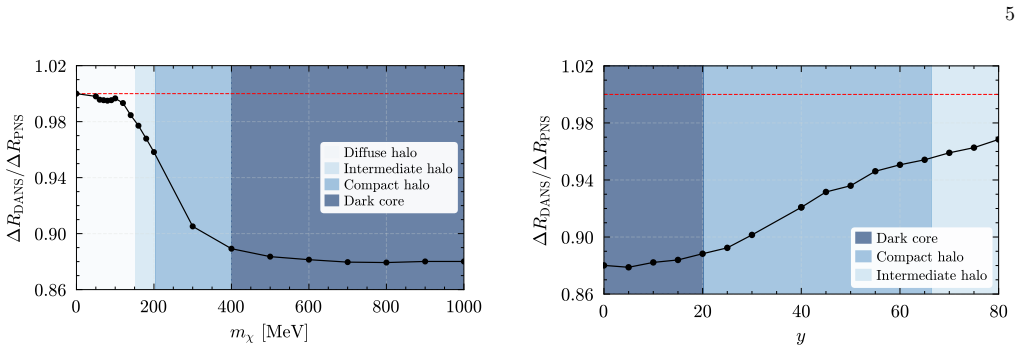
At fixed total gravitational mass and DM mass fraction, DM reduces the crust thickness in comparison to pure baryonic-matter neutron stars. The thinning of the crust is negligible when most of the DM distribution extends beyond the star's baryonic surface. However, the crust thickness can decrease by as much as 12% when the DM distribution is within the star's baryonic surface, i.e., when the star has a dark core. The oscillation frequencies are in general higher than those of a comparable pure baryonic-matter NS, with the largest frequency shifts happening in the same parameter space where the crust thickness decreases the most. Approximate analytical formulas for the crust thickness agree
What carries the argument
Two-fluid equilibrium solutions wherein baryonic and DM interact gravitationally only, adopting a unified nuclear equation of state for baryons and a fermionic equation of state with repulsive self-interaction for DM; the equation for crustal torsional modes in the relativistic Cowling approximation.
If this is right
- Crust thinning is negligible if most DM lies outside the baryonic surface.
- Torsional frequencies increase most where crust thinning is largest.
- Degeneracy between DM effects and baryonic microphysics such as electron screening can be broken in some regions of parameter space.
- Torsional oscillations could be used to infer the existence of a DM core within massive NSs if measured.
Where Pith is reading between the lines
- The frequency shifts might allow multi-messenger observations to separate DM signals from variations in nuclear crust parameters.
- The two-fluid gravitational setup could be applied to study mixed compositions in other compact objects.
- Crust thinning may indirectly affect NS cooling or magnetic field dynamics not calculated in this work.
Load-bearing premise
Baryonic and dark matter interact only gravitationally and the results rely on one specific unified nuclear EOS for baryons plus one fermionic self-interacting EOS for DM.
What would settle it
A measured torsional oscillation frequency in a massive neutron star of known mass and inferred DM fraction that shows no upward shift relative to the pure baryonic prediction, despite parameters indicating a dark core.
Figures




read the original abstract
We study how dark matter (DM) impacts the crust and the spectrum of torsional crust oscillations of dark-matter-admixed neutron stars (DANSs). We construct two-fluid equilibrium solutions wherein baryonic and DM interact gravitationally only, adopting a unified nuclear equation of state for the former and a fermionic equation of state with repulsive self-interaction for the latter. At fixed total gravitational mass and DM mass fraction, we find that DM reduces the crust thickness in comparison to pure baryonic-matter neutron stars (NSs). The thinning of the crust is negligible when most of the DM distribution extends beyond the star's baryonic surface. However, the crust thickness can decrease by as much as 12% when the DM distribution is within the star's baryonic surface, i.e., when the star has a "dark core." We support these results by deriving approximate analytical formulas for the crust thickness that agree with our numerical calculations at the sub-percent level in best case scenarios. Next, we derive the equation that describes crustal torsional modes of DANSs in the relativistic Cowling approximation. We find that the oscillation frequencies are in general higher than those of a comparable pure baryonic-matter NS, with the largest frequency shifts happening in the same parameter space where the crust thickness decreases the most. Moreover, we study the degeneracy between DM and baryonic-crustal microphysics effects on these modes. As an example, we study electron screening, which softens the crust's shear modulus, thus decreasing the frequencies. We find that the degeneracy between the competing effects of DM and electron screening can be broken in some regions of the parameter space we explored. Should they be measured, our results suggest that torsional oscillations could be used to infer the existence of a DM core within massive NSs. (Abridged)
Editorial analysis
A structured set of objections, weighed in public.
Referee Report
Summary. The manuscript constructs two-fluid TOV equilibria for dark-matter-admixed neutron stars using a unified nuclear EOS for baryons and a self-interacting fermionic EOS for DM. At fixed total gravitational mass and DM mass fraction it reports that a dark core thins the baryonic crust by as much as 12 %, derives analytic crust-thickness approximations that match the numerical solutions at the sub-percent level in best cases, and shows that the associated torsional frequencies (computed in the relativistic Cowling approximation) are systematically higher, with the largest shifts occurring in the same dark-core regime. The work also examines the competing effect of electron screening on the shear modulus and finds that the DM-induced frequency up-shift can be distinguished from screening-induced down-shifts in parts of parameter space.
Significance. If the quantitative results survive EOS variation, the paper supplies both a concrete observational signature (elevated torsional frequencies) for the presence of a DM core and a practical analytic tool for estimating crust thickness. The explicit demonstration that DM and electron-screening effects are not fully degenerate in some regions adds value for future mode-based constraints.
major comments (2)
- [Abstract and numerical crust results] Abstract and crust-thickness results: the reported maximum thinning of 12 % (and the associated frequency shifts) is obtained with one specific unified nuclear EOS and one specific fermionic DM EOS; the manuscript presents no additional runs that vary the nuclear symmetry-energy slope, high-density stiffness, or DM self-interaction coupling. Because the gravitational compression of the baryonic envelope depends directly on these microphysical choices, the numerical value of the thinning percentage is tied to the adopted EOS pair and its robustness remains untested.
- [Analytic approximations section] Analytic crust-thickness formulas: the text states that the approximations agree with the numerical solutions “at the sub-percent level in best case scenarios.” The manuscript should quantify the typical (not just best-case) fractional error across the explored range of DM mass fraction and core radius, and state the conditions under which the analytic expressions remain accurate to the claimed precision.
minor comments (2)
- [Methods / equilibrium construction] The definition of the DM mass fraction and the precise radial boundary used to identify a “dark core” should be stated explicitly in the methods section to avoid ambiguity when comparing with other two-fluid studies.
- [Figures] Figure captions for the frequency-shift plots would benefit from an explicit statement of the fixed total mass and the range of DM fractions shown.
Simulated Author's Rebuttal
We thank the referee for the careful reading and constructive suggestions. We address each major comment below.
read point-by-point responses
-
Referee: [Abstract and numerical crust results] Abstract and crust-thickness results: the reported maximum thinning of 12 % (and the associated frequency shifts) is obtained with one specific unified nuclear EOS and one specific fermionic DM EOS; the manuscript presents no additional runs that vary the nuclear symmetry-energy slope, high-density stiffness, or DM self-interaction coupling. Because the gravitational compression of the baryonic envelope depends directly on these microphysical choices, the numerical value of the thinning percentage is tied to the adopted EOS pair and its robustness remains untested.
Authors: We agree that the quoted 12 % maximum thinning (and the associated frequency shifts) is specific to the chosen unified nuclear EOS and fermionic DM EOS; no parameter variations of the symmetry-energy slope, high-density stiffness, or DM self-interaction strength were performed. The gravitational mechanism itself is independent of those details, but the precise percentage is not. In the revised manuscript we will add an explicit caveat in the abstract, results, and discussion sections stating that the numerical value depends on the microphysical inputs and that a broader EOS survey would be required to establish robustness of the percentage. We will also note that the analytic crust-thickness formulas remain applicable regardless of the specific EOS choice. revision: partial
-
Referee: [Analytic approximations section] Analytic crust-thickness formulas: the text states that the approximations agree with the numerical solutions “at the sub-percent level in best case scenarios.” The manuscript should quantify the typical (not just best-case) fractional error across the explored range of DM mass fraction and core radius, and state the conditions under which the analytic expressions remain accurate to the claimed precision.
Authors: We will revise the analytic-approximations section to report both the typical (mean and rms) and worst-case fractional errors between the analytic formulas and the numerical solutions over the full grid of DM mass fractions and core radii. We will also add an explicit statement of the conditions (primarily the presence of a DM core with radius exceeding ~0.6 of the baryonic radius) under which sub-percent accuracy is achieved, together with a brief discussion of the regimes where the error grows. revision: yes
Circularity Check
No significant circularity; standard two-fluid TOV and Cowling derivations are self-contained
full rationale
The paper solves the standard two-fluid Tolman-Oppenheimer-Volkoff equations for equilibrium configurations with a fixed unified nuclear EOS for baryons and a fixed fermionic self-interacting EOS for DM. Crust thickness is obtained directly from the resulting density profiles at fixed total mass and DM fraction. Torsional mode frequencies follow from the relativistic Cowling-approximation wave equation applied to those profiles. Approximate analytic crust-thickness expressions are derived from the same equilibrium structure and validated numerically; they are not fitted to the target observables. No self-citations are invoked as load-bearing uniqueness theorems, no parameters are fitted to a data subset and then relabeled as predictions, and no ansatz is smuggled via prior work. The quantitative 12% figure is therefore an output of the chosen EOS and the standard equations, not a re-expression of the inputs by construction.
Axiom & Free-Parameter Ledger
free parameters (2)
- DM mass fraction
- DM self-interaction coupling
axioms (2)
- domain assumption Baryonic and DM fluids interact only through gravity
- domain assumption Relativistic Cowling approximation for torsional modes
Reference graph
Works this paper leans on
-
[1]
The data tables we use in our numerical calculations are generated as described in Shawqi and Morsink [40], Sec
The baryonic equation of state We adopt the NL3ωρL55 equation of state [35, 36], obtained from the CompOSE database [37–39]. The data tables we use in our numerical calculations are generated as described in Shawqi and Morsink [40], Sec. 2.1. NL3ωρL55 is a stiff equation of state that predicts a maximum mass Mmax = 2.752M⊙ for a nonrotating neu- tron star...
-
[2]
relativistic parameter
The dark matter equation of state As an illustrative example, we adopt a fermionic dark- matter equation of state with repulsive self-interaction [43, 44]. This equation of state was employed in several works in the literature, including, e.g., Refs. [45–49]. The energy density,εd, and pressure,pd, are: εd = m4 χ 8π2 [(2x3 +x) p 1 +x 2 −arcsinhx] + m4 χ y...
-
[3]
3 and 4: the crust was always thinner for the DANS
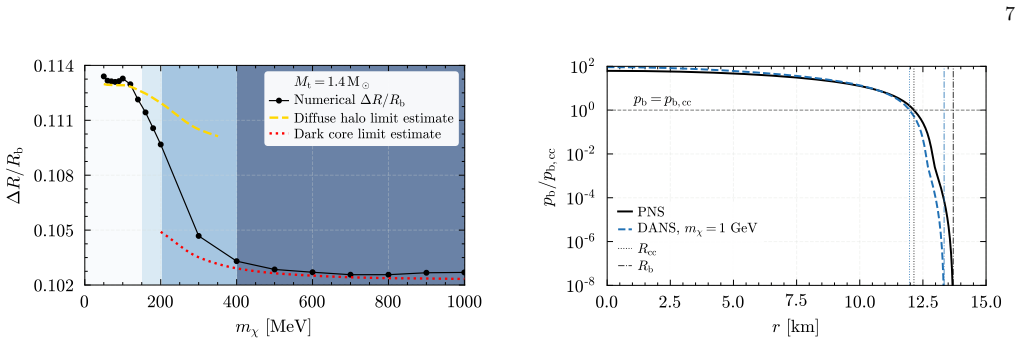
Pressure profile analysis Regardless of how much the crust thickness of our DANS solutions deviated from its value for a PNS refer- ence solution, one pattern emerged from Figs. 3 and 4: the crust was always thinner for the DANS. The reason why the crust becomes thinner can be understood by analyzing the baryonic pressure profile,pb(r). In Fig. 8, we comp...
-
[4]
zero-torque
Approximate formula analysis We now study the behavior of∆R as a function ofmχ. By taking the derivative of Eq.(19) with respect tomχ, we find d dmχ ∆R Rb = dCb dmχ d dCb ∆R Rb =− α [Cb +α(1−2C b)]2 dCb dmχ .(25) Since α > 0, the fractional crust thickness decreases wheneverd Cb/dmχ > 0, as shown in Fig. 6. For the crust thickness, we write∆Rb =R b(∆R/Rb)...
-
[5]
J. M. Lattimer and M. Prakash, The physics of neutron stars, Science304, 536 (2004), arXiv:astro-ph/0405262
Pith/arXiv arXiv 2004
-
[6]
F. Özel and P. Freire, Masses, Radii, and the Equation of State of Neutron Stars, Ann. Rev. Astron. Astrophys. 54, 401 (2016), arXiv:1603.02698 [astro-ph.HE]
Pith/arXiv arXiv 2016
-
[7]
G. Baym, T. Hatsuda, T. Kojo, P. D. Powell, Y. Song, and T. Takatsuka, From hadrons to quarks in neutron stars: a review, Rept. Prog. Phys.81, 056902 (2018), arXiv:1707.04966 [astro-ph.HE]
Pith/arXiv arXiv 2018
-
[8]
J. M. Lattimer, Neutron Stars and the Nuclear Matter Equation of State, Ann. Rev. Nucl. Part. Sci.71, 433 (2021)
2021
-
[9]
Goldman and S
I. Goldman and S. Nussinov, Weakly Interacting Mas- sive Particles and Neutron Stars, Phys. Rev. D40, 3221 (1989)
1989
-
[10]
N.F.Bell, G.Busoni, S.Robles,andM.Virgato,Improved Treatment of Dark Matter Capture in Neutron Stars, JCAP09, 028, arXiv:2004.14888 [hep-ph]
arXiv 2004
-
[11]
Busoni, Capture of Dark Matter in Neutron Stars, Moscow Univ
G. Busoni, Capture of Dark Matter in Neutron Stars, Moscow Univ. Phys. Bull.77, 301 (2022), arXiv:2201.00048 [hep-ph]
arXiv 2022
-
[12]
F. Sandin and P. Ciarcelluti, Effects of mirror dark mat- ter on neutron stars, Astropart. Phys.32, 278 (2009), arXiv:0809.2942 [astro-ph]
Pith/arXiv arXiv 2009
-
[13]
P. Ciarcelluti and F. Sandin, Have neutron stars a dark matter core?, Phys. Lett. B695, 19 (2011), arXiv:1005.0857 [astro-ph.HE]
Pith/arXiv arXiv 2011
-
[14]
N. Rutherford, G. Raaijmakers, C. Prescod-Weinstein, and A. Watts, Constraining bosonic asymmetric dark mat- ter with neutron star mass-radius measurements, Phys. Rev. D107, 103051 (2023), arXiv:2208.03282 [astro- ph.HE]
arXiv 2023
- [15]
-
[16]
N. Rutherford, C. Prescod-Weinstein, and A. Watts, Prob- ing fermionic asymmetric dark matter cores using global neutron star properties, Phys. Rev. D111, 123034 (2025), arXiv:2410.00140 [astro-ph.HE]
arXiv 2025
-
[17]
S. C. Leung, M. C. Chu, and L. M. Lin, Dark-matter admixed neutron stars, Phys. Rev. D84, 107301 (2011), arXiv:1111.1787 [astro-ph.CO]
Pith/arXiv arXiv 2011
-
[18]
A. Das, T. Malik, and A. C. Nayak, Dark matter admixed neutron star properties in light of gravitational wave observations: A two fluid approach, Phys. Rev. D105, 123034 (2022), arXiv:2011.01318 [nucl-th]
arXiv 2022
-
[19]
K.-L. Leung, M.-c. Chu, and L.-M. Lin, Tidal deformabil- ity of dark matter admixed neutron stars, Phys. Rev. D 105, 123010 (2022), arXiv:2207.02433 [astro-ph.HE]
arXiv 2022
-
[20]
A. Kumar and H. Sotani, Constraints on the parameter space in dark matter admixed neutron stars, Phys. Rev. D110, 063001 (2024), arXiv:2408.15312 [astro-ph.HE]
arXiv 2024
-
[21]
A. Kumar and H. Sotani, Impact of dark matter distribu- tion on neutron star properties, Phys. Rev. D111, 043016 (2025), arXiv:2501.07052 [astro-ph.HE]
arXiv 2025
-
[22]
R.C.Duncan,Globalseismicoscillationsinsoftgammare- peaters, Astrophys. J. Lett.498, L45 (1998), arXiv:astro- ph/9803060
arXiv 1998
-
[23]
G. Israel, T. Belloni, L. Stella, Y. Rephaeli, D. Gru- ber, P. G. Casella, S. Dall’Osso, N. Rea, M. Persic, and R. Rothschild, Discovery of rapid x-ray oscillations in the tail of the SGR 1806-20 hyperflare, Astrophys. J. Lett. 628, L53 (2005), arXiv:astro-ph/0505255
Pith/arXiv arXiv 2005
-
[24]
T. E. Strohmayer and A. L. Watts, The 2004 Hyperflare from SGR 1806-20: Further Evidence for Global Torsional Vibrations, Astrophys. J.653, 593 (2006), arXiv:astro- ph/0608463
arXiv 2004
-
[25]
A. L. Watts and T. E. Strohmayer, Neutron star oscilla- tions and QPOs during magnetar flares, Adv. Space Res. 40, 1446 (2007), arXiv:astro-ph/0612252
Pith/arXiv arXiv 2007
-
[26]
Levin, On the theory of magnetar QPOs, Mon
Y. Levin, On the theory of magnetar QPOs, Mon. Not. Roy. Astron. Soc.377, 159 (2007), arXiv:astro- ph/0612725
arXiv 2007
-
[27]
A. M. El-Mezeini and A. I. Ibrahim, Discovery of Quasi- Periodic Oscillations in the Recurrent Burst Emission from SGR 1806-20, Astrophys. J. Lett.721, L121 (2010), arXiv:1008.3870 [astro-ph.HE]
Pith/arXiv arXiv 2010
-
[28]
B. L. Schumaker and K. S. Thorne, Torsional oscillations of neutron stars, MNRAS203, 457 (1983)
1983
-
[29]
L. Samuelsson and N. Andersson, Neutron Star Asteroseis- mology. Axial Crust Oscillations in the Cowling Approx- imation, Mon. Not. Roy. Astron. Soc.374, 256 (2007), arXiv:astro-ph/0609265
Pith/arXiv arXiv 2007
-
[30]
A. A. Kozhberov and D. G. Yakovlev, Deformed crystals and torsional oscillations of neutron star crust, Mon. Not. Roy. Astron. Soc.498, 5149 (2020), arXiv:2009.04952 [astro-ph.HE]
arXiv 2020
-
[31]
D. G. Yakovlev, Self-similarity relations for torsional os- cillations of neutron stars, Mon. Not. Roy. Astron. Soc. 518, 1148 (2022), arXiv:2210.02931 [astro-ph.SR]
arXiv 2022
-
[32]
A. L. Watts, Neutron starquakes and the dynamic crust (2011), arXiv:1111.0514 [astro-ph.SR]
Pith/arXiv arXiv 2011
-
[33]
H. Sotani, Magnetar QPOs and Neutron Star Crust Elas- ticity, Universe10, 231 (2024), arXiv:2405.11858 [astro- ph.HE]
arXiv 2024
-
[34]
Kodama and M
T. Kodama and M. Yamada, Theory of superdense stars, Progress of Theoretical Physics47, 444 (1972)
1972
-
[35]
D. Kobyakov and C. J. Pethick, Dynamics of the inner crust of neutron stars: hydrodynamics, elasticity and col- lective modes, Phys. Rev. C87, 055803 (2013), [Erratum: Phys.Rev.C 94, 059902 (2016)], arXiv:1303.1315 [nucl-th]
Pith/arXiv arXiv 2013
-
[36]
Sotani, Electron screening effects on crustal tor- sional oscillations, Phys
H. Sotani, Electron screening effects on crustal tor- sional oscillations, Phys. Lett. B730, 166 (2014), arXiv:1401.6977 [astro-ph.HE]
Pith/arXiv arXiv 2014
-
[37]
R. C. Tolman, Static solutions of Einstein’s field equations for spheres of fluid, Phys. Rev.55, 364 (1939)
1939
-
[38]
J. R. Oppenheimer and G. M. Volkoff, On massive neutron cores, Phys. Rev.55, 374 (1939)
1939
-
[39]
C. J. Horowitz and J. Piekarewicz, Neutron star structure and the neutron radius of Pb-208, Phys. Rev. Lett.86, 5647 (2001), arXiv:astro-ph/0010227
Pith/arXiv arXiv 2001
-
[40]
H.PaisandC.Providência,Vlasovformalismforextended relativistic mean field models: The crust-core transition and the stellar matter equation of state, Phys. Rev. C94, 015808 (2016), arXiv:1607.05899 [nucl-th]
Pith/arXiv arXiv 2016
-
[41]
S. Typel, M. Oertel, and T. Klähn, CompOSE CompStar online supernova equations of state harmonising the con- cert of nuclear physics and astrophysics compose.obspm.fr, Phys. Part. Nucl.46, 633 (2015), arXiv:1307.5715 [astro- ph.SR]. 18
Pith/arXiv arXiv 2015
-
[42]
M. Oertel, M. Hempel, T. Klähn, and S. Typel, Equations ofstateforsupernovaeandcompactstars,Rev.Mod.Phys. 89, 015007 (2017), arXiv:1610.03361 [astro-ph.HE]
Pith/arXiv arXiv 2017
-
[43]
Typelet al.(CompOSE Core Team), CompOSE Reference Manual, Eur
S. Typelet al.(CompOSE Core Team), CompOSE Reference Manual, Eur. Phys. J. A58, 221 (2022), arXiv:2203.03209 [astro-ph.HE]
arXiv 2022
-
[44]
S. Shawqi and S. M. Morsink, Interpreting Mass and Radius Measurements of Neutron Stars with Dark Matter Halos, Astrophys. J.975, 123 (2024), arXiv:2406.03332 [astro-ph.HE]
arXiv 2024
-
[45]
A. Y. Potekhin, A. F. Fantina, N. Chamel, J. M. Pearson, and S. Goriely, Analytical representations of unified equa- tions of state for neutron-star matter, Astron. Astrophys. 560, A48 (2013), arXiv:1310.0049 [astro-ph.SR]
Pith/arXiv arXiv 2013
-
[46]
M. Fortin, C. Providencia, A. R. Raduta, F. Gulminelli, J. L. Zdunik, P. Haensel, and M. Bejger, Neutron star radii and crusts: uncertainties and unified equations of state, Phys. Rev. C94, 035804 (2016), arXiv:1604.01944 [astro-ph.SR]
Pith/arXiv arXiv 2016
-
[47]
G. Narain, J. Schaffner-Bielich, and I. N. Mishustin, Com- pact stars made of fermionic dark matter, Phys. Rev. D 74, 063003 (2006), arXiv:astro-ph/0605724
Pith/arXiv arXiv 2006
-
[48]
A. Nelson, S. Reddy, and D. Zhou, Dark halos around neutron stars and gravitational waves, JCAP07, 012, arXiv:1803.03266 [hep-ph]
-
[49]
Z. Miao, Y. Zhu, A. Li, and F. Huang, Dark Matter Admixed Neutron Star Properties in the Light of X-Ray Pulse Profile Observations, Astrophys. J.936, 69 (2022), arXiv:2204.05560 [astro-ph.HE]
arXiv 2022
-
[50]
P. Routaray, V. Parmar, H. C. Das, B. Kumar, G. F. Bur- gio, and H. J. Schulze, Effects of asymmetric dark matter on a magnetized neutron star: A two-fluid approach, Phys. Rev. D111, 103045 (2025), arXiv:2412.21097 [nucl-th]
arXiv 2025
-
[51]
A. Konstantinou, The Effect of a Dark Matter Core on the Structure of a Rotating Neutron Star, Astrophys. J. 968, 83 (2024), arXiv:2405.01487 [astro-ph.HE]
arXiv 2024
-
[52]
S. Shawqi, A. Konstantinou, and S. M. Morsink, Rotating neutron stars with dark matter halos, JCAP04, 011, arXiv:2508.18434 [astro-ph.HE]
-
[53]
B. X. Zhou, H. C. Das, J. B. Wei, G. F. Burgio, Z. H. Li, and H. J. Schulze, Cooling of dark neutron stars, Phys. Rev. D112, 123035 (2025), arXiv:2508.09704 [astro- ph.HE]
arXiv 2025
-
[54]
J. Ellis, G. Hütsi, K. Kannike, L. Marzola, M. Raidal, and V. Vaskonen, Dark Matter Effects On Neutron Star Prop- erties, Phys. Rev. D97, 123007 (2018), arXiv:1804.01418 [astro-ph.CO]
Pith/arXiv arXiv 2018
-
[55]
R. D. Sorkin, A Stability criterion for many parameter equilibrium families, Astrophys. J.257, 847 (1982)
1982
-
[56]
Jetzer, Stability of combined boson-fermion stars, Phys
P. Jetzer, Stability of combined boson-fermion stars, Phys. Lett. B243, 36 (1990)
1990
-
[57]
A. B. Henriques, A. R. Liddle, and R. G. Moorhouse, Stability of boson-fermion stars, Phys. Lett. B251, 511 (1990)
1990
-
[58]
Kain, Dark matter admixed neutron stars, Phys
B. Kain, Dark matter admixed neutron stars, Phys. Rev. D103, 043009 (2021), arXiv:2102.08257 [gr-qc]
arXiv 2021
-
[59]
T. Gleason, B. Brown, and B. Kain, Dynamical evolution of dark matter admixed neutron stars, Phys. Rev. D105, 023010 (2022), arXiv:2201.02274 [gr-qc]
arXiv 2022
-
[60]
D. A. Caballero, J. L. Ripley, and N. Yunes, Radial mode stability of two-fluid neutron stars, Phys. Rev. D110, 103038 (2024), arXiv:2408.04701 [gr-qc]
arXiv 2024
-
[61]
N. Chamel and P. Haensel, Physics of Neutron Star Crusts, Living Rev. Rel.11, 10 (2008), arXiv:0812.3955 [astro-ph]
Pith/arXiv arXiv 2008
-
[62]
P. N. McDermott, H. M. van Horn, and J. F. Scholl, Nonradial g-mode oscillations of warm neutron stars, As- trophys. J.268, 837 (1983)
1983
-
[63]
L. S. Finn, Relativistic stellar pulsations in the Cowling approximation, Monthly Notices of the Royal Astronomi- cal Society232, 259 (1988)
1988
-
[64]
K. S. Thorne and A. Campolattaro, Non-Radial Pulsation ofGeneral-RelativisticStellarModels.I.AnalyticAnalysis forl≥2(1967)
1967
-
[65]
Carter and H
B. Carter and H. Quintana, Gravitational and Acoustic Waves in an Elastic Medium, Phys. Rev. D16, 2928 (1977)
1977
-
[66]
Ogata and S
S. Ogata and S. Ichimaru, First-principles calculations of shear moduli for Monte Carlo-simulated Coulomb solids, Phys. Rev. A42, 4867 (1990)
1990
-
[67]
Strohmayer, S
T. Strohmayer, S. Ogata, H. Iyetomi, S. Ichimaru, and H. M. van Horn, The Shear Modulus of the Neutron Star Crust and Nonradial Oscillations of Neutron Stars, Astrophys. J.375, 679 (1991)
1991
-
[68]
F. Douchin and P. Haensel, A unified equation of state of dense matter and neutron star structure, Astron. Astro- phys.380, 151 (2001), arXiv:astro-ph/0111092
Pith/arXiv arXiv 2001
-
[69]
D. R. Karkevandi, M. Shahrbaf, S. Shakeri, and S. Typel, Exploring the Distribution and Impact of Bosonic Dark Matter in Neutron Stars, Particles7, 201 (2024), arXiv:2402.18696 [astro-ph.HE]
arXiv 2024
- [70]
-
[71]
D. R. Karkevandi, S. Shakeri, V. Sagun, and O. Ivanyt- skyi, Bosonic dark matter in neutron stars and its effect on gravitational wave signal, Phys. Rev. D105, 023001 (2022), arXiv:2109.03801 [astro-ph.HE]
arXiv 2022
- [72]
-
[73]
S. C. Leung, M. C. Chu, and L. M. Lin, Equilibrium Structure and Radial Oscillations of Dark Matter Ad- mixed Neutron Stars, Phys. Rev. D85, 103528 (2012), arXiv:1205.1909 [astro-ph.CO]
Pith/arXiv arXiv 2012
-
[74]
P. Routaray, H. C. Das, S. Sen, B. Kumar, G. Panotopou- los, and T. Zhao, Radial oscillations of dark matter ad- mixed neutron stars, Phys. Rev. D107, 103039 (2023), arXiv:2211.12808 [nucl-th]
arXiv 2023
-
[75]
H. Sotani and A. Kumar, Emergence of new oscillation modes in dark matter admixed neutron stars, Phys. Rev. D111, 123013 (2025), arXiv:2505.18800 [astro-ph.HE]
arXiv 2025
-
[76]
H. Sotani, K. Nakazato, K. Iida, and K. Oyamatsu, Prob- ing the Equation of State of Nuclear Matter via Neu- tron Star Asteroseismology, Phys. Rev. Lett.108, 201101 (2012), arXiv:1202.6242 [astro-ph.HE]
Pith/arXiv arXiv 2012
-
[77]
H. Sotani, K. Iida, and K. Oyamatsu, Constraints on the Nuclear Equation of State and the Neutron Star Structure from Crustal Torsional Oscillations, Mon. Not. Roy. Astron. Soc.479, 4735 (2018), arXiv:1807.00528 [astro-ph.HE]
Pith/arXiv arXiv 2018
-
[78]
N. Messios, D. B. Papadopoulos, and N. Stergioulas, Tor- sional oscillations of magnetized relativistic stars, Mon. Not. Roy. Astron. Soc.328, 1161 (2001), arXiv:astro- ph/0105175
arXiv 2001
-
[79]
K. Glampedakis, L. Samuelsson, and N. Andersson, Elas- tic or magnetic? A toy model for global magnetar oscil- 19 lations with implications for QPOs during flares, Mon. Not. Roy. Astron. Soc.371, L74 (2006), arXiv:astro- ph/0605461
arXiv 2006
-
[80]
H. Sotani, K. D. Kokkotas, and N. Stergioulas, Torsional Oscillations of Relativistic Stars with Dipole Magnetic Fields, Mon. Not. Roy. Astron. Soc.375, 261 (2007), arXiv:astro-ph/0608626
Pith/arXiv arXiv 2007
discussion (0)
Sign in with ORCID, Apple, or X to comment. Anyone can read and Pith papers without signing in.