Chemical Divergence and Water Depletion: Gas Properties of Evolved Upper Scorpius Disks Revealed by JWST/MIRI
Pith reviewed 2026-06-29 01:05 UTC · model grok-4.3
The pith
Upper Scorpius disks display high chemical diversity with depleted water and colder carbon molecules, where strong outer dust traps set the inner chemical outcome instead of dust cavities.
A machine-rendered reading of the paper's core claim, the machinery that carries it, and where it could break.
Core claim
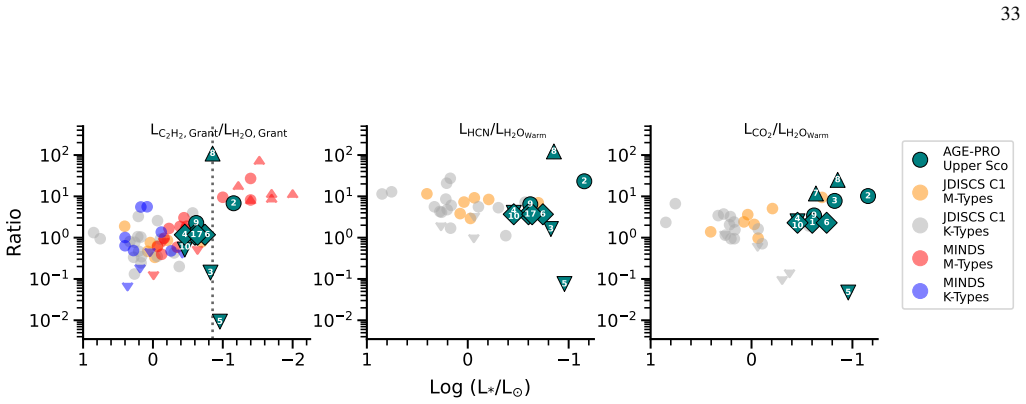
Upper Scorpius disks exhibit an unexpectedly high diversity of distinct chemical compositions. Disks with strong carbon-based molecular features but no observed H2O defy expectations of an inner-disk dust cavity or a low R_gas/R_dust ratio, instead suggesting that the presence of a strong outer-disk dust trap largely controls the chemical outcome of the terrestrial planet-forming region.
What carries the argument
Water Classification (Rich/Poor/Absent) and Chemotype (Organic-Rich/CO2-Dominated/Molecule-Absent) axes derived from MCMC slab modeling of molecular line luminosities, used to compare against ALMA dust-trap properties.
If this is right
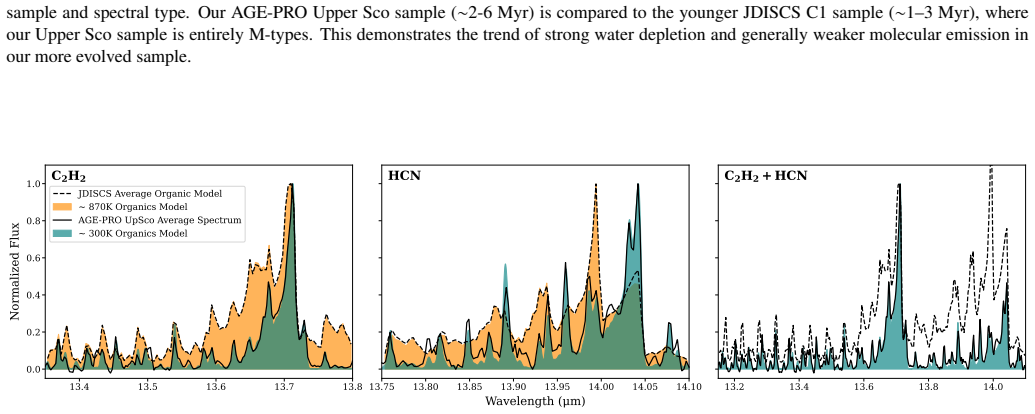
- Carbon molecules sit at excitation temperatures of 300 K or lower, colder than the 600-1000 K values typical in younger star-forming regions.
- Water line luminosities fall by factors of 10-1000 compared with 1-3 Myr disks.
- New wavelength regions are identified as diagnostics for species including C2H2, HCN, HC3N, and CO2.
- Strong outer dust traps correlate with carbon-rich, water-absent inner chemistry, overriding the influence of inner cavities.
Where Pith is reading between the lines
- Disks that form terrestrial planets in systems with mature outer traps may inherit carbon-dominated rather than water-rich conditions.
- ALMA maps of trap strength could be cross-checked against these chemotypes to test whether trap mass or location sets the inner outcome.
- The observed spread in compositions at fixed age implies that local dust dynamics matter more than global age for chemical pathways.
Load-bearing premise
Non-detection of H2O lines reflects a genuine absence of water molecules in the inner disk rather than viewing geometry, optical depth, or limits in the slab modeling.
What would settle it
A direct detection of H2O emission in one of the Water-Absent disks at higher sensitivity or with alternate modeling would undermine both the classification and the outer-trap control claim.
Figures







read the original abstract
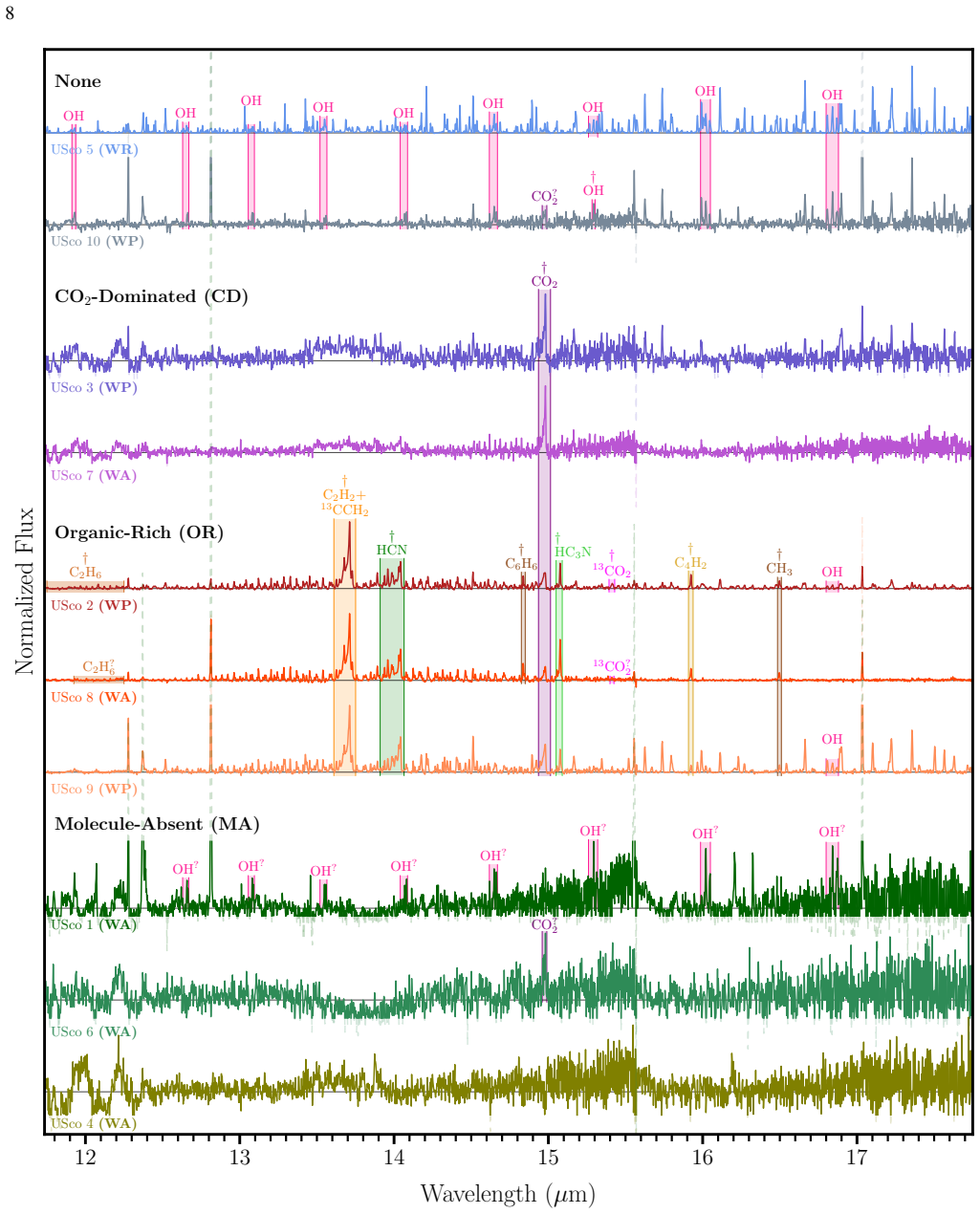
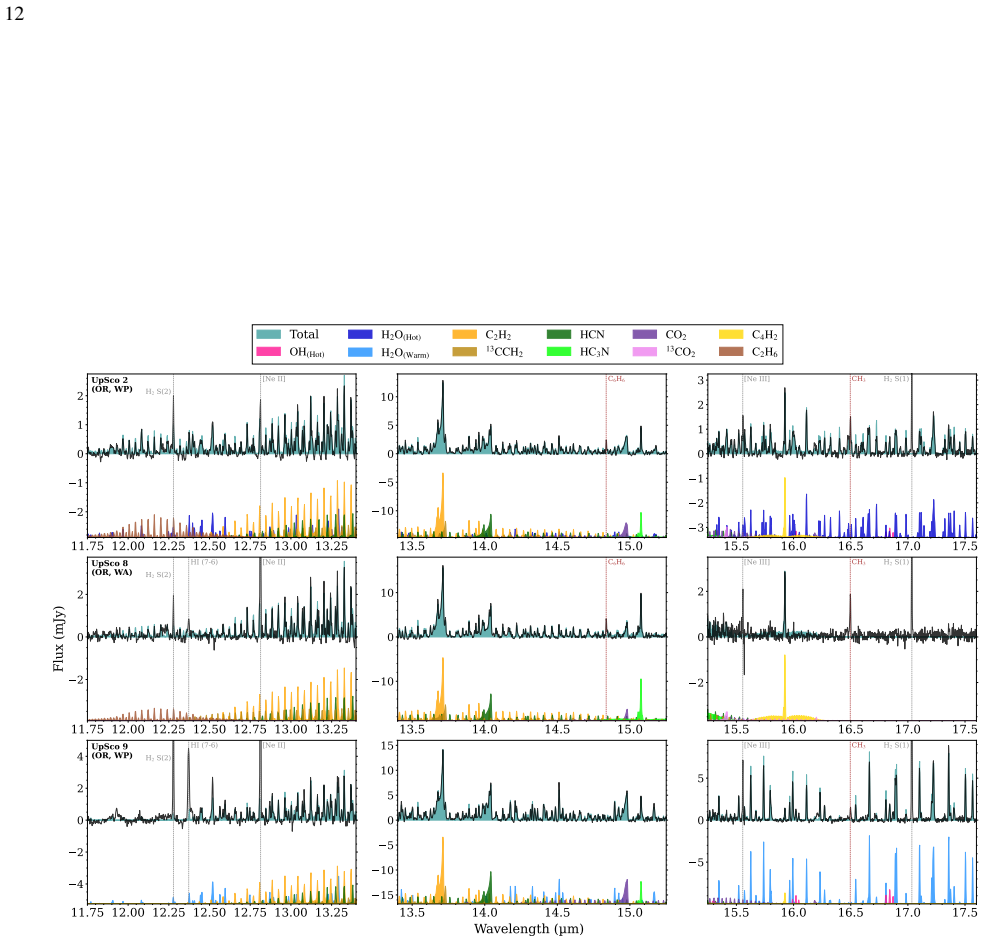
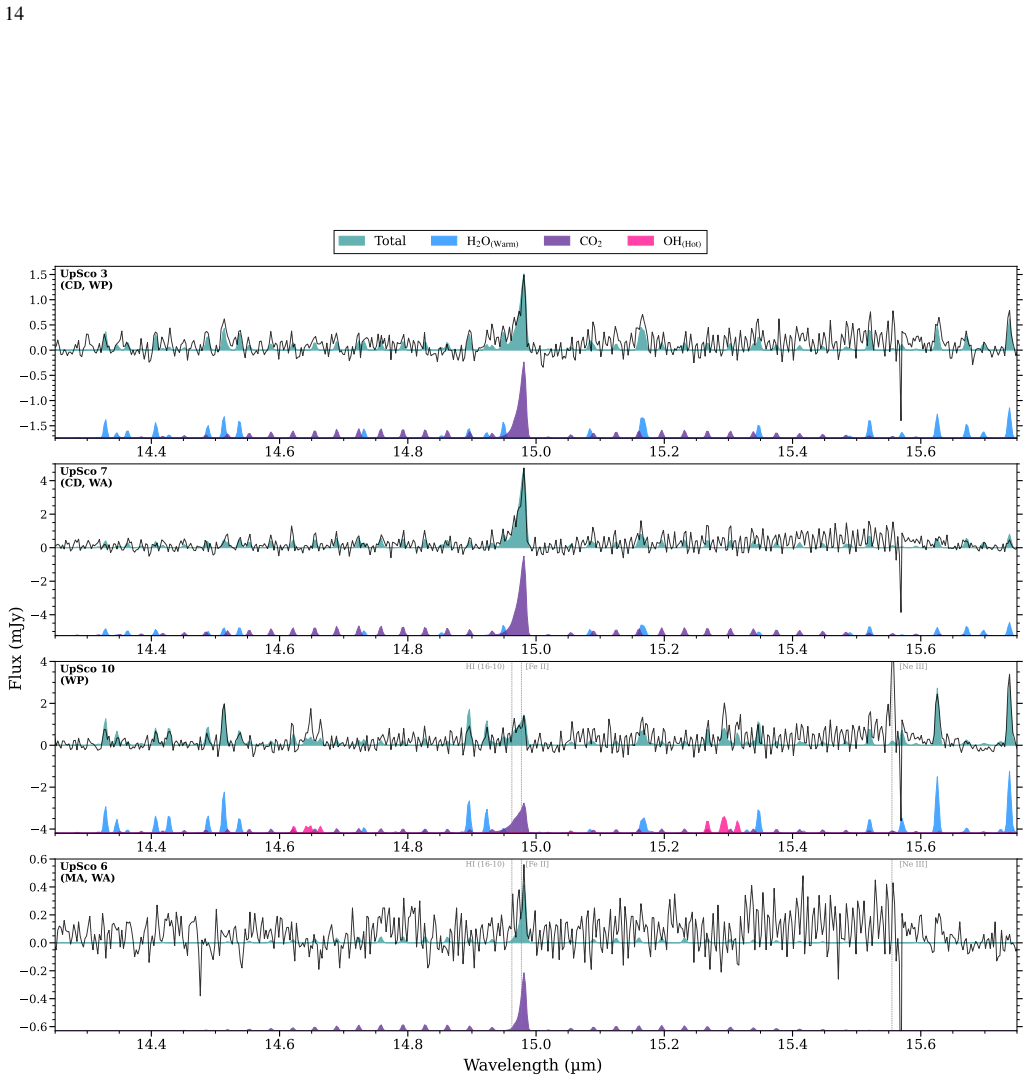
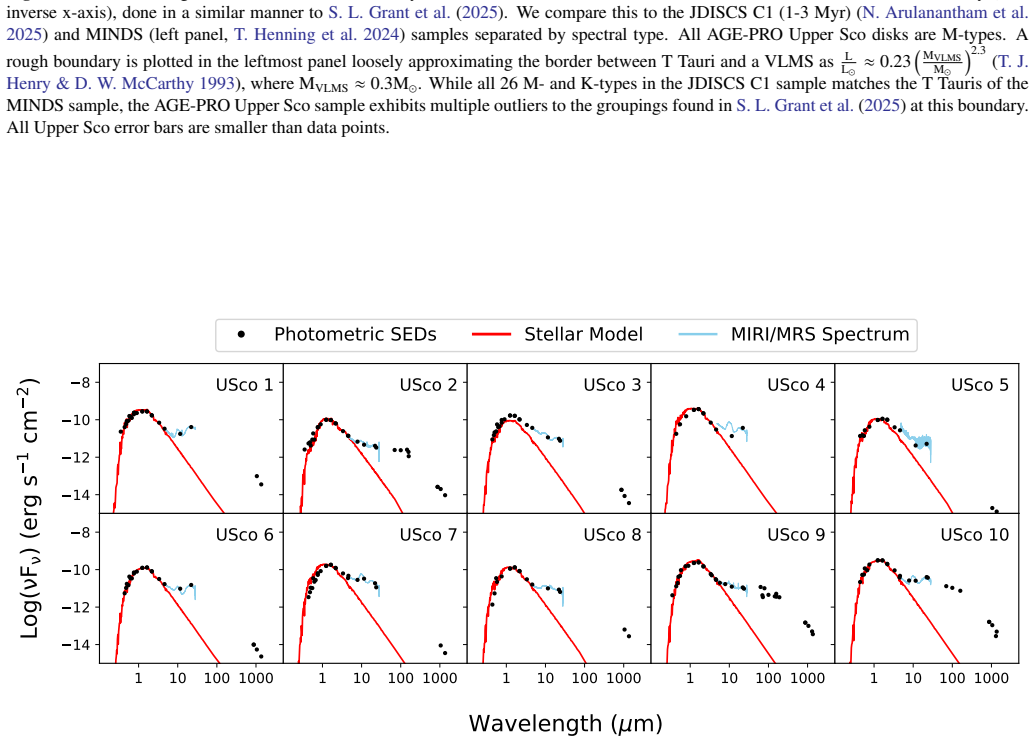
Tracing the chemical evolution of protoplanetary disks over time requires observations of disks at different ages. However, most JWST/MIRI surveys published to date have targeted younger ($\sim$1-3 Myr) rather than older systems. We present the results of a JWST/MIRI MRS survey of the inner regions of 10 protoplanetary disks (ages $\sim$2-6 Myr, spectral types M0-M4.5) in the Upper Scorpius region previously characterized by the ALMA AGE-PRO large program. Using MCMC slab modeling, we fit to a wide variety of detected molecules, including H$_2$O, CO, C$_2$H$_2$, $^{13}$CCH$_2$, HCN, HC$_3$N, CO$_2$, $^{13}$CO$_2$, C$_2$H$_6$, C$_4$H$_2$, and OH, as well as C$_6$H$_6$, CH$_3$, and H$_2$ visually. We classify each disk along two independent axes-a Water Classification based on H$_2$O line luminosity (Water-Rich, Water-Poor, or Water-Absent) and a Chemotype based on the dominant non-water chemistry (Organic-Rich, CO$_2$-Dominated, or Molecule-Absent)-and find an unexpectedly high diversity of distinct chemical compositions within our population. We leverage the heterogeneity of detected molecules in our sample to present new characteristic "diagnostic" wavelength regions for most species. We find that carbon-based molecules consistently exhibit markedly lower excitation temperatures ($\lesssim$300 K) compared to younger ($\sim$1-3 Myr) star-forming regions ($\sim$600-1000 K), hinting at relatively colder molecular reservoirs. We also determine that Upper Scorpius disks show systematically lower water luminosities by factors of 10-1000. In particular, disks with strong carbon-based molecular features but no observed H$_2$O defy expectations of an inner-disk dust cavity or a low ($\lesssim3$) $R_{\rm gas}/R_{\rm dust}$ ratio, instead suggesting that the presence of a strong outer-disk dust trap largely controls the chemical outcome of the terrestrial planet-forming region.
Editorial analysis
A structured set of objections, weighed in public.
Referee Report
Summary. The paper presents JWST/MIRI MRS observations of 10 Upper Scorpius protoplanetary disks (ages ~2-6 Myr, M0-M4.5) previously characterized by ALMA AGE-PRO. Using MCMC slab modeling, the authors detect and fit molecules including H2O, CO, C2H2, HCN, CO2 and others, classify each disk on two axes (Water Classification: Rich/Poor/Absent based on H2O line luminosity; Chemotype: Organic-Rich/CO2-Dominated/Molecule-Absent), report lower carbon-molecule excitation temperatures (<300 K) and water luminosities (factors of 10-1000) than in younger regions, and interpret disks showing strong carbon features but no H2O as evidence that strong outer-disk dust traps control terrestrial-region chemistry, defying expectations from inner dust cavities or low R_gas/R_dust ratios.
Significance. If the Water-Absent classifications prove robust to modeling assumptions and the dust-trap correlation is quantitatively demonstrated against the ALMA data, the result would provide key constraints on how outer-disk structures influence inner-disk chemistry in evolved systems, with implications for terrestrial planet formation models. The diagnostic wavelength regions and direct comparison to younger star-forming regions are useful additions.
major comments (2)
- [Abstract] Abstract: the claim that disks with carbon-based features but no observed H2O 'defy expectations' and indicate outer-disk dust traps control chemistry assumes non-detections reflect intrinsic depletion rather than geometry, optical depth, or slab-model limitations. The MCMC description provides no tests of inclination effects on projected emitting area, continuum optical depth, temperature structure priors, or LTE departures; a 1 dex shift in H2O upper limits would shrink the 'defy expectations' subsample and weaken the correlation.
- [Modeling and classification sections] Modeling and classification sections: no error bars, fit statistics (e.g., reduced chi-squared), or robustness checks against alternative slab models or priors are reported for the MCMC fits. This makes it impossible to assess whether the Water-Absent and Chemotype assignments are stable, directly affecting the central diversity and dust-trap claims.
minor comments (2)
- [Abstract] The abstract states 'we classify each disk along two independent axes' but does not tabulate the final counts per class or list which disks fall into the key 'carbon features but no H2O' category used for the dust-trap interpretation.
- [Results] The phrase 'visually' for C6H6, CH3, and H2 detection is imprecise; the manuscript should specify the exact criterion (e.g., S/N threshold or visual inspection protocol) used for these species.
Simulated Author's Rebuttal
We thank the referee for their constructive comments, which highlight important aspects of our analysis and interpretation. We address each major comment below and describe the revisions planned for the manuscript.
read point-by-point responses
-
Referee: [Abstract] Abstract: the claim that disks with carbon-based features but no observed H2O 'defy expectations' and indicate outer-disk dust traps control chemistry assumes non-detections reflect intrinsic depletion rather than geometry, optical depth, or slab-model limitations. The MCMC description provides no tests of inclination effects on projected emitting area, continuum optical depth, temperature structure priors, or LTE departures; a 1 dex shift in H2O upper limits would shrink the 'defy expectations' subsample and weaken the correlation.
Authors: We agree that the abstract language is strong and that non-detections could in principle arise from geometric or optical-depth effects rather than intrinsic depletion. Our Water-Absent classification is observationally defined by the absence of detectable H2O lines above the noise floor, and the correlation with ALMA dust-trap properties is presented as suggestive rather than definitive. In revision we will soften the abstract phrasing, add an explicit caveats paragraph in the discussion, and include supplementary MCMC runs that vary inclination, continuum optical depth, and temperature priors to quantify their impact on the derived luminosities and classifications. A sensitivity test to a 1 dex change in upper limits will also be shown. revision: partial
-
Referee: [Modeling and classification sections] Modeling and classification sections: no error bars, fit statistics (e.g., reduced chi-squared), or robustness checks against alternative slab models or priors are reported for the MCMC fits. This makes it impossible to assess whether the Water-Absent and Chemotype assignments are stable, directly affecting the central diversity and dust-trap claims.
Authors: We concur that the absence of reported fit statistics and robustness tests reduces transparency. The revised manuscript will include (i) reduced chi-squared values for every slab-model fit, (ii) 1-sigma posterior uncertainties on all fitted parameters (including line luminosities), and (iii) an appendix with explicit robustness checks that repeat the MCMC analysis under alternative priors and slab-model assumptions (single- vs. two-temperature components). These additions will allow direct evaluation of the stability of the Water Classification and Chemotype assignments. revision: yes
Circularity Check
No circularity: observational classifications and inferences are data-driven
full rationale
The paper is an empirical JWST/MIRI survey that performs MCMC slab fits to observed spectra, classifies disks by measured H2O line luminosities and dominant chemistry, and offers an interpretive inference about outer-disk dust traps. No equations, predictions, or derivations are presented that reduce by construction to fitted parameters or self-citations. Classifications follow directly from the data; the dust-trap suggestion is post-hoc interpretation, not a self-referential derivation. This matches the default case of a self-contained observational study.
Axiom & Free-Parameter Ledger
Reference graph
Works this paper leans on
-
[1]
ctool: Continuum tool
-
[2]
Gas and Dust in the Ophiuchus Star-forming Region , journal =
The ALMA Survey of Gas Evolution of PROtoplanetary Disks (AGE-PRO): II. Gas and Dust in the Ophiuchus Star-forming Region , journal =. 2025, in press , volume =
2025
-
[3]
Protoplanetary gas disk masses , journal =
The ALMA Survey of Gas Evolution of PROtoplanetary Disks (AGE-PRO): V. Protoplanetary gas disk masses , journal =. in press, 2025 , volume =
2025
-
[4]
Comparison of Dust Evolution Models to AGE-PRO Observations , journal =
The ALMA Survey of Gas Evolution of PROtoplanetary Disks (AGE-PRO): VI. Comparison of Dust Evolution Models to AGE-PRO Observations , journal =. 2025, in press , volume =
2025
-
[5]
Hints of Planet Formation Signatures in a Large-cavity Disk Studied in the AGE-PRO ALMA Large Program. , keywords =. doi:10.3847/1538-4357/ad6e73 , archivePrefix =. 2407.16651 , primaryClass =
-
[6]
Fifteenth International Symposium on Space Terahertz Technology , editor =
-
[7]
doi:10.1109/TTHZ.2011.2177734 , journal =
-
[8]
Apparent rotation signatures and application to HH212
Constraining MHD disk winds with ALMA. Apparent rotation signatures and application to HH212. , keywords =. doi:10.1051/0004-6361/201834377 , archivePrefix =. 2004.08804 , primaryClass =
-
[9]
ALMA Observations of the Protostar L1527 IRS: Probing Details of the Disk and the Envelope Structures. , keywords =. doi:10.3847/1538-4357/aa8264 , archivePrefix =. 1707.08697 , primaryClass =
work page internal anchor Pith review Pith/arXiv arXiv doi:10.3847/1538-4357/aa8264
-
[10]
Formation of a Keplerian Disk in the Infalling Envelope around L1527 IRS: Transformation from Infalling Motions to Kepler Motions. , keywords =. doi:10.1088/0004-637X/796/2/131 , archivePrefix =. 1410.0172 , primaryClass =
work page internal anchor Pith review Pith/arXiv arXiv doi:10.1088/0004-637x/796/2/131
-
[11]
arXiv , author =:2307.02657 , journal =
doi:10.3847/1538-4357/acdfcc , eid =. arXiv , author =:2307.02657 , journal =
-
[12]
The nested morphology of disk winds from young stars revealed by JWST/NIRSpec observations. Nature Astronomy , keywords =. doi:10.1038/s41550-024-02385-7 , archivePrefix =. 2410.18033 , primaryClass =
-
[13]
High-contrast JWST-MIRI Spectroscopy of Planet-forming Disks for the JDISC Survey. , keywords =. doi:10.3847/1538-4357/ad20f0 , archivePrefix =. 2311.17020 , primaryClass =
-
[14]
ALMA CN Zeeman Observations of AS 209: Limits on Magnetic Field Strength and Magnetically Driven Accretion Rate. , keywords =. doi:10.3847/1538-4357/abd94e , archivePrefix =. 2101.01846 , primaryClass =
-
[15]
Protoplanetary Disk Chemistry. , keywords =. doi:10.1146/annurev-astro-022823-040820 , archivePrefix =. 2309.05685 , primaryClass =
-
[16]
Multiwavelength continuum sizes of protoplanetary discs: scaling relations and implications for grain growth and radial drift. , keywords =. doi:10.1093/mnras/stab1808 , archivePrefix =. 2010.02249 , primaryClass =
-
[17]
Dust in Proto-Planetary Disks: Properties and Evolution
Dust in Protoplanetary Disks: Properties and Evolution. Protostars and Planets V , year = 2007, editor =. doi:10.48550/arXiv.astro-ph/0602041 , archivePrefix =. astro-ph/0602041 , primaryClass =
work page internal anchor Pith review Pith/arXiv arXiv doi:10.48550/arxiv.astro-ph/0602041 2007
-
[18]
doi:10.3847/1538-4357/ace4bf , eid =. arXiv , author =:2307.02704 , journal =
-
[19]
arXiv , author =:2111.05833 , journal =
doi:10.3847/1538-4357/ac3826 , eid =. arXiv , author =:2111.05833 , journal =
-
[20]
Disk evolution in the solar neighborhood. I Disk frequencies from 1 to 100 Myr
doi:10.1051/0004-6361/201322597 , eid =. arXiv , author =:1312.0609 , journal =
work page internal anchor Pith review Pith/arXiv arXiv doi:10.1051/0004-6361/201322597
-
[21]
arXiv , author =:2209.09286 , journal =
doi:10.1051/0004-6361/202244227 , eid =. arXiv , author =:2209.09286 , journal =
-
[22]
doi:10.1093/mnras/stab2112 , eprint =
, keywords =. doi:10.1093/mnras/stab2112 , eprint =
-
[23]
arXiv , author =:2109.06419 , journal =
doi:10.3847/1538-4365/ac143c , eid =. arXiv , author =:2109.06419 , journal =
-
[24]
Protoplanetary disk lifetimes vs stellar mass and possible implications for giant planet populations
doi:10.1051/0004-6361/201424846 , eid =. arXiv , author =:1502.00631 , journal =
work page internal anchor Pith review Pith/arXiv arXiv doi:10.1051/0004-6361/201424846
-
[25]
doi:10.1093/mnras/staa3335 , eprint =
, keywords =. doi:10.1093/mnras/staa3335 , eprint =
-
[26]
arXiv , author =:2101.11307 , journal =
doi:10.1051/0004-6361/202039733 , eid =. arXiv , author =:2101.11307 , journal =
-
[27]
The Mass Dependence Between Protoplanetary Disks and their Stellar Hosts
doi:10.1088/0004-637X/771/2/129 , eid =. arXiv , author =:1305.5262 , journal =
work page internal anchor Pith review Pith/arXiv arXiv doi:10.1088/0004-637x/771/2/129
-
[28]
The ALMA Legacy Survey of Class 0/I Disks in Corona australis, Aquila, chaMaeleon, oPhiuchus north, Ophiuchus, Serpens (CAMPOS). I. Evolution of Protostellar Disk Radii. , keywords =. doi:10.3847/1538-4357/ad6152 , archivePrefix =. 2404.02809 , primaryClass =
-
[29]
Explaining millimeter-sized particles in brown dwarf disks
Explaining millimeter-sized particles in brown dwarf disks. , keywords =. doi:10.1051/0004-6361/201220875 , archivePrefix =. 1304.6638 , primaryClass =
work page internal anchor Pith review Pith/arXiv arXiv doi:10.1051/0004-6361/201220875
-
[30]
Hints on the origins of particle traps in protoplanetary disks given by the M _ dust - M _ relation. , keywords =. doi:10.1051/0004-6361/201937003 , archivePrefix =. 2001.11045 , primaryClass =
-
[31]
, month = sep, pages =
-
[32]
arXiv , author =:2207.09752 , journal =
doi:10.1140/epjp/s13360-022-03602-w , eid =. arXiv , author =:2207.09752 , journal =
-
[33]
arXiv , author =:2206.11910 , journal =
doi:10.1140/epjp/s13360-022-03314-1 , eid =. arXiv , author =:2206.11910 , journal =
-
[34]
doi:10.1088/1674-4527/12/1/001 , journal =
-
[35]
doi:10.3847/1538-4357/acb2c9 , eid =. arXiv , author =:2301.09240 , journal =
-
[36]
arXiv , author =:2111.13946 , journal =
doi:10.3847/1538-3881/ac35e2 , eid =. arXiv , author =:2111.13946 , journal =
-
[37]
doi:10.3847/1538-3881/abd806 , eid =. arXiv , author =:2012.05220 , journal =
work page internal anchor Pith review Pith/arXiv arXiv doi:10.3847/1538-3881/abd806 2012
-
[38]
arXiv , author =:2310.14617 , journal =
doi:10.3847/1538-4357/acf7c1 , eid =. arXiv , author =:2310.14617 , journal =
-
[39]
arXiv , author =:2004.14232 , journal =
doi:10.1051/0004-6361/202037949 , eid =. arXiv , author =:2004.14232 , journal =
-
[40]
doi:10.1086/318774 , journal =
-
[41]
doi:10.1088/0004-637X/746/2/154 , eid =. arXiv , author =:1112.1695 , journal =
work page internal anchor Pith review Pith/arXiv arXiv doi:10.1088/0004-637x/746/2/154
-
[42]
arXiv , author =:2103.09840 , journal =
doi:10.3847/1538-4357/abf044 , eid =. arXiv , author =:2103.09840 , journal =
-
[43]
arXiv , author =:2211.14225 , journal =
doi:10.1051/0004-6361/202243690 , eid =. arXiv , author =:2211.14225 , journal =
-
[44]
Coherent star formation patterns in space and time
doi:10.1051/0004-6361/202346901 , eid =. arXiv , author =:2302.07853 , journal =
-
[45]
doi:10.1086/341174 , journal =
-
[46]
arXiv , author =:2210.13314 , keywords =
Protostars and Planets VII , doi =. arXiv , author =:2210.13314 , keywords =
-
[47]
, keywords =. doi:10.1093/mnras/stz1190 , eprint =
-
[48]
Measurement of Circumstellar Disk Sizes in the Upper Scorpius OB Association with ALMA
doi:10.3847/1538-4357/aa989d , eid =. arXiv , author =:1711.04045 , journal =
work page internal anchor Pith review Pith/arXiv arXiv doi:10.3847/1538-4357/aa989d
-
[49]
doi:10.2138/rmg.2024.90.03 , eprint =
Reviews in Mineralogy and Geochemistry , keywords =. doi:10.2138/rmg.2024.90.03 , eprint =
-
[50]
doi:10.1109/MCSE.2007.55 , journal =
-
[51]
The HH30 edge-on T Tauri star A rotating and precessing monopolar outflow scrutinized by ALMA
doi:10.1051/0004-6361/201731733 , eid =. arXiv , author =:1808.03285 , journal =
work page internal anchor Pith review Pith/arXiv arXiv doi:10.1051/0004-6361/201731733
-
[52]
arXiv , author =:2001.09776 , journal =
doi:10.1051/0004-6361/201936950 , eid =. arXiv , author =:2001.09776 , journal =
-
[53]
arXiv , author =:2203.10068 , keywords =
Protostars and Planets VII , doi =. arXiv , author =:2203.10068 , keywords =
-
[54]
Monthly Notices of the Royal Astronomical Society , volume =
, keywords =. doi:10.1093/mnras/stac1285 , eprint =
-
[55]
arXiv , author =:2302.01433 , journal =
doi:10.1016/j.newar.2023.101674 , eid =. arXiv , author =:2302.01433 , journal =
-
[56]
Global simulations of protoplanetary disks with net magnetic flux: I. Non-ideal MHD case
doi:10.1051/0004-6361/201630056 , eid =. arXiv , author =:1612.00883 , journal =
work page internal anchor Pith review Pith/arXiv arXiv doi:10.1051/0004-6361/201630056
-
[57]
Global simulations of protoplanetary disks with ohmic resistivity and ambipolar diffusion
doi:10.1088/0004-637X/801/2/84 , eid =. arXiv , author =:1501.05431 , journal =
work page internal anchor Pith review Pith/arXiv arXiv doi:10.1088/0004-637x/801/2/84
-
[58]
doi:10.1093/mnras/199.4.883 , journal =
-
[59]
arXiv , author =:2303.15675 , journal =
doi:10.1051/0004-6361/202244731 , eid =. arXiv , author =:2303.15675 , journal =
-
[60]
arXiv , author =:2110.05639 , journal =
doi:10.1051/0004-6361/202141689 , eid =. arXiv , author =:2110.05639 , journal =
-
[61]
Protostars and Planets VII , editor =
-
[62]
arXiv , author =:1909.04674 , journal =
doi:10.3847/2041-8213/ab4423 , eid =. arXiv , author =:1909.04674 , journal =
-
[63]
arXiv , author =:2312.13287 , journal =
doi:10.48550/arXiv.2312.13287 , eid =. arXiv , author =:2312.13287 , journal =
-
[64]
arXiv , author =:2309.03807 , journal =
doi:10.1051/0004-6361/202245793 , eid =. arXiv , author =:2309.03807 , journal =
-
[65]
doi:10.1146/annurev-astro-081817-052035 , eprint =
, keywords =. doi:10.1146/annurev-astro-081817-052035 , eprint =
-
[66]
doi:10.1086/156357 , journal =
-
[67]
, keywords =. doi:10.1086/320685 , eprint =
-
[68]
arXiv , author =:2006.02812 , journal =
doi:10.1051/0004-6361/202037851 , eid =. arXiv , author =:2006.02812 , journal =
-
[69]
doi:10.1088/0004-637X/692/2/973 , eprint =
, keywords =. doi:10.1088/0004-637X/692/2/973 , eprint =
-
[70]
arXiv , author =:2309.05651 , journal =
doi:10.1051/0004-6361/202347627 , eid =. arXiv , author =:2309.05651 , journal =
-
[71]
doi:10.1051/0004-6361/201322254 , eid =. arXiv , author =:1310.2069 , journal =
work page internal anchor Pith review Pith/arXiv arXiv doi:10.1051/0004-6361/201322254 2069
-
[72]
doi:10.1051/0004-6361/201629929 , eid =. arXiv , author =:1612.07054 , journal =
work page internal anchor Pith review Pith/arXiv arXiv doi:10.1051/0004-6361/201629929
-
[73]
arXiv , author =:2306.15406 , journal =
doi:10.3847/1538-4357/acd384 , eid =. arXiv , author =:2306.15406 , journal =
-
[74]
arXiv , author =:2203.09930 , keywords =
Protostars and Planets VII , doi =. arXiv , author =:2203.09930 , keywords =
-
[75]
arXiv , author =:2203.09759 , keywords =
Protostars and Planets VII , doi =. arXiv , author =:2203.09759 , keywords =
-
[76]
arXiv , author =:2402.01903 , journal =
doi:10.1051/0004-6361/202347135 , eid =. arXiv , author =:2402.01903 , journal =
-
[77]
doi:10.1088/1538-3873/ac9642 , eid =. arXiv , author =:2210.02276 , journal =
work page internal anchor Pith review Pith/arXiv arXiv doi:10.1088/1538-3873/ac9642
-
[78]
doi:10.1086/117668 , journal =
-
[79]
arXiv , author =:2109.06188 , journal =
doi:10.3847/1538-4365/ac1430 , eid =. arXiv , author =:2109.06188 , journal =
-
[80]
Astronomical Data Analysis Software and Systems XVI , editor =
discussion (0)
Sign in with ORCID, Apple, or X to comment. Anyone can read and Pith papers without signing in.