Causal Inference for Functional Treatments with Stochastic Policies
Pith reviewed 2026-06-29 00:58 UTC · model grok-4.3
The pith
Stochastic policies for functional treatments allow estimation of causal effects by modifying distributions through a single basis function without positivity assumptions.
A machine-rendered reading of the paper's core claim, the machinery that carries it, and where it could break.
Core claim
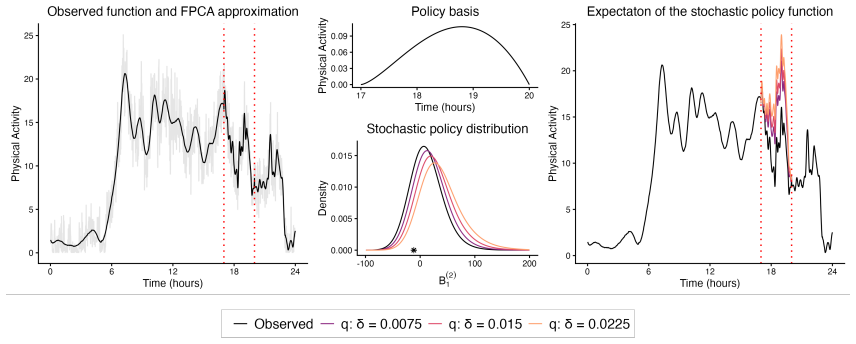
Stochastic policies for functional treatments allow estimation of causal effects of changing the treatment distribution without requiring a positivity assumption. The method modifies the treatment through a single basis function chosen by the analyst, allowing clear control over treatment modification and temporal confounding feedback. The estimators show asymptotic normality and rate double robustness.
What carries the argument
Stochastic policies that modify the functional treatment distribution via a single analyst-chosen basis function to control confounding feedback.
If this is right
- Causal effects of policies for functional treatments like physical activity can be estimated.
- Estimators achieve asymptotic normality.
- Rate double robustness holds for the estimators.
- The approach provides control over temporal confounding in continuous time.
- Application to NHANES data reveals effects on mortality.
Where Pith is reading between the lines
- The framework could apply to other continuous-time functional data in health or other fields.
- It might enable estimation in settings where strict positivity is unrealistic for real policies.
- Extensions could involve multiple basis functions if the single one proves limiting.
Load-bearing premise
Modifying the treatment distribution through a single analyst-chosen basis function sufficiently controls temporal confounding feedback and produces a scientifically meaningful estimand for real-world policies.
What would settle it
Empirical evidence that the single basis function modification does not adequately address temporal confounding, or that the estimators lack the claimed double robustness in finite samples.
Figures



read the original abstract
Wearable devices can accurately measure human behavior, providing a unique opportunity to understand how behavior impacts health. Recent studies leveraging functional regression methods have found a strong relationship between accelerometer-collected physical activity and mortality. However, to determine if physical activity patterns impact mortality it is necessary to understand the causal effects of policies for physical activity, i.e., a function-valued treatment. Functional treatments present several challenges for causal effect estimation: 1) defining a scientifically meaningful estimand that reflects real-world policies and satisfies positivity is nontrivial; and 2) the potential for temporal confounding over continuous time. To address these, we propose stochastic policies for functional treatments that allow estimation of causal effects of changing the treatment distribution without requiring a positivity assumption. We develop a novel method for such that modifies the treatment through a single basis function chosen by the analyst, allowing for clear control over treatment modification and temporal confounding feedback. We show asymptotic normality of our estimators and that they exhibit rate double robustness. We apply our methods to the National Health and Nutrition Examination Survey to determine the causal effect of increasing physical activity over three-hour periods on mortality.
Editorial analysis
A structured set of objections, weighed in public.
Referee Report
Summary. The manuscript proposes stochastic policies for causal inference with functional treatments, where the treatment distribution is modified along a single analyst-chosen basis function. This construction is used to define scientifically meaningful estimands that avoid positivity assumptions while addressing temporal confounding in continuous time. The authors claim to establish asymptotic normality of the resulting estimators along with rate double robustness, and they apply the approach to NHANES data to estimate the causal effect of increased physical activity over three-hour windows on mortality.
Significance. If the single-basis modification can be shown to block relevant temporal feedback paths and the asymptotic results are rigorously derived, the work would advance methodology for policy-relevant causal inference with functional data from wearables. The rate double robustness property, if established, would be a practical strength for applications in health research.
major comments (2)
- [Abstract] Abstract: The central claims of asymptotic normality and rate double robustness are stated without any derivation details, error bounds, or verification steps. These properties are load-bearing for the theoretical contribution and cannot be assessed from the given description.
- [Abstract] Abstract (method description): The claim that modification through a single basis function provides clear control over temporal confounding feedback is load-bearing for the identifying assumption and the applicability of the robustness results. No argument is given showing that this one-dimensional change blocks all relevant feedback loops (e.g., those involving orthogonal components such as intensity versus timing within the three-hour windows), which would be required for the NHANES target parameter to be identified.
minor comments (1)
- [Abstract] Abstract: The NHANES application is described only in terms of the scientific question; no effect sizes, standard errors, or robustness checks are reported, which limits evaluation of the empirical contribution.
Simulated Author's Rebuttal
We thank the referee for their detailed and constructive comments on our manuscript. We address each of the major comments below, indicating where revisions to the manuscript will be made.
read point-by-point responses
-
Referee: [Abstract] Abstract: The central claims of asymptotic normality and rate double robustness are stated without any derivation details, error bounds, or verification steps. These properties are load-bearing for the theoretical contribution and cannot be assessed from the given description.
Authors: The abstract serves as a concise summary of the paper's contributions. Detailed derivations of asymptotic normality and rate double robustness, including error bounds and verification steps, are provided in Sections 3 and 4, with complete proofs in the Supplementary Material. We will revise the abstract to include a short phrase indicating that these properties are established via influence function-based estimators and double robustness arguments. revision: yes
-
Referee: [Abstract] Abstract (method description): The claim that modification through a single basis function provides clear control over temporal confounding feedback is load-bearing for the identifying assumption and the applicability of the robustness results. No argument is given showing that this one-dimensional change blocks all relevant feedback loops (e.g., those involving orthogonal components such as intensity versus timing within the three-hour windows), which would be required for the NHANES target parameter to be identified.
Authors: The single-basis modification is chosen by the analyst to correspond to the scientifically relevant direction of policy change, as described in Section 2. This ensures control over the modification without positivity violations in other directions. The identifying assumptions in Section 2.2 specify that confounding feedback is blocked for the modified component, with orthogonal directions held fixed. We acknowledge that an explicit demonstration that this blocks all relevant loops (including orthogonal ones like intensity vs. timing) is not fully elaborated in the current text. We will add a dedicated paragraph in Section 2.3 providing this argument, including why the NHANES basis function choice (e.g., total count) suffices for the target parameter. revision: yes
Circularity Check
No circularity detected; theoretical results derived independently
full rationale
The paper introduces stochastic policies for functional treatments by modifying the treatment distribution along one analyst-chosen basis function, then derives asymptotic normality and rate double robustness for the resulting estimators. These properties are obtained from the proposed construction and identifying assumptions rather than by fitting parameters to the target NHANES estimand or by reducing via self-citation chains. No load-bearing step equates the claimed prediction or uniqueness result to its own inputs by definition, and the method is presented as new with external theoretical support. The derivation chain remains self-contained against the stated assumptions.
Axiom & Free-Parameter Ledger
Reference graph
Works this paper leans on
-
[1]
D., Clark, J., Shin, H.-C., Rammon, J
Chen, T.-C., Parker, J. D., Clark, J., Shin, H.-C., Rammon, J. R., and Burt, V. L. (2018). National Health and Nutrition Examination Survey : Estimation Procedures , 2011-2014. Vital and Health Statistics. Series 2, Data Evaluation and Methods Research , (177):1--26
2018
-
[2]
Chernozhukov, V., Chetverikov, D., Demirer, M., Duflo, E., Hansen, C., Newey, W., and Robins, J. (2018). Double/debiased machine learning for treatment and structural parameters. The Econometrics Journal , 21(1):C1--C68
2018
-
[3]
M., Goldsmith, J., Leroux, A., and Cui, E
Crainiceanu, C. M., Goldsmith, J., Leroux, A., and Cui, E. (2024). Functional Data Analysis with R . Chapman and Hall/CRC, New York
2024
-
[4]
and Hall, P
Delaigle, A. and Hall, P. (2010). Defining probability density for a distribution of random functions. The Annals of Statistics , 38(2):1171--1193. Publisher: Institute of Mathematical Statistics
2010
-
[5]
and Hejazi, N
Díaz, I. and Hejazi, N. S. (2020). Causal Mediation Analysis for Stochastic Interventions . Journal of the Royal Statistical Society Series B: Statistical Methodology , 82(3):661--683
2020
-
[7]
and Hastie, T
Gao, Z. and Hastie, T. (2022). LinCDE : Conditional Density Estimation via Lindsey 's Method . Journal of Machine Learning Research , 23(52):1--55
2022
-
[8]
M., Caffo, B., and Reich, D
Goldsmith, J., Bobb, J., Crainiceanu, C. M., Caffo, B., and Reich, D. (2011). Penalized Functional Regression . Journal of computational and graphical statistics : a joint publication of American Statistical Association, Institute of Mathematical Statistics, Interface Foundation of North America , 20(4):830--851
2011
-
[10]
W., Yang, S., and Hashimoto, T
Hashimoto, K., Dora, K., Murakami, Y., Matsumura, T., Yuuki, I. W., Yang, S., and Hashimoto, T. (2025). Positive impact of a 10-min walk immediately after glucose intake on postprandial glucose levels. Scientific Reports , 15(1):22662. Publisher: Nature Publishing Group
2025
-
[11]
and Yamada, S
Hijikata, Y. and Yamada, S. (2011). Walking just after a meal seems to be more effective for weight loss than waiting for one hour to walk after a meal. International Journal of General Medicine , 4:447--450
2011
-
[12]
Jiang, Z., Cui, E., and Huling, J. D. (2026). Estimating causal effects of functional treatments with modified functional treatment policies. arXiv:2602.09145 [stat]
arXiv 2026
-
[13]
John, D., Tang, Q., Albinali, F., and Intille, S. (2019). An Open - Source Monitor - Independent Movement Summary for Accelerometer Data Processing . Journal for the measurement of physical behaviour , 2(4):268--281
2019
-
[15]
and Muschelli, J
Koffman, L. and Muschelli, J. (2025). Minute level step counts and physical activity data from the National Health and Nutrition Examination Survey (NHANES) 2011-2014 . PhysioNet . Version 1.0.0
2025
-
[16]
A., and Crainiceanu, C
Leroux, A., Cui, E., Smirnova, E., Muschelli, J., Schrack, J. A., and Crainiceanu, C. M. (2024). NHANES 2011-2014: Objective Physical Activity Is the Strongest Predictor of All - Cause Mortality . Medicine and Science in Sports and Exercise , 56(10):1926--1934
2024
-
[17]
Leroux, A., Xu, S., Kundu, P., Muschelli, J., Smirnova, E., Chatterjee, N., and Crainiceanu, C. (2021). Quantifying the Predictive Performance of Objectively Measured Physical Activity on Mortality in the UK Biobank . The Journals of Gerontology: Series A , 76(8):1486--1494
2021
-
[18]
Robins, J. (1986). A new approach to causal inference in mortality studies with a sustained exposure period—application to control of the healthy worker survivor effect. Mathematical Modelling , 7(9):1393--1512
1986
-
[19]
M., Hernán, M
Robins, J. M., Hernán, M. A., and Brumback, B. (2000). Marginal structural models and causal inference in epidemiology. Epidemiology , 11(5):550--560
2000
-
[20]
Schindl, K., Shen, S., and Kennedy, E. H. (2026). Incremental effects for continuous exposures. arXiv:2409.11967 [stat]
arXiv 2026
-
[21]
Smirnova, E., Leroux, A., Cao, Q., Tabacu, L., Zipunnikov, V., Crainiceanu, C., and Urbanek, J. K. (2020). The Predictive Performance of Objective Measures of Physical Activity Derived From Accelerometry Data for 5- Year All - Cause Mortality in Older Adults : National Health and Nutritional Examination Survey 2003–2006. The Journals of Gerontology: Serie...
2020
-
[22]
Tan, R., Huang, W., Zhang, Z., and Yin, G. (2025). Causal Effect of Functional Treatment . Journal of Machine Learning Research , 26(91):1--39
2025
-
[23]
Wang, J., Wong, R. K. W., Zhang, X., and Chan, K. C. G. (2026). Flexible Functional Treatment Effect Estimation . Journal of Machine Learning Research , 27(16):1--48
2026
-
[24]
Ying, A. (2024a). Causality for Complex Continuous -time Functional Longitudinal Studies with Dynamic Treatment Regimes . arXiv:2406.06868 [math] version: 1
-
[25]
Ying, A. (2024b). Causality for Functional Longitudinal Data . In Proceedings of the Third Conference on Causal Learning and Reasoning , pages 665--687. PMLR. ISSN: 2640-3498
-
[26]
Zhang, X., Xue, W., and Wang, Q. (2021). Covariate balancing functional propensity score for functional treatments in cross-sectional observational studies. Computational Statistics & Data Analysis , 163:107303
2021
-
[27]
The Annals of Statistics , author =
Defining probability density for a distribution of random functions , volume =. The Annals of Statistics , author =. 2010 , note =. doi:10.1214/09-AOS741 , abstract =
-
[28]
Journal of the American Statistical Association , volume =
Nonparametric. Journal of the American Statistical Association , author =. 2023 , note =. doi:10.1080/01621459.2021.1955691 , abstract =
-
[29]
Statistics in Biosciences , author =
Functional. Statistics in Biosciences , author =. 2025 , keywords =. doi:10.1007/s12561-024-09439-4 , abstract =
-
[30]
Statistics in Medicine , author =
Estimation of the effect of interventions that modify the received treatment , volume =. Statistics in Medicine , author =. 2013 , note =. doi:10.1002/sim.5907 , abstract =
-
[31]
Schindl, Kyle and Shen, Shuying and Kennedy, Edward H. , month = jan, year =. Incremental effects for continuous exposures , url =. doi:10.48550/arXiv.2409.11967 , abstract =
-
[32]
Journal of the American Statistical Association , author =
Nonparametric. Journal of the American Statistical Association , author =. 2019 , note =. doi:10.1080/01621459.2017.1422737 , abstract =
-
[33]
Levis, Alexander W. and Kennedy, Edward H. and McClean, Alec and Balakrishnan, Sivaraman and Wasserman, Larry , month = nov, year =. Stochastic interventions, sensitivity analysis, and optimal transport , url =. doi:10.48550/arXiv.2411.14285 , abstract =
-
[34]
Journal of Machine Learning Research , author =
Causal. Journal of Machine Learning Research , author =. 2025 , pages =
2025
-
[35]
Journal of Machine Learning Research , author =
Flexible. Journal of Machine Learning Research , author =. 2026 , pages =
2026
-
[36]
Causality for
Ying, Andrew , month = mar, year =. Causality for. Proceedings of the
-
[37]
Ying, Andrew , month = jun, year =. Causality for. doi:10.48550/arXiv.2406.06868 , abstract =
-
[38]
Computational Statistics & Data Analysis , author =
Covariate balancing functional propensity score for functional treatments in cross-sectional observational studies , volume =. Computational Statistics & Data Analysis , author =. 2021 , keywords =. doi:10.1016/j.csda.2021.107303 , abstract =
-
[39]
Jiang, Ziren and Cui, Erjia and Huling, Jared D. , month = feb, year =. Estimating causal effects of functional treatments with modified functional treatment policies , url =. doi:10.48550/arXiv.2602.09145 , abstract =
-
[40]
Journal of the Royal Statistical Society: Series B (Statistical Methodology) , author =
On properties of functional principal components analysis , volume =. Journal of the Royal Statistical Society: Series B (Statistical Methodology) , author =. 2006 , note =. doi:10.1111/j.1467-9868.2005.00535.x , abstract =
-
[41]
Journal of the Royal Statistical Society Series B: Statistical Methodology , author =
Causal. Journal of the Royal Statistical Society Series B: Statistical Methodology , author =. 2020 , pages =. doi:10.1111/rssb.12362 , abstract =
-
[42]
Koffman, Lily and Muschelli, John , title =. 2025 , month = jan, note =. doi:10.13026/ah0j-3z47 , url =
-
[43]
Medicine and Science in Sports and Exercise , author =. 2024 , pmid =. doi:10.1249/MSS.0000000000003497 , abstract =
-
[44]
Statistics in biosciences , author =
Organizing and analyzing the activity data in. Statistics in biosciences , author =. 2019 , pmid =. doi:10.1007/s12561-018-09229-9 , abstract =
-
[45]
Medicine and Science in Sports and Exercise , author =
Comparing. Medicine and Science in Sports and Exercise , author =. 2025 , pmid =. doi:10.1249/MSS.0000000000003616 , abstract =
-
[46]
The Journals of Gerontology: Series A , author =
Quantifying the. The Journals of Gerontology: Series A , author =. 2021 , pages =. doi:10.1093/gerona/glaa250 , abstract =
-
[47]
Vital and Health Statistics
National. Vital and Health Statistics. Series 2, Data Evaluation and Methods Research , author =. 2018 , pmid =
2018
-
[48]
Journal for the measurement of physical behaviour , author =
An. Journal for the measurement of physical behaviour , author =. 2019 , pmid =. doi:10.1123/jmpb.2018-0068 , abstract =
-
[49]
The Journals of Gerontology: Series A , author =
The. The Journals of Gerontology: Series A , author =. 2020 , pages =. doi:10.1093/gerona/glz193 , abstract =
-
[50]
Penalized. Journal of computational and graphical statistics : a joint publication of American Statistical Association, Institute of Mathematical Statistics, Interface Foundation of North America , author =. 2011 , pmid =. doi:10.1198/jcgs.2010.10007 , abstract =
-
[51]
2022 , pages =
Journal of Machine Learning Research , author =. 2022 , pages =
2022
-
[52]
A “one-size-fits-most” walking recognition method for smartphones, smartwatches, and wearable accelerometers , volume =. npj Digital Medicine , author =. 2023 , note =. doi:10.1038/s41746-022-00745-z , abstract =
-
[53]
International Journal of General Medicine , author =
Walking just after a meal seems to be more effective for weight loss than waiting for one hour to walk after a meal , volume =. International Journal of General Medicine , author =. 2011 , pmid =. doi:10.2147/IJGM.S18837 , abstract =
-
[54]
Positive impact of a 10-min walk immediately after glucose intake on postprandial glucose levels , volume =. Scientific Reports , author =. 2025 , note =. doi:10.1038/s41598-025-07312-y , abstract =
-
[55]
and Goldsmith, Jeff and Leroux, Andrew and Cui, Erjia , month = mar, year =
Crainiceanu, Ciprian M. and Goldsmith, Jeff and Leroux, Andrew and Cui, Erjia , month = mar, year =. Functional
-
[56]
The Econometrics Journal , volume =
Double/debiased machine learning for treatment and structural parameters , volume =. The Econometrics Journal , author =. 2018 , pages =. doi:10.1111/ectj.12097 , abstract =
-
[57]
Jiang, Ziren and Crooke, Philip S. and Marini, John J. and Huling, Jared D. , month = jul, year =. Exploring the effects of mechanical ventilator settings with modified vector-valued treatment policies , url =. doi:10.48550/arXiv.2507.09809 , abstract =
-
[58]
The Annals of Statistics , author =
Continuous-time targeted minimum loss-based estimation of intervention-specific mean outcomes , volume =. The Annals of Statistics , author =. 2022 , note =. doi:10.1214/21-AOS2114 , abstract =
-
[59]
Marginal structural models and causal inference in epidemiology , volume =. Epidemiology , author =. 2000 , keywords =. doi:10.1097/00001648-200009000-00011 , abstract =
-
[60]
Mathematical Modelling , author =
A new approach to causal inference in mortality studies with a sustained exposure period—application to control of the healthy worker survivor effect , volume =. Mathematical Modelling , author =. 1986 , pages =. doi:10.1016/0270-0255(86)90088-6 , abstract =
-
[61]
Koffman, L., Crainiceanu, C., and Muschelli, J. (2025). Comparing Step Counting Algorithms for High - Resolution Wrist Accelerometry Data in NHANES 2011-2014. Medicine and Science in Sports and Exercise , 57(4):746--755
2025
-
[62]
J., Cao, Q., Bayatmokhtari, E., Tabacu, L., Zipunnikov, V., Urbanek, J
Leroux, A., Di, J., Smirnova, E., Mcguffey, E. J., Cao, Q., Bayatmokhtari, E., Tabacu, L., Zipunnikov, V., Urbanek, J. K., and Crainiceanu, C. (2019). Organizing and analyzing the activity data in NHANES . Statistics in biosciences , 11(2):262--287
2019
-
[63]
one-size-fits-most
Straczkiewicz, M., Huang, E. J., and Onnela, J.-P. (2023). A “one-size-fits-most” walking recognition method for smartphones, smartwatches, and wearable accelerometers. npj Digital Medicine , 6(1):29. Publisher: Nature Publishing Group
2023
discussion (0)
Sign in with ORCID, Apple, or X to comment. Anyone can read and Pith papers without signing in.