Discovery of an extremely narrow trail-like feature crossing the Veil Supernova Remnant in deep amateur observations
Pith reviewed 2026-06-29 01:00 UTC · model grok-4.3
The pith
A narrow trail crossing the Veil Nebula is a Balmer-dominated non-radiative shock from the Cygnus Loop supernova remnant.
A machine-rendered reading of the paper's core claim, the machinery that carries it, and where it could break.
Core claim
The current evidence instead favours a Balmer-dominated non-radiative shock associated with the Cygnus Loop, generated as the SNR blast wave encounters a dense material layer or magnetic structure viewed nearly edge-on.
What carries the argument
Model-fitting code developed for extragalactic stellar tidal streams, applied to extract the trail's constant width, brightness, and structural parameters from narrow-band images.
If this is right
- The trail's uniform width and brightness indicate a stable, extended interaction between the blast wave and the encountered dense layer or structure.
- The feature's exclusive H-alpha detection without [S II] marks it as a non-radiative shock distinct from typical radiative shocks in the remnant.
- Confirmation of this origin would demonstrate that edge-on viewing of dense layers can produce narrow, collimated shock features in supernova remnants.
- The physical scale of approximately 1200 AU shows that such interactions can occur on small scales within the remnant.
Where Pith is reading between the lines
- Similar narrow trails may exist in other supernova remnants but would require comparable deep narrow-band H-alpha imaging to detect.
- If the association holds, the trail offers a probe of localized density or magnetic structures within the Cygnus Loop on scales not previously resolved.
- Multi-wavelength follow-up could test for associated emission that would further constrain the shock properties.
Load-bearing premise
The trail lies at the same distance as the Veil Nebula and is physically associated with the supernova remnant.
What would settle it
Detection of a driving stellar source, bow-shock apex, or [S II] emission along the trail.
Figures
read the original abstract
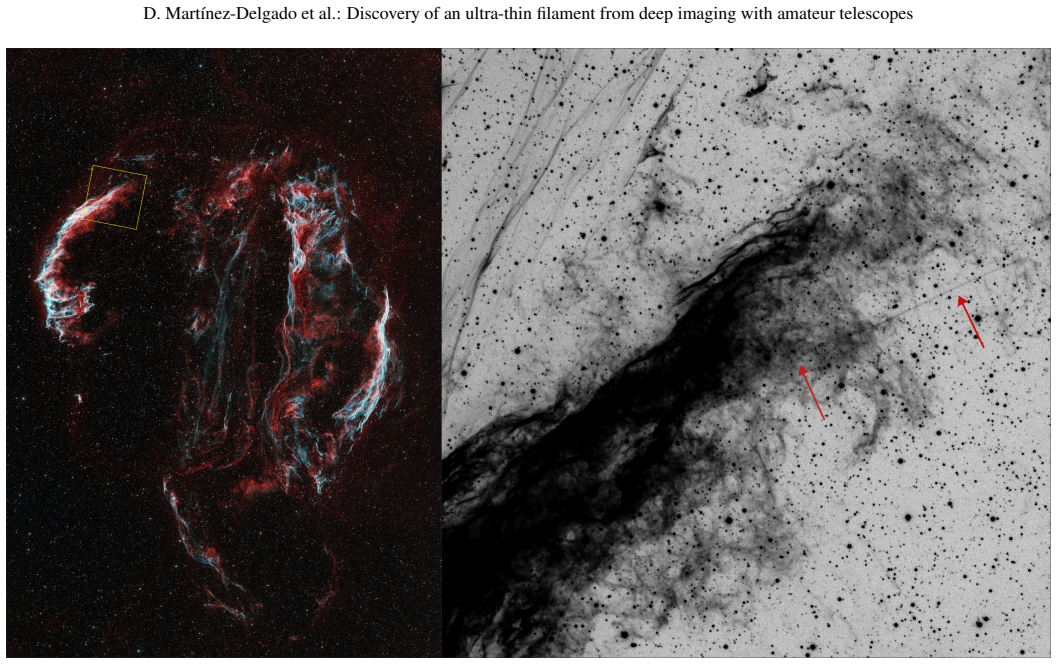
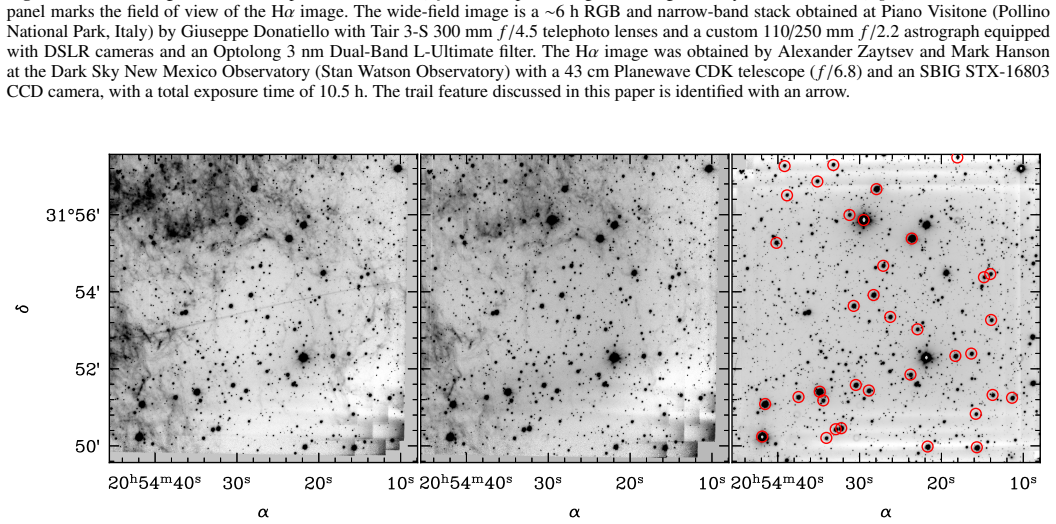
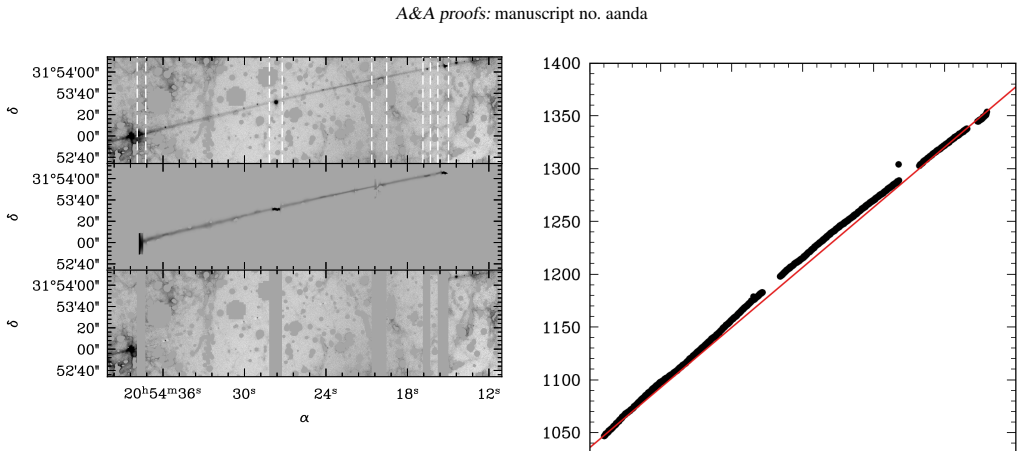
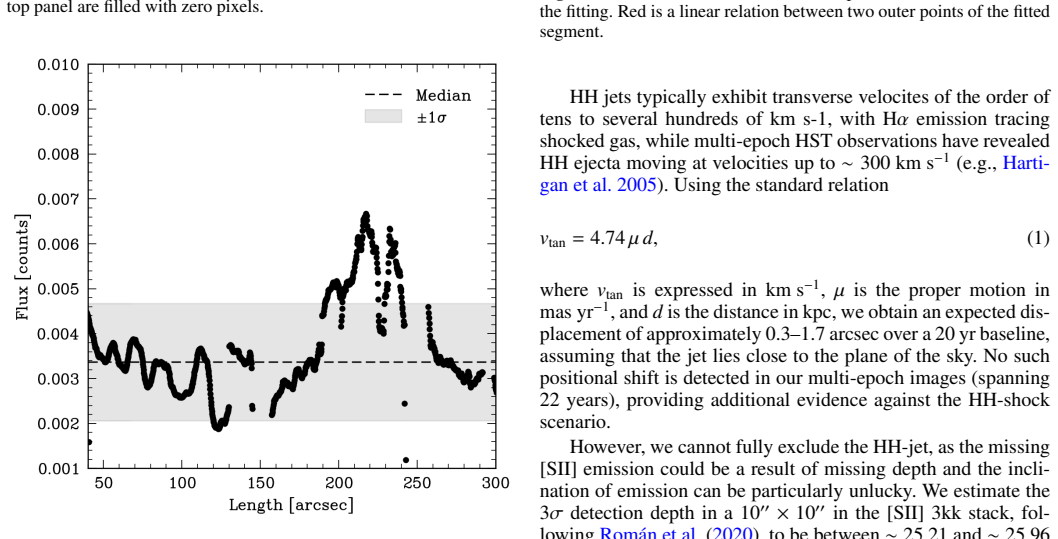
We report the discovery of an extremely narrow and highly collimated gaseous trail-like structure crossing the eastern region of the Veil Nebula (Cygnus Loop). The feature was first identified in deep narrow-band H-alpha images obtained by a small telescope and was confirmed in more than a dozen publicly available amateur and professional images in the last two decades, rejecting the possibility of being an artifact (e.g., artificial satellite trail). To characterize its structural and luminosity parameters, we applied a model-fitting code originally developed for the analysis of extragalactic stellar tidal streams. The structure is only detected in H-alpha emission, with no detectable counterpart in [SII] or in visible observations, and shows an almost constant brightness and width along its extension. It exhibits a surface brightness of 22.32+/- 0.13 H-alpha mag arcsec^2. Model fitting yields a median width of 1.63", which corresponds to a physical scale of approximately 1200 UA, assuming it is at the same distance (2400 light-years) as the Veil Nebula remnant. We discuss several potential scenarios for the origin of this feature: a Herbig-Haro-like jet, the trail of a high-velocity object, or a non-radiative shock associated with the supernova remnant. We rule out the Herbig-Haro scenario, given the absence of a driving stellar source and the lack of [S II] emission. A high-velocity-object wake cannot yet be excluded, particularly if the driver is a compact remnant, but the absence of an obvious source or bow-shock apex and the extremely small, nearly constant width of the structure make a normal runaway-star origin unlikely. The current evidence instead favours a Balmer-dominated non-radiative shock associated with the Cygnus Loop, generated as the SNR blast wave encounters a dense material layer or magnetic structure viewed nearly edge-on.
Editorial analysis
A structured set of objections, weighed in public.
Referee Report
Summary. The manuscript reports the discovery of an extremely narrow, Hα-only trail-like gaseous feature crossing the eastern Veil Nebula (Cygnus Loop). The structure is confirmed in more than a dozen amateur and professional images spanning two decades, ruling out artifacts. Model fitting to the Hα data yields a median width of 1.63 arcsec (corresponding to ~1200 AU at the assumed 2400 light-year distance), with nearly constant brightness and width and no detectable [S II] counterpart. The authors rule out a Herbig-Haro jet (no driving source, no [S II]) and deem a high-velocity object wake unlikely, favoring instead a Balmer-dominated non-radiative shock generated as the SNR blast wave encounters a dense layer or magnetic structure viewed nearly edge-on.
Significance. If the physical association with the Cygnus Loop holds, the result would be significant as a rare, well-characterized example of an extremely narrow, constant-width shock structure within an SNR, potentially constraining models of blast-wave interactions with inhomogeneous media or magnetic fields. The multi-epoch, multi-telescope confirmation and quantitative model fitting (adapted from tidal-stream analysis) provide solid support for the detection itself.
major comments (1)
- [Abstract and Discussion] Abstract and Discussion: The favored non-radiative shock interpretation and the quoted physical scale of ~1200 AU both rest on the assumption that the feature lies at the same distance (2400 light-years) as the Veil Nebula. No radial-velocity, proper-motion, or extinction data are supplied to test co-distance or co-location, so the physical association with the SNR blast wave remains conditional on an unverified premise.
minor comments (1)
- [Abstract] Abstract: '1200 UA' is presumably a typographical error for 'AU' (astronomical units).
Simulated Author's Rebuttal
We thank the referee for their thoughtful review and for highlighting the conditional nature of our interpretation. We address the major comment below.
read point-by-point responses
-
Referee: [Abstract and Discussion] Abstract and Discussion: The favored non-radiative shock interpretation and the quoted physical scale of ~1200 AU both rest on the assumption that the feature lies at the same distance (2400 light-years) as the Veil Nebula. No radial-velocity, proper-motion, or extinction data are supplied to test co-distance or co-location, so the physical association with the SNR blast wave remains conditional on an unverified premise.
Authors: We agree that both the physical scale (~1200 AU) and the favored Balmer-dominated shock interpretation are conditional on the feature sharing the Veil Nebula distance. The manuscript already qualifies the scale with the phrase 'assuming it is at the same distance (2400 light-years) as the Veil Nebula remnant,' and the discussion frames the non-radiative shock scenario as the currently favored but not definitive explanation. We will revise the abstract and discussion sections to state more explicitly that the association with the SNR blast wave is tentative and that the quoted physical parameters rest on this unverified premise. We note, however, that the available data consist solely of narrow-band imaging; no spectroscopy was obtained, so radial velocities, proper motions, or differential extinction cannot be measured from the existing observations. revision: partial
- No radial-velocity, proper-motion, or extinction measurements are available in the current imaging-only dataset to test co-distance or co-location with the Veil Nebula.
Circularity Check
No significant circularity in derivation chain
full rationale
The paper's central claims rest on direct narrow-band imaging detections, the absence of [S II] emission, constant width and brightness along the feature, and application of an external model-fitting code to measure the 1.63 arcsec angular width. The conversion to ~1200 AU physical scale is explicitly conditional on the stated distance assumption to the Veil Nebula; this assumption is not derived from or fed back into the data in a self-referential manner. Scenario evaluation (ruling out Herbig-Haro, deeming high-velocity object unlikely, favoring non-radiative shock) follows from the observed emission properties and comparison to established shock physics rather than any fitted parameter renamed as a prediction or any self-citation chain. The derivation is therefore self-contained against the imaging data and external benchmarks.
Axiom & Free-Parameter Ledger
free parameters (2)
- distance to Veil Nebula =
2400 light-years
- median width from model fit =
1.63 arcsec
axioms (2)
- domain assumption The structure lies at the same distance as the Veil Nebula and is physically associated with the SNR.
- domain assumption Absence of [SII] emission and lack of driving source rules out a Herbig-Haro jet.
Reference graph
Works this paper leans on
-
[1]
P., Sankrit, R., & Raymond, J
Blair, W. P., Sankrit, R., & Raymond, J. C. 2005, The Astronomical Journal, 129, 2268
2005
-
[2]
& Romani , R
Brownsberger , S. & Romani , R. W. 2014, ApJ, 784, 154
2014
-
[3]
Cant \'o , J., Raga , A., Steffen , W., & Shapiro , P. R. 1998, , 502, 695
1998
-
[4]
& Raga, A
Cant \'o , J. & Raga, A. C. 1998, Monthly Notices of the Royal Astronomical Society, 297, 383
1998
-
[5]
& Cordes , J
Chatterjee , S. & Cordes , J. M. 2002, ApJ, 575, 407
2002
-
[6]
& Cordes , J
Chatterjee , S. & Cordes , J. M. 2004, , 600, L51
2004
-
[7]
& Romani , R
de Vries , M. & Romani , R. W. 2020, ApJL, 896, L7
2020
-
[8]
& Romani , R
de Vries , M. & Romani , R. W. 2022, ApJ, 928, 39
2022
-
[9]
Fesen , R. A. & Hurford , A. P. 1996, , 106, 563
1996
-
[10]
A., Weil , K
Fesen , R. A., Weil , K. E., Cisneros , I., Blair , W. P., & Raymond , J. C. 2021, , 507, 244
2021
-
[11]
A., Weil, K
Fesen, R. A., Weil, K. E., Cisneros, I., Blair, W. P., et al. 2021, Monthly Notices of the Royal Astronomical Society, 507, 261
2021
-
[12]
, Brown, A
Gaia Collaboration , Vallenari, A. , Brown, A. G. A. , et al. 2023, A&A, 674, A1
2023
-
[13]
C., & Hartigan , P
Ghavamian , P., Raymond , J., Smith , R. C., & Hartigan , P. 2001, The Astrophysical Journal, 547, 995
2001
-
[14]
2005, Astronomical Journal, 130, 2197
Hartigan, P., Heathcote, S., Morse, J., Reipurth, B., & Bally, J. 2005, Astronomical Journal, 130, 2197
2005
-
[15]
2010, Publications of the Astronomical Society of Australia, 27, 23
Heng , K. 2010, Publications of the Astronomical Society of Australia, 27, 23
2010
-
[16]
J., Raymond , J
Hester , J. J., Raymond , J. C., & Blair , W. P. 1994, The Astrophysical Journal, 420, 721
1994
-
[17]
J., Raymond , J
Hester , J. J., Raymond , J. C., & Danielson , G. E. 1986, The Astrophysical Journal Letters, 303, L17
1986
-
[18]
M.-A., van Marle , A.-J., Kuiper , R., & Kley , W
Meyer , D. M.-A., van Marle , A.-J., Kuiper , R., & Kley , W. 2016, MNRAS, 459, 1146
2016
-
[19]
2012, The Astrophysical Journal, 760, 137
Morlino, G., Bandiera, R., Blasi, P., & Amato, E. 2012, The Astrophysical Journal, 760, 137
2012
-
[20]
S., Benaglia , P., Brookes , D
Peri , C. S., Benaglia , P., Brookes , D. P., Stevens , I. R., & Isequilla , N. 2012, A&A, 538, A108
2012
-
[21]
S., Benaglia , P., & Isequilla , N
Peri , C. S., Benaglia , P., & Isequilla , N. L. 2015, A&A, 578, A45
2015
-
[22]
2025, The Astrophysical Journal, 980, 244
Pippert, J.-N., Kluge, M., & Bender, R. 2025, The Astrophysical Journal, 980, 244
2025
-
[23]
2000, , 314, 681
Raga , A., L \'o pez-Mart \' n , L., Binette , L., et al. 2000, , 314, 681
2000
-
[24]
C., Cant \'o , J., & Noriega-Crespo , A
Raga , A. C., Cant \'o , J., & Noriega-Crespo , A. 2022, Revista Mexicana de Astronom \'i a y Astrof \'i sica, 58, 395
2022
-
[25]
C., Chilingarian , I
Raymond , J. C., Chilingarian , I. V., Blair , W. P., et al. 2023, The Astrophysical Journal, 954, 34
2023
-
[26]
& Bally , J
Reipurth , B. & Bally , J. 2001, Annual Review of Astronomy and Astrophysics, 39, 403
2001
-
[27]
2020, A&A, 644, A42
Rom\'an , J., Trujillo , I., & Montes, Mireia . 2020, A&A, 644, A42
2020
-
[28]
Sollerman , J., Ghavamian , P., Lundqvist , P., & Smith , R. C. 2003, Astronomy & Astrophysics, 407, 249
2003
-
[29]
A., & Filipovi \'c , M
Stupar , M., Parker , Q. A., & Filipovi \'c , M. D. 2012, Monthly Notices of the Royal Astronomical Society, 419, 1413
2012
-
[30]
Tetzlaff , N., Neuh \"a user , R., & Hohle , M. M. 2011, , 410, 190
2011
-
[31]
D., et al
Uro s evi \'c , D., Andjeli \'c , M., Filipovi \'c , M. D., et al. 2026, The radio emission from radiative filaments of Cygnus Loop
2026
-
[32]
2023, Serbian Astronomical Journal, 207, 9
Vu c eti \'c , M., Milanovi \'c , N., Uro s evi \'c , D., et al. 2023, Serbian Astronomical Journal, 207, 9
2023
-
[33]
Wilkin , F. P. 1996, ApJ, 459, L31
1996
-
[34]
ApJ , year =. doi:10.1086/309939 , adsurl =
-
[35]
E-BOSS: an Extensive stellar BOw Shock Survey. I: Methods and First Catalogue
A&A , year =. doi:10.1051/0004-6361/201118116 , archivePrefix =. 1109.3689 , primaryClass =
work page internal anchor Pith review Pith/arXiv arXiv doi:10.1051/0004-6361/201118116
-
[36]
E-BOSS: An Extensive stellar BOw Shock Survey. II. Catalogue second release
A&A , year =. doi:10.1051/0004-6361/201424676 , archivePrefix =. 1504.04264 , primaryClass =
work page internal anchor Pith review Pith/arXiv arXiv doi:10.1051/0004-6361/201424676
-
[37]
On the observability of bow shocks of Galactic runaway OB stars
MNRAS , year =. doi:10.1093/mnras/stw651 , archivePrefix =. 1603.04755 , primaryClass =
work page internal anchor Pith review Pith/arXiv arXiv doi:10.1093/mnras/stw651
-
[38]
Revista Mexicana de Astronom. 2022 , volume =. doi:10.22201/ia.01851101p.2022.58.02.18 , adsurl =
-
[39]
Bow Shocks from Neutron Stars: Scaling Laws and HST Observations of the Guitar Nebula
ApJ , year =. doi:10.1086/341139 , archivePrefix =. astro-ph/0201062 , adsurl =
work page internal anchor Pith review Pith/arXiv arXiv doi:10.1086/341139
-
[40]
A Survey for H$\alpha$ Pulsar Bow Shocks
ApJ , year =. doi:10.1088/0004-637X/784/2/154 , archivePrefix =. 1402.5465 , primaryClass =
work page internal anchor Pith review Pith/arXiv arXiv doi:10.1088/0004-637x/784/2/154
-
[41]
doi:10.3847/1538-4357/ac5739 , archivePrefix =
ApJ , year =. doi:10.3847/1538-4357/ac5739 , archivePrefix =. 2202.03506 , primaryClass =
-
[42]
doi:10.1093/mnras/stac823 , archivePrefix =
MNRAS , year =. doi:10.1093/mnras/stac823 , archivePrefix =. 2203.10842 , primaryClass =
-
[43]
The Astrophysical Journal , year =. doi:10.1086/318408 , adsurl =
-
[44]
doi:10.1071/AS09057 , adsurl =
Publications of the Astronomical Society of Australia , year =. doi:10.1071/AS09057 , adsurl =
-
[45]
The Astrophysical Journal Letters , year =. doi:10.1086/184646 , adsurl =
-
[46]
The Astrophysical Journal , year =. doi:10.1086/173598 , adsurl =
-
[47]
doi:10.1146/annurev.astro.39.1.403 , adsurl =
Annual Review of Astronomy and Astrophysics , year =. doi:10.1146/annurev.astro.39.1.403 , adsurl =
-
[48]
Astronomy & Astrophysics , year =. doi:10.1051/0004-6361:20030839 , archivePrefix =. astro-ph/0306196 , adsurl =
work page internal anchor Pith review Pith/arXiv arXiv doi:10.1051/0004-6361:20030839
-
[49]
Monthly Notices of the Royal Astronomical Society , year =. doi:10.1111/j.1365-2966.2011.19797.x , adsurl =
-
[50]
doi:10.3847/1538-4357/ace68e , adsurl =
The Astrophysical Journal , year =. doi:10.3847/1538-4357/ace68e , adsurl =
-
[51]
Serbian Astronomical Journal , keywords =
Proper Motion of Cygnus Loop Shock Filaments. Serbian Astronomical Journal , keywords =. doi:10.2298/SAJ2307009V , archivePrefix =. 2403.05215 , primaryClass =
-
[52]
An updated distance to the Cygnus Loop based on Gaia Early DR3. , keywords =. doi:10.1093/mnras/stab2066 , archivePrefix =. 2109.05368 , primaryClass =
-
[53]
The Astrophysical Journal , abstract =
Pippert, Jan-Niklas and Kluge, Matthias and Bender, Ralf , title =. The Astrophysical Journal , abstract =. 2025 , month =. doi:10.3847/1538-4357/adabda , url =
-
[54]
Spectrophotometry of the Cygnus Loop. , keywords =. doi:10.1086/160408 , adsurl =
-
[55]
A Catalog of Ultraviolet, Optical, and Near-Infrared Emission Lines Identified in Supernova Remnants. , keywords =. doi:10.1086/192348 , adsurl =
-
[56]
Optical kinematics in the Cygnus Loop. II. Interpretation. , keywords =
-
[57]
Panoramic Views of the Cygnus Loop
Panoramic Views of the Cygnus Loop. , keywords =. doi:10.1086/313136 , archivePrefix =. astro-ph/9805008 , primaryClass =
work page internal anchor Pith review Pith/arXiv arXiv doi:10.1086/313136
-
[58]
, year = 1967, month = aug, volume =
A Model for the ``filaments'' in the Cygnus Loop. , year = 1967, month = aug, volume =. doi:10.1086/149259 , adsurl =
-
[59]
White dwarfs and the interstellar medium. , keywords =. doi:10.1086/184173 , adsurl =
-
[60]
The structure and emission spectrum of a nonradiative shock wave in the Cygnus Loop. , keywords =. doi:10.1086/161561 , adsurl =
-
[61]
Shock Speed, Cosmic Ray Pressure, and Gas Temperature in the Cygnus Loop
Shock Speed, Cosmic Ray Pressure, and Gas Temperature in the Cygnus Loop. , keywords =. doi:10.1088/0004-637X/702/1/327 , archivePrefix =. 0812.2515 , primaryClass =
work page internal anchor Pith review Pith/arXiv arXiv doi:10.1088/0004-637x/702/1/327
-
[62]
The pre-shock gas of SN1006 from HST/ACS observations
The Preshock Gas of SN 1006 from Hubble Space Telescope Advanced Camera for Surveys Observations. , keywords =. doi:10.1086/512483 , archivePrefix =. astro-ph/0701311 , primaryClass =
work page internal anchor Pith review Pith/arXiv arXiv doi:10.1086/512483
-
[63]
Shadows behind Neutral Clumps in Photoionized Regions. , keywords =. doi:10.1086/305946 , adsurl =
-
[64]
The emergence of a neutral Herbig-Haro jet into a photoionized nebula. , keywords =. doi:10.1046/j.1365-8711.2000.03308.x , adsurl =
-
[65]
Galactic cirri in deep optical imaging , DOI= "10.1051/0004-6361/201936111", url= "https://doi.org/10.1051/0004-6361/201936111", journal =
-
[66]
Gaia Data Release 3 - Summary of the content and survey properties , DOI= "10.1051/0004-6361/202243940", url= "https://doi.org/10.1051/0004-6361/202243940", journal =
-
[67]
and Weil, Kathryn E
Fesen, Robert A. and Weil, Kathryn E. and Cisneros, Ignacio and Blair, William P. and others , title =. Monthly Notices of the Royal Astronomical Society , volume =. 2021 , doi =
2021
-
[68]
and Sankrit, Ravi and Raymond, John C
Blair, William P. and Sankrit, Ravi and Raymond, John C. , title =. The Astronomical Journal , volume =. 2005 , doi =
2005
-
[69]
and Heathcote, S
Hartigan, P. and Heathcote, S. and Morse, J. and Reipurth, B. and Bally, J. , title =. Astronomical Journal , year =
-
[70]
An analytic solution to the hypersonic, radiative blunt body problem , journal =
Cant. An analytic solution to the hypersonic, radiative blunt body problem , journal =. 1998 , volume =
1998
-
[71]
Galactic runaway O and Be stars found using Gaia DR3. , keywords =. doi:10.1051/0004-6361/202346613 , archivePrefix =. 2311.01827 , primaryClass =
-
[72]
2011, , 412, 2469, 10.1111/j.1365-2966.2010.18068.x
A catalogue of young runaway Hipparcos stars within 3 kpc from the Sun. , keywords =. doi:10.1111/j.1365-2966.2010.17434.x , archivePrefix =. 1007.4883 , primaryClass =
-
[73]
Smashing the Guitar: An Evolving Neutron Star Bow Shock
Smashing the Guitar: An Evolving Neutron Star Bow Shock. , keywords =. doi:10.1086/381498 , archivePrefix =. astro-ph/0311340 , primaryClass =
work page internal anchor Pith review Pith/arXiv arXiv doi:10.1086/381498
-
[74]
Morlino, G. and Bandiera, R. and Blasi, P. and Amato, E. , title =. The Astrophysical Journal , abstract =. 2012 , month =. doi:10.1088/0004-637X/760/2/137 , url =
-
[75]
The radio emission from radiative filaments of Cygnus Loop , year =
Uro. The radio emission from radiative filaments of Cygnus Loop , year =. 2605.21068 , archivePrefix=
discussion (0)
Sign in with ORCID, Apple, or X to comment. Anyone can read and Pith papers without signing in.