Detached Post-Algol Eclipsing Binaries Caught Between Case A and Case AB Mass Transfer
Pith reviewed 2026-06-29 00:29 UTC · model grok-4.3
The pith
Detached post-Algol eclipsing binaries provide the first empirical evidence that intermediate-mass stars contract along the terminal-age main sequence.
A machine-rendered reading of the paper's core claim, the machinery that carries it, and where it could break.
Core claim
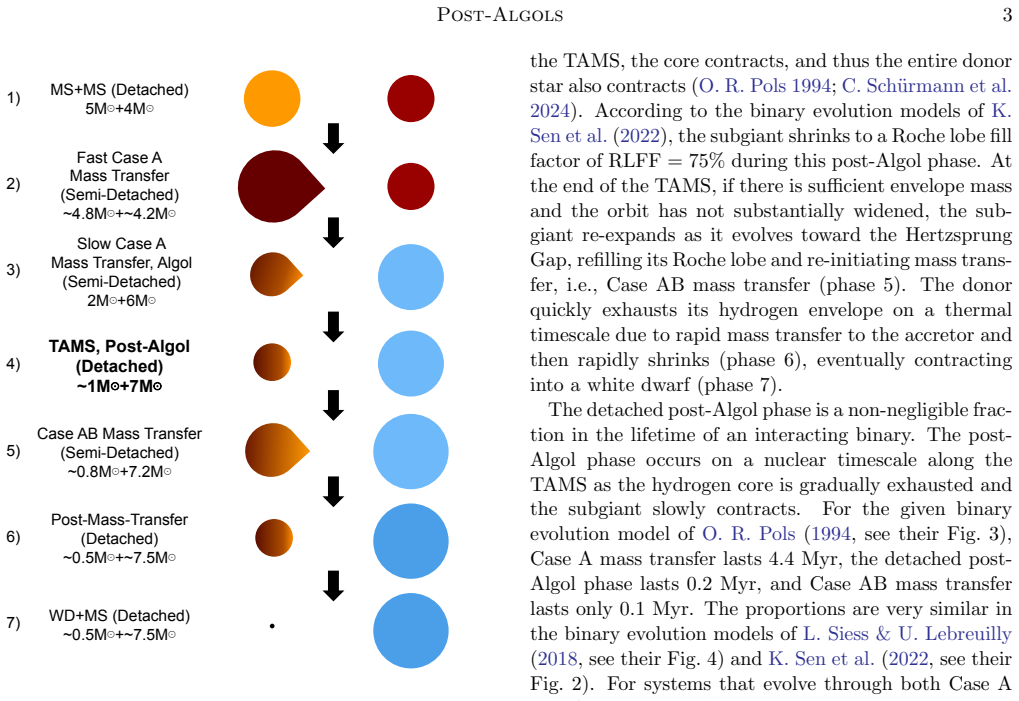
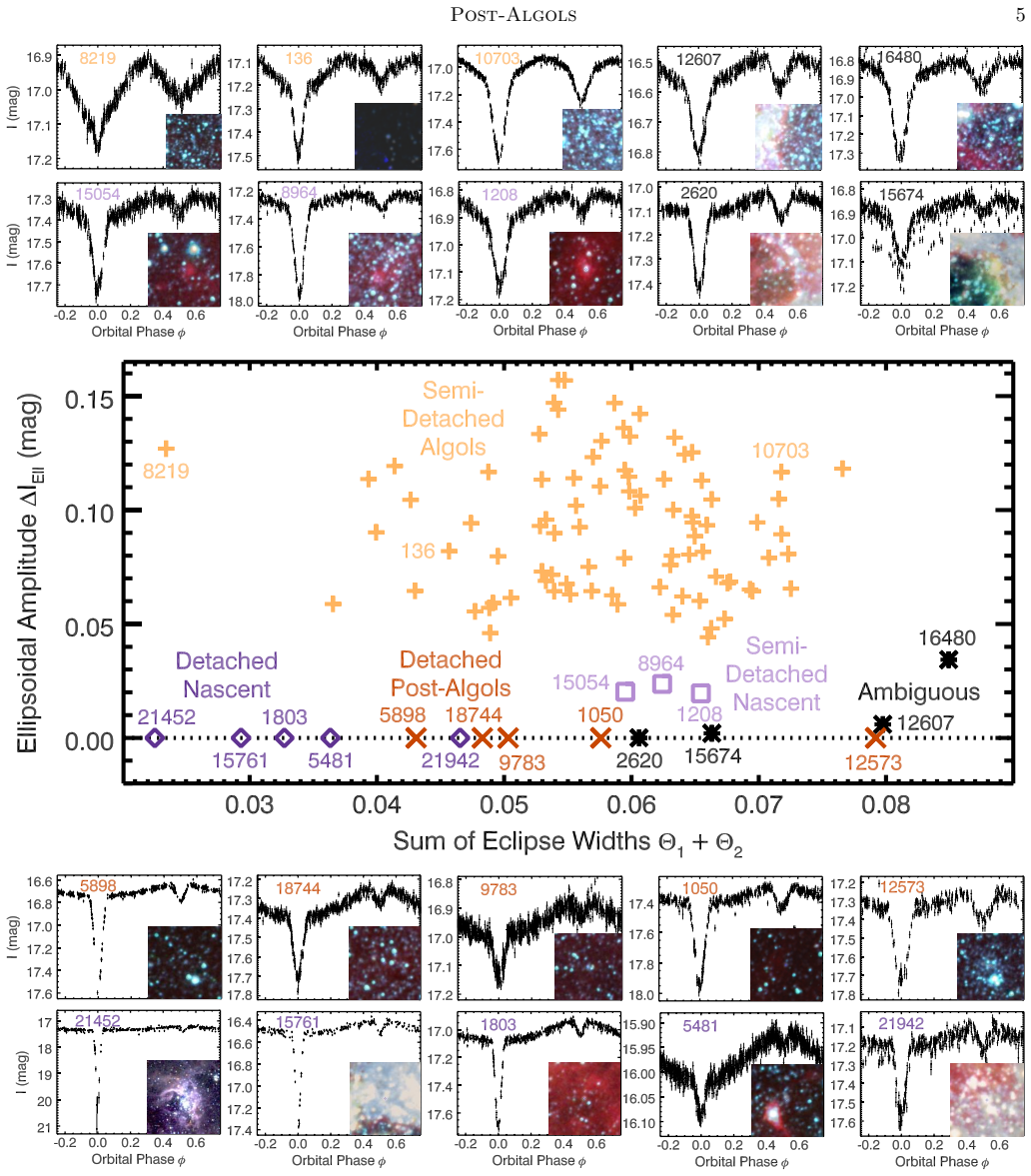
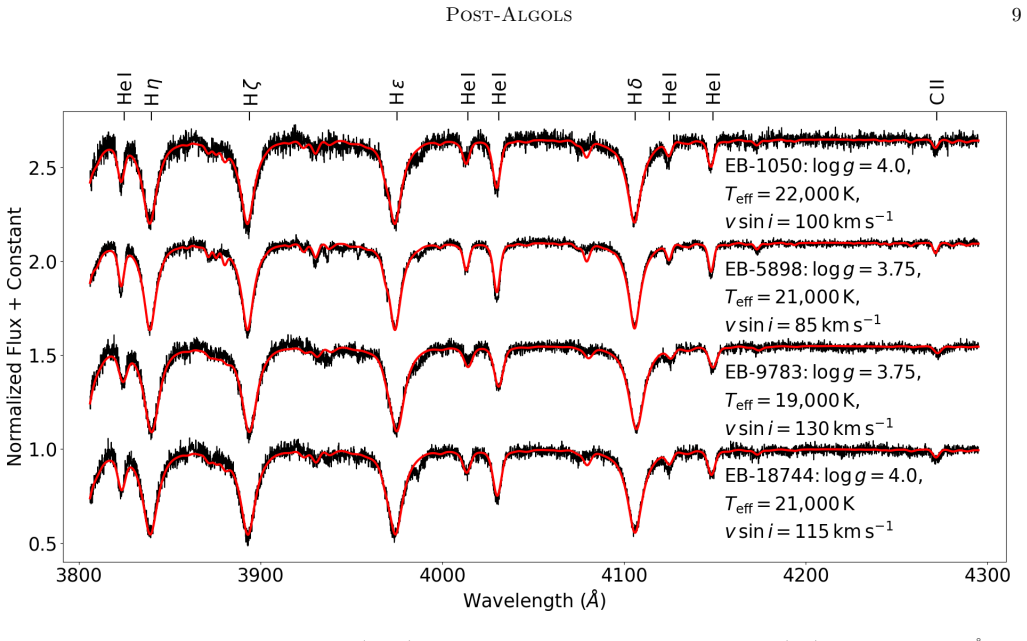
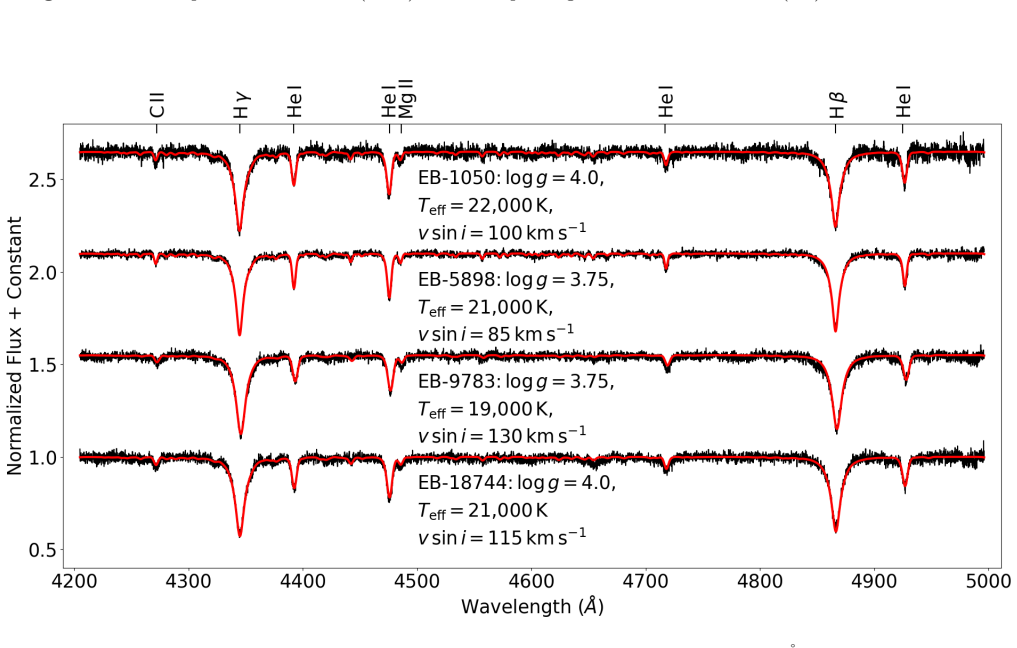
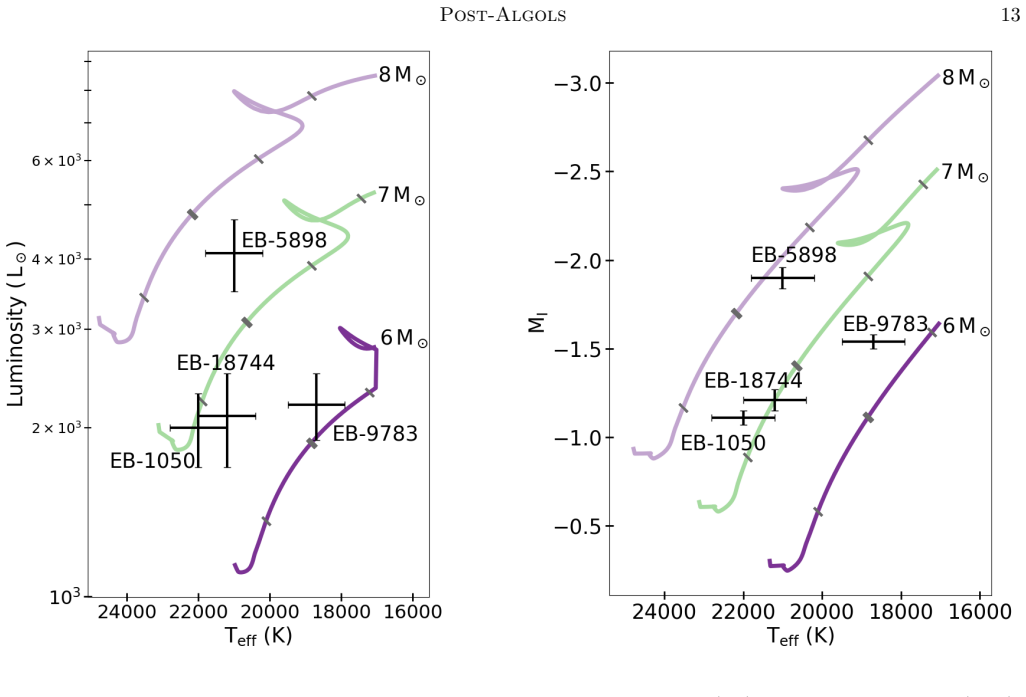
We report the discovery of detached post-Algol EB candidates in the LMC caught between Case A and Case AB mass transfer. Their OGLE light curves feature strong reflection effects as the hot primary irradiates the cool subgiant secondary. The primaries have mid-B MS atmospheres with masses 6-8 solar masses, and dynamical masses of the subgiant secondaries are 0.9-1.2 solar masses. Detailed fitting of the light curves reveals Roche lobe fill factors of 73-89 percent, consistent with binary evolution models. This provides the first empirical evidence that intermediate-mass stars contract along the TAMS.
What carries the argument
The Roche-lobe fill factors of the subgiant secondaries in post-Algol systems, measured from light curve fitting and compared to binary evolution tracks.
If this is right
- The main-sequence hook feature on the Hertzsprung-Russell diagram for intermediate-mass stars is confirmed by observation.
- Binary evolution models for the transition from Case A to Case AB mass transfer can be tested with these systems.
- The duration of the detached post-Algol phase can be calibrated using the observed population.
- Mass determinations from eclipsing binaries provide anchors for stellar models of subgiants.
Where Pith is reading between the lines
- This identification may help refine the timescales in binary population synthesis models for Algol systems.
- Similar systems could be searched for in other galaxies to test if the contraction phase is universal.
- Future observations of the primaries' evolution could link to the formation of other exotic binaries.
Load-bearing premise
The 73-89% Roche-lobe fill factors place the secondaries in the brief post-Case-A contraction window on the TAMS rather than in some other detached evolutionary state.
What would settle it
Detailed comparison of the observed systems to binary evolution tracks showing that the fill factors and positions do not correspond to the predicted contraction phase after Case A mass transfer.
Figures




read the original abstract
For sixty years, stellar evolutionary models have predicted that intermediate-mass stars slightly contract on the terminal-age main-sequence (TAMS) as they exhaust hydrogen in their convective cores, producing the main-sequence (MS) hook on the Hertzsprung-Russell diagram. Contraction along the TAMS has not previously been observationally verified, but an evolved eclipsing binary (EB) with a component on the TAMS can test this prediction. In a very close binary with an orbital period of less than a week, the primary star initially fills its Roche lobe on the MS (Case A mass transfer), and the binary can invert mass ratios, producing a classical Algol. The subgiant donor then contracts on the TAMS and detaches slightly from its Roche lobe. The subgiant subsequently re-expands and refills its Roche lobe as it evolves toward the Hertzsprung Gap (Case AB mass transfer). We report the discovery of detached post-Algol EB candidates in the LMC caught between Case A and Case AB mass transfer. Their OGLE light curves feature strong reflection effects as the hot primary (former mass gainer) irradiates the cool subgiant secondary. We analyze multi-epoch echelle spectra of four post-Algol candidates taken with the MIKE spectrograph at the 6.5m Magellan-Clay telescope. The primaries have mid-B MS atmospheres (M1 = 6 - 8 Msun). We measure dynamical masses of the subgiant secondaries to be M2 = 0.9 - 1.2 Msun. Detailed fitting of the OGLE light curves with PHOEBE reveals that the subgiants have Roche lobe fill factors of RLF F2 = 73% - 89%, consistent with binary evolution models. Our discovery of detached post-Algol candidates provides the first empirical evidence that intermediate-mass stars contract along the TAMS.
Editorial analysis
A structured set of objections, weighed in public.
Referee Report
Summary. The paper reports the discovery of four detached eclipsing binaries in the LMC interpreted as post-Algol systems in the brief window between Case A and Case AB mass transfer. Spectroscopic analysis yields dynamical masses M1 = 6–8 M⊙ (mid-B primaries) and M2 = 0.9–1.2 M⊙ (subgiant secondaries), while PHOEBE modeling of OGLE light curves gives secondary Roche-lobe fill factors of 73–89% together with strong reflection effects; the authors conclude these systems supply the first empirical evidence that intermediate-mass stars contract along the TAMS.
Significance. If the phase identification can be shown to be unique, the result would constitute the first direct observational test of the long-predicted TAMS hook for intermediate-mass stars. Dynamical masses and multi-epoch spectroscopy provide a solid foundation, but the absence of quantitative model comparisons limits the immediate impact.
major comments (2)
- [Abstract] Abstract: the assertion that RLF F2 = 73–89% is 'consistent with binary evolution models' is load-bearing for the central claim that the systems are observed precisely during the post-Case-A contraction phase. No specific evolutionary tracks, grid parameters, or quantitative overlap metrics are referenced, leaving open whether other detached channels (post-Case B, residual thermal adjustment, or certain pre-transfer states) can produce the same fill-factor range.
- [Abstract] Abstract: no uncertainties are reported on the dynamical masses or fill factors, and no goodness-of-fit statistics (e.g., χ² or residual rms) are given for the PHOEBE solutions. These omissions prevent assessment of whether the observed parameters robustly exclude alternative evolutionary states.
minor comments (1)
- [Abstract] The abstract states 'detailed fitting' but does not indicate whether the reflection-effect amplitudes or temperature ratios were fitted simultaneously with the fill factors.
Simulated Author's Rebuttal
We thank the referee for their careful reading and constructive feedback. The comments highlight areas where additional quantitative detail will strengthen the manuscript. We agree that explicit model comparisons and error reporting are needed and will revise the paper accordingly to address both points.
read point-by-point responses
-
Referee: [Abstract] Abstract: the assertion that RLF F2 = 73–89% is 'consistent with binary evolution models' is load-bearing for the central claim that the systems are observed precisely during the post-Case-A contraction phase. No specific evolutionary tracks, grid parameters, or quantitative overlap metrics are referenced, leaving open whether other detached channels (post-Case B, residual thermal adjustment, or certain pre-transfer states) can produce the same fill-factor range.
Authors: We agree that the abstract statement requires supporting detail to demonstrate uniqueness of the evolutionary phase. In the revised manuscript we will add explicit comparisons to published binary evolution grids (e.g., MESA-based Case A sequences for 6–8 M⊙ primaries) that predict Roche-lobe fill factors of 70–90 % during the brief TAMS contraction window, together with quantitative overlap metrics and a short discussion ruling out post-Case B and pre-transfer states at the observed mass ratio and period. revision: yes
-
Referee: [Abstract] Abstract: no uncertainties are reported on the dynamical masses or fill factors, and no goodness-of-fit statistics (e.g., χ² or residual rms) are given for the PHOEBE solutions. These omissions prevent assessment of whether the observed parameters robustly exclude alternative evolutionary states.
Authors: We concur that uncertainties and fit-quality metrics are essential. The revised version will report 1σ uncertainties on M1, M2, and RLF F2 derived from the MIKE radial-velocity orbits and PHOEBE light-curve solutions, and will include χ² per degree of freedom together with residual rms values for each system. These additions will allow readers to evaluate the robustness of the parameters relative to alternative channels. revision: yes
Circularity Check
No significant circularity; fill-factor measurements are independent of the cited models
full rationale
The paper measures dynamical masses from MIKE echelle spectra and Roche-lobe fill factors (RLF F2 = 73–89 %) from PHOEBE fitting of OGLE light curves; these quantities are extracted directly from observations and are not defined by or fitted to the binary evolution tracks. The tracks are invoked only for post-hoc consistency checks. No self-citation, self-definitional loop, or fitted-input-called-prediction appears in the derivation. The phase identification therefore rests on external comparison rather than internal reduction, satisfying the criteria for a self-contained, non-circular result.
Axiom & Free-Parameter Ledger
axioms (1)
- domain assumption Binary evolution models correctly predict the duration and fill-factor range of the post-Case-A detached phase for 6-8 solar-mass primaries.
Reference graph
Works this paper leans on
-
[1]
Abt, H. A., Levato, H., & Grosso, M. 2002, ApJ, 573, 359, doi: 10.1086/340590
-
[2]
Baron, F., Monnier, J. D., Pedretti, E., et al. 2012, ApJ, 752, 20, doi: 10.1088/0004-637X/752/1/20
-
[3]
Bernstein, R., Shectman, S. A., Gunnels, S. M., Mochnacki, S., & Athey, A. E. 2003, in Society of Photo-Optical Instrumentation Engineers (SPIE) Conference Series, Vol. 4841, Instrument Design and Performance for Optical/Infrared Ground-based Telescopes, ed. M. Iye & A. F. M. Moorwood, 1694–1704, doi: 10.1117/12.461502
-
[4]
M., Sobral, D., Smail, I., et al
Bressan, A., Marigo, P., Girardi, L., et al. 2012, MNRAS, 427, 127, doi: 10.1111/j.1365-2966.2012.21948.x
-
[5]
B., Nascimbeni, V., Borsato, L., et al
Brown-Sevilla, S. B., Nascimbeni, V., Borsato, L., et al. 2021, MNRAS, 506, 2122, doi: 10.1093/mnras/stab1843
-
[6]
Chen, B. Q., Guo, H. L., Gao, J., et al. 2022, MNRAS, 511, 1317, doi: 10.1093/mnras/stac072
-
[7]
2016, ApJ, 823, 102, doi: 10.3847/0004-637X/823/2/102
Choi, J., Dotter, A., Conroy, C., et al. 2016, ApJ, 823, 102, doi: 10.3847/0004-637X/823/2/102 de Burgos, A., Sim´ on-D´ ıaz, S., Urbaneja, M. A., et al. 2025, A&A, 695, A87, doi: 10.1051/0004-6361/202453242 de Mink, S. E., Pols, O. R., & Hilditch, R. W. 2007, A&A, 467, 1181, doi: 10.1051/0004-6361:20067007
work page internal anchor Pith review doi:10.3847/0004-637x/823/2/102 2016
-
[8]
Deschamps, R., Siess, L., Davis, P. J., & Jorissen, A. 2013, A&A, 557, A40, doi: 10.1051/0004-6361/201321509
-
[9]
2008, ApJS, 178, 89, doi: 10.1086/589654
Dotter, A., Chaboyer, B., Jevremovi´ c, D., et al. 2008, ApJS, 178, 89, doi: 10.1086/589654
-
[10]
Eggleton, P. P. 1983, ApJ, 268, 368, doi: 10.1086/160960
-
[11]
Fitzpatrick, E. L. 1999, PASP, 111, 63, doi: 10.1086/316293 Post-Algols21
-
[12]
Fujii, M. S., & Portegies Zwart, S. 2011, Science, 334, 1380, doi: 10.1126/science.1211927
-
[13]
Gies, D. R., & Bolton, C. T. 1986, ApJS, 61, 419, doi: 10.1086/191118 G lowacki, M., Soszy´ nski, I., Udalski, A., et al. 2024, AcA, 74, 241, doi: 10.32023/0001-5237/74.4.1
-
[14]
Graczyk, D., Soszy´ nski, I., Poleski, R., et al. 2011, AcA, 61, 103, doi: 10.48550/arXiv.1108.0446
work page internal anchor Pith review Pith/arXiv arXiv doi:10.48550/arxiv.1108.0446 2011
-
[15]
Hoogerwerf, R., de Bruijne, J. H. J., & de Zeeuw, P. T. 2001, A&A, 365, 49, doi: 10.1051/0004-6361:20000014
-
[16]
1967a, ARA&A, 5, 571, doi: 10.1146/annurev.aa.05.090167.003035
Iben, Jr., I. 1967a, ARA&A, 5, 571, doi: 10.1146/annurev.aa.05.090167.003035
-
[17]
1967b, ApJ, 147, 650, doi: 10.1086/149041
Iben, Jr., I. 1967b, ApJ, 147, 650, doi: 10.1086/149041
-
[18]
2021, MNRAS, 503, 5554, doi: 10.1093/mnras/stab846
Jerzykiewicz, M., Pigulski, A., Michalska, G., et al. 2021, MNRAS, 503, 5554, doi: 10.1093/mnras/stab846
-
[19]
Kelson, D. D. 2003, PASP, 115, 688, doi: 10.1086/375502
-
[20]
2000, ApJ, 531, 159, doi: 10.1086/308445
Franx, M. 2000, ApJ, 531, 159, doi: 10.1086/308445
-
[21]
2007, ApJS, 169, 83, doi: 10.1086/511270
Lanz, T., & Hubeny, I. 2007, ApJS, 169, 83, doi: 10.1086/511270
-
[22]
Lechien, T., de Mink, S. E., Valli, R., et al. 2025, ApJL, 990, L51, doi: 10.3847/2041-8213/adfdd4
-
[23]
Malkov, O. Y. 2007, MNRAS, 382, 1073, doi: 10.1111/j.1365-2966.2007.12086.x
-
[24]
2013, ApJ, 778, 95, doi: 10.1088/0004-637X/778/2/95
Moe, M., & Di Stefano, R. 2013, ApJ, 778, 95, doi: 10.1088/0004-637X/778/2/95
-
[25]
2015a, ApJ, 801, 113, doi: 10.1088/0004-637X/801/2/113
Moe, M., & Di Stefano, R. 2015a, ApJ, 801, 113, doi: 10.1088/0004-637X/801/2/113
-
[26]
2015b, ApJ, 810, 61, doi: 10.1088/0004-637X/810/1/61
Moe, M., & Di Stefano, R. 2015b, ApJ, 810, 61, doi: 10.1088/0004-637X/810/1/61
-
[27]
2017, A&A, 606, A92, doi: 10.1051/0004-6361/201730613
Mowlavi, N., Lecoeur-Ta¨ ıbi, I., Holl, B., et al. 2017, A&A, 606, A92, doi: 10.1051/0004-6361/201730613
-
[28]
2023, A&A, 674, A16, doi: 10.1051/0004-6361/202245330 Naz´ e, Y., Rauw, G., Ko laczek-Szyma´ nski, P
Mowlavi, N., Holl, B., Lecoeur-Ta¨ ıbi, I., et al. 2023, A&A, 674, A16, doi: 10.1051/0004-6361/202245330 Naz´ e, Y., Rauw, G., Ko laczek-Szyma´ nski, P. A., Britavskiy, N., & Labadie-Bartz, J. 2025, A&A, 703, A239, doi: 10.1051/0004-6361/202556441
-
[29]
Negu, S. H., & Tessema, S. B. 2018, Astronomische Nachrichten, 339, 709, doi: 10.1002/asna.201813533
-
[30]
I - Formation of electron-degenerate O + NE + MG cores
Nomoto, K. 1984, ApJ, 277, 791, doi: 10.1086/161749
-
[31]
Nomoto, K., Sparks, W. M., Fesen, R. A., et al. 1982, Nature, 299, 803, doi: 10.1038/299803a0
-
[32]
Offner, S. S. R., Moe, M., Kratter, K. M., et al. 2023, in Astronomical Society of the Pacific Conference Series, Vol. 534, Protostars and Planets VII, ed. S. Inutsuka, Y. Aikawa, T. Muto, K. Tomida, & M. Tamura, 275, doi: 10.48550/arXiv.2203.10066
work page internal anchor Pith review Pith/arXiv arXiv doi:10.48550/arxiv.2203.10066 2023
-
[33]
The OGLE Collection of Variable Stars. Eclipsing Binaries in the Magellanic System
Pawlak, M., Soszy´ nski, I., Udalski, A., et al. 2016, AcA, 66, 421, doi: 10.48550/arXiv.1612.06394
work page internal anchor Pith review Pith/arXiv arXiv doi:10.48550/arxiv.1612.06394 2016
-
[34]
Petrovic, J., Langer, N., & van der Hucht, K. A. 2005, A&A, 435, 1013, doi: 10.1051/0004-6361:20042368 Pietrzy´ nski, G., Graczyk, D., Gallenne, A., et al. 2019, Nature, 567, 200, doi: 10.1038/s41586-019-0999-4
-
[35]
2024, Bulletin de la Societe Royale des Sciences de Liege, 93, 4, doi: 10.25518/0037-9565.12243
Pigulski, A. 2024, Bulletin de la Societe Royale des Sciences de Liege, 93, 4, doi: 10.25518/0037-9565.12243
-
[36]
Pols, O. R. 1994, A&A, 290, 119 Prˇ sa, A., Pepper, J., & Stassun, K. G. 2011, AJ, 142, 52, doi: 10.1088/0004-6256/142/2/52 Prˇ sa, A., & Zwitter, T. 2005, ApJ, 628, 426, doi: 10.1086/430591
-
[37]
G., Tammann, G
Richter, O. G., Tammann, G. A., & Huchtmeier, W. K. 1987, A&A, 171, 33 Ruci´ nski, S. M. 1969, AcA, 19, 245
1987
-
[38]
Schneider, F. R. N., Izzard, R. G., Langer, N., & de Mink, S. E. 2015, ApJ, 805, 20, doi: 10.1088/0004-637X/805/1/20 Sch¨ urmann, C., Langer, N., Kramer, J. A., et al. 2024, A&A, 690, A282, doi: 10.1051/0004-6361/202450353
-
[39]
Sen, K., Langer, N., Marchant, P., et al. 2022, A&A, 659, A98, doi: 10.1051/0004-6361/202142574
-
[40]
2018, A&A, 614, A99, doi: 10.1051/0004-6361/201732502
Siess, L., & Lebreuilly, U. 2018, A&A, 614, A99, doi: 10.1051/0004-6361/201732502
-
[41]
M., Skowron, J., Udalski, A., et al
Skowron, D. M., Skowron, J., Udalski, A., et al. 2021, ApJS, 252, 23, doi: 10.3847/1538-4365/abcb81
-
[42]
Smith, N. 2013, MNRAS, 434, 102, doi: 10.1093/mnras/stt1004 Soszy´ nski, I., Pawlak, M., Pietrukowicz, P., et al. 2016, AcA, 66, 405, doi: 10.48550/arXiv.1701.03105
work page internal anchor Pith review Pith/arXiv arXiv doi:10.1093/mnras/stt1004 2013
-
[43]
Udalski, A., Soszynski, I., Szymanski, M. K., et al. 2008, AcA, 58, 89, doi: 10.48550/arXiv.0807.3889 University of Wyoming Advanced Research Computing Center. 2018, UW ARCC MedicineBow High Performance Compute Cluster, University of Wyoming, doi: 10.15786/M2FY47 Van Hamme, W. 1993, AJ, 106, 2096, doi: 10.1086/116788 van Rensbergen, W., & de Greve, J.-P. ...
work page internal anchor Pith review Pith/arXiv arXiv doi:10.48550/arxiv.0807.3889 2008
-
[44]
Virtanen, P., Gommers, R., Oliphant, T. E., et al. 2020, Nature Methods, 17, 261, doi: 10.1038/s41592-019-0686-2
-
[45]
Wang, Z. H., Zhu, L. Y., & Yue, Y. F. 2022, MNRAS, 511, 488, doi: 10.1093/mnras/stac037
-
[46]
2001, A&A, 369, 939, doi: 10.1051/0004-6361:20010151
Wellstein, S., Langer, N., & Braun, H. 2001, A&A, 369, 939, doi: 10.1051/0004-6361:20010151
-
[47]
2013, PASJ, 65, 45, doi: 10.1093/pasj/65.2.45
Yang, Y.-G., Dai, H.-F., He, J.-J., Zhang, J., & Ding, W. 2013, PASJ, 65, 45, doi: 10.1093/pasj/65.2.45
-
[48]
Zapartas, E., de Mink, S. E., Izzard, R. G., et al. 2017, A&A, 601, A29, doi: 10.1051/0004-6361/201629685
-
[49]
Zaritsky, D., Harris, J., Thompson, I. B., & Grebel, E. K. 2004, AJ, 128, 1606, doi: 10.1086/423910
discussion (0)
Sign in with ORCID, Apple, or X to comment. Anyone can read and Pith papers without signing in.