FoggyTrust: Robust Federated Learning with Hierarchical Trust Networks
Pith reviewed 2026-06-29 01:05 UTC · model grok-4.3
The pith
A hierarchical extension of FLTrust localizes trust scoring to fog nodes to handle heterogeneous data distributions in Byzantine-robust federated learning.
A machine-rendered reading of the paper's core claim, the machinery that carries it, and where it could break.
Core claim
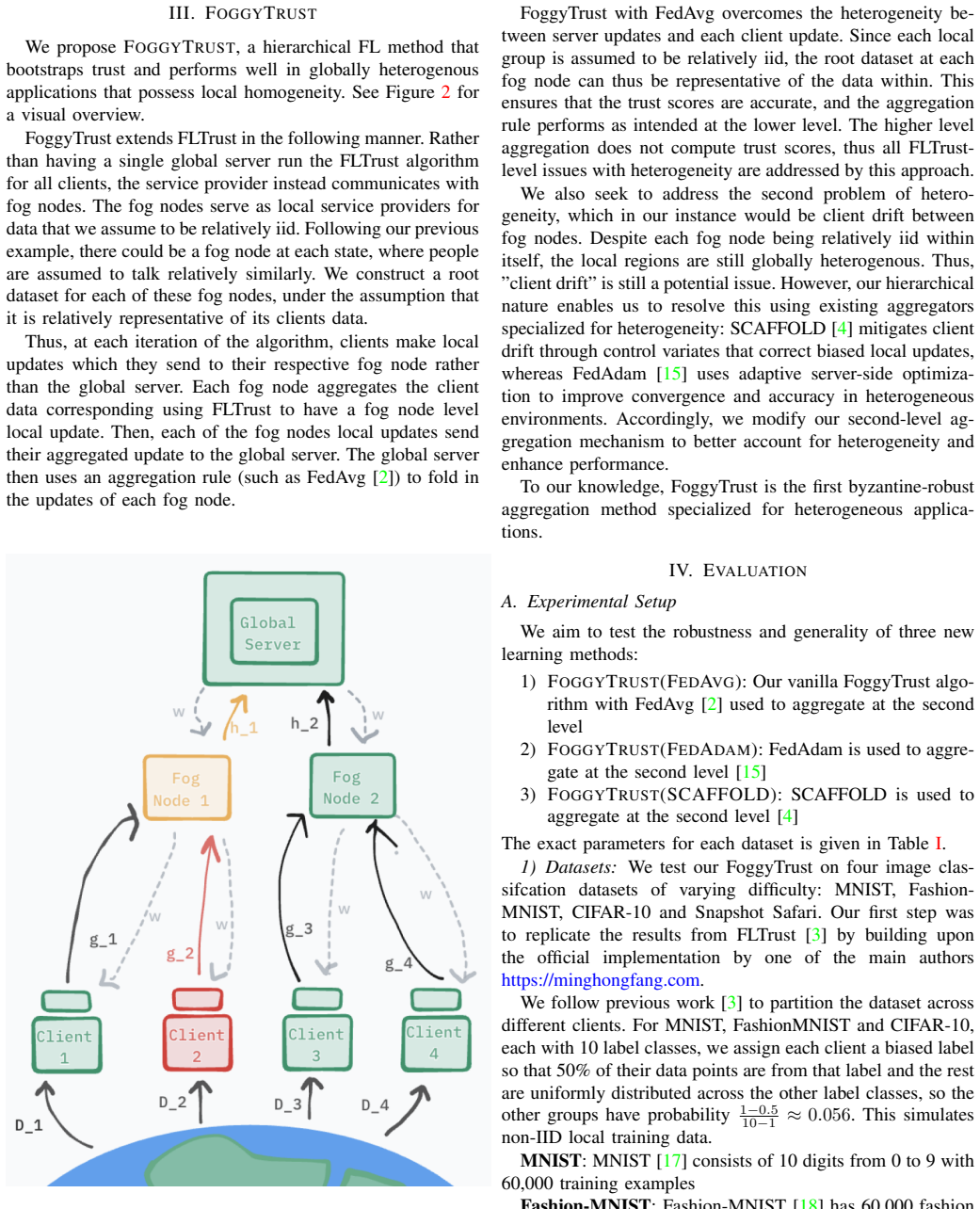
By moving trust computation to intermediate fog nodes that serve locally homogeneous client clusters, FoggyTrust manages distribution mismatch in trust scores and client drift across groups while retaining robustness against malicious updates.
What carries the argument
Two-level hierarchical trust architecture that computes localized trust scores at fog nodes and combines them with heterogeneity-aware global optimizers.
If this is right
- Localized trust scores become reliable when clients at each fog node have similar data.
- Global optimizers mitigate drift between different fog-node groups.
- Performance gains are largest under strong attacks on heterogeneous benchmarks.
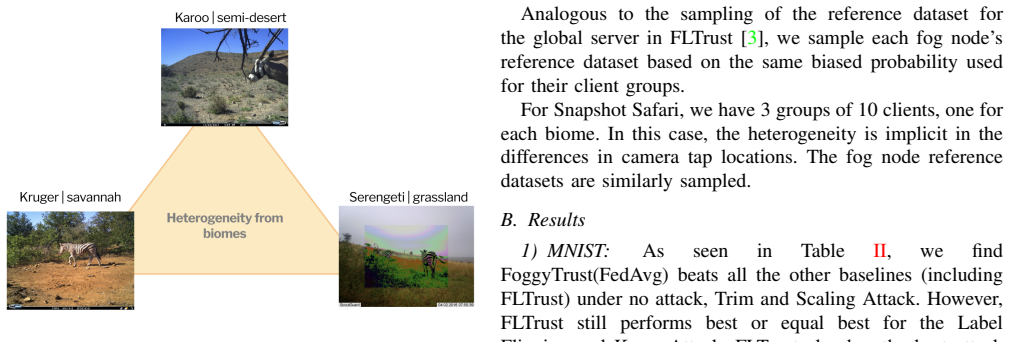
- The architecture supports deployment in real-world settings like distributed wildlife monitoring.
Where Pith is reading between the lines
- If client groups at fog nodes lack homogeneity, the localized trust mechanism may lose its advantage over central trust scoring.
- Similar hierarchical structures could apply to other network topologies beyond fog computing for robust aggregation.
- Further tests on additional attack vectors or larger client populations would clarify the limits of the two-level design.
Load-bearing premise
Client data naturally forms locally homogeneous groups at the fog-node level so that localized trust scores remain reliable while global heterogeneity is managed by the two-level structure and auxiliary optimizers.
What would settle it
A test case in which clients are assigned to fog nodes without ensuring local data homogeneity, resulting in no accuracy improvement or worse performance than FLTrust under the same attack conditions on CIFAR-10.
Figures

read the original abstract
Byzantine-robust federated learning seeks to protect distributed model training from malicious or corrupted clients without requiring access to their private data. FLTrust addresses this challenge by introducing a trusted server-side root dataset that assigns trust scores to client updates for more robust aggregation. In this work, we propose FOGGYTRUST, a hierarchical extension of FLTrust that localizes trust computation to fog nodes, allowing the framework to better handle globally heterogeneous data while preserving robustness within locally homogeneous client groups. We further show that this two-level architecture can simultaneously address distribution mismatch in trust estimation and client drift across groups by combining local trust-based aggregation with heterogeneity-aware global optimizers such as FedAdam and SCAFFOLD. Across benchmark datasets, FOGGYTRUST achieves its strongest gains on more challenging heterogeneous settings, particularly on CIFAR-10 under Krum and Trim attacks, where it achieves an over 50% improvement over FLTrust. We also test FOGGYTRUST in a real-world safari dataset to show the promise of hierarchical trust networks for robust federated learning in socially impactful, safety-critical settings such as distributed wildlife monitoring.
Editorial analysis
A structured set of objections, weighed in public.
Referee Report
Summary. The manuscript proposes FOGGYTRUST as a hierarchical extension of FLTrust for Byzantine-robust federated learning. Trust computation is localized to fog nodes to handle global data heterogeneity while preserving robustness in locally homogeneous client groups. The two-level architecture combines local trust-based aggregation with heterogeneity-aware global optimizers (FedAdam, SCAFFOLD) to mitigate distribution mismatch and client drift. Strongest gains are reported on heterogeneous settings, including >50% improvement over FLTrust on CIFAR-10 under Krum and Trim attacks; results are also shown on a real-world safari dataset for wildlife monitoring.
Significance. If the central claims hold, the work would address a practical limitation of FLTrust in non-IID settings by using hierarchy to localize trust estimation. The application to safety-critical domains is a positive aspect. However, with no experimental details, baselines, statistical tests, partitioning method, homogeneity validation, or ablations available in the provided text, the reported performance gains cannot be evaluated and the significance remains unclear.
major comments (1)
- [Abstract] Abstract: The headline claim of >50% improvement on CIFAR-10 under Krum/Trim attacks is load-bearing for the contribution, yet no details are given on fog-node partitioning, validation that intra-fog distributions are locally homogeneous, or ablations that isolate the hierarchical trust mechanism from the auxiliary optimizers. Without these, it is impossible to determine whether the two-level structure actually solves the distribution-mismatch problem or simply reverts to the same global mismatch issue when local groups are not homogeneous.
Simulated Author's Rebuttal
We thank the referee for their review. We address the major comment below, noting that the full manuscript (beyond the abstract) contains the requested experimental details on partitioning, homogeneity validation, and ablations.
read point-by-point responses
-
Referee: [Abstract] Abstract: The headline claim of >50% improvement on CIFAR-10 under Krum/Trim attacks is load-bearing for the contribution, yet no details are given on fog-node partitioning, validation that intra-fog distributions are locally homogeneous, or ablations that isolate the hierarchical trust mechanism from the auxiliary optimizers. Without these, it is impossible to determine whether the two-level structure actually solves the distribution-mismatch problem or simply reverts to the same global mismatch issue when local groups are not homogeneous.
Authors: The abstract is intentionally concise as a summary. The full manuscript details fog-node partitioning via similarity-based clustering in Section 3.2 to form locally homogeneous groups. Section 4.1 validates intra-fog homogeneity using distribution divergence metrics (e.g., reduced Wasserstein distance within fog nodes vs. global). Section 5.3 provides ablations that isolate the hierarchical trust mechanism from FedAdam/SCAFFOLD, showing independent contributions to robustness. These confirm the two-level structure addresses mismatch rather than reverting to global issues, supporting the reported gains. revision: no
Circularity Check
No circularity detected; proposal is an empirical hierarchical extension without self-referential derivations
full rationale
The provided abstract and description contain no equations, derivations, or mathematical claims. FOGGYTRUST is presented as a direct architectural extension of the existing FLTrust method that localizes trust scoring to fog nodes and combines it with known heterogeneity-aware optimizers (FedAdam, SCAFFOLD). Performance gains are reported as empirical results on benchmarks rather than derived predictions. The key modeling assumption (local homogeneity at fog nodes) is stated explicitly as a design premise rather than derived from prior results or self-citations. No steps match any of the enumerated circularity patterns; the work is self-contained against external benchmarks and does not reduce its central claims to fitted inputs or self-referential definitions.
Axiom & Free-Parameter Ledger
axioms (1)
- domain assumption Client data distributions form locally homogeneous groups suitable for per-fog-node trust scoring
Reference graph
Works this paper leans on
-
[1]
Federated Learning: Strategies for Improving Communication Efficiency
J. Kone ˇcn´y, H. B. McMahan, F. X. Yu, P. Richt ´arik, A. T. Suresh, and D. Bacon, “Federated learning: Strategies for improving communication efficiency,”CoRR, vol. abs/1610.05492, 2016. [Online]. Available: http://arxiv.org/abs/1610.05492
work page internal anchor Pith review Pith/arXiv arXiv 2016
-
[2]
Communication-efficient learning of deep networks from decentralized data,
H. B. McMahan, E. Moore, D. Ramage, S. Hampson, and B. A. y Arcas, “Communication-efficient learning of deep networks from decentralized data,” 2023. [Online]. Available: https://arxiv.org/abs/1602.05629
-
[4]
Available: https://arxiv.org/abs/2012.13995
[Online]. Available: https://arxiv.org/abs/2012.13995
-
[5]
Scaffold: Stochastic controlled averaging for federated learning,
S. P. Karimireddy, S. Kale, M. Mohri, S. J. Reddi, S. U. Stich, and A. T. Suresh, “Scaffold: Stochastic controlled averaging for federated learning,” 2021. [Online]. Available: https://arxiv.org/abs/1910.06378
-
[6]
Federated learning: Collaborative machine learning without centralized training data,
Google AI Blog, “Federated learning: Collaborative machine learning without centralized training data,” https://ai.googleblog.com/2017/04/ federated-learning-collaborative.html, 2017, accessed: 2026-04-30
2017
-
[7]
A systematic review of federated learning applications for biomedical data,
M. Mammadli, R. M. Hewett, and M. J. Harmsen, “A systematic review of federated learning applications for biomedical data,” BioMedInformatics, vol. 2, no. 4, pp. 745–760, 2022. [Online]. Available: https://pmc.ncbi.nlm.nih.gov/articles/PMC9619858/
2022
-
[8]
Poisoning Attacks against Support Vector Machines
B. Biggio, B. Nelson, and P. Laskov, “Poisoning attacks against support vector machines,” inProceedings of the 29th International Conference on Machine Learning (ICML 2012), 2012. [Online]. Available: https://arxiv.org/abs/1206.6389
work page internal anchor Pith review Pith/arXiv arXiv 2012
-
[9]
Exploiting machine learning to subvert your spam filter,
B. Nelson, M. Barreno, F. J. Chi, A. D. Joseph, B. I. P. Rubinstein, U. Saini, C. Sutton, J. D. Tygar, and K. Xia, “Exploiting machine learning to subvert your spam filter,” in First USENIX Workshop on Large-Scale Exploits and Emergent Threats (LEET 08). San Francisco, CA: USENIX Association, Apr
-
[10]
Available: https://www.usenix.org/conference/leet-08/ exploiting-machine-learning-subvert-your-spam-filter
[Online]. Available: https://www.usenix.org/conference/leet-08/ exploiting-machine-learning-subvert-your-spam-filter
-
[11]
Lo- cal model poisoning attacks to byzantine-robust federated learning,
M. Fang, X. Cao, J. Jia, and N. Z. Gong, “Lo- cal model poisoning attacks to byzantine-robust federated learning,” in29th USENIX Security Symposium (USENIX Security 20). USENIX Association, 2020. [Online]. Available: https://www.usenix.org/conference/usenixsecurity20/presentation/fang
2020
-
[12]
Analyzing federated learning through an adversarial lens,
A. N. Bhagoji, S. Chakraborty, P. Mittal, and S. Calo, “Analyzing federated learning through an adversarial lens,” inProceedings of the 36th International Conference on Machine Learning, ser. Proceedings of Machine Learning Research, K. Chaudhuri and R. Salakhutdinov, Eds., vol. 97. PMLR, 2019, pp. 634–643. [Online]. Available: https://proceedings.mlr.pre...
2019
-
[13]
How to backdoor federated learning,
E. Bagdasaryan, A. Veit, Y . Hua, D. Estrin, and V . Shmatikov, “How to backdoor federated learning,” inProceedings of the Twenty Third International Conference on Artificial Intelligence and Statistics, ser. Proceedings of Machine Learning Research, S. Chiappa and R. Calandra, Eds., vol. 108. PMLR, 2020, pp. 2938–2948. [Online]. Available: https://procee...
2020
-
[14]
Dba: Distributed backdoor attacks against federated learning,
C. Xie, K. Huang, P.-Y . Chen, and B. Li, “Dba: Distributed backdoor attacks against federated learning,” inInternational Conference on Learning Representations, 2020. [Online]. Available: https: //openreview.net/forum?id=rkgyS0VFvr
2020
-
[15]
Machine learning with adversaries: Byzantine tolerant gradient descent,
P. Blanchard, E. M. E. Mhamdi, R. Guerraoui, and J. Stainer, “Machine learning with adversaries: Byzantine tolerant gradient descent,” inAd- vances in Neural Information Processing Systems 30 (NeurIPS 2017), 2017
2017
-
[16]
Byzantine-robust distributed learning: Towards optimal statistical rates,
D. Yin, Y . Chen, K. Ramchandran, and P. Bartlett, “Byzantine-robust distributed learning: Towards optimal statistical rates,” inProceedings of the 35th International Conference on Machine Learning (ICML 2018), 2018
2018
-
[17]
Adaptive federated optimization,
S. Reddi, Z. Charles, M. Zaheer, Z. Garrett, K. Rush, J. Kone ˇcn´y, S. Kumar, and H. B. McMahan, “Adaptive federated optimization,”
-
[18]
Adaptive Federated Optimization
[Online]. Available: https://arxiv.org/abs/2003.00295v5
work page internal anchor Pith review Pith/arXiv arXiv 2003
-
[19]
Snapshot safari 2024 expansion,
LILA BC (Labeled Information Library of Alexandria: Biology and Conservation), “Snapshot safari 2024 expansion,” https://lila.science/ datasets/snapshot-safari-2024-expansion/, 2024, camera trap dataset with 4M+ images across 15 projects and 151 categories
2024
-
[20]
Mnist handwritten digit database,
Y . LeCun, C. Cortes, and C. Burges, “Mnist handwritten digit database,” ATT Labs [Online]. Available: http://yann.lecun.com/exdb/mnist, vol. 2, 2010
2010
-
[21]
Fashion-MNIST: a Novel Image Dataset for Benchmarking Machine Learning Algorithms
H. Xiao, K. Rasul, and R. V ollgraf, “Fashion-mnist: a novel image dataset for benchmarking machine learning algorithms,” 2017. [Online]. Available: https://arxiv.org/abs/1708.07747
work page internal anchor Pith review Pith/arXiv arXiv 2017
-
[22]
Learning multiple layers of features from tiny images,
A. Krizhevsky, “Learning multiple layers of features from tiny images,” University of Toronto, Tech. Rep., 2009, technical Report
2009
-
[23]
Deep Residual Learning for Image Recognition
K. He, X. Zhang, S. Ren, and J. Sun, “Deep residual learning for image recognition,” 2015. [Online]. Available: https://arxiv.org/abs/1512.03385
work page internal anchor Pith review Pith/arXiv arXiv 2015
discussion (0)
Sign in with ORCID, Apple, or X to comment. Anyone can read and Pith papers without signing in.