Analysis, thermodynamics, and a numeric solver for a pressure-temperature equilibrium closure of the four-equation model
Pith reviewed 2026-06-29 03:47 UTC · model grok-4.3
The pith
The four-equation model admits a convex admissible set and a unique pressure-temperature equilibrium solution under thermodynamic assumptions on the equations of state.
A machine-rendered reading of the paper's core claim, the machinery that carries it, and where it could break.
Core claim
The four-equation model possesses a convex admissible set that supports invariant-domain methods, and the pressure-temperature equilibrium closure exists and is unique for general equations of state; a robust solver computes the equilibrated pressure and temperature for any number of materials.
What carries the argument
The admissible set of mixture states, proven convex, together with the nonlinear solver that locates the unique pressure-temperature equilibrium point.
If this is right
- Convexity of the admissible set directly enables construction of invariant-domain preserving discretizations for the four-equation model.
- Existence and uniqueness supply a mathematically well-defined closure that can be used with tabular equations of state and any number of materials.
- The new solver furnishes a practical, efficient route to compute the equilibrium state inside each computational cell.
Where Pith is reading between the lines
- Convexity of the admissible set may allow similar invariant-domain arguments in other multi-material equilibrium closures.
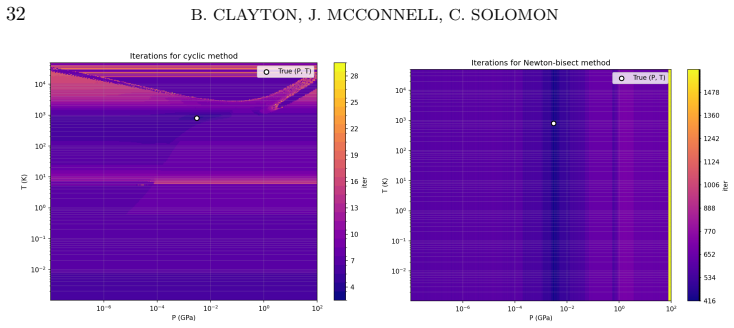
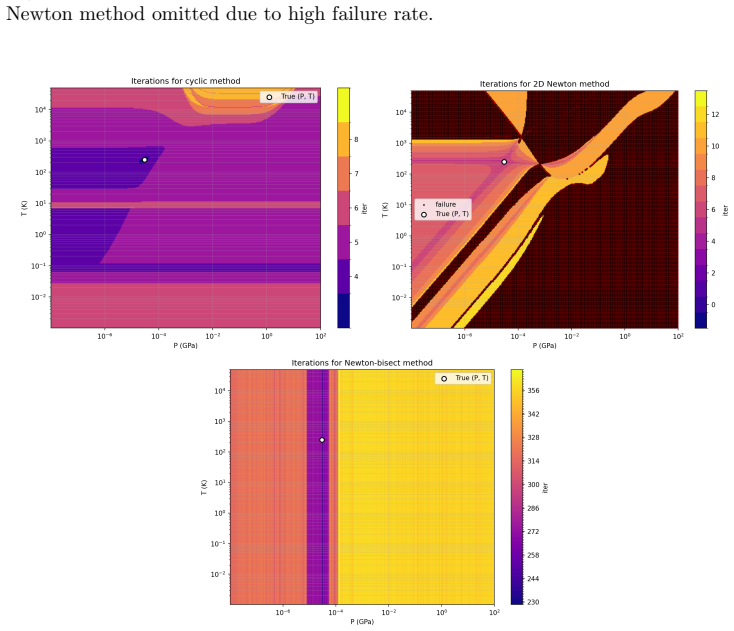
- The solver could be embedded in existing hydrodynamics codes to replace approximate or iterative equilibrium steps.
- The thermodynamic analysis supplies a template that might be reused for other equilibrium closures such as pressure-volume or chemical-potential equilibrium.
Load-bearing premise
The thermodynamic assumptions on the equations of state that are needed to guarantee existence and uniqueness of the pressure-temperature equilibrium.
What would settle it
A concrete set of equations of state obeying the paper's thermodynamic assumptions for which the pressure-temperature equilibrium equations have either no solution or more than one solution.
Figures


read the original abstract
We analyze an often used closure model for multi-material hydrodynamics where pressure temperature equilibrium (PTE) is assumed for every state; emphasis is placed on tabular equations of state. This multi-material model is often referred to as the four-equation model. The identification of the admissible set is presented and is proven to be convex, setting the foundation for development of invariant-domain methods for this model. A novel, robust, and efficient method is presented for solving the highly nonlinear system for the equilibrated pressure and temperature with an arbitrary number of materials. Additionally, we provide a detailed analysis of the thermodynamics of the mixture model for general equations of state and prove existence and uniqueness of the pressure-temperature equilibrium solution under some thermodynamic assumptions.
Editorial analysis
A structured set of objections, weighed in public.
Referee Report
Summary. The manuscript analyzes the four-equation multi-material hydrodynamics model under the pressure-temperature equilibrium (PTE) closure, with emphasis on tabular equations of state. It identifies the admissible set and proves its convexity, develops a novel robust solver for the nonlinear PTE system with an arbitrary number of materials, and provides a thermodynamic analysis proving existence and uniqueness of the PTE solution under unspecified thermodynamic assumptions for general EOS.
Significance. If the thermodynamic assumptions hold globally for tabular EOS, the convexity of the admissible set would directly enable invariant-domain preserving discretizations, while the solver would address a practical bottleneck in multi-material simulations. The combination of analysis and numerics targets a core closure problem in computational hydrodynamics.
major comments (2)
- [thermodynamic analysis section (referenced in abstract)] The existence and uniqueness proof rests on thermodynamic assumptions whose precise statement, scope, and verification for tabular EOS are not provided; without an explicit list of these assumptions (e.g., monotonicity or convexity properties of the mixture internal energy) and checks against common tabular materials, the result does not underwrite the claimed robustness of the solver or admissible-set methods.
- [admissible set identification section] The convexity proof of the admissible set is load-bearing for the invariant-domain claim, yet the manuscript provides no explicit definition of the set or the convexity argument; this must be supplied with a concrete characterization (e.g., via specific inequalities on the EOS) before the foundation for invariant-domain methods can be assessed.
minor comments (2)
- [Abstract] The abstract states proofs of convexity, existence, and uniqueness but supplies no details on the thermodynamic assumptions or derivation steps; the main text should include a dedicated subsection listing the assumptions with equation references.
- [thermodynamics section] Notation for the mixture internal energy and entropy should be introduced with explicit dependence on the volume fractions and specific internal energies to avoid ambiguity when general EOS are substituted.
Simulated Author's Rebuttal
We thank the referee for the careful review and constructive feedback on our manuscript. We address each major comment point by point below and will revise the manuscript accordingly to improve clarity and explicitness.
read point-by-point responses
-
Referee: [thermodynamic analysis section (referenced in abstract)] The existence and uniqueness proof rests on thermodynamic assumptions whose precise statement, scope, and verification for tabular EOS are not provided; without an explicit list of these assumptions (e.g., monotonicity or convexity properties of the mixture internal energy) and checks against common tabular materials, the result does not underwrite the claimed robustness of the solver or admissible-set methods.
Authors: We agree that the assumptions merit a more explicit statement. The existence/uniqueness result in Section 4 is based on the mixture internal energy being strictly convex in specific volume and entropy, with pressure and temperature strictly increasing in their arguments. In the revision we will insert a dedicated subsection that lists these assumptions verbatim, states their scope for general EOS, and adds verification checks against representative tabular materials from the SESAME and LEOS libraries. This will directly support the robustness claims for the solver. revision: yes
-
Referee: [admissible set identification section] The convexity proof of the admissible set is load-bearing for the invariant-domain claim, yet the manuscript provides no explicit definition of the set or the convexity argument; this must be supplied with a concrete characterization (e.g., via specific inequalities on the EOS) before the foundation for invariant-domain methods can be assessed.
Authors: Section 3.1 defines the admissible set explicitly as the collection of states ( ho, e, Y) satisfying ho > 0, e > 0, ∑ Y_k = 1, Y_k > 0 together with the thermodynamic constraints implied by each material EOS. Theorem 3.2 proves convexity by showing the set is the intersection of convex half-spaces induced by the monotonicity and convexity properties of the EOS. To address the concern we will augment the section with the explicit inequalities that characterize membership and expand the convexity argument with additional intermediate steps. revision: yes
Circularity Check
No circularity; derivation is self-contained under external thermodynamic assumptions.
full rationale
The paper's central results are an identification and convexity proof for the admissible set plus an existence/uniqueness theorem for the PTE solution, both explicitly conditioned on 'some thermodynamic assumptions' for general EOS. No load-bearing step reduces by the paper's own equations to a fitted parameter, self-citation chain, or definitional tautology; the assumptions are stated as external inputs rather than derived from the target result. The numeric solver is presented as a separate algorithmic contribution. This matches the default expectation of a non-circular analysis paper.
Axiom & Free-Parameter Ledger
axioms (1)
- domain assumption Some thermodynamic assumptions on the equations of state that guarantee existence and uniqueness of the pressure-temperature equilibrium solution
Reference graph
Works this paper leans on
-
[1]
lim P→inf(P) + τm(P, T) =∞for allT >0
-
[2]
lim P→∞ τm′(P, T) = 0for allT >0
-
[3]
hypothetical cold curve
lim T→∞ em′′(P(τ 0, T,Y 0), T) =∞ hold for at least one equation of state per assumption; that is,m, m ′, m′′ ∈ {1:M} may or may not be unique and whereP(τ 0, T,Y 0)is the generalized pressure from Definition 2.13. Then a unique solution exists to the PTE system(2.14). Proof.From thermodynamic stability and assumptions 1 and 2, we know that the generalize...
-
[4]
rectangular box
Tabular approximation.We now present a method for constructing a tab- ular equation of state provided some discrete set of data. The construction process is not the sole focus of the paper; however, we illustrate a possible approximation method and discuss several issues with tabular approximations. The tabular equation of state that we shall use consists...
-
[5]
The constructions we have provided are somewhat sim- ple since we define a single local interpolation method from some predefined data
Hence the equation of state for pressure isinconsistent!□ Remark3.3 (Real data). The constructions we have provided are somewhat sim- ple since we define a single local interpolation method from some predefined data. In general, for a global tabular EOS, constructing a highly accurate approximation is incredibly complex. The process consists of a variety ...
-
[6]
Note, we drop theenotation used in Section 3.2 since there is no requirement that the equations of state must be tabulated
Pressure-temperature equilibrium preliminaries.We now proceed by establishing a few preliminaries as well as some standard numerical methods for solv- ing nonlinear systems of equations. Note, we drop theenotation used in Section 3.2 since there is no requirement that the equations of state must be tabulated. First, recall the system we are interested in ...
-
[7]
Alternatively, the Newton-bisection method typically converges even when the initial guess is far away from the solution; however, the computational time is quite large
The cyclic method.While the 2D Newton method converges at a quadratic rate, it may fail to converge unless the initial guess is close enough to the root. Alternatively, the Newton-bisection method typically converges even when the initial guess is far away from the solution; however, the computational time is quite large. Solving PTE is just one part of s...
-
[8]
Take a Newton step in thex-direction forf(x, y) =afrom the point (x 0, y0) to find a point (ex0, y0)
-
[9]
Construct the tangent line,I x f(ex0, y0), to the curveF f(ex0,y0) using the cyclic rule (Corollary 2.4)
-
[10]
Take a Newton step in they-direction forg(x, y) =bfrom the point (ex 0, y0) to find a point (ex0,ey0)
-
[11]
Construct the tangent line,I y g(ex0,ey0), to the curveG g(ex0,ey0) using the cyclic rule (Corollary 2.4)
-
[12]
We now provide more explicit details on the construction of the tangent lines
Find the intersection point, (x 1, y1), ofI x f(ex0, y0) andI y g(ex0,ey0). We now provide more explicit details on the construction of the tangent lines. After the first Newton step, we obtain the point (ex 0, y0). The slopes of the tangent lines are provided by the cyclic rule, respectively as, (5.5) ∂x ∂y f (ex0, y0) =− ∂f ∂y x(ex0, y0) ∂f ∂x y(ex0, y0...
-
[13]
We provide only the necessary details in order to perform the PTE solve
Equation of state.We describe several equations of state which will be used in the testing of the PTE solver. We provide only the necessary details in order to perform the PTE solve. THERMODYNAMICS OF PTE23 Algorithm 5.2PTE cyclic method. Require:P (0),T (0) setn= 0 while((4.4)and(4.5)false)do eP (n) =P (n) − ϱ(P (n),T (n)) ∂P ϱ(P (n),T (n)) ▷Newton step ...
-
[14]
[29, Tables I
and use the parameters from Jadrich et al. [29, Tables I. and II.]. 24B. CLAYTON, J. MCCONNELL, C. SOLOMON The reactant Davis pressure and specific internal energy are given by, e(τ, T) =e s(τ) + c0 vTs(τ) 1 +α ST h T Ts(τ) 1+αST −1 i ,(6.3) P(τ, T) =P s(τ) + Γ(τ) τ c0 vTs(τ) 1 +α ST h T Ts(τ) 1+αST −1 i (6.4) where Ts(τ) =T 0 ( τ τ0 −Γ0 ,ifτ > τ 0, τ τ0 ...
-
[15]
steps” that the numerical method has taken. Since each method is fairly distinct, we would like to clarify the definition of a “step
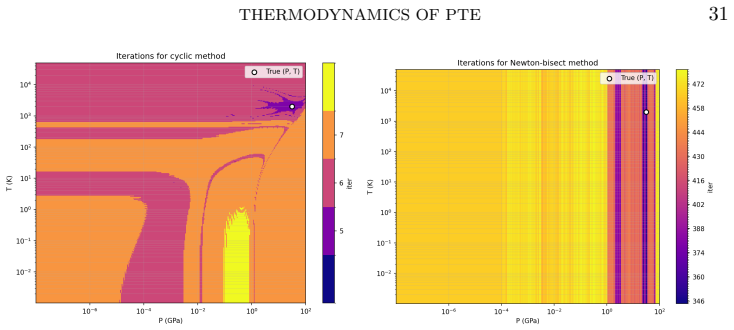
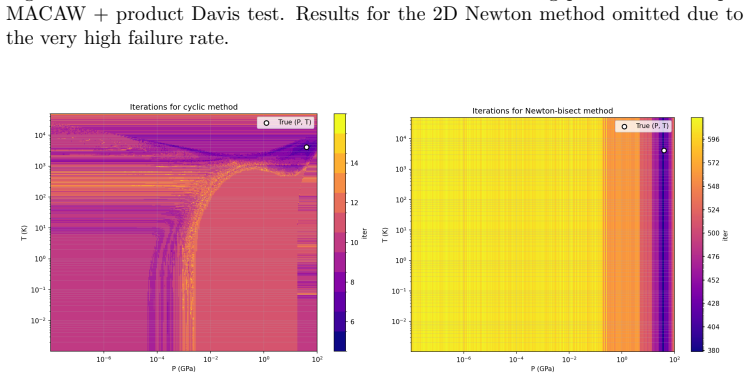
Numerical results.We deploy a series of tests to determine the efficiency and accuracy of the methods for a variety of different EOS. THERMODYNAMICS OF PTE25 Random trial #1 (Ideal/Stiffened) Cyclic 2D Newton Newton+Bisection Failure rate 0% 61.6% 0% Average steps 6.7 41.7 7.6 Average bisections - - 308 Average CPU time 2.8×10 −4 s 5.2×10 −4 s 1.5×10 −3 s...
2000
-
[16]
We covered the mixture thermodynamic derivatives and various other thermodynamic properties
Conclusion.We have analyzed the pressure-temperature equilibrium clo- sure model imposed on the four-equation model for general equations of state that are thermodynamically stable. We covered the mixture thermodynamic derivatives and various other thermodynamic properties. In particular, the admissible set was identified in Definition 2.24 and was found ...
-
[17]
A five-equation model for the simulation of interfaces between compressible fluids.Journal of Computa- tional Physics, 181(2):577–616, 2002
Gr´ egoire Allaire, S´ ebastien Clerc, and Samuel Kokh. A five-equation model for the simulation of interfaces between compressible fluids.Journal of Computa- tional Physics, 181(2):577–616, 2002
2002
-
[18]
A simple macaw equation of state
Tariq Dennis Aslam and Jose Eduardo Lozano. A simple macaw equation of state. Technical report, Los Alamos National Laboratory (LANL), Los Alamos, NM (United States), 2024
2024
-
[19]
On two-phase pressure and temperature equilibration with Mie-Gr¨ uneisen equations of state
Tariq Dennis Aslam, Nirmal Kumar Rai, Stephen Arthur Andrews, Matthew An- thony Price, David Benjamin Culp, and Vaibhav Rajora. On two-phase pressure and temperature equilibration with Mie-Gr¨ uneisen equations of state. Techni- cal report, Los Alamos National Laboratory (LANL), Los Alamos, NM (United States); Purdue Univ., West Lafayette, IN (United Stat...
-
[20]
A two-phase mixture theory for the deflagration-to-detonation transition (DDT) in reactive granular materials.In- ternational journal of multiphase flow, 12(6):861–889, 1986
Melvin R Baer and Jace W Nunziato. A two-phase mixture theory for the deflagration-to-detonation transition (DDT) in reactive granular materials.In- ternational journal of multiphase flow, 12(6):861–889, 1986
1986
-
[21]
On the theory of shock waves for an arbitrary equation of state
Hans Albrecht Bethe. On the theory of shock waves for an arbitrary equation of state. InClassic papers in shock compression science, pages 421–495. Springer, 1998
1998
-
[22]
An exact Riemann solver in the algorithms for multicomponent gas dynamics.Keldysh Institute preprints, (96):1–28, 2018
Vitaly Evgenyevich Borisov and Yuri Germanovich Rykov. An exact Riemann solver in the algorithms for multicomponent gas dynamics.Keldysh Institute preprints, (96):1–28, 2018
2018
-
[23]
John Wiley & Sons, 2nd edition, 1985
Herbert B Callen.Thermodynamics and an Introduction to Thermostatistics. John Wiley & Sons, 2nd edition, 1985
1985
-
[24]
Alexandre Chiapolino, Richard Saurel, and S´ ebastien Bodard. Existence condi- tion for detonations in condensed explosives with pressure–temperature equilib- rium models.Physics of Fluids, 36(11):116124, 11 2024. ISSN 1070-6631. doi: 10.1063/5.0238486. URL https://doi.org/10.1063/5.0238486
-
[25]
Positively invariant regions for systems of nonlinear diffusion equations.Indiana University Mathematics Journal, 26(2):373–392, 1977
Kai N Chueh, Charles C Conley, and Joel A Smoller. Positively invariant regions for systems of nonlinear diffusion equations.Indiana University Mathematics Journal, 26(2):373–392, 1977
1977
-
[26]
Bennett Clayton and Eric J Tovar. Approximation technique for preserving the minimum principle on the entropy for the compressible Euler equations.arXiv preprint arXiv:2503.10612, 2025
-
[27]
Bennett Clayton, Tarik Dzanic, and Eric J Tovar. Second-order invariant-domain preserving approximation to the multi-species Euler equations.arXiv preprint arXiv:2505.09581, 2025
-
[28]
Bennett Clayton, Tarik Dzanic, and Eric J. Tovar. Second-order invariant-domain 34B. CLAYTON, J. MCCONNELL, C. SOLOMON preserving approximation to the multi-species Euler equations.Computers & Fluids, 317:107159, 2026
2026
-
[29]
Numerical simulation of the homogeneous equilibrium model for two- phase flows.Journal of Computational Physics, 161(1):354–375, 2000
S Clerc. Numerical simulation of the homogeneous equilibrium model for two- phase flows.Journal of Computational Physics, 161(1):354–375, 2000
2000
-
[30]
Henry Collis, Deniz A Bezgin, Shahab Mirjalili, and Ali Mani. A robust four- equation model for compressible multi-phase multi-component flows satisfying interface equilibrium and phase-immiscibility conditions.Journal of Computa- tional Physics, page 114827, 2026
2026
-
[31]
Homogeneous two-phase flow models and accurate steam- water table look-up method for fast transient simulations.International journal of multiphase flow, 95:199–219, 2017
Marco De Lorenzo, Ph Lafon, Michele Di Matteo, Marica Pelanti, J-M Seynhaeve, and Yann Bartosiewicz. Homogeneous two-phase flow models and accurate steam- water table look-up method for fast transient simulations.International journal of multiphase flow, 95:199–219, 2017
2017
-
[32]
Consistent thermodynamic derivative estimates for tabular equa- tions of state.Physical Review E—Statistical, Nonlinear, and Soft Matter Physics, 73(6):066704, 2006
Gary A Dilts. Consistent thermodynamic derivative estimates for tabular equa- tions of state.Physical Review E—Statistical, Nonlinear, and Soft Matter Physics, 73(6):066704, 2006
2006
-
[33]
Phase equilibrium of multicomponent mixtures: continuous mixture Gibbs free energy minimization and phase rule.Chemical Engineering Communications, 54(1-6):139–148, 1987
Pin Chan Du and GA Mansoori. Phase equilibrium of multicomponent mixtures: continuous mixture Gibbs free energy minimization and phase rule.Chemical Engineering Communications, 54(1-6):139–148, 1987
1987
-
[34]
Hans J Fecht. Thermodynamic properties and stability of grain boundaries in metals based on the universal equation of state at negative pressure.Acta Met- allurgica et Materialia, 38(10):1927–1932, 1990
1927
-
[35]
Courier Corporation, 2012
Enrico Fermi.Thermodynamics. Courier Corporation, 2012
2012
-
[36]
Relaxation two-phase flow models and the sub- characteristic condition.Mathematical Models and Methods in Applied Sciences, 21(12):2379–2407, 2011
Tore Fl˚ atten and Halvor Lund. Relaxation two-phase flow models and the sub- characteristic condition.Mathematical Models and Methods in Applied Sciences, 21(12):2379–2407, 2011
2011
-
[37]
Wave propagation in multicomponent flow models.SIAM Journal on Applied Mathematics, 70(8): 2861–2882, 2010
Tore Fl˚ atten, Alexandre Morin, and Svend Tollak Munkejord. Wave propagation in multicomponent flow models.SIAM Journal on Applied Mathematics, 70(8): 2861–2882, 2010
2010
-
[38]
On the use of tabulated equations of state for multi-phase simulations in the homogeneous equilibrium limit.Shock Waves, 29(5):769–793, 2019
Fabian F¨ oll, Timon Hitz, Christoph M¨ uller, C-D Munz, and Michael Dumbser. On the use of tabulated equations of state for multi-phase simulations in the homogeneous equilibrium limit.Shock Waves, 29(5):769–793, 2019
2019
-
[39]
Maps of convex sets and invariant regions for finite-difference systems of conservation laws.Archive for rational mechanics and analysis, 160 (3):245–269, 2001
Hermano Frid. Maps of convex sets and invariant regions for finite-difference systems of conservation laws.Archive for rational mechanics and analysis, 160 (3):245–269, 2001
2001
-
[40]
First-principles mode Gruneisen parameters and negative thermal expansion inα-ZrW2O8.Physical review letters, 109(19):195503, 2012
V Gava, AL Martinotto, and CA Perottoni. First-principles mode Gruneisen parameters and negative thermal expansion inα-ZrW2O8.Physical review letters, 109(19):195503, 2012
2012
-
[41]
Formulation of entropy-stable schemes for the multicomponent compressible Euler equations
Ayoub Gouasmi, Karthik Duraisamy, and Scott M Murman. Formulation of entropy-stable schemes for the multicomponent compressible Euler equations. Computer Methods in Applied Mechanics and Engineering, 363:112912, 2020
2020
-
[42]
Pressure-velocity equilibrium hydrodynamic models.Acta math- ematica scientia, 30(2):563–594, 2010
John W Grove. Pressure-velocity equilibrium hydrodynamic models.Acta math- ematica scientia, 30(2):563–594, 2010
2010
-
[43]
Some comments on thermodynamic consistency for equilibrium mixture equations of state.Computers & Mathematics with Applications, 78(2): 582–597, 2019
John W Grove. Some comments on thermodynamic consistency for equilibrium mixture equations of state.Computers & Mathematics with Applications, 78(2): 582–597, 2019
2019
-
[44]
Invariant domains and first-order con- tinuous finite element approximation for hyperbolic systems.SIAM Journal on Numerical Analysis, 54(4):2466–2489, 2016
Jean-Luc Guermond and Bojan Popov. Invariant domains and first-order con- tinuous finite element approximation for hyperbolic systems.SIAM Journal on Numerical Analysis, 54(4):2466–2489, 2016
2016
-
[45]
Un- certainty quantified reactant and product equation of state for composition B
Ryan B Jadrich, Beth A Lindquist, Jeffery A Leiding, and Tariq D Aslam. Un- certainty quantified reactant and product equation of state for composition B. In THERMODYNAMICS OF PTE35 AIP Conference Proceedings, volume 2844, page 310003. AIP Publishing LLC, 2023
2023
-
[46]
The Noble-Abel stiffened-gas equation of state.Physics of Fluids, 28(4), 2016
Olivier Le M´ etayer and Richard Saurel. The Noble-Abel stiffened-gas equation of state.Physics of Fluids, 28(4), 2016
2016
-
[47]
An analytic and com- plete equation of state for condensed phase materials.Journal of Applied Physics, 134(12), 2023
Eduardo Lozano, Marc J Cawkwell, and Tariq D Aslam. An analytic and com- plete equation of state for condensed phase materials.Journal of Applied Physics, 134(12), 2023
2023
-
[48]
A hierarchy of relaxation models for two-phase flow.SIAM Journal on Applied Mathematics, 72(6):1713–1741, 2012
Halvor Lund. A hierarchy of relaxation models for two-phase flow.SIAM Journal on Applied Mathematics, 72(6):1713–1741, 2012
2012
-
[49]
Depressurization of carbon dioxide in pipelines–models and methods.Energy Procedia, 4:2984–2991, 2011
Halvor Lund, Tore Fl˚ atten, and Svend Tollak Munkejord. Depressurization of carbon dioxide in pipelines–models and methods.Energy Procedia, 4:2984–2991, 2011
2011
-
[50]
Mersenne twister: a 623- dimensionally equidistributed uniform pseudo-random number generltor.ACM Transactions on Modeling and Computer Simulation (TOMACS), 8(1):3–30, 1998
Makoto Matsumoto and Takuji Nishimura. Mersenne twister: a 623- dimensionally equidistributed uniform pseudo-random number generltor.ACM Transactions on Modeling and Computer Simulation (TOMACS), 8(1):3–30, 1998
1998
-
[51]
The Riemann problem for fluid flow of real materials.Reviews of modern physics, 61(1):75, 1989
Ralph Menikoff and Bradley J Plohr. The Riemann problem for fluid flow of real materials.Reviews of modern physics, 61(1):75, 1989
1989
-
[52]
Sharp interface capturing Godunov method for multi-material flow simulations.Computers & Fluids, page 106725, 2025
Igor Menshov, Pavel Zakharov, and Rodion Muratov. Sharp interface capturing Godunov method for multi-material flow simulations.Computers & Fluids, page 106725, 2025
2025
-
[53]
Safe starting regions for iterative methods
Ramon E Moore and Sandie T Jones. Safe starting regions for iterative methods. SIAM Journal on Numerical Analysis, 14(6):1051–1065, 1977
1977
-
[54]
Large-eddy simulation of a 3d airblast injector using a diffuse interface four-equation model: Effects of evapo- ration and combustion.Combustion and Flame, 285:114771, 2026
Benoˆ ıt P´ eden, Pierre Boivin, and Nicolas Odier. Large-eddy simulation of a 3d airblast injector using a diffuse interface four-equation model: Effects of evapo- ration and combustion.Combustion and Flame, 285:114771, 2026
2026
-
[55]
Courier Corporation, 2013
Max Planck.Treatise on thermodynamics. Courier Corporation, 2013
2013
-
[56]
Evaluation of thermodynamic closure models for partially reacted two-phase mixture of condensed phase explosives.Journal of Applied Physics, 131(18), 2022
Nirmal K Rai and Tariq D Aslam. Evaluation of thermodynamic closure models for partially reacted two-phase mixture of condensed phase explosives.Journal of Applied Physics, 131(18), 2022
2022
-
[57]
Multiphase tin equation of state using density functional theory.Physical Review B, 103(18):184102, 2021
Daniel A Rehn, Carl W Greeff, Leonid Burakovsky, Daniel G Sheppard, and Scott D Crockett. Multiphase tin equation of state using density functional theory.Physical Review B, 103(18):184102, 2021
2021
-
[58]
Entropy stable, robust and high-order dgsem for the compressible multicomponent Euler equations.Journal of Computational Physics, 445:110584, 2021
Florent Renac. Entropy stable, robust and high-order dgsem for the compressible multicomponent Euler equations.Journal of Computational Physics, 445:110584, 2021
2021
-
[59]
A multiphase Godunov method for compress- ible multifluid and multiphase flows.Journal of Computational Physics, 150(2): 425–467, 1999
Richard Saurel and R´ emi Abgrall. A multiphase Godunov method for compress- ible multifluid and multiphase flows.Journal of Computational Physics, 150(2): 425–467, 1999
1999
-
[60]
Modelling phase transition in metastable liquids: application to cavitating and flashing flows.Journal of Fluid Mechanics, 607:313–350, 2008
Richard Saurel, Fabien Petitpas, and R´ emi Abgrall. Modelling phase transition in metastable liquids: application to cavitating and flashing flows.Journal of Fluid Mechanics, 607:313–350, 2008
2008
-
[61]
Richard Saurel, Fabien Petitpas, and Ray A Berry. Simple and efficient relaxation methods for interfaces separating compressible fluids, cavitating flows and shocks in multiphase mixtures.Journal of Computational Physics, 228(5):1678–1712, 2009
2009
-
[62]
A general formulation for cavitating, boiling and evaporating flows.Computers & Fluids, 128:53–64, 2016
Richard Saurel, Pierre Boivin, and Olivier Le M´ etayer. A general formulation for cavitating, boiling and evaporating flows.Computers & Fluids, 128:53–64, 2016
2016
-
[63]
A scalable compressible volume of fluid solver using a stratified flow model.International Journal for 36B
Mae L Sementilli, Matthew T McGurn, and James Chen. A scalable compressible volume of fluid solver using a stratified flow model.International Journal for 36B. CLAYTON, J. MCCONNELL, C. SOLOMON Numerical Methods in Fluids, 95(5):777–795, 2023
2023
-
[64]
An efficient shock-capturing algorithm for compressible multi- component problems.Journal of Computational Physics, 142(1):208–242, 1998
Keh-Ming Shyue. An efficient shock-capturing algorithm for compressible multi- component problems.Journal of Computational Physics, 142(1):208–242, 1998
1998
-
[65]
Multiphase aluminum equa- tions of state via density functional theory.Physical Review B, 94(14):144101, 2016
Travis Sjostrom, Scott Crockett, and Sven Rudin. Multiphase aluminum equa- tions of state via density functional theory.Physical Review B, 94(14):144101, 2016
2016
-
[66]
Multiphase equilibrium calculations us- ing Gibbs minimization techniques.Industrial & engineering chemistry research, 42(16):3786–3801, 2003
Y Sofyan, AJ Ghajar, and KAM Gasem. Multiphase equilibrium calculations us- ing Gibbs minimization techniques.Industrial & engineering chemistry research, 42(16):3786–3801, 2003
2003
-
[67]
Newton’s method with a model trust region modification
Danny C Sorensen. Newton’s method with a model trust region modification. SIAM Journal on Numerical Analysis, 19(2):409–426, 1982
1982
-
[68]
Two-phase flow: models and methods
H Bruce Stewart and Burton Wendroff. Two-phase flow: models and methods. Journal of Computational Physics, 56(3):363–409, 1984
1984
-
[69]
A study of equation-solving and Gibbs free energy minimization methods for phase equilibrium calculations.Chemical Engineering Research and Design, 80(7):745–759, 2002
YS Teh and GP Rangaiah. A study of equation-solving and Gibbs free energy minimization methods for phase equilibrium calculations.Chemical Engineering Research and Design, 80(7):745–759, 2002
2002
-
[70]
Positivity-preserving discontinuous spectral el- ement methods for compressible multi-species flows.Computers & Fluids, 280: 106343, 2024
Will Trojak and Tarik Dzanic. Positivity-preserving discontinuous spectral el- ement methods for compressible multi-species flows.Computers & Fluids, 280: 106343, 2024
2024
-
[71]
The state of the cubic equations of state.Industrial & engineering chemistry research, 42(8):1603–1618, 2003
Jos´ e O Valderrama. The state of the cubic equations of state.Industrial & engineering chemistry research, 42(8):1603–1618, 2003
2003
-
[72]
Notes on Davis EOS: Historical perspective, derivations & physical considerations
Kirill A Velizhanin. Notes on Davis EOS: Historical perspective, derivations & physical considerations. Technical report, Los Alamos National Laboratory (LANL), Los Alamos, NM (United States), 2023
2023
-
[73]
Man Long Wong, Jordan B Angel, and Cetin C Kiris. A positivity-preserving Eulerian two-phase approach with thermal relaxation for compressible flows with a liquid and gases.arXiv preprint arXiv:2208.04488, 2022
-
[74]
Precipitation of pure solids in fluid mixtures: A calculation procedure based on Gibbs energy minimization.Chemical Engineering Science, 269:118484, 2023
Xiaochun Xu, Jean-No¨ el Jaubert, Guillaume de Combarieu, and Romain Privat. Precipitation of pure solids in fluid mixtures: A calculation procedure based on Gibbs energy minimization.Chemical Engineering Science, 269:118484, 2023
2023
-
[75]
Recent advances in trust region algorithms.Mathematical Pro- gramming, 151(1):249–281, 2015
Ya-xiang Yuan. Recent advances in trust region algorithms.Mathematical Pro- gramming, 151(1):249–281, 2015
2015
-
[76]
A review on global optimization methods for phase equilibrium modeling and calculations
Haibao Zhang, Adrian Bonilla-Petriciolet, and Gade Pandu Rangaiah. A review on global optimization methods for phase equilibrium modeling and calculations. The Open Thermodynamics Journal, 5(1):71–92, 2011
2011
-
[77]
JW Zwanziger. Phonon dispersion and Gr¨ uneisen parameters of zinc dicyanide and cadmium dicyanide from first principles: Origin of negative thermal ex- pansion.Physical Review B—Condensed Matter and Materials Physics, 76(5): 052102, 2007
2007
discussion (0)
Sign in with ORCID, Apple, or X to comment. Anyone can read and Pith papers without signing in.