An ACA map of a molecular cloud interacting with supernova remnant W28
Pith reviewed 2026-06-29 03:48 UTC · model grok-4.3
The pith
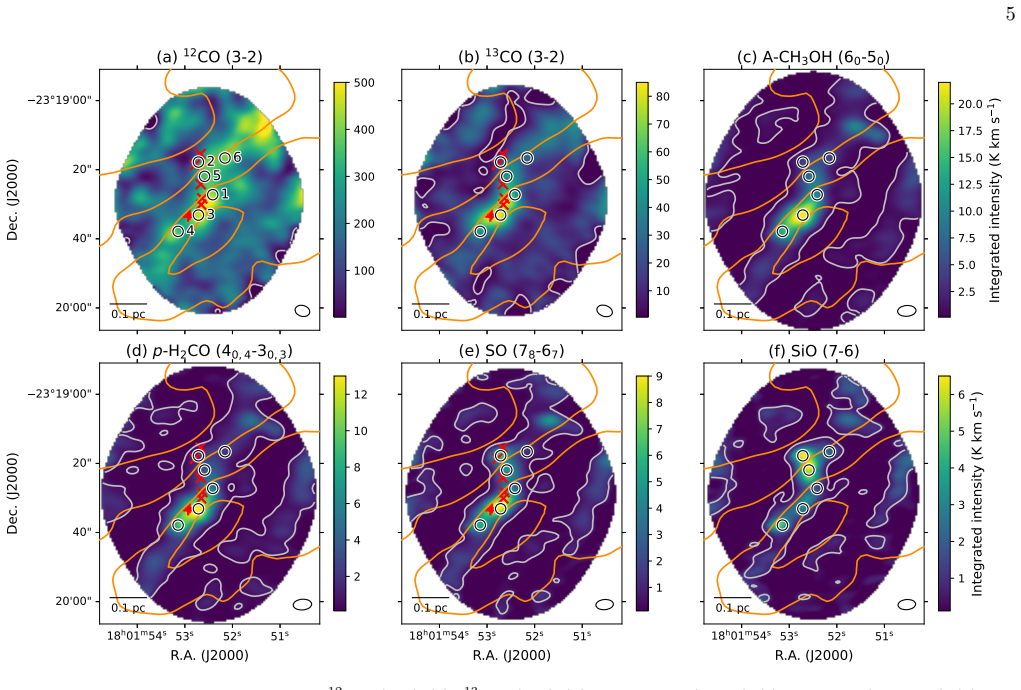
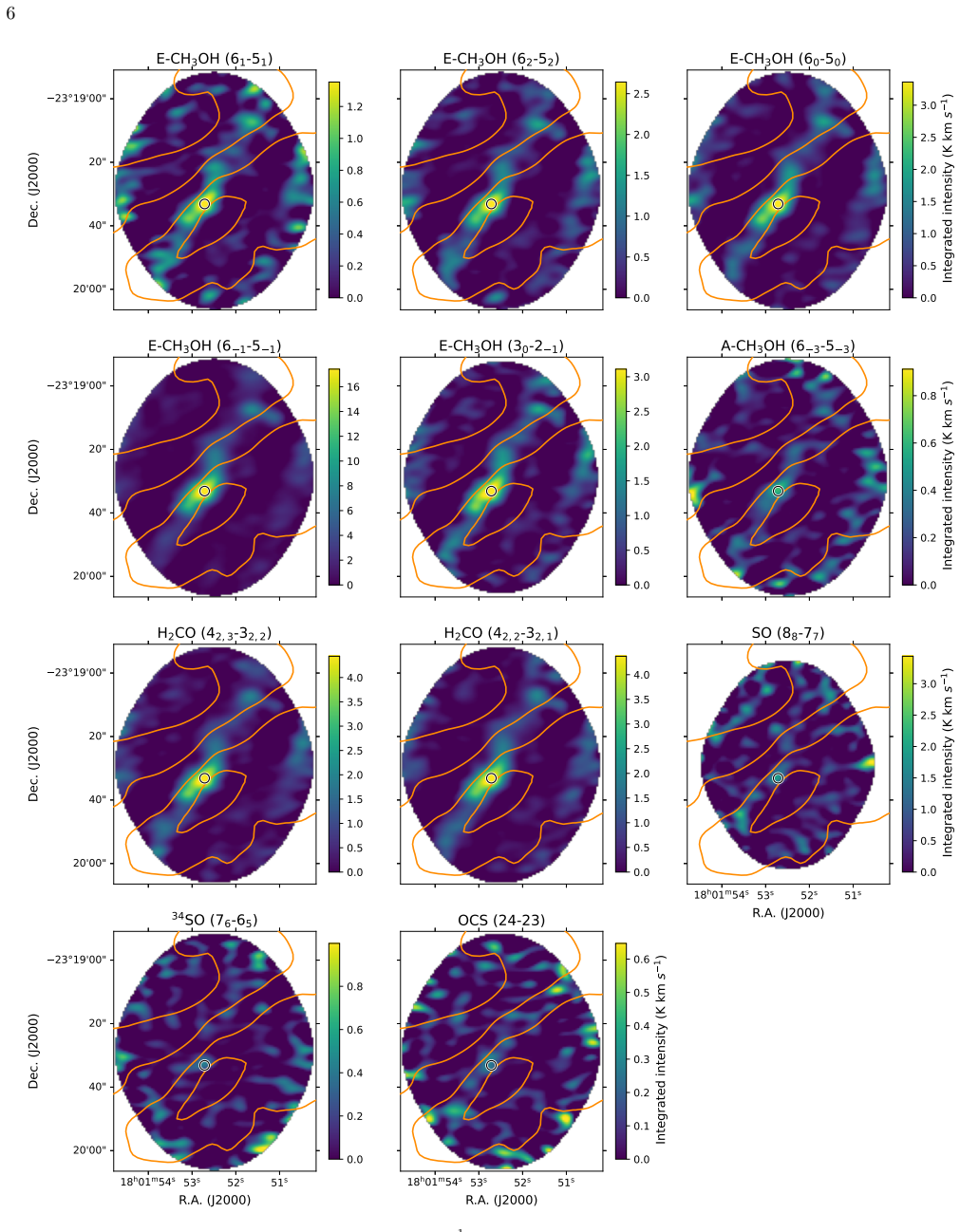
Shocks from SNR W28 separate CH3OH and SiO emission by tracing slow versus fast velocities in the interacting molecular cloud.
A machine-rendered reading of the paper's core claim, the machinery that carries it, and where it could break.
Core claim
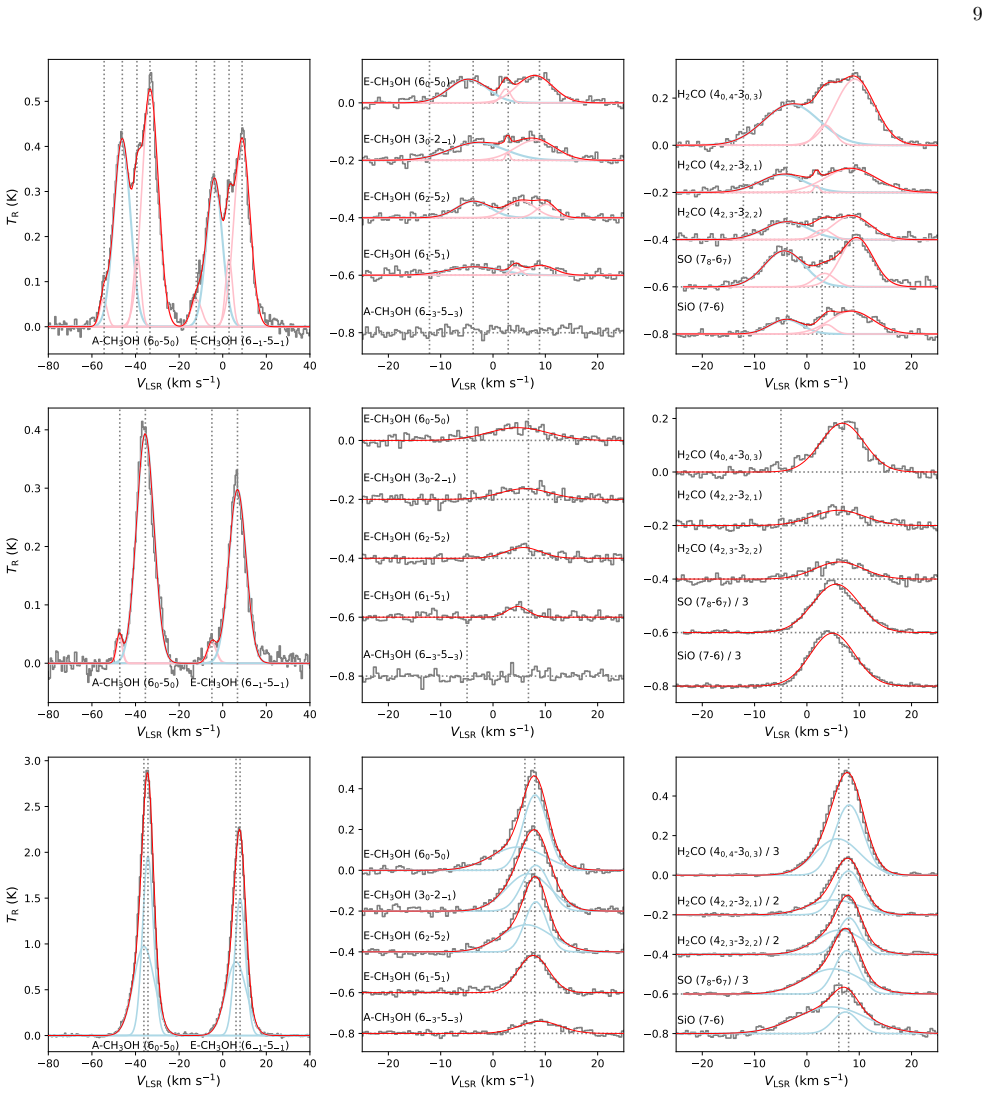
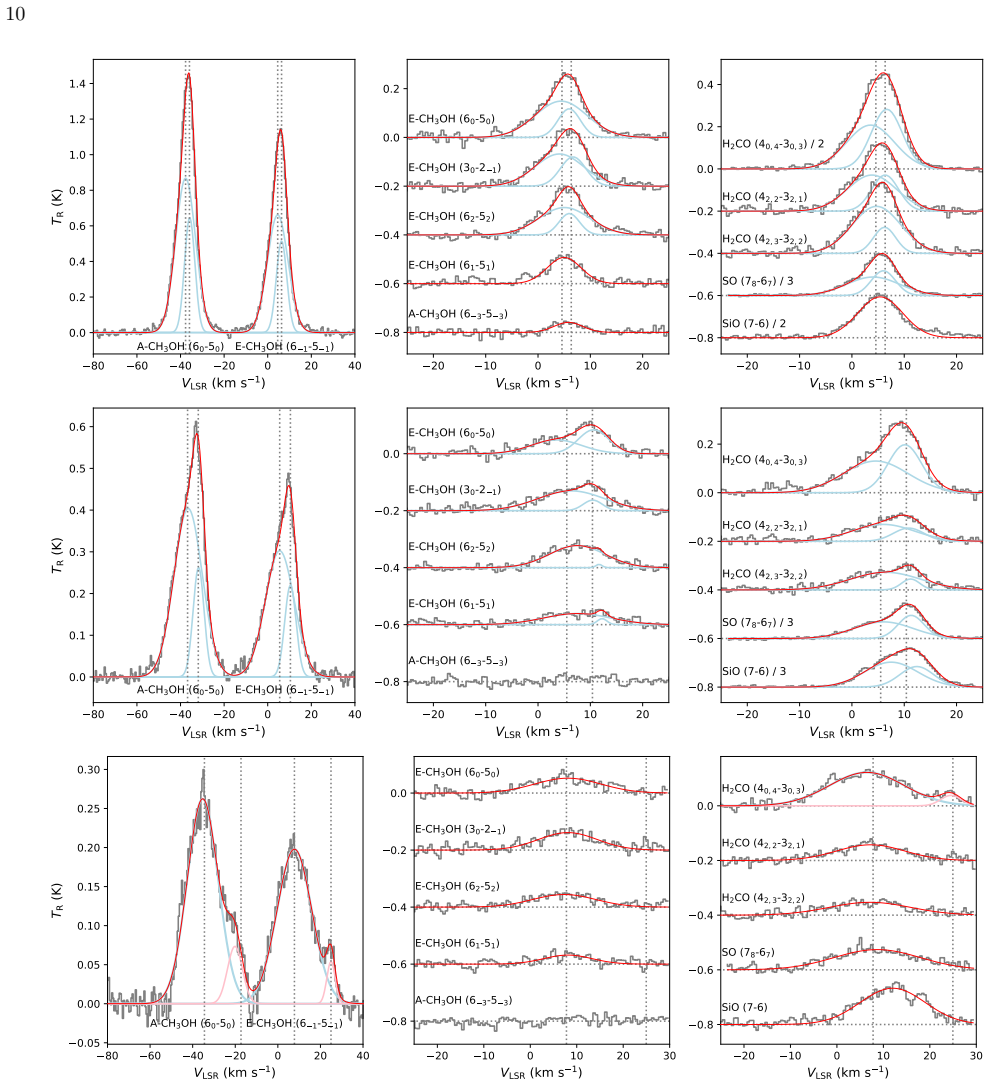
The chemical segregation between CH3OH and SiO, in both the spatial and spectral regime, can be explained by the fact that CH3OH traces slow shocks while SiO traces fast shocks. The high abundance ratio between E-CH3OH and A-CH3OH (> 0.9) suggests extra gas-phase processes to enhance this ratio, such as proton exchange with H3+ and HCO+.
What carries the argument
Non-local-thermodynamic-equilibrium analysis of CH3OH and p-H2CO lines that derives clump densities and temperatures used to link molecular distributions to shock-speed differences.
If this is right
- SNR shocks propagate into multi-phase gas while maintaining pressure balance with the hot X-ray plasma.
- Methanol isomer ratios above the statistical value require gas-phase proton-exchange reactions beyond grain-surface formation.
- Different molecular species can be used as selective tracers of distinct shock-velocity regimes within the same cloud.
Where Pith is reading between the lines
- Similar chemical segregation patterns may appear in other SNR-MC interactions once mapped at comparable resolution.
- The observed density-temperature anti-correlation could be tested against hydrodynamic simulations of multi-phase shock propagation.
- If the proton-exchange explanation holds, the E/A ratio should vary systematically with local ionization fraction across the cloud.
Load-bearing premise
The non-LTE fits to the CH3OH and p-H2CO lines produce densities and temperatures that correctly represent the physical conditions inside the selected clumps.
What would settle it
Velocity-resolved maps or proper-motion measurements showing that regions dominated by CH3OH emission have shock speeds equal to or higher than those dominated by SiO emission.
Figures




read the original abstract
Supernova remnants (SNRs) strongly influence the physical and chemical properties of the molecular clouds (MCs) with which they interact. We carried out a high-resolution observation toward W28F, a chemically rich MC interacting with SNR W28, with the Atacama Compact Array (ACA) in Band 7. Significant emission (> 10 sigma) of CO, CH3OH, p-H2CO, SiO and SO is detected. We reveal the clumpy structures of the shocked MC, with different spatial distributions between CH3OH and SiO. We select six molecular clumps to conduct spectral decomposition and non-local-thermodynamic-equilibrium analysis with the CH3OH and p-H2CO lines. The best-fit results show a H2 density of nH2 ~ (1-3) * 10^5 cm^-3 and a gas temperature of Tgas ~ 50-170 K in most of the fitted components. The H2 density and gas temperature show a clear anti-correlation across different regions, with the thermal pressure consistent with that of the adjacent X-ray-emitting hot plasma. This is consistent with the picture that the SNR shocks propagate into multi-phase gas, with a pressure balance existing between different phases. We propose that the high abundance ratio between E-CH3OHand A-CH3OH (> 0.9) suggests extra gas-phase processes to enhance this ratio, such as proton exchange with H3+ and HCO+. The chemical segregation between CH3OH and SiO, in both the spatial and spectral regime, can be explained by the fact that CH3OH traces slow shocks while SiO traces fast shocks.
Editorial analysis
A structured set of objections, weighed in public.
Referee Report
Summary. The manuscript reports ACA Band 7 observations toward the W28F molecular cloud interacting with SNR W28. Significant (>10 sigma) emission is detected from CO, CH3OH, p-H2CO, SiO, and SO. The data reveal clumpy structures with differing spatial distributions between CH3OH and SiO. Spectral decomposition and non-LTE analysis of CH3OH and p-H2CO lines for six selected clumps yield best-fit H2 densities nH2 ~ (1-3)×10^5 cm^{-3} and gas temperatures Tgas ~ 50-170 K. These parameters exhibit an anti-correlation whose thermal pressure matches that of adjacent X-ray-emitting plasma. The paper interprets the E/A-CH3OH abundance ratio >0.9 as evidence for extra gas-phase processes (e.g., proton exchange with H3+ and HCO+) and attributes the CH3OH/SiO chemical segregation to CH3OH tracing slow shocks while SiO traces fast shocks.
Significance. If the non-LTE parameters prove robust, the work supplies high-resolution constraints on SNR-MC interactions, including multi-phase pressure balance and shock-velocity-dependent molecular chemistry. The clumpy mapping and multi-species detections add concrete observational detail to models of shocked interstellar chemistry.
major comments (2)
- [non-LTE analysis paragraph] Non-LTE analysis paragraph (and associated results): the reported best-fit nH2 and Tgas values lack uncertainties, reduced-chi-squared statistics, or any table of input line intensities, optical depths, or covariance information. Because the anti-correlation, pressure-balance statement, and both the slow/fast-shock and extra-process interpretations rest directly on these parameters, the absence of fitting diagnostics and error estimates is load-bearing for the central claims.
- [abstract and results on abundance ratio] Abstract and results on abundance ratio: the claim that the E-CH3OH/A-CH3OH ratio exceeds 0.9 and therefore requires additional gas-phase processes is presented without the separate column densities, their uncertainties, or the specific transitions used for each isomer. This makes it impossible to assess whether the ratio is robust or whether the proposed proton-exchange mechanism is required by the data.
minor comments (2)
- A table listing all detected transitions, their integrated intensities, and the velocity components fitted for each clump would improve reproducibility and allow independent verification of the non-LTE inputs.
- The manuscript should state explicitly how background radiation and possible line overlap were treated in the non-LTE modeling, even if the treatment is standard.
Simulated Author's Rebuttal
We thank the referee for the constructive comments. We agree that the non-LTE fitting details and the E/A-CH3OH supporting data require explicit presentation to substantiate the central claims. The revised manuscript will incorporate the requested information.
read point-by-point responses
-
Referee: Non-LTE analysis paragraph (and associated results): the reported best-fit nH2 and Tgas values lack uncertainties, reduced-chi-squared statistics, or any table of input line intensities, optical depths, or covariance information. Because the anti-correlation, pressure-balance statement, and both the slow/fast-shock and extra-process interpretations rest directly on these parameters, the absence of fitting diagnostics and error estimates is load-bearing for the central claims.
Authors: We agree that the fitting diagnostics are essential. The revised manuscript will add a dedicated table listing the input line intensities for each of the six clumps, the best-fit nH2 and Tgas values with 1-sigma uncertainties, reduced-chi-squared statistics for each model, derived optical depths, and a brief discussion of parameter covariances. These additions will directly support the reported density-temperature anti-correlation and the pressure-balance conclusion. revision: yes
-
Referee: Abstract and results on abundance ratio: the claim that the E-CH3OH/A-CH3OH ratio exceeds 0.9 and therefore requires additional gas-phase processes is presented without the separate column densities, their uncertainties, or the specific transitions used for each isomer. This makes it impossible to assess whether the ratio is robust or whether the proposed proton-exchange mechanism is required by the data.
Authors: We acknowledge that the column-density details were not provided. In the revision we will report the separate E-CH3OH and A-CH3OH column densities (with uncertainties) for the relevant clumps and explicitly list the transitions used in the ratio calculation. This will allow readers to evaluate the robustness of the >0.9 ratio and the motivation for invoking additional gas-phase processes. revision: yes
Circularity Check
No significant circularity; purely observational reporting and interpretation
full rationale
The paper reports ACA Band 7 observations of CO, CH3OH, p-H2CO, SiO and SO toward W28F, identifies clumpy structures, selects six clumps, performs spectral decomposition, and applies non-LTE analysis to CH3OH and p-H2CO lines to obtain nH2 ~ (1-3)×10^5 cm^-3 and Tgas ~ 50-170 K. These fitted parameters are outputs used for subsequent interpretation of anti-correlation, pressure balance, E/A-CH3OH ratio, and shock-type segregation. No step reduces a claimed prediction to a quantity defined by the fit itself, invokes self-citation for a uniqueness theorem, or smuggles an ansatz; the derivation chain remains self-contained against standard non-LTE modeling and external line-intensity data.
Axiom & Free-Parameter Ledger
free parameters (1)
- nH2 and Tgas from non-LTE fits
axioms (1)
- domain assumption Detected emission lines originate from the molecular cloud interacting with SNR W28.
Reference graph
Works this paper leans on
-
[1]
Anderl, S. and Gusdorf, A. and G. A&A , volume =. doi:10.1051/0004-6361/201423561 , langid =
-
[2]
Arikawa, Yuji and Tatematsu, Ken'ichi and Sekimoto, Yutaro and Takahashi, Tadayuki , year = 1999, journal =. Shocked. doi:10.1093/pasj/51.4.L7 , langid =
-
[3]
MNRAS , volume =
Structure and Kinematics of Shocked Gas in. MNRAS , volume =
-
[4]
Bachiller, R. and P. Chemically Active Outflow. A&A , volume =
-
[5]
, author =
Methanol Enhancemant in Young Bipolar Outflows. , author =. A&A , volume =
-
[6]
Rotationally Inelastic Collisions of
Balan. Rotationally Inelastic Collisions of. MNRAS , volume =
-
[7]
and Melnick, Gary J
Bergin, Edwin A. and Melnick, Gary J. and Neufeld, David A. , year = 1998, journal =. The
1998
-
[8]
A&A , volume =
Testing Grain-Surface Chemistry in Massive Hot-Core Regions , author =. A&A , volume =
-
[9]
and Caselli, P
Bizzocchi, L. and Caselli, P. and Spezzano, S. and Leonardo, E. , year = 2014, journal =. Deuterated Methanol in the Pre-Stellar Core
2014
-
[10]
and Ruiz, M
Bohigas, J. and Ruiz, M. T. and Carrasco, L. and Salas, L. and Herrera, M. A. , year = 1983, journal =. Spectroscopic Observations of Supernova Remnant Candidates
1983
-
[11]
and Viti, S
Bouvier, M. and Viti, S. and Behrens, E. and Butterworth, J. and Huang, K.-Y. and Mangum, J. G. and Harada, N. and Mart. An. A&A , volume =
-
[12]
Brogan, C. L. and Goss, W. M. and Hunter, T. R. and Richards, A. M. S. and Chandler, C. J. and Lazendic, J. S. and Koo, B. -C. and Hoffman, I. M. and Claussen, M. J. , year = 2013, journal =
2013
-
[13]
and Dollhopf, Niklaus M
Burkhardt, Andrew M. and Dollhopf, Niklaus M. and Corby, Joanna F. and Carroll, P. Brandon and Shingledecker, Christopher N. and Loomis, Ryan A. and Booth, Shawn Thomas and Blake, Geoffrey A. and Herbst, Eric and Remijan, Anthony J. and McGuire, Brett A. , year = 2016, journal =
2016
-
[14]
and Shingledecker, Christopher N
Burkhardt, Andrew M. and Shingledecker, Christopher N. and Le Gal, Romane and McGuire, Brett A. and Remijan, Anthony J. and Herbst, Eric , year = 2019, journal =. Modeling
2019
-
[15]
and Hartquist, T
Caselli, P. and Hartquist, T. W. and Havnes, O. , year = 1997, journal =. Grain-Grain Collisions and Sputtering in Oblique
1997
-
[16]
Ceccarelli, C. and. Supernova-Enhanced. ApJL , volume =
-
[17]
, year = 1999, journal =
Chevalier, Roger A. , year = 1999, journal =. Supernova
1999
-
[18]
A Complete
Chi, Yi-Heng and Zhou, Ping and Chen, Yang and Sun, Lei and Li, Chengkui and Jia, Shumei and Chen, Yong and Ge, Chong and Yuan, Weimin , year = 2026, journal =. A Complete
2026
-
[19]
Claussen, M. J. and Frail, D. A. and Goss, W. M. and Gaume, R. A. , year = 1997, journal =. Polarization
1997
-
[20]
and Bachiller, R
Codella, C. and Bachiller, R. , year = 1999, journal =. Molecular Outflows in Intermediate-Mass Star Forming Regions: The Case of
1999
-
[21]
and Bianchi, E
Codella, C. and Bianchi, E. and Podio, L. and De Simone, M. and. A&A , volume =
-
[22]
Interstellar
Cosentino, Giuliana and. Interstellar. ApJ , volume =
-
[23]
Cosentino, G. and. Negative and. MNRAS , volume =. doi:10.1093/mnras/stac070 , archiveprefix =. 2201.03008 , pages =
-
[24]
Cosentino, G. and. Widespread. MNRAS , volume =
-
[25]
A&A , volume =
Microscopic Simulation of Methanol and Formaldehyde Ice Formation in Cold Dense Cores , author =. A&A , volume =
-
[26]
MNRAS , volume =
Rotational Excitation of Methanol in Collisions with Molecular Hydrogen , author =. MNRAS , volume =
-
[27]
Dell'Ova, P. and Gusdorf, A. and Gerin, M. and Riquelme, D. and G. Interstellar Anatomy of the. A&A , volume =. doi:10.1051/0004-6361/202038339 , langid =
-
[28]
Theory of Interstellar Shocks , author =. ARA&A , volume =. doi:10.1146/annurev.aa.31.090193.002105 , langid =
-
[29]
Flower, D. R. and Pineau Des For. Excitation and Emission of. Monthly Notices of the Royal Astronomical Society , volume =
-
[30]
Flower, D. R. and. Theoretical Studies of Interstellar Molecular Shocks. MNRAS , volume =
-
[31]
PASP , volume =
Emcee:. PASP , volume =
-
[32]
Fuchs, G. W. and Cuppen, H. M. and Ioppolo, S. and Romanzin, C. and Bisschop, S. E. and Andersson, S. and. Hydrogenation Reactions in Interstellar. A&A , volume =
-
[33]
Fuente, A. and. Gas Phase. A&A , volume =. doi:10.1051/0004-6361/202244843 , langid =
-
[34]
JPCA , volume =
Systematic. JPCA , volume =
-
[35]
Methanol and
Garay, Guido and Mardones, Diego and Rodr. Methanol and. ApJ , volume =
-
[36]
Molecular
Garay, Guido and K. Molecular. ApJ , volume =
-
[37]
Garay, Guido and Mardones, Diego and Rodr. Silicon. ApJ , volume =
-
[38]
Are Gas-Phase Models of Interstellar Chemistry Tenable?
Garrod, Robin and Park, In Hee and Caselli, Paola and Herbst, Eric , year = 2006, journal =. Are Gas-Phase Models of Interstellar Chemistry Tenable?
2006
-
[39]
and Robitaille, T
Ginsburg, A. and Robitaille, T. and Beaumont, C. and Rosolowsky, E. and Leroy, A. and Brogan, C. and Hunter, T. and Teuben, P. and Brisbin, D. , year = 2015, volume =. Radio
2015
-
[40]
and Cotton, W
Goedhart, S. and Cotton, W. D. and Camilo, F. and Thompson, M. A. and Umana, G. and Bietenholz, M. and Woudt, P. A. and Anderson, L. D. and Bordiu, C. and Buckley, D. A. H. and Buemi, C. S. and Bufano, F. and Cavallaro, F. and Chen, H. and Chibueze, J. O. and Egbo, D. and Frank, B. S. and Hoare, M. G. and Ingallinera, A. and Irabor, T. and. The. MNRAS , volume =
-
[41]
and Pineau Des For
Guillet, V. and Pineau Des For. Shocks in Dense Clouds. A&A , volume =
-
[42]
Gusdorf, A. and Anderl, S. and G. Probing Magnetohydrodynamic Shocks with High-. A&A , volume =. doi:10.1051/0004-6361/201218907 , langid =
-
[43]
Gusdorf, A. and Cabrit, S. and Flower, D. R. and Pineau Des For. A&A , volume =. doi:10.1051/0004-6361:20078900 , langid =
-
[44]
Starburst
Harada, Nanase and Mart. Starburst. ApJ , volume =
-
[45]
Outflow-
Hiramatsu, Masaaki and Hirano, Naomi and Takakuwa, Shigehisa , year = 2010, journal =. Outflow-
2010
-
[46]
and Goss, W
Hoffman, Ian M. and Goss, W. M. and Brogan, C. L. and Claussen, M. J. , year = 2005, journal =. The
2005
-
[47]
and Jackson, James M
Hogge, Taylor G. and Jackson, James M. and Allingham, David and Guzman, Andres E. and. The. ApJ , volume =
-
[48]
and Viti, Serena and Behrens, Erica and Harada, Nanase and Mart
Holdship, Jonathan and Mangum, Jeffrey G. and Viti, Serena and Behrens, Erica and Harada, Nanase and Mart. Energizing. ApJ , volume =
-
[49]
Observations of
Holdship, Jonathan and Viti, Serena and Codella, Claudio and Rawlings, Jonathan and. Observations of. ApJ , volume =
-
[50]
Hsieh, T. -H. and Pineda, J. E. and. A&A , volume =
-
[51]
Huang, K. -Y. and Behrens, E. and Bouvier, M. and Viti, S. and Mangum, J. G. and Eibensteiner, C. , year = 2025, journal =. Investigating the Chemical Link between
2025
-
[52]
Huang, K.-Y. and. Investigating Solid-State. A&A , volume =
-
[53]
Tracing the Chemical Footprint of Shocks in
Huang, Ko-Yun and Viti, Serena , year = 2023, journal =. Tracing the Chemical Footprint of Shocks in
2023
-
[54]
Absorption-Line
Indriolo, Nick , year = 2023, journal =. Absorption-Line
2023
-
[55]
and Goto, Miwa and Usuda, Tomonori and Oka, Takeshi and Geballe, T
Indriolo, Nick and Blake, Geoffrey A. and Goto, Miwa and Usuda, Tomonori and Oka, Takeshi and Geballe, T. R. and Fields, Brian D. and McCall, Benjamin J. , year = 2010, journal =. Investigating the
2010
-
[56]
Cavity of Molecular Gas Associated with Supernova Remnant 3C 397
Jiang, Bing and Chen, Yang and Wang, Junzhi and Su, Yang and Zhou, Xin and. Cavity of. ApJ , volume =. doi:10.1088/0004-637X/712/2/1147 , archiveprefix =. 1001.2204 , pages =
work page internal anchor Pith review Pith/arXiv arXiv doi:10.1088/0004-637x/712/2/1147
-
[57]
Parametrization of. A&A , volume =. doi:10.1051/0004-6361:20078054 , langid =
-
[58]
The Impact of Shocks on the Chemistry of Molecular Clouds
J. The Impact of Shocks on the Chemistry of Molecular Clouds. A&A , volume =
-
[59]
, year = 2015, journal =
Kim, Chang-Goo and Ostriker, Eve C. , year = 2015, journal =. Momentum
2015
-
[60]
Koralesky, Barron and Frail, D. A. and Goss, W. M. and Claussen, M. J. and Green, A. J. , year = 1998, journal =. Shock-Excited
1998
-
[61]
and McKee, Christopher F
Krumholz, Mark R. and McKee, Christopher F. and Tumlinson, Jason , year = 2009, journal =. The
2009
-
[62]
and Ryder, Stuart , year = 2019, journal =
Lee, Yong-Hyun and Koo, Bon-Chul and Lee, Jae-Joon and Burton, Michael G. and Ryder, Stuart , year = 2019, journal =. Near-Infrared [
2019
-
[63]
and Cabrit, S
Lefloch, B. and Cabrit, S. and Busquet, G. and Codella, C. and Ceccarelli, C. and Cernicharo, J. and Pardo, J. R. and Benedettini, M. and Lis, D. C. and Nisini, B. , year = 2012, journal =. The
2012
-
[64]
and Godard, B
Lehmann, A. and Godard, B. and. Self-Generated Ultraviolet Radiation in Molecular Shock Waves. A&A , volume =
-
[65]
and Wyrowski, F
Lin, Y. and Wyrowski, F. and Liu, H. B. and Gong, Y. and Sipil. Massive Clumps in. A&A , volume =
-
[66]
and Senent, M.-L
Lique, F. and Senent, M.-L. and Spielfiedel, A. and Feautrier, N. , year = 2007, journal =. Rotationally Inelastic Collisions of
2007
-
[67]
Lockett, Phil and Gauthier, Eric and Elitzur, Moshe , year = 1999, journal =
1999
-
[68]
and Blair, William P
Long, Knox S. and Blair, William P. and White, Richard L. and Matsui, Yutaka , year = 1991, journal =. W28 and
1991
-
[69]
How to Calculate Molecular Column Density
Mangum, Jeffrey G. and Shirley, Yancy L. , year = 2015, journal =. How to. doi:10.1086/680323 , archiveprefix =. 1501.01703 , pages =
work page internal anchor Pith review Pith/arXiv arXiv doi:10.1086/680323 2015
-
[70]
Maxted, Nigel I. and. Ammonia Excitation Imaging of Shocked Gas towards the. MNRAS , volume =. doi:10.1093/mnras/stw1687 , archiveprefix =. 1607.03061 , pages =
work page internal anchor Pith review Pith/arXiv arXiv doi:10.1093/mnras/stw1687
-
[71]
and Tang, Xindi , year = 2022, journal =
Mazumdar, Parichay and Tram, Le Ngoc and Wyrowski, Friedrich and Menten, Karl M. and Tang, Xindi , year = 2022, journal =. Submillimeter Observations of Molecular Gas Interacting with the Supernova Remnant. doi:10.1051/0004-6361/202037564 , langid =
-
[72]
, author =
The Interaction between the Blast Wave of a Supernova Remnant and Interstellar Clouds. , author =. ApJ , volume =
-
[73]
and Spaans, M
Meijerink, R. and Spaans, M. and Israel, F. P. , year = 2006, journal =. Irradiated
2006
-
[74]
Menten, K. M. and Walmsley, C. M. and Henkel, C. and Wilson, T. L. , year = 1988, journal =. Methanol in the
1988
-
[75]
and Brand, P
Moorhouse, A. and Brand, P. W. J. L. and Geballe, T. R. and Burton, M. G. , year = 1991, journal =. Surprinsingly High-Pressure Shocks in the Supernova Remnant
1991
-
[76]
and Gusdorf, Antoine and G
Neufeld, David A. and Gusdorf, Antoine and G. The. ApJ , volume =
-
[77]
ApJ , volume =
Low-Velocity. ApJ , volume =
-
[78]
2011, MNRAS, 411, 955, doi: 10.1111/j.1365-2966.2010.17731.x
Nicholas, B. and Rowell, G. and Burton, M. G. and Walsh, A. and Fukui, Y. and Kawamura, A. and Longmore, S. and Keto, E. , year = 2011, journal =. 12 Mm Line Survey of the Dense Molecular Gas towards the. doi:10.1111/j.1365-2966.2010.17778.x , langid =
-
[79]
Nicholas, B. P. and Rowell, G. and Burton, M. G. and Walsh, A. J. and Fukui, Y. and Kawamura, A. and Maxted, N. I. , year = 2012, journal =. A 7 Mm Line Survey of the Shocked and Disrupted Molecular Gas towards the. doi:10.1111/j.1365-2966.2011.19688.x , langid =
-
[80]
and Persson, C
Olmi, L. and Persson, C. M. and Codella, C. , year = 2015, journal =. Herschel-
2015
discussion (0)
Sign in with ORCID, Apple, or X to comment. Anyone can read and Pith papers without signing in.