Universality in strongly interacting bosonic clusters
Pith reviewed 2026-06-29 02:33 UTC · model grok-4.3
The pith
An effective field theory fixes two- and three-body interactions solely by dimer and trimer energies, producing cutoff-independent cluster energies up to fifteen particles.
A machine-rendered reading of the paper's core claim, the machinery that carries it, and where it could break.
Core claim
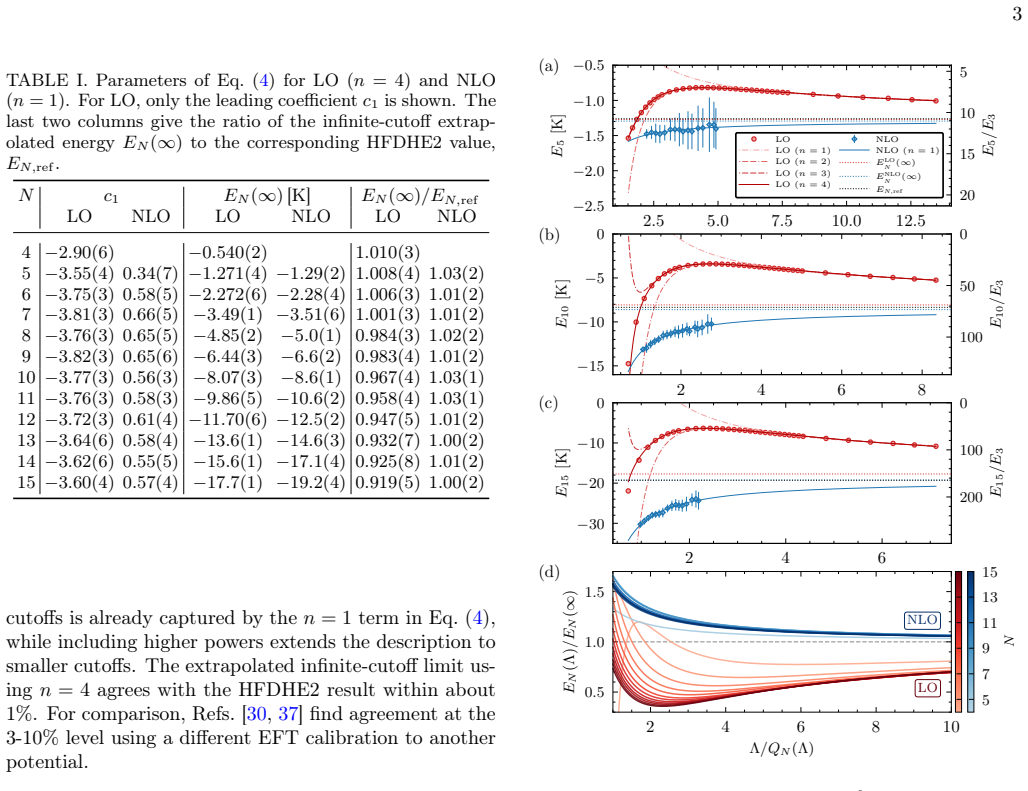
At leading order the two- and three-body zero-range interactions are fixed completely by the dimer and trimer ground-state energies. With these interactions the ground-state energies of clusters containing up to fifteen particles approach cutoff-independent limits whose extrapolation coefficients remain of natural size. At next-to-leading order the inclusion of two-body range corrections together with a four-body force calibrated to the tetramer ground-state energy reduces the residual cutoff dependence and brings the results into closer agreement with calculations that employ a realistic potential.
What carries the argument
Leading-order zero-range two- and three-body contact interactions fixed by the dimer and trimer binding energies.
If this is right
- Ground-state energies for clusters up to N=15 approach cutoff-independent limits.
- The extrapolation coefficients needed to reach those limits have natural size.
- Next-to-leading-order range corrections and a four-body force reduce cutoff sensitivity.
- Results at both orders agree closely with those obtained from a realistic potential.
- The same effective theory applies directly to larger clusters and to bulk helium.
Where Pith is reading between the lines
- The approach may extend without new parameters to other bosonic systems that share a large scattering length.
- Higher-order terms could eventually connect few-body cluster properties to macroscopic helium observables.
- Precise experimental values for the tetramer energy would tighten the next-to-leading-order calibration.
Load-bearing premise
That two- and three-body zero-range forces fixed only by dimer and trimer energies are sufficient to describe larger clusters without needing additional short-distance physics or higher-body forces.
What would settle it
A calculation for sixteen or more particles that shows energies failing to approach a cutoff-independent limit or requiring extrapolation coefficients much larger than natural size would falsify the leading-order result.
Figures


read the original abstract
We develop an effective field theory (EFT) for strongly interacting bosonic clusters, using $^4$He as a paradigmatic example of universality in systems with large scattering length. At leading order (LO), two- and three-body zero-range interactions are entirely determined by the dimer and trimer ground-state energies. We show that ground-state energies for up to $N=15$ particles converge to cutoff-independent limits with extrapolation coefficients of natural size. At next-to-leading order (NLO), corrections stemming from the two-body interaction range and a four-body force, calibrated to the tetramer ground-state energy, reduce cutoff sensitivity. Close agreement with results from a realistic potential is found at LO and improved at NLO, demonstrating systematic convergence with few parameters at each order. The resulting EFT is directly applicable to larger clusters and bulk helium.
Editorial analysis
A structured set of objections, weighed in public.
Referee Report
Summary. The manuscript develops a zero-range effective field theory (EFT) for bosonic clusters with large scattering length, taking 4He as example. At leading order the two- and three-body contacts are fixed exclusively by the dimer and trimer ground-state energies; the authors report that the resulting N-body ground-state energies for N ≤ 15 converge to cutoff-independent limits whose extrapolation coefficients are of natural size. At NLO, finite-range corrections to the two-body interaction together with a four-body force (calibrated to the tetramer energy) are added, further reducing cutoff dependence and yielding closer agreement with calculations that employ realistic potentials. The EFT is presented as directly extensible to larger clusters and to bulk helium.
Significance. If the reported numerical convergence holds under the stated regulators and cutoff windows, the work supplies concrete evidence that three-body forces alone suffice to absorb short-distance sensitivity up to N=15 at LO, thereby furnishing a predictive, few-parameter framework for universal bosonic few-body physics. The explicit demonstration of natural-size extrapolation coefficients and systematic improvement from LO to NLO constitutes a strength of the manuscript.
major comments (2)
- [Section 4] The central claim that LO results for N>3 are cutoff-independent rests on the numerical observation that three-body contact (fixed by trimer energy) removes all regulator dependence. Section 4 (or equivalent) should state the range of cutoffs explored, the functional form of the regulator, and the precise extrapolation procedure used to extract the infinite-cutoff limit; without these details the size of residual cutoff artifacts cannot be assessed quantitatively.
- [Table 2] Table 2 (or equivalent) lists N-body energies at several cutoffs; the reported extrapolation coefficients are stated to be natural, yet no uncertainty from the fit or from variation of the cutoff window is provided. This information is required to judge whether the convergence is robust or could be an artifact of the chosen cutoff interval.
minor comments (2)
- [Abstract] The abstract states convergence but does not quote any numerical values or error estimates; a brief parenthetical mention of the largest N and the size of the extrapolation coefficients would improve readability.
- [Section 2] Notation for the LO and NLO Lagrangians is introduced without an explicit equation number; cross-referencing would aid readers who wish to reproduce the power counting.
Simulated Author's Rebuttal
We thank the referee for the careful reading of the manuscript and the positive recommendation for minor revision. We address the two major comments point by point below.
read point-by-point responses
-
Referee: [Section 4] The central claim that LO results for N>3 are cutoff-independent rests on the numerical observation that three-body contact (fixed by trimer energy) removes all regulator dependence. Section 4 (or equivalent) should state the range of cutoffs explored, the functional form of the regulator, and the precise extrapolation procedure used to extract the infinite-cutoff limit; without these details the size of residual cutoff artifacts cannot be assessed quantitatively.
Authors: We agree that an explicit statement of these technical details will allow readers to assess residual cutoff dependence more quantitatively. In the revised manuscript we will expand the relevant section to specify the cutoff range explored, the precise functional form of the regulator employed, and the functional form and fitting procedure used for the infinite-cutoff extrapolation. revision: yes
-
Referee: [Table 2] Table 2 (or equivalent) lists N-body energies at several cutoffs; the reported extrapolation coefficients are stated to be natural, yet no uncertainty from the fit or from variation of the cutoff window is provided. This information is required to judge whether the convergence is robust or could be an artifact of the chosen cutoff interval.
Authors: We acknowledge that quantitative uncertainties on the extrapolation coefficients and an assessment of stability under changes to the cutoff window would strengthen the presentation. In the revised version we will supply fit uncertainties and discuss the sensitivity to the chosen cutoff interval, either in the text or via an augmented table. revision: yes
Circularity Check
No significant circularity in EFT parameter fixing and numerical convergence
full rationale
The paper fixes LO two- and three-body zero-range interactions explicitly to the dimer and trimer ground-state energies (standard EFT input) and then numerically computes and extrapolates ground-state energies for N up to 15, reporting cutoff independence as an observed outcome with natural-size coefficients. This does not reduce any central claim to a self-definition or fitted input renamed as prediction by construction; the higher-N results are independent calculations within the regulated theory. NLO includes an explicit four-body force calibrated to the tetramer, stated separately. No load-bearing self-citation, uniqueness theorem, or ansatz smuggling appears in the derivation chain. The approach is self-contained against external benchmarks via comparison to realistic potentials.
Axiom & Free-Parameter Ledger
Reference graph
Works this paper leans on
-
[1]
Universality in few- body systems with large scattering length,
E. Braaten and H.-W. Hammer, “Universality in few- body systems with large scattering length,” Phys. Rept. 428(2006) 259
2006
-
[2]
EfimovPhysics: areview,
P.NaidonandS.Endo, “EfimovPhysics: areview,” Rept. Prog. Phys.80(2017) 056001
2017
-
[3]
Fesh- bach resonances in ultracold gases,
C. Chin, R. Grimm, P. Julienne and E. Tiesinga, “Fesh- bach resonances in ultracold gases,” Rev. Mod. Phys.82 (2010) 1225
2010
-
[4]
Nuclear ef- fective field theory: status and perspectives,
H.-W. Hammer, S. König and U. van Kolck, “Nuclear ef- fective field theory: status and perspectives,” Rev. Mod. Phys.92(2020) 025004
2020
-
[5]
Efimov Physics and Connections to Nuclear Physics,
A. Kievsky, L. Girlanda, M. Gattobigio and M. Viviani, “Efimov Physics and Connections to Nuclear Physics,” Ann. Rev. Nucl. Part. Sci.71(2021) 465
2021
-
[6]
An accurate intermolecular potential for helium,
R. A. Aziz, V. P. S. Nain, J. S. Carley, W. L. Taylor and G. T. McConville, “An accurate intermolecular potential for helium,” J. Chem. Phys.70(1979) 4330
1979
-
[7]
An examination of ab initio results for the helium potential energy curve,
R. A. Aziz and M. J. Slaman, “An examination of ab initio results for the helium potential energy curve,” J. Chem. Phys.94(1991) 8047
1991
-
[8]
Modern He–He potentials: Anotherlookatbindingenergy, effectiverangetheory, re- tardation, andEfimovstates,
A. R. Janzen and R. A. Aziz, “Modern He–He potentials: Anotherlookatbindingenergy, effectiverangetheory, re- tardation, andEfimovstates,” J.Chem.Phys.103(1995) 9626
1995
-
[9]
An accurate potential energy curve for helium based on ab initio calculations,
A. R. Janzen and R. A. Aziz, “An accurate potential energy curve for helium based on ab initio calculations,” J. Chem. Phys.107(1997) 914
1997
-
[10]
Helium dimer potential from symmetry- adapted perturbation theory calculations using large gaussian geminal and orbital basis sets,
T. Korona, H. L. Williams, R. Bukowski, B. Jeziorski and K. Szalewicz, “Helium dimer potential from symmetry- adapted perturbation theory calculations using large gaussian geminal and orbital basis sets,” J. Chem. Phys. 106(1997) 5109
1997
-
[11]
Relativistic and Quan- tum Electrodynamics Effects in the Helium Pair Poten- tial,
M. Przybytek, W. Cencek, J. Komasa, G. Lach, B. Jeziorski and K. Szalewicz, “Relativistic and Quan- tum Electrodynamics Effects in the Helium Pair Poten- tial,” Phys.Rev.Lett.104(2010)183003[erratum: Phys. Rev. Lett.108(2012) 129902]
2010
-
[12]
Calculations of Ground-State Properties of Liquid4He Droplets,
V. R. Pandharipande, J. G. Zabolitzky, S. C. Pieper, R. B. Wiringa and U. Helmbrecht, “Calculations of Ground-State Properties of Liquid4He Droplets,” Phys. Rev. Lett.50(1983) 1676
1983
-
[13]
The helium trimer with soft-core potentials,
A. Kievsky, E. Garrido, C. Romero-Redondo and P. Bar- letta, “The helium trimer with soft-core potentials,” Few Body Syst.51(2011) 259
2011
-
[14]
Variational calculation of 4He tetramer ground and excited states using a realistic pair potential,
E. Hiyama and M. Kamimura, “Variational calculation of 4He tetramer ground and excited states using a realistic pair potential,” Phys. Rev. A85(2012) 022502
2012
-
[15]
Linear correlations be- tween 4He trimer and tetramer energies calculated with various realistic4He potentials,
E. Hiyama and M. Kamimura, “Linear correlations be- tween 4He trimer and tetramer energies calculated with various realistic4He potentials,” Phys. Rev. A85(2012) 062505
2012
-
[16]
Universality in Efimov- associated tetramers in 4He,
E. Hiyama and M. Kamimura, “Universality in Efimov- associated tetramers in 4He,” Phys. Rev. A90(2014) 052514
2014
-
[17]
N- boson spectrum from a Discrete Scale Invariance,
A. Kievsky, N. K. Timofeyuk and M. Gattobigio, “N- boson spectrum from a Discrete Scale Invariance,” Phys. Rev. A90(2014) 032504
2014
-
[18]
Few bosons to many bosons inside the unitary window: A transition between universal and nonuniversal behavior,
A. Kievsky, A. Polls, B. Juliá-Díaz, N. K. Timofeyuk and M. Gattobigio, “Few bosons to many bosons inside the unitary window: A transition between universal and nonuniversal behavior,” Phys. Rev. A102(2020) 063320
2020
-
[19]
Structural properties of4HeN (N=2–10) clusters for different potential models at the physical point and at unitarity,
A. J. Yates and D. Blume, “Structural properties of4HeN (N=2–10) clusters for different potential models at the physical point and at unitarity,” Phys. Rev. A105(2022) 022824
2022
-
[20]
Subleading contributions to N-boson systems inside the universal window,
P. Recchia, A. Kievsky, L. Girlanda and M. Gattobigio, “Subleading contributions to N-boson systems inside the universal window,” Phys. Rev. A106(2022) 022812
2022
-
[21]
Modern potentials and the properties of condensed He-4,
M. H. Kalos, M. A. Lee, P. A. Whitlock and G. V. Chester, “Modern potentials and the properties of condensed He-4,” Phys. Rev. B24(1981) 115. 6
1981
-
[22]
Path integrals in the theory of con- densed helium,
D. M. Ceperley, “Path integrals in the theory of con- densed helium,” Rev. Mod. Phys.67(1995) 279
1995
-
[23]
Equation of state of solid3He,
S. Moroni, F. Pederiva, S. Fantoni and M. Boninsegni, “Equation of state of solid3He,” Phys. Rev. Lett.84 (2000) 2650
2000
-
[24]
Energy levels arising from the resonant two- body forces in a three-body system,
V. Efimov, “Energy levels arising from the resonant two- body forces in a three-body system,” Phys. Lett. B33 (1970) 563
1970
-
[25]
Weakly-bound states of 3 resonantly- interacting particles,
V. N. Efimov, “Weakly-bound states of 3 resonantly- interacting particles,” Sov. J. Nucl. Phys.12(1971) 589
1971
-
[26]
Observation of the Efimov state of the helium trimer,
M. Kunitski, S. Zeller, J. Voigtsberger, A. Kalinin, L. P. H. Schmidt, M. Schöffler, A. Czasch, W. Schöl- lkopf, R. E. Grisenti and T. Jahnke,et al., “Observation of the Efimov state of the helium trimer,” Science348 (2015) 551
2015
-
[27]
Effective field theory for few-nucleon systems,
P. F. Bedaque and U. van Kolck, “Effective field theory for few-nucleon systems,” Ann. Rev. Nucl. Part. Sci.52 (2002) 339
2002
-
[28]
Renor- malization of the three-body system with short-range in- teractions,
P.F.Bedaque, H.-W.HammerandU.vanKolck, “Renor- malization of the three-body system with short-range in- teractions,” Phys. Rev. Lett.82(1999) 463
1999
-
[29]
The three-boson system with short-range interactions,
P. F. Bedaque, H.-W. Hammer and U. van Kolck, “The three-boson system with short-range interactions,” Nucl. Phys. A646(1999) 444
1999
-
[30]
Four-Body Scale in Uni- versal Few-Boson Systems,
B. Bazak, J. Kirscher, S. König, M. Pavón Valderrama, N. Barnea and U. van Kolck, “Four-Body Scale in Uni- versal Few-Boson Systems,” Phys. Rev. Lett.122(2019) 143001
2019
-
[31]
Effective field theory of short-range forces,
U. van Kolck, “Effective field theory of short-range forces,” Nucl. Phys. A645(1999) 273
1999
-
[32]
Univer- sal equation for Efimov states,
E. Braaten, H.-W. Hammer and M. Kusunoki, “Univer- sal equation for Efimov states,” Phys. Rev. A67(2003) 022505
2003
-
[33]
Universality in the three-body problem for He-4 atoms,
E. Braaten and H.-W. Hammer, “Universality in the three-body problem for He-4 atoms,” Phys. Rev. A67 (2003) 042706
2003
-
[34]
The four- boson system with short-range interactions,
L. Platter, H.-W. Hammer and U.-G. Meißner, “The four- boson system with short-range interactions,” Phys. Rev. A70(2004) 052101
2004
-
[35]
The Three-Boson System at Next-To-Next-To-Leading Order,
L. Platter and D. R. Phillips, “The Three-Boson System at Next-To-Next-To-Leading Order,” Few Body Syst.40 (2006) 35
2006
-
[36]
Effective Field Theory Analy- sis of Three-Boson Systems at Next-To-Next-To-Leading Order,
C. Ji and D. R. Phillips, “Effective Field Theory Analy- sis of Three-Boson Systems at Next-To-Next-To-Leading Order,” Few Body Syst.54(2013) 2317
2013
-
[37]
Effective Field Theory for Few-Boson Systems,
B. Bazak, M. Eliyahu and U. van Kolck, “Effective Field Theory for Few-Boson Systems,” Phys. Rev. A94(2016) 052502
2016
-
[38]
Improved action for contact effective field theory,
L. Contessi, M. Schäfer and U. van Kolck, “Improved action for contact effective field theory,” Phys. Rev. A 109(2024) 022814
2024
-
[39]
Four- boson first excited state near two-body unitarity,
F. Wu, T. Frederico, R. Higa and U. van Kolck, “Four- boson first excited state near two-body unitarity,” Phys. Rev. A109(2024) 043301
2024
-
[40]
Small clusters of He atoms in finite-cutoff EFT,
B. Bazak, “Small clusters of He atoms in finite-cutoff EFT,” arXiv:2511.12538 [cond-mat.quant-gas]
-
[41]
Three- and four-boson systems expanded around the unitarity limit: Application to4He,
F. Wu, X. Lin, U. van Kolck and S. König, “Three- and four-boson systems expanded around the unitarity limit: Application to4He,” [arXiv:2606.00854 [cond-mat.quant- gas]]
-
[42]
Quantum Monte Carlo simulations of solids,
W. M. C. Foulkes, L. Mitas, R. J. Needs and G. Ra- jagopal, “Quantum Monte Carlo simulations of solids,” Rev. Mod. Phys.73(2001) 33
2001
-
[43]
Ground-statepropertiesofunitarybosons: fromclusters to matter,
J. Carlson, S. Gandolfi, U. van Kolck and S. A. Vitiello, “Ground-statepropertiesofunitarybosons: fromclusters to matter,” Phys. Rev. Lett.119(2017) 223002
2017
-
[44]
Quantum Monte Carlo studies of a trimer scaling function with microscopic two- and three- body interactions,
L. Madeira, T. Frederico, S. Gandolfi, L. Tomio and M. T. Yamashita, “Quantum Monte Carlo studies of a trimer scaling function with microscopic two- and three- body interactions,” Phys. Rev. A104(2021) 033301
2021
-
[45]
Determina- tion of the Bond Length and Binding Energy of the He- lium Dimer by Diffraction from a Transmission Grating,
R. E. Grisenti, W. Schöllkopf, J. P. Toennies, G. C. Hegerfeldt, T. Kohler and M. Stoll, “Determina- tion of the Bond Length and Binding Energy of the He- lium Dimer by Diffraction from a Transmission Grating,” Phys. Rev. Lett.85(2000) 2284
2000
-
[46]
Imaging the structure of the trimer systems 4He3 and 3He4He2,
J. Voigtsberger, S. Zeller, J. Becht, N. Neumann, F. Sturm, H.-K. Kim, M. Waitz, F. Trinter, M. Ku- nitski, A. Kalinin, J. Wu, W. Schöllkopf, D. Bres- sanini, A. Czasch, J. B. Williams, K. Ullmann-Pfleger, L. Ph. H. Schmidt, M. S. Schöffler, R. E. Grisenti, T. Jahnke and R. Dörner, “Imaging the structure of the trimer systems 4He3 and 3He4He2,” Nature Com...
2014
-
[47]
Imaging the He2 quantum halo state using a free electron laser,
S. Zeller, M. Kunitski, J. Voigtsberger, A. Kalinin, A. Schottelius, C. Schober, M. Waitz, H. Sann, A. Har- tung and T. Bauer,et al.“Imaging the He2 quantum halo state using a free electron laser,” Proc. Natl. Acad. Sci. 113(2016) 4651
2016
-
[48]
See Supplemental Material at [URL will be inserted by publisher] for details of the EFT calibration, extrapola- tion procedure, and additional cluster results
-
[49]
Solving the quantum many- body problem with artificial neural networks,
G. Carleo and M. Troyer, “Solving the quantum many- body problem with artificial neural networks,” Science 355(2017) 602
2017
-
[50]
Hidden- nucleons neural-network quantum states for the nuclear many-body problem,
A. Lovato, C. Adams, G. Carleo and N. Rocco, “Hidden- nucleons neural-network quantum states for the nuclear many-body problem,” Phys. Rev. Res.4(2022) 043178
2022
-
[51]
Nuclei with up toA= 6nucleons with artificial neural network wave functions,
A. Gnech, C. Adams, N. Brawand, G. Carleo, A. Lovato and N. Rocco, “Nuclei with up toA= 6nucleons with artificial neural network wave functions,” Few Body Syst. 63(2022) 7
2022
-
[52]
Synergy between deep neural networks and the variational Monte Carlo method for small 4HeN clusters,
W. Freitas and S. A. Vitiello, “Synergy between deep neural networks and the variational Monte Carlo method for small 4HeN clusters,” Quantum7(2023) 1209
2023
-
[53]
Modeling4HeN clusters with wave functions based on neural networks,
W. Freitas, B. Abreu and S. A. Vitiello, “Modeling4HeN clusters with wave functions based on neural networks,” J. Low Temp. Phys.215(2024) 357
2024
-
[54]
Nuclear Physics Around the Unitarity Limit,
S. König, H. W. Grießhammer, H.-W. Hammer and U. van Kolck, “Nuclear Physics Around the Unitarity Limit,” Phys. Rev. Lett.118(2017) 202501
2017
-
[55]
Energies and radii of light nuclei around uni- tarity,
S. König, “Energies and radii of light nuclei around uni- tarity,” Eur. Phys. J. A56(2020) 113
2020
-
[56]
Unitarity and Discrete Scale Invariance,
U. van Kolck, “Unitarity and Discrete Scale Invariance,” Few-Body Syst.58(2017) 112
2017
-
[57]
The thermody- namic properties of liquid 3He–4He mixtures between 0 and 20 atm in the limit of absolute zero temperature,
R. De Bruyn Ouboter and C. N. Yang, “The thermody- namic properties of liquid 3He–4He mixtures between 0 and 20 atm in the limit of absolute zero temperature,” Physica B+C144(1987) 127
1987
-
[58]
Theory of the Effective Range in Nuclear Scattering,
H. A. Bethe, “Theory of the Effective Range in Nuclear Scattering,” Phys. Rev.76(1949) 38
1949
-
[59]
Scattering length and effective range of microscopic two-body potentials,
M. Macêdo-Lima and L. Madeira, “Scattering length and effective range of microscopic two-body potentials,” Rev. Bras. Ens. Fis.45(2023) e20230079
2023
-
[60]
Delta function potentials in two-dimensional and three-dimensional quantum mechanics,
R. Jackiw, “Delta function potentials in two-dimensional and three-dimensional quantum mechanics,” MIT-CTP- 1937 (1991)
1937
-
[61]
Scattering Theory: The Quantum Theory of Nonrelativistic Collisions,
J. R. Taylor, “Scattering Theory: The Quantum Theory of Nonrelativistic Collisions,” John Wiley & Sons, Inc. 7 (1972)
1972
-
[62]
Lower Limit for the Energy Derivative of the Scattering Phase Shift,
E. P. Wigner, “Lower Limit for the Energy Derivative of the Scattering Phase Shift,” Phys. Rev.98(1955) 145
1955
-
[63]
Causality and the effective range expansion,
H.-W. Hammer and D. Lee, “Causality and the effective range expansion,” Annals Phys.325(2010) 2212
2010
-
[64]
How short is too short? Constraining contact interactions in nucleon- nucleon scattering,
D. R. Phillips and T. D. Cohen, “How short is too short? Constraining contact interactions in nucleon- nucleon scattering,” Phys. Lett. B390(1997) 7
1997
-
[65]
The po- tential of effective field theory in NN scattering,
S. R. Beane, T. D. Cohen and D. R. Phillips, “The po- tential of effective field theory in NN scattering,” Nucl. Phys. A632(1998) 445
1998
-
[66]
The Interaction Between a Neutron and a Proton and the Structure of H3,
L. H. Thomas, “The Interaction Between a Neutron and a Proton and the Structure of H3,” Phys. Rev.47(1935) 903
1935
-
[67]
Scaling limit of weakly bound triatomic states,
T. Frederico, L. Tomio, A. Delfino and A. E. A. Amorim, “Scaling limit of weakly bound triatomic states,” Phys. Rev. A60(1999) R9
1999
-
[68]
Exact renormalization relation and binding energies for three identical bosons,
L. Chen and P. Zhang, “Exact renormalization relation and binding energies for three identical bosons,” Phys. Rev. A112(2025) 033319
2025
-
[69]
Three-body limit cycle: Universal form for general regulators,
L. Chen, F. Wu, X. Lin, S. König, U. van Kolck and P. Zhang, “Three-body limit cycle: Universal form for general regulators,” Phys. Rev. A113(2026) 013314
2026
-
[70]
Spectra and Scattering of Light Lattice Nuclei from Effective Field Theory,
J. Kirscher, N. Barnea, D. Gazit, F. Pederiva and U. van Kolck, “Spectra and Scattering of Light Lattice Nuclei from Effective Field Theory,” Phys. Rev. C92(2015) 054002. 1 Supplemental Material: Universality in strongly interacting bosonic clusters In this Supplemental Material, we detail the match- ing of the EFT to the underlying potential, including t...
2015
discussion (0)
Sign in with ORCID, Apple, or X to comment. Anyone can read and Pith papers without signing in.