Extracting behavioural properties from face-to-face interactions temporal networks: a measure of egonet persistency
Pith reviewed 2026-06-29 02:20 UTC · model grok-4.3
The pith
The Neighbourhood Persistency Criterion isolates genuine behavioural persistence in temporal social networks from structural effects like degree.
A machine-rendered reading of the paper's core claim, the machinery that carries it, and where it could break.
Core claim
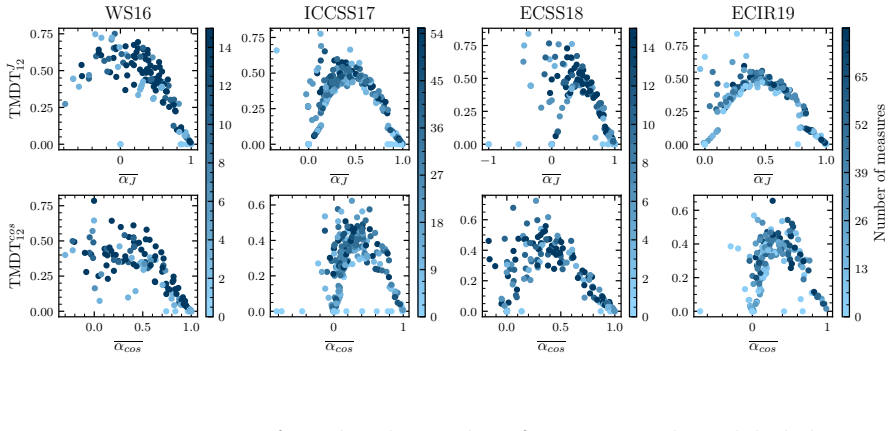
The Neighbourhood Persistency Criterion combines classical similarity measures with tailored null models that control for network topology and interaction weights. Applied to high temporal resolution face-to-face interaction networks from four Computational Social Science conferences, it reveals a common behavioural structure across events characterised by an exploration-exploitation trade-off in social interactions. While many individuals alternate between both strategies, others exhibit stable interaction patterns throughout the event, and these behaviours show little systematic association with socio-demographic attributes.
What carries the argument
The Neighbourhood Persistency Criterion (NPC), a framework that quantifies egonet persistence by comparing observed temporal similarity against expectations from null models preserving degree and weight distributions.
If this is right
- A common exploration-exploitation trade-off characterises social interaction persistence across different conference events.
- Many individuals switch between exploring new contacts and exploiting repeated ones, while some maintain stable patterns.
- These interaction strategies have little systematic association with socio-demographic attributes.
- NPC provides a flexible tool for studying egonet persistence in other temporal networks and social systems.
Where Pith is reading between the lines
- Contextual factors at events likely play a larger role than individual traits in shaping how people manage their social contacts over time.
- The measure could be extended to study persistence in online interaction data or workplace proximity networks.
- If the trade-off holds more broadly, models of social dynamics might need to incorporate both stable and variable interaction strategies.
Load-bearing premise
The tailored null models isolate genuine temporal correlations without leaving residual bias from node degree or interaction weights.
What would settle it
Recomputing NPC on the same conference datasets but with null models that also preserve higher-order temporal structures, and checking whether the exploration-exploitation patterns remain or vanish.
Figures





read the original abstract
Understanding how individuals repeat social interactions over time is a central problem in the analysis of temporal networks. In social systems, repeated interactions shape processes such as information diffusion, collective coordination, and the emergence of social structure. Existing measures of egonet persistence often conflate genuine behavioural regularities with structural effects such as node degree, making it difficult to distinguish meaningful temporal correlations from random mixing. In this work, we introduce the Neighbourhood Persistency Criterion (NPC), a statistically grounded framework for quantifying egonet persistence across time. NPC combines classical similarity measures with tailored null models controlling for network topology and interaction weights. We apply this framework to high temporal resolution face-to-face interaction networks collected at four Computational Social Science conferences using the SocioPatterns platform. Our results reveal a common behavioural structure across events, characterised by an exploration$\unicode{x2013}$exploitation trade-off in social interactions. While many individuals alternate between both strategies, others exhibit stable interaction patterns throughout the event. Importantly, these behaviours show little systematic association with socio-demographic attributes, suggesting that interaction strategies are shaped primarily by contextual factors rather than stable individual traits. NPC thus provides a flexible and interpretable tool for studying egonet persistence in temporal networks and social systems.
Editorial analysis
A structured set of objections, weighed in public.
Referee Report
Summary. The paper introduces the Neighbourhood Persistency Criterion (NPC), a framework that combines similarity measures with tailored null models controlling for topology and interaction weights to quantify egonet persistence in temporal networks. Applied to four high-resolution face-to-face SocioPatterns datasets from Computational Social Science conferences, the results indicate a common exploration-exploitation trade-off in interaction strategies across events, with many individuals alternating strategies and others showing stable patterns, and little systematic association with socio-demographic attributes.
Significance. If the NPC framework and its null models are shown to correctly isolate behavioral regularities, the work provides a flexible, interpretable tool for studying temporal correlations in social networks beyond degree and weight effects. The cross-event replication and contextual (rather than trait-based) interpretation of strategies would be a useful contribution to temporal network analysis in social systems.
major comments (2)
- [Methods (null-model construction)] The description of the tailored null models (Methods section) states that they control for network topology and interaction weights, but does not specify whether they also preserve per-node inter-event time distributions, session lengths, or burstiness. In SocioPatterns conference data, which exhibit strong temporal inhomogeneities, failure to preserve these features would leave residual temporal correlations that NPC could misattribute to behavioral exploration-exploitation patterns rather than artifacts.
- [Results (socio-demographic analysis)] The central claim that behaviors show 'little systematic association with socio-demographic attributes' (Results) is load-bearing for the interpretation that strategies are shaped primarily by contextual factors. The manuscript must report the specific statistical tests, effect sizes, or correlation measures used to reach this conclusion, including any multiple-testing corrections across the four datasets.
minor comments (2)
- [Abstract] The abstract refers to 'tailored null models' and 'statistically grounded framework' without citing the relevant equations or definitions; adding forward references to the Methods would improve clarity for readers.
- [Figures and Tables] Figure captions and table legends should explicitly state the number of nodes, time windows, and null-model realizations used for each NPC computation to allow direct reproducibility assessment.
Simulated Author's Rebuttal
We thank the referee for their constructive comments, which help clarify the scope and limitations of the NPC framework. We address each major comment below and indicate planned revisions.
read point-by-point responses
-
Referee: The description of the tailored null models (Methods section) states that they control for network topology and interaction weights, but does not specify whether they also preserve per-node inter-event time distributions, session lengths, or burstiness. In SocioPatterns conference data, which exhibit strong temporal inhomogeneities, failure to preserve these features would leave residual temporal correlations that NPC could misattribute to behavioral exploration-exploitation patterns rather than artifacts.
Authors: Our null models are configuration-model variants that rewire edges while preserving the observed degree sequence and the total weight of each edge (or node strength), but they do not preserve per-node inter-event time distributions, session lengths, or burstiness. This design isolates structural effects from the similarity measures used in NPC; temporal features are deliberately left uncontrolled so that any excess persistence detected by NPC can be attributed to higher-order behavioral patterns beyond degree and weight. We agree that the Methods section should explicitly state what is and is not preserved and should discuss the implications for bursty SocioPatterns data. We will add this clarification and a short limitations paragraph. revision: partial
-
Referee: The central claim that behaviors show 'little systematic association with socio-demographic attributes' (Results) is load-bearing for the interpretation that strategies are shaped primarily by contextual factors. The manuscript must report the specific statistical tests, effect sizes, or correlation measures used to reach this conclusion, including any multiple-testing corrections across the four datasets.
Authors: We agree that the statistical basis for this claim must be reported in full. The original analysis used chi-squared tests for categorical attributes (gender, role) and Spearman correlations for continuous attributes (age, number of co-authors), with p-values adjusted by Bonferroni correction across the four conferences and the set of attributes tested. All associations yielded small effect sizes (Cramér’s V < 0.15; |ρ| < 0.2) and remained non-significant after correction. We will insert a dedicated paragraph (or supplementary table) in the Results section that lists the exact tests, sample sizes per attribute, uncorrected and corrected p-values, and effect-size measures. revision: yes
Circularity Check
NPC framework uses external similarity measures and null models; no reduction of behavioural claims to fitted inputs or self-citation chains.
full rationale
The paper defines Neighbourhood Persistency Criterion (NPC) by combining classical similarity measures with tailored null models that control for node degree and interaction weights. Application to SocioPatterns conference data then yields the reported exploration-exploitation trade-off and weak socio-demographic associations. These outputs are not equivalent to the inputs by construction; the null models are independent controls, and no load-bearing step collapses to a self-citation or parameter fit. A score of 2 accounts for possible minor self-citation in the methodology without affecting the central data-driven claims.
Axiom & Free-Parameter Ledger
Reference graph
Works this paper leans on
-
[1]
A.-L. Barab´ asi. The origin of bursts and heavy tails in human dynamics.Nature, 435 (7039):207–211. doi: https://doi.org/10.1038/nature03459
-
[2]
A. Barrat, C. Cattuto, M. Szomszor, W. Van Den Broeck, and H. Alani. Social Dynamics in Conferences: Analyses of Data from the Live Social Semantics Application. InThe Semantic Web – ISWC 2010, volume 6497, pages 17–33. Springer Berlin Heidelberg, 2010. doi: https://doi.org/10.1007/978-3-642-17749-1 2
-
[3]
E. Brunner and U. Munzel. The nonparametric behrens-fisher problem: Asymptotic theory and a small-sample approximation.Biometrical Journal, 42(1):17–25, 2000. doi: https: //doi.org/10.1002/(SICI)1521-4036(200001)42:1⟨17::AID-BIMJ17⟩3.0.CO;2-U
-
[4]
C. Cattuto, W. Van den Broeck, A. Barrat, V. Colizza, J.-F. Pinton, and A. Vespignani. Dynamics of person-to-person interactions from distributed RFID sensor networks.PLOS ONE, 5(7):1–9, 2010. doi: https://doi.org/10.1371/journal.pone.0011596
-
[5]
E. Colman, V. Colizza, E. M. Hanks, D. P. Hughes, and S. Bansal. Social fluidity mobilizes contagion in human and animal populations.eLife, 10:e62177, 2021. doi: https://doi.org/ 10.7554/eLife.62177
-
[6]
S. Dai, H. Bouchet, M. Karsai, J.-P. Chevrot, E. Fleury, and A. Nardy. Longitudinal data collection to follow social network and language development dynamics at preschool.Sci Data, 9(1):777, Dec. 2022. doi: https://doi.org/10.1038/s41597-022-01756-x
-
[7]
T. Elmer, K. Chaitanya, P. Purwar, and C. Stadtfeld. The validity of RFID badges mea- suring face-to-face interactions.Behavior Research Methods, 51(5):2120–2138, Oct. 2019. doi: https://doi.org/10.3758/s13428-018-1180-y
-
[8]
D. Escribano, F. J. Lapuente, J. A. Cuesta, R. I. M. Dunbar, and A. S´ anchez. Stability of the personal relationship networks in a longitudinal study of middle school students. Scientific Reports, 13(1):14575. doi: https://doi.org/10.1038/s41598-023-41787-x
-
[9]
L. Gauvin, M. G´ enois, M. Karsai, M. Kivel¨ a, T. Takaguchi, E. Valdano, and C. L. Vester- gaard. Randomized reference models for temporal networks.SIAM Rev., 64(4):763–830, Nov. 2022. doi: http://doi.org/10.1137/19M1242252
-
[10]
M. G´ enois, M. Zens, M. Oliveira, C. M. Lechner, J. Schaible, and M. Strohmaier. Combin- ing Sensors and Surveys to Study Social Interactions: A Case of Four Science Conferences. Personality Science, 4(1):e9957, Jan. 2023. doi: https://doi.org/10.5964/ps.9957
-
[11]
P. Holme. Modern temporal network theory: A colloquium.The European Physical Journal B, 88(9):234, Sept. 2015. doi: https://doi.org/10.1140/epjb/e2015-60657-4
-
[12]
P. Holme and J. Saram¨ aki. Temporal networks.Physics Reports, 519(3):97–125. doi: https://doi.org/10.1016/j.physrep.2012.03.001. 10
-
[13]
L. Isella, J. Stehl´ e, A. Barrat, C. Cattuto, J.-F. Pinton, and W. Van den Broeck. What’s in a crowd? Analysis of face-to-face behavioral networks.Journal of Theoretical Biology, 271(1):166–180, 2011. doi: https://doi.org/10.1016/j.jtbi.2010.11.033
-
[14]
J. D. Karch. Bmtest: A Jamovi Module for Brunner–Munzel’s Test—A Robust Alternative to Wilcoxon–Mann–Whitney’s Test.Psych, 5(2):386–395, June 2023. doi: https://doi.org/ 10.3390/psych5020026
-
[15]
M. Karsai, M. Kivel¨ a, R. K. Pan, K. Kaski, J. Kert´ esz, A.-L. Barab´ asi, and J. Saram¨ aki. Small but slow world: How network topology and burstiness slow down spreading.Phys. Rev. E, 83:025102(R), Feb 2011. doi: https://doi.org/10.1103/PhysRevE.83.025102
-
[16]
R. Kordts-Freudinger, D. Al-Kabbani, and N. Schaper. Learning and interaction at a conference.New Horizons in Adult Education and Human Resource Development, 29(1): 29–38, 2017. doi: https://doi.org/10.1002/nha3.20169
-
[17]
L. Kovanen, M. Karsai, K. Kaski, J. Kert´ esz, and J. Saram¨ aki. Temporal motifs in time- dependent networks.Journal of Statistical Mechanics: Theory and Experiment, 2011(11): P11005, 2011. doi: https://doi.org/10.1088/1742-5468/2011/11/P11005
-
[18]
R. H. Lyles and J. Lin. Sensitivity analysis for misclassification in logistic regression via likelihood methods and predictive value weighting.Statistics in Medicine, 29(22):2297– 2309, 2010. doi: https://doi.org/10.1002/sim.3971
-
[19]
Masuda and R
N. Masuda and R. Lambiotte.A Guide to Temporal Networks. World Scientific, 2016. ISBN 978-1-78634-114-3
2016
-
[20]
V. Nicosia, J. Tang, C. Mascolo, M. Musolesi, G. Russo, and V. Latora. Graph Metrics for Temporal Networks. In P. Holme and J. Saram¨ aki, editors,Temporal Networks, pages 15–40. Springer. doi: https://doi.org/10.1007/978-3-642-36461-7 2
-
[21]
R. K. Pan and J. Saram¨ aki. Path lengths, correlations, and centrality in temporal networks. Phys. Rev. E, 84:016105, Jul 2011. doi: https://doi.org/10.1103/PhysRevE.84.016105
-
[22]
J. Stehl´ e, N. Voirin, A. Barrat, C. Cattuto, L. Isella, J.-F. Pinton, M. Quaggiotto, W. Van den Broeck, C. R´ egis, B. Lina, and P. Vanhems. High-Resolution Measurements of Face-to-Face Contact Patterns in a Primary School.PLOS ONE, 6(8):e23176, 2011. doi: https://doi.org/10.1371/journal.pone.0023176
-
[23]
M. A. Stephens. EDF Statistics for Goodness of Fit and Some Comparisons.Journal of the American Statistical Association, 69(347):730–737, 1974. doi: https://doi.org/10.1080/ 01621459.1974.10480196
arXiv 1974
-
[24]
T. Takaguchi, Y. Yano, and Y. Yoshida. Coverage centralities for temporal networks.Eur. Phys. J. B, 89(2):35, Feb. 2016. doi: https://doi.org/10.1140/epjb/e2016-60498-7
-
[25]
E. Valdano, C. Poletto, A. Giovannini, D. Palma, L. Savini, and V. Colizza. Predicting Epidemic Risk from Past Temporal Contact Data.PLoS Comput Biol, 11(3):e1004152, Mar. 2015. doi: https://doi.org/10.1371/journal.pcbi.1004152. 11 Supplementary Informations A Dispersion estimators A wide range of dispersion estimators exists; however, most studies rely a...
discussion (0)
Sign in with ORCID, Apple, or X to comment. Anyone can read and Pith papers without signing in.